

Several major banks that helped set up the UN’s now-defunct Net-Zero Banking Alliance (NZBA) in 2021 have since continued to lend money to coal companies, a new report has revealed.
Bank of America, Barclays, Citibank, Deutsche Bank and Santander were heavily involved in the NZBA and the associated Glasgow Financial Alliance for Net Zero (GFANZ) when it was launched by Mark Carney, then a UN climate envoy and now Canada’s leader, in the run-up to the COP26 climate summit in Glasgow.
Despite their involvement, data released this week shows those banks and some others did not reduce the amount of money they lent, nor the value of their underwriting, to coal activities between 2022 and 2025. Around half of the NZBA members who were engaged in coal financing over that time increased it and half cut it, according to the report by German environmental research group Urgewald.
Ana Botín, executive chair of Santander, was a member of the GFANZ CEO principals’ group and said at the time of the NZBA launch that her Spanish bank was “proud to be part of the founding members of this new alliance and to accelerate progress towards net zero”.
Since then, the report’s data documents that Santander has provided loans and underwriting worth hundreds of millions of dollars each year to coal companies, particularly American coal-power plant operators Duke Energy and the Southern Company. Santander did not respond to a request for comment.
Urgewald’s research adjusts the value of loans and underwriting provided to coal companies based on how much of a company’s revenues come from the most polluting fossil fuel. So a hypothetical $100 million loan to German utility RWE is valued at $21 million, as 21% of RWE’s revenue is from coal.
The research does not take account of whether companies are expanding their coal business or phasing it out for greener alternatives. Some banks have said their coal clients need to put in place transition plans by a certain date. Some also say that, by a certain date, they will stop lending money to clients that get more than a set percentage of their revenue from coal.
-
What’s on the climate calendar for October 2026?
Brazilians are heading to the polls, diplomats are gathering in the Pacific for Pre-COP, and it’s crunch time for the IPCC -
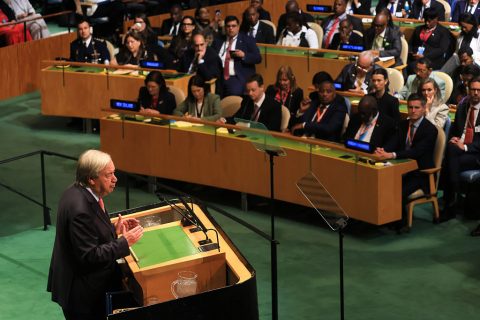
UN chief urges countries to adopt fossil fuel transition plans with timelines
In his last speech to the UN General Assembly, António Guterres for the first time called on every nation to deliver a plan to phase out coal, oil and gas while protecting workers

Most companies expanding coal are in Asian nations like China, India and Indonesia and are largely financed by banks from their own countries. But there are examples of NZBA founding members supporting companies that are actively prolonging the life of their coal businesses.
For example, Glencore, a Switzerland-based multinational that gets 4% of its revenue from coal, has just won preliminary regulatory approval to keep on coal mining in Australia’s Hunter Valley until 2045. Last year, the company was supported by loans and underwriting from Bank of America, Citigroup, Santander, Barclays, Deutsche Bank, HSBC and Standard Chartered.
Good and bad news
Some NZBA founding members like Swiss giant UBS have reduced their loans and underwriting for coal companies, the data suggests. Others – like Triodos and Kenya Commercial Bank – have provided no support for coal companies since at least 2021.
Urgewald researcher Hannah O’Neill told Climate Home News that “the banking sector is not moving in one direction. There is a growing divide between banks that are tightening their coal policies and reducing their exposure, and those where coal policies remain weak or where financing continues.”
Unlike the UN’s Race to Zero campaign, with which it partnered, the NZBA did not require its members to end financing for fossil fuels like coal, leading to accusations by climate campaigners that its rules were too weak.
Despite this, after Donald Trump’s re-election as US president in November 2024, several North American banks quit the alliance and the NZBA’s requirements were diluted in April 2025. After further withdrawals, the group shut itself down in October 2025.
Globally, the Urgewald report found that many banks in the European Union, Thailand, Malaysia, India and Taiwan have reduced their coal finance since governments agreed at COP26 to phase down coal power.
But with Chinese, American, Indonesian and South Korean banks increasing their support, total bank financing for the coal industry has remained broadly the same each year since 2022.
“Coal financing is not disappearing – but it is concentrating in banks and markets where coal policies are either missing or weak,” said Heffa Schücking, director of Urgewald.
Urgewald’s definition of coal companies includes firms and their subsidiaries that explore for, process, trade, transport and mine coal, or burn it in power plants to produce electricity, or manufacture equipment for the coal industry. It does not include companies that use coal to make cement or steel – and an adjustment is made to account for how much of the business model is coal-related.
Banks defend delays
At the time of publication, most of the banks named in the report for increasing their coal finance had not responded to requests for comment. But a spokesperson for Deutsche Bank pointed Climate Home News to its May 2026 announcement that it was delaying its requirement for existing clients to present it with transition plans and cut their coal exposure.
Instead of having to present these plans by the end of 2025, the bank has given them until the end of 2027. They will also have to ensure that their revenue share from thermal coal falls below half by then, the bank added. New clients need energy transition plans to access finance.
Deutsche Bank said at the time it was delaying its requirements because of the “increasingly complex regulatory environment as well as differing speeds of energy transition in various regions beyond what was anticipated by Deutsche Bank in 2023”.
Big banks’ lending to coal backers undermines Indonesia’s green plans
A spokesperson for Barclays told Climate Home News: “Many companies in this report are diversified energy or mining companies. We do not provide financing to companies that generate more than 30% of revenues from thermal coal mining or power generation, and we will phase out all financing by 2035.”
The Barclays spokesperson added: “Barclays is financing an energy sector in transition, providing finance to meet current energy needs and also financing the scaling of clean energy. Over the past three years, we have facilitated more than $300 billion of sustainable and transition finance, including billions to cleaner energy projects, and invested millions into climate tech.”
The post Big banks behind “net zero” alliance continued lending to coal firms appeared first on Climate Home News.
Big banks behind “net zero” alliance continued lending to coal firms

Climate Change
Albanese must deliver credible action to end fossil fuel chokehold, not just rhetoric
ANTALYA,Türkiye, Thursday 12 November 2026 — In response to Prime Minister Albanese’s COP31 Leaders’ Summit address, Shiva Gounden, Head of Pacific at Greenpeace Australia Pacific, speaking from Antalya said:
“Prime Minister Albanese’s COP31 address was full of nice rhetoric, but once again failed to confront or even mention the root cause of the climate crisis — fossil fuels.
“In Antalya, UN climate chief Guterres told leaders to “tell the truth”. The truth is Australia can not credibly talk about its clean energy transition while continuing to expand the industry it needs to leave behind. Australia must reckon with reality; its damning track record of 38 coal and gas approvals since it took office in 2022.
“We meet in Antalya amidst a global energy shock and dire projections of 1.5°C overshoot. Overshoot means something in the Pacific — it means irreversible harm, lives and cultures lost forever, entire nations at stake. We must face the fierce urgency of now.
“Never before has the need to end the fossil fuel chokehold been so abundantly clear, as our Pacific communities again suffer the consequences of a global economy hooked on coal, oil and gas. The Pacific needs credible roadmaps and clear timelines to unhook from fossil fuels — Australia can’t keep saying implementation and not reflect it with credible action.”
ENDS
COP31 images and video available here in Greenpeace Media Library
Media contact: Kate O’Callaghan in Antalya (GMT+3) on +61 406 231 892 (Whatsapp/Signal)
Albanese must deliver credible action to end fossil fuel chokehold, not just rhetoric
A second set of world leaders give their speeches on Thursday before heading out of town and leaving their negotiators to it. After around 40 leaders spoke on Wednesday, today there will be just 25 or so including the UK’s Andy Burnham, Venezuela’s Delcy Rodriguez and Bangladesh’s Tarique Rahman.
But Brazil’s President Lula is still there and is expected to keep grabbing headlines, along with California’s Governor – and maybe next US president – Gavin Newsom – and Swedish climate activist Greta Thunberg who has lost none of her star power, if the crowd around her in the press centre was anything to go by.
We’ll bring you highlights through the day on issues ranging from finance to methane, and update you on a pledging event for the Pacific Resilience Facility, which the climate-vulnerable region is relying on to keep small island nations as safe as possible in the face of intensifying storms, drought and sea level rise.

The post COP31 Bulletin Day 4: Burnham speaks with UK climate policy under fire appeared first on Climate Home News.
COP31 Bulletin Day 4: Burnham speaks with UK climate policy under fire
Climate Change
Australia must ‘pull all available levers’ to deliver fossil fuel phase out, following Albanese’s COP31 address
ANTALYA, Türkiye, Wednesday 11 November 2026 — In response to Prime Minister Albanese’s COP31 Leaders’ Summit address, Dr Susie Byers, Head of Advocacy at Greenpeace Australia Pacific, speaking from Antalya said:
“Prime Minister Albanese’s Leaders’ Summit address emphasised the power and clarity of Pacific climate leadership and that we must all fight to return warming to below 1.5°C. To inject the momentum these talks critically need, Australia must lead by example.
“Australia takes the reins of the COP31 talks at a critical moment where global instability can spark transformative change, or entrench more of the same inaction and paper pledges. Australia must pull all available levers over the next two weeks, taking the baton from Brazil and sprinting forward.
“The world’s most important job in Antalya is to deliver tangible action to end the fossil fuel era. Communities in Australia, the Pacific and around the world who are grappling with climate disasters and a cost of living crisis need concrete dates and credible plans. We know the transition is coming, one way or another. Our Government has a responsibility to make a plan for this change, which is based on the best available science, and a commitment to put people, energy security and our environment ahead of fossil fuel profits.
“In his address, UN climate chief Guterres told leaders to “tell the truth”. Prime Minister Albanese told an important truth today: that we all have solemn responsibilities to return warming to below 1.5°C. We also know that the best way for Australia to lead through this summit is to start by making its own commitments to turn the temperature down, by stopping developing and exporting fossil fuels.
“Australia’s domestic progress on renewables, and the ‘35 by 35’ electrification goal, are welcome and important. Now we must ensure electricity comes from clean, renewable sources that actually displace fossil fuels and align with the science of 1.5°C.
“The pressure on Australia is building. COP31 must deliver real action to advance multilateral climate cooperation, accelerate the just transition away from fossil fuels, and advance Pacific priorities — including significantly scaling-up climate finance and keeping 1.5°C alive.”
ENDS
COP31 images and video available here in Greenpeace Media Library
Media contact: Kate O’Callaghan in Antalya (GMT+3) on +61 406 231 892 (Whatsapp/Signal)



-
Climate Change1 year ago
Guest post: Why China is still building new coal – and when it might stop
-
Greenhouse Gases1 year ago
Guest post: Why China is still building new coal – and when it might stop
-

 Greenhouse Gases2 years ago
嘉宾来稿:满足中国增长的用电需求 光伏加储能“比新建煤电更实惠”
-

 Climate Change2 years ago
嘉宾来稿:满足中国增长的用电需求 光伏加储能“比新建煤电更实惠”
-

 Renewable Energy1 year ago
Sending Progressive Philanthropist George Soros to Prison?
-
Greenhouse Gases1 year ago
嘉宾来稿:探究火山喷发如何影响气候预测
-

 Climate Change2 years ago
Analysis: China’s CO2 falls 1% in Q2 2024 in first quarterly drop since Covid-19
-

 Climate Change1 year ago
嘉宾来稿:探究火山喷发如何影响气候预测