Carbon Brief is seeking a skilled data analyst to support our award-winning journalism. You’ll help us analyse climate and energy data to find new stories and bring fresh numbers to the conversation.
- Do you know how to find, process and analyse data?
- Do you have an eye for data-driven stories and insights?
- Can you spot opportunities to use data to inform topical talking points?
- Do you want to contribute to accurate reporting of climate change and energy?
Job description
Working with our team of specialist journalists, you’ll carry out original analysis of climate and energy data to bring new developments to life in a clear and engaging way.
Reporting to the Policy Section Editor, you’ll undertake a mixture of snap analysis and longer-term data-driven projects, as well as tracking relevant data trends to surface novel insights.
This could mean estimating the emissions impact of Trump’s election victory, working out the UK’s annual greenhouse gas emissions and electricity mix, building automated trackers for key global summits or finding ways to bring new numbers to important policy debates.
You’ll work with journalists across Carbon Brief’s editorial teams, on topics ranging from UK climate policy through to China’s energy transition and the intersection of climate, food, land and nature. You’ll also collaborate with our multimedia team to help produce high-impact charts and graphics.
You’ll have exceptional data analysis skills and experience with advanced analytical packages, such as Python and R. You’ll have a proven ability to spot stories in data and know how to communicate them in an accessible way to a wider audience. You’ll be meticulous about accuracy and fact-checking and be able to work closely with our writers, editors and multimedia producers to develop story ideas and support article research.
This role is primarily focused on working with data, but there may be occasional opportunities for co-writing articles.
Responsibilities
- Conduct original, in-depth analysis of climate and energy data.
- Lead on sourcing and building relevant and credible data to feed Carbon Brief’s analysis.
- Work on several projects concurrently, ranging from rapid-turnaround analysis to annually repeating projects and longer-term research.
- Work with the wider Carbon Brief team to develop compelling data-led story ideas.
- Scope for emerging themes, topics, people, research and opportunities and contribute to Carbon Brief’s editorial strategy.
- Represent Carbon Brief at external conferences, events and meetings and actively build our network of contacts.
- You may be asked to perform related tasks, as required by Carbon Brief’s editors.
Qualifications
Essential
- Exceptional data analysis skills, using Python (preferred) or R.
- Highly numerate, with the ability to think statistically.
- Strong communication skills, particularly with non-specialist audiences.
- The ability to spot compelling insights and stories in data.
- An interest in climate change and energy.
- Meticulous attention to detail and a commitment to accuracy.
Desirable
- A knowledge of climate and energy policies.
- A wider interest in the role of climate change communication.
- An appreciation for Carbon Brief’s brand, style and tone.
Location: Carbon Brief’s office is in central London. There is flexibility within this role to be based remotely and the successful candidate will be comfortable working across different time zones. You may be expected to undertake some travel as part of your work.
Duration: This is a permanent position.
Salary: Competitive, with generous benefits. Salary will be discussed with shortlisted applicants, due to the possibility of it being a part-time or full-time position.
How to apply
To apply, please send:
- Your CV.
- A covering letter explaining why you would be a good fit for the role and the organisation, including examples of your work with data.
To: jobs@carbonbrief.org
Please state “Data analyst application – Carbon Brief” in the email subject header.
Applications must be submitted by 9AM BST Monday 17 Feb. Interviews will be held on Monday 24 Feb and Tuesday 25 Feb via Zoom.
Carbon Brief is committed to encouraging equality, diversity and inclusion among our workforce. Our aim is to be truly representative of all sections of society and for each employee to feel respected and able to give their best. We strongly encourage applications from those who feel underrepresented in climate journalism, including ethnic and social minorities.
About Carbon Brief
Carbon Brief specialises in clear, evidence-based articles and data visualisations to help improve the understanding of climate change, both in terms of the science and the policy response. We publish a wide range of content, including Q&As, in-depth reporting, analysis, interviews, newsletters, interactives and maps. Our audience is global and diverse, but our content particularly serves policymakers, journalists, NGOs and academics. We are proud of the reach and engagement we have with our audiences, who value our rigorous and authoritative brand of ‘explainer journalism’.
The post Vacancy: Data analyst appeared first on Carbon Brief.

For the first time, new-energy vehicles (NEVs) made up 67% of new car sales in China in September, according to the latest data from the China Passenger Car Association (CPCA).
The figures show that NEVs, which include battery electric cars and plug-in hybrids, captured a record share of sales, even though fewer were sold than last year.
This is because sales of combustion-engine cars are falling steeply, a trend that the CPCA has attributed to rising petrol prices following the start of the Hormuz crisis.
Indeed, sales of fuel-only cars were down 31% year-on-year in the first nine months of 2026, with plug-in hybrid sales down 26% – whereas battery EV sales were only down 4%.
One analyst tells Carbon Brief that China’s rapidly growing EV fleet has offset demand for 143m barrels of oil since the start of the Hormuz crisis.
Another says that the crisis is “reinforcing China’s electrification of road transport”.
Meanwhile, amid slowing domestic sales, Chinese carmakers’ exports of NEVs more than doubled [in 2026 to date / in September] from a year earlier.
NEV record
A record two out of every three cars sold in September in China were NEVs, according to CPCA data, as shown in the figure below.
(NEVs predominantly include battery electric vehicles – BEVs – and plug-in hybrids – PHEVs. BEVs only run on electricity, whereas PHEVs also have a combustion engine.)
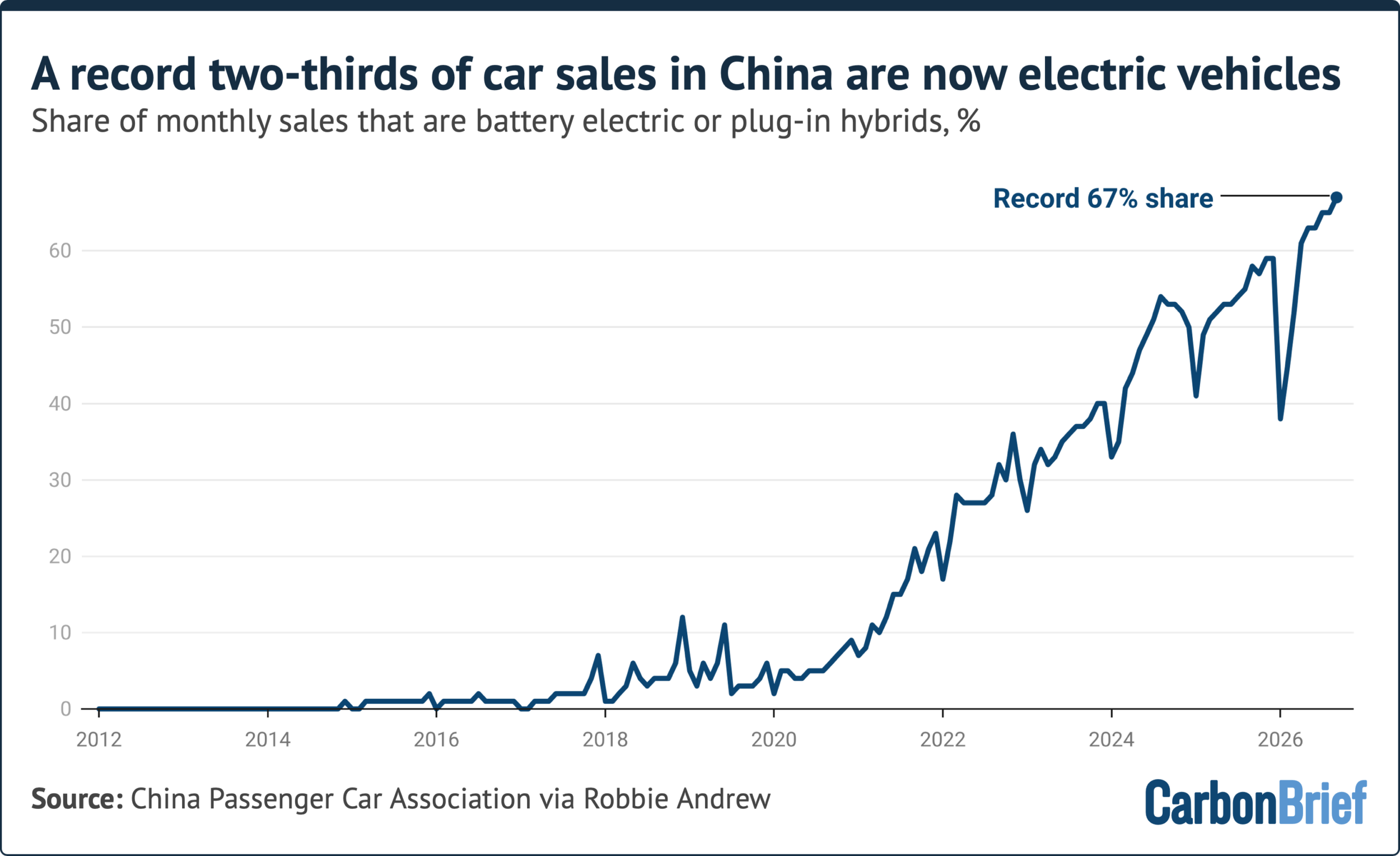
This marks a rapid rise for NEVs from just 6% of new car sales in 2020 up to 58% in 2026 to date – and a record 67% in the month of September.
This year, NEVs’ share of sales has also bounced back from a low of 39% in January, after the full purchase tax exemption that had been in place for more than a decade came to an end in December 2025.
The gain in NEV share in 2026 has come amid a slowdown across the wider domestic passenger-car market, which has hit sales of combustion-engine vehicles particularly hard.
This September, passenger-car retail sales across all categories declined, with overall sales volumes falling 28% year-on-year.
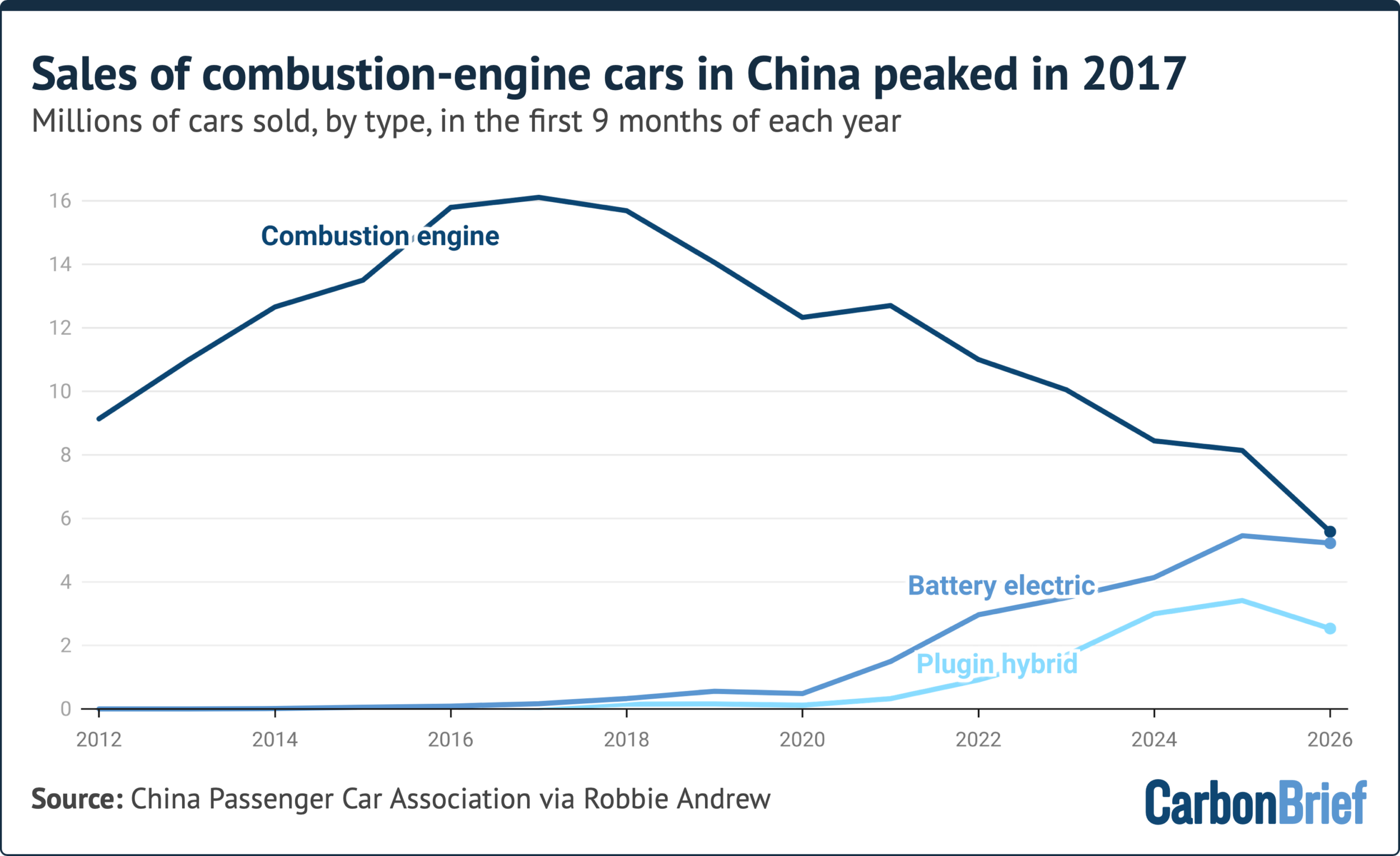
The contraction was led by combustion-engine vehicles, which saw sales fall 43% year-on-year in September and 31% in 2026 to date.
However, sales of PHEVs also fell by 36% year-on-year in September and by 26% in 2026 to date. By comparison, BEVs performed better, although sales still declined 8.5% from a year earlier in September and 4% in 2026 to date.
As a result, NEV sales overall fell by 17% in September and 13% in 2026 to date.
While the market changes in 2026 to date were particularly dramatic, they reflect a broad continuation of trends seen over the past decade.
Indeed, sales of combustion-engine cars in China peaked in 2017 and they have been declining ever since, shown in the figure below.
Impact of Hormuz
Part of the reason for the advance of NEVs in 2026, said Chinese technology news outlet OFweek, was petrol cars “giving up market share” as they were outperformed by electric alternatives.
Cui Dongshu, secretary-general of the CPCA, cited higher petrol prices as an explanation for September’s weak combustion-car sales, in comments to financial news outlet National Business Daily.
Imports of oil into China in January-September have fallen 15% compared to 2025, equivalent to 470m barrels, as ongoing conflict tightened supply and drove up prices.
China’s passenger-car NEV fleet has displaced 143m barrels of oil so far during the strait of Hormuz crisis, Euan Graham, senior energy analyst at thinktank Ember, tells Carbon Brief.
EVs “accounted for 12% of the decrease in China’s oil use post-Hormuz”, according to an estimate provided to thinktank the Brookings Institute by an unnamed analyst.
Erica Downs, a senior research scholar at Columbia University’s Center on Global Energy Policy, tells Carbon Brief that the strait of Hormuz crisis and higher oil prices are “reinforcing China’s electrification of road transport”.
She says the “world’s largest oil supply disruption” vindicates China’s early bet on EVs, which was partly driven by concerns about oil-supply security.
NEV demand down
Nevertheless, NEV sales have fallen year-on-year, albeit at a slower rate than overall car sales. The growth in NEV market share has also been decelerating.
Zhang Yichao, a partner at consulting firm AlixPartners, tells Carbon Brief that NEVs benefit from government trade-in policies and a “strong pipeline” of new models, particularly those involving innovation.
He says these factors help explain why NEVs sales have fallen at a slower rate to their combustion-car counterparts.
Cui told the state-run China National Radio that the fall for NEVs and for cars overall in September 2026, is also due to a high baseline of sales from the same month in 2025, as well as changes to trade-in policies and disruptions from the holiday period.
Other factors, says consulting firm Wood Mackenzie, are the weakened demand due to “demand pull-forward” in 2025 caused by the end of subsidies, as well as “tighter financing conditions”.
Zhang tells Carbon Brief he does not “see much more room ahead” for further growth in NEVs’ market share.
He adds that, in his view, their share in China is unlikely to exceed 80%, as some premium-market segments and specific use cases will continue to require combustion-engine vehicles.
Exports surge
Meanwhile, while domestic NEV retail sales fell 17% in September 2026, exports more than doubled, increasing 164% year-on-year, according to the CPCA.
This extends the decline in domestic sales and very strong growth in exports seen across 2026 to date, as shown in the figure below.
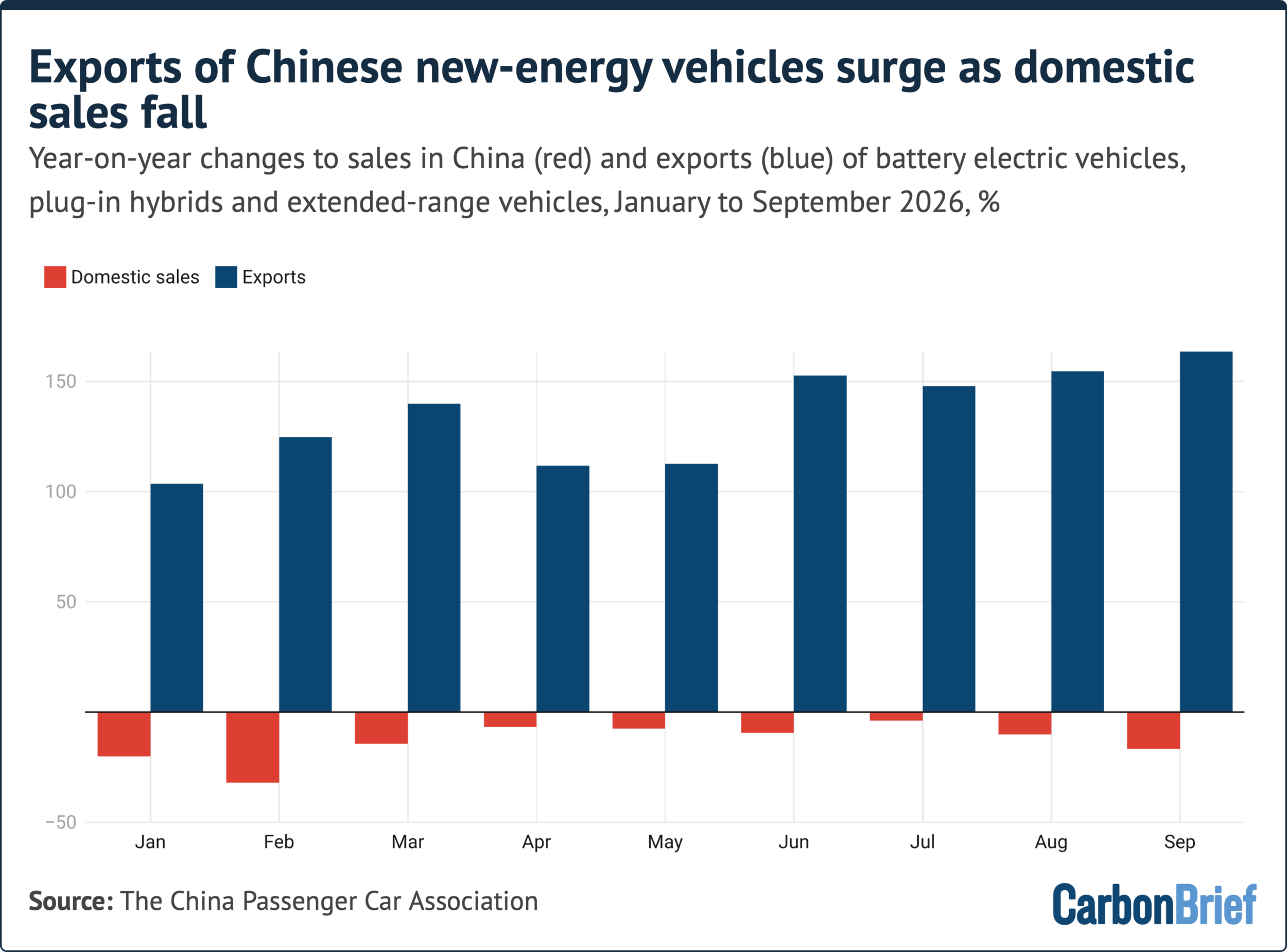
In September, 1,084,000 NEVs were sold domestically in China, while 558,000 NEVs were exported.
Exports are becoming increasingly important to Chinese carmakers, in the face of weaker domestic demand and cut-throat industrial competition.
The CPCA says exports have become “a core priority” for some carmakers.
However, the surge in exports from China has created concern in the EU, which has placed tariffs on imports of EVs from China and recently agreed plans to cut imports of hybrids.
Countries including Mexico and Turkey have also placed tariffs on Chinese EV imports.
At the same time, the Chinese government is putting policies in place that might be expected to disincentivise exports, such as cutting VAT export rebates.
Analysts differ on what impact this policy shift will have, with some saying it will be limited, while others believe it could cause the price of exported cars to rise.