

The UK has avoided the need for gas imports worth £5.9bn since the start of the Hormuz crisis as a result of record electricity generation from wind and solar, reveals Carbon Brief analysis.
While gas prices are surging towards levels not seen since the 2022 energy crisis, the UK has been generating record amounts of power from wind and solar, up 14% year-on-year.
This unprecedented clean-power generation is directly cutting the need for gas-fired electricity, which is down by nearly 10% year-on-year in 2026 to date.
In total, wind and solar have generated a record 41% share of the UK’s electricity needs in 2026 to date, compared with 25% from gas, according to Carbon Brief’s analysis.
The figure below shows that wind and solar generation has avoided the need for UK gas imports worth a total of £5.9bn since the outbreak of war between the US and Iran in February 2026.
The analysis shows that these avoided gas imports would have required the UK to secure the equivalent of more than 100 additional tanker deliveries of liquefied natural gas (LNG).
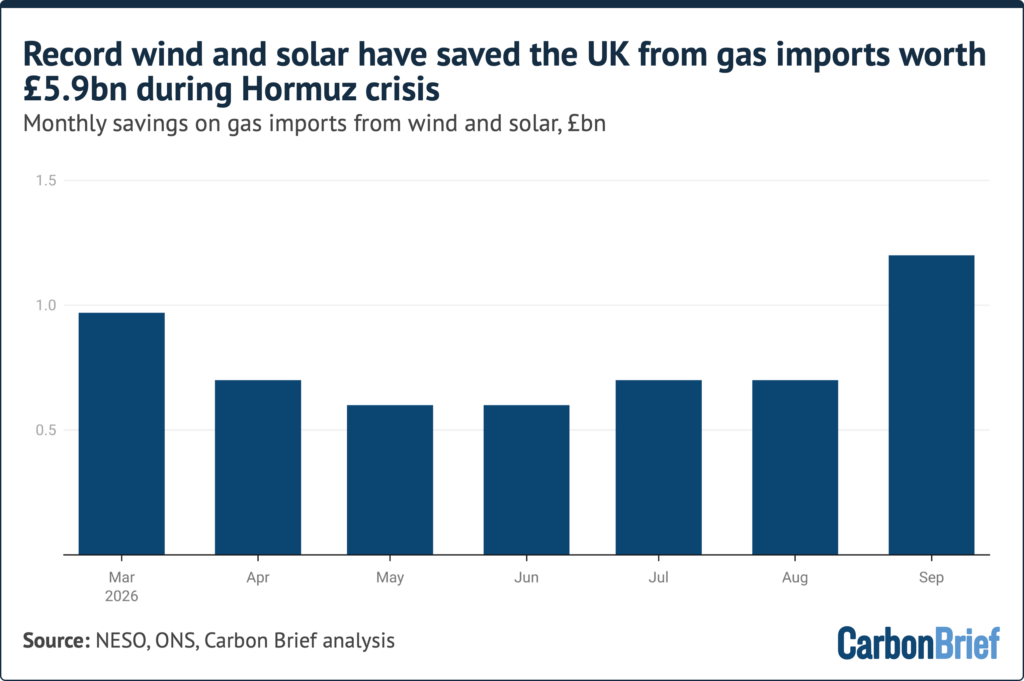
The £1.3bn import saving in September 2026 to date is the result of record wind and solar output, at nearly 10 terawatt hours (TWh), combined with surging gas prices.
Wholesale gas prices in the UK have remained elevated ever since Russia cut off supplies to Europe in the wake of its invasion of Ukraine in 2022. Gas averaged 90p per therm from 2023 until the start of this year, roughly three times above 2019 prices, before the Covid and Ukraine crises.
Since the outbreak of war in the Middle East in March, gas prices have climbed higher still, averaging 134p per therm or nearly four times the level seen in 2019.
In September 2026 to date, gas prices have averaged 189p per therm, reaching their highest level since the global energy crisis in 2022, as shown in the figure below.
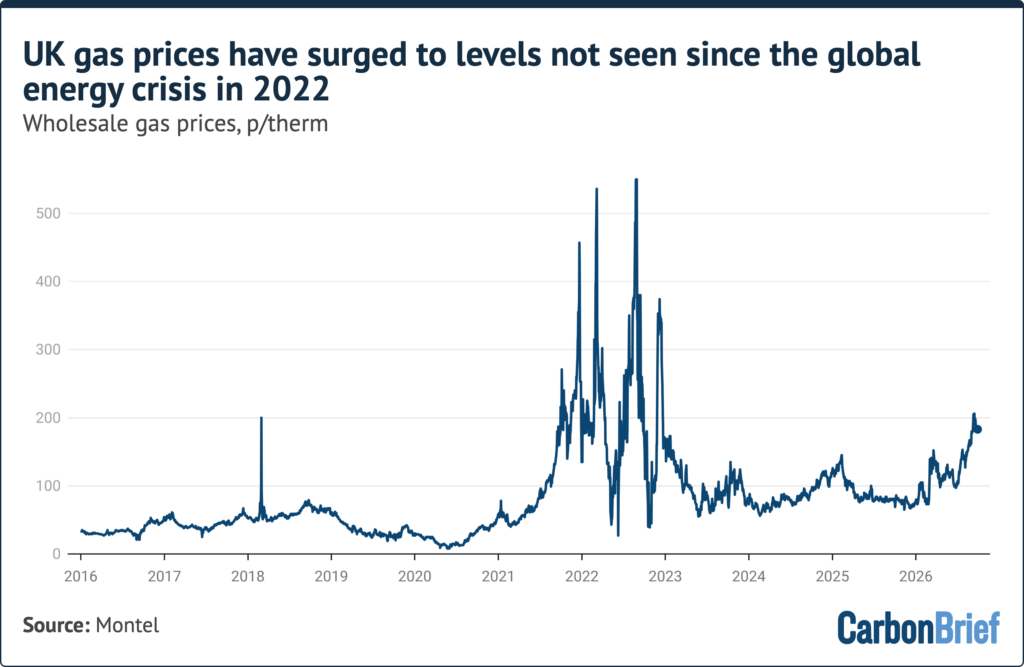
UK gas prices are spiking again because winter is approaching – meaning higher demand for heating – and there is no end in sight for the Hormuz crisis.
At the same time, European gas stocks are low. This means Europe will have to compete with Asia to secure the cargoes of LNG needed to keep warm.
In the UK, high wholesale gas prices are hitting household gas bills under the price cap set by energy regulator Ofgem – but thanks to clean energy, electricity bills have barely increased.
From this Thursday, 1 October, typical household gas bills will be 33% higher than they were in April, some £200 per year, according to thinktank Nesta.
In contrast, household electricity bills will only have risen 4%, according to Nesta’s analysis.
Andrew Sissons, director for sustainable future at Nesta, explained in a social media post that “the link between electricity and gas prices has already begun to break”.
The UK and other fossil-fuel importing nations are being hit not only by high gas prices, but also by high prices for oil, diesel and other refined fuels. The EU has reportedly had to pay an extra €100bn for fossil-fuel imports since the start of the crisis.
For example, UK diesel prices this week hit record levels of nearly £2 per litre. In contrast, recent Carbon Brief analysis shows that electric cars are up to nine times cheaper to drive.
In her speech to the Labour party conference this week, energy secretary Miatta Fahnbulleh said that energy bills were high because the UK is “exposed to global fossil-fuel markets”.
In his own conference speech, prime minister Andy Burnham said the expansion of clean energy was easing the impact of high gas prices on electricity bills. He said:
“We are already taking more control of our electricity prices with a massive expansion of home-grown renewables and nuclear. I have asked Miatta to speed up the breaking of the link between what we pay for power at home and the international gas market, to get bills down.”
The post Analysis: Wind and solar save UK from gas imports worth £5.9bn during Hormuz crisis appeared first on Carbon Brief.
Analysis: Wind and solar save UK from gas imports worth £5.9bn during Hormuz crisis

Climate Change
Albanese must deliver credible action to end fossil fuel chokehold, not just rhetoric
ANTALYA,Türkiye, Thursday 12 November 2026 — In response to Prime Minister Albanese’s COP31 Leaders’ Summit address, Shiva Gounden, Head of Pacific at Greenpeace Australia Pacific, speaking from Antalya said:
“Prime Minister Albanese’s COP31 address was full of nice rhetoric, but once again failed to confront or even mention the root cause of the climate crisis — fossil fuels.
“In Antalya, UN climate chief Guterres told leaders to “tell the truth”. The truth is Australia can not credibly talk about its clean energy transition while continuing to expand the industry it needs to leave behind. Australia must reckon with reality; its damning track record of 38 coal and gas approvals since it took office in 2022.
“We meet in Antalya amidst a global energy shock and dire projections of 1.5°C overshoot. Overshoot means something in the Pacific — it means irreversible harm, lives and cultures lost forever, entire nations at stake. We must face the fierce urgency of now.
“Never before has the need to end the fossil fuel chokehold been so abundantly clear, as our Pacific communities again suffer the consequences of a global economy hooked on coal, oil and gas. The Pacific needs credible roadmaps and clear timelines to unhook from fossil fuels — Australia can’t keep saying implementation and not reflect it with credible action.”
ENDS
COP31 images and video available here in Greenpeace Media Library
Media contact: Kate O’Callaghan in Antalya (GMT+3) on +61 406 231 892 (Whatsapp/Signal)
Albanese must deliver credible action to end fossil fuel chokehold, not just rhetoric
A second set of world leaders give their speeches on Thursday before heading out of town and leaving their negotiators to it. After around 40 leaders spoke on Wednesday, today there will be just 25 or so including the UK’s Andy Burnham, Venezuela’s Delcy Rodriguez and Bangladesh’s Tarique Rahman.
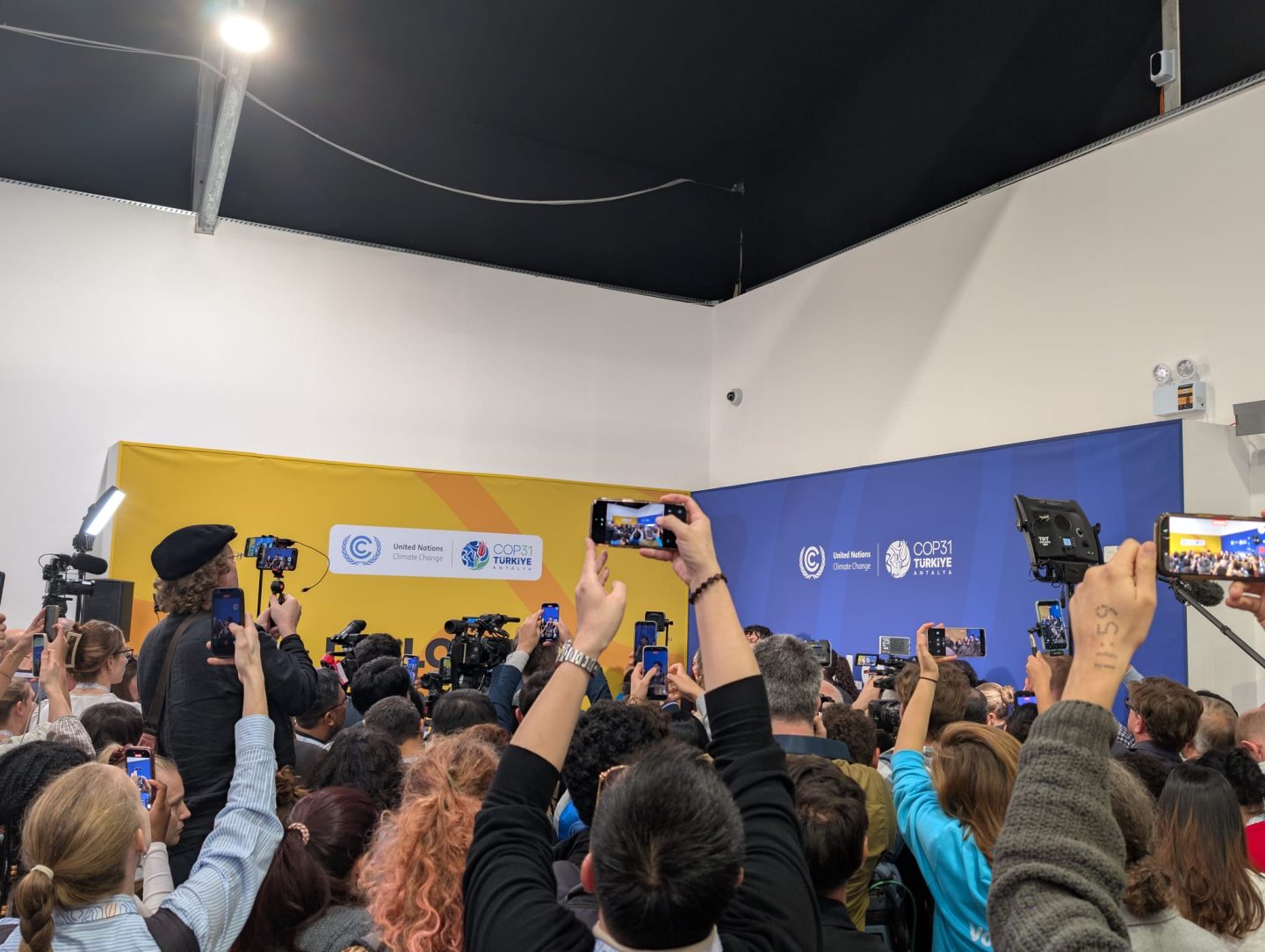
But Brazil’s President Lula is still there and is expected to keep grabbing headlines, along with California’s Governor – and maybe next US president – Gavin Newsom – and Swedish climate activist Greta Thunberg who has lost none of her star power, if the crowd around her in the press centre was anything to go by.
We’ll bring you highlights through the day on issues ranging from finance to methane, and update you on a pledging event for the Pacific Resilience Facility, which the climate-vulnerable region is relying on to keep small island nations as safe as possible in the face of intensifying storms, drought and sea level rise.
The post COP31 Bulletin Day 4: Burnham speaks with UK climate policy under fire appeared first on Climate Home News.
COP31 Bulletin Day 4: Burnham speaks with UK climate policy under fire
Climate Change
Australia must ‘pull all available levers’ to deliver fossil fuel phase out, following Albanese’s COP31 address
ANTALYA, Türkiye, Wednesday 11 November 2026 — In response to Prime Minister Albanese’s COP31 Leaders’ Summit address, Dr Susie Byers, Head of Advocacy at Greenpeace Australia Pacific, speaking from Antalya said:
“Prime Minister Albanese’s Leaders’ Summit address emphasised the power and clarity of Pacific climate leadership and that we must all fight to return warming to below 1.5°C. To inject the momentum these talks critically need, Australia must lead by example.
“Australia takes the reins of the COP31 talks at a critical moment where global instability can spark transformative change, or entrench more of the same inaction and paper pledges. Australia must pull all available levers over the next two weeks, taking the baton from Brazil and sprinting forward.
“The world’s most important job in Antalya is to deliver tangible action to end the fossil fuel era. Communities in Australia, the Pacific and around the world who are grappling with climate disasters and a cost of living crisis need concrete dates and credible plans. We know the transition is coming, one way or another. Our Government has a responsibility to make a plan for this change, which is based on the best available science, and a commitment to put people, energy security and our environment ahead of fossil fuel profits.
“In his address, UN climate chief Guterres told leaders to “tell the truth”. Prime Minister Albanese told an important truth today: that we all have solemn responsibilities to return warming to below 1.5°C. We also know that the best way for Australia to lead through this summit is to start by making its own commitments to turn the temperature down, by stopping developing and exporting fossil fuels.
“Australia’s domestic progress on renewables, and the ‘35 by 35’ electrification goal, are welcome and important. Now we must ensure electricity comes from clean, renewable sources that actually displace fossil fuels and align with the science of 1.5°C.
“The pressure on Australia is building. COP31 must deliver real action to advance multilateral climate cooperation, accelerate the just transition away from fossil fuels, and advance Pacific priorities — including significantly scaling-up climate finance and keeping 1.5°C alive.”
ENDS
COP31 images and video available here in Greenpeace Media Library
Media contact: Kate O’Callaghan in Antalya (GMT+3) on +6