

When it comes to shopping responsibly for furniture, one of the key decision factors to consider is locally-made — so if you’re in the United States, you might be looking for American made furniture companies.
Why Does Locally-Made Furniture Matter?
The first element that comes to mind is reducing shipping emissions. International shipping alone accounted for 2% of global energy-related CO2 emissions in 2022. So it’s crucial that we start to buy more locally and regionally made in general, and furniture is likely among the most bulky items we are going to buy so it feels like a particularly impactful area to focus on.
Additionally, when a product is locally made there is often more transparency. This is not always the case, but several of the US-made furniture companies here even have their own furniture workshops or partner with hyper-local manufacturers that they can regularly visit.
And with audit deception commonplace, it’s vital that a company visits their factories or has close relationships with their manufacturers to ensure social responsibility.
Another benefit is that you’ll contribute to supporting your local economy, especially if you’re purchasing from an American-made furniture brand that is based in your own state or region.
It goes without saying that American-made furniture is likely going to be more expensive than your standard mass-market furniture retailer.
However, there are several direct-to-consumer brands in this guide that avoid retailer markups to deliver more accessibly-priced furniture than some of the mid-tier to higher end furniture companies you might be familiar with that produce abroad.
A Quick Note on Certifications
You’ll see a few certifications referenced throughout this guide. Here’s what each one actually covers! You’ll notice many of them are quite specific to certain areas of the furniture. That’s why many sustainably-minded American-made furniture companies have products with several certifications.
- FSC Certified = the wood sourcing was responsibly managed; not a finish, foam, or textile guarantee. Some brands (like Avocado) hold their own facility-level FSC certification, which is a stronger signal than sourcing FSC-certified wood from a third party.
- GOLS Certified = verifies that latex foam is made from certified organic latex, grown and processed to strict environmental and safety standards; this is a latex-specific certification, not a wood, fabric, or product-level guarantee
- GOTS Certified = the fabric meets strict organic and safety standards, with labor protections built into the entire supply chain; this is a textile-specific certification, not a wood or foam guarantee
- OEKO-TEX® STANDARD 100 = tests the finished textile for harmful substances; a fabric-specific certification, not a claim about the wood or foam underneath it.
- Cradle to Cradle Certified (Gold/Silver/Bronze) = evaluates a product across material health, circularity, clean air/climate, water/soil stewardship, and social fairness; this is one of the few certifications that can assess a whole product rather than a single material and it’s the one sustainability managers at brands tell me is the toughest to get
Now that this is all cleared up, let’s dive into the guide!
My Top Picks for American Made Furniture Brands
Note that the following includes affiliate links, which means we may earn a small commission if you make a purchase, at no additional cost to you. As always we only feature brands that meet strict criteria that we love!
1. Medley
Best for: full range of American-made, non-toxic furniture
Categories: Living, Bedroom, and Dining Furniture
Made in: California and North Carolina
Price Range: $595 (poufs) – $10,290 (sectionals)
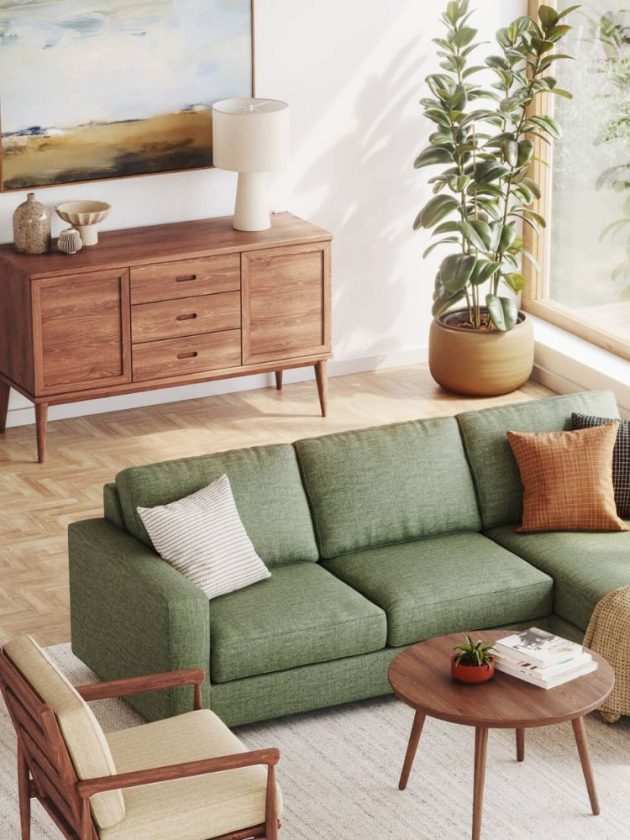
Medley is consistently at the top of my mind when I think of American-made furniture — their commitment to safe materials, sustainability, and craftsmanship is hard to match.
The brand combines traditional craftsmanship with modern ecological sensibility. Each sustainable furniture piece is meticulously made-to-order in California ensuring quality, supporting local manufacturing, and reducing their carbon footprint. Medley uses some of the best eco-certified materials in furniture too, like GOLS + GOTS-certified organic latex foam and OEKO-TEX® Standard 100-certified wool.
2. Avocado
Best for: FSC-certified and reclaimed wood furniture, made in their own LA woodshop
Categories: Bedroom and Living Room Furniture
Made in: California
Price Range: $349 (side table) – $3,999 (full bed frame)
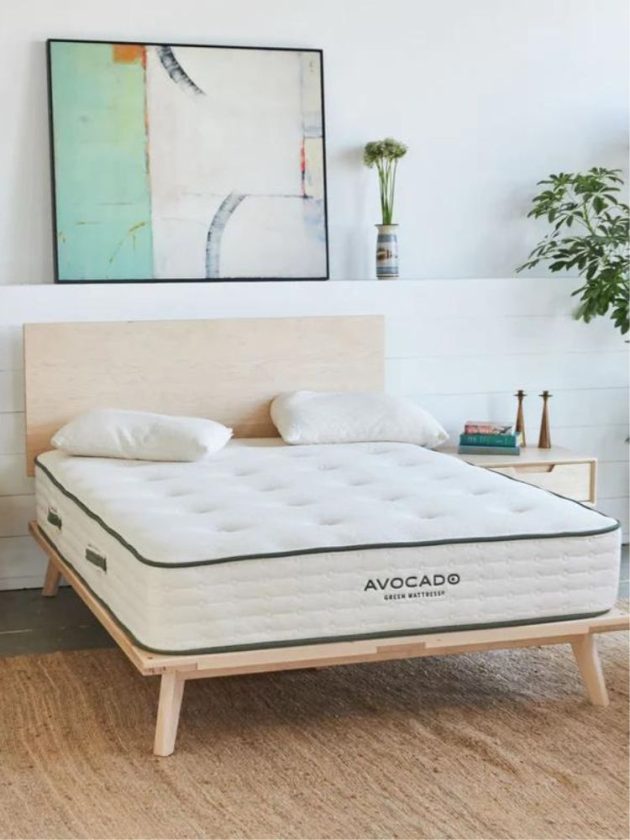
Rooted in a commitment to sustainability, Avocado has their own FSC®-certified (C156318) woodshop in Los Angeles! Among their offerings, you’ll find living room and bedroom furniture crafted from reclaimed wood or FSC-certified wood. Whether your aesthetic is minimal, Scandi, boho or MCM, you’ll find a beautiful piece to add to your home on this California-made furniture company’s site.
What really makes Avocado stand out to me though is their ethical labor standards. They produce in their own woodshop, pay living wages, and offer solid benefits to their factory team.
3. Cisco Home @ Urban Natural
Best for: design-forward furniture with three decades of LA craftsmanship
Categories: Living and Bedroom Furniture
Made in: California
Price Range: $975 (ottoman) – $9,000+ (large sectional)
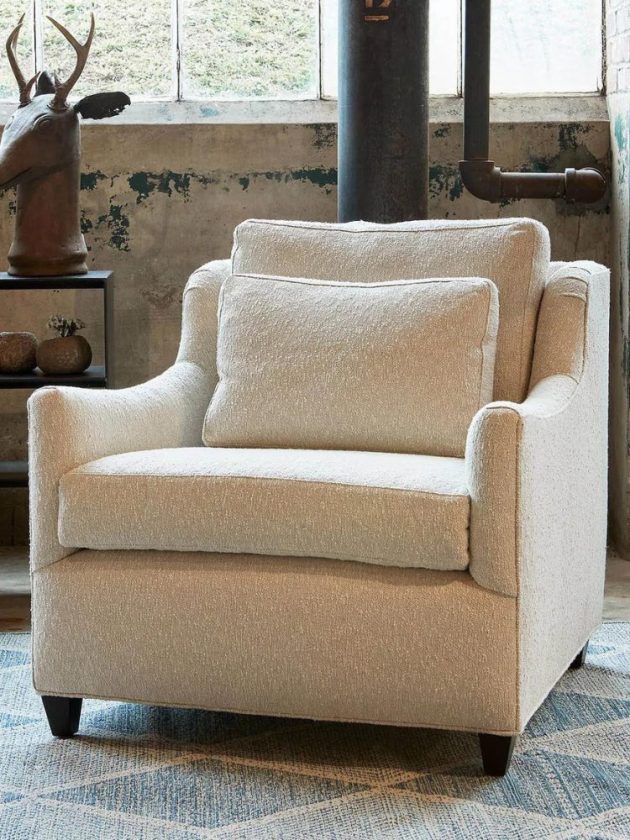
Founded in Los Angeles by Cisco Pinedo, Cisco Home focuses on environmentally responsible practices and local craftsmanship. Each piece, made in their Los Angeles workshop, combines modern elegance with rustic charm using materials like FSC-certified hardwoods and natural fabrics like hemp and organic cotton. Cisco Home’s three decades of experience in making quality sustainable furniture, makes them a top choice for American-made furniture.
Cisco Home’s default furniture options don’t automatically include their best eco materials though. So for the most eco-minded option, check “Organic Upgrade” on the product page.
4. Copeland @ Urban Natural
Best for: heirloom hardwood furniture
Categories: Living, Bedroom, and Office Furniture
Made in: Vermont
Price Range: $256 (shelf nightstand) – $6,865 (storage bed)
Copeland Furniture, based in Bradford, Vermont has been making heirloom-quality pieces since 1976. The USA-made furniture company sources their hardwoods like cherry, maple, and walnut from sustainably managed forests in the Northeast. Their collections blend traditional craftsmanship with elegant, contemporary design and functionality. You’ll find pieces like extendable tables and sit-stand desks from Copeland.
Copeland’s pieces are priced on the higher end, but they are truly stunning pieces that may be worth the investment if they’re within your budget.

5. Savvy Rest
Best for: fully organic, non-toxic bedroom and living room furniture
Categories: Bedroom and Living Room Furniture
Made in: Virginia
Price Range: $400 (bedside table) – $3,999 (sofa)
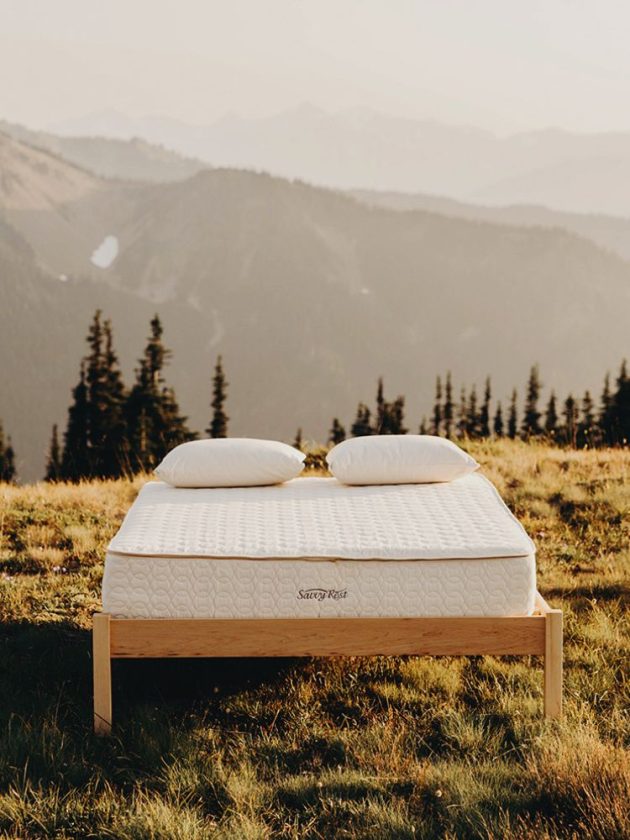
Savvy Rest’s commitment to organic materials and sustainable production practices is unmatched. I haven’t found another brand yet that matches their level of integrity!
The Northeast US-made furniture company crafts each piece of furniture with only the best non-toxic materials like GOTS-certified organic fabrics, Cradle-to-Cradle Natural Talalay latex foam, and zero-VOC finishes. Made in their Central Virginia wood shop, Savvy Rest exemplifies a dedication to creating non-toxic and sustainably-minded American-made furniture that is built to last.
6. What WE Make
Best for: reclaimed wood furniture
Categories: Dining, Living, Office, and Bathroom Furniture
Made in: Illinois
Price Range: $425 (bar stools) – $6,425 (bathroom vanities)
I loved learning that What WE Make produces their furniture right in Chicagoland, local to me!
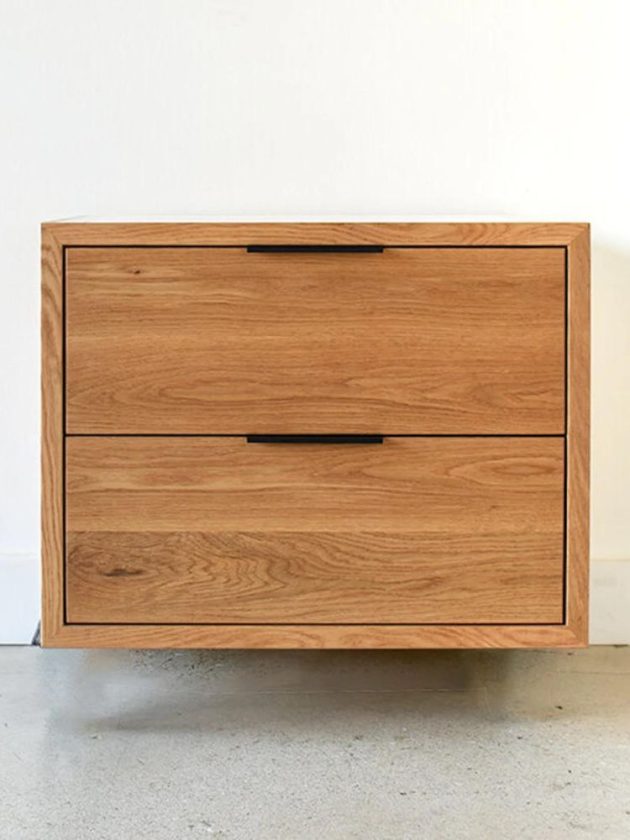
What WE Make crafts tables, vanities, and more from old-growth salvaged wood sourced from torn down Midwestern barns. And ensuring the furniture brings in minimal to no toxins, the pieces are finished with zero-VOC finishes. Each piece is made-to-order and you can even get a vanity, table, or other furniture piece fully customized to your liking!
7. Sabai
Best for: affordable, repairable American-made seating
Categories: Living Room Furniture
Made in: North Carolina and Tennessee (go behind the scenes)
Price Range: $495 (side table) – $6,295 (sectional)
Sabai’s American-made furniture collection focuses on environmental consciousness and accessible pricing. Sabai’s sofas and chairs are made crafted from 100% recycled fabrics or natural upholstery (they have a cotton + hemp option) and FSC-certified wood while being free of PFAS and flame retardants. The best part about Sabai in my opinion, though, might be their Repair Don’t Replace program so you can ensure your sofa makes it for the long haul.

8. Maple Corner Woodworks @ Urban Natural
Best for: traditional Shaker-style Vermont craftsmanship
Categories: Bedroom, Living Room, Office, and Dining Room Furniture
Made in: Vermont
Price Range: $815 (end table) – $9,650 (armoire)
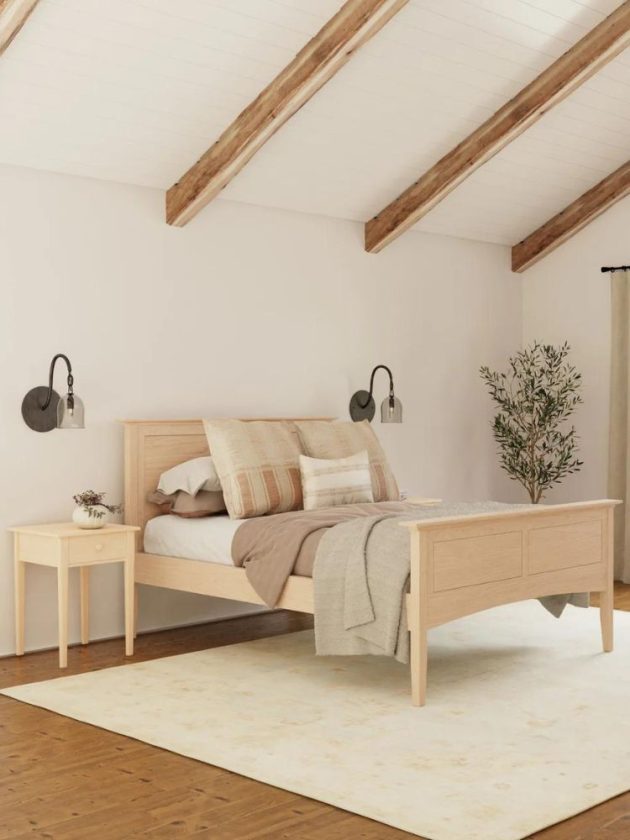
Maple Corner Woodworks is dedicated to crafting heirloom-quality, timeless furniture in Vermont, which is well-known for its quality woodworking.
With their most popular styles inspired elements by the best of furniture design from the mid to late 1800s, it’s safe to say that MCW prioritizes the longevity of their solid hardwood furniture. If you’re looking for classic designs, this is the direction I’d point you.
9. Loll Designs
Best for: American-made outdoor furniture
Categories: Outdoor Furniture
Made in: Minnesota
Price Range: $345 (stool) – $4,995 (sofa)
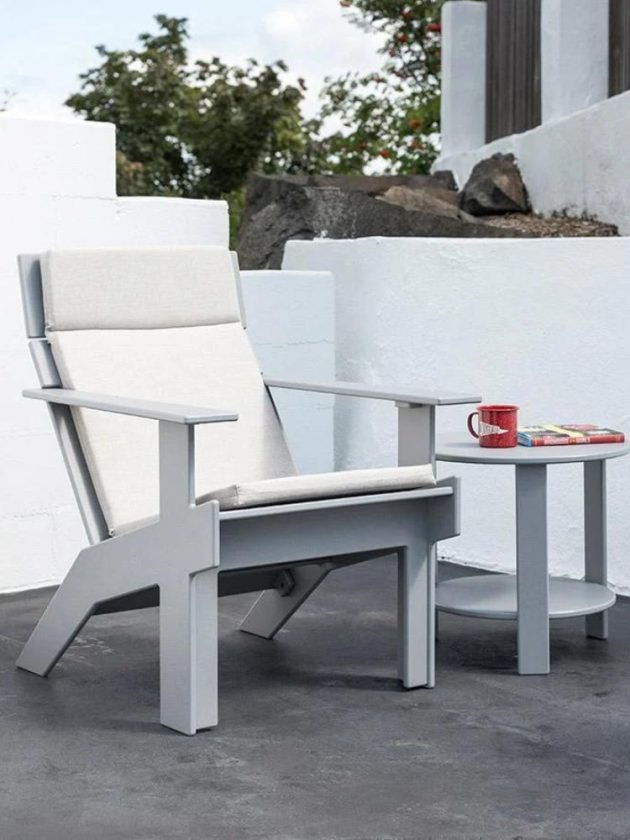
Loll Designs has everything you need for your patio redesign, from coffee tables and cabinets to benches and lounge chairs.
Made using recycled high-density polyethylene (HDPE), Loll Designs creates USA-made furniture build to last. The furniture is designed to not rot, splinter, or require any re-staining. In fact the brand was awarded the Cradle to Cradle Certified BRONZE certification, which as I mentioned is one of the toughest certifications for a company to get.
That wraps it up for our guide to American made furniture companies! I hope you find a quality piece or two that will last you a lifetime in this guide.
You Might Also Want to Check Out:
The Top Non-Toxic Furniture Companies
The Best Sustainable Tables to Gather Around
Comfy and Cozy Eco-Friendly Chairs
The post 9 American Made Furniture Companies Prioritizing Quality Over Quantity appeared first on Conscious Life & Style.
9 American Made Furniture Companies Prioritizing Quality Over Quantity

Green Living
Sustainability In Your Ear: XPRIZE’s David Babson on Why Climate Grand Challenges Need Buyers, Too
Buyers contracted nearly 30 million tons of durable carbon removal in 2025, more than triple the 2024 total, according to CDR.fyi data reported by Heatmap. About 90% of those purchases came from a single company, Microsoft, and suppliers delivered only about 450,000 tons during the year. That is a sliver of the six to 10 billion tons of removal a year that climate scenarios suggest the world will need by 2050. The technology to pull carbon out of the air works, but the customers needed to scale it remain scarce.
Our guest today, David Babson, is executive vice president of the Energy, Climate, and Nature domain at the XPRIZE Foundation. He calls the slow progress a market failure, because the technology is progressing faster than it is being adopted. Babson previously led MIT’s Climate Grand Challenges initiative and was a program director at the U.S. Department of Energy’s ARPA-E. His portfolio includes XPRIZE Carbon Removal, which drew 1,334 teams and whose participants have raised more than $3.3 billion. In April 2025, Mati Carbon won its $50 million grand prize for spreading crushed basalt on smallholder farms in India, where the rock locks away carbon dioxide. “If people could make money taking carbon out of the air and putting it underground, as opposed to only being able to make money taking it from underground and putting it in the air, we would be in a better place,” Babson says. Mati is weathering the slump in part because its rock dust also improves soil health and crop yields, giving farmers a reason to participate that doesn’t depend on carbon credit prices.

XPRIZE’s answer is to change what winners receive. Babson describes “mixed purses” that pair a cash award with a guaranteed buyer through an advance market commitment, a power purchase agreement, or an offtake contract. In one thought experiment, a carbon removal prize would come with a separate $1 billion fund raised from credit buyers, which qualified teams could draw on as they deliver verified tons. XPRIZE is applying the same thinking to a planned series of fusion energy prizes, pairing technical milestones with market mechanisms to build the supply chain that commercial fusion will require. The same gap between invention and adoption shows up in other XPRIZE competitions. On September 23, XPRIZE Wildfire awarded about $4.55 million from its $11 million purse, with defense contractor Anduril Industries taking first place in autonomous fire response along with a $1 million Lockheed Martin bonus. Babson expects costs to fall as fire agencies adopt the tools and as startups license individual components into cheaper platforms, though underfunded agencies will need a way to buy the first systems. He also notes that the competition left fuel management and ground-based autonomy for future prizes. Earlier this year, program director Andrea Santy told us that field testing had moved ahead of drone regulations. In biodiversity, Limelight Rainforest won $5 million for surveying 100 hectares of tropical forest in under 24 hours and identifying more than 250 species. Biodiversity still lacks a price, but Babson argues that once ecosystems can be measured, slow-walking policy becomes “a dereliction of what they should be doing.”
We also discuss the tension inside XPRIZE’s vision of “equitable abundance,” including a $101 million Healthspan prize that could add years of consumption to longer lives. Babson argues that abundant, cheap clean energy would let society move beyond efficiency as its organizing principle, powering uses such as indoor vertical farms that could return millions of acres of farmland to nature. You can follow XPRIZE’s new competitions and get involved in its prize ideation workshops at xprize.org.
- Subscribe to Sustainability In Your Ear on iTunes
- Follow Sustainability In Your Ear on Spreaker, iHeartRadio, or YouTube
Interview Transcript
Mitch Ratcliffe 00:36
Hello. Good morning, good afternoon, or good evening, wherever you are on this beautiful planet of ours. Welcome to Sustainability In Your Ear. This is the podcast conversation about accelerating the transition to a sustainable, carbon-neutral society, and I’m your host, Mitch Ratcliffe. Thanks for joining the conversation today.
Let’s talk about the power and the uses of grand challenge programs to kickstart low-carbon industries and respond to the changing environment. Over the past several years, we’ve talked on the show with leaders of grand challenge programs designed to accelerate progress on humanity’s most difficult challenges, from pulling carbon out of the atmosphere to fighting rapidly growing wildfire threats in cities and rural communities. Many of these competitions have been launched by XPRIZE, whose leaders have shared on the show the stories of these competitions as they launched and unfolded.
Today is a chance to take stock, to look back and think about how climate markets, technology, and politics are changing fast, and how that makes this a good moment to ask the question: Are these programs designed to accelerate progress actually delivering that progress?
Our guest today designs XPRIZE’s climate bets. David Babson is executive vice president of the Energy, Climate, and Nature domain at the XPRIZE Foundation. Before XPRIZE, he was the executive director of MIT’s Climate Grand Challenges initiative and a program director at the U.S. Energy Department’s ARPA-E energy technology research agency.
His portfolio includes the largest incentive in prize history. In 2025, Mati Carbon received a $50 million grand prize for their enhanced rock weathering solution for capturing and drawing down carbon, and XPRIZE now reports that companies participating in its programs have raised $3.3 billion. That carbon removal win arrived just as the removal market hit serious turbulence, and as XPRIZE’s wildfire competition wrapped up with its top prize still unclaimed.
So we’re going to discuss what grand challenges can really accomplish, which winners continue to build and which stall, and what the reasons are, as well as the tensions inside a portfolio that funds both climate solutions and longer human lifespans. We’ll get to the conversation right after this brief commercial break. Stay tuned.
[COMMERCIAL BREAK]
Welcome back to Sustainability In Your Ear, and welcome, David Babson, to Sustainability In Your Ear. How are you doing today?
David Babson 03:10
I’m doing well.
Mitch Ratcliffe 03:11
I’m glad to have you here. You’ve run research portfolios at ARPA-E and MIT. What can a prize purse accomplish that a well-funded grant program can’t, or are they complementary?
David Babson 03:22
They’re absolutely complementary. The way that I think about it is that the value of these different mechanisms for promoting innovation is at different parts of the innovation supply chain, if you will. A prize is not a substitute for the very necessary investments that places like governments make into basic, applied, and advanced research. In fact, those types of investments are really valuable for establishing the innovation ecosystems and the technical capacities to eventually win prizes.
Where the prize is very valuable is somewhat downstream: translating technologies, ideas, and innovations that are coming out of academia and labs to market for scale. It challenges the innovators to imagine those technical capacities as solutions to global challenges, and then the visibility that the prize brings to those translations of technologies de-risks funding to flow to those innovators so they can imagine their uses in practice.
So I actually see them as very complementary, particularly when it comes to solutions in the energy and climate space that require rapid adoption of technologies in markets to have impact. Just having an energy solution or a climate solution is not valuable unless it can be de-risked and connected to markets to scale for impact. And that’s what the prize is actually very good at doing.
Mitch Ratcliffe 05:22
That comes through in the impact report that you all published recently. About 1,300 different organizations were catalyzed. The groups came together, apparently, because of their desire to compete in the competition.
What I’ve found in my work with public-private partnerships, in particular, is that impact investors are looking for that initial traction, and to a degree, the prize and the distribution of money within the prize group is that catalyst that says there’s a real opportunity for an impact profit, something that both does good and is profitable. How does the organization consult with the financial communities that are going to back these companies once your prize has been awarded? Is there a backroom conversation about that, for lack of a better way of putting it?
David Babson 06:10
Not an explicit backroom conversation about it, but the prize itself brings attention to the innovations that are coming out to win the competition. Oftentimes, as you’re noting, these impact investing communities exist, and they are looking for technologies to invest in to have impact.
What the prize is effective at doing is casting a wider net and surfacing the best solutions across the board, where there may have been silos in the past, or there may not have been transparency to individual investors about where to put their money. The prize is capable of elevating all of them, creating better visibility, and therefore, just by its inherent operation, creates better opportunities for investment capital to flow to the right types of teams to have greater impact more quickly.
So we don’t have explicit discussions with those types of investor communities to have them directly connected to individual prizes. But we often consult with investors and experts in industry to inform the metrics that we would want to have demonstrated, so that we know that when teams are winning our competitions, the demonstrations that they do are de-risking capital to flow to those innovators so that they can be translated to market.
Mitch Ratcliffe 07:47
We’re talking about growing industries, which of course means diversifying into a lot of specializations. Once you’ve got this kind of anchor winning team or teams, how does XPRIZE think about propagating the information that’s necessary for the rest of the industry to grow and fill in around them, in order to provide the kind of comprehensive geographic coverage and range of functions that are necessary for the industry to thrive? Is that something that you think about cultivating, like you would in agriculture?
David Babson 08:22
It is something that we think a lot about. With a few of the more recent prize competitions that we’ve run, we have also paired those competitions with a subsequent impact phase, which is designed to further build the community that has been established through the operation of the prize and connect the technologies that came out of the competition to the right types of markets and investors so that they can scale.
So that is one of the things that we’re thinking about in future competitions as well: not just running an innovation competition to surface new innovations, but how do we augment the community building that the prize provides as a way to also promote the back-end business models and industries that can scale those solutions for impact?
Mitch Ratcliffe 09:19
How would you describe the patterns you’re looking for that indicate that an organization can become that durable enterprise? What separates them from the rest? Have you got thoughts about that?
David Babson 09:29
I do have thoughts about it. In a lot of ways, the rigorous metrics that we set up when we’re designing the competition are informed by what experts believe would be the necessary demonstrations to actually generate a solution that is market viable. So a lot of it is very quantitative in terms of how we architect the competition.
But what we’ve also seen is that there are elements of winning teams that can’t always be controlled by just the scientific metrics. A lot of times, it’s the composition of the team, how diverse they are, and the unique mentality that the leaders of the team have in terms of their vision and their ambition. Those are parts that you can’t control for, but the prize model is very effective at also attracting the type of entrepreneurial, big-thinking individuals that actually tend to be behind some of the most successful companies.
Mitch Ratcliffe 10:40
Those big-thinking individuals often struggle with the transition from inventor. And to your point about the academic community often being the source of many of the teams that are competing, that’s not something that academics are necessarily good at. As part of the prize process, do you also begin to coach them on how to staff for the operators who are going to be able to translate the invention into a market success?
David Babson 11:04
Absolutely. On the front end, the prize itself sets a target that is typically beyond what researchers in an academic setting are imagining for what they’re doing. It gives them a way to imagine their technical innovations as scalable solutions to big problems, so that gets them excited to be in the competition. But you’re right: they’re not necessarily all business-minded or have the types of experience that would allow even very, very good solutions to become very strong companies and business models.
So one of the things that we have tried out recently, and it’s a model that we could replicate in future competitions as well, is an accelerator cohort in the carbon removal prize. It was optional for teams to opt into the cohort to get additional guidance and consulting from experts in startups and technology translation. That would help them think about the unique elements of their proposed carbon removal strategy, how they would connect it to markets, and how they would drive greater value for their solutions.
That is something that we can do as part of the competition, because we’re building a community of innovators that are striving toward a shared aim. Therefore, we can better define what an accelerator cohort looks like, so that the guidance that is provided is more effective at actually generating the right type of thinking for scaling the solutions that we’re interested in.
Mitch Ratcliffe 12:52
That kind of accelerator approach gets you ready for market competition, but it doesn’t always get you ready for the market in which you’re going to have to exist as an organization. It’s templated, and the specifics of any individual company’s success are very unique.
Let’s take Mati Carbon as an example. They won the $50 million prize. They are doing carbon drawdown using basalt ground up and mixed into farmers’ fields, but their success is really anchored in the carbon credit market’s growth. How does the prize work with those sources of carbon credit purchases, for instance, Meta or Microsoft, to connect them to these opportunities to make prize winners thriving organizations?
David Babson 13:38
There are some limitations to what we can do in that space. I think the uncertainty and the pullback in commitments to carbon credits and carbon markets is a challenge to the cohort of teams that competed in the carbon removal prize.
Ironically, I think one of the things that is allowing Mati to continue growing on the business plan that they have is that a lot of the value that they’re able to assign to their solution actually goes toward the agricultural implications: the ability for their treated lands to not just remove and store carbon, but to improve soil quality and soil health to improve agricultural yields. So there’s a different value stream that they can draw from. Broadly, it would be much better if there were a great deal more certainty in the market for carbon removal attributes.
Mitch Ratcliffe 14:47
This is a systems thinking problem, and your domain includes nature alongside energy and climate. How do you think differently about designing a prize for an ecosystem as compared to designing one for a technology that has a clear cost curve and an adoption challenge?
David Babson 15:02
I think that it’s a really interesting question, and one that we’ve been thinking about a lot in my domain in particular. As I was saying earlier, it’s not sufficient to just surface new innovations that could be a solution. In order for them to have impact, you have to figure out how you connect those to markets and get them into use, so that they can scale to drive that impact.
So there are two parts of the incentive model that we need to push on. We need to continue the incentive that the traditional non-dilutive purse offers in attracting innovators to