

Curtains are often an afterthought when styling your interior spaces, but the right window treatment can honestly bring the entire room together — or add the perfect unexpected accent. The importance of choosing sustainable curtains is equally important in my opinion for several reasons, too.
Why does choosing sustainable curtains even matter?
Toxic Chemicals:
As with any other type of textile, the curtain market is full of plastic curtains made and treated with toxic chemicals. Vinyl curtains are among the worst culprits as they’re typically made from PVC. Research has shown that these PVC curtains contain toxic chemicals like volatile organic compounds (VOCs) phthalates, and organotins.
And sometimes you can feel the impact: when my husband and I moved into our home, the previous owners had left their curtains. At first, we thought: score! Free curtains. But then the rooms that had windows with full sun kept reeking of burning plastic. My husband would complain of headaches when he was in his office (one of said full-sun rooms). At first, he thought it was all the computer hardware, but as someone who’s written about sustainable fashion and home for a decade, I had a feeling it was the curtains. Sure enough, the second we removed the curtains, the burning plastic smell was gone as were the headaches.
Materials:
The vast majority of curtains are made from synthetic fabrics like polyester. In other words, plastic. In fact when we went shopping for curtains at our local hardware stores, we found that 100% — and I am not exaggerating here — of the options sold on the floor were 100% polyester. Not only is this an unsustainable material, but I do not want the heat of the sun hitting plastic fabric in my house all day long (see above for why!).
Labor Issues
Just as fast fashion is often made in exploitative conditions, home textiles are just as likely to be produced in manufacturing facilities with little transparency by workers earning low wages, working long hours. Sweatshops, child labor, and even forced labor are a reality in the home goods industry as well.
So, what are sustainable curtains?
Sustainable curtains will ideally address these various issues. While every curtain has to be made by human makers from fiber, dyes, and other inputs, all of those elements can be more considered.
Materials:
When it comes to sustainable materials, I look for natural fibers first and foremost. Of course not all natural fibers are low impact, but linen and hemp tend to require fewer resources to grow than cotton. Certified organic cotton can be a better alternative that does not use synthetic pesticides or herbicides for production. That doesn’t mean conventional cotton is “bad” — a lot depends on how that cotton was farmed — but it’s a consideration to keep in mind. I would still always choose cotton over polyester, which releases microplastics when washed.
Dyes and Chemicals:
Most dyes today are also made from petroleum. (It’s depressing, I know.) But there are some brands prioritizing natural, organic dyes for their products — including a few in this guide!
You can identify if a product was potentially made with toxic finishes if the product description says something like “wrinkle free” or “stain resistant”. Water or stain-repellent products can contain PFAS (also called “forever chemicals” because they don’t break down in the environment or in your body).
This information isn’t always disclosed and frankly, the majority of dyes even from brands using natural fibers are synthetic. So I’d suggest looking for the OEKO-TEX® STANDARD 100 certification which tests for over 1,000 hazardous and harmful chemicals. A product made with synthetic fibers and synthetic dyes can still hold this certification — it does not mean a product is natural — but it can be an assurance against avoiding the most widely known toxic chemicals in textiles.
Ethical Production:
This one is pretty straightforward. Were the people making these curtains treated fairly and paid well?
To ensure this, I look to see if the brand offers transparency into their production. Are they making the curtains themselves? Do they make the curtains in their own studio or production house? If they outsource production, how do they ensure fair wages and safe conditions, and reasonable working hours? One way this is done is through the Fair Trade Certified certification. While no certification is perfect, this is an added assurance that the facility where that product was made upheld good conditions for workers, and that workers earned a fair wage.
Another approach, particularly for small businesses, is close partnerships with artisan cooperatives. In these arrangements, the cooperatives often set the prices to the brands, giving them financial agency in their work. That doesn’t mean artisan partnerships are always ethical, though. I still like to see transparency into what that relationship is like between designer or brand and artisan.
If you’re thinking: wow, that’s a lot to look for! Don’t worry, I’ve got you covered. I researched and vetted dozens of brands to curate the best of the best for ethical and sustainable curtains. These brands use fair practices, source sustainably, craft with quality, and have beautiful designs, too.
Where to Find Sustainable and Fair Trade Curtains
Note that this guide includes affiliates. As always, all brands featured meet rigorous sustainability criteria and are brands we love — and that we think you’ll love too!
1. Ichcha
Best for: artisan handmade curtains
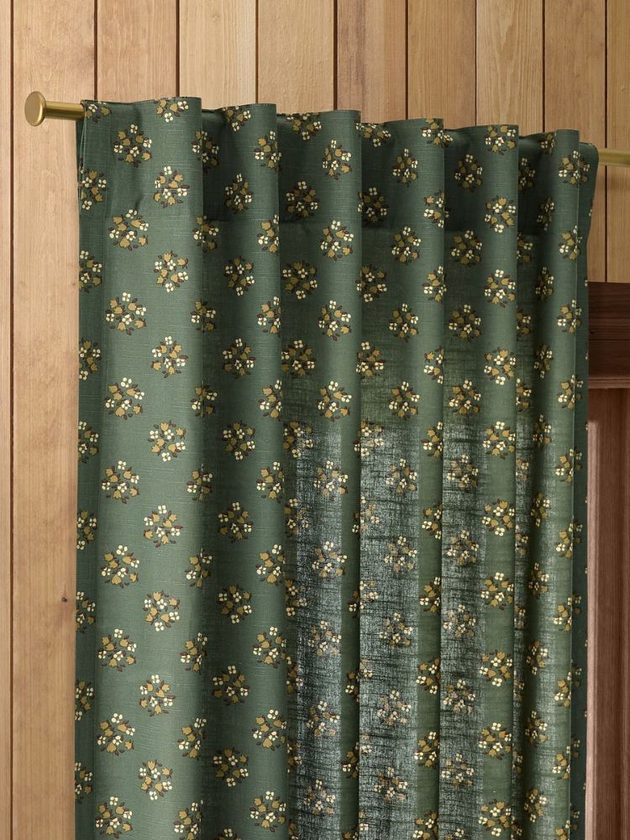
Many curtains say “handmade”, but what makes Ichcha special is that each curtain is not just sewn by hand but printed by hand using carved wooden blocks and dyed by hand with natural dyes in Rajasthan, India. Natural doesn’t mean dull though — the brand’s collection is full of vibrant hues.
In short: the craftsmanship behind Ichcha is the real deal. Just keep in mind that with the handcrafted nature of these products, there will be slight variations in products.
Conscious Qualities: Natural Dyes, 100% Cotton, Artisan Handmade
Price Range: $54 – $86

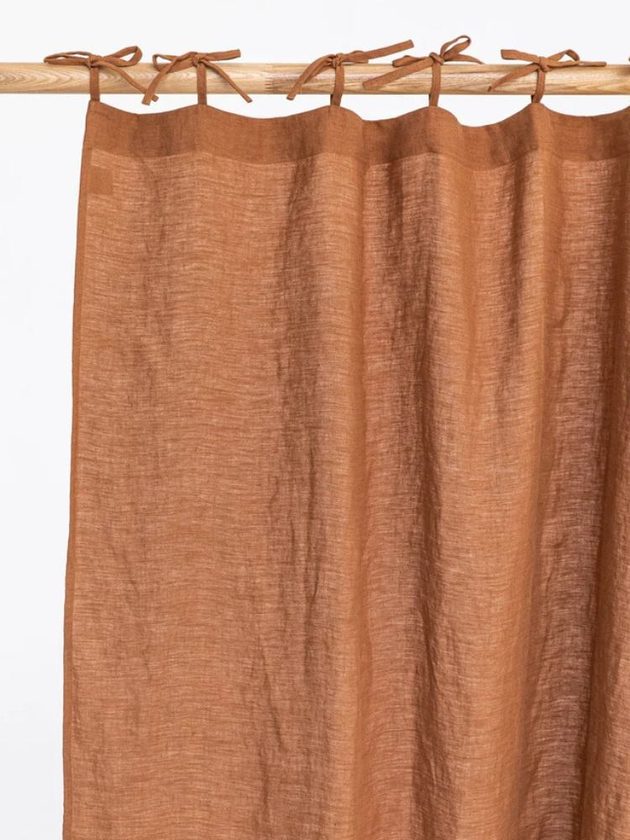
2. Magic Linen
Best for: high-quality 100% linen curtains
I purchased a set of Magic Linen curtains for my home a few years ago and was quite impressed with the weightiness of the brand’s stonewashed linen curtains. The color facing the full sun window has faded, which is to be expected with lower impact dyes, so we just keep the faded side facing outwards.
MagicLinen makes all of their linen products to order locally in Lithuania in-house, minimizing waste throughout production, and shipping products in compostable packaging.
Conscious Qualities: 100% Linen, In-House Production, Made to Order, Compostable Packaging
Price Range: $55 – $217
3. GreenRow
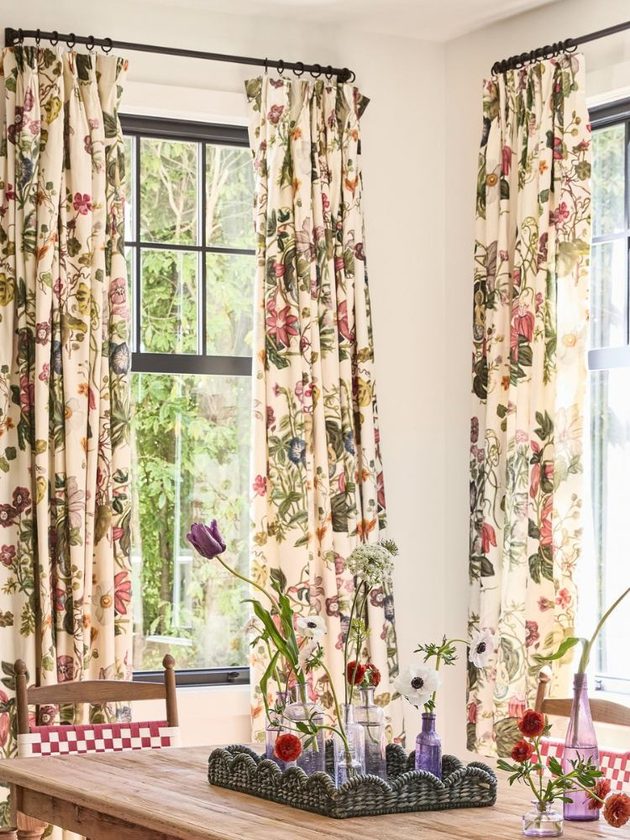
Best for: curtains with vintage-inspired prints
If you haven’t heard of GreenRow, you likely will soon. Part of the Williams-Sonoma network of brands, GreenRow was founded as a furniture and home company of exclusively sustainably-sourced pieces.
Their vibrant patterned curtains are among my favorite for their cozy meets vintage chic vibes. The natural fiber curtains are mostly linen/cotton blends, and several options are OEKO-TEX® STANDARD 100 certified and Fair Trade Certified. (Check each product’s description.)
Conscious Qualities: Natural Fibers, OEKO-TEX® STANDARD 100 certified and Fair Trade Certifiedoptions
Price Range: $129 – $559
4. Linenistic
Best for: organic fiber curtains
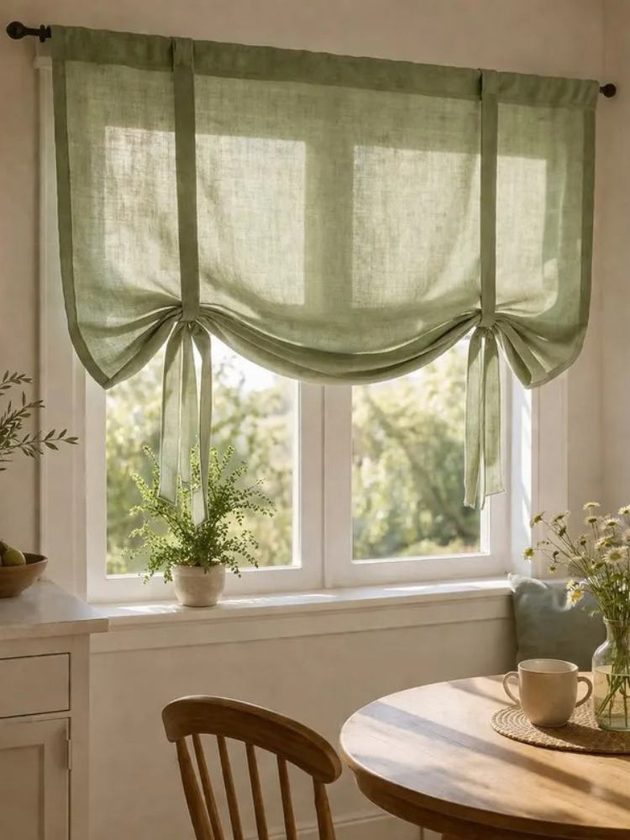
Linenistic is one of the few curtain brands out there that has curtains made from GOTS-certified organic linen. The natural medium-weight curtains come in dozens of colors and customizable lengths and widths.
Styles include everything from Japanese Noren curtains and European-style café curtains to piped edge linen drapes and tie-up curtains ideal for a kitchen. You can also add on ruffles (a touch I love!) or add a second color if you choose.
Conscious Qualities: GOTS-Certified Organic Linen, Natural Dyes, Made to Order
Price Range: $35 – $128
5. Rawganique
Best for: non-toxic curtains
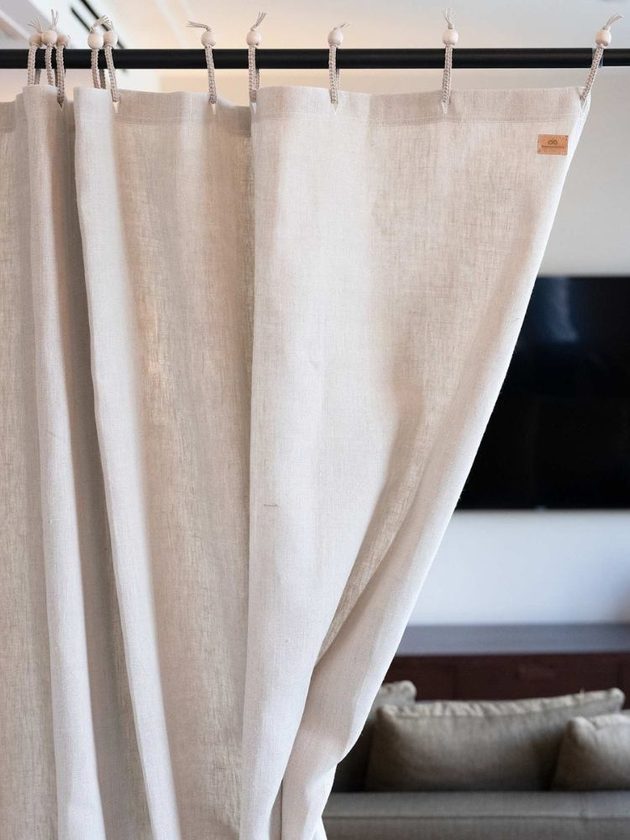
If finding all-natural curtains is important to you, I’d steer you towards Rawganique. The brand not only uses top of the line sustainably-sourced materials like organic hemp and organic linen for the curtains, but even the thread is cotton, which from my experience in this industry, I know is quite rare. Further, the brand uses exclusively biodegradable organic dyes or leaves their curtains undyed for a natural look.
Rawganique also has the only fully plastic-free blackout curtain that I’ve seen on the market.
Conscious Qualities: Organic Fabrics, Non-Toxic Dyes & Finishes, In-House Production
Price Range: $79 – $249
6. West Elm Fair Trade Certified
Best for: fair trade curtains
Home retailer West Elm has a sizable selection of Fair Trade Certifiedcurtains in plenty of pretty prints from floral to gingham. (My favorites are from the Emma Chamberlain collection.) If neutral solids are more your style, West Elm has plenty of more basic fair trade curtains as well.
Many of their curtains are made of 100% cotton or 100% linen and STANDARD 100 by OEKO-TEX® Certified as well. (Though not all of them, so you may want to double check the product description if natural fibers are a priority for you.)
Conscious Qualities: Made in Fair Trade Certified facilities, Natural Fiber Options
Price Range: $39 – $838
7. Linden Studio
Best for: customizable linen curtains
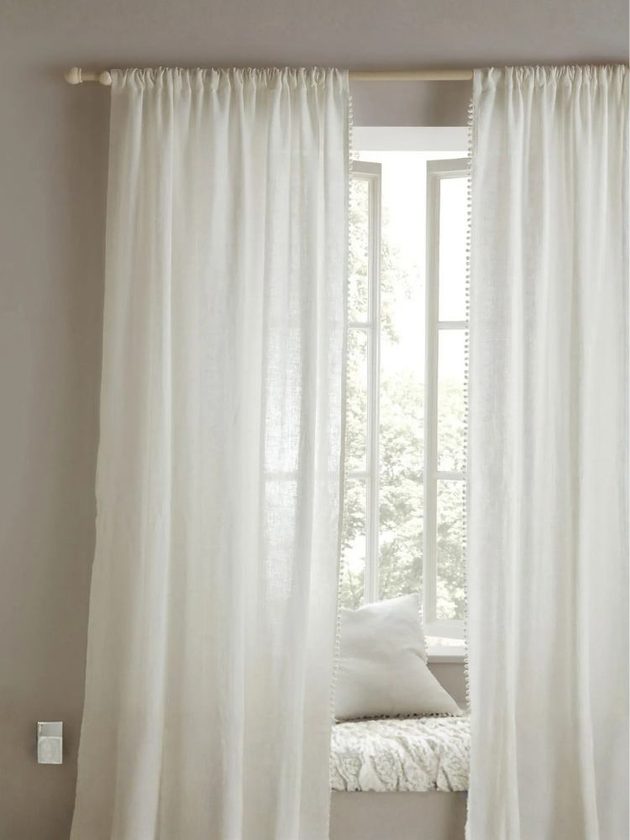
Run by a sister duo who have long been passionate about designing and crafting, Linden Studio is a shop creating made to order goods from 100% European linen in their Maryland studio. Among their curtain collection, you’ll find unique detailing like ruffles and pompoms. While pictured all in white, the brand has 12 different colors like cinnamon and terracotta to choose from.
What really makes this option stand out to me though is their custom sewing services — you can send them unused fabric you already picked out. Or if you want to remake old curtains or bedding, you can contact them for a custom quote.
Conscious Qualities: 100% Linen, Made-to-Order, Ethically Made
Price Range: $79 – $164
You May Also Want to Check Out
Ethical Home Decor Brands to Curate a Conscious Space
What is Sustainable Interior Design? Tips, Tricks, and Common Myths
Eco Friendly and Ethical Throw Pillows for Every Aesthetic
The post Fair Trade and Eco-Friendly Curtains to Accent Your Space Sustainably appeared first on Conscious Life & Style.
Fair Trade and Eco-Friendly Curtains to Accent Your Space Sustainably

Last winter, we kept our house at 60 degrees and our electric bill was STILL $280. I’ve been interested in solar for a long time, but on the long list of house projects (especially when you’re restoring a 200 year old house on the historic registry) some are more pressing than others.
But with a few of those major projects wrapping up, and a daunting bill before me, I figured now was the time for a quick google search on solar panels, and let me tell you….. It can be very overwhelming.
Figuring out the rules (cough, cough, historic society), incentives or rebates if applicable, how much it would cost, how much we could save, etc. felt a little like a part-time job. But, one website made it really easy to compare things, and I am happy to be partnering with Aurora Solar to share that site with you.
Because I think you should be able to easily run the numbers on your house without a lot of hassle!
This post is sponsored by Aurora Solar, but all thoughts and opinions are my own.
If you’ve ever gotten a solar quote, there’s a good chance that Aurora Solar was involved. Aurora was founded in 2013 after its co-founders spent seven months trying to design a solar energy system using a patchwork of different tools.
Afterall, designing a solar system shouldn’t be harder than actually installing one. So they built software specifically for solar professionals. Today, more than 7,000 solar organizations use Aurora, and more than 20 million solar projects have been designed using the platform. They are also the largest solar software provider in the world. Their software is used by roughly 80% of the top 75 residential solar companies in the U.S.
All of this tech has been primarily used by professional installers to map your roof and then create a proposal, but now Aurora is offering this tech to us to help compare quotes.
So instead of having to call a bunch of different installers, I could use the Aurora Solar Marketplace to understand my solar potential, compare estimates, understand my possible savings, look into battery storage and other home electrification incentives, and map out different financing options.
1. know how much electricity the system will actually produce
Before you even get into the price, make sure you understand what you’re actually being quoted.
Two solar systems can have very different prices because they may not be the same size or produce the same amount of electricity. A cheaper system might simply have fewer panels and offset less of your electric bill.
With Aurora, you can compare solar estimates and see the system size, energy production, and how much electricity the system should offset.
You can also upload your utility bill to get a solar estimate based more closely on your actual energy usage, to make the quote accurate for you instead of a ‘generic household’.
2. understand the solar payback period
Aurora calculates things like payback period and lifetime savings, which makes it much easier to understand the long-term finances.
The solar payback period is basically how long it takes for your estimated savings to make up for what you spent on the system, and this is the number that surprised me most!
One estimate had a payback period of around 7 years, and another was closer to 11 years! Over 25 years, two of the estimates I looked at had almost a $13,000 difference in projected savings.
Of course, these are still projections as electricity rates can change (HELLO 2026) but when you’re trying to compare two options for the same house, knowing that one is projected to pay for itself four years sooner is pretty useful information.
3. look beyond the monthly payment
Depending on the installer, you may be looking at a cash purchase, solar loan, lease, or power purchase agreement.
But thankfully with Aurora you can compare the different financing options side-by-side which makes it a lot easier to see the trade-offs. One option may have a lower upfront cost, another may have a lower monthly payment, and another may give you better long-term savings.
4. find out which solar incentives actually apply to you
The minute you start Googling solar, you can find federal incentives, state incentives, utility programs, rebates, net metering, and a whole bunch of information that may or may not even apply to where you live.
And some of the articles ranking at the top of Google are several years old! (RIP to the federal incentives canceled at the end of 2025.) But, Aurora can account for solar incentives when calculating the cost and savings of a system, including state, local, and utility-specific programs.
I would still double check any incentive or tax benefit you’re planning to use before signing a contract, especially because programs and eligibility can change, but having all the relevant information in the same place makes the research process much less overwhelming.
5. research the installer, equipment, and warranties
Aurora lets you compare solar installers based on things like reviews, reputation, pricing, and financing options, which I think is just as important as the actual quote.
I’d also look closely at what equipment is included. What panels are they using? What kind of inverter? How long are the equipment warranties? Is there also a workmanship warranty from the installer? Who handles repairs if something goes wrong five or ten years from now?
And, I know I’ve said it a million times, but it’s nice to see it side-by-side without having to fill out a bunch of forms and be hounded on the phone just to get an idea of what solar may look like.
The post How to Compare Solar Quotes: What to Look For Before You Choose appeared first on Going Zero Waste.
How to Compare Solar Quotes: What to Look For Before You Choose
Green Living
Sustainability In Your Ear: XPRIZE’s David Babson on Why Climate Grand Challenges Need Buyers, Too
Buyers contracted nearly 30 million tons of durable carbon removal in 2025, more than triple the 2024 total, according to CDR.fyi data reported by Heatmap. About 90% of those purchases came from a single company, Microsoft, and suppliers delivered only about 450,000 tons during the year. That is a sliver of the six to 10 billion tons of removal a year that climate scenarios suggest the world will need by 2050. The technology to pull carbon out of the air works, but the customers needed to scale it remain scarce.
Our guest today, David Babson, is executive vice president of the Energy, Climate, and Nature domain at the XPRIZE Foundation. He calls the slow progress a market failure, because the technology is progressing faster than it is being adopted. Babson previously led MIT’s Climate Grand Challenges initiative and was a program director at the U.S. Department of Energy’s ARPA-E. His portfolio includes XPRIZE Carbon Removal, which drew 1,334 teams and whose participants have raised more than $3.3 billion. In April 2025, Mati Carbon won its $50 million grand prize for spreading crushed basalt on smallholder farms in India, where the rock locks away carbon dioxide. “If people could make money taking carbon out of the air and putting it underground, as opposed to only being able to make money taking it from underground and putting it in the air, we would be in a better place,” Babson says. Mati is weathering the slump in part because its rock dust also improves soil health and crop yields, giving farmers a reason to participate that doesn’t depend on carbon credit prices.

XPRIZE’s answer is to change what winners receive. Babson describes “mixed purses” that pair a cash award with a guaranteed buyer through an advance market commitment, a power purchase agreement, or an offtake contract. In one thought experiment, a carbon removal prize would come with a separate $1 billion fund raised from credit buyers, which qualified teams could draw on as they deliver verified tons. XPRIZE is applying the same thinking to a planned series of fusion energy prizes, pairing technical milestones with market mechanisms to build the supply chain that commercial fusion will require. The same gap between invention and adoption shows up in other XPRIZE competitions. On September 23, XPRIZE Wildfire awarded about $4.55 million from its $11 million purse, with defense contractor Anduril Industries taking first place in autonomous fire response along with a $1 million Lockheed Martin bonus. Babson expects costs to fall as fire agencies adopt the tools and as startups license individual components into cheaper platforms, though underfunded agencies will need a way to buy the first systems. He also notes that the competition left fuel management and ground-based autonomy for future prizes. Earlier this year, program director Andrea Santy told us that field testing had moved ahead of drone regulations. In biodiversity, Limelight Rainforest won $5 million for surveying 100 hectares of tropical forest in under 24 hours and identifying more than 250 species. Biodiversity still lacks a price, but Babson argues that once ecosystems can be measured, slow-walking policy becomes “a dereliction of what they should be doing.”
We also discuss the tension inside XPRIZE’s vision of “equitable abundance,” including a $101 million Healthspan prize that could add years of consumption to longer lives. Babson argues that abundant, cheap clean energy would let society move beyond efficiency as its organizing principle, powering uses such as indoor vertical farms that could return millions of acres of farmland to nature. You can follow XPRIZE’s new competitions and get involved in its prize ideation workshops at xprize.org.
- Subscribe to Sustainability In Your Ear on iTunes
- Follow Sustainability In Your Ear on Spreaker, iHeartRadio, or YouTube
Interview Transcript
Mitch Ratcliffe 00:36
Hello. Good morning, good afternoon, or good evening, wherever you are on this beautiful planet of ours. Welcome to Sustainability In Your Ear. This is the podcast conversation about accelerating the transition to a sustainable, carbon-neutral society, and I’m your host, Mitch Ratcliffe. Thanks for joining the conversation today.
Let’s talk about the power and the uses of grand challenge programs to kickstart low-carbon industries and respond to the changing environment. Over the past several years, we’ve talked on the show with leaders of grand challenge programs designed to accelerate progress on humanity’s most difficult challenges, from pulling carbon out of the atmosphere to fighting rapidly growing wildfire threats in cities and rural communities. Many of these competitions have been launched by XPRIZE, whose leaders have shared on the show the stories of these competitions as they launched and unfolded.
Today is a chance to take stock, to look back and think about how climate markets, technology, and politics are changing fast, and how that makes this a good moment to ask the question: Are these programs designed to accelerate progress actually delivering that progress?
Our guest today designs XPRIZE’s climate bets. David Babson is executive vice president of the Energy, Climate, and Nature domain at the XPRIZE Foundation. Before XPRIZE, he was the executive director of MIT’s Climate Grand Challenges initiative and a program director at the U.S. Energy Department’s