


- What are the benefits and challenges of using AI in weather and climate forecasting?
- What are some other current uses of AI in climate science research?
- How is AI being used to advance climate policy and action?
- How could AI be used in climate research over the coming years?
- Are there any misconceptions about the use of AI in climate science?
- Could AI improve or exacerbate inequalities in climate research?
- What are some other risks and challenges of AI in climate change research?

With June’s UN climate talks inching towards gridlock, a group of diplomats calling themselves “Friends of Science” issued a stark warning: climate science was under attack in Bonn.
The coalition, spanning the world’s richest to its most vulnerable nations, pointed the finger primarily at those who think “science threatens their economic prospects” – a thinly-veiled reference to fossil fuel-dependent states accused of casting doubt on long-held scientific tenets in the UN climate process.
Fiji’s lead negotiator, Sivendra Michael, went still further. He denounced what he called “a very polluted narrative” taking hold outside the negotiating rooms and singled out ECO, a daily newsletter on the talks produced by Climate Action Network (CAN) International, for overlooking the issue.
“They are representing developing countries, but they are not representing us,” Michael said. His words hinted at how a rift between governments over the science of global warming has created tensions inside the climate movement.
Watchers of the UN climate talks have told Climate Home News there is growing unease over where the world’s most influential coalition of climate NGOs stands in an increasingly heated debate about how scientific messages produced by the Intergovernmental Panel on Climate Change (IPCC) are crafted and turned into global climate policy.
UN sets out narrow path back to 1.5C warming after inevitable overshoot
CAN’s international leadership has publicly backed a line of argument, championed by some big emerging economies including India, that questions how fair and equitable the models underpinning the work of the IPCC – the UN’s climate science body – are because they are dominated by research from the Global North.
But some climate activists, including from nations on the frontline of the climate crisis in the Pacific, are increasingly disappointed by CAN’s silence in a connected row over whether the IPCC’s forthcoming assessment report should be finished in time to inform the next UN scorecard of global climate action.
Over the last two years, India, Saudi Arabia, China, Russia and Kenya have pushed back against attempts by a large coalition of nations to align the IPCC’s AR7 report timeline with the second stocktake of national climate plans under the UN climate process. They claim this would put a burden on developing countries with limited resources and restrict their ability to provide scientific input into the process.
India flags bias in IPCC assumptions
CAN International Executive Director Tasneem Essop spoke at an online event last month in which panelists challenged the “Friends of Science” campaign launched at the Bonn talks.
During the webinar, an Indian scientist and government negotiator set out her view that the IPCC’s way of working and scientific assumptions perpetuate inequity between developed and developing countries – and yet its reports have come to be treated as “scripture” that cannot be questioned.
In her intervention, Essop did not comment directly on the Bonn science campaign nor on the IPCC timeline issue. But the participation of CAN’s leadership in an event where such criticism of the IPCC was aired has sparked concern in some parts of the NGO community.
“The way in which CAN International is playing into what could be the destruction of the IPCC inputs into the climate process is very concerning,” said Bill Hare, who was involved in CAN’s establishment nearly four decades ago and now runs think-tank Climate Analytics.
Science ‘under attack’ from fossil fuel interests at UN climate talks
He added that it was a mistake for CAN International to align itself with arguments made by India and Saudi Arabia, when those countries are blocking the conclusion of the IPCC’s next key report on cutting emissions in time for it to feed into the next global stocktake, which is due to conclude in 2028.
Like other insiders Climate Home News spoke to, the veteran Australian climate scientist fears these tensions could hamper CAN’s widely recognised power to influence the talks.
“The CAN International voice has been very, very important in the process. That voice doesn’t need to be diluted at this moment in history – that would be a really bad move,” Hare said.
Dialogue to reconcile differing views
Over the last decade, CAN has been working to transform itself into an organisation that is more representative of, and responsive to, voices and needs in the Global South. In 2019, it appointed Essop – a South African expert on climate, energy, poverty and social justice – as executive director, shifting further away from its European and North American roots.
CAN International, which functions as the broader network’s secretariat, says it is discussing how to reconcile varying views on the IPCC and the science and equity question among its hundreds of member groups spread across 130 countries.
“We acknowledge that there are different perspectives within a global network of over 2,000 members on these issues,” CAN International’s Essop said in response to questions from Climate Home News. “Given this diversity, we have democratic processes to build internal agreements.”
“Science and equity are both fundamental principles for effective climate action and are firmly embedded in CAN’s work,” she added in a written statement. “Putting these principles into practice in a painfully unjust world is not always straightforward, which is why we need continued dialogue across the network.”
Calls for “fair share” approach
The webinar in late August – which aimed to untangle what organisers described as “a growing narrative” that “treats science and equity as opposing priorities” – opened with a presentation by Tejal Kanitkar, a prominent Indian climate scientist who also serves on her government’s delegations at the IPCC and UN climate talks.
Outlining the findings of a paper she co-authored, Kanitkar argued that the IPCC had used scenarios for future emission reduction trajectories based primarily on assumptions put forward by Global North researchers that are skewed against the world’s poorest nations. These, she noted, were then incorporated into the first UN review of global climate action in 2023 and turned into widely cited emissions-cutting targets for limiting warming to 1.5C – a goal the UN has now conceded will be breached, at least temporarily.
Kanitkar said the “Friends of Science” group included “some of the people who have over-consumed the carbon budget and now use science as a slogan”. When Climate Home News raised the participation of diplomats from vulnerable countries, she said they should be asked why they “accept outcomes that burden the poorest the most”.
Commenting on Kanitkar’s presentation, CAN’s Essop said everyone knows that “imbalances of power dictate who sits at the table, who designs the models and who determines the assumptions underlying them”.
Her wider intervention focused more generally on the need to ensure that emissions-reduction pathways follow an equitable approach and account for the “fair share” of action countries need to take based on their historical responsibilities for climate change.
IPCC working to update models
Hare later acknowledged that most of the IPCC models used for 1.5C scenarios fail to account for the higher cost of capital and transition financing faced by developing countries. But as this is a “well-known” limitation, the IPCC gives a nuanced reading of the scenarios, and the next generation of models it uses is expected to include more consideration of equity, he added.
Echoing this, a climate scientist from a developing country currently involved in the IPCC process, who did not want to be identified, told Climate Home News that economic models inevitably contain biases and IPCC authors are already working to identify and correct them.
-
UN sets out narrow path back to 1.5C warming after inevitable overshoot
Leading scientists say warming must peak at 1.8C to be able to reverse course this century, but current government climate policies are way off track -
Keeping to 1.5C of warming is no longer possible – but we must still limit the overshoot
We need a strategy for navigating the huge risks to ecosystems and societies
Despite criticisms of how IPCC scientific reports have been produced, all governments must sign off on every line of a key “summary for policy-makers” at a dedicated meeting. In 2023, the approved summary included the emissions reduction figures in question that informed the UN’s first global stocktake.
Irrespective of this wider debate, Hare said the “Friends of Science” campaign, which he supports, is focused on the timing of the IPCC’s next assessment cycle rather than the equity of its models.
Unresolved row over IPCC report timeline
A political battle over that time-frame has dragged on for more than two years at successive meetings of the science panel, with governments repeatedly failing to find a solution.
A large majority of nations have been pushing for a timeline that would ensure the next round of AR7 reports can feed into the UN’s global stocktake. But a group of countries, including Saudi Arabia, India, China, Russia and Kenya, have said at previous IPCC meetings that this would put a burden on developing countries with limited resources and have lobbied for a longer process.
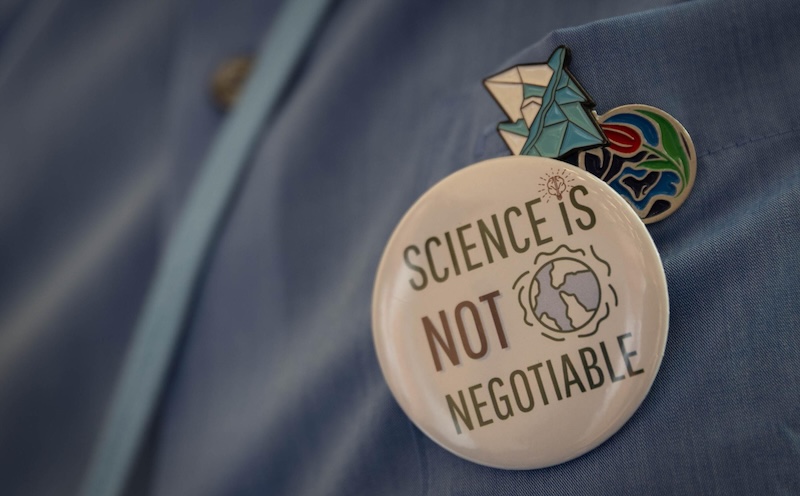
In Bonn this summer, the coalition that wants to align AR7 with the 2028 stocktake – which includes diplomats from Fiji, Nepal, the European Union, Switzerland, Sierra Leone and Panama – vowed to ensure that decision-making in the UN climate process remains based on the “best available science”, including the IPCC assessment reports.
They pointed the finger at “the usual suspects” but stopped short of singling out any countries at the public press conference. Discussions in the previous week had seen Saudi Arabia and India play down the centrality of IPCC reports in the UN stocktake and oppose calls in draft texts to encourage scientific work on scenarios to limit an overshoot of the 1.5C warming goal.
Bonn upset fuels further tension
A campaigner with knowledge of internal discussions told Climate Home News that many civil society groups from some of the world’s most vulnerable nations, including the Pacific islands, had expected CAN International to back calls in Bonn defending the centrality of the IPCC in UN climate policy-making.
Despite this, a day before the “Friends of Science” press conference, CAN published an ECO newsletter that did not mention the issue. Instead, it voiced surprise over the claims of an attack on science happening in the negotiations and accused some of the IPCC’s loudest-defending governments of hypocrisy for continuing to expand fossil fuels and not delivering “fair shares” of emissions cuts and finance to the developing world.
“We were really shocked we could not find a common position and then this jarring narrative was being pushed,” the campaigner added.
After divisions hardened in Bonn, Hare said his organisation was approached by “very upset” CAN members from various regions about the stance taken by the network’s international leadership on the issue.
Industry and NGOs lobby to weaken UN carbon credit rules in “coordinated” push
While Climate Home News understands that internal discussions have continued during the summer, including at a CAN leadership meeting in Nairobi in recent days, the campaigner said that CAN International’s endorsement of the recent webinar that directly challenged the “Friends of Science” coalition did not send a reassuring signal.
Some observers said they feared it would inflame tensions over how climate science is defined and utilised for policy purposes, with consequences reaching well beyond Bonn.
In a statement to Climate Home News, Essop said that “at a time when communities are experiencing the most horrific impacts of climate chaos, our collective energy must turn to solutions such as filling the Loss and Damage Fund, the phasing out of fossil fuels led by the Global North, and justice for people who are least responsible for this climate emergency”.
The post As science comes under attack at UN talks, climate movement splits over how to respond appeared first on Climate Home News.
As science comes under attack at UN talks, climate movement splits over how to respond
Continue Reading
Climate Change
Loss and damage fund agrees $20m for Nepal but rich nations warn it should not set precedent
The board of the UN’s Fund for Responding to Loss and Damage agreed on Thursday to set aside $20 million to help Nepal recover from the devastating climate-driven flood it suffered in August.
At an extraordinary online meeting, board members unanimously invited Nepal’s government to submit a proposal for how to use the money, which will be considered at a future board meeting.
The board’s co-chair Camila Minerva Rodriguez described the decision as “truly historic” as it is the first time the new fund has allocated any money since it was set up three years ago. It is expected to approve its first set of projects at its next board meeting in December.
Maheshwar Dhakal, a senior official at Nepal’s climate ministry, told the meeting the decision was “a powerful expression of humanity, compassion, solidarity and hope” and, for the flood victims, a “recognition of their suffering, respect for their dignity and hope that they are not alone in their darkest hour”.
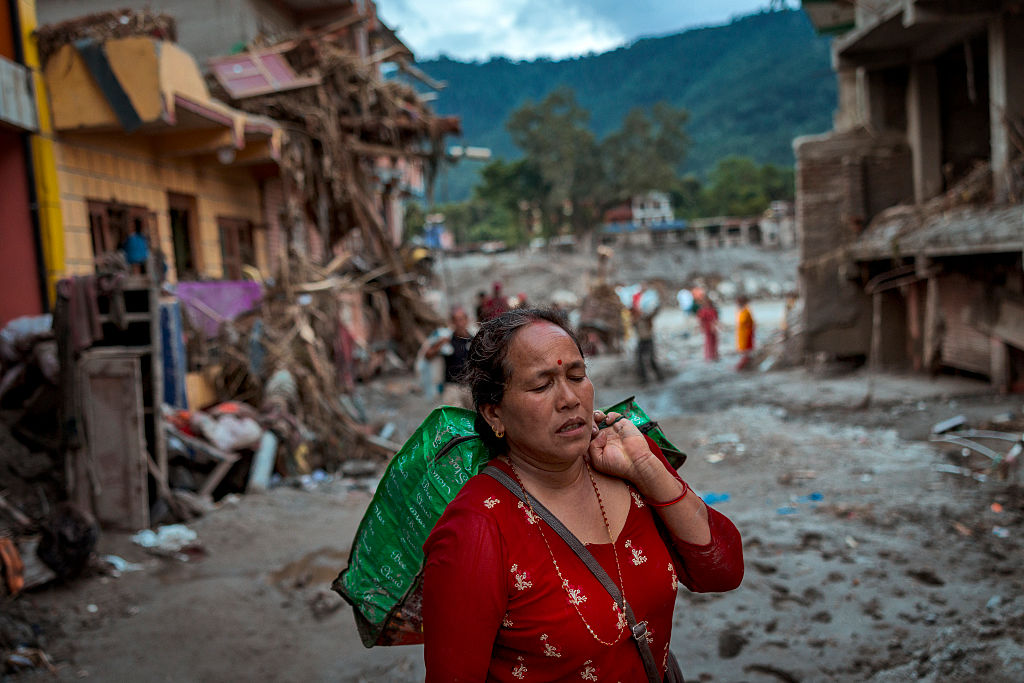
While board members were united in approving the $20 million, plus $1.6 million of administrative costs, representatives of developed and developed countries were divided over the extent to which the decision should set a precedent for the fund’s long-term way of operating.
Germany and Czechia’s board members said it should not set a “precedent” while Japan’s representative said the decision is “truly exceptional” and that the fund’s support must be “in accordance with established rule and procedure”.
Learning the lessons?
Responding, Pakistan’s Ali Sheikh said the lessons from the Nepal case should “feed the long-term model and its work on rapid disbursement” of funds.
He added that he had heard Jan Dusik, Czechia’s board member saying that “we are open for learning but not in setting precedent”. “Please do not define the boundaries for learning,” he emphasised.
Sheikh complained that the decision approved by the board – the result of negotiations between a group of four developed and four developing-country representatives – was narrower than developing countries had hoped for.
“We are saying it is a one-time and Nepal-only window, a sentiment against which many developed countries have raised their voice,” he said, adding there had been no time to review the decision.
Walter Schuldt from Ecuador echoed Sheikh, saying “we should not put limits on lesson learning”. He said the decision, which he was involved in negotiating through “intense exchanges”, tells the fund’s staff to assess the lessons learned.
The fund is currently in a start-up phase and the board will debate its long-term model – including whether and how to rapidly disburse funds in response to climate-driven disasters – at its next board meeting in the Philippines in December.
At Thursday’s meeting, several developing-country board members called for wealthy nations to put more money into the fund. Recovery and reconstruction from Nepal’s flood alone is estimated to cost $4.8 billion – in comparison, the fund has only around $350 million to allocate, with a current cap of $20 million per project.
The post Loss and damage fund agrees $20m for Nepal but rich nations warn it should not set precedent appeared first on Climate Home News.
Loss and damage fund agrees $20m for Nepal but rich nations warn it should not set precedent
Artificial intelligence (AI) is developing at a rapid pace and is increasingly being used by scientists to better understand climate change.
AI is perhaps best-known for its use in “large language models”, such as ChatGPT, Claude and Gemini.
However, the field is vast.
From weather forecasting to analysing satellite images, climate scientists are using various types of AI to develop faster and more efficient ways to study the warming planet.
However, the technology comes with no shortage of risks and challenges, including overreliance on unverified results, intensive energy use and exacerbating existing inequalities in climate science.
Carbon Brief spoke to 10 experts working across a range of climate-related fields – from developing climate forecasts to analysing changes in the energy grid – about how AI is being used.
Their answers are set out below, grouped by theme.
- What are the benefits and challenges of using AI in weather and climate forecasting?
- What are some other current uses of AI in climate science research?
- How is AI being used to advance climate policy and action?
- How could AI be used in climate research over the coming years?
- Are there any misconceptions about the use of AI in climate science?
- Could AI improve or exacerbate inequalities in climate research?
- What are some other risks and challenges of AI in climate change research?
What are the benefits and challenges of using AI in weather and climate forecasting?
Dr Doug McNeall, science lead in data-driven climate modelling at the UK Met Office:
One of the most significant recent developments has been the success of AI weather-prediction models, which learn from large volumes of weather data to predict the next few hours ahead and then repeatedly feed those predictions back into themselves to generate forecasts up to two weeks into the future.
These models have demonstrated that AI can provide accurate predictions while requiring far less computing power than existing numerical models [which rely on mathematical equations to simulate the climate].
One of the main challen