


- What are the benefits and challenges of using AI in weather and climate forecasting?
- What are some other current uses of AI in climate science research?
- How is AI being used to advance climate policy and action?
- How could AI be used in climate research over the coming years?
- Are there any misconceptions about the use of AI in climate science?
- Could AI improve or exacerbate inequalities in climate research?
- What are some other risks and challenges of AI in climate change research?

Amy Youngman is a legal and policy specialist at the campaigning group Environmental Investigation Agency (EIA).
The chair’s August Aid to Negotiations is being sold as a pragmatic way to rescue the global plastics treaty. However, the text is starting to resemble the architecture of a Paris Agreement-style framework: a patchwork of vague commitments, nationally determined action and reporting, with the hardest substantive decisions left to a future that, my experience following these negotiations tells me, would never arrive.
In March 2022, governments adopted UNEA Resolution 5/14 by consensus, launching negotiations for a legally binding international instrument to end plastic pollution. I joined the global plastics treaty process in Paris in 2023, where hopes of drafting a treaty capable of confronting one of the defining environmental and human health threats of our time were first derailed by procedural warfare.
-
“We’ve gone backwards” – new plastics treaty text dims hopes for production curbs
During troubled talks, fossil fuel-producing nations have pushed for a global pact to tackle only plastic waste rather than reducing the size of the problem -
Why we couldn’t agree on a plastics treaty in Geneva – and what might happen next
Switzerland’s lead negotiator at INC-5.2 reflects on why the talks didn’t succeed – and the options now for getting an effective agreement
Five months later, in Nairobi, I watched the chair close a meeting while delegates still negotiated -allegedly to catch a flight. In 2024 and 2025, in Ottawa, Busan and Geneva, the same small group of blocking states grew bolder, cloaking opposition in language about defending the vulnerable while subsidising a system that fuels the pollution crisis. Offended by ambition, ashamed of nothing.
A year after the last formal attempt to negotiate a treaty, we are tasked with protecting a fragile process. And despite long-standing support, including legal, policy and technical expertise from my own Environmental Investigation Agency, the chair has excluded observers from the rooms where the treaty’s fate is being decided.
In that orchestrated quiet, the loudest proposal emerged: the suggestion that the instrument be a “framework convention.” The new Aid, intended to shape the late-September Heads of Delegation meeting, never uses the word “framework”. It does not need to. It strips back substantive obligations and presupposes future action.
A framework is no match for this crisis
Framework conventions outline broad principles and leave each country to develop its own plan, often delaying tough decisions to future negotiations that may never happen. This tactic is a political shell game: persuading states that want action now to give up meaningful, binding measures to reach agreement.
The Chair’s Aid arrives at a framework by subtraction rather than by proposal, which makes it harder to name and potentially easier to accept. Using the Aid, effectively the rejected text from Geneva, as a basis for the next informal meeting in Bangkok will be sold as a way to preserve a distressed UN system and reach consensus in a fractured geopolitical environment.
This is diplomacy drowning in wishful thinking that the countries fighting binding rules today will approve tougher ones tomorrow. Four years of negotiations and decades of climate diplomacy taught us that this is not a bridge to ambition – this is how ambition dies.

Production is driven by global oil, gas and chemical markets, while products and waste travel across borders. No singular government can regulate its way out of a problem created and amplified by a globalised system.
Countries have tried, and production kept rising. Now there is plastic everywhere we look, and the cost falls hardest on the people least responsible.
That failure is why there was consensus to negotiate a treaty, because this crisis requires global action. The purpose was never to list national efforts and call that progress but to create common global rules to address pollution.
The most politically sensitive issues cannot simply be postponed. How much plastic is produced, which toxic chemicals are allowed in it, which throwaway products are banned, and how future decisions are made are precisely the issues that require global answers. An instrument that refuses to negotiate them will be easier to adopt but useless on arrival.
Learn from climate governance
Supporters of a framework approach may point to the ozone treaty as proof that it can work. But the Vienna Convention succeeded for one reason: governments quickly adopted binding upstream controls on ozone-depleting substances.
Climate offers the opposite warning: a framework followed by contested, delayed and insufficient measures, while emissions keep rising.
The new chair not only deleted a direct reference to “production and consumption” and bracketed similar preambular language copied from the original mandate. The article on reporting borrows language from the Paris Agreement. Another summer of record heat, fires and floods offers a glimpse of how well that model is working.
Nothing suggests that the states blocking binding rules today will suddenly accept them tomorrow, and the exponential rise in unchecked plastic production will not pause while governments wait for courage. Blockage is not being resolved, but just pushed forward.
A framework would lock in the wrong response: unlimited upstream growth with waste management attempting to handle it downstream. No waste system can keep pace with a material engineered for endless growth.
Keeping to 1.5C of warming is no longer possible – but we must still limit the overshoot
After four years of INC negotiations, governments know this. States must reject the false choice that the only path to agreement is an instrument too weak to solve the problem it was created to address. Compromise is part of diplomacy. Surrender is not.
And if the UN keeps pushing that choice, the countries prepared to act must be willing to pursue alternative pathways. Groups of willing governments have built effective agreements before, and existing environmental regimes can deliver new rules without inventing a new empty instrument.
This process was never meant to find a lowest common denominator. It was to create the rules necessary to change our direction. Bangkok in September will be where the second iteration of this text is shaped. If ambitious countries do not push back, the argument about a framework convention will already be lost by default.
Negotiations cannot end with governments accepting the crisis rather than solving it. The science is clear and the damage is accelerating. The world does not need another promise to act later. It needs the treaty governments promised to deliver in 2022.
The post The world doesn’t need a Paris Agreement for plastics appeared first on Climate Home News.
Continue Reading
Climate Change
Loss and damage fund agrees $20m for Nepal but rich nations warn it should not set precedent
The board of the UN’s Fund for Responding to Loss and Damage agreed on Thursday to set aside $20 million to help Nepal recover from the devastating climate-driven flood it suffered in August.
At an extraordinary online meeting, board members unanimously invited Nepal’s government to submit a proposal for how to use the money, which will be considered at a future board meeting.
The board’s co-chair Camila Minerva Rodriguez described the decision as “truly historic” as it is the first time the new fund has allocated any money since it was set up three years ago. It is expected to approve its first set of projects at its next board meeting in December.
Maheshwar Dhakal, a senior official at Nepal’s climate ministry, told the meeting the decision was “a powerful expression of humanity, compassion, solidarity and hope” and, for the flood victims, a “recognition of their suffering, respect for their dignity and hope that they are not alone in their darkest hour”.
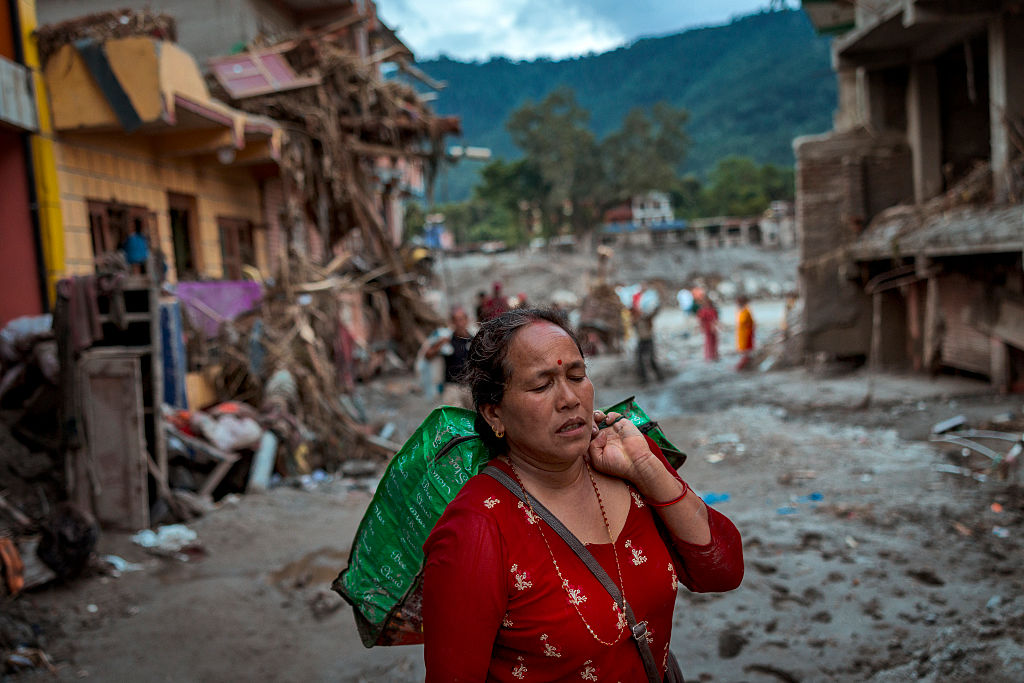
While board members were united in approving the $20 million, plus $1.6 million of administrative costs, representatives of developed and developed countries were divided over the extent to which the decision should set a precedent for the fund’s long-term way of operating.
Germany and Czechia’s board members said it should not set a “precedent” while Japan’s representative said the decision is “truly exceptional” and that the fund’s support must be “in accordance with established rule and procedure”.
Learning the lessons?
Responding, Pakistan’s Ali Sheikh said the lessons from the Nepal case should “feed the long-term model and its work on rapid disbursement” of funds.
He added that he had heard Jan Dusik, Czechia’s board member saying that “we are open for learning but not in setting precedent”. “Please do not define the boundaries for learning,” he emphasised.
Sheikh complained that the decision approved by the board – the result of negotiations between a group of four developed and four developing-country representatives – was narrower than developing countries had hoped for.
“We are saying it is a one-time and Nepal-only window, a sentiment against which many developed countries have raised their voice,” he said, adding there had been no time to review the decision.
Walter Schuldt from Ecuador echoed Sheikh, saying “we should not put limits on lesson learning”. He said the decision, which he was involved in negotiating through “intense exchanges”, tells the fund’s staff to assess the lessons learned.
The fund is currently in a start-up phase and the board will debate its long-term model – including whether and how to rapidly disburse funds in response to climate-driven disasters – at its next board meeting in the Philippines in December.
At Thursday’s meeting, several developing-country board members called for wealthy nations to put more money into the fund. Recovery and reconstruction from Nepal’s flood alone is estimated to cost $4.8 billion – in comparison, the fund has only around $350 million to allocate, with a current cap of $20 million per project.
The post Loss and damage fund agrees $20m for Nepal but rich nations warn it should not set precedent appeared first on Climate Home News.
Loss and damage fund agrees $20m for Nepal but rich nations warn it should not set precedent
Artificial intelligence (AI) is developing at a rapid pace and is increasingly being used by scientists to better understand climate change.
AI is perhaps best-known for its use in “large language models”, such as ChatGPT, Claude and Gemini.
However, the field is vast.
From weather forecasting to analysing satellite images, climate scientists are using various types of AI to develop faster and more efficient ways to study the warming planet.
However, the technology comes with no shortage of risks and challenges, including overreliance on unverified results, intensive energy use and exacerbating existing inequalities in climate science.
Carbon Brief spoke to 10 experts working across a range of climate-related fields – from developing climate forecasts to analysing changes in the energy grid – about how AI is being used.
Their answers are set out below, grouped by theme.
- What are the benefits and challenges of using AI in weather and climate forecasting?
- What are some other current uses of AI in climate science research?
- How is AI being used to advance climate policy and action?
- How could AI be used in climate research over the coming years?
- Are there any misconceptions about the use of AI in climate science?
- Could AI improve or exacerbate inequalities in climate research?
- What are some other risks and challenges of AI in climate change research?
What are the benefits and challenges of using AI in weather and climate forecasting?
Dr Doug McNeall, science lead in data-driven climate modelling at the UK Met Office:
One of the most significant recent developments has been the success of AI weather-prediction models, which learn from large volumes of weather data to predict the next few hours ahead and then repeatedly feed those predictions back into themselves to generate forecasts up to two weeks into the future.
These models have demonstrated that AI can provide accurate predictions while requiring far less computing power than existing numerical models [which rely on mathematical equations to simulate the climate].
One of the main challenges is that AI weather-prediction models have been developed for relatively short timescales, where large amounts of observational data [for example, temperature, rainfall or sea ice extent data] is available and model performance can be evaluated quickly and rigorously.
Climate prediction is fundamentally different. To provide useful climate information, we need to make projections for future climates that lie outside the observational record.
One promising route forward is, therefore, to use AI to emulate or accelerate these existing models, rather than relying solely on purely data-driven approaches. This blended approach could make climate risk information far more accessible and affordable to produce, while retaining the physical understanding [based on mathematical and scientific principles] that underpins confidence in climate projections.
Prof William Collins, professor of AI for climate science at the University of East Anglia:
We’re seeing a really exciting renaissance in both weather and climate science…Machine learning [a subset of AI that uses algorithms to let computers learn from data and make predictions without being explicitly programmed] has had an enormous impact on numerical weather prediction.
So, for example, the European Center for Mid-Range Weather Forecasts is now deploying an AI forecast system as part of their official communication of weather predictions to the European community, alongside the traditional forecast system. AI systems have become good enough that they’re absolutely competitive with the world’s leading numerical weather prediction…So that’s been quite remarkable.
Much of machine learning and AI involves learning from data and climate represents a future for which we do not have data. We’re literally trying to predict the future. We don’t have observations of it. So, where does the data come from to inform the models? That is, at the moment, the central challenge that the climate community is attempting to overcome.
Dr Amirpasha Mozaffari, researcher in Earth artificial intelligence at the Barcelona Supercomputing Centre:
AI forecast models do well on typical weather, but underperform physics-based models on record-breaking and unprecedented extremes – precisely the events that matter most for adaptation [to climate change].
Solving that – whether through hybrid models [which combine AI with traditional models], physical constraints [in which rules are implemented based on the laws of physics to help the models make realistic forecasts] or new ways of evaluating models on what they have not seen – is the central open problem for the field.
What are some other current uses of AI in climate science research?
Dr Stefano Materia, researcher in climate variability and change at the Barcelona Supercomputing Centre:
Besides the climate modelling and prediction framework, the proliferation of Earth-observation satellites has created a massive influx of geospatial data (for example, images showing deforestation or sea ice melt). AI is used to translate raw pixel data into actionable climate intelligence.
Methane tracking and ecosystem monitoring are two examples of this kind of application. Methane is a potent greenhouse gas, but leaks are largely invisible and hard to track. AI algorithms now automatically scan hyperspectral imagery [which uses data from across the electromagnetic spectrum] from satellites to pinpoint specific industrial methane leaks globally, alerting operators in near real-time.
At the same time, machine-learning models process thousands of satellite images daily to detect illegal logging, track land-use changes and monitor glacier retreat long before humans could manually review the footage.