

Patrick Schröder is a senior research fellow at Chatham House’s Environment and Society Centre.
A climate summit serious about implementation cannot afford to leave major emissions reductions off the table. Yet, that is the risk COP31 faces unless it makes reducing raw material use central to the way countries decarbonise their economies.
On the sidelines of the UN General Assembly in New York last week, COP31 host Türkiye laid out proposals to accelerate emissions cuts in the next decade. Its plans include global goals to increase the share of recycled products in material use to at least 15% (up from 6.9% in 2025) and halve waste generation by 2035.
COP31 offers an opportunity to connect efforts to improve material circularity with stronger national climate commitments and mitigation pathways. But these targets could be a lot more ambitious.
The case for circularity
The Paris Agreement cannot be delivered through cleaner electricity alone. We must also reduce the emissions that are embedded in the way we extract resources, manufacture products, build infrastructure and dispose of waste.
Circularity principles are pivotal to credible mitigation pathways: designing technologies and products to last, repairing and reusing them, and reducing demand for virgin resources.
The scale of the opportunity is striking. A recent European Environment Agency review found that adopting such principles could deliver average global emissions reductions potential of 52% in the waste sector against a business-as-usual scenario, 48% in construction and buildings, 28% in transport and mobility, 26% in industry and 24% in agriculture.
-
Recycling could meet half of Europe’s critical mineral needs by 2050
A new report by an EU-funded research project says the bloc could harness its “urban mines” to reduce its dependence on China for energy transition minerals -
China maximises battery recycling to shore up critical mineral supplies
Beijing is bracing for a tsunami of spent EV batteries by taking steps to boost recycling – a strategy that could also cut its reliance on imports of clean energy minerals -
The Canadian city betting on recycling rare earths for the energy transition
As countries scramble to secure critical minerals, Kingston’s burgeoning clean tech ecosystem is attracting startups to create circular supply chains and reduce reliance on China


These figures make a compelling case for raising circularity ambitions across the economy, offering the promise of far more than better recycling bins.
In fact, recycling minerals used in cleantech equipment, for example, illustrate the extent of the emissions savings available. The carbon footprint of minerals and metals recovered from secondary sources is up to 80% lower than those produced from new mining and processing, according to the International Energy Agency.
A major EU-funded project estimates that recovered materials could substitute up to 56% of Europe’s primary critical raw material requirements by 2050, provided they achieve the necessary quality. The main takeaway goes beyond Europe: yesterday’s products can become tomorrow’s strategic resources while mitigating climate change.
In this light, a target to increase the share of recovered material use to 15% isn’t enough.
The evidence-based Circularity Gap Report found a 17% target by 2032 is possible and could unlock additional emissions reductions amounting to several gigatonnes of CO2.
Reducing material demand
A higher circularity metric is only part of the answer, however. An economy can increase its recycling rate at the same time as extracting more primary materials if total material demand keeps growing.
The tougher issue governments need to address is identifying what reductions in primary material use are needed.
The Circularity Gap Report uses an indicative benchmark of eight tonnes of virgin materials consumed per person annually. This is already being translated into policy: Germany’s 2024 circular economy strategy aims to reduce primary resource consumption, with the German Federal Environment Agency identifying six to eight tonnes per person as an ambitious target.

Reducing primary material demand will require a closer integration of energy and resource policies. Efficient EVs charged with solar power can complement better public transport and walkable cities, while batteries designed to be repaired and reused for stationary energy storage before being recycled will reduce the materials footprint of transport and clean energy services.
Coordinated infrastructure development and urban planning can prevent unnecessary overbuild, while renovating existing building stock reduces demand for new steel, cement and aluminium, which are emissions-intensive to produce. Connecting industrial waste heat to district heating networks can further reduce energy demand and emissions.
What governments should agree at COP31
COP31 can translate this approach into three concrete commitments.
First, governments should agree a stronger circularity ambition, supported by material-footprint indicators and milestones. The presidency should seek recognition of these priorities in negotiated outcomes, alongside concrete delivery partnerships under its COP31 Action Agenda.
Second, countries should include quantified circular economy measures in their updated nationally determined contributions (NDCs) and implementation plans. Such measures should include reuse, material efficiency and circularity targets, as well as transparent estimates of emissions savings that avoid double counting across sectors. By the end of 2025, countries had developed 101 national circular economy roadmaps and action plans, yet these often remained disconnected from their NDCs.
-
Self-taught mechanics give second life to Jordan’s glut of spent EV batteries
As EV sales boom in Jordan, a lack of formal infrastructure for dealing with end-of-life batteries is leading to some innovative solutions -
Indian start-ups mine e-waste for battery minerals but growing industry has a dark side
Recycling e-waste can unlock a vast and sustainable supply of transition minerals but in India the sector relies on a neglected informal economy


Third, climate finance should support the delivery of circular solutions such as material recovery at scale, investments into circular critical mineral value chains beyond mining, developing a circular plastics economy, and designing buildings and cities that support material reuse. Developing countries need technology, affordable finance and support to deliver these ambitions, including for the informal workers whose livelihoods depend on recovering and recycling materials.
The test for COP31 is to reach an agreement that can start the transformation of our production and consumption systems and how they are financed.
A headline circularity target will achieve little without policies that address absolute resource demand and deliver measurable emissions cuts. But COP31 offers an opportunity to make circularity a central element of climate policy, with targets strong enough to matter and institutions equipped to deliver them.
The post COP31 must aim higher to cut emissions from the use of materials appeared first on Climate Home News.
COP31 must aim higher to cut emissions from the use of materials

Climate Change
Albanese must deliver credible action to end fossil fuel chokehold, not just rhetoric
ANTALYA,Türkiye, Thursday 12 November 2026 — In response to Prime Minister Albanese’s COP31 Leaders’ Summit address, Shiva Gounden, Head of Pacific at Greenpeace Australia Pacific, speaking from Antalya said:
“Prime Minister Albanese’s COP31 address was full of nice rhetoric, but once again failed to confront or even mention the root cause of the climate crisis — fossil fuels.
“In Antalya, UN climate chief Guterres told leaders to “tell the truth”. The truth is Australia can not credibly talk about its clean energy transition while continuing to expand the industry it needs to leave behind. Australia must reckon with reality; its damning track record of 38 coal and gas approvals since it took office in 2022.
“We meet in Antalya amidst a global energy shock and dire projections of 1.5°C overshoot. Overshoot means something in the Pacific — it means irreversible harm, lives and cultures lost forever, entire nations at stake. We must face the fierce urgency of now.
“Never before has the need to end the fossil fuel chokehold been so abundantly clear, as our Pacific communities again suffer the consequences of a global economy hooked on coal, oil and gas. The Pacific needs credible roadmaps and clear timelines to unhook from fossil fuels — Australia can’t keep saying implementation and not reflect it with credible action.”
ENDS
COP31 images and video available here in Greenpeace Media Library
Media contact: Kate O’Callaghan in Antalya (GMT+3) on +61 406 231 892 (Whatsapp/Signal)
Albanese must deliver credible action to end fossil fuel chokehold, not just rhetoric
A second set of world leaders give their speeches on Thursday before heading out of town and leaving their negotiators to it. After around 40 leaders spoke on Wednesday, today there will be just 25 or so including the UK’s Andy Burnham, Venezuela’s Delcy Rodriguez and Bangladesh’s Tarique Rahman.
But Brazil’s President Lula is still there and is expected to keep grabbing headlines, along with California’s Governor – and maybe next US president – Gavin Newsom – and Swedish climate activist Greta Thunberg who has lost none of her star power, if the crowd around her in the press centre was anything to go by.
We’ll bring you highlights through the day on issues ranging from finance to methane, and update you on a pledging event for the Pacific Resilience Facility, which the climate-vulnerable region is relying on to keep small island nations as safe as possible in the face of intensifying storms, drought and sea level rise.
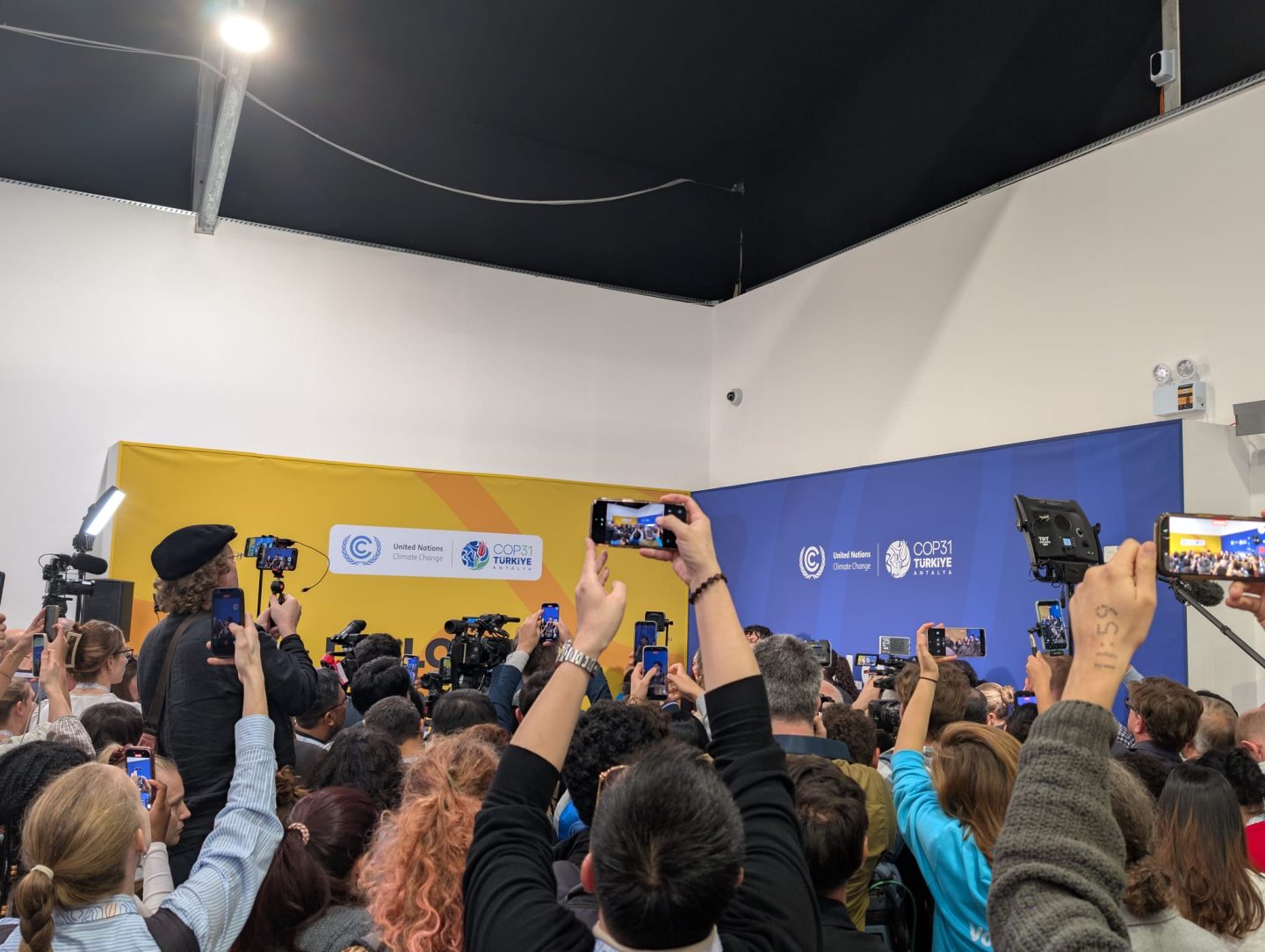
The post COP31 Bulletin Day 4: Burnham speaks with UK climate policy under fire appeared first on Climate Home News.
COP31 Bulletin Day 4: Burnham speaks with UK climate policy under fire
Climate Change
Australia must ‘pull all available levers’ to deliver fossil fuel phase out, following Albanese’s COP31 address
ANTALYA, Türkiye, Wednesday 11 November 2026 — In response to Prime Minister Albanese’s COP31 Leaders’ Summit address, Dr Susie Byers, Head of Advocacy at Greenpeace Australia Pacific, speaking from Antalya said:
“Prime Minister Albanese’s Leaders’ Summit address emphasised the power and clarity of Pacific climate leadership and that we must all fight to return warming to below 1.5°C. To inject the momentum these talks critically need, Australia must lead by example.
“Australia takes the reins of the COP31 talks at a critical moment where global instability can spark transformative change, or entrench more of the same inaction and paper pledges. Australia must pull all available levers over the next two weeks, taking the baton from Brazil and sprinting forward.
“The world’s most important job in Antalya is to deliver tangible action to end the fossil fuel era. Communities in Australia, the Pacific and around the world who are grappling with climate disasters and a cost of living crisis need concrete dates and credible plans. We know the transition is coming, one way or another. Our Government has a responsibility to make a plan for this change, which is based on the best available science, and a commitment to put people, energy security and our environment ahead of fossil fuel profits.
“In his address, UN climate chief Guterres told leaders to “tell the truth”. Prime Minister Albanese told an important truth today: that we all have solemn responsibilities to return warming to below 1.5°C. We also know that the best way for Australia to lead through this summit is to start by making its own commitments to turn the temperature down, by stopping developing and exporting fossil fuels.
“Australia’s domestic progress on renewables, and the ‘35 by 35’ electrification goal, are welcome and important. Now we must ensure electricity comes from clean, renewable sources that actually displace fossil fuels and align with the science of 1.5°C.
“The pressure on Australia is building. COP31 must deliver real action to advance multilateral climate cooperation, accelerate the just transition away from fossil fuels, and advance Pacific priorities — including significantly scaling-up climate finance and keeping 1.5°C alive.”
ENDS
COP31 images and video available here in Greenpeace Media Library
Media contact: Kate O’Callaghan in Antalya (GMT+3) on +61 406 231 892 (Whatsapp/Signal)



