

- What are the benefits and challenges of using AI in weather and climate forecasting?
- What are some other current uses of AI in climate science research?
- How is AI being used to advance climate policy and action?
- How could AI be used in climate research over the coming years?
- Are there any misconceptions about the use of AI in climate science?
- Could AI improve or exacerbate inequalities in climate research?
- What are some other risks and challenges of AI in climate change research?

The deadly flash flood that thundered down Nepal’s Bhote Koshi valley a month ago may have been hard to predict given the complexity of monitoring glacial slopes in the high mountains. But it should come as a surprise to no one that such a disaster could happen in a world set to barrel past the 1.5C warming limit governments agreed to in 2015.
I say this with confidence because even before the ink was dry on the Paris Agreement, former colleagues and I were writing extensively about the dangers posed by accelerating glacier melt in the Himalayas. I went back to look at what we covered, often working with local journalists in Pakistan, India and Nepal. It was substantial.
Comment: The response to Nepal’s disaster is a test for global climate institutions
In one story from a conference on climate change and geology, Bill McGuire, a professor who then led the Benfield Hazard Research Centre at University College London, was quoted as saying: “The most likely thing we are going to see soon is an increased level in giant landslides in mountainous terrains, huge collapses, millions of cubic metres of rock.”
That is precisely what unleashed Nepal’s most recent disaster, some 13 years later.
Other articles zoomed in on internationally funded programmes to prevent glacial lake outburst floods; studies warning of the rising risks to downstream communities; and cross-border efforts (or lack of them) to set up monitoring systems. But information has not led to sufficient action.
Falling behind growing impacts
Reporting on climate-related disasters over the past 20 years (it was way back then that UN aid chief John Holmes started referring to extreme weather as the “new normal”) has been a pretty frustrating beat, as things have gotten dramatically worse.
There’s no question that our understanding of the risks has grown hugely – alongside our knowledge of how to protect people and infrastructure in the face of fast-growing threats.
Yet governments and businesses have dragged their feet on adaptation policies and practical measures, even when confronted with the numbers showing it’s far cheaper to prevent and prepare than to clean up and rebuild after a flood or a storm. This intransigence has left a yawning chasm in the world’s ability to deal with climate change-driven impacts.
Let’s call it the adaptation accountability gap.
-
UN Climate Summit: UN chief says world has tools to end fossil fuel age
At the UN Secretary-General’s climate summit in New York, countries shared their energy transition plans while Nepal and island nations advocated for more international support -
Threatened by rising seas, small islands secure right to keep their statehood
Efforts to protect marine ecosystems and coastal communities have risen up the political agenda at the UN General Assembly in New York
These days we see the effects all around us – in hospital emergency rooms where workers and older people struggle with heat exhaustion; in campsites and hotels abandoned by holidaymakers fleeing forest fires; in flooded streets piled high with mud, broken furniture and twisted cars.
The only bright side to the growing climate chaos we’re experiencing is that it’s become practically impossible for politicians and corporate bosses to ignore the evidence – and the rising cost to their balance sheets. Voters who can no longer afford to shoulder the economic and social burden of this damage need to let their leaders know time’s up.
1.5C overshoot means adapting differently
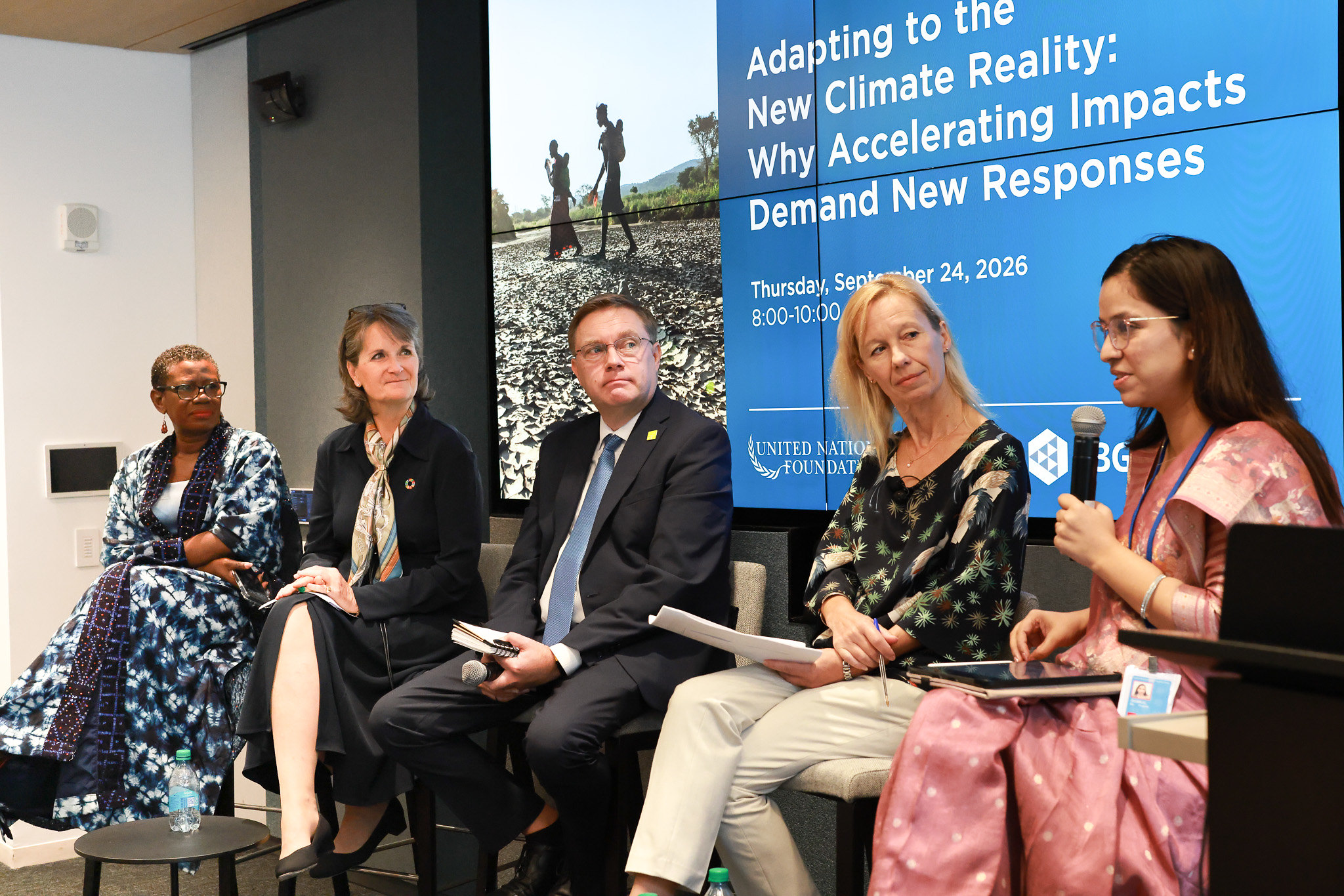
Last week, during Climate Week NYC, I moderated an event packed with experts who work on adapting to climate change – from Nepal to Brazil, from Sierra Leone to the Marshall Islands, and from communities to the top of governments and UN agencies. They spoke of tree-planting to stabilise slopes, heat insurance for informal workers, a climate risk guide for midwives, drought-resistant seeds and solar panels to irrigate farmland along the Nile.
Amid the diversity of experiences and approaches, there were two common threads: first, as underlined by the UN Environment Programme’s new report on overshooting 1.5C, we may have missed the boat to catch up on adaptation as we know it.
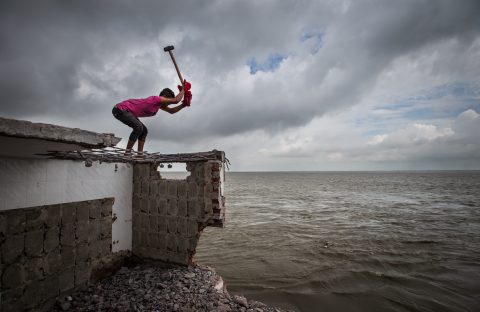
With global warming continuing apace, we’ll need to come up with new “transformational” strategies if the coral reefs, ice sheets, oceans and other natural systems on which we rely cross tipping points and unleash cascading consequences. Nepal’s flash flood is being flagged as an example of the kind of disaster that requires a major change in how we think about adaptation.
Second, the investment required to adapt to intensifying climate shocks and stresses can no longer be seen as something to be squeezed out of shrinking foreign aid budgets. There are a growing number of tried-and-tested funds and mechanisms for channelling finance at the local, national and global levels – these must be filled, replenished and used without delay.
Businesses need to get stuck in too, not least to safeguard their assets, operations and profits – but also because in some sectors like agriculture or water there are opportunities for a return. Despite this, there are many activities governments will have no choice but to pay for, such as moving people out of the path of rising seas.
Finance not flowing where needed
Mikko Ollikainen, who heads up the UN’s pioneering Adaptation Fund for developing countries, told the event the fund has a portfolio of projects worth $1.6 billion but a pipeline waiting to be financed to the tune of $1.8 billion. Yet, in recent years, as needs balloon, donor nations have failed to meet its annual fundraising target of $300 million at COP climate summits.
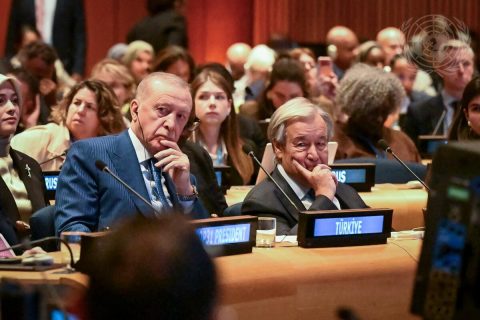
The chair of the UN climate body for implementation, Julia Gardiner, said she expects to see more pressure on governments at November’s COP31 summit in Türkiye to show how they will meet a goal to triple adaptation finance by 2035 and fill the under-resourced coffers of the fledgling Fund for Responding to Loss and Damage (FRLD).
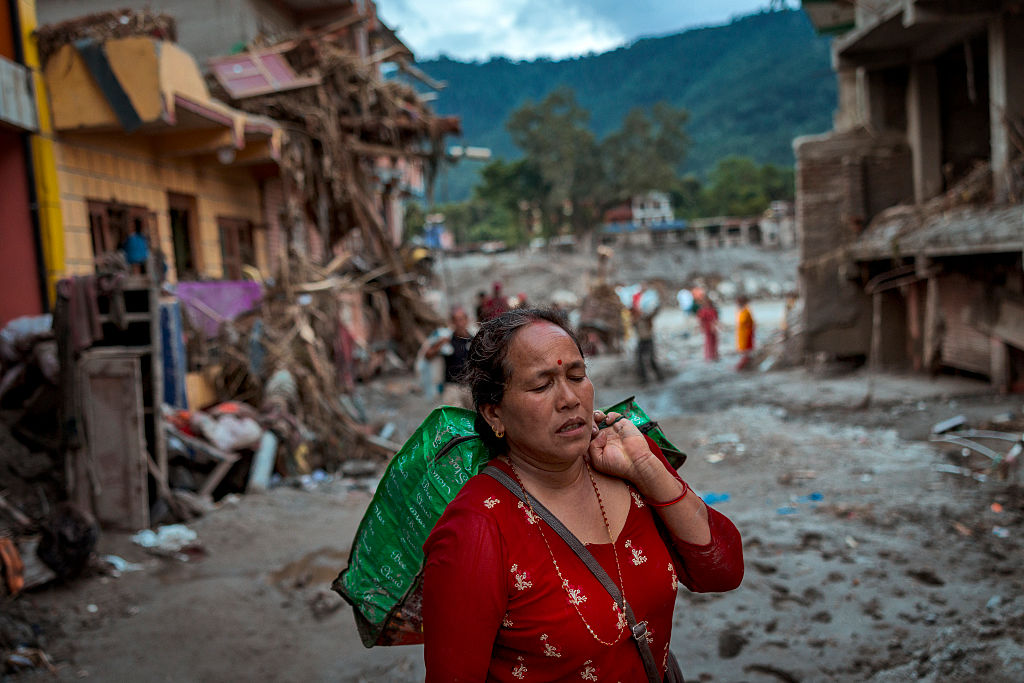
Nepal, meanwhile, is still waiting for a formal response to its request to the FRLD for urgent support to tackle the aftermath of the flood. Manjeet Dhakal, a Nepali scientist who advises least-developed countries in the UN climate process, said the disaster – which killed over 1,450 people and left nearly 6,000 missing – cannot be treated as just the latest climate crisis that grabs the headlines before it’s replaced by another.
That was backed up by Prakriti Dhakal, personal under-secretary to Nepal’s prime minister, who has been working closely on the emergency response. She said she had received many condolences and warm words of support during her meetings in New York.
But, she asked, “when you go home, will you continue having that sympathy for us that translates into something rational, something long-term, to strengthen the communities in Nepal?” A fitting response would be for governments to get behind a new Himalayan Climate Resilience Mechanism, proposed by Nepal’s leader at the UN last week, as one way to start closing the adaptation accountability gap.
The post Nepal’s disaster has laid bare the world’s adaptation accountability gap appeared first on Climate Home News.
Nepal’s disaster has laid bare the world’s adaptation accountability gap
Continue Reading
Climate Change
Loss and damage fund agrees $20m for Nepal but rich nations warn it should not set precedent
The board of the UN’s Fund for Responding to Loss and Damage agreed on Thursday to set aside $20 million to help Nepal recover from the devastating climate-driven flood it suffered in August.
At an extraordinary online meeting, board members unanimously invited Nepal’s government to submit a proposal for how to use the money, which will be considered at a future board meeting.
The board’s co-chair Camila Minerva Rodriguez described the decision as “truly historic” as it is the first time the new fund has allocated any money since it was set up three years ago. It is expected to approve its first set of projects at its next board meeting in December.
Maheshwar Dhakal, a senior official at Nepal’s climate ministry, told the meeting the decision was “a powerful expression of humanity, compassion, solidarity and hope” and, for the flood victims, a “recognition of their suffering, respect for their dignity and hope that they are not alone in their darkest hour”.
While board members were united in approving the $20 million, plus $1.6 million of administrative costs, representatives of developed and developed countries were divided over the extent to which the decision should set a precedent for the fund’s long-term way of operating.
Germany and Czechia’s board members said it should not set a “precedent” while Japan’s representative said the decision is “truly exceptional” and that the fund’s support must be “in accordance with established rule and procedure”.
Learning the lessons?
Responding, Pakistan’s Ali Sheikh said the lessons from the Nepal case should “feed the long-term model and its work on rapid disbursement” of funds.
He added that he had heard Jan Dusik, Czechia’s board member saying that “we are open for learning but not in setting precedent”. “Please do not define the boundaries for learning,” he emphasised.
Sheikh complained that the decision approved by the board – the result of negotiations between a group of four developed and four developing-country representatives – was narrower than developing countries had hoped for.
“We are saying it is a one-time and Nepal-only window, a sentiment against which many developed countries have raised their voice,” he said, adding there had been no time to review the decision.
Walter Schuldt from Ecuador echoed Sheikh, saying “we should not put limits on lesson learning”. He said the decision, which he was involved in negotiating through “intense exchanges”, tells the fund’s staff to assess the lessons learned.
The fund is currently in a start-up phase and the board will debate its long-term model – including whether and how to rapidly disburse funds in response to climate-driven disasters – at its next board meeting in the Philippines in December.
At Thursday’s meeting, several developing-country board members called for wealthy nations to put more money into the fund. Recovery and reconstruction from Nepal’s flood alone is estimated to cost $4.8 billion – in comparison, the fund has only around $350 million to allocate, with a current cap of $20 million per project.
The post Loss and damage fund agrees $20m for Nepal but rich nations warn it should not set precedent appeared first on Climate Home News.
Loss and damage fund agrees $20m for Nepal but rich nations warn it should not set precedent
Artificial intelligence (AI) is developing at a rapid pace and is increasingly being used by scientists to better understand climate change.
AI is perhaps best-known for its use in “large language models”, such as ChatGPT, Claude and Gemini.
However, the field is vast.
From weather forecasting to analysing satellite images, climate scientists are using various types of AI to develop faster and more efficient ways to study the warming planet.
However, the technology comes with no shortage of risks and challenges, including overreliance on unverified results, intensive energy use and exacerbating existing inequalities in climate science.
Carbon Brief spoke to 10 experts working across a range of climate-related fields – from developing climate forecasts to analysing changes in the energy grid – about how AI is being used.
Their answers are set out below, grouped by theme.
- What are the benefits and challenges of using AI in weather and climate forecasting?
- What are some other current uses of AI in climate science research?
- How is AI being used to advance climate policy and action?
- How could AI be used in climate research over the coming years?
- Are there any misconceptions about the use of AI in climate science?
- Could AI improve or exacerbate inequalities in climate research?
- What are some other risks and challenges of AI in climate change research?
What are the benefits and challenges of using AI in weather and climate forecasting?
Dr Doug McNeall, science lead in data-driven climate modelling at the UK Met Office:
One of the most significant recent developments has been the success of AI weather-prediction models, which learn from large volumes of weather data to predict the next few hours ahead and then repeatedly feed those predictions back into themselves to generate forecasts up to two weeks into the future.
These models have demonstrated that AI can provide accurate predictions while requiring far less computing power than existing numerical models [which rely on mathematical equations to simulate the climate].
One of the main challenges is that AI weather-prediction models have been developed for relatively short timescales, where large amounts of observational data [for example, temperature, rainfall or sea ice extent data] is available and model performance can be evaluated quickly and rigorously.
Climate prediction is fundamentally different. To provide useful climate information, we need to make projections for future climates that lie outside the observational record.
One promising route forward is, therefore, to use AI to emulate or accelerate these existing models, rather than relying solely on purely data-driven approaches. This blended approach could make climate risk information far more accessible and affordable to produce, while retaining the physical understanding [based on mathematical and scientific principles] that underpins confidence in climate projections.
Prof William Collins, professor of AI for climate science at the University of East Anglia:
We’re seeing a really exciting renaissance in both weather and climate science…Machine learning [a subset of AI that uses algorithms to let computers learn from data and make predictions without being explicitly programmed] has had an enormous impact on numerical weather prediction.
So, for example, the European Center for Mid-Range Weather Forecasts is now deploying an AI forecast system as part of their official communication of weather predictions to the European community, alongside the traditional forecast system. AI systems have become good enough that they’re absolutely competitive with the world’s leading numerical weather prediction…So that’s been quite remarkable.
Much of machine learning and AI involves learning from data and climate represents a future for which we do not have data. We’re literally trying to predict the future. We don’t have observations of it. So, where does the data come from to inform the models? That is, at the moment, the central challenge that the climate community is attempting to overcome.
Dr Amirpasha Mozaffari, researcher in Earth artificial intelligence at the Barcelona Supercomputing Centre:
AI forecast models do well on typical weather, but underperform physics-based models on record-breaking and unprecedented extremes – precisely the events that matter most for adaptation [to climate change].
Solving that – whether through hybrid models [which combine AI with traditional models], physical constraints [in which rules are implemented based on the laws of physics to help the models make realistic forecasts] or new ways of evaluating models on what they have not seen – is the central open problem for the field.
What are some other current uses of AI in climate science research?
Dr Stefano Materia, researcher in climate variability and change at the Barcelona Supercomputing Centre:
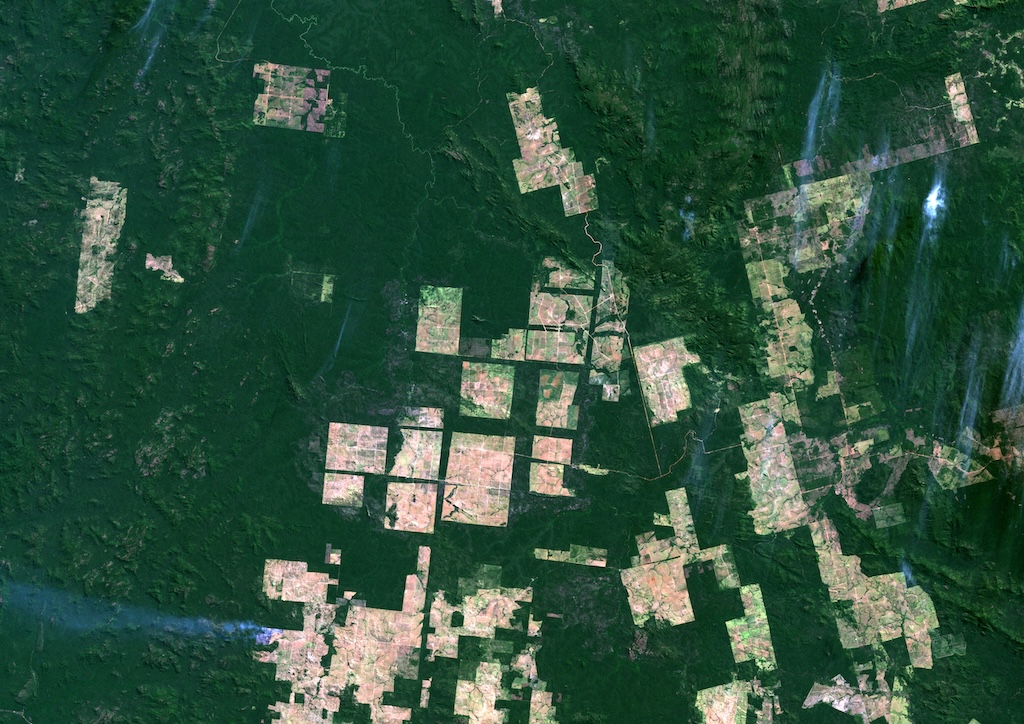
Besides the climate modelling and prediction framework, the proliferation of Earth-observation satellites has created a massive influx of geospatial data (for example, images showing deforestation or sea ice melt). AI is used to translate raw pixel data into actionable climate intelligence.
Methane tracking and ecosystem monitoring are two examples of this kind of application. Methane is a potent greenhouse gas, but leaks are largely invisible and hard to track. AI algorithms now automatically scan hyperspectral imagery [which uses data from across the electromagnetic spectrum] from satellites to pinpoint specific industrial methane leaks globally, alerting operators in near real-time.
At the same time, machine-learning models process thousands of satellite images daily to detect illegal logging, track land-use changes and monitor glacier retreat long before humans could manually review the footage.
Dr Clare Eayrs, polar research scientist at the Environmental Fluid Dynamics Lab at New York University:
In sea ice research, machine learning is now used across the sea ice modelling workflow…The most mature application is extracting more information from observations, for example, mapping fine-scale sea ice deformation from ship radar and classifying snow layers in micropenetrometer profiles [which measure the hardness or softness of different layers of snow].
Forecasting is the most visible application in this field. Ice Net [a sea ice forecasting system] was an early demonstration that a deep-learning syst