Connect with us

Published

on

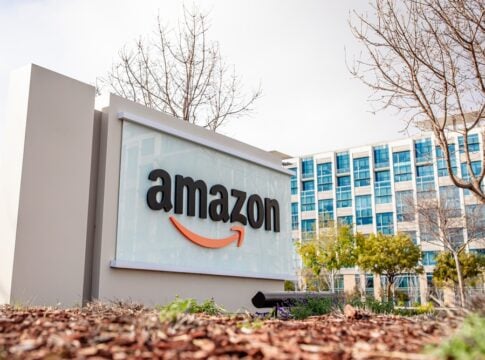
Amazon is expanding the types of carbon credits available to companies through its Sustainability Exchange, helping businesses lower emissions across their operations and supply chains. The e-commerce giant now offers lower-carbon fuel (LCF) inset credits and superpollutant refrigerant destruction credits, giving companies more tools to take meaningful climate action.

The Sustainability Exchange: A Hub for Climate Action

Amazon launched the Sustainability Exchange in 2024 to provide resources, playbooks, and guidance for companies aiming to meet net-zero goals. It shares knowledge on measuring emissions, transitioning to clean energy, decarbonizing operations, and purchasing high-quality carbon credits.

Since its launch, the Exchange has expanded its offerings to support companies at every stage of their climate journey, especially those within Amazon’s supply chain. However, these credits are available only to companies with net-zero targets across Scope 1, 2, and 3, who measure and report emissions regularly and commit to implementing decarbonization strategies aligned with climate science.

The platform now includes a wider variety of carbon credits, making it easier for companies to take action beyond their own facilities.
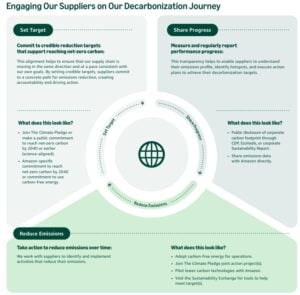
amazon sustainability
Source: Amazon

Lower-Carbon Fuel (LCF) Inset Credits: Decarbonizing Transportation the Smart Way

Transportation is one of the most challenging sectors to decarbonize. Long-haul trucking, aviation, and maritime shipping often rely on heavy payloads and lack sufficient electrification infrastructure. Thus, lower-carbon fuels provide a practical path to reduce emissions while using existing infrastructure.

How They Work

LCF inset credits help companies support the production of cleaner fuels such as renewable diesel, biodiesel, and sustainable aviation fuel, which can reduce greenhouse gas emissions by 65–80% compared with conventional fossil fuels.

These credits, a type of Environmental Attribute Certificate (EAC), allow companies to claim emission reductions by investing in cleaner fuel production even if they cannot directly use the fuels themselves. For instance, a company operating diesel trucks can purchase renewable diesel inset credits to support cleaner fuel production and receive recognition for the equivalent emissions reductions, enabling transportation decarbonization without changing existing operations.

Amazon’s Approach

Amazon prioritizes efficiency and electrification first, then uses LCFs where access is limited. The company tracks the full life cycle of fuels—from feedstock production to final use—using third-party verification and globally recognized methodologies. Waste-based feedstocks, like used cooking oil and agricultural byproducts, are prioritized for their high emission reduction potential and support for circular economies.

The Advanced and Indirect Mitigation (AIM) Platform helps companies account for and report on insets across sectors. Amazon’s methodology aligns with cross-industry standards while adapting to specific sectors, ensuring that results are accurate and verifiable.

Notably, Crane Worldwide Logistics is one company using Amazon’s LCF credits. Sustainability Director Carlos Pacheco said, “Partnering with Amazon on their carbon insets program helps us drive real reductions in sectors that matter most to our business.”
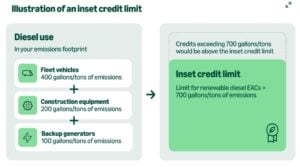
inset credit amazon
Source: Amazon

Superpollutant Refrigerant Destruction Credits: Tackling Methane, HFCs, and Black Carbon

Superpollutants, including methane, HFCs, black carbon, and tropospheric ozone, are significantly more potent than CO₂. Unlike CO₂, which can linger in the atmosphere for centuries, superpollutants last from a few days to around a century, meaning cutting their emissions can produce measurable results within decades.

Millions of tons of refrigerant gases remain in old equipment, materials, or stockpiles. Without intervention, these superpollutants could add billions of tons of CO₂ equivalents to the atmosphere. Reducing these emissions can prevent up to 0.6°C of warming by 2050, according to IPCC scenarios.
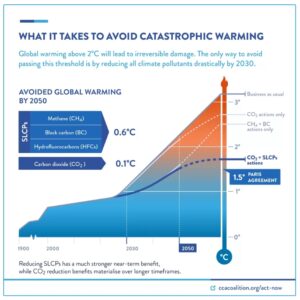
methane

How They Work

Now these credits fund the safe destruction of potent greenhouse gases, such as methane and hydrofluorocarbons (HFCs), which trap far more heat than CO₂. By destroying these gases, companies can help slow global warming and achieve measurable climate benefits within decades.

Amazon’s Approach

Amazon sources refrigerants primarily from small businesses in developing countries and avoids large corporate or government stockpiles. Specialized facilities destroy gases using incineration or plasma-arc gasification, converting them into CO₂, water, and inert salts.

Furthermore, refrigerant destruction also helps the ozone layer recover faster, reducing harmful UV radiation, protecting ecosystems, supporting global food production, and benefiting human health.

It credits companies based on modeled leak rates over a maximum 10-year period, ensuring realistic and verifiable climate impact. Projects follow internationally recognized protocols and avoid double-counting emissions reductions.

Building a Robust Carbon Credit Strategy 

As we understand now, Amazon’s carbon credit program allows companies to blend neutralization and inset credits, giving them flexibility to tackle Scope 1, 2, and 3 emissions while pursuing net-zero targets.

Insetting vs. Offsetting

  • Insets: Reduce emissions directly within a company’s own supply chain.
  • Offsets: Compensate for emissions by supporting external climate projects.

Neutralizing Remaining Emissions

While cutting emissions within its own operations remains the top priority, Amazon invests in climate mitigation efforts outside its value chain. This includes direct investments, advance purchase agreements, coalition building, new methodology development, and innovative technologies.

Despite its Climate Pledge commitment, its total carbon emissions rose to 68.25 million metric tons of CO₂ equivalent in 2024, a 6% increase from 2023. This growth was driven by data center expansion for AI and fuel use in its delivery fleet.
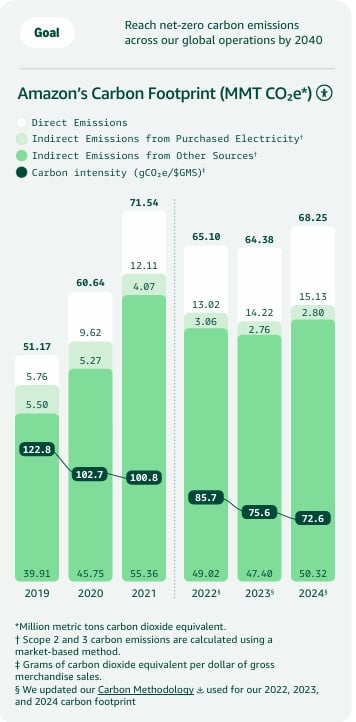
amazon emissions
Source: Amazon

Amazon mainly uses carbon credits to complement its own emissions reductions. Its focus is on high-quality, science-based removal projects rather than offsetting ongoing emissions.

Key Purchases, Investments, and Strategy Context

The retail giant has committed to buying 250,000 metric tons of direct air capture (DAC) credits from 1PointFive’s STRATOS facility over 10 years starting in 2023. In addition, it sources credits through the LEAF Coalition to help protect Brazilian forests and invests in nature-based projects, such as preventing deforestation and restoring ecosystems.

More recently, Amazon expanded its platform to include lower-carbon fuel inset credits, like renewable diesel, alongside its existing nature- and technology-based removal credits. Early users include companies like Flickr and industries such as real estate and tech consulting.

In simple terms, these credits help Amazon reach its goal of net-zero emissions by 2040 under the Climate Pledge. The main focus is on removing leftover emissions after first improving energy efficiency and using renewable energy. While Amazon does not share the exact yearly volume of credits it buys, every credit is carefully checked for additionality, permanence, and transparency. This ensures credibility and addresses doubts about the voluntary carbon market.

The post Amazon Expands Its Carbon Credit Strategy with Lower-Carbon Fuel and Superpollutant Solutions appeared first on Carbon Credits.

Continue Reading

Carbon Footprint

Carbon credit project stewardship: what happens after credit issuance

Published

on

A carbon credit purchase is not a transaction that closes at issuance. The credit may be retired, the certificate filed, and the reporting box ticked. But on the ground, in the forest, in the field, and in the community, the work continues. It endures for years. In many cases, for decades.

Continue Reading

Carbon Footprint

Industries with the biggest nature footprints and what their decarbonisation looks like

Published

on

A corporate carbon footprint is never just an accounting figure. It maps onto real ecosystems. Before a product leaves the factory gate, something on the ground has already paid the cost. A forest has been converted. A river has been depleted. A patch of savannah that was once home to dozens of species now grows a single crop in every direction.

Continue Reading

Carbon Footprint

Apple, Amazon Lead 60+ Firms to Ease Global Carbon Reporting Rules

Published

on

Apple, Amazon Lead 60+ Firms to Ease Global Carbon Reporting Rules

More than 60 global companies, including Apple, Amazon, BYD, Salesforce, Mars, and Schneider Electric, are pushing back against proposed changes to global emissions reporting rules. The group is calling for more flexibility under the Greenhouse Gas Protocol (GHG Protocol), the most widely used framework for measuring corporate carbon footprints.

The companies submitted a joint statement asking that new requirements, especially those affecting Scope 2 emissions, remain optional rather than mandatory. Their letter stated:

“To drive critical climate progress, it’s imperative that we get this revision right. We strongly urge the GHGP to improve upon the existing guidance, but not stymie critical electricity decarbonization investments by mandating a change that fundamentally threatens participation in this voluntary market, which acts as the linchpin in decarbonization across nearly all sectors of the economy. The revised guidance must encourage more clean energy procurement and enable more impactful corporate action, not unintentionally discourage it.”

The debate comes at a critical time. Corporate climate disclosures now influence trillions of dollars in capital flows, while stricter reporting rules are being introduced across major economies.

The Rulebook for Carbon: What the GHG Protocol Is and Why It’s Being Updated

The Greenhouse Gas Protocol is the world’s most widely used system for measuring corporate emissions. It is used by over 90% of companies that report greenhouse gas data globally, making it the foundation of most climate disclosures.

It divides emissions into three categories:

  • Scope 1: Direct emissions from operations
  • Scope 2: Emissions from purchased electricity
  • Scope 3: Emissions across the value chain
scope emissions sources overview
Source: GHG Protocol

The current Scope 2 rules were introduced in 2015, but energy markets have changed since then. Renewable energy has expanded, and companies now play a major role in funding clean power.

Corporate buyers have already supported more than 100 gigawatts (GW) of renewable energy capacity globally through voluntary purchases. This shows how influential the current system has been.

The GHG Protocol is now updating its rules to improve accuracy and transparency. The revision process includes input from more than 45 experts across industry, government, and academia, reflecting its global importance.

Scope 2 Shake-Up: The Battle Over Real-Time Carbon Tracking

The proposed update would shift how companies report electricity emissions. Instead of using flexible systems like renewable energy certificates (RECs), companies would need to match their electricity use with clean energy that is:

  • Generated at the same time, and
  • Located in the same grid region.

This is known as “24/7” or hourly or real-time matching. It aims to reflect the actual impact of electricity use on the grid. Companies, including Apple and Amazon, say this shift could create challenges.

GHG accounting from the sale and purchase of electricity
Source: GHG Protocol

According to industry feedback, stricter rules could raise energy costs and limit access to renewable energy in some regions. It can also slow corporate investment in new clean energy projects.

The concern is that many markets do not yet have enough renewable supply for real-time matching. Infrastructure for tracking hourly emissions is also still developing.

This creates a key tension. The new rules could improve accuracy and reduce greenwashing. But they may also make it harder for companies to scale clean energy quickly.

The outcome will shape how companies measure emissions, invest in renewables, and meet net-zero targets in the years ahead.

Why More Than 60 Companies Oppose the Changes

The companies argue that stricter rules could slow climate progress rather than accelerate it. Their main concern is cost and feasibility. Many regions still lack enough renewable energy to support real-time matching. For global companies, aligning energy use across different grids is complex.

In their joint statement, the group warned that mandatory changes could:

  • Increase electricity prices,
  • Reduce participation in voluntary clean energy markets, and
  • Slow investment in renewable energy projects.

They argue that current market-based systems, such as RECs, have helped scale clean energy quickly over the past decade. Removing flexibility could weaken that momentum.

This reflects a broader tension between accuracy and scalability in climate reporting.

Big Tech Pushback: Apple and Amazon’s Climate Progress

Despite their push for flexibility, both companies have made measurable progress on emissions reduction.

Apple reports that it has reduced its total greenhouse gas emissions by more than 60% compared to 2015 levels, even as revenue grew significantly. The company is targeting carbon neutrality across its entire value chain by 2030. It also reported that supplier renewable energy use helped avoid over 26 million metric tons of CO₂ emissions in 2025 alone.

In addition, about 30% of materials used in Apple products in 2025 were recycled, showing a shift toward circular manufacturing.

Amazon has also set a net-zero target for 2040 under its Climate Pledge. The company is one of the world’s largest corporate buyers of renewable energy and continues to invest heavily in clean power, logistics electrification, and low-carbon infrastructure.

Both companies argue that flexible accounting frameworks have supported these investments at scale.

The Bigger Challenge: Scope 3 and Digital Emissions

The debate over Scope 2 reporting is only part of a larger issue. For most large companies, Scope 3 emissions account for more than 70% of total emissions. These include supply chains, product use, and outsourced services.

In the technology sector, emissions are rising due to:

  • Data centers,
  • Cloud computing, and
  • Artificial intelligence workloads.

Global data centers already consume about 415–460 terawatt-hours (TWh) of electricity per year, equal to roughly 1.5%–2% of global power demand. This figure is expected to increase sharply. The International Energy Agency estimates that data center electricity demand could double by 2030, driven largely by AI.

This creates a major reporting challenge. Even with cleaner electricity, total emissions can rise as digital demand grows.

Climate Reporting Rules Are Tightening Globally

The pushback comes as climate disclosure requirements are expanding and becoming more standardized across major economies. What was once voluntary ESG reporting is steadily shifting toward mandatory, audit-ready climate transparency.

In the European Union, the Corporate Sustainability Reporting Directive (CSRD) is now active. It requires large companies and, later, listed SMEs, to share detailed sustainability data. This data must match the European Sustainability Reporting Standards (ESRS). This includes granular reporting on emissions across Scope 1, 2, and increasingly Scope 3 value chains.

In the United States, the Securities and Exchange Commission (SEC) aims for mandatory climate-related disclosures for public companies. This includes governance, risk exposure, and emissions reporting. However, some parts of the rule face legal and political scrutiny.

The United Kingdom has included climate disclosure through TCFD requirements. Now, it is moving toward ISSB-based global standards to make comparisons easier. Similarly, Canada is progressing with ISSB-aligned mandatory reporting frameworks for large public issuers.

In Asia, momentum is also accelerating. Japan is introducing the Sustainability Standards Board of Japan (SSBJ) rules that match ISSB standards. Meanwhile, China is tightening ESG disclosure rules for listed companies through updates from its securities regulators. Singapore has also mandated climate reporting for listed companies, with phased Scope 3 expansion.

A clear trend is forming across jurisdictions: climate disclosure is aligning with ISSB global standards. There’s a growing focus on assurance, comparability, and transparency in value-chain emissions.

This regulatory tightening raises the bar significantly for corporations. The challenge is clear. Companies must:

  • Align with multiple evolving disclosure regimes,
  • Ensure emissions data is verifiable and auditable, and
  • Expand reporting across complex global supply chains.

Balancing operational growth with compliance is becoming increasingly complex as climate regulation converges and intensifies worldwide.

A Turning Point for Global Carbon Accounting 

The outcome of this debate could shape global carbon accounting standards for years.

If stricter rules are adopted, emissions reporting will become more precise. This could improve transparency and reduce greenwashing risks. However, it may also increase compliance costs and limit flexibility.

If the proposed changes remain optional, companies may continue using current accounting methods. This could support faster clean energy investment, but may leave gaps in reporting accuracy.

The new rules could take effect as early as next year, making this a near-term decision for global companies.

The push by Apple, Amazon, and other companies highlights a key tension in climate strategy. On one side is the need for accurate, real-time emissions reporting. On the other is the need for flexible systems that support large-scale clean energy investment.

As digital infrastructure expands and energy demand rises, how emissions are measured will matter as much as how they are reduced. The next phase of climate action will depend not just on targets—but on the systems used to track them.

The post Apple, Amazon Lead 60+ Firms to Ease Global Carbon Reporting Rules appeared first on Carbon Credits.

Continue Reading

Trending

Copyright © 2022 BreakingClimateChange.com

