Bonn, Germany, Monday 8 June 2026 — As the UN climate negotiations in Bonn commence, Greenpeace Australia Pacific is calling on Climate and Energy Minister Chris Bowen to lead with vision and ambition to advance multilateral climate cooperation, and use his unique position to drive concrete progress at COP31 and ensure a meaningful partnership with the Pacific.
In the context of a global energy crisis and turbulent geopolitics, the Bonn Climate Change Conference will be a critical moment to sustain emerging political momentum towards a just transition away from fossil fuels. The midway point on the road to COP31 in Türkiye in November, Bonn will be the first time Minister Bowen has attended a major UN conference in his role as COP31 President of Negotiations.
The start of the Bonn meetings also marks 100 days since the illegal US-Israel war on Iran sparked a global energy shock and after 57 countries including Australia met in Santa Marta, Colombia in April for the world’s first conference on the transition away from fossil fuels — a landmark moment signalling political winds of change in the face of threats to multilateralism.
Speaking from Bonn, Dr Simon Bradshaw, COP31 Lead at Greenpeace Australia Pacific, said: “Amidst a global energy crisis, accelerating climate disasters and a looming super El Niño, the urgency to accelerate climate action and break free from fossil fuel dependence has never been clearer.
“Minister Bowen has been telling Australia and the world that we are in a global ‘fossil fuel crisis’, and that unhooking from fossil fuels is fundamental both to tackling the climate crisis and to ensuring secure and affordable energy. It’s time to match that message with a clear vision and agenda for COP31 — one that has the transition away from fossil fuels at its heart.
“As COP31 President of Negotiations, Australia has both the opportunity and responsibility to build on the momentum of COP30 in Belém and the recent landmark conference in Santa Marta on transitioning away from fossil fuels. This includes leading by example at home, with an immediate halt to new fossil fuel projects — including the mammoth proposed Browse gas project — and committing to develop a national roadmap away from fossil fuel production.”
“Few countries have as much skin the game as Australia: we are a country highly vulnerable to extreme heat, fires, floods and other impacts of climate change, we are suffering the consequences of fossil fuel dependency in terms of our energy security and affordability, but we have some of the world’s best renewable energy opportunities.
“Bonn is a key moment for the incoming Presidency to start shaping the vision, building the necessary trust, and actively setting priorities and expectations for the COP. We therefore hope and expect our Minister to be much more vocal and active in Bonn.
“Australia, in partnership with the Pacific, is taking the reins of global climate cooperation at a critical moment in the world’s transition away from fossil fuels. There is no more time to lose.”
Also in Bonn, Shiva Gounden, Head of Pacific at Greenpeace Australia Pacific, said: “Multilateral cooperation is the antidote to climate and geopolitical chaos. At Bonn, Pacific nations’ legacy of leadership from the frontlines of the climate crisis can be our guiding star as we build a more peaceful and secure world for all.
“We must build on the progress at Santa Marta and break the hold fossil fuels have on our global security and economies. Pacific nations are already facing the brunt of a global climate crisis, but now facing the compounding injustice of an energy crisis brought on by fossil fuel dependence. We did not create either of these crises, but are among the most exposed to both.
“The International Court of Justice made clear that responsibility to address the climate crisis extends beyond borders and that continuing to expand fossil fuel production, including for export, could constitute an internationally wrongful act — a ruling that has now been overwhelmingly endorsed by the UN General Assembly. Continuing down the fossil fuel path, and failing to align efforts with limiting warming to 1.5C, is a breach of our international legal obligations.
“We must not lose sight of what’s needed — by elevating the voices of Pacific leaders, backing Pacific-led solutions, and maximising the opportunity of the Pacific pre-COP, we can ensure the 1.5°C imperative and the transition away from fossil fuels are central to the agenda at COP31, and that communities are granted the finance they need to build a strong, resilient future beyond fossil fuels.”
Ahead of SB64, Greenpeace International has produced a policy briefing outlining the core elements of a just transition away from fossil fuels and the urgent, priority actions needed from national governments and through global co-operation to make it a reality.[1]
ENDS
[1] A Just Transition Away from Fossil Fuels: Policy Briefing
Photos in the Greenpeace Media Library
Media contact
Kate O’Callaghan on +61 406 231 892 (Whatsapp/Signal) or kate.ocallaghan@greenpeace.org

For the first time, new-energy vehicles (NEVs) made up 67% of new car sales in China in September, according to the latest data from the China Passenger Car Association (CPCA).
The figures show that NEVs, which include battery electric cars and plug-in hybrids, captured a record share of sales, even though fewer were sold than last year.
This is because sales of combustion-engine cars are falling steeply, a trend that the CPCA has attributed to rising petrol prices following the start of the Hormuz crisis.
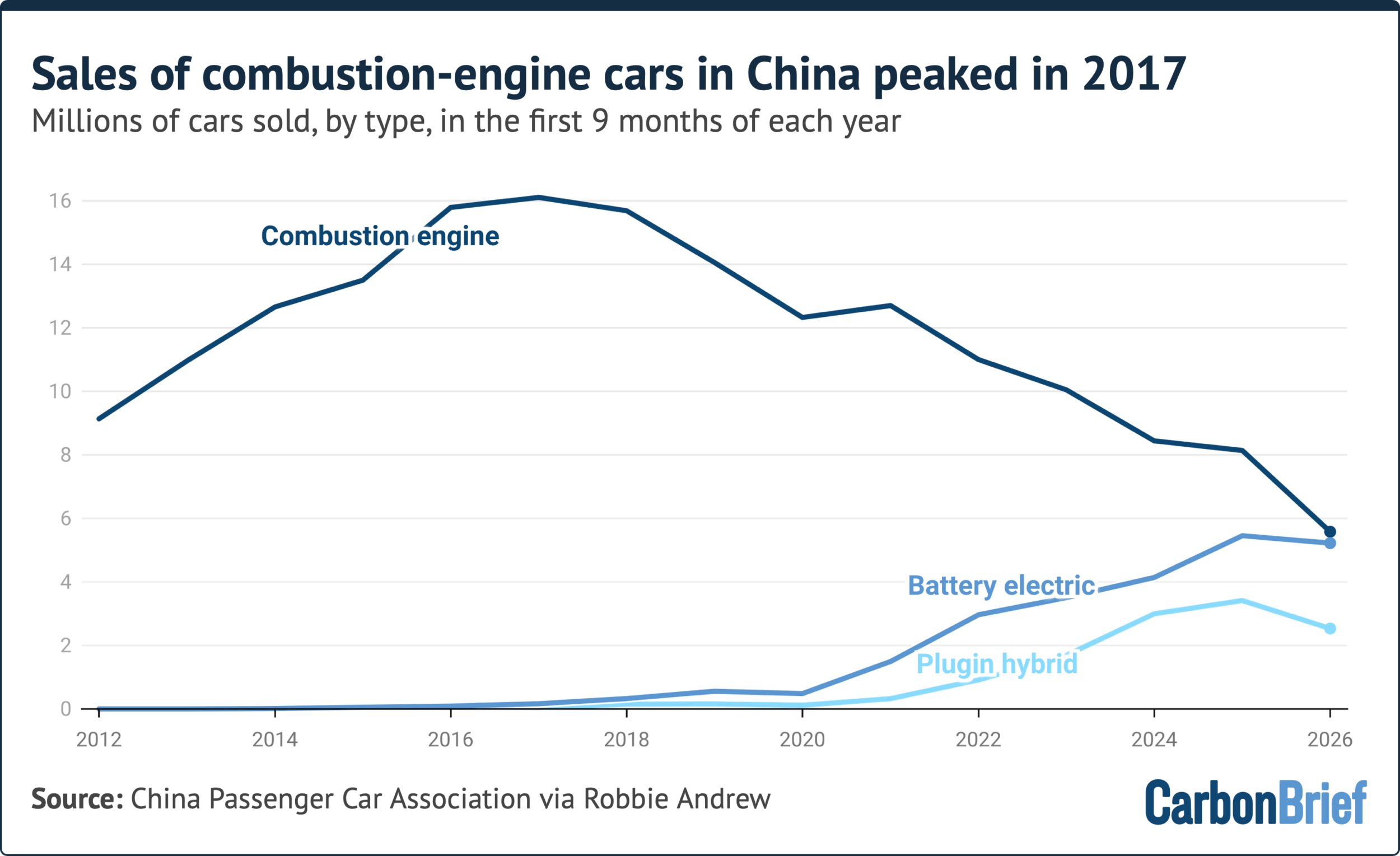
Indeed, sales of fuel-only cars were down 31% year-on-year in the first nine months of 2026, with plug-in hybrid sales down 26% – whereas battery EV sales were only down 4%.
One analyst tells Carbon Brief that China’s rapidly growing EV fleet has offset demand for 143m barrels of oil since the start of the Hormuz crisis.
Another says that the crisis is “reinforcing China’s electrification of road transport”.
Meanwhile, amid slowing domestic sales, Chinese carmakers’ exports of NEVs more than doubled [in 2026 to date / in September] from a year earlier.
NEV record
A record two out of every three cars sold in September in China were NEVs, according to CPCA data, as shown in the figure below.
(NEVs predominantly include battery electric vehicles – BEVs – and plug-in hybrids – PHEVs. BEVs only run on electricity, whereas PHEVs also have a combustion engine.)
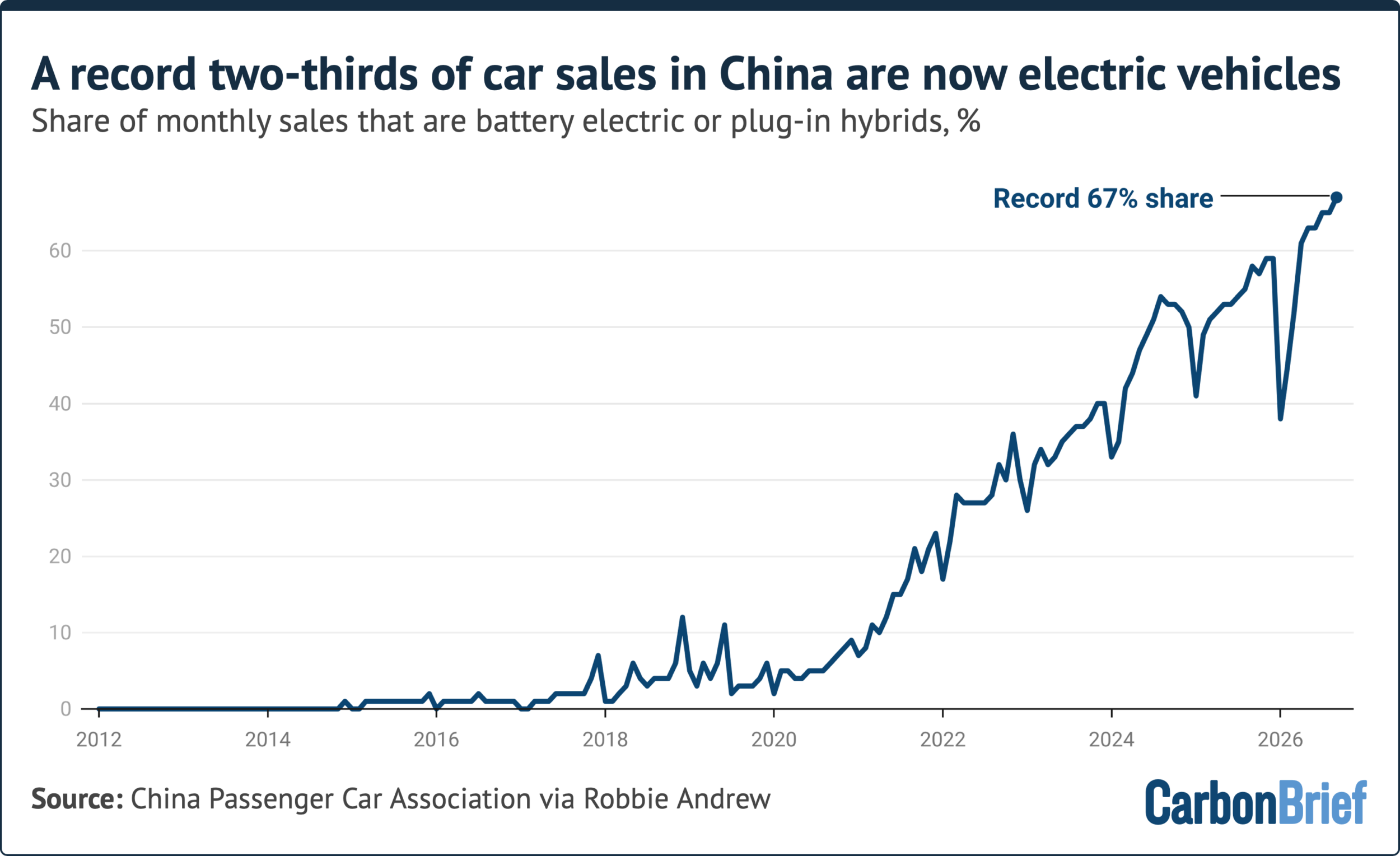
This marks a rapid rise for NEVs from just 6% of new car sales in 2020 up to 58% in 2026 to date – and a record 67% in the month of September.
This year, NEVs’ share of sales has also bounced back from a low of 39% in January, after the full purchase tax exemption that had been in place for more than a decade came to an end in December 2025.
The gain in NEV share in 2026 has come amid a slowdown across the wider domestic passenger-car market, which has hit sales of combustion-engine vehicles particularly hard.
This September, passenger-car retail sales across all categories declined, with overall sales volumes falling 28% year-on-year.
The contraction was led by combustion-engine vehicles, which saw sales fall 43% year-on-year in September and 31% in 2026 to date.
However, sales of PHEVs also fell by 36% year-on-year in September and by 26% in 2026 to date. By comparison, BEVs performed better, although sales still declined 8.5% from a year earlier in September and 4% in 2026 to date.
As a result, NEV sales overall fell by 17% in September and 13% in 2026 to date.
While the market changes in 2026 to date were particularly dramatic, they reflect a broad continuation of trends seen over the past decade.
Indeed, sales of combustion-engine cars in China peaked in 2017 and they have been declining ever since, shown in the figure below.
Impact of Hormuz
Part of the reason for the advance of NEVs in 2026, said Chinese technology news outlet OFweek, was petrol cars “giving up market share” as they were outperformed by electric alternatives.
Cui Dongshu, secretary-general of the CPCA, cited higher petrol prices as an explanation for September’s weak combustion-car sales, in comments to financial news outlet National Business Daily.
Imports of oil into China in January-September have fallen 15% compared to 2025, equivalent to 470m barrels, as ongoing conflict tightened supply and drove up prices.
China’s passenger-car NEV fleet has displaced 143m barrels of oil so far during the strait of Hormuz crisis, Euan Graham, senior energy analyst at thinktank Ember, tells Carbon Brief.
EVs “accounted for 12% of the decrease in China’s oil use post-Hormuz”, according to an estimate provided to thinktank the Brookings Institute by an unnamed analyst.
Erica Downs, a senior research scholar at Columbia University’s Center on Global Energy Policy, tells Carbon Brief that the strait of Hormuz crisis and higher oil prices are “reinforcing China’s electrification of road transport”.
She says the “world’s largest oil supply disruption” vindicates China’s early bet on EVs, which was partly driven by concerns about oil-supply security.
NEV demand down
Nevertheless, NEV sales have fallen year-on-year, albeit at a slower rate than overall car sales. The growth in NEV market share has also been decelerating.
Zhang Yichao, a partner at consulting firm AlixPartners, tells Carbon Brief that NEVs benefit from government trade-in policies and a “strong pipeline” of new models, particularly those involving innovation.
He says these factors help explain why NEVs sales have fallen at a slower rate to their combustion-car counterparts.
Cui told the state-run China National Radio that the fall for NEVs and for cars overall in September 2026, is also due to a high baseline of sales from the same month in 2025, as well as changes to trade-in policies and disruptions from the holiday period.
Other factors, says consulting firm Wood Mackenzie, are the weakened demand due to “demand pull-forward” in 2025 caused by the end of subsidies, as well as “tighter financing conditions”.
Zhang tells Carbon Brief he does not “see much more room ahead” for further growth in NEVs’ market share.
He adds that, in his view, their share in China is unlikely to exceed 80%, as some premium-market segments and specific use cases will continue to require combustion-engine vehicles.
Exports surge
Meanwhile, while domestic NEV retail sales fell 17% in September 2026, exports more than doubled, increasing 164% year-on-year, according to the CPCA.
This extends the decline in domestic sales and very strong growth in exports seen across 2026 to date, as shown in the figure below.
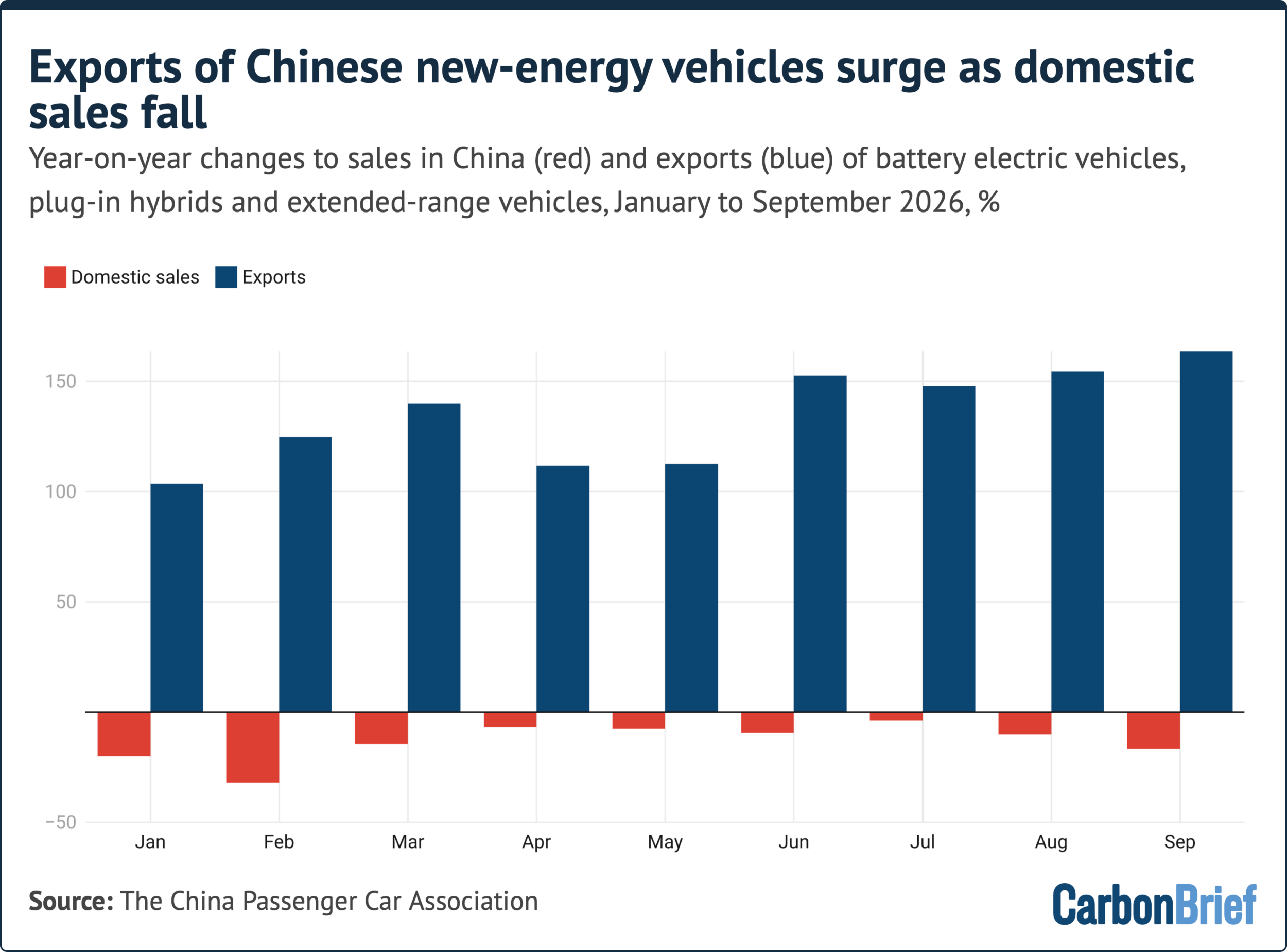
In September, 1,084,000 NEVs were sold domestically in China, while 558,000 NEVs were exported.
Exports are becoming increasingly important to Chinese carmakers, in the face of weaker domestic demand and cut-throat industrial competition.
The CPCA says exports have become “a core priority” for some carmakers.
However, the surge in exports from China has created concern in the EU, which has placed tariffs on imports of EVs from China and recently agreed plans to cut imports of hybrids.
Countries including Mexico and Turkey have also placed tariffs on Chinese EV imports.
At the same time, the Chinese government is putting policies in place that might be expected to disincentivise exports, such as cutting VAT export rebates.
Analysts differ on what impact this policy shift will have, with some saying it will be limited, while others believe it could cause the price of exported cars to rise.