
Connect with us

Published

on

What is Carbon Capture and Storage? Your Ultimate Guide to CCS Technology

Carbon capture and storage (CCS) is moving from niche pilot projects to a global climate strategy worth billions. Once seen as a backup plan, it’s now racing to the forefront — from massive U.S. industrial hubs to China’s fast-expanding carbon pipelines. Supporters call it essential for tackling the world’s toughest emissions in steel, cement, and energy. Critics warn it could be a costly detour.

As governments, investors, and big tech pour money into CCS, one question looms: can it deliver the deep carbon cuts needed to hit net zero by 2050?

This guide walks you through everything you need to know: how CCS works, the latest technologies, the biggest projects and market leaders, and where the fastest growth is happening. 

We’ll also explore market trends, policy drivers, corporate demand, and the risks investors should watch. Whether you’re new to CCS or tracking it as a climate tech opportunity, this resource covers the science, the strategy, and the business potential shaping the future of carbon removal.

What is Carbon Capture and Storage (CCS)?

Carbon Capture and Storage is a climate technology designed to prevent carbon dioxide (CO₂) from entering the atmosphere. It captures CO₂ emissions from places like power plants, cement factories, and steel mills. This happens before the emissions can add to global warming.

A related term is Carbon Capture, Utilization, and Storage (CCUS). It takes things further by using captured CO₂ in products like synthetic fuels, building materials, or plastics.

The key difference between CCS and CCUS lies in the “U” — utilization. In CCS, the captured CO₂ is permanently stored underground, while in CCUS, part or all of that CO₂ is repurposed for industrial use before storage.

This technology helps fight climate change. It can reduce emissions from hard-to-decarbonize industries. The Intergovernmental Panel on Climate Change (IPCC) and the International Energy Agency (IEA) both recognize CCS as a critical tool for achieving net-zero targets.

Global climate agreements, like those at the annual UN Climate Change Conferences (COP), stress that CCS is key to limiting global temperature rise to below 1.5°C.

How Carbon Capture Works: A Step-by-Step Process

CCS works in three main stages — capture, transport, and storage — with an optional fourth step for utilization. Let’s break down each one of them. 
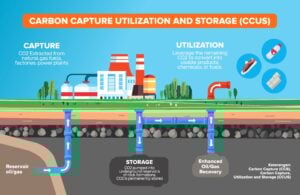
CCUS process
Source: Shutterstock
  1. Capture: The process starts by separating CO₂ from other gases produced during industrial processes or electricity generation. This can be done at power plants, cement kilns, oil refineries, and other facilities. Special chemical solvents, membranes, or advanced filters are used to remove CO₂ from flue gas or fuel before combustion.
  2. Transport: Once captured, CO₂ must be moved to a storage or utilization site. The most common method is through high-pressure pipelines. In some cases, ships or even trucks carry CO₂ over long distances, especially if storage sites are far from industrial hubs.
  3. Storage: For permanent storage, CO₂ is injected deep underground into geological formations such as saline aquifers or depleted oil and gas fields. These sites are chosen for their ability to trap CO₂ securely for thousands of years, with monitoring systems in place to detect any leaks.
  4. Utilization: In CCUS projects, some or all of the captured CO₂ is reused instead of being stored immediately. It can be converted into synthetic fuels, used in making cement and plastics, or even injected into greenhouses to boost plant growth. While utilization does not always result in permanent storage, it can reduce the need for fossil-based raw materials.

Tech Toolbox: The Many Ways of Capturing Carbon

CCS is not a single technology. Different methods are used depending on the type of facility, the fuel being used, and the stage at which CO₂ is removed. The main types are:

Post-combustion capture: This is the most common method today. CO₂ is removed from the exhaust gases after fuel has been burned. Chemical solvents or filters separate the CO₂ from other gases before it is compressed for transport.

Pre-combustion capture: Here, the fuel is treated before it is burned. The process converts the fuel into a mixture of hydrogen and CO₂. The CO₂ is separated and stored, while the hydrogen can be used to produce energy without direct emissions.

Oxy-fuel combustion: In this method, fuel is burned in pure oxygen instead of air. This creates a stream of exhaust that is mostly CO₂ and water vapor, making it easier to capture the CO₂.

Direct Air Capture (DAC): DAC removes CO₂ from the air instead of just one source. It uses big fans and chemical filters to do this. It can be used anywhere but requires more energy because CO₂ in the air is less concentrated.

As of end-2024, around 53 DAC plants were expected to be operational globally, rising to 93 by 2030 with a capacity of 6.4–11.4 MtCO₂/year. 

Bioenergy with CCS (BECCS): This approach combines biomass energy production with carbon capture. Plants absorb CO₂ while growing, and when the biomass is burned for energy, the emissions are captured and stored. This can result in “negative emissions,” removing CO₂ from the atmosphere.

Global Race: Which Countries Are Winning CCS Leadership

Carbon capture and storage is now a reality. It’s in operation in many countries, with numerous projects either planned or being built. CCS technology is still new compared to global emissions. But momentum is growing.

Governments, industries, and investors are now committing to large-scale deployment. CCS capacity differs between regions:
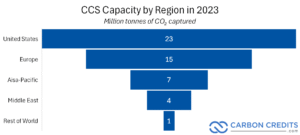
ccs capacity by region

United States

The U.S. leads CCS deployment, holding about 40% of global operational capacity. By mid-2024, facilities captured roughly 22–23 Mt CO₂ annually. Growth is driven by the expanded 45Q tax credit under the Inflation Reduction Act, rewarding storage and utilization. Flagship projects include Petra Nova in Texas and Midwest CCS hubs serving ethanol, fertilizer, and industrial sites.

Canada

Canada hosts pioneering projects like Boundary Dam (the world’s first commercial coal CCS) and Quest in Alberta, capturing CO₂ from hydrogen linked to oil sands. National capacity is ~4 Mt per year, supported by a federal CCS investment tax credit targeting heavy industry and clean hydrogen. 

Norway

Norway has led offshore CO₂ storage since the Sleipner project began in 1996, injecting ~1 Mt annually into a saline aquifer. The Northern Lights project, part of Longship, will create a shared CO₂ transport and storage network for European industries.

China

China’s CCS capacity grew from ~1 Mt/year in 2022 to over 3.5 Mt in 2024, mainly in coal-to-chemicals, gas processing, and EOR. CCS is now part of national climate strategies, signaling rapid expansion.

United Kingdom

The UK’s cluster model links industries via shared pipelines and offshore storage. The East Coast Cluster and HyNet, due late 2020s, could together capture over 20 Mt CO₂ annually.

Australia

Australia’s ~4 Mt/year capacity includes the massive Gorgon gas-linked CCS facility in Western Australia, despite operational setbacks. With vast geological storage potential, the country aims to be a CO₂ storage hub for Asia’s export industries.
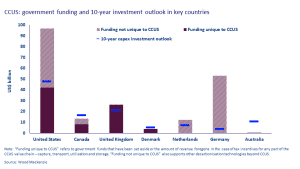
Wood Mackenzie

Total Operational Capacity and Growth

As of 2024, global CCS facilities in operation had a combined capture capacity of just over 50 million tonnes of CO₂ per year. This shows steady growth, up from about 40 Mt a few years ago. However, it still accounts for just a small part of the over 40 billion tonnes of CO₂ emitted worldwide each year.global ccs capacity growth
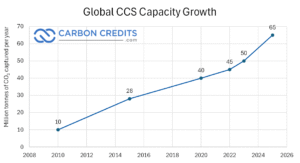
However, the project pipeline is expanding quickly. The facilities being built will double the current capacity. Early development projects might raise global capacity to over 400 million tonnes per year by the early 2030s if they stay on track.

The Rise of CCS Hubs and Clusters

A key trend in the industry is the creation of CCS hubs—shared infrastructure networks where multiple companies use the same transport and storage systems. This model lowers costs and speeds up deployment by avoiding the need for every facility to build its own pipeline or storage site.

The U.S. Midwest ethanol corridor, Norway’s Northern Lights, and the UK’s industrial clusters are among the most advanced examples. These hubs usually form close to industrial areas. Here, emissions are high, and the current infrastructure, like pipelines and ports, can be adjusted for CO₂ transport.

Why CCS Matters in the Climate Fight

Carbon capture and storage is not meant to replace renewable energy or other climate solutions. Instead, it focuses on the toughest parts of the emissions problem—places where cutting CO₂ is especially hard or expensive. Experts call these hard-to-abate sectors.

Hard-to-Abate Sectors

Some industries can’t simply switch to clean electricity. For example, making steel requires very high heat and chemical reactions that release CO₂. Cement production also releases CO₂ as a byproduct of making clinker, the key ingredient in concrete.

Chemical plants and refineries have complex processes that generate large amounts of CO₂. Even aviation faces limits, since planes can’t yet fly long distances on batteries alone. CCS can capture emissions from these sources. This helps reduce climate impact while keeping production running.

Here is the technology’s application in various industries:
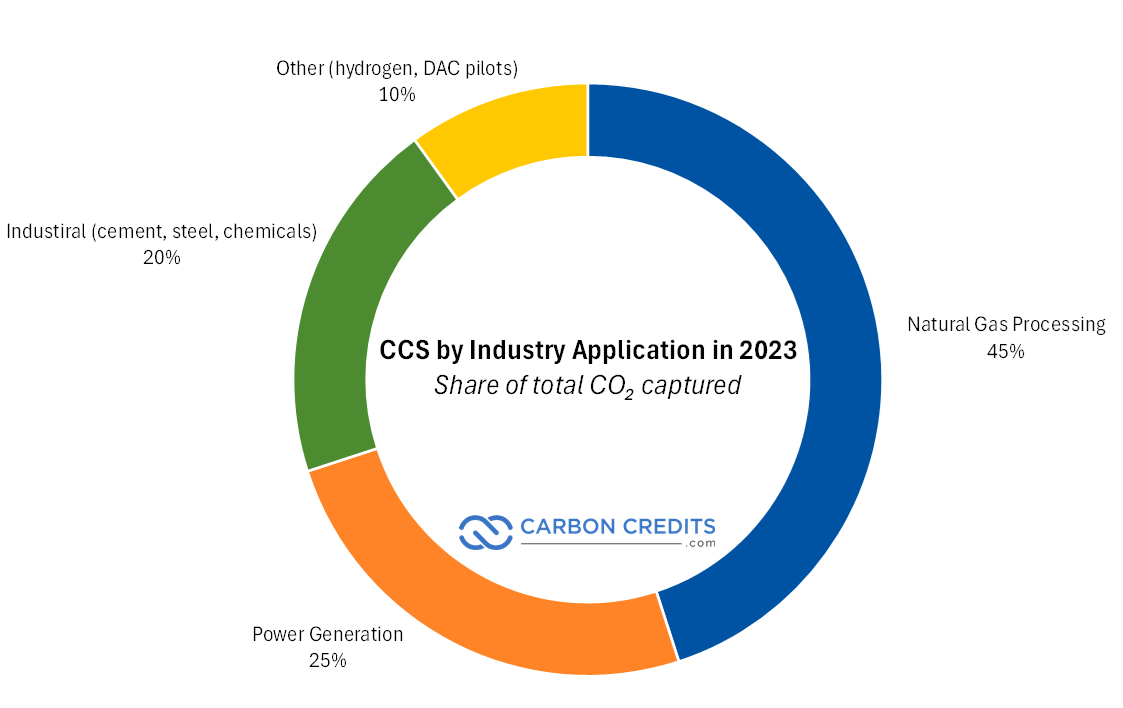
ccs by industry application

Role in Meeting the 1.5°C Target and Net-Zero by 2050

To avoid the worst effects of climate change, scientists say global warming must be kept to 1.5°C above pre-industrial levels. That means reaching net-zero emissions by around 2050. 

The Intergovernmental Panel on Climate Change (IPCC) has run hundreds of models to see how this can be done. In most scenarios, CCS plays a key role. Without it, the cost of meeting climate targets could rise by 70% or more, because other solutions would have to carry the full load.

global carbon emissions captured with CCS

Synergies with Clean Hydrogen, Carbon Markets, and Industrial Strategy

CCS also works well with other low-carbon solutions. CCS captures CO₂ that would escape when producing clean hydrogen, especially “blue hydrogen” from natural gas. This creates a cleaner fuel for use in transport, heating, and industry.

In carbon markets, CCS can generate credits for each tonne of CO₂ captured and stored. These credits can be sold to companies looking to offset their emissions. Governments are also linking CCS to industrial strategy by building shared hubs and pipelines. These will serve multiple factories, power plants, and fuel producers. This makes CCS cheaper and faster to deploy.

Endorsements from the IEA and UN

The International Energy Agency (IEA) calls CCS “critical” for reaching net zero, especially in heavy industry. It estimates the world will need to store 1.2 billion tonnes of CO₂ each year by 2050.

The United Nations also recognizes CCS in its climate plans. It has been featured in multiple COP agreements as a key technology for both reducing emissions and removing CO₂ from the atmosphere. These endorsements matter because they help drive policy support, funding, and international cooperation.

CCS Investment and Financing: How Much Does It Cost?

Carbon capture and storage can make a big impact on emissions. But it comes with a high price tag. Most projects cost between $50 and $150 for every tonne of CO₂ (and even over $400 for some technologies) captured and stored.

The lower end usually applies to large industrial sites near storage locations. The higher end often applies to smaller or more complex projects, or those that require long transport pipelines.
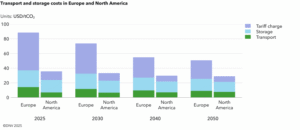
DNV_CCS_forecast_2050_transport_and_storage_costs_in_EUR_and_NAM

Government Support

Governments play a key role in making CCS affordable. In the U.S., the 45Q tax credit offers up to $85 per tonne for CO₂ stored underground and $60 per tonne for CO₂ used in other industrial processes.

Canada provides an Investment Tax Credit (ITC) covering up to 50% of eligible CCS costs. In Europe, the Innovation Fund supports early-stage CCS and other low-carbon projects, offering billions in grants.

Blended Finance and Partnerships

Because CCS is expensive, many projects rely on blended finance—a mix of public and private funding. Oil and gas companies invest in cutting carbon emissions. Meanwhile, governments help by offering grants and tax breaks.

Public-private partnerships are common, especially for shared CCS hubs where multiple companies use the same pipelines and storage sites. International lenders, such as the World Bank and the Asian Development Bank, are funding CCS in emerging economies.

Voluntary Carbon Market (VCM)

CCS can also generate carbon removal credits for sale in the voluntary carbon market. These credits are purchased by companies aiming to offset their emissions.

While VCM prices vary, high-quality removal credits often sell for $100 per tonne or more, making them a potential revenue stream for CCS operators. Market demand for CCS-based credits is still growing. It relies on trust in the technology’s monitoring and verification.

Investor Angle: How to Invest in the CCS Industry

Interest in carbon capture and storage is rising among ESG, climate tech, and energy transition investors. The global CCS market was valued at about $4.5 billion in 2023 and could grow to more than $20 billion by 2033, according to industry forecasts. This growth is being driven by stricter climate policies, corporate net-zero pledges, and rising carbon prices.

Public Stocks

Investors can buy shares in companies directly involved in CCS. Examples include Aker Carbon Capture (Norway), Occidental Petroleum (U.S.), Air Liquide (France), and ExxonMobil.

Many oil and gas majors now see CCS as essential to keeping their assets viable in a low-carbon future. These firms are investing billions in CCS hubs and carbon removal partnerships.

Private Startups

Private markets offer exposure to emerging technologies like DAC. Leading firms include Climeworks (Switzerland), CarbonCapture (U.S.), and Heirloom (U.S.).

DAC projects are smaller today but attract premium interest from tech backers and climate-focused venture capital. In 2022 alone, DAC startups raised over $1 billion in funding.

ETFs and Funds

There are also climate-focused ETFs and funds that include carbon removal technologies as part of their portfolios. These funds reduce risk by investing in various companies. They focus on CCS, renewable energy, hydrogen, and other low-carbon solutions.

Carbon Credit Markets

Some investors buy into CCS through the carbon credit market. This can be done by funding CCS or DAC projects that issue carbon removal credits.

Platforms like Puro.earth and CIX (Climate Impact X) connect investors with verified carbon removal projects. Credits from high-quality CCS projects can fetch $100–$200 per tonne depending on location and verification standards.

Due Diligence

Before investing, it is important to check policy risk, technology readiness, cost curves, and scalability. CCS works best in large industrial hubs with access to geological storage.  Finally, watch these key sectors because they will likely drive demand and scale for CCS: 

  • The oil & gas sector uses CCS for enhanced oil recovery and to lower its emissions. 
  • Cement firms need CCS because their production process emits CO₂ that can’t be avoided easily. 
  • Hydrogen—especially blue hydrogen—depends on CCS to cut its carbon footprint. 
  • DAC startups aim to remove CO₂ directly from the air and may sell high-value removal credits. 
  • And carbon marketplaces and registries will shape how removal credits are priced and trusted.

These areas have the most potential to scale quickly as policies tighten and carbon prices rise.

Risks, Challenges, and Criticism of CCS

While CCS has strong potential as a climate solution, it faces several challenges that investors, policymakers, and project developers must consider.

  • High Capital Costs and Slow ROI: Large CCS projects cost hundreds of millions to billions of dollars. At $50–$150 per tonne captured, returns depend on strong policy support, carbon pricing, or premium credits, with payback periods often spanning years.
  • Energy Requirements and Lifecycle Emissions: CCS uses significant energy, sometimes from fossil fuels. Without low-carbon power, net emissions savings shrink, making efficiency improvements essential.
  • Storage Risks: Leakage, Permanence, and Monitoring: Geological storage is generally safe, but leakage is possible. Continuous monitoring ensures CO₂ remains underground for centuries.
  • Debate Over Fossil Fuel Dependency vs. Genuine Decarbonization: Critics say CCS can prolong fossil fuel use. Supporters argue it’s vital for industries like cement and steel.
  • Policy Uncertainty and Lack of Global Standards: Policy changes can undermine project economics. The absence of global CO₂ measurement standards adds risk to cross-border investments.

Market Outlook (2024–2030): What’s Next for CCS?

The world is gearing up for a big expansion in carbon capture and storage. But just how fast will CCS grow—and what could power that growth?
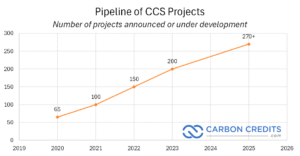
ccs pipeline projects

Growing CCS Pipeline and Capacity

Momentum is clearly building. The Global CCS Institute reports a record 628 projects in the pipeline—an increase of over 200 from the previous year.

The expected annual capture capacity from these projects is 416 million tonnes of CO₂. This amount has been growing at a 32% rate each year since 2017. Once the current construction is completed, operational capacity is set to double to more than 100 Mt per year.

Similarly, the IEA sees global capture capacity rising from roughly 50 Mt/year today to about 430 Mt/year by 2030, with storage capability reaching 670 Mt/year.
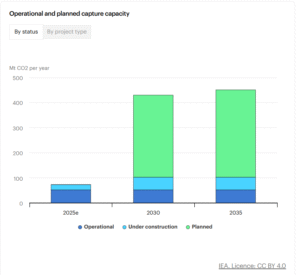
Still, this is only a start. To meet global climate goals, CCS will need to scale much more, lasting into the billions of tonnes annually.

Policies Fueling Momentum

Governments are shoring up policy support to accelerate CCS rollout. Here are the regional trends so far:

  • In the U.S., the Inflation Reduction Act (IRA) expanded the 45Q tax credit—making CCS more financially appealing for project developers.
  • The EU’s Net-Zero Industry Act and updated Industrial Carbon Management Strategy aim to help the region capture at least 50 Mt by 2030, rising to 280 Mt by 2040.
  • Across the Asia-Pacific, countries like Australia are positioning themselves as carbon storage hubs. With strong geology and policy backing, Australia could generate over US$500 billion in regional carbon storage revenue by 2050.

Corporate Buyers Powering Demand

Major companies are not just talking—they’re signing deals:

  • Microsoft stands out as a leading buyer of carbon removal credits. It has contracted close to 30 million tonnes. This includes 3.7 million tonnes over 12 years with startup CO280 and 1.1 million tonnes in a 10-year deal with Norway’s Hafslund Celsio project.
  • Shopify co-founded Frontier—a $925 million advance market commitment—with other big names like Stripe and Alphabet. It has also purchased over $80 million in carbon removal from startups using DAC, enhanced weathering, and other technologies.

These corporate purchases show a strong demand for CCS-backed removal credits. They also help build a stable market for project developers.

Carbon Pricing, ESG Rules, and Global Markets

CCS is also benefiting from broader climate market trends:

  • Carbon pricing and trading systems globally are starting to include CCS credits. As prices rise, CCS projects can improve their economics.
  • ESG reporting and net-zero commitments are increasing transparency and accountability. Firms are expected to show real results—CCS helps deliver that.
  • The rise of international carbon markets and registries is creating standardized ways to value and certify carbon removals. This makes CCS credits more trustworthy and investable.

Quick Take

By 2030, CCS capacity could rise eightfold—from 50 million to over 400 million tonnes. This growth is being driven by government policy, big corporate offtake deals, and a maturing carbon credit market. While still far from what’s needed to fully tackle climate change, the CCS sector is clearly moving from pilot stage to commercial reality

The Role of CCS in a Net-Zero Future

CCS isn’t a silver bullet. It’s a vital tool that works with renewables, electrification, and nature-based solutions like reforestation.

Renewables stop future emissions. CCS tackles the emissions that still exist, especially from old infrastructure in steel, cement, and chemicals. These are costly and slow to replace. 

CCS captures emissions at the source. This helps extend facility lifespans and supports climate goals. It’s especially important for economies with new industrial assets.

CCS growth 2050

Beyond reduction, CCS can enable permanent carbon removal through direct air capture and bioenergy with CCS, storing CO₂ underground for centuries. These methods can offset hard-to-abate sectors such as aviation and agriculture.

Responsible deployment is key. It needs strong MRV standards, community engagement, and alignment with sustainability goals. This helps avoid delays in phasing out fossil fuels.

CCS, when used wisely, connects our current fossil fuel economy to a low-carbon future. It helps reduce emissions we can’t fully eliminate yet and gives us time to develop cleaner technologies.

CCS is Not a Silver Bullet—But a Vital Tool

Carbon capture and storage is not a cure-all for the climate crisis. No single technology can deliver net zero on its own, and CCS should be viewed as one tool in a broader decarbonization toolkit. 

A balanced approach requires acknowledging both the potential and the limitations of CCS. The technology can cut emissions and even remove carbon permanently when it’s based on solid science, strong policies, and clear reporting.

However, overreliance or misuse—particularly if it delays the shift away from fossil fuels—risks undermining climate goals.

The pathway to net zero will demand a combination of innovation, investment, and urgency. Carbon capture and storage is part of that solution set, and with careful governance, sustained funding, and clear standards, it can help bridge the gap between today’s emissions reality and the low-carbon future we urgently need.

The post What is Carbon Capture and Storage? Your Ultimate Guide to CCS Technology appeared first on Carbon Credits.

Continue Reading

Carbon Footprint

OpenAI Hits Pause on $40B UK AI Project: Energy Costs Shake Data Center Economics

Published

on

OpenAI Hits Pause on $40B UK AI Project: Energy Costs Shake Data Center Economics

ChatGPT developer OpenAI has paused its flagship UK data center project, known as “Stargate UK,” citing high energy costs and regulatory uncertainty. The project was part of a broader £31 billion ($40+ billion) investment plan aimed at expanding artificial intelligence (AI) infrastructure in the country.

The initiative was designed to deploy up to 8,000 GPUs initially, with plans to scale to 31,000 GPUs over time. It was aimed to boost the UK’s “sovereign compute” capacity. This means building local infrastructure to support AI development and reduce reliance on foreign systems.

However, the company has now paused development. An OpenAI spokesperson stated that they:

“…support the government’s ambition to be an AI leader. AI compute is foundational to that goal – we continue to explore Stargate UK and will move forward when the right conditions such as regulation and the cost of energy enable long-term infrastructure investment.”

Energy Costs Are Now a Core Constraint

The main issue is energy. AI data centers require large amounts of electricity to run GPUs and cooling systems.

In the UK, industrial electricity prices are among the highest in developed markets. Recent estimates show costs at around £168 per megawatt-hour, compared to £69 in France and £38 in Texas. This gap creates a major disadvantage for large-scale data center investments.

AI workloads are especially power-intensive. A single large data center can consume as much electricity as tens of thousands of homes. As AI adoption grows, this demand is rising quickly.

Globally, the International Energy Agency estimates that data centers could consume over 1,000 terawatt-hours (TWh) of electricity by 2030, up sharply from about 415 TWh in 2024. This growth is largely driven by AI. 

data center electricity use 2035
Source: IEA

The result is clear. Energy is no longer just a cost. It is a key factor in where AI infrastructure gets built.

Regulation Adds Another Layer of Risk

Energy is only part of the challenge. Regulation is also slowing investment. In the UK, uncertainty around AI rules, especially copyright laws for training data, has created hesitation among companies.

Earlier proposals to allow AI firms to use copyrighted content were withdrawn after backlash. This left companies without clear guidance on compliance.

For large infrastructure projects, this uncertainty increases risk. Data centers require billions in upfront investment. Companies need stable rules before committing capital.

Planning delays and grid connection timelines also add friction. These factors increase both cost and project timelines.

Together, energy costs and regulatory uncertainty create a difficult environment for hyperscale AI infrastructure.

OpenAI’s Global Infrastructure Expands, But More Selectively

Despite the pause, ChatGPT-maker is still expanding globally. The company is investing heavily in AI infrastructure through partnerships with Microsoft, NVIDIA, and Oracle. It is also linked to a much larger $500 billion “Stargate” initiative in the United States, focused on building next-generation AI data centers.

At the same time, the company faces rising costs. Reports suggest OpenAI could lose billions of dollars annually as it scales infrastructure to meet demand.

This reflects a broader industry shift. AI is becoming more like energy or telecom infrastructure. It requires large capital investment, long timelines, and stable operating conditions.

The pause also highlights a deeper issue. AI growth is increasing pressure on energy systems and the environment.

The Hidden Carbon Cost Behind Every AI Query

ChatGPT and similar tools rely on large data centers. These facilities already account for about 1% to 1.5% of global electricity use. Projections for their energy use vary widely due to various factors. 

Each individual query may seem small. A typical ChatGPT request can use about 0.3 watt-hours of electricity, which is relatively low. However, usage at scale changes the picture.

ChatGPT now serves hundreds of millions of users. Even small energy use per query adds up quickly. Training models is even more energy-intensive. For example, training GPT-3 required about 1,287 megawatt-hours of electricity and produced roughly 550 metric tons of CO₂.

chatgpt environmental footprint

Newer models are even larger. Some estimates suggest training advanced models like GPT-4 could emit up to 15,000 metric tons of CO₂, depending on the energy source.

At the system level, the impact is growing fast. AI systems could generate between 32.6 and 79.7 million tons of CO₂ emissions in 2025 alone. By 2030, AI-driven data centers could add 24 to 44 million tons of CO₂ annually.

AI servers annual carbon emissions
Note: carbon emissions (g) of AI servers from 2024 to 2030 under different scenarios. The red dashed lines in e–g denote the forecast footprint of the US data centres, based on previous literature. Source: https://doi.org/10.1038/s41893-025-01681-y

Looking further ahead, global generative AI emissions could reach up to 245 million tons per year by 2035 if growth continues. These numbers show a clear pattern. Efficiency is improving, but total demand is rising faster.

Big Tech Scrambles to Balance AI Growth and Emissions

OpenAI has not published a detailed standalone net-zero target. However, its operations rely heavily on partners such as Microsoft, which has committed to becoming carbon negative by 2030.

The company has acknowledged that energy use is a real concern. Leadership has pointed to the need for more renewable energy, including nuclear and clean power, to support AI growth.

Across the industry, companies are responding in several ways:

  • Improving model efficiency to reduce energy per query
  • Investing in renewable energy and long-term power contracts
  • Exploring new cooling systems to reduce water and energy use

Efficiency gains are already visible. Some AI systems have reduced energy per query by more than 30 times within a year, showing how quickly technology can improve. Still, total emissions continue to rise because demand is scaling faster than efficiency gains.

The Global AI Infrastructure Race

The pause in the UK highlights a larger trend. AI infrastructure is becoming a global competition shaped by energy, policy, and cost.

Regions with lower energy prices and faster permitting processes have an advantage. The United States and parts of the Middle East are attracting large-scale AI investments due to cheaper power and supportive policies.

At the same time, governments are trying to attract these projects. The UK has pledged billions to support AI growth and improve compute capacity. But this case shows that policy ambition alone is not enough. Companies need reliable energy, clear rules, and predictable costs.

AI’s Next Phase Will Be Decided by Energy, Not Code

The decision by OpenAI does not signal a retreat from AI investment. Instead, it reflects a shift in priorities.

Companies are becoming more selective about where they build infrastructure. They are focusing on locations that offer the right mix of energy access, cost stability, and regulatory clarity.

The UK project may still move forward, but only if conditions improve. For now, the message is clear. The future of AI will not be shaped by technology alone. It will also depend on energy systems, policy frameworks, and long-term investment conditions.

The post OpenAI Hits Pause on $40B UK AI Project: Energy Costs Shake Data Center Economics appeared first on Carbon Credits.

Continue Reading

Carbon Footprint

U.S. Uranium Mining Returns: UEC Launches First New Mine in a Decade

Published

on

U.S. Uranium Mining Returns: UEC Launches First New Mine in a Decade

Uranium Energy Corporation (NYSE: UEC) has started production at its Burke Hollow project in South Texas. This is the first new uranium mine to open in the U.S. in over ten years.

The project started production in April 2026 after getting final regulatory approval. This marks a big step for domestic uranium supply. It’s also the world’s newest in-situ recovery (ISR) uranium mine, which shows a move toward less harmful extraction methods.

Burke Hollow was originally discovered in 2012 and spans roughly 20,000 acres, with only about half of the site explored so far. This suggests significant long-term expansion potential as additional wellfields are developed.

The mine’s output will go to UEC’s Hobson Central Processing Plant in Texas. This plant can produce up to 4 million pounds of uranium each year.

A Scalable ISR Platform Expands U.S. Uranium Capacity

The Burke Hollow launch transforms UEC into a multi-site uranium producer in the United States. The company runs two active ISR production platforms. The second one is at its Christensen Ranch facility in Wyoming; both are shown in the table from UEC.

UEC burke hollow resources

UEC Christensen Ranch resources

This “hub-and-spoke” model allows uranium from multiple wellfields to be processed through centralized facilities, improving efficiency and scalability. UEC’s operations in Texas and Wyoming are now active. This gives them a licensed production capacity of about 12 million pounds per year across the U.S.

ISR mining plays a key role in this strategy. Unlike conventional mining, ISR involves circulating solutions underground to dissolve uranium and pump it to the surface. This reduces surface disturbance and can lower environmental impact compared to open-pit or underground mining.

Burke Hollow is the largest ISR uranium discovery in the U.S. in the last ten years. This boosts its long-term value as a domestic resource.

Unhedged Strategy Pays Off as Uranium Prices Rise

UEC’s production launch comes at a time of strong uranium market conditions. The company uses a fully unhedged strategy. This means it sells uranium at current market prices instead of securing long-term contracts.

This approach has recently delivered strong financial results. In early 2026, UEC sold 200,000 pounds of uranium for $101 each. This price was about 25% higher than average market rates. The sale brought in over $20 million in revenue and around $10 million in gross profit.

The strategy allows the company to benefit directly from rising uranium prices, which have been supported by:

  • Growing global nuclear energy demand
  • Supply constraints in key producing regions
  • Increased long-term contracting by utilities

Unhedged exposure raises risk in downturns, but offers more upside in strong markets. UEC is currently taking advantage of this.

Nuclear Energy Growth Is Driving Demand for Uranium

The timing of Burke Hollow’s launch aligns with a broader global shift back toward nuclear energy. Governments are increasingly turning to nuclear power as a reliable, low-carbon energy source.

nuclear power capacity additions IAEA projection 2024 to 2050
Source: IAEA

The International Atomic Energy Agency projects that global nuclear capacity could double by 2050, depending on policy and investment trends. This would require a significant increase in uranium supply.

In the United States, nuclear energy accounts for around 20% of electricity generation. It also produces zero carbon emissions during operations. This makes it a key component of many net-zero strategies.

There are several factors supporting renewed nuclear demand, including:

  • Development of small modular reactors (SMRs)
  • Extension of existing nuclear plant lifetimes
  • Government funding to maintain nuclear capacity
  • Rising electricity demand from data centers and electrification

As demand grows, securing a reliable uranium supply becomes increasingly important.

uranium demand and supply UEC

Reducing Import Risk: A Strategic Domestic Supply Push

The Burke Hollow project also addresses a major vulnerability in U.S. energy policy. The country currently imports about 95% of its uranium needs, leaving it exposed to global supply risks.

A large share of uranium production and enrichment capacity is concentrated in a few countries, including Russia and Kazakhstan. This concentration has raised concerns about supply disruptions and geopolitical risk.

uranium production US 2025 EIA

By expanding domestic production, UEC is helping to reduce reliance on imports and strengthen the U.S. nuclear fuel supply chain.

The company’s broader strategy includes building a vertically integrated platform covering mining, processing, and, eventually, uranium conversion. This approach aligns with U.S. government efforts to rebuild domestic nuclear fuel capabilities.

Federal programs have allocated billions to boost uranium production and enrichment. This shows how important the sector is.

Two Hubs, One Strategy: Wyoming Supports the Texas Breakthrough

While Burke Hollow is the main focus, UEC’s Christensen Ranch operation in Wyoming remains an important part of its production base.

The Wyoming site has recently received approvals for expanded wellfield development, allowing it to increase output alongside the Texas operation.

Together, the two sites form the foundation of UEC’s dual-hub production model. However, it is the Texas project that marks the first new U.S. uranium mine in over a decade, making it the central milestone in the company’s growth strategy.

Investor Momentum Builds Around Uranium Revival

The restart of U.S. uranium production is drawing strong attention from investors and industry players. Uranium markets have tightened in recent years, driven by rising demand and limited new supply.

UEC’s production launch has already had a positive market impact. The company’s share price rose following the announcement, reflecting investor confidence in its growth strategy.

UEC stock price

At the same time, utilities are increasing long-term contracting activity to secure fuel supply. This trend is expected to continue as new nuclear capacity comes online and existing plants extend operations.

Industry forecasts suggest that uranium demand will remain strong through the 2030s, supporting higher prices and increased investment in new production.

Lower Impact Mining, Higher ESG Expectations

The use of ISR mining at Burke Hollow reflects a broader shift toward more sustainable extraction methods. ISR typically reduces land disturbance and avoids large-scale excavation.

However, environmental management remains critical. Key issues include groundwater protection, chemical use, and long-term site restoration.

UEC has emphasized environmental controls and regulatory compliance in its operations. These efforts are important for maintaining social license and meeting ESG expectations.

From a climate perspective, uranium production plays an indirect but important role. Supporting nuclear energy, it helps enable low-carbon electricity generation and reduces reliance on fossil fuels.

The Bottom Line: A Defining Moment for U.S. Uranium Production

The launch of the Burke Hollow mine marks a major milestone for the U.S. uranium sector. It ends a decade-long gap in new mine development and signals renewed momentum in domestic production.

In the short term, it strengthens supply and supports rising uranium markets. In the long term, it highlights the growing role of nuclear energy in global decarbonization strategies.

UEC’s Burke Hollow shows that new uranium projects can advance in today’s market. There are still challenges, like scaling production and handling environmental risks, but progress is possible.

As demand for nuclear energy continues to grow, domestic projects like Burke Hollow will play a key role in shaping the future of energy security and low-carbon power.

The post U.S. Uranium Mining Returns: UEC Launches First New Mine in a Decade appeared first on Carbon Credits.

Continue Reading

Carbon Footprint

Carbon Market 2026: Supply Squeeze Pushes Premium Carbon Credit Prices Up, Sylvera Finds

Published

on

The global carbon market is changing fast in 2026. The latest insights from Sylvera’s State of Carbon Credits report show a clear shift. Volumes are falling, but value is holding steady. This means buyers now focus more on quality than quantity.

Furthermore, the market is splitting into two clear segments. High-quality credits are in demand and sell at higher prices. Older or lower-quality credits are losing interest. This divide is growing stronger and shaping how the market will evolve in the coming years.

Shell’s Sharp Cut Pulls Down Market Volumes

Carbon credit retirements reached 51 million in the first quarter of 2026. This is down from 55.3 million in the same period last year. The total market value also fell slightly to $290 million, compared to $309 million a year ago.

Despite this decline, prices did not weaken. The average price per credit increased to $5.69 from $5.60. This shows that buyers are willing to pay more for credits they trust.

Carbon credit retirements

Interestingly, a major reason for the drop in volumes was reduced activity from Shell. The company sharply cut its purchases. It retired just 494,000 credits in Q1 2026, compared to 6.7 million in Q1 2025 and 5.6 million in 2024. This single change had a large impact on the overall market.

Value Now Drives the Market

The carbon market now runs on a simple idea. Value matters more than volume. Buyers want credits that deliver real environmental impact. They prefer projects with clear data, strong verification, and proven results.

High-quality credits now define the market. These credits meet strict standards and often align with compliance systems. Because of this, they command higher prices and stronger demand.

This shift is also linked to the rise of compliance markets. Programs like CORSIA are increasing demand for reliable credits. As a result, voluntary buyers and compliance buyers now compete for the same supply.

Experts expect this trend to grow stronger. Compliance demand could surpass voluntary demand by 2027. This will increase pressure on supply and push premium credit prices higher.

The report highlighted that, investment-grade credits (BBB+) now command an average of $20.10 per credit in Q1 2026, up from $18.10 in Q1 2025, as shown in the image below:

high quality credits

Recap of 2025 Carbon Market

Compliance programs made up 24% of total retirements in 2025. According to Sylvera, this share is rising fast. It is expected to go beyond voluntary demand by 2027. This growth is mainly driven by CORSIA Phase 1 rules and the expansion of domestic carbon markets.

This means compliance demand is set to change the carbon market in a big way. Soon, both voluntary buyers and regulated systems will compete for the same high-quality credits. This is already making supply tighter and more competitive.

At the same time, international trading under Article 6 gained momentum. In 2025, around 20 new bilateral agreements were signed, and the first large-scale carbon credit trades took place. This shows that global carbon transfer systems are now becoming active in practice.

carbon credits
Source: Sylvera

However, the system is also becoming more complex. One key factor is “corresponding adjustments,” which now decide whether a credit is fully acceptable in compliance markets. In addition, countries like China, Japan, Brazil, and Indonesia are building their own domestic carbon systems.

These systems are expected to create strong new demand, but they also add more rules and complexity to the market.

Supply Crunch Becomes the Key Challenge

However, Sylvera has flagged a different scenario for his year. Supply is now the biggest issue in the market. High-quality credits are becoming harder to find. Many credits exist, but not all meet strict requirements.

Furthermore, the main bottleneck is coming from approvals under Article 6. These rules govern international carbon trading. Delays in approvals mean many credits cannot yet enter the market. Now this creates a gap. Supply looks strong on paper, but usable supply remains limited. This shortage keeps prices firm and supports premium credits.

CORSIA Supply Expands, But Not Enough

There has been progress in aviation supply. Eligible credits under CORSIA reached 32.68 million. This is more than double last year’s level.

These credits come from major registries like Verra, Gold Standard, and ART TREES. However, supply still falls short in practice. Not all credits meet full compliance standards. This keeps the market tight and competitive.

Moving on, the question is what’s driving market growth.

Cookstoves Drive Market Growth

Cookstove projects are growing quickly. Their share increased from 17% in 2025 to 26% in Q1 2026. Africa leads this segment. Around 80% of the supply comes from the region. Most of these projects also meet compliance requirements under CORSIA.

Quality is improving in this category. Developers are moving away from older methods. They now use stronger, data-driven approaches. This shift improves trust and attracts more buyers.

Other projects: 

  • REDD+ Regains Trust: Forestry projects under REDD+ are making a comeback. Their share of retirements rose to 25% in Q1 2026. These projects faced heavy criticism in the past. However, new rules and better standards are restoring confidence. Updated methodologies have removed weaker credits. This has improved the overall quality of supply. Global policy clarity has also helped. Buyers now have more confidence in using REDD+ credits in compliance markets. This has supported demand.
  • Waste management projects: They are growing in importance, and their share reached 10% of total retirements, the highest so far. Landfill methane projects are leading this growth. These projects are easier to measure and verify. They also meet compliance standards. Buyers are now exploring options beyond traditional sectors. Waste projects offer a reliable and practical solution.

New Credit Types Expand the Market

Several new project types are growing fast. They are adding fresh supply and attracting new buyers.

  • Clean water projects have seen strong growth in recent years. They now produce millions of credits annually. Marine and mangrove projects are also gaining attention. They offer strong environmental benefits and long-term carbon storage.
  • Industrial projects focused on nitrous oxide reduction are expanding as well. These projects are highly measurable and align well with compliance systems. At the same time, regenerative agriculture is growing at the fastest pace. It has moved from almost no activity to millions of credits in a short time.

These new categories are helping the market grow. However, quality remains the key factor that drives demand.

carbon credits type

Buyers Shift Toward Better Credits: Regional Analysis 

Buyer behavior is changing across regions. The United Kingdom is leading the move toward high-quality credits. Companies are under pressure to show real climate action. This has pushed them to choose better credits.

The United States and Canada are also improving. Buyers prefer projects that meet both voluntary and compliance standards. This supports demand for high-quality supply.

North America Sets the Benchmark

North America sets the benchmark for quality. A large share of its credits meets high rating standards. This strong quality supports higher prices. The average price reached $14.80, the highest globally. Strong domestic demand and strict standards drive this trend.

On the other hand, South America is seeing strong demand but limited new supply. This creates pressure in the market. Prices have slightly declined to $11.50. However, the quality mix is improving. Waste projects are helping fill the gap left by falling forestry supply.

  • Europe remains the largest market by volume. However, the quality mix is still uneven. Some buyers continue to use lower-rated credits.
  • Japan and South Korea focus on lower-cost options like hydropower. This keeps their share of high-quality credits low. In Latin America, buyers often choose local projects. Limited regulatory pressure keeps the quality demand weaker.
  • Africa is moving toward better quality. High-rated supply is increasing, while low-rated supply is falling. As explained before, cookstove projects are the main driver. At the same time, lower-quality forestry projects are declining. This improves the region’s overall market position.
  • Asia faces weaker market conditions. Supply has dropped sharply due to fewer renewable energy projects. The average price stands at $5.30, the lowest globally. Demand remains steady but lacks strong growth. This keeps prices under pressure.

Indonesia Stands Out in Asia

Indonesia is a bright spot in the region. Credit prices have risen strongly in the past year. High-quality peatland projects are driving this growth. International deals under Article 6 are also adding value. These factors attract buyers looking for reliable credit.

This shows how strong quality and supportive policies can boost market performance.

Final Take: Quality Defines the Future

The carbon market in 2026 is clear and focused. Quality now drives demand, pricing, and growth. Buyers are becoming more selective. They want credits that are verified, reliable, and compliant.

Supply remains tight, especially for high-quality credits. At the same time, compliance markets are growing. This increases competition and pushes prices higher.

The gap between high- and low-quality credits will continue to widen. In simple terms, the market is no longer about how many credits exist. It is about how good they are.

The post Carbon Market 2026: Supply Squeeze Pushes Premium Carbon Credit Prices Up, Sylvera Finds appeared first on Carbon Credits.

Continue Reading

Trending

Copyright © 2022 BreakingClimateChange.com
