A new community-led carbon initiative has launched in Zambia. Its goal is ambitious: to remove up to 2 million tonnes of CO₂ each year by 2030. This project, called The Ecopreneur Movement – Miombo Woodland Restoration Project, is led by Community Climate Solutions (CCS) and backed by Climate Impact Partners.
The initiative empowers 240,000 Zambians to create sustainable livelihoods while restoring degraded ecosystems. Farmers, trained as “Ecopreneurs,” play a crucial role. They are revitalizing Zambia’s Miombo Woodlands, vital carbon sinks, through tree planting, sustainable farming, and fire prevention.
Unlocking the Miombo Woodland Carbon Project
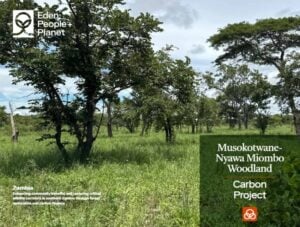
Zambia’s Musokotwane-Nyawa Miombo Woodland Carbon Project, part of Eden: People+Planet’s portfolio.
Located in the Kazungula District, this 185,000-hectare initiative restores wildlife corridors between Kafue and Mosi-oa-Tunya National Parks.
- The 40-year project aims to deliver 2.9–6 million verified carbon credits while supporting 23 communities.
Long-Term Community and Ecological Benefits
The project uses various restoration methods, including:
- Assisted natural regeneration of degraded woodlands
- Indigenous tree nurseries for planting
- Fire breaks and buffer zones
- Watershed rehabilitation for water security
Communities benefit from programs like climate-smart farming, sustainable beekeeping, and eco-friendly businesses. This ensures carbon revenues are not the only source of resilience.
A Model That Puts Communities First
The project prioritizes community benefits. Farmers receive upfront payments for eco-services through CCS seed funding. Once carbon revenues arrive, 60% of the proceeds, after fees, return to the farmers and their communities.
Currently, 25,000 farmers have joined, and this number is expected to double by 2025. This growth supports one of Sub-Saharan Africa’s most ambitious restoration efforts.
By the decade’s end, the program aims to plant 30 million native trees and reach the 2-million-tonne CO₂ target.

Two Pillars of Restoration
Farmers use two key strategies:
-
Introducing Native Trees to Farmlands: Adding trees to cropland improves soil, boosts food production, and captures carbon.
-
Restoring Miombo Woodlands: Farmers encourage natural regrowth, plant native species, and apply fire-prevention techniques to enhance biodiversity.
This dual approach increases productivity and resilience, linking environmental gains to livelihoods.
Transparency and Integrity at Scale
To ensure credibility, the project employs satellite monitoring alongside local field checks. Key indicators include fire reduction, woody biomass growth, and soil carbon accumulation.
Digital payments are tracked, and project revenues will be publicly reported and audited. The program will register under Verra’s reforestation methodology (VM0047), aligning with the Core Carbon Principles. It also aims for the ABACUS quality label at initial verification.
Carbon credits are expected to start in 2027, with verified removals over a 40-year lifespan.

Financing Big Ambitions
The Musokotwane-Nyawa project uses blended finance, combining philanthropy with carbon market mechanisms. It expects to channel about $90.8 million into restoration efforts.
Preparations are underway. By Q1 2026, the program will be fully implemented, planting 800,000 native trees and establishing fire prevention measures.
Tackling Drivers of Deforestation
Zambia’s Miombo ecosystems face pressure from slash-and-burn farming, unsustainable logging, and charcoal production. These practices harm landscapes, reduce biodiversity, and increase greenhouse gas emissions.
Both projects aim to reverse this. By restoring Miombo woodlands and protecting natural growth, they offer communities sustainable alternatives that lessen forest pressure.
Zambia’s Roadmap for Carbon Markets and Forest Conservation
These initiatives align with Zambia’s Eighth National Development Plan and the Green Economy and Climate Change Act of 2024. This framework regulates carbon markets, protects ecosystems, and directs funds toward climate resilience.
Zambia is also a pilot for the REDD+ mechanism, benefiting from international funding to protect forests. With 49 million hectares of forest, the country is poised to lead in high-integrity carbon projects.
Investment Potential: A Green Goldmine
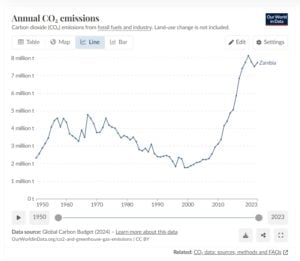
Zambia contributes about 6% of Africa’s carbon credit output and 0.7% globally. The potential is vast: Africa’s carbon markets could generate $6 billion annually by 2030, creating 30 million green jobs, according to the Africa Carbon Markets Initiative.
The global voluntary carbon market, valued at $331.8 billion in 2022, is projected to grow 31% annually from 2024 to 2028. Major companies like TotalEnergies and ENI are showing interest in Zambia’s market, attracting significant investment.
Beyond Carbon: Lasting Impact
Both initiatives aim for more than just carbon removal. They seek to:
- Restore biodiversity by reviving habitats
- Enhance food security through climate-smart farming
- Minimize wildfire risk and protect watersheds
- Boost household incomes through carbon revenues and new ventures
- Safeguard wildlife corridors vital for conservation across Southern Africa
This holistic approach makes Zambia’s Miombo woodland projects unique in the voluntary carbon market.
With carbon credits set to issue from 2027, Zambia’s community-led restoration projects are unlocking grassroots climate solutions. By combining community leadership, scientific methods, and innovative funding, they remove millions of tonnes of CO₂ while also promoting sustainable economic growth in rural Zambia.
The post Unlocking Zambia’s Carbon Market: Miombo Woodland Restoration to Remove 2M Tonnes of CO₂ Annually appeared first on Carbon Credits.
Carbon Footprint
How to improve Scope 3 data accuracy for CSRD
For most businesses, the emissions that matter most sit outside their own walls. Scope 3 emissions, everything generated across your value chain, from the suppliers who make your inputs to the customers who use your products, typically make up the majority of a company’s total carbon footprint. Under the Corporate Sustainability Reporting Directive (CSRD), those value-chain emissions now have to be measured and disclosed with a rigour that spend-based estimates alone struggle to satisfy. This guide sets out how to improve Scope 3 data accuracy for CSRD: the calculation methods open to you, how to move from estimates to verified supplier data, and how to govern that data so it holds up to audit.
![]()
Carbon Footprint
How community stewardship makes carbon credits durable
A carbon credit is a commitment that extends well into the future. The tonne of CO₂ compensated for today from a nature-based carbon project must remain out of the atmosphere for good, which means the forest behind the credit has to remain standing long after the transaction is complete. For any buyer, this raises a defining question: What ensures that the forest endures?
![]()
Carbon Footprint
Why Conventional Carbon Offsets Are Losing Boardroom Credibility
What replaced the cheap REDD credit on the boardroom slide deck, and why procurement is leading the rewrite.
Three years ago, a corporate slide showing a portfolio of cheap REDD+ credits could carry a board meeting. The number was big, the price was low, and the press release wrote itself. Today, that same slide gets sent back with questions. The questions are uncomfortable, the answers are unclear, and your general counsel is suddenly in the room.
Conventional carbon offsets are not dead. The voluntary carbon market retired 202 million tonnes in 2025, and the Morgan Stanley Institute for Sustainable Investing survey published in January 2026 confirmed that interest from corporate buyers remains substantial. What changed is the credibility threshold. The integrity floor has risen, the disclosure scrutiny has tightened, and the buyer profile has shifted. This article tracks what changed, what sophisticated buyers now ask before signing, and what serious corporates are putting on the board slide instead.
What boards used to buy, and why it stopped working
The 2020 to 2022 model was simple: buy a large tranche of avoidance credits at low single-digit prices, retire them against the company footprint, announce the carbon-neutral claim, and move on. Most of those credits came from REDD+ projects, renewable energy installations in countries where the renewable energy was already economic, or methane projects with thin documentation.
Several things broke that model. Academic research published in 2023, including a widely cited Science paper, found that the majority of REDD+ credits issued under the most common methodologies did not represent additional reductions when tested against rigorous counterfactuals. The Voluntary Carbon Markets Integrity Initiative published its Claims Code of Practice, which sets requirements for what companies can credibly claim from credit use. The European Union finalised its Green Claims Directive, restricting how companies can describe products as climate-neutral. France’s Décret 2022-539 already restricts carbon neutrality advertising. California’s AB 1305 imposes disclosure requirements on any company making net-zero or carbon-neutral claims while doing business in the state.
The collective effect: the cheap credit no longer buys the announcement, and the announcement now carries litigation risk.
The integrity reset: ICVCM, VCMI, and what changed
The Integrity Council for the Voluntary Carbon Market published the Core Carbon Principles in 2023 and began assessing methodologies against them in 2024. The first methodologies received the CCP label later that year. The point of the label is to give corporate buyers a defensible quality screen they can cite in disclosure.
The Voluntary Carbon Markets Integrity Initiative complements this on the demand side. Its Claims Code of Practice defines what a buyer can say (Silver, Gold, or Platinum claims, with associated requirements) based on the quality of credits used and the underlying decarbonisation strategy. Together, CCP and VCMI build a quality stack: CCP on the supply, VCMI on the claim, with the science-based target sitting underneath both.
The reset is not a ban on offsets. It is a ratchet. Credits that meet the new bar continue to clear; credits that do not, do not. The Morgan Stanley survey found that 61% of current buyers like the CCP label concept but that supply of labelled credits remains limited. That supply constraint is now visible in pricing.
What sophisticated buyers ask before they sign
The questions on the procurement scorecard have changed. A 2022 buyer might have asked about price, vintage, and project type. A 2026 buyer asks five different questions before any of those.
- What does the counterfactual look like, and who validated it.
- What is the permanence regime, and what is the buffer pool exposure.
- What is the leakage risk, and how is it mitigated.
- What rating has the project received from the independent ratings agencies (Sylvera, BeZero, Calyx Global), and what was the rationale.
- What is the documentation discipline that survives an audit four years from now when the procurement team that signed the contract has moved on.
If the vendor cannot answer those five questions on a first call, the conversation ends. Conversely, if the vendor can answer them with documented specificity, the conversation often expands beyond a single transaction toward a multi-year engagement.
Where this leaves your near-term commitments
You probably have near-term commitments that pre-date the integrity reset. Public targets to be carbon neutral by 2025 or 2030. Product-level claims that ran in last year’s marketing. Disclosed reduction trajectories that assumed continued access to cheap credits.
You have three workable paths. The first is to re-baseline your strategy, replacing the most exposed credits with higher-quality alternatives and adjusting the public language to match what you can defend. The second is to shift the underlying spend from offsetting outside your value chain to investing inside your value chain, where reductions count against Scope 3 directly and the audit trail is cleaner. The third is to keep the strategy and absorb the risk, which is increasingly the most expensive option once you price in litigation, restatement, and reputational exposure.
Most serious buyers are choosing the second path. It moves the carbon spend from a compliance cost to a procurement and resilience investment, and it removes the central failure point of the legacy model: the disconnect between where the emissions occurred and where the reductions sat. Nature-based supply chain investments, structured under the GHG Protocol Land Sector and Removals Standard and aligned to the SBTi FLAG Guidance, are the asset class that fits this brief. They generate inventory-grade reductions, they produce audit-grade documentation, and they survive the new claim restrictions because the carbon math sits inside the value chain that the disclosure already covers.
If you are reassessing a carbon strategy under the new integrity bar, or rebuilding a board narrative that has to survive a more skeptical audience, the carbon and sustainability experts at Carbon Credit Capital can help. The Dual-Value Model gives you a defensible alternative to legacy offset purchases, with the documentation and operational integration that survives the procurement scorecard and the audit. Schedule a consultation.
-
Climate Change11 months ago
Guest post: Why China is still building new coal – and when it might stop
-
Greenhouse Gases11 months ago
Guest post: Why China is still building new coal – and when it might stop
-
Greenhouse Gases2 years ago嘉宾来稿:满足中国增长的用电需求 光伏加储能“比新建煤电更实惠”
-

Climate Change2 years ago嘉宾来稿:满足中国增长的用电需求 光伏加储能“比新建煤电更实惠”
-
Climate Change2 years ago
Bill Discounting Climate Change in Florida’s Energy Policy Awaits DeSantis’ Approval
-
Renewable Energy9 months agoSending Progressive Philanthropist George Soros to Prison?
-
Carbon Footprint2 years agoUS SEC’s Climate Disclosure Rules Spur Renewed Interest in Carbon Credits
-
Greenhouse Gases1 year ago
嘉宾来稿:探究火山喷发如何影响气候预测

