By Leonie Jaeger (ICBM Oldenburg)
The ocean is the dominant climate regulator of our Earth. I am on board the RV Meteor to conduct measurements that helps us better understand the critical processes at the interface between the atmosphere and the ocean. The focus of these measurements is heat and freshwater fluxes, two key drivers that both influence and regulate Earth’s climate.
The ocean stores and transports vast amounts of heat across the whole globe. The exchange of heat between the atmosphere and the ocean is controlled by different surface heat fluxes. The sun emits shortwave radiation, which warms the surface ocean, though part of this radiation is reflected at the water surface. At the same time, the ocean emits longwave radiation towards the sky due to its temperature, some of which is reflected and absorbed by water vapor and clouds. To quantify these fluxes, I use radiometers: sets of upward- and downward-looking sensors that measure radiation coming from the sky and from the ocean. Specifically, pyranometers measure shortwave radiation, while pyrgeometers measure longwave radiation.
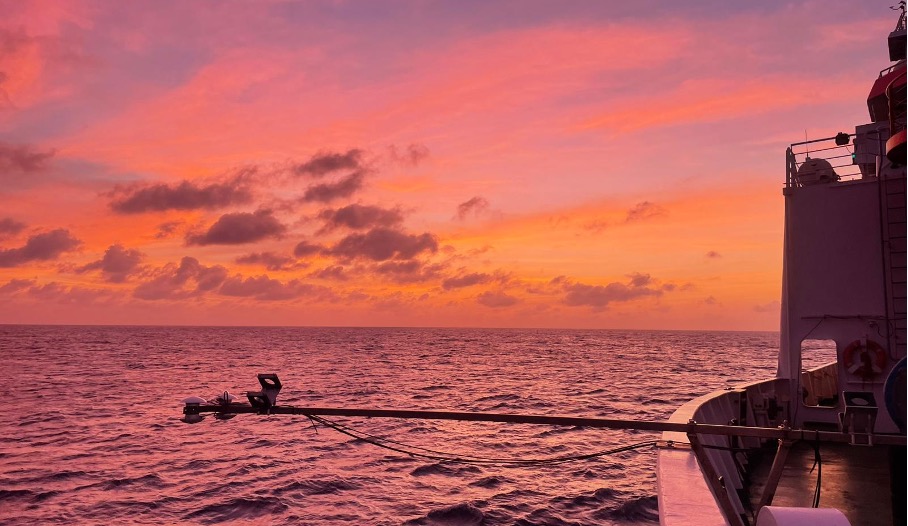
Over the open ocean, freshwater fluxes result from two processes: evaporation and precipitation. Approximately 80% of the global freshwater flux occurs over the ocean, underscoring the ocean’s dominance in the global water cycle and its influence on climate over land. In a warming climate, evaporation is expected to intensify as temperatures rise and the atmosphere’s capacity to hold moisture increases. That makes is very important to better understand these fluxes. However, high-quality measurements of precipitation and evaporation using remote techniques remain challenging. On this cruise, I am using a disdrometer, an instrument that measures rain in high resolution. It allows us to investigate not only the total amount of rain but also the velocity and size of individual raindrops, enabling a detailed characterization of rain events.
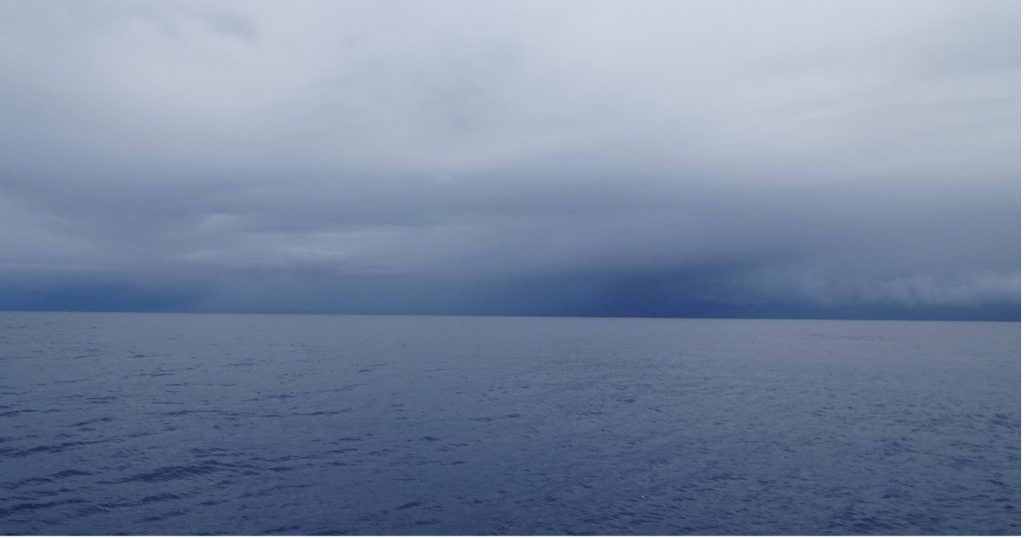
Our cruise track crosses the Atlantic Ocean from South to North, passing the equator. This transect will provide a valuable dataset. Importantly, we will cross the Inter-Tropical Convergence Zone (ITCZ), a region near the equator characterized by heavy rain and thunderstorms. These storms originate from warm, moist air that rises continuously. As the air rises, it cools and condenses, forming thick clouds and intense precipitation. Because the ITCZ is driven by the convergence of trade winds from both hemispheres, it maintains persistent bands of convection. In this zone, these convective systems can trigger even more convection in the atmosphere driving the tropical climate. Together with warm surface temperatures, these high-energy processes can lead to the genesis of tropical cyclones. Thus, the atmosphere influences the ocean, and the ocean influences the atmosphere. Direct measurements at their interface are essential to better understand these processes shaping our climate. My responsibilities include installing and maintaining the measurements systems, as well as data validation and data storage. Maintaining sensors close to the ocean requires frequent cleaning, because sea spray leaves salt deposits everywhere, leading to corrosion. Together with ship-based measurements such as air temperature, wind speed and humidity, and oceanographic underway measurements including continuous observation of the water temperature, salinity, turbidity and chlorophyll, our data will provide a comprehensive dataset to study fresh and heat water fluxes between the ocean and the atmosphere.
Ocean Acidification
METEOR Sets Sail on Its Final Voyage
Welcome to the M219 ocean blog!
Here, we will share updates and stories about the scientific work taking place during this research expedition. We also hope to offer a glimpse into daily life and work at sea.
For many members of the scientific party, this is their first time aboard METEOR. It will also be their last, as METEOR is embarking on its final voyage before retiring from service as a German research vessel after more than 40 years at sea. Over the course of its distinguished career, METEOR has travelled more than 1.7 million nautical miles, which is equivalent to more than 8 times the distance between the Earth and the Moon. Throughout those decades the vessel has supported countless scientific discoveries and generations of marine scientists. We are very grateful and honored to be part of the final chapter of this remarkable ship’s history and to accompany her on the last few thousand miles of her legendary journey.

The scientific program of this cruise focuses on long-term observations of ocean currents off the coast of Brazil and at the equator, as well as interdisciplinary measurements near the Cape Verde Islands. At all these sites, GEOMAR has maintained observational programs for the past 10 to 20 years. Over the next four weeks, we will introduce these regions and the measurements carried out there in more detail. But first, let’s look at what happened in Brazil before the cruise began.
On Thursday, May 28, many of the scientists and students left the hotel early in the morning to attend a seminar at the Universidade Federal de Pernambuco (UFPE), celebrating the long-standing scientific collaboration between Brazil and Germany.
The seminar was opened by Prof. Dr. Marius Müller, a former student at GEOMAR and now a professor for biological oceanography at UFPE. These meetings have become a valued tradition, having been organized for more than 20 years by now. This year marked the 9th edition of the seminar since its inception over 20 years ago.
A total of 8 scientists and students from Brazil, Germany, and the U.S. presented their research on various aspects of the tropical Atlantic Ocean. We would like to thank Marius Müller, Doris Veleda and all the Brazilian scientists and students who helped organize the seminar and provided such a warm welcome. We greatly enjoyed the exchange of ideas and look forward to celebrating the 10th seminar in the years to come.

After the seminar we returned to the hotel, but there was little time to rest. Later that same day, the captain of METEOR and the German Consul General in Recife hosted a reception aboard METEOR in the Port of Recife.
The event brought together members of the scientific party, representatives of local institutions, and guests from the Brazilian and German scientific communities. It provided an excellent opportunity to celebrate the long-standing partnership between the two countries.

On Friday, May 29, the scientific party finally boarded METEOR. There was little time to settle into our cabins and workspaces, as preparations for departure were already in full swing. We left the Port of Recife as soon as possible and at around 1pm METEOR set sail and began the final voyage of her remarkable career.
About 12 hours after leaving port, we arrived at our first station. Thanks to the dedicated efforts of technical and scientific teams, all instruments had been installed and prepared in time for the start of operations. This station marked the beginning of our observational program off the coast of Brazil, which includes the deployment and recovery of tall moorings as well as CTD measurements. An intensive first week lies ahead, with a demanding schedule of measurements and mooring operations. After months of planning and preparation, everyone is excited to finally begin the scientific work and make the most of the final weeks aboard METEOR.

Ocean Acidification
All About Gobies
There are more than 2,000 species of gobies (Gobiidae) known to science today, making them the largest family of fish in the ocean. But these small creatures are far more complex and essential to marine ecosystems than first meets the eye. Found all around the world in brackish, fresh and salt water in tropical and subtropical regions, they are an astonishingly diverse group of fish with several curious characteristics that set them apart.
Most gobies are quite small and don’t usually measure more than six inches long. Measuring just about eight millimeters long, the dwarf pygmy goby (Trimmatom nanus) is not only the tiniest goby known to science but also one of the smallest of all fish species in the world.
Primarily bottom-dwellers, gobies are known to be excellent foragers and have evolved expert burrowing behaviors over time. As they sift around looking for food like copepods, seaworms and tiny crustaceans, their movement helps to aerate sediment and keep algae in check. Some are even known to be “cleaner fish,” snacking on parasites they remove off larger creatures. It’s like a spa day for the animal being cleaned and a choose-your-own-adventure buffet for the gobies. Studies also show that cleaner goby activity is largely tied to the microbial health of coral reefs, showcasing that even the tiniest of species are essential to functioning marine ecosystems.
Gobies have some unique aspects to their anatomy, too. First, their fused pelvic fins are designed to help them form a strong suction cup to perch on coral reefs, rocks and other ocean terrain amidst turbulent currents. Some freshwater species are even known to use this suction to climb waterfalls. It may come as no surprise then that gobies are cousins to mudskippers, animals known to “walk” through mud. There are more species-specific features that set certain gobies apart. From the use of bioluminescence to symbiotic relationships with shrimp, the adaptations within the goby family are truly wide-ranging. Some species have even been found to use marine terrain memorization to navigate back to the tide pools where they were born. Isn’t nature mind-blowing sometimes?
Get Ocean Updates in Your Inbox
Sign up with your email and never miss an update.
Gobies have equally complex and varied behaviors. Male gobies are infamous for being territorial protectors of their nests. Many larger males are known as “guarders;” these hopeful fish make careful nests to attract a mate, and once fertilization occurs, guarders will remain diligently near the nests to keep eggs safe. However, there’s another type of male goby that complicates this dynamic. These other males are known as “sneaker gobies” and are called that for one reason: They’re sneaky! If guarder gobies aren’t careful, sneakers can creep into the nest, fertilize some of the eggs and quickly escape. As if on an underwater episode of Maury, guarder males who aren’t careful could end up unknowingly babysitting little gobies that aren’t their actual offspring.
Gobies serve as indicators of ecological health and are essential to keeping delicate food webs in check. Unfortunately, many changes in our ocean threaten their ability to survive and thrive today. Coral bleaching and degradation endanger the health of one of their key habitats, and a combination of warming waters and coastal development can make it difficult for both juvenile and adult gobies to survive and thrive.
Healthy gobies mean a healthy ocean. Their essential role in marine ecosystems demonstrates that even the tiniest creatures play a major role in helping hold together the beautiful yet fragile habitats that make up our beloved ocean. Visit Ocean Conservancy’s Action Center and join the movement to protect our blue planet today and for years to come—from the tiniest goby to the largest whales, our ocean is counting on us.

The post All About Gobies appeared first on Ocean Conservancy.
Ocean Acidification
Do You Know the Difference Between El Niño and La Niña?
Recently, you may have heard about something called “El Niño.” But what exactly is El Niño and its sibling “La Niña”? Why do these terms seem to emerge from the depths of the scientific community and drop into popular vocabulary every few years? And how are they connected to extreme weather and our ocean?
What Are El Niño and La Niña?
El Niño and La Niña are part of a natural climate pattern in the tropical Pacific called the El Niño-Southern Oscillation, or ENSO. These two phases are different sides of the same coin, creating equally extreme shifts in temperature and air pressure.
El Niño occurs when surface water in the equatorial Pacific becomes warmer than average and easterly winds weaken. La Niña is the opposite: cooler-than-normal sea surface temperatures and stronger easterly winds. ENSO cycles can last up to seven years. El Niño and La Niña significantly impact weather patterns in all corners of the globe, often leading to more extreme weather, storm frequency and intensity.
A strong El Niño can cause flooding in some regions and drought, heat waves and wildfires in others. It often causes crop losses, coral bleaching and marine die-offs due to unusually warm ocean temperatures. El Niño tends to suppress Atlantic hurricane activity, though it increases the risk of heavy precipitation and harm to fisheries elsewhere. In the Northern Hemisphere, El Niño typically builds between March and June, peaks in December, and weakens by February.
La Niña, by contrast, often fuels an active Atlantic hurricane season and increases tornado frequency across the southern United States. Like El Niño, it builds in spring and peaks around December.
Get Ocean Updates in Your Inbox
Sign up with your email and never miss an update.
Predicting ENSO
In 1923, the physicist Sir Gilbert Walker discovered the “Southern Oscillation,” or large-scale changes in sea level pressure across the tropical Pacific. However, it wasn’t until the late 1960s that the metorologist Jacob Bjerknes found that the changes in the ocean and the atmosphere were connected, and the hybrid term “ENSO” was born. In 1974, researchers at Oregon State University attempted to predict ENSO for the first time.
Modeling has greatly advanced since the early days. Today, scientists at the National Oceanic and Atmospheric Administration (NOAA) issue regular predictions about ENSO, which are now more accurate than ever.
NOAA gives a one-in-four chance that an El Niño could reach “very strong” intensity later in 2026, qualifying it as a “super El Niño.” This threshold has been crossed only a handful of times in recorded history, each triggering droughts, floods and record temperatures across multiple continents. NOAA’s data and models deliver life-saving early warning forecasts, like that of the predicted super El Niño, which allow communities to better prepare for and respond to extreme weather events.

Take Action
Every American, regardless of where they live, depends on NOAA’s scientists and professionals, whose work spans from the ocean floor to the far reaches of space. Unfortunately, NOAA is under threat. The Trump administration has proposed billions of dollars in cuts to the agency, which could weaken weather forecasting, disrupt fisheries management and stall critical ocean research, putting American lives and global scientific leadership at risk.
Ocean Conservancy is committed to working with NOAA to keep the public informed on climate and ocean science. We all benefit from a healthier ocean, and investing in research is the most effective way to restore ocean health and reduce the impact of severe weather events caused by El Niño and La Niña. Our ocean is not partisan, and protecting it requires all hands on deck and all sides of the aisle. Now, it’s more important than ever to demand that members of Congress prioritize our ocean. Add your name now.
The post Do You Know the Difference Between El Niño and La Niña? appeared first on Ocean Conservancy.
-
Climate Change10 months ago
Guest post: Why China is still building new coal – and when it might stop
-
Greenhouse Gases10 months ago
Guest post: Why China is still building new coal – and when it might stop
-
Greenhouse Gases2 years ago嘉宾来稿:满足中国增长的用电需求 光伏加储能“比新建煤电更实惠”
-
Climate Change2 years ago嘉宾来稿:满足中国增长的用电需求 光伏加储能“比新建煤电更实惠”
-
Climate Change2 years ago
Bill Discounting Climate Change in Florida’s Energy Policy Awaits DeSantis’ Approval
-
Renewable Energy8 months agoSending Progressive Philanthropist George Soros to Prison?
-
Carbon Footprint2 years agoUS SEC’s Climate Disclosure Rules Spur Renewed Interest in Carbon Credits
-
Greenhouse Gases11 months ago
嘉宾来稿:探究火山喷发如何影响气候预测
