Verde AgriTech, a company based in Brazil, has entered into an exclusive partnership with UNDO Carbon Ltd., a UK-based firm. Under this agreement, they will work together to create carbon removal credits. These credits will come from a process called Enhanced Rock Weathering (ERW), using a special mineral that Verde mines in Brazil.
This deal marks Verde’s first major step into the carbon credit market. Both companies believe their combined strengths can lead to large-scale removal of carbon dioxide (CO₂) from the atmosphere.
What Is Enhanced Rock Weathering (ERW)?
ERW is a method to capture CO₂ using natural minerals. The idea is to spread crushed rock, rich in silicate minerals, over farmland. When rain and soil interact with this rock, a natural chemical reaction pulls CO₂ from the air. Over time, that CO₂ becomes part of new, stable minerals — basically locking it in the ground.
UNDO specializes in this technique. They have developed systems to measure how much carbon is removed. They also know how to verify and package these removals into credits that companies can buy.
- RELATED: Microsoft and UNDO Partner for 15,000 Tons of Carbon Removal Using Enhanced Rock Weathering!
Scaling Carbon Removal Together
The partnership allows Verde to expand beyond fertilizers and minerals by selling carbon removal credits. Verde brings a large supply of glauconitic siltstone, mining operations, field-application capacity across Brazil, and local expertise in soil, agriculture, and mineral processing.
In effect, UNDO gains reliable access to mineral feedstock and a strong local partner, essential for scaling ERW projects. Verde’s facilities can handle, crush, and spread the rock, supported by its logistics and soil sampling experience.
UNDO will handle the measurement, reporting, and verification (MRV) of CO₂ removed from the atmosphere. Their platform uses proprietary (patent‑pending) protocols to ensure the credits are real and permanent.
- Together, they aim to remove hundreds of thousands of tonnes of CO₂, with each tonne of rock capturing 70–120 kilograms depending on conditions.
Verde’s mineral reserves, in the hundreds of millions of tonnes, give the partnership long-term capacity to meet these goals.
The deal also offers a new revenue stream for the agritech company and high-quality credits verified through strict MRV, aligning with standards such as Verra, Gold Standard, and Puro.earth.
Cristiano Veloso, Founder and CEO, Verde, said:
“By combining our glauconitic siltstone products and established operations in Brazil with UNDO’s award-winning expertise in measurement, reporting, and verification, we aim to originate and deliver durable, high-quality carbon removal credits aligned with global best practices, including leading Enhanced Rock Weathering methodologies .”
The warrant system further aligns interests: UNDO benefits only when credits are sold, while Verde shares in future growth. With these combined strengths, the partnership could scale ERW locally and globally, providing credible, durable carbon removal.
Turning CO₂ Into Credible Carbon Credits
Verde and UNDO plan to sell the carbon removal credits to companies that want to offset their emissions. These credits are expected to be durable — meaning the CO₂ will stay locked away for a very long time.
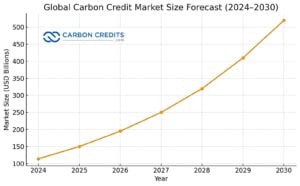
The voluntary carbon market has grown steadily in recent years. Industry estimates show it reached around $2 billion in annual transactions. Projections suggest that it could rise to over $40 billion by 2030 as companies demand more high-quality carbon removal. This growth provides a strong commercial foundation for Verde and UNDO as they prepare to bring ERW credits to market.
Meanwhile, estimates show the global carbon market will rise sharply by 2030.
To align incentives, Verde is granting UNDO up to 1.7 million share purchase warrants. These warrants will vest (or become usable) based on future sales of carbon credits.
Here is how the warrant structure works:
- Initial warrants: 100,000 options, tied to credit sales at a high price per ton of CO₂.
- Additional warrants: 1,000,000, tied to more credit sales at slightly lower prices.
- Success-based warrants: 600,000, tied to further future sales if targets are met.
Verde’s Long Road to Carbon Market Leadership
Verde’s entry into carbon credits is not instant. In 2023, the company announced plans to enter the market. It highlighted the potential of its silicate rock for ERW to capture a lot of CO₂.
Based on its mineral reserves and processing capacity, Verde estimates it can produce up to 300,000 tonnes of carbon removal credits annually. This shows that carbon removal is a long-term strategic focus, not a side project.
To prepare, Verde explored partnerships that could strengthen its expertise in carbon markets. Verde teamed up early with WayCarbon, a well-known carbon project developer. They looked into how Verde’s minerals could help remove carbon and generate revenue.
WayCarbon guided Verde on project design, verification paths, and market demand. This helped Verde grasp what’s needed for high-quality, credible carbon credits.
These steps helped Verde gain experience in science, market trends, and regulations. This groundwork paved the way for bigger deals, like its current partnership with UNDO.
Studies in journals like Nature and PNAS back ERW’s effectiveness. They show that finely crushed silicate rock can capture CO₂ in months to years.
The carbon stays stored in mineral form for tens of thousands to millions of years. This validates Verde’s confidence in its mineral reserves as a tool for long-term climate mitigation.
ERW in Action: Impact on Emissions and Agriculture
This deal is part of a larger trend in the climate field: companies are looking for durable, scalable ways to remove CO₂. Enhanced Rock Weathering is one such method. When done right, it can store carbon for very long periods.
Brazil emits roughly 2.4 to 2.7 billion tonnes of CO₂-equivalent each year, depending on land-use trends. Agriculture accounts for about one-quarter of national emissions. Because ERW is deployed directly on farmland, it offers a pathway to reduce or offset part of this sector’s footprint while improving soil conditions.
Partnerships like this one help make carbon removal more real and credible. They mix scientific innovation (UNDO’s MRV systems) with physical capacity (Verde’s mineral operations). This could attract more buyers who want serious, long-term climate solutions.
However, scaling ERW also comes with challenges. Large-scale rock crushing and distribution can increase operational costs, and long-term monitoring requires specialized scientific methods.
Regulatory clarity for ERW credits is still developing in many markets, and some buyers remain cautious as they compare different carbon removal approaches. These factors may influence how quickly Verde and UNDO can expand their projects.
Blueprint for Scalable, Durable Carbon Removal
Verde AgriTech’s exclusive partnership with UNDO Carbon is a major step for both companies. Verde gains a new source of income. UNDO secures a reliable supply of mineral feedstock for its ERW work. Together, they hope to produce high-quality, durable carbon credits from Brazil.
If they succeed, they could remove hundreds of thousands of tonnes of CO₂ while building a scalable model for future carbon removal. Their partnership could become a blueprint for how mining and climate technology firms work together to fight climate change — not just in Brazil, but around the world.
The post Verde AgriTech and UNDO Carbon Partner to Scale Enhanced Rock Weathering appeared first on Carbon Credits.
Carbon Footprint
Tesla Q1 2026 Hits $22.38B Revenue – But Do Weak Deliveries and Falling Credits Expose a Fragile Growth?
Tesla (TSLA) reported a mixed performance in the first quarter of 2026 (Q1 2026. The company beat earnings expectations and delivered stronger margins, but several underlying trends pointed to weakening demand signals and rising execution pressure across key segments.
Earnings Beat, But Growth Is Not Fully Organic
Tesla posted revenue of $22.38 billion, slightly ahead of Wall Street expectations of $22.3 billion. Earnings came in at $0.41 per share (non-GAAP), above the expected $0.37. This marked a clear improvement from Q1 2025, when the company reported weaker results. Revenue grew about 14% year over year, while earnings rose roughly 33%.
However, the quality of earnings raised questions. Tesla itself highlighted that part of the profit improvement came from one-time benefits tied to warranties and tariffs. These are not recurring revenue sources. As a result, the headline beat does not fully reflect the underlying operating strength.
Margins Improve, But Vehicle Demand Weakens
One of the strongest positives in the quarter was profitability. Tesla’s gross margin rose to 21.1%, compared to 16.3% a year ago and 20.1% in the previous quarter. This was one of the best margin performances in recent periods and showed better cost control and pricing stability.
But the demand picture told a different story.
Tesla delivered 358,023 vehicles, falling short of expectations by around 7,600 units. At the same time, production exceeded deliveries by more than 50,000 vehicles. This created a noticeable inventory buildup.

This gap matters because it suggests supply is running ahead of demand. If this continues, Tesla may face pricing pressure, higher discounts, or slower production adjustments in future quarters. In simple terms, the company is producing more cars than the market is absorbing right now.
Regulatory Credit Revenue Slides 30%
Another weak point was the sharp decline in regulatory credit revenue. Tesla generated about $380 million in Q1 2026, down from $542 million in Q4 2025, a drop of nearly 30% in just one quarter.

These credits have historically been one of its highest-margin income streams. The company earns them by producing zero-emission vehicles and selling surplus credits to other automakers that fail to meet emissions requirements.
The decline in credit revenue reflects a structural change in the EV market. More automakers are now producing electric vehicles, and emissions rules are evolving. This reduces demand for Tesla’s credits over time. As a result, Tesla is becoming less dependent on this high-margin but unpredictable revenue stream.
Energy Storage Weakens Despite Long-Term Potential
Tesla’s energy business also showed softness in Q1. Energy storage deployments fell to 8.8 GWh, down 38% from the previous quarter. This was significantly below analyst expectations and marked a slowdown in momentum for a key growth area.
Even so, Tesla continues to invest heavily in energy. The company is expanding its Megafactory near Houston, which will produce next-generation Megapack systems. Production is expected to begin later this year, and the facility is central to Tesla’s long-term energy strategy.
The company also began rolling out its new in-house solar panels. These panels are designed to perform better in low-light conditions and offer faster installation. While early in deployment, Tesla sees energy products as a long-term growth engine that can complement its vehicle business.

Autonomy, AI, and Robotics Define the Long-Term Vision
Tesla continues to shift its focus toward advanced technologies, particularly autonomy, artificial intelligence, and robotics.
- In the Robotaxi program, paid miles nearly doubled compared to the previous quarter. It is expanding testing and regulatory groundwork across multiple U.S. cities, including Austin, Dallas, and Houston. The company is preparing for a broader rollout and expects its upcoming Cybercab to eventually become a core fleet vehicle.

- In robotics, Tesla is accelerating work on its Optimus humanoid robot. The company plans to build a dedicated large-scale production facility. The first phase targets a capacity of up to one million robots per year, with long-term expansion plans reaching significantly higher volumes.
- In artificial intelligence, the company is moving toward semiconductor development. It is working with SpaceX to develop chip manufacturing capabilities. The goal is to build a vertically integrated system covering chip design, fabrication, and packaging.
Tesla has already completed the design of its next-generation AI5 inference chip, which will support future autonomy and robotics workloads. This step is important because chip demand is expected to rise sharply as Robotaxi and Optimus scale.
FSD Numbers Remain Unclear
Tesla reported 1.28 million Full Self-Driving (FSD) users, but the figure includes both subscription users and customers who purchased the package outright. This makes it difficult to understand actual subscription growth.
The company has also pushed more customers toward subscription-based access in recent quarters. While this may improve recurring revenue over time, the current reporting structure makes trends harder to track clearly.
PG&E and Tesla’s Vehicle-to-Grid Push Expands Energy Role
A notable development this quarter came from Tesla’s partnership with Pacific Gas and Electric Company. Tesla’s Cybertruck and energy products are now part of PG&E’s Vehicle-to-Everything (V2X) program.
This system allows electric vehicles to send power back to homes or the grid. During outages, vehicles can act as backup power sources. During peak demand, they can export electricity to stabilize the grid and earn compensation.
Additionally,
- Customers participating in the program can receive up to $4,500 in incentives, along with additional payments for participating in grid events.
- The system uses AC-based bidirectional charging, which reduces complexity compared to traditional DC systems.
This development is important because it expands the role of electric vehicles beyond transportation. EVs are increasingly becoming distributed energy assets that support grid stability, especially in high-adoption markets like California.
Is Musk Balancing Two Futures?
Tesla’s Q1 2026 results show a company moving through a transition phase. On one side, profitability is improving, and margins are strong. On the other hand, demand signals are weakening in key areas such as vehicle deliveries, energy storage, and regulatory credit revenue.
At the same time, it is investing aggressively in long-term technologies like autonomy, robotics, and AI infrastructure. These areas could define the company’s future growth, but they remain early-stage and execution-heavy.
The key challenge ahead is balance. Tesla must manage short-term operational pressure while scaling long-term bets that are still under development. The direction is clear, but the path forward will depend heavily on execution in the coming quarters.
The post Tesla Q1 2026 Hits $22.38B Revenue – But Do Weak Deliveries and Falling Credits Expose a Fragile Growth? appeared first on Carbon Credits.
Carbon Footprint
RBC and Scotiabank Step Back on Climate Targets as Policy Support Weakens and AI Drives Energy Demand
Canada’s biggest banks are quietly resetting their climate ambitions. As reported by The Canadian Press, both Royal Bank of Canada (RBC) and Scotiabank have pulled back from key interim emissions targets, signaling a broader shift in how financial institutions are navigating the energy transition.
The move reflects a more complicated reality. Climate goals are colliding with policy uncertainty, geopolitical tensions, and a sharp rise in energy demand—especially from artificial intelligence. What once looked like a clear path to net zero is now far less predictable.
RBC Does a Reality Check on 2030 Targets
RBC had set clear 2030 targets in 2022. The bank aimed to reduce financed emissions across three high-impact sectors: oil and gas, power generation, and automotive. These interim goals were meant to guide its broader ambition of reaching net-zero financed emissions by 2050.
However, in its 2025 sustainability report, the bank acknowledged that the landscape has changed significantly. After reviewing policy shifts, global energy trends, and technology progress, the bank concluded that some of these targets are simply “not reasonably achievable.”
This is not a complete retreat. RBC is still committed to its long-term net-zero goal. But the bank is adjusting its expectations. It now emphasizes that success depends heavily on external factors—strong government policies, technological breakthroughs, and stable capital flows.
In simple terms, RBC is saying it cannot drive the transition alone.

- ALSO READ: Canada to Launch Sustainable Investment Taxonomy in 2026 to Guide Green and Transition Finance
Strategy Shifts Toward Flexibility
Instead of sticking to rigid targets, RBC is moving toward a more flexible approach. The bank will continue tracking emissions intensity in key sectors and reporting absolute emissions for oil and gas. At the same time, it is doubling down on financing the transition.
Its strategy now focuses on supporting clients through the shift to a low-carbon economy. This includes advising companies on decarbonization, investing in climate solutions, and scaling financing for clean energy. RBC is also working to manage its exposure to high-emission sectors while capturing opportunities in emerging technologies.
To support this transition, the bank is strengthening internal capabilities across its energy transition, sustainable finance, and cleantech teams. These efforts aim to align its business growth with long-term climate goals while remaining responsive to changing market conditions.
- MUST READ: Mark Carney Admits Canada Will Miss 2030 and 2035 Climate Targets as Policy Rollbacks Slow Progress
Scotiabank Goes Further: Net Zero Goal Dropped
While RBC has recalibrated, Scotiabank has taken a more decisive step. The bank has not only withdrawn its interim 2030 targets but also scrapped its goal of achieving net-zero financed emissions by 2050.
This marks a significant shift.
According to its sustainability report, the bank cited slower-than-expected progress in climate policy, rising global energy demand, and delays in key technologies such as carbon capture. It also pointed to major policy changes, including the rollback of parts of the U.S. Inflation Reduction Act and Canada’s removal of the consumer carbon tax.
Scotiabank said the assumptions behind its 2022 targets no longer reflect current realities. The transition, it noted, is not moving as quickly as expected.
Still, the bank continues to focus on managing climate-related risks and financing opportunities. It remains committed to mobilizing $350 billion in climate-related finance by 2030 and has already delivered over $200 billion since 2018.

Climate Momentum Slows Across Canada
The banks’ decisions reflect a broader slowdown in climate momentum across Canada.
Insights from RBC’s Climate Action 2026: Retreat, Reset or Renew show that, for the first time, the Climate Action Barometer has declined. This index tracks climate-related progress across policy, capital flows, business activity, and consumer behavior.
The drop was broad-based. Policy changes, including the removal of the consumer carbon tax and the reduction of electric vehicle incentives, weakened momentum. At the same time, economic uncertainty and trade tensions shifted focus toward affordability and job creation.
Energy policy also added friction. Restrictions on renewable energy development in Alberta slowed project pipelines. As a result, both businesses and consumers pulled back on clean energy investments.
Capital Flows Show Signs of Caution
Investment trends reinforce this shift. Climate-related investment in Canada has plateaued at roughly $20 billion per year. However, public funding continues to provide support, with nearly $100 billion in clean technology incentives planned through 2035. But private capital is becoming more cautious.
Investors are increasingly selective, particularly when it comes to early-stage climate technologies. Policy uncertainty is amplifying risks in sectors like renewable energy and clean manufacturing.
While some regions—such as Canada’s East Coast wind projects—continue to attract funding, overall growth has slowed.
AI and Energy Demand Complicate the Transition
Another major factor reshaping the transition is the rapid rise in energy demand from artificial intelligence.
AI systems require vast computing infrastructure, and data centers are expanding quickly. This surge in electricity demand is putting pressure on energy systems already trying to decarbonize.
For banks, this creates a difficult balancing act. They must support high-growth sectors like AI while also working to reduce emissions. This tension makes near-term climate targets harder to meet.
A Shift From Targets to Transition
The decisions by RBC and Scotiabank highlight a broader shift in strategy. Instead of rigid interim targets, banks are moving toward a more flexible, transition-focused approach.
They recognize that achieving net zero depends on factors beyond their control—policy support, technology development, and global energy demand. When those factors shift, strategies must adapt.
Rather than committing to targets that may become unrealistic, banks are focusing on financing solutions, managing risks, and supporting clients through the transition.
The Road Ahead
The rollback of interim targets signals a more cautious phase in the energy transition. It shows that progress is uneven and heavily dependent on policy alignment and market conditions.
RBC continues to hold its long-term net-zero ambition. Scotiabank, meanwhile, is prioritizing flexibility and risk management. Both approaches reflect a more complex and uncertain path forward.
Ultimately, achieving net zero will require stronger coordination between governments, industries, and financial institutions. Without that alignment, even the most ambitious climate plans will face significant hurdles.
For now, Canada’s largest banks are adjusting course—responding to a transition that is proving far more challenging than expected.
The post RBC and Scotiabank Step Back on Climate Targets as Policy Support Weakens and AI Drives Energy Demand appeared first on Carbon Credits.
Carbon Footprint
India and South Korea Sign Article 6.2 Deal as Global Carbon Trading Gains Momentum
India and South Korea have signed a cooperation agreement under Article 6.2 of the Paris Agreement. This is a key step for creating cross-border carbon markets between these two major Asian economies.
The deal was signed when the South Korean president visited India. More than a dozen agreements were made about clean energy, trade, and industrial cooperation. It reflects growing global interest in carbon trading as countries seek cost-effective ways to meet climate targets.
The agreement allows both countries to cooperate on emissions reduction projects and exchange carbon credits. This could open up new sources of climate finance and help decarbonize sectors like energy, industry, and transport.
How Article 6.2 Unlocks Cross-Border Carbon Trading
Article 6.2 of the Paris Agreement allows countries to trade emission reductions through bilateral or multilateral deals. These are known as “internationally transferred mitigation outcomes” (ITMOs).
Each ITMO represents one tonne of carbon dioxide equivalent (tCO₂e) reduced or removed. Countries can invest in emissions-cutting projects abroad and count those reductions toward their own climate targets.
A key rule is the “corresponding adjustment.” The host country must add the sold emissions back to its carbon balance. This prevents double-counting and ensures transparency.
This system improves on older carbon markets under the Kyoto Protocol. It links carbon trading directly to national climate targets and strengthens accountability.
Although Article 6.2 is still new, activity is growing quickly.
- Around 58 bilateral Article 6.2 agreements have already been signed globally.
- At least 68 pilot ITMO projects are under development worldwide.
- More than 100 countries have signaled interest in using Article 6 mechanisms.
Here are key examples of these agreements, as shown in the World Bank carbon pricing dashboard:

Most early projects are in developing countries. These nations can supply carbon credits while receiving investment and technology. Buyers are often developed countries with stricter climate targets and higher costs of domestic emissions reduction.
India and South Korea confirmed that their agreement will support:
- Investment-driven mitigation projects,
- Development of carbon markets, and
- Cooperation in renewable energy and low-carbon technologies.
This is a major step because global carbon markets are still in early stages. Many countries are now building bilateral agreements to operationalize Article 6 mechanisms.

The deal also aligns with a broader shift toward market-based climate solutions. These mechanisms are seen as a way to lower the cost of achieving national climate targets.
Net Zero Targets Drive Bilateral Climate Cooperation
The agreement is closely tied to both countries’ long-term climate goals. India has committed to reaching net-zero emissions by 2070. South Korea has set an earlier target of 2050.

These timelines create both challenges and opportunities. South Korea is a developed economy with limited land and resources. So, it may look for cost-effective ways to cut emissions abroad.

India, as a fast-growing economy, offers large-scale opportunities for clean energy and carbon reduction projects. This creates a natural partnership. The two countries also agreed to expand cooperation in:
- Renewable energy,
- Green hydrogen, and
- Low-carbon industrial technologies.
These sectors are critical for reducing emissions in hard-to-abate industries such as steel, cement, and heavy transport. Both countries also reaffirmed their commitment to the Paris Agreement and global climate action.
Carbon Markets Poised for Rapid Global Growth
The India–South Korea deal comes as global carbon markets are expected to expand significantly over the next decade.
Carbon pricing systems already cover about 28% of global emissions, according to the World Bank’s 2025 State and Trends of Carbon Pricing report. At the same time, voluntary carbon markets and compliance markets are evolving rapidly.
Analysts expect carbon markets to grow into a multi-billion-dollar sector by 2030, until 2050, driven by:
- Net-zero commitments from over 140 countries,
- Increasing corporate climate targets, and
- Rising demand for carbon offsets.

Article 6 agreements are expected to play a key role in this growth. They provide a formal framework for cross-border carbon trading, which has been limited in the past.
For emerging economies like India, this could unlock new sources of climate finance. For developed economies like South Korea, it offers flexibility in meeting emissions targets.
Economic Ties Expand Alongside Climate Cooperation
The carbon agreement is part of a broader expansion in India–South Korea relations. The two countries aim to double bilateral trade from about $27 billion today to $50 billion by 2030.
They also signed multiple agreements covering clean energy and critical minerals, shipbuilding and manufacturing, and semiconductors and digital trade. This reflects a wider strategy to align economic growth with sustainability goals.
Both countries are working to build resilient supply chains in key sectors such as batteries, energy, and advanced manufacturing. These industries are essential for the global energy transition.
The partnership also includes efforts to improve energy security. This is especially important as global energy markets face volatility due to geopolitical tensions.
A Strategic Shift in Global Climate Cooperation
The signing of the Article 6.2 agreement marks a broader shift in how countries approach climate action. Instead of relying only on domestic measures, governments are increasingly turning to international cooperation. This allows them to share technology, reduce costs, and accelerate emissions reductions.
For India, the agreement opens new opportunities to attract climate finance and scale up clean energy projects.
For South Korea, it provides access to cost-effective mitigation options and supports its net-zero strategy.
The deal also strengthens the strategic partnership between the two countries. It links climate action with trade, technology, and industrial policy.
As more countries adopt similar agreements, Article 6.2 could become a central pillar of global carbon markets. This would reshape how emissions reductions are financed and delivered worldwide.
The Big Picture: Carbon Markets Move From Concept to Reality
The India–South Korea Article 6.2 agreement is more than a climate deal. It is part of a larger shift toward market-based decarbonization and international cooperation.
With global carbon markets set to expand and net-zero targets tightening, such partnerships are likely to increase.
For both countries, the agreement offers a pathway to balance economic growth with climate goals. It also signals growing momentum behind carbon trading as a key tool in the global energy transition.
As implementation begins, the real impact will depend on how quickly projects are developed and how well carbon markets scale. But the signal is clear: cross-border climate cooperation is moving from theory to practice.
The post India and South Korea Sign Article 6.2 Deal as Global Carbon Trading Gains Momentum appeared first on Carbon Credits.
-
Climate Change9 months ago
Guest post: Why China is still building new coal – and when it might stop
-
Greenhouse Gases9 months ago
Guest post: Why China is still building new coal – and when it might stop
-
Greenhouse Gases2 years ago嘉宾来稿:满足中国增长的用电需求 光伏加储能“比新建煤电更实惠”
-

Climate Change2 years ago
Bill Discounting Climate Change in Florida’s Energy Policy Awaits DeSantis’ Approval
-
Climate Change2 years ago嘉宾来稿:满足中国增长的用电需求 光伏加储能“比新建煤电更实惠”
-
Climate Change Videos2 years ago
The toxic gas flares fuelling Nigeria’s climate change – BBC News
-
Renewable Energy6 months agoSending Progressive Philanthropist George Soros to Prison?
-
Carbon Footprint2 years agoUS SEC’s Climate Disclosure Rules Spur Renewed Interest in Carbon Credits


