

Welcome to Carbon Brief’s China Briefing.
China Briefing handpicks and explains the most important climate and energy stories from China over the past fortnight. Subscribe for free here.
Key developments
Trade tensions intensify
AUTHORITY TO RETALIATE: China has issued “sweeping” new rules that increase “controls over the overseas transfer of domestic technology”, while also giving the government “explicit” authority to retaliate against governments that restrict Chinese investments, reported finance news outlet Caixin. The rules are a “shield for Chinese enterprises”, argued an editorial in the state-run newspaper China Daily, as well as a way to “protect” China’s “development interests”. Cosimo Ries, an analyst at Trivium China, told Carbon Brief that protecting China’s lead in cleantech manufacturing is one of the aims of the regulations. He said that language around restrictive foreign actions is, in his view, “clearly designed as a response” to the EU’s Industrial Accelerator Act. Ries added that the government is “increasingly working to prevent Chinese IP from being forcefully appropriated or handed away by its own companies seeking market access abroad”.
COMMISSIONERS MEET: The rules come as the EU debates plans to “broaden the use of its trade defences” to protect industries from what the EU industry commissioner described to the Financial Times as “unfair” Chinese competition. A meeting of EU commissioners reaffirmed the need for a “more robust and coherent” response to trade and investment from China, which is seen as “not sustainable”, according to a readout from the European Commission. In response, China said it will “resolutely” retaliate to any “discriminatory” EU trade measures, reported Bloomberg. Meanwhile, Chinese automaker SAIC has confirmed plans to invest €200m ($232m) to build a factory in Spain for vehicles including electric vehicles, said Caixin. Trade envoys from the EU and China backed further discussions after a meeting in early June, reported Reuters.
SURPLUS ‘WIDENED’: According to Chinese customs data covered by Bloomberg, China’s trade surplus with the EU “widened slightly” in May, though its exports to the bloc “slowed”. The outlet added ongoing EU-China trade tensions “could pose a risk to Beijing’s favoured ‘new three’ energy industries”, for which the EU was the “destination for about 40% of exports” in 2025. While country-specific data is not yet available, China’s global exports of “green products”, such as batteries and wind turbines, grew by around 40% in January-May, according to state news agency Xinhua.
Early heat tests China’s grid
PATTERNS BROKEN: China Southern Power Grid, which covers a number of provinces across southern China, reported that it saw a record electricity load of 259 gigawatts (GW) in late May, according to Shanghai-based outlet the Paper. It added that the new record – driven by “widespread cooling demand” due to high temperatures – came “nearly a month earlier” than usual, “breaking a seasonal pattern” where peaks occurred in June and July. High temperatures continued in early June across both northern and southern China, reported China Daily, with some regions reporting temperatures of almost 40C.
HEAVY RAINS: China also continued to see heavy rains across “multiple provinces in southern China”, reported China Daily, with “nearly 10,000 residents” evacuated in Guizhou after torrential rains caused flooding in the area. Flood-response measures have been activated in Hunan and Guangxi, said Bloomberg. The Communist party-affiliated People’s Daily said that floods were also expected in Yunnan, Guangdong and Fujian provinces. Meanwhile, northern China’s Hebei province experienced “dramatic” weather, including “thunderstorms, strong winds, hail and heavy downpours”, said Jing-Jin-Ji News Channel.
CROP RISK: “Against the backdrop of intensifying global warming, northern China is seeing a clear trend of more frequent and severe extreme weather,” said the People’s Daily. Meteorologists attributed the unusually early and intense rain to shifting weather patterns that “reflects broader weather changes in China associated with global warming”, said Bloomberg. An article in the People’s Daily noted that extreme and unusual weather, driven by “climate change”, has “posed varying degrees of risks and challenges to agricultural production”. Another Bloomberg article said expected further rains in southern China could “inundat[e] crops and damag[e] rice fields”.
Mineral trade controls and concerns
EXPORTS BLOCKED: Elsewhere, the Chinese government has “penalised at least 11 companies this year for illegally exporting restricted rare earths and critical minerals”, reported Caixin. It said this included a subsidiary of solar manufacturer JA (formerly JA Solar) for “shipping unlicensed graphite parts to Vietnam”. The Hong Kong-based South China Morning Post reported that China’s rare-earth exports fell by 6.4% in May as “Beijing maintained tight control over shipments”. A new report on rare earths by the Center for Strategic and International Studies stated that “although China’s exports of rare earths and rare-earth magnets have resumed”, flows have been “highly volatile” and licensing has been “uneven”. This was echoed in a report by the Royal United Services Institute that said “China incentivises the export of final products containing rare earths…rather than rare earths themselves”, which could pose “risks” to electric vehicle (EV) and offshore wind supply chains.
EXPORTS CONTROLLED: Zimbabwe has announced that a Chinese company will establish a lithium-carbonate plant in the country, said Bloomberg. It said this followed a ban on lithium exports as the country aimed to “build up local processing capacity for the battery metal”. Meanwhile, Reuters reported that Chinese investors in Indonesia’s coal-dependent nickel industry are looking to other countries. It said this followed plans by the Indonesian government to plan nickel export controls, tighter quotas and tax hikes.
More China news
- ‘GEC’ GUIDANCE: A new set of trial guidelines has been issued to “unify” how clean-electricity consumption is measured, said state broadcaster CCTV. Ying (Jenny) Zheng, a researcher at the Tsinghua TianGong Thinktank, told Carbon Brief that the measures are more than just accounting guidelines. She said they provide a “foundation for one of the key control indicators within China’s emerging carbon-control framework” that should help boost consumption of low-carbon power.
- TOWNS AND TRACTORS: China called for “vigorous efforts” to develop low-carbon buildings in a new 15th five-year plan for “urban renewal”, said BJX News. A five-year plan for agriculture also listed “accelerating” the “green transformation” of agriculture as one of seven key tasks, said Xinhua.
- FUNDRAISING FIGURES: China raised 6bn yuan ($885m) in green sovereign bonds, reported Bloomberg. It said these have previously been used for emissions reductions and “biodiversity preservation”.
- SALES SLUMP: Sales of electric vehicles (EVs) and plug-in hybrids in China fell 7.5% year-on-year in May, reported Reuters. It said they nevertheless made up 62% of all sales, with the Associated Press noting that petrol-car sales fell 42%.
- UK DIALOGUE: UK foreign secretary Yvette Cooper told her Chinese counterpart Wang Yi that the UK is willing to “deepen cooperation” with China on energy and climate change, according to a readout by China’s Ministry of Foreign Affairs.
- MEASURING SUBSIDIES: The Organisation for Economic Cooperation and Development (OECD) released a report saying Chinese companies received “three to eight times more government support than firms based in the OECD”, said Agence France Presse. China’s commerce ministry responded saying the report was “one-sided and arbitrary”, according to Xinhua.
Captured
China’s emissions in January-March 2026 rose 2% year-on-year, driven by growing “curtailment” of wind and solar in the power sector due to “inflexible grid management”, said new analysis for Carbon Brief.
Spotlight
What do China’s provincial five-year plans reveal about its energy transition?
China’s provincial-level governments have now all published their 15th five-year plans – economic and social development blueprints for 2026-2030.
In this issue, Carbon Brief analyses what all 31 documents say about energy and climate.
Provinces remain focused on clean energy
At the broad level, the new provincial plans follow China’s overarching climate goals. All 31 provincial-level jurisdictions in mainland China pledged to peak carbon emissions before 2030.
Every plan also mentioned the core elements of China’s energy transition strategy, including solar, wind, hydrogen, energy storage and upgrading the power grid.
While solar featured in every plan, specific interests in the technology vary from province to province.
Some set goals to add new solar capacity by 2030. Zhejiang province aims to add 90GW of solar capacity, while Shaanxi plans to “accelerate” construction of wind and solar “bases”. Several others mentioned developing offshore solar farms in the next five years.
However, others instead focused on recycling old solar panels or strengthening solar R&D.
Almost every plan mentioned growing consumption and production of new-energy vehicles (NEVs).
Around 15 provinces mentioned promoting NEV uptake. Jilin set a target for NEVs comprising more than 50% of new car sales by 2030, although its current rate is already thought to be 47%.
While the central government is issuing directives to limit “overcapacity” in the sector, more than 20 provinces said they will continue developing their NEV industries, with many aiming to generate hundreds of billions – or even trillions – of yuan in value.
Meanwhile, 24 provinces will prioritise developing renewable power “direct connection” models, in which renewable generators supply industrial users via a dedicated line – a system that could boost consumption of clean energy.
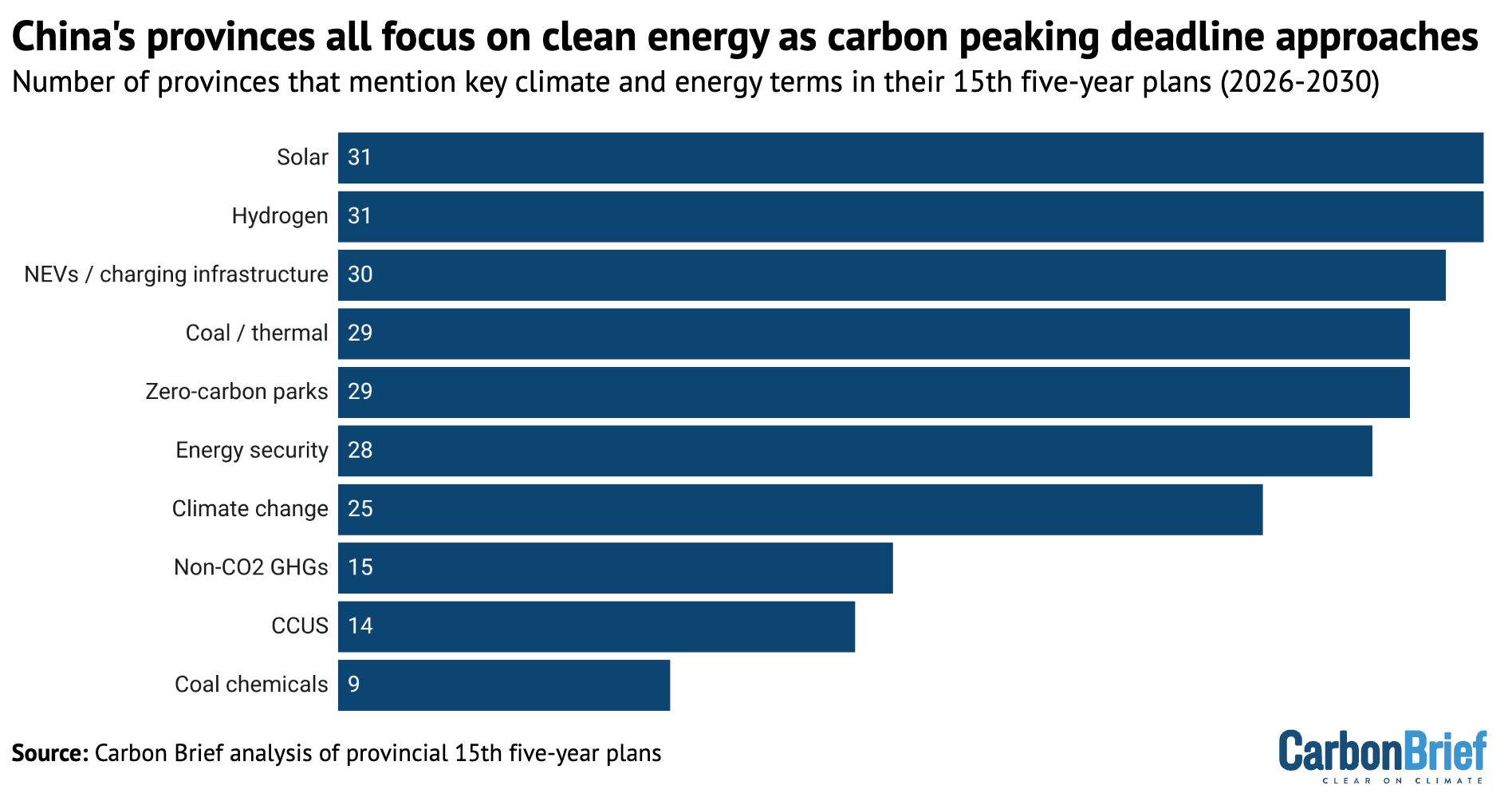
Provinces diverge in terms of what other technologies they name and how detailed their plans are.
For example, offshore wind and nuclear are mentioned by 11 and 12 provinces respectively, with both technologies mostly targeted to be built in coastal provinces.
But in general, variation reflects more than just geography or resources endowment, said Anders Hove, a senior research fellow at the Oxford Institute for Energy Studies.
“The differences between provinces reflect primarily differences in economic development capabilities and industrial structure,” he told Carbon Brief.
Half of provinces to expand fossil-fuel production
Almost every province pledged to peak coal and oil consumption, in line with similar language in the national-level plan.
However, 17 local governments also pledged to produce more fossil fuels – trying to peak consumption while also expanding output, opening new reserves or lifting production limits.
Most of these are regions designated as national energy-supply bases, including Inner Mongolia, Xinjiang, Shaanxi, Gansu and Heilongjiang.
Yang Li, deputy executive director at the Beijing-based thinktank Institute for Global Decarbonization Progress (iGDP), toldCarbon Brief this pattern reflects the “two dimensions of China’s [energy] transition”. These are a national-level push for peaking fossil-fuel consumption and a desire for energy security by provinces rich in energy resources.
Provinces with significant fossil-fuel economies are also the most likely to mention carbon capture, utilisation and storage (CCUS), which appears in 14 plans.
Provinces jostle to take the lead on AI and hydrogen
With the national government preparing to spend trillions of yuan on datacentres for the artificial intelligence (AI) industry in the next five years, provincial officials are also tying AI to their energy systems.
More than 20 aim to use AI to help manage coal mines, power grids, oilfields and forecasting renewables output.
Yang said that “AI+energy” represents a desire by policymakers to use AI to enhance energy governance, but adds that “large-scale commercialisation [of the technology] still has some way to go”.
Unlike AI, all provincial plans mention hydrogen, which is named as a “future industry” in the central-level five-year plan.
For example, Hunan calls for promoting hydrogen trucks and rail transport and developing “renewable energy-based” hydrogen production, while Shandong pledges to focus on technological breakthroughs around hydrogen transport and storage, as well as production of green hydrogen.
Similarly, 12 provinces named the other energy-related future industry – nuclear fusion, which remains an experimental technology – as a priority for the next five years. These provinces include Anhui, Guangdong, Hebei, Hubei and Shaanxi.
This spotlight is by freelance China analyst Lekai Liu for Carbon Brief.
Watch, read, listen
FUTURE-FOCUSED: Qiushi, China’s official journal for political theory, published an edition based on “future industries”, in which President Xi Jinping called for advancing hydrogen energy and nuclear fusion.
MIGHTY MANGROVES: The Grantham Research Institute explored China’s uptake of “blue carbon credits”, which could help preserve “powerful carbon sinks” in coastal ecosystems.
IN THE LEAD: Mission Possible Partnership published a report saying China is “widening its lead” in developing a low-carbon industrial sector.
‘AUTOBESITY’: Blue Map examined “autobesity”, the trend towards larger Chinese EVs, and what this could mean for their carbon footprint
13
The number of Chinese solar companies that have joined forces to create the Space Energy Development Alliance, a new organisation to promote space solar energy, said Bloomberg.
5
Minutes devoted to the opening ceremony, which did not offer “any details” on the alliance’s objectives, according to the outlet.
New science
- National and provincial planning scenarios for China’s solar and wind expansion until 2060 will present different trade-offs with biodiversity | Nature Ecology and Evolution
- Policies to decrease carbon emissions and declines in technology costs could together help achieve “deep” carbon emissions reductions by 2060 in China’s steel industry | PNAS
Recently published on WeChat
China Briefing is written by Anika Patel, with contributions from Lekai Liu, and edited by Simon Evans. Please send tips and feedback to china@carbonbrief.org
The post China Briefing 11 June 2026: Tech clampdown | Extreme weather | Provinces’ energy plans appeared first on Carbon Brief.
China Briefing 11 June 2026: Tech clampdown | Extreme weather | Provinces’ energy plans

For the first time, new-energy vehicles (NEVs) made up 67% of new car sales in China in September, according to the latest data from the China Passenger Car Association (CPCA).
The figures show that NEVs, which include battery electric cars and plug-in hybrids, captured a record share of sales, even though fewer were sold than last year.
This is because sales of combustion-engine cars are falling steeply, a trend that the CPCA has attributed to rising petrol prices following the start of the Hormuz crisis.
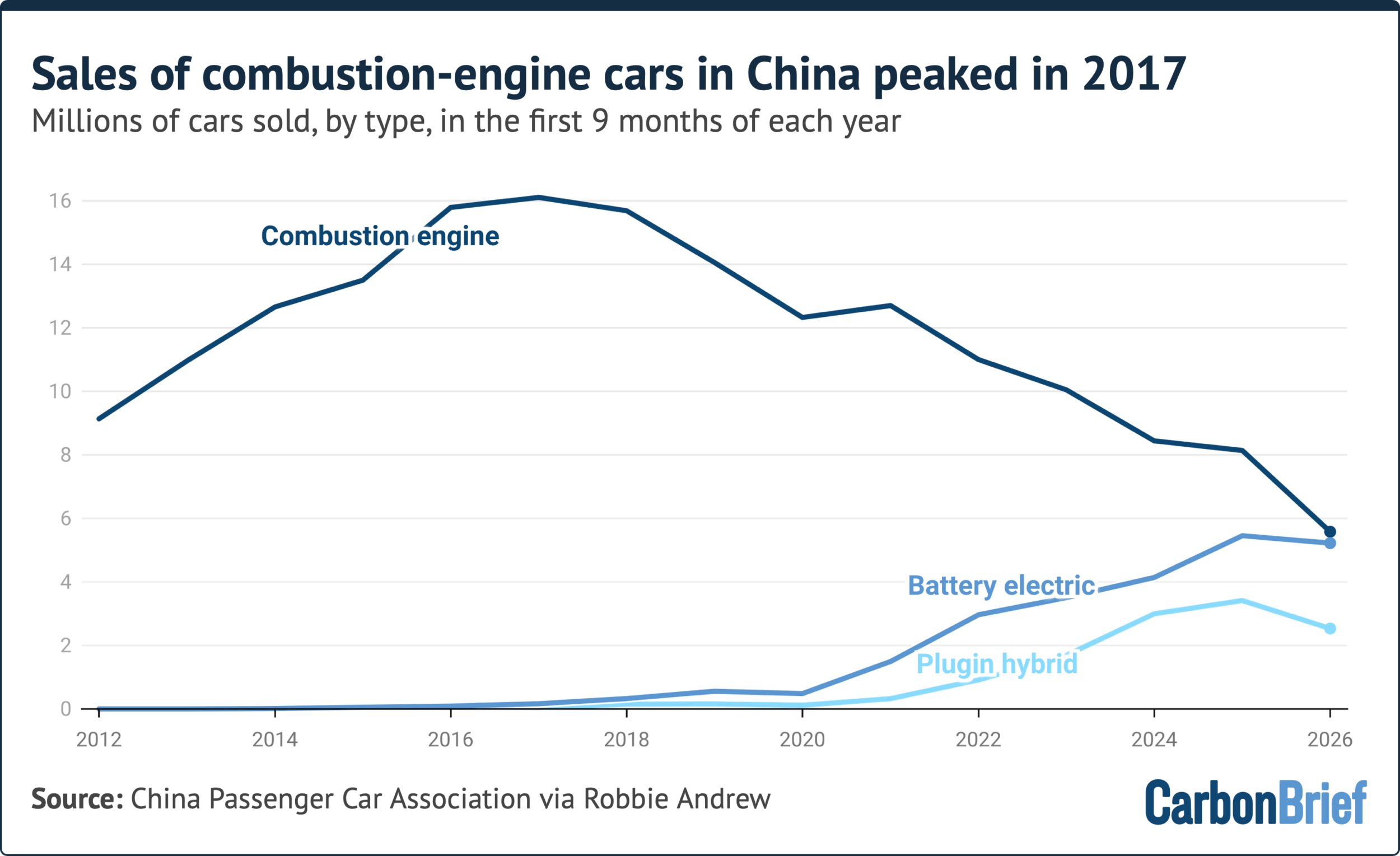
Indeed, sales of fuel-only cars were down 31% year-on-year in the first nine months of 2026, with plug-in hybrid sales down 26% – whereas battery EV sales were only down 4%.
One analyst tells Carbon Brief that China’s rapidly growing EV fleet has offset demand for 143m barrels of oil since the start of the Hormuz crisis.
Another says that the crisis is “reinforcing China’s electrification of road transport”.
Meanwhile, amid slowing domestic sales, Chinese carmakers’ exports of NEVs more than doubled [in 2026 to date / in September] from a year earlier.
NEV record
A record two out of every three cars sold in September in China were NEVs, according to CPCA data, as shown in the figure below.
(NEVs predominantly include battery electric vehicles – BEVs – and plug-in hybrids – PHEVs. BEVs only run on electricity, whereas PHEVs also have a combustion engine.)
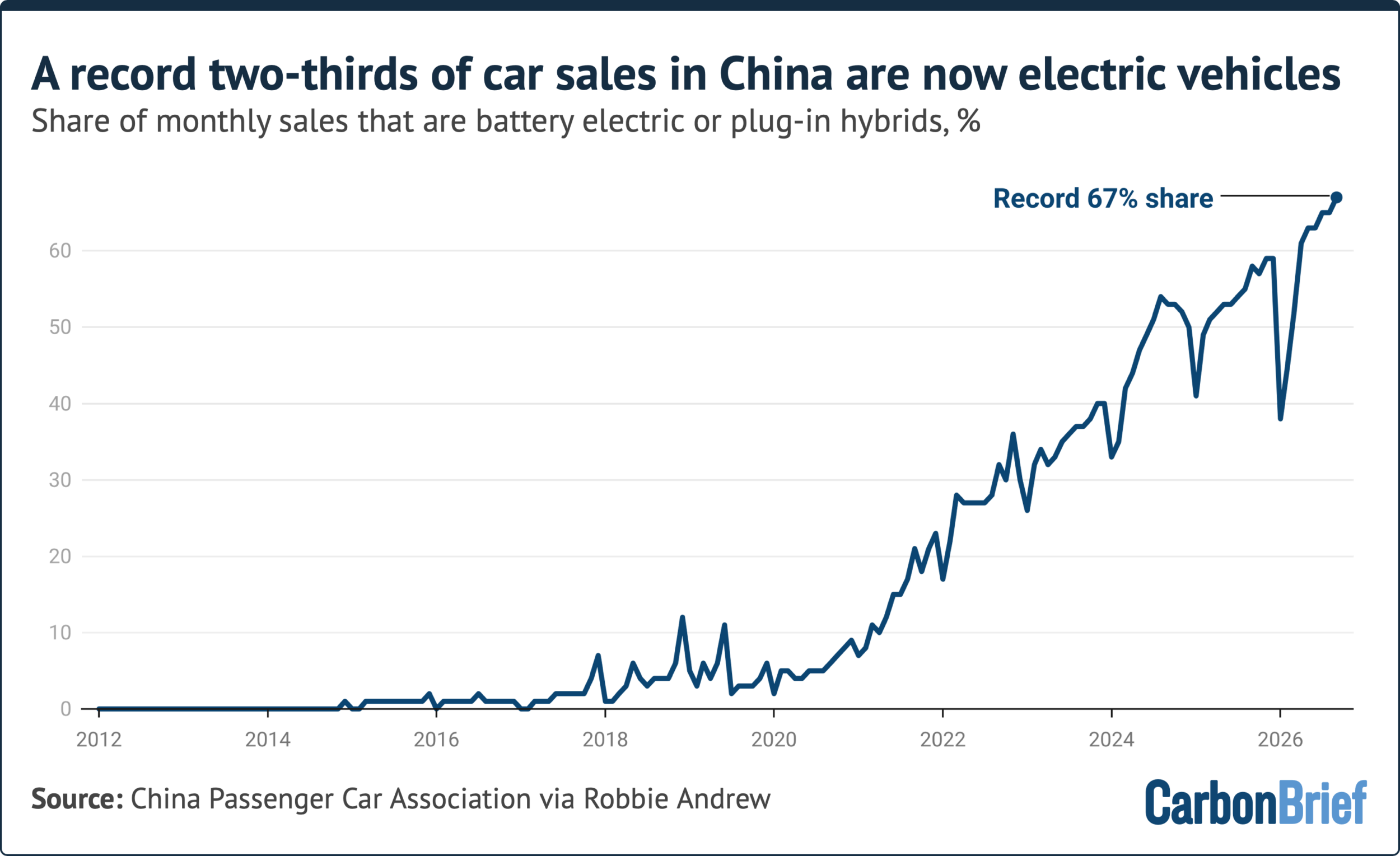
This marks a rapid rise for NEVs from just 6% of new car sales in 2020 up to 58% in 2026 to date – and a record 67% in the month of September.
This year, NEVs’ share of sales has also bounced back from a low of 39% in January, after the full purchase tax exemption that had been in place for more than a decade came to an end in December 2025.
The gain in NEV share in 2026 has come amid a slowdown across the wider domestic passenger-car market, which has hit sales of combustion-engine vehicles particularly hard.
This September, passenger-car retail sales across all categories declined, with overall sales volumes falling 28% year-on-year.
The contraction was led by combustion-engine vehicles, which saw sales fall 43% year-on-year in September and 31% in 2026 to date.
However, sales of PHEVs also fell by 36% year-on-year in September and by 26% in 2026 to date. By comparison, BEVs performed better, although sales still declined 8.5% from a year earlier in September and 4% in 2026 to date.
As a result, NEV sales overall fell by 17% in September and 13% in 2026 to date.
While the market changes in 2026 to date were particularly dramatic, they reflect a broad continuation of trends seen over the past decade.
Indeed, sales of combustion-engine cars in China peaked in 2017 and they have been declining ever since, shown in the figure below.
Impact of Hormuz
Part of the reason for the advance of NEVs in 2026, said Chinese technology news outlet OFweek, was petrol cars “giving up market share” as they were outperformed by electric alternatives.
Cui Dongshu, secretary-general of the CPCA, cited higher petrol prices as an explanation for September’s weak combustion-car sales, in comments to financial news outlet National Business Daily.
Imports of oil into China in January-September have fallen 15% compared to 2025, equivalent to 470m barrels, as ongoing conflict tightened supply and drove up prices.
China’s passenger-car NEV fleet has displaced 143m barrels of oil so far during the strait of Hormuz crisis, Euan Graham, senior energy analyst at thinktank Ember, tells Carbon Brief.
EVs “accounted for 12% of the decrease in China’s oil use post-Hormuz”, according to an estimate provided to thinktank the Brookings Institute by an unnamed analyst.