Connect with us

Published

on

Despite skyrocketing demand driven by data center development, the industry says it is not the cause of increasing costs for consumers.

Advocates for lower electricity prices in Pennsylvania said Wednesday their goals can be achieved by requiring large-load users like data centers to supply their own power rather than taking it from the grid, by reducing utility profits and by speeding up the interconnection of new clean-energy projects.

Pennsylvania Activists Urge Lawmakers to Help Curb Soaring Electric Bills

Continue Reading

Climate Change

Fewer journalists register for Bonn talks, as cuts to climate reporting bite

Published

on

The number of journalists registered to attend the annual climate negotiations in Bonn has declined this year, as climate reporters have been let go and media coverage of climate issues falls around the world.

Data from UN Climate Change, which runs the two weeks of talks, shows that just 135 media representatives have signed up to attend. Climate Home News analysis of previous data shows this is the lowest figure since 2021, when COVID-19 restrictions limited travel and the Bonn talks were held in a hybrid format to enable online participation.

The number of journalists that actually attend the talks will not be known until later this month but is typically significantly less than are registered. Press conferences, held back-to-back each day by campaign groups, have been sparsely attended in the first few days and often filled mainly with climate campaigners and researchers rather than journalists.

Alexandra Endres, a reporter for German-language website Table Briefings, told Climate Home News in Bonn there are fewer German journalists covering the conference in-person. “I think it is important to have more journalists covering the negotiations because when the climate coverage increases, the interest of the public grows,” she said.

Media outlets that have registered fewer journalists than previous years, or no journalists, include global heavyweights like Reuters, Bloomberg and the BBC, as well as German outlets like Deutsche Welle and ZDF television, and specialist publications like business information service Argus and climate broadcaster We Don’t Have Time.

Activist Harjeet Singh, who is in Bonn advising the Fossil Fuel Treaty Initiative, said that “the empty press seats here in Bonn are a warning signal. While the world’s gaze is often fixed on the annual COP summits, the real-world consequences of the climate crisis—from financing the fossil fuel transition to protecting vulnerable populations—are being shaped, or ignored, in these mid-year negotiations right now.”

“Journalists are the essential eyes and ears of the public,” he said. “We need them to shine a light on these rooms: hold negotiators accountable, defend the principles of equity and historical responsibility, and ensure that ‘technical’ negotiations do not become an excuse for delay.”

UN Climate Change said they could not comment on the situation at this point in the Bonn talks.

Climate coverage is falling

Outside of Bonn and the official UN climate negotiations, coverage of climate change is falling to lows not seen since the start of the COVID-19 pandemic, according to analysis of newspapers and television reporting conducted by the Media and Climate Change Observatory (MECCO).

MECCO’s head Max Boykoff told Climate Home News that climate coverage in the first five months of 2025 was 35% down on the same period of 2025 and 41% less than in 2021. New analysis by the Yale Programme on Climate Change Communication found a similar fall in climate coverage in 2026.

Boykoff said media attention has been drawn away from climate change to issues like the Iran war and now the World Cup getting underway in North America.

While both stories have climate implications, he said, the media have “failed to connect the dots” on the conflict in the Middle East, with coverage focusing on the politics, air strikes and violence of the war. “Reporters have been pulling up short,” he said.

He added that since 2025 there have been cuts to climate teams at US outlets like the Washington Post, CBS, National Public Radio and the Los Angeles Times. On top of this, the Thomson Reuters Foundation’s Context website has been shut down and Politico recently folded specialist environmental outlet E&E News into its broader energy coverage.

Mark Hertsgaard, head of global journalism collaboration Covering Climate Now, also said that fewer reporters at Bonn is “part of a larger pattern”. He said no US television network sent reporters to the recent Santa Marta conference on transitioning away from fossil fuels “and as a result they missed covering what turned out to be a landmark development in the climate story”.

    “No one can know if the Bonn talks will yield something similar until the [they] actually take place and conclude. But the fewer journalists that are on the scene, the less the world’s people and policymakers will know about that. And that’s a problem,” he said.

    Media may also have been put off from attending by a new registration system which is more complicated, especially for freelance journalists. In addition, the rise in jet fuel prices has made travelling by plane to Bonn much more expensive than last year and reporters from many developing countries continue to face hurdles getting visas to enter the Schengen area, of which Germany is part.

    Diego Arguedas Ortiz, who led the Oxford Climate Journalism Network from 2022 until it was shut down by the Reuters Institute for the Study of Journalism in 2025, said journalists can’t cover the talks so well remotely.

    While press conferences, plenaries and open negotiating sessions are broadcast for the public to watch on the UNFCCC’s website, Ortiz said relying solely on this means “you miss the interviews in the hall”.

    “You can´t catch scientists and ministers as they leave the rooms. And the audience is back home suffering. Because audiences are relying on reporters and editors to explain how these seemingly abstract negotiations have daily implications for them,” he explained.

    The post Fewer journalists register for Bonn talks, as cuts to climate reporting bite appeared first on Climate Home News.

    Fewer journalists register for Bonn talks, as cuts to climate reporting bite

    Continue Reading

    Climate Change

    WHO issues new guidance on heat-health action plans, as El Niño sets in

    Published

    on

    The World Health Organization (WHO) has unveiled new guidance for governments seeking to protect people from extreme heat, a growing priority as climate change pushes temperatures higher worldwide and intensifies heatwaves and related health risks.

    The launch came as the US National Oceanic and Atmospheric Administration said on Thursday that El Niño has developed in the tropical Pacific. The climate phenomenon – which occurs naturally every few years – is predicted to intensify to a moderate or strong level this autumn, the service said.

    Scientists have warned that a strong El Niño weather pattern could fuel “unprecedented” weather extremes in the coming months, including severe fires and droughts, and may make 2027 the next record-breaking hot year as it supercharges human-driven warming.  

    Scientists warn El Niño could intensify climate extremes in 2026

    Unveiling updated recommendations for “Heat-Health Action Plans”, which are tailored for Europe but can be adapted globally, Hans Henri P. Kluge, WHO’s regional director for Europe, said that over the past four years, heat has claimed more than 200,000 lives across 32 European countries.

    He added that most of those deaths were “entirely preventable” and are “just the tip of the iceberg”, with millions more people being affected physically and mentally by the effects of extreme heat. Scientists have said Europe is the fastest-warming continent.

    “Individual action, such as keeping out of the heat, keeping our homes cool and keeping our bodies hydrated, can make a big difference in protecting us, but it is not enough to fight a systemic crisis,” Kluge said in a statement. “We need a coordinated, powerful and institutional response.”

    The new guidance focuses on the importance of providing early warning and alerts, targeting vulnerable groups and putting in place longer-term prevention measures across households and buildings, especially in cities which are often hotter than rural areas, as well as offering practical advice on how to do that.

    Who’s most vulnerable to heat?

    Heat can trigger exhaustion and heat stroke, and exacerbate existing medical conditions, including diabetes and cardiovascular, respiratory and cerebrovascular diseases, as well as disrupting sleep and aggravating mental health conditions.

    In a fact-sheet, the WHO warned that rising global temperatures, more people living in cities and demographic aging are increasing exposure to heat and vulnerability to its impacts. Some of the most at-risk groups include older people, children, outdoor workers, athletes and sports players, those attending mass public gatherings and poorer social groups, it said.

    Employers need plans to protect workers from rising heat stress, UN says

    The WHO emphasised, however, that it does not just propose wider use of air-conditioning (AC) as the solution because it is not sustainable, is often unaffordable for those with low incomes and increases energy demand.

    “It contributes to both the urban heat island effect and climate change, thus worsening heat exposures in the medium and long term,” the fact-sheet said.

    Europe’s intense May heatwave

    On Wednesday, Europe’s Copernicus Climate Change Service (C3S) announced that May 2026 was the second warmest May on record globally across land and sea.

    Across Europe, the month saw a rapid transition from much cooler-than-average conditions to one of the most intense heatwaves ever observed this early in the year in western Europe, C3S said. Numerous temperature records were broken for May with France, the UK, Ireland and Portugal enduring particularly severe conditions, it added.

    C3S noted that the quick flip to a period of extreme heat “likely increased impacts on populations, leaving little time for people – or crops and ecosystems during growing season – to acclimatise to much higher temperatures”.

    “Prepare for rougher times”

    In a foreword to the new WHO heat plan guidance, Wopke Hoekstra, European Commissioner for Climate, Net Zero and Clean Growth, wrote that extreme heat is responsible for some 95% of all climate-related deaths in Europe, undermines labour productivity and risks overwhelming hospitals.

    He noted that investing in emission reductions is far cheaper than paying for climate damage.

    “Yet, while we push for emission reductions, we must also prepare for rougher times. Strengthening Europe’s climate resilience, protecting both well-being and economies, is non-negotiable,” he added.

    By the end of this year, the European Union plans to adopt a new framework for climate resilience across all sectors, including health.

    A woman cools herself with an electric portable fan during a heatwave, in London, Britain, August 12, 2025. (Photo: REUTERS/Jack Taylor)

    A woman cools herself with an electric portable fan during a heatwave, in London, Britain, August 12, 2025. (Photo: REUTERS/Jack Taylor)

    In the UK, the independent Climate Change Committee warned last month that, in a projected scenario of 2C of global warming by 2050, recent record hot summers will become the “new normal” in the usually temperate country, putting regular stress on domestic agricultural production.

    Heatwaves lasting at least a week will be common and could regularly exceed 40C in the south, the committee’s report on adaptation said, posing challenges for keeping vulnerable people sufficiently cool.

    It recommended that cooling will be needed in hospitals, prisons, schools and care homes, while regulation should set maximum temperature limits for workplaces.

    Berlin’s Heat-Health Action Plan

    On Thursday, the WHO said that since the publication of the first edition of its heat and health guidance in 2008, far more scientific evidence and practical experience have been gained. Many countries have since established Heat-Health Action Plans, but their adoption and implementation have been uneven, it said.

    Comment: Early warnings for heatwaves can save lives – and we need them now

    In Germany, where local authorities are primarily responsible for heat protection, the Berlin Senate adopted a state-wide heat–health action plan in 2025. It contains 72 measures to improve heat protection for residents, including informing them every summer of the risks via traditional and digital media.

    A heat protection portal offers access to Berlin’s heat–health action plan, and a map of cool places in the city, as well as behavioural advice.

    Berlin Senator Ina Czyborra said the city is also working on the long-term maintenance and expansion of parks, green spaces and water bodies, which can all help alleviate the effects of heat.

    “One thing is clear: protection from heat is a cross-cutting task that can only be tackled through a joint effort by all administrative departments and levels, and with the involvement of civil society actors,” she added in a statement.

    The post WHO issues new guidance on heat-health action plans, as El Niño sets in appeared first on Climate Home News.

    WHO issues new guidance on heat-health action plans, as El Niño sets in

    Continue Reading

    Climate Change

    China Briefing 11 June 2026: Tech clampdown | Extreme weather | Provinces’ energy plans

    Published

    on

    Welcome to Carbon Brief’s China Briefing.

    China Briefing handpicks and explains the most important climate and energy stories from China over the past fortnight. Subscribe for free here.

    Key developments

    Trade tensions intensify

    AUTHORITY TO RETALIATE: China has issued “sweeping” new rules that increase “controls over the overseas transfer of domestic technology”, while also giving the government “explicit” authority to retaliate against governments that restrict Chinese investments, reported finance news outlet Caixin. The rules are a “shield for Chinese enterprises”, argued an editorial in the state-run newspaper China Daily, as well as a way to “protect” China’s “development interests”. Cosimo Ries, an analyst at Trivium China, told Carbon Brief that protecting China’s lead in cleantech manufacturing is one of the aims of the regulations. He said that language around restrictive foreign actions is, in his view, “clearly designed as a response” to the EU’s Industrial Accelerator Act. Ries added that the government is “increasingly working to prevent Chinese IP from being forcefully appropriated or handed away by its own companies seeking market access abroad”.

    COMMISSIONERS MEET: The rules come as the EU debates plans to “broaden the use of its trade defences” to protect industries from what the EU industry commissioner described to the Financial Times as “unfair” Chinese competition. A meeting of EU commissioners reaffirmed the need for a “more robust and coherent” response to trade and investment from China, which is seen as “not sustainable”, according to a readout from the European Commission. In response, China said it will “resolutely” retaliate to any “discriminatory” EU trade measures, reported Bloomberg. Meanwhile, Chinese automaker SAIC has confirmed plans to invest €200m ($232m) to build a factory in Spain for vehicles including electric vehicles, said Caixin. Trade envoys from the EU and China backed further discussions after a meeting in early June, reported Reuters.

    SURPLUS ‘WIDENED’: According to Chinese customs data covered by Bloomberg, China’s trade surplus with the EU “widened slightly” in May, though its exports to the bloc “slowed”. The outlet added ongoing EU-China trade tensions “could pose a risk to Beijing’s favoured ‘new three’ energy industries”, for which the EU was the “destination for about 40% of exports” in 2025. While country-specific data is not yet available, China’s global exports of “green products”, such as batteries and wind turbines, grew by around 40% in January-May, according to state news agency Xinhua.

    Early heat tests China’s grid

    PATTERNS BROKEN: China Southern Power Grid, which covers a number of provinces across southern China, reported that it saw a record electricity load of 259 gigawatts (GW) in late May, according to Shanghai-based outlet the Paper. It added that the new record – driven by “widespread cooling demand” due to high temperatures – came “nearly a month earlier” than usual, “breaking a seasonal pattern” where peaks occurred in June and July. High temperatures continued in early June across both northern and southern China, reported China Daily, with some regions reporting temperatures of almost 40C.

    HEAVY RAINS: China also continued to see heavy rains across “multiple provinces in southern China”, reported China Daily, with “nearly 10,000 residents” evacuated in Guizhou after torrential rains caused flooding in the area. Flood-response measures have been activated in Hunan and Guangxi, said Bloomberg. The Communist party-affiliated People’s Daily said that floods were also expected in Yunnan, Guangdong and Fujian provinces. Meanwhile, northern China’s Hebei province experienced “dramatic” weather, including “thunderstorms, strong winds, hail and heavy downpours”, said Jing-Jin-Ji News Channel.

    CROP RISK: “Against the backdrop of intensifying global warming, northern China is seeing a clear trend of more frequent and severe extreme weather,” said the People’s Daily. Meteorologists attributed the unusually early and intense rain to shifting weather patterns that “reflects broader weather changes in China associated with global warming”, said Bloomberg. An article in the People’s Daily noted that extreme and unusual weather, driven by “climate change”, has “posed varying degrees of risks and challenges to agricultural production”. Another Bloomberg article said expected further rains in southern China could “inundat[e] crops and damag[e] rice fields”.

    Mineral trade controls and concerns

    EXPORTS BLOCKED: Elsewhere, the Chinese government has “penalised at least 11 companies this year for illegally exporting restricted rare earths and critical minerals”, reported Caixin. It said this included a subsidiary of solar manufacturer JA (formerly JA Solar) for “shipping unlicensed graphite parts to Vietnam”. The Hong Kong-based South China Morning Post reported that China’s rare-earth exports fell by 6.4% in May as “Beijing maintained tight control over shipments”. A new report on rare earths by the Center for Strategic and International Studies stated that “although China’s exports of rare earths and rare-earth magnets have resumed”, flows have been “highly volatile” and licensing has been “uneven”. This was echoed in a report by the Royal United Services Institute that said “China incentivises the export of final products containing rare earths…rather than rare earths themselves”, which could pose “risks” to electric vehicle (EV) and offshore wind supply chains.

    EXPORTS CONTROLLED: Zimbabwe has announced that a Chinese company will establish a lithium-carbonate plant in the country, said Bloomberg. It said this followed a ban on lithium exports as the country aimed to “build up local processing capacity for the battery metal”. Meanwhile, Reuters reported that Chinese investors in Indonesia’s coal-dependent nickel industry are looking to other countries. It said this followed plans by the Indonesian government to plan nickel export controls, tighter quotas and tax hikes.

    More China news

    • ‘GEC’ GUIDANCE: A new set of trial guidelines has been issued to “unify” how clean-electricity consumption is measured, said state broadcaster CCTV. Ying (Jenny) Zheng, a researcher at the Tsinghua TianGong Thinktank, told Carbon Brief that the measures are more than just accounting guidelines. She said they provide a “foundation for one of the key control indicators within China’s emerging carbon-control framework” that should help boost consumption of low-carbon power.
    • TOWNS AND TRACTORS: China called for “vigorous efforts” to develop low-carbon buildings in a new 15th five-year plan for “urban renewal”, said BJX News. A five-year plan for agriculture also listed “accelerating” the “green transformation” of agriculture as one of seven key tasks, said Xinhua.
    • FUNDRAISING FIGURES: China raised 6bn yuan ($885m) in green sovereign bonds, reported Bloomberg. It said these have previously been used for emissions reductions and “biodiversity preservation”.
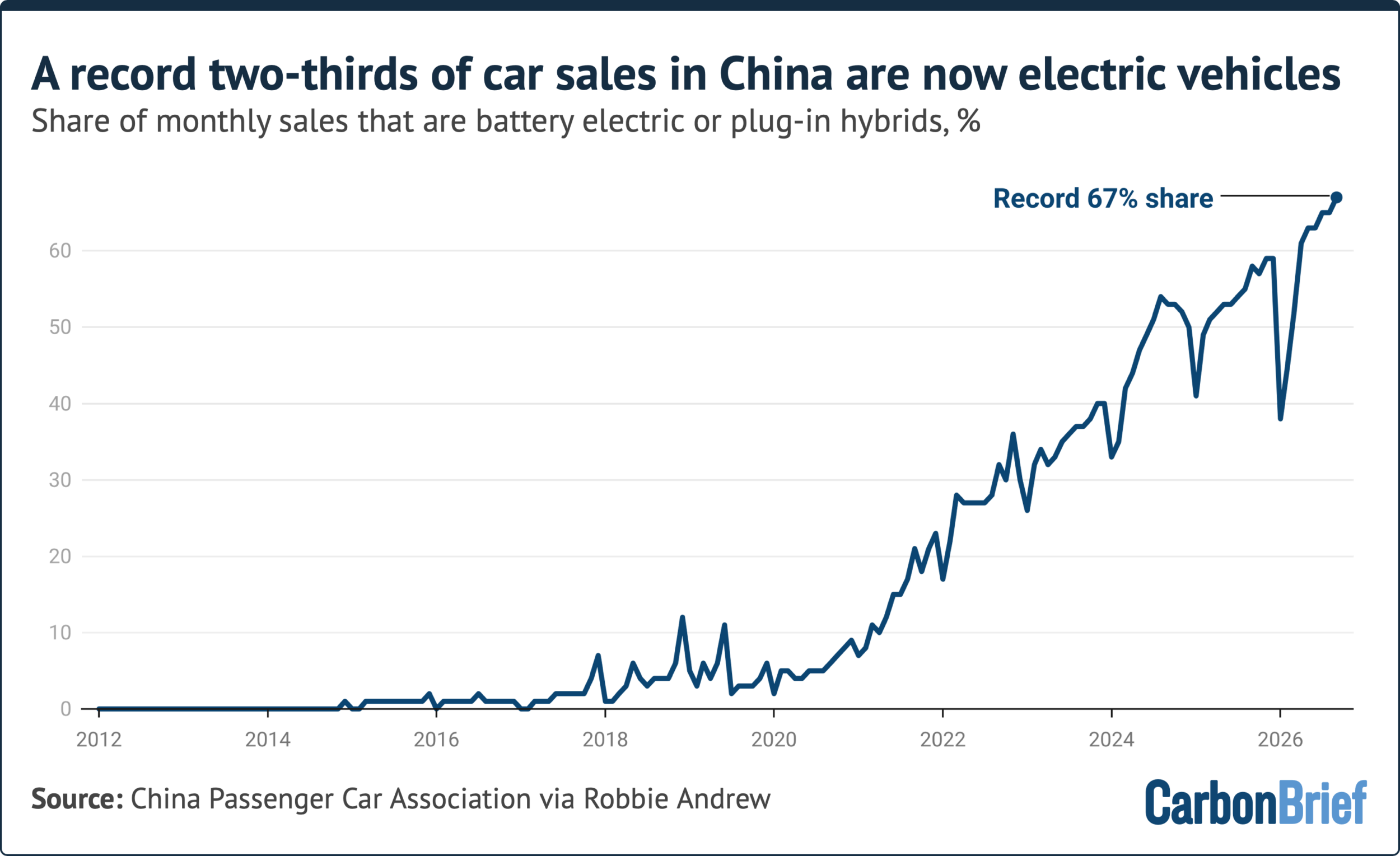
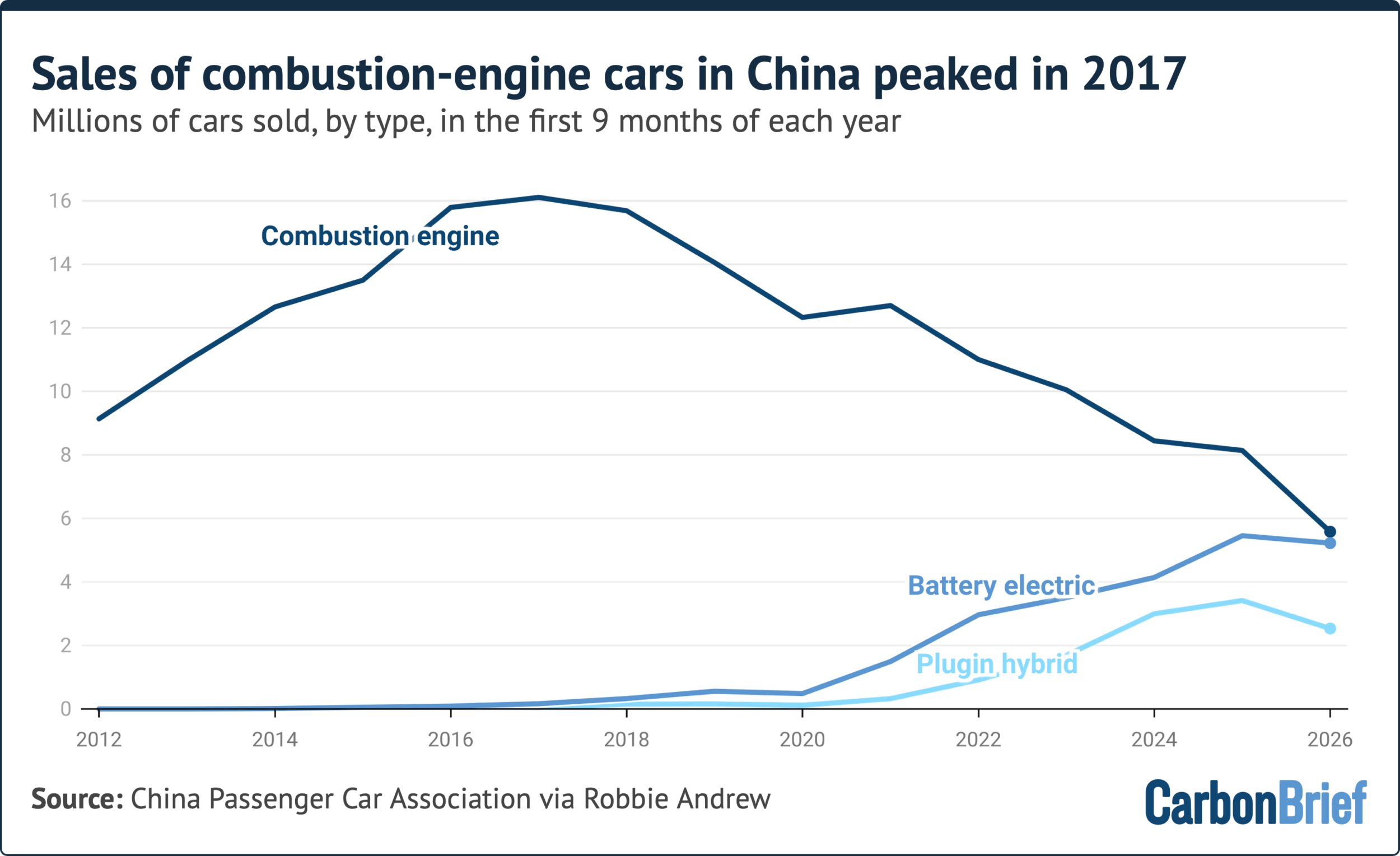
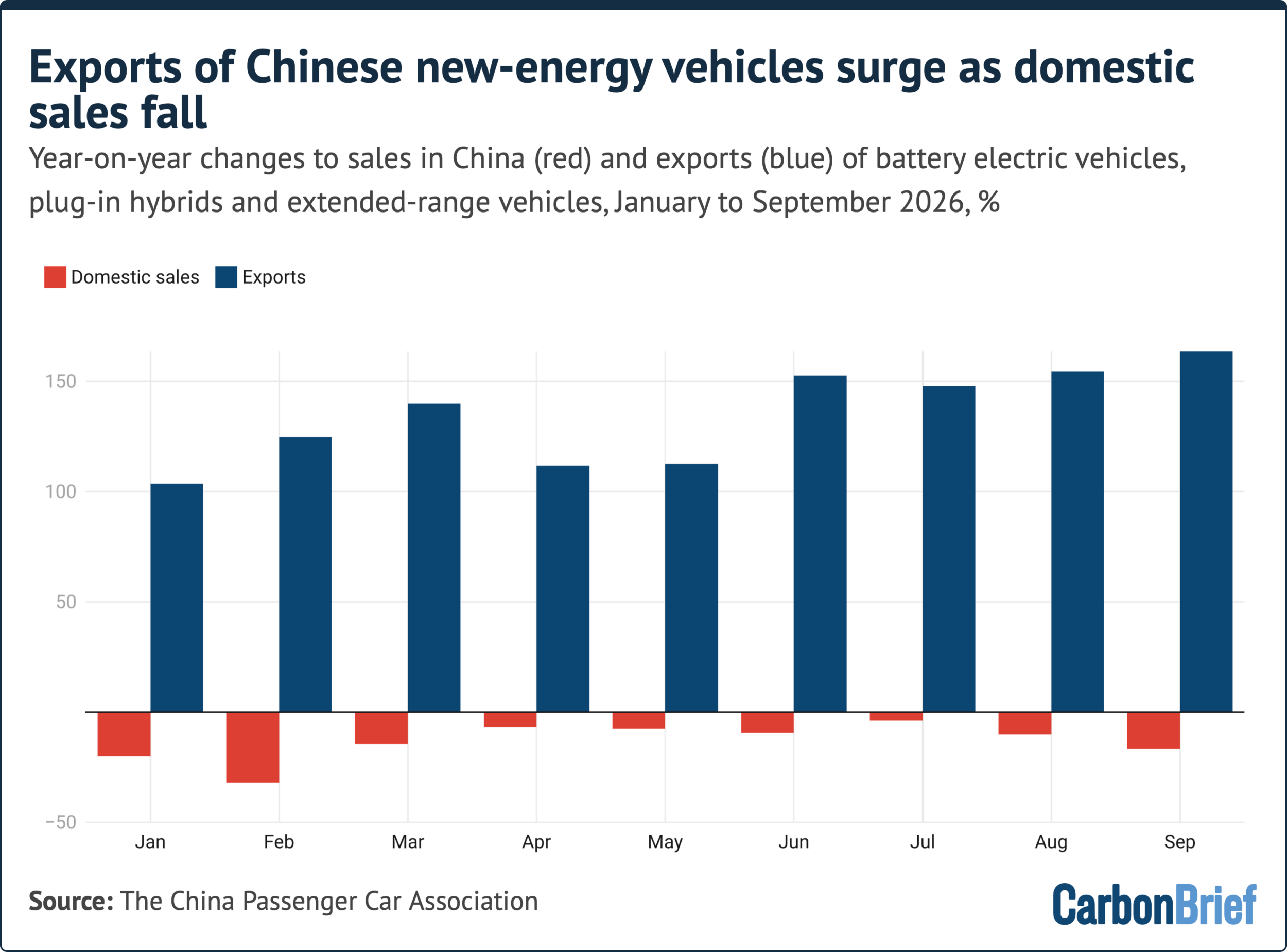
    • SALES SLUMP: Sales of electric vehicles (EVs) and plug-in hybrids in China fell 7.5% year-on-year in May, reported Reuters. It said they nevertheless made up 62% of all sales, with the Associated Press noting that petrol-car sales fell 42%.
    • UK DIALOGUE: UK foreign secretary Yvette Cooper told her Chinese counterpart Wang Yi that the UK is willing to “deepen cooperation” with China on energy and climate change, according to a readout by China’s Ministry of Foreign Affairs.
    • MEASURING SUBSIDIES: The Organisation for Economic Cooperation and Development (OECD) released a report saying Chinese companies received “three to eight times more government support than firms based in the OECD”, said Agence France Presse. China’s commerce ministry responded saying the report was “one-sided and arbitrary”, according to Xinhua.

    Captured

    China’s emissions in January-March 2026 rose 2% year-on-year, driven by growing “curtailment” of wind and solar in the power sector due to “inflexible grid management”, said new analysis for Carbon Brief.

    Spotlight 

    What do China’s provincial five-year plans reveal about its energy transition?

    China’s provincial-level governments have now all published their 15th five-year plans – economic and social development blueprints for 2026-2030.

    In this issue, Carbon Brief analyses what all 31 documents say about energy and climate.

    Provinces remain focused on clean energy

    At the broad level, the new provincial plans follow China’s overarching climate goals. All 31 provincial-level jurisdictions in mainland China pledged to peak carbon emissions before 2030.

    Every plan also mentioned the core elements of China’s energy transition strategy, including solar, wind, hydrogen, energy storage and upgrading the power grid.

    While solar featured in every plan, specific interests in the technology vary from province to province.

    Some set goals to add new solar capacity by 2030. Zhejiang province aims to add 90GW of solar capacity, while Shaanxi plans to “accelerate” construction of wind and solar “bases”. Several others mentioned developing offshore solar farms in the next five years.

    However, others instead focused on recycling old solar panels or strengthening solar R&D.

    Almost every plan mentioned growing consumption and production of new-energy vehicles (NEVs).

    Around 15 provinces mentioned promoting NEV uptake. Jilin set a target for NEVs comprising more than 50% of new car sales by 2030, although its current rate is already thought to be 47%.

    While the central government is issuing directives to limit “overcapacity” in the sector, more than 20 provinces said they will continue developing their NEV industries, with many aiming to generate hundreds of billions – or even trillions – of yuan in value.

    Meanwhile, 24 provinces will prioritise developing renewable power “direct connection” models, in which renewable generators supply industrial users via a dedicated line – a system that could boost consumption of clean energy.

    Number of Chinese provinces that mention key climate and energy terms in their 15th five-year plans.
    Number of provinces that mention key climate and energy terms in their 15th five-year plans. Source: Carbon Brief analysis of provincial 15th five-year plans.

    Provinces diverge in terms of what other technologies they name and how detailed their plans are.

    For example, offshore wind and nuclear are mentioned by 11 and 12 provinces respectively, with both technologies mostly targeted to be built in coastal provinces.

    But in general, variation reflects more than just geography or resources endowment, said Anders Hove, a senior research fellow at the Oxford Institute for Energy Studies.

    “The differences between provinces reflect primarily differences in economic development capabilities and industrial structure,” he told Carbon Brief.

    Half of provinces to expand fossil-fuel production

    Almost every province pledged to peak coal and oil consumption, in line with similar language in the national-level plan.

    However, 17 local governments also pledged to produce more fossil fuels – trying to peak consumption while also expanding output, opening new reserves or lifting production limits.

    Most of these are regions designated as national energy-supply bases, including Inner Mongolia, Xinjiang, Shaanxi, Gansu and Heilongjiang.

    Yang Li, deputy executive director at the Beijing-based thinktank Institute for Global Decarbonization Progress (iGDP), toldCarbon Brief this pattern reflects the “two dimensions of China’s [energy] transition”. These are a national-level push for peaking fossil-fuel consumption and a desire for energy security by provinces rich in energy resources.

    Provinces with significant fossil-fuel economies are also the most likely to mention carbon capture, utilisation and storage (CCUS), which appears in 14 plans.

    Provinces jostle to take the lead on AI and hydrogen 

    With the national government preparing to spend trillions of yuan on datacentres for the artificial intelligence (AI) industry in the next five years, provincial officials are also tying AI to their energy systems.

    More than 20 aim to use AI to help manage coal mines, power grids, oilfields and forecasting renewables output.

    Yang said that “AI+energy” represents a desire by policymakers to use AI to enhance energy governance, but adds that “large-scale commercialisation [of the technology] still has some way to go”.

    Unlike AI, all provincial plans mention hydrogen, which is named as a “future industry” in the central-level five-year plan.

    For example, Hunan calls for promoting hydrogen trucks and rail transport and developing “renewable energy-based” hydrogen production, while Shandong pledges to focus on technological breakthroughs around hydrogen transport and storage, as well as production of green hydrogen.

    Similarly, 12 provinces named the other energy-related future industry – nuclear fusion, which remains an experimental technology – as a priority for the next five years. These provinces include Anhui, Guangdong, Hebei, Hubei and Shaanxi.

    This spotlight is by freelance China analyst Lekai Liu for Carbon Brief.

    Watch, read, listen

    FUTURE-FOCUSED: Qiushi, China’s official journal for political theory, published an edition based on “future industries”, in which President Xi Jinping called for advancing hydrogen energy and nuclear fusion.

    MIGHTY MANGROVES: The Grantham Research Institute explored China’s uptake of “blue carbon credits”, which could help preserve “powerful carbon sinks” in coastal ecosystems.

    IN THE LEAD: Mission Possible Partnership published a report saying China is “widening its lead” in developing a low-carbon industrial sector.

    ‘AUTOBESITY’: Blue Map examined “autobesity”, the trend towards larger Chinese EVs, and what this could mean for their carbon footprint


    13

    The number of Chinese solar companies that have joined forces to create the Space Energy Development Alliance, a new organisation to promote space solar energy, said Bloomberg.

    5

    Minutes devoted to the opening ceremony, which did not offer “any details” on the alliance’s objectives, according to the outlet.


    New science 

    • National and provincial planning scenarios for China’s solar and wind expansion until 2060 will present different trade-offs with biodiversity | Nature Ecology and Evolution
    • Policies to decrease carbon emissions and declines in technology costs could together help achieve “deep” carbon emissions reductions by 2060 in China’s steel industry | PNAS

    Recently published on WeChat

    China Briefing is written by Anika Patel, with contributions from Lekai Liu, and edited by Simon Evans. Please send tips and feedback to china@carbonbrief.org 

    The post China Briefing 11 June 2026: Tech clampdown | Extreme weather | Provinces’ energy plans appeared first on Carbon Brief.

    China Briefing 11 June 2026: Tech clampdown | Extreme weather | Provinces’ energy plans

    Continue Reading

    Trending

    Copyright © 2022 BreakingClimateChange.com