

Developing countries are receiving just a fraction of the international finance they need to prepare citizens and adapt infrastructure for escalating climate impacts.
That is according to the latest adaptation gap report from the UN Environment Programme (UNEP), which calculates that developing nations will need more than $310bn annually between now and 2035 to prepare for the impacts of climate change.
And yet, in 2023, developed nations provided just $26bn in international adaptation finance to developing nations, according to the report.
UNEP warns that, under current trends, developed nations are on track to miss their goal – agreed at the COP26 climate summit in Glasgow – of doubling 2019 international adaptation finance by 2025.
It cautions that countries’ more recent climate-finance pledge for 2035 – the new collective quantified goal (NCGQ) – will be “insufficient” to meet adaptation finance needs.
The UN report – entitled, “Running on empty: The world is gearing up for climate resilience without the money to get there” – also explores how countries are integrating adaptation priorities into national climate plans, policies and practices.
It finds that 87% of countries have at least one national adaptation plan or strategy in place, but warns that gaps remain in the implementation of measures.
Inger Andersen, the executive director of UNEP, says: “Even amid tight budgets and competing priorities, the reality is simple: if we do not invest in adaptation now, we will face escalating costs every year.”
Below, Carbon Brief summarises some of the key takeaways from the report.
- Developed countries are on track to miss their 2025 adaptation finance goal
- Developing nations’ adaptation finance needs are 12 times greater than current flows
- A majority of countries have a national adaptation plan or strategy in place
- Implementation of adaptation measures is progressing – but gaps remain
- The NCQG is insufficient on its own to meet adaptation finance needs
Developed countries are on track to miss their 2025 adaptation finance goal
Climate change adaptation refers to a range of measures that reduce society’s and infrastructure’s vulnerability to climate change, from planting crop varieties that can withstand greater heat through to building stronger defences against floods.
Spending from the public funds of developed nations is a key source of finance for these actions in developing nations, especially for low-income countries that are vulnerable to climate impacts.
Under Article 9 of the Paris Agreement, developed countries agreed to achieve a “balance” in the amount of climate finance raised for emissions reduction and adaptation. However, more money has been raised for cutting emissions than preparing for climate impacts.
UNEP’s adaptation gap report notes that, in 2023, the amount of public money channelled to developing countries from richer nations for adaptation measures fell.
In total, developed countries raised $25.9bn in international adaptation finance – marking a decline on the $27.9bn recorded in 2022.
The report authors attribute the fall to a decline in funding from multilateral development banks, such as the World Bank, which provided more than half – 57% – of international adaptation finance.
The table below shows how adaptation finance provided by developed countries for developing countries (orange) dipped in 2023 – despite an uptick in climate finance as a whole.
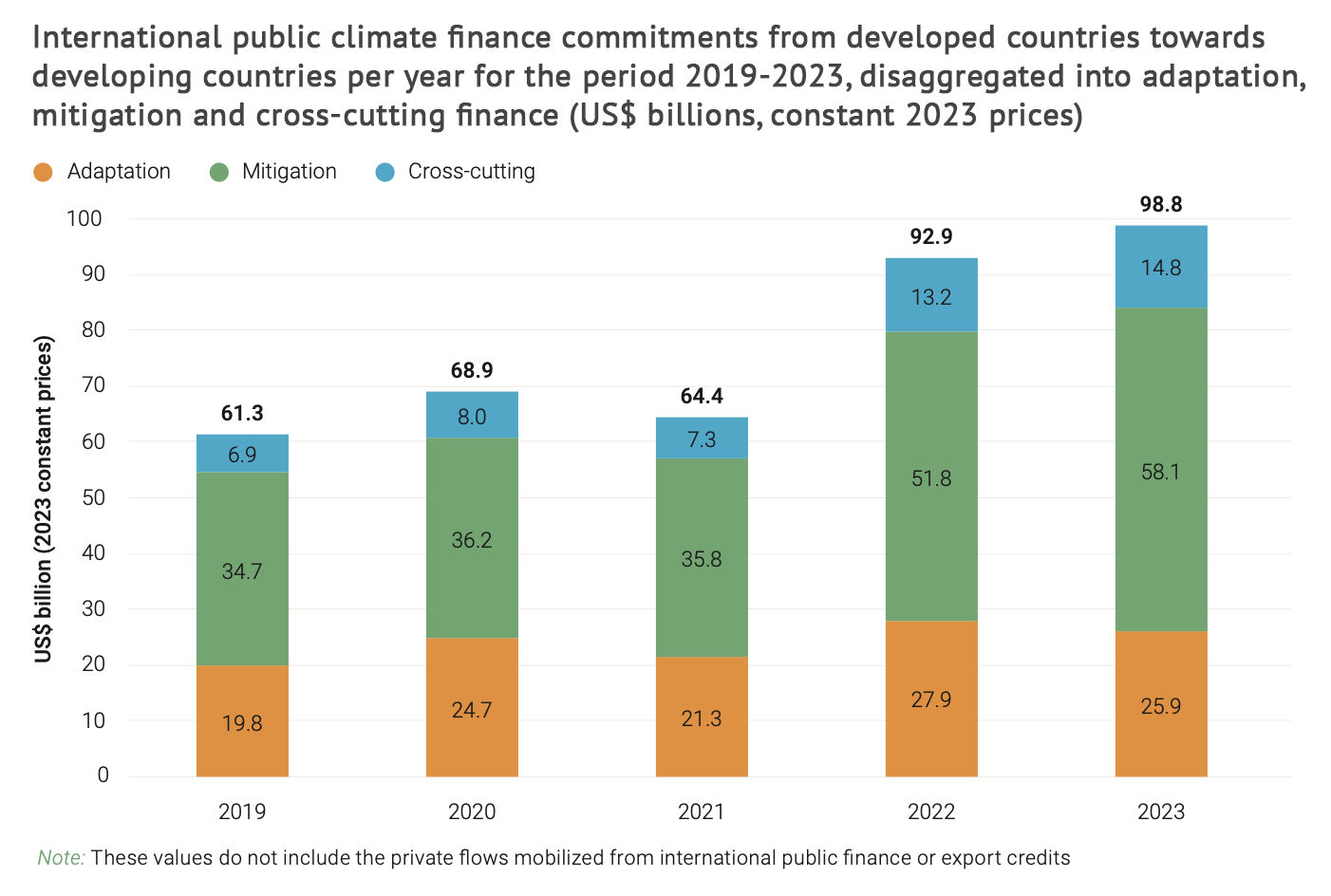
The UN warns that, if current trends continue, developed nations are set to miss their goal of doubling 2019 adaptation finance flows by 2025.
This goal – set out in the Glasgow Climate Pact agreed at the COP26 climate summit in 2021 – commits developed nations to providing $40bn in adaptation funding for developing nations by 2025.
Official climate-finance figures from the Organisation for Economic Co-operation and Development (OECD) for 2025 will not be available for several years. However, the report notes that, over 2019-23, international adaptation finance grew at a compound rate of 7% – falling short of the 12% rate required to meet the Glasgow Climate Pact goal.
Cuts to international aid budgets since 2023 are also threatening the Glasgow Climate Pact goal, according to the report authors. They note that, globally, foreign aid fell by 9% in 2024 and predict that reductions announced in 2025 are “likely” to lead to a further 9-17% decline.
Meanwhile, countries’ more recent pledge to help raise $300bn a year by 2035 for both tackling and adapting to climate change – set out in the new collective quantified goal for climate finance (NCQG), agreed last year at COP29 in Baku – is also under threat, according to the report.
In the introduction of the report, UNEP’s Anderson writes:
“While the numbers for 2024 and 2025 are not yet available, one thing is clear: unless trends in adaptation financing do not turn around, which currently seems unlikely, the Glasgow Climate Pact goal will not be achieved, the NCQG will not be achieved and many more people will suffer needlessly.”
‘Adaptation investment trap’
The report also breaks down international adaptation finance in 2023 by funding type. It finds that that 70% was either grants, which allow countries to address climate impacts without exacerbating debt, or “concessional” loans, which are provided at below market rate.
However, it notes that “non-consessional” finance – which is provided at, or near, market rates – is on the rise, growing at an annual compound rate of 7% over 2019-23. In 2023, non-concessional loans exceeded concessional ones for the first time, the report notes.
The “increasing proportion” of non-concessional finance raises “long-term affordability and equity” concerns, the authors warn. They also point to the risk of an “adaptation investment trap” – whereby rising climate disasters increase developing countries’ “indebtedness”, which subsequently makes it harder for them to invest in adaptation.
The report also finds that loans and other forms of “debt instruments” comprised “58% on average” of international adaptation finance in 2022-23.
The NCQG text highlights the need for “concessional” and “non-debt creating” finance.
(This came after strong calls from many developing countries to exclude “non-concessional” loans – which result in wealth flowing back to the donor countries as loan repayments and interest – as a form of climate finance. Analysis has shown that many developing countries are spending more on servicing debts than they receive in climate finance.)
Elsewhere, the authors also find that funding for new adaptation projects through UN Framework Convention on Climate Change (UNFCCC) funds (the adaptation fund, green climate fund (GCF) and the least developed countries fund (LDCF) and special climate change fund (SCCF) managed by the Global Environment Facility) saw a “large spike” in 2024, with grants reaching around $920m.
However, they note that the recent increase “may not be a trend, with financial constraints likely to rise beyond 2025”.
Developing nations’ adaptation finance needs are 12 times greater than current flows
While previous UN adaptation gap reports have investigated adaptation finance shortfalls through to 2030, this latest analysis extends its estimates through to 2035.
This is in light of the NCQG, which states that developed countries should “take the lead” in raising “at least $300bn” a year for climate action in developing countries by 2035.
The report calculates that the costs of adaptation by 2035 for developing countries sit in a “plausible central range” of $310-365bn annually. It explains that it has arrived at this range based on “two lines of evidence”:
- A modelled estimate of the additional costs of adaptation, calculated using “global sectoral models with national-level resolution”. This exercise pins the cost of adaptation for developing countries at $310bn a year by 2035 under an intermediate emissions scenario.
- An analysis of the climate finance needs set out by developing countries in 97 national adaptation plans and nationally determined contributions (NDCs) submitted to the UNFCCC – with “extrapolation” of this data to all 155 developing countries. This results in the upper figure of $365bn per year up to 2035.
The chart below shows the disparity between existing finance flows (dark blue bar) and adaptation finance needs and modelled costs (red bars).
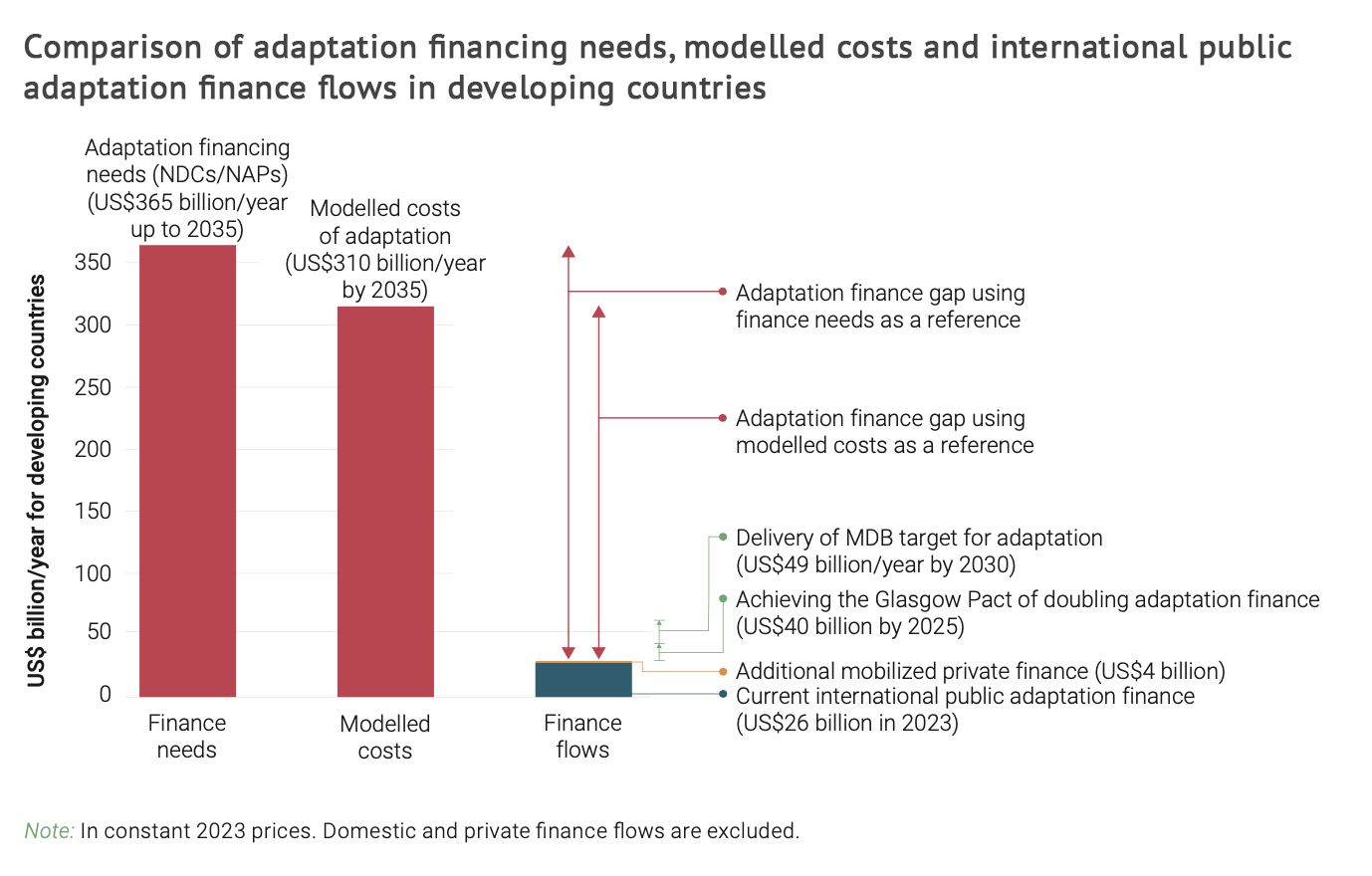
With current levels of international adaptation finance estimated at $26bn a year, the report calculates that developing countries are facing an “adaptation finance gap” in the range of $284-339bn per year by 2035.
As such, it calculates that the adaptation finance needs of developing countries by 2035 are “12-14 times” as much as current finance flows.
Of the public adaptation finance that has been issued, a higher proportion currently goes to the countries most exposed to climate hazards, according to the report. It notes that, in 2022-23, $10.4bn and $1.2bn was allocated to least-developed countries (LDCs), including Afghanistan and Rwanda, and small island developing states (SIDS), such as Tuvalua and the Marshall Islands, respectively.
Nevertheless, finance provided to these climate-vulnerable nations is still “modest relative to needs”, the report warns. It estimates that the adaptation finance needs of LDCs and SIDS are $50bn a year.
It also finds that per-capita adaptation finance to both country groups was lower in 2022-23 than previous years, at $9 for LDCs and $20 in SIDs.
A majority of countries have a national adaptation plan or strategy in place
Under the framework for the global goal on adaptation agreed at COP28, countries said they would put in place “national adaptation plans, policy instruments and planning processes and/or strategies” by 2030.
To assess the “global status” of national adaptation planning, the authors of the report tracked the publication of national plans, strategies and policies for adaptation in each country.
According to the report, the first national adaptation policy was published in 2002. It finds that there was a “notable acceleration” in countries developing national adaptation planning instruments over 2011-21, but says that, since then, progress has “slowed significantly”.
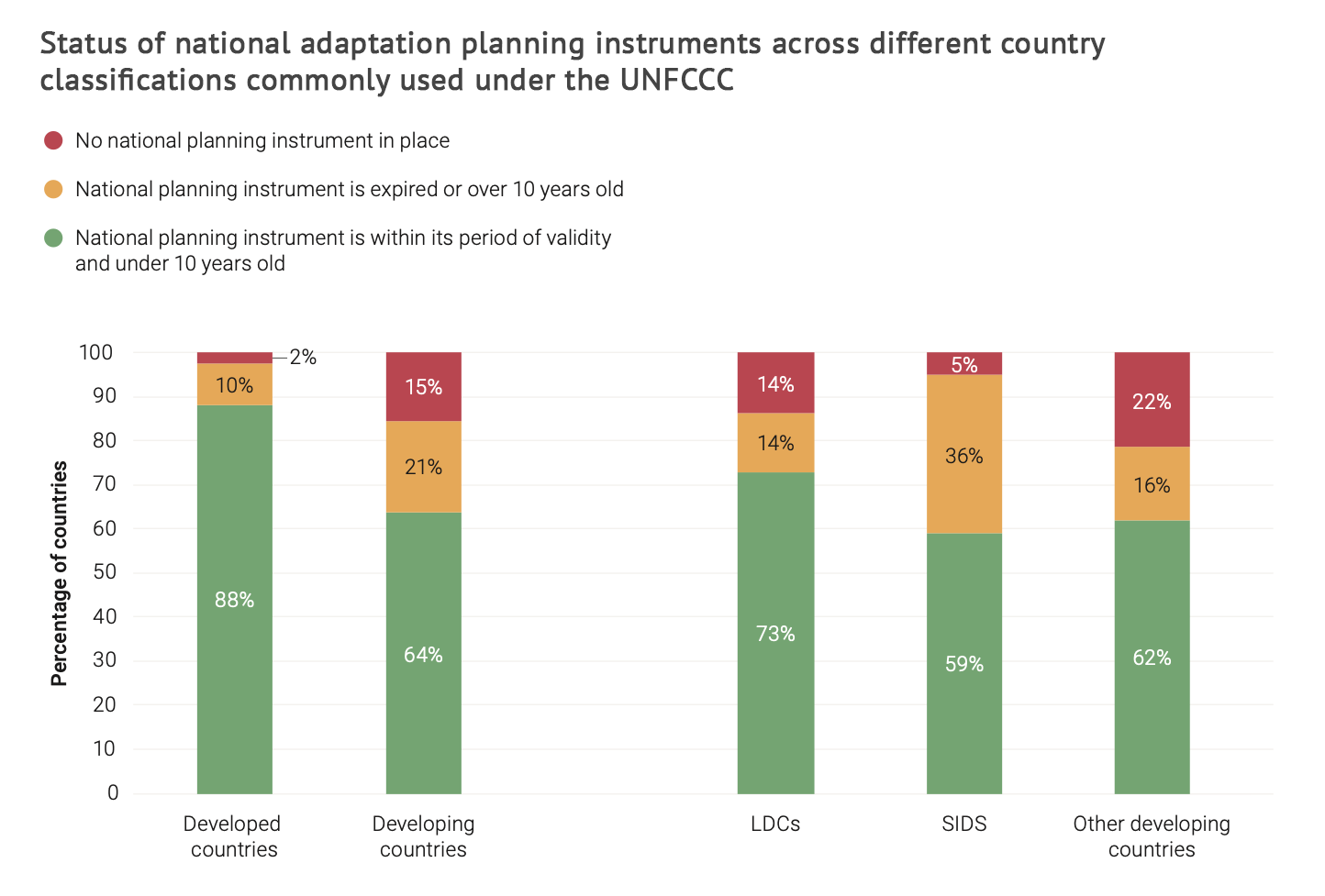
According to the report, 87% of countries had at least one national adaptation policy, strategy or plan in place as of 31 August 2025. However, 36 of these 172 countries’ plans are “expired” or “outdated”.
Meanwhile, 25 countries had no national adaptation plan at all, according to the report. It explains that these are “predominantly developing countries, suggesting that financial, technical and human resource constraints inhibit national adaptation planning”.
Of these countries without plans, 21 have “initiated a process to develop” a national adaptation plan, according to the report. However, it notes that many of these countries have “been in this process for a long time”.
The chart below shows the percentage of countries from different “country classifications” that have no national adaptation planning instrument in place (red), an expired adaptation planning instrument in place (yellow) and a valid instrument in place (green).
The report also discusses different types of adaptation “mainstreaming”. This is defined by the report authors as the “integration of adaptation objectives and climate risk considerations into the established functions, policy and practice of government institutions to build climate resilience”.
The authors list six different mainstreaming strategies. For example, “directed” mainstreaming means “dedicating funding, staff capacity-building and resources specifically to adaptation, including through financial frameworks and fiscal processes such as budget planning”.
Another example is “regulatory mainstreaming”, which means “modifying the formal or informal policy instruments such as legislation, frameworks, strategies and plans by integrating adaptation”.
According to the report, only regulatory mainstreaming is captured by the framework for the global goal on adaptation’s target related to planning.
The report also outlines the different “levels” of mainstreaming. These range from “prioritisation”, which it describes as a strong level of mainstreaming in which adaptation takes precedence over existing policy goals, to “coordination”, in which adaptation “is recognised as a policy goal, but is secondary to existing priorities”.
However, the report says there is “presently no agreement on how to measure and assess the outcomes of mainstreaming”.
Implementation of adaptation measures is progressing – but gaps remain
Under the UN “enhanced transparency framework”, countries are required to submit information about their climate progress in biennial transparency reports (BTR). The first report was due at the end of 2024.
The adaptation gap report calls BTRs the “most comprehensive national source of information on adaptation implementation worldwide available”.
The report says that 105 countries had submitted BRTs as of 31 August 2025, of which 94 include details about adaptation
The authors find that 75 of these BTRs mention gender in relation to adaptation. However, only 4% of the results reported through BTRs are directly related to “gender and social inclusion”.
The report also highlights the “uneven coverage” of BTRs globally. According to the report, 88% of developed countries have submitted a BTR, compared to only 37% of developing countries.
It adds that there are further inequalities within the bracket of “developing countries”. Only 21% of SIDS and 14% of LDCs have submitted BTRs with “detailed information on climate impacts and adaptation”, according to the report.
This could “indicate that preparing national reports such as BTRs is most burdensome for the countries with the least capacity”, the report authors suggest.
The map below shows the countries that have submitted a BTR including “detailed information on climate impacts and adaptation” (blue) and those that have not (grey). For the former category, darker blue indicates that the country’s BTR includes more segments of text (data points) about climate impacts and adaptation.
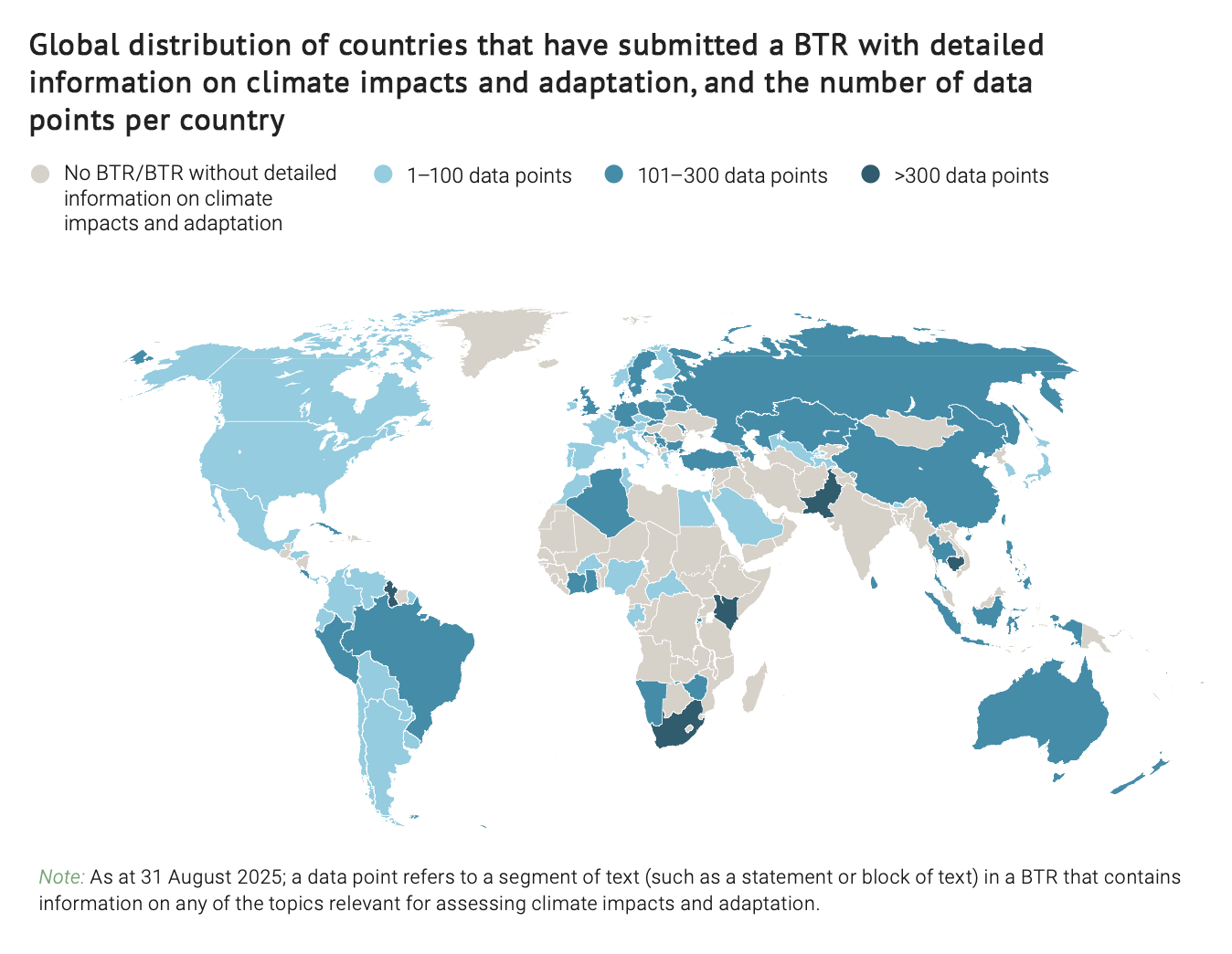
The report finds that countries are “disproportionately reporting on climate hazards, systems at risk, climate change impacts and adaptation priorities” in BTRs. Meanwhile, only 15% and 7% of the data points in the map above discuss adaptation “actions” and “results” respectively.
In total, the report identifies 1,640 “adaptation actions” across 68 BTRs. It says that 23% of these are related to “biodiversity and ecosystems”, 18% to “infrastructure and human settlements”, 16% to “water and sanitation” and 14% to “food and agriculture”.
However, it finds that actions targeting health and poverty alleviation or livelihoods are each accounting for only 5%, while those addressing cultural heritage are “nearly absent” and account for less than 1% of all reported actions.
In a separate analysis, the report explores documents submitted by developing countries to the UNFCCC to understand how adaptation needs break down by sector. It finds that the 55 plans submitted by developing countries which include “detailed sectoral information” reveal that the agriculture and food sector and water supply are “common priorities across all regions, though they vary in terms of their relative importance”.
The NCQG is insufficient on its own to meet adaptation finance needs
At COP29 last year, developed nations pledged to raise at least $300bn per year under the NCQG for both mitigation and adaptation.
The report says that, although the target “appears significantly higher than the previous goal for developed countries to mobilise $100bn by 2020 for developing countries”, it is still “clearly insufficient” to meet adaptation finance needs in 2035.
The report sets out two reasons for this.
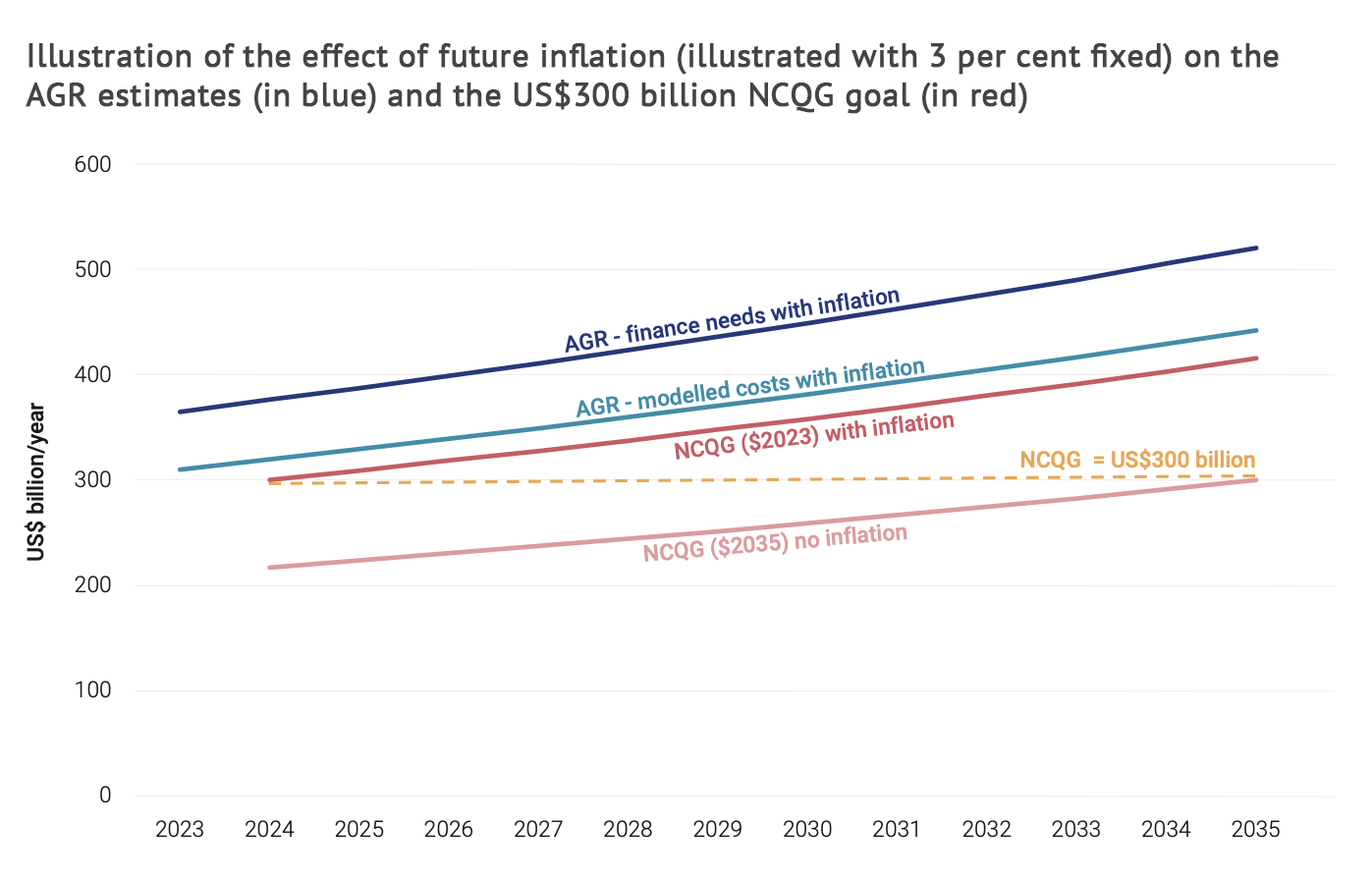
First, the authors explain that the $300bn target is not adjusted for inflation. It says that adaptation costs for developing countries are currently estimated at $310-365bn annually until 2035, based on costs in 2023. However, when adjusting for an inflation rate of 3% per year for the next decade, this number rises to US$440–520bn by 2035.
(In an analysis published last year, Carbon Brief noted that the $300bn target does not account for inflation.)
The plot below shows the effect of inflation on adaptation finance needs (dark blue) and modelled costs (light blue). It also shows the NCQG goal, accounting for inflation, based on 2023 costs (red) and without inflation based on 2035 costs (pink). It also shows the NCQG goal of $300bn by 2035 (yellow).
Second, it notes that the NCQG covers both mitigation – namely, efforts to cut emissions – and adaptation. So far, it warns that no “subgoal” has been agreed to determine how much money goes to each.
The report authors have also developed two scenarios exploring how much the NCQG would bridge the adaptation finance gap, if the $300bn target is met, both of which account for inflation. These are:
- A “minimum adaptation scenario”. The authors assume that 26% of the NCQG money will be used for adaptation finance as this is the percentage of all international climate finance that was spent on adaptation over 2011-20. Based on historical proportioning of finance, $3bn of the resulting $78bn this would go to SIDS and the rest to $25bn to LDCs.
- A “maximum adaptation scenario”. Under this scenario, the Glasgow Pact and Baku to Belém Roadmap are achieved, meaning that adaptation funding reaches $40bn annually by 2025 and $120bn annually by 2030. They also assume that adaptation finance grows by 7% per year, reaching $166bn by 2035 – more than half of the NCGQ finance goal of $300bn. Under this scenario, SIDS would receive $6bn in adaptation funding by 2035 and LDCs would receive $55bn.
The report concludes that, even if the NCQG is achieved, a “significant adaptation finance gap” is likely to remain in 2035 “regardless of the share of international public climate finance that will flow towards adaptation”.
Meanwhile, the report notes that private-sector finance can help “fill the adaptation finance gap” – but cautions that its overall contribution is likely to be “modest”.
The “realistic” potential for private-sector investment, according to the report, is $50bn per year by 2035 – a figure it estimates would cover 15-20% of overall estimated needs.
Reaching this level of private-sector finance will require “targeted policy action” given that current private-sector flows to “publicly identified” adaptation priorities in 2023 are estimated at $5bn, it notes.
Furthermore, UNEP warns that many proposed approaches for raising private-sector funds for adaptation measures pass “most of the costs of adaptation back to developing countries or households”.

The post UN report: Five charts which explain the ‘gap’ in finance for climate adaptation appeared first on Carbon Brief.
UN report: Five charts which explain the ‘gap’ in finance for climate adaptation

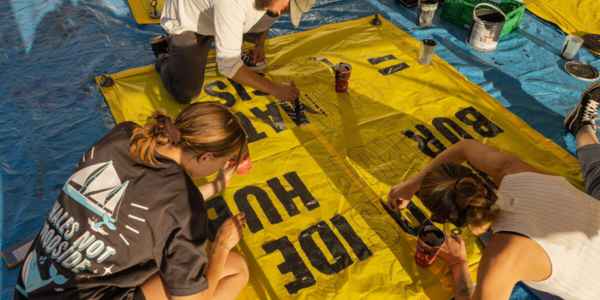
© Harriet Spark / Grumpy Turtle Film / Greenpeace
The banner drop is a distinctive part of the Greenpeace repertoire.
The moment of the unfolding is intrinsically dramatic. It is the reveal; when the moral and scientific truth of a situation is unveiled to the world. The wrong is being labelled—not through a written submission, or a social media post, or a statement in a meeting—but in words emblazoned in real physical space, chosen and occupied with precision, for all to see. There is jeopardy and transgression. And there are consequences—for the activists and for Greenpeace, as well as for the target of the communication. One of the reasons the banner remains such an effective tool in our toolbox is because of its undeniable clarity in cutting through, driving change and accountability in a way that few other tactics can. It is naming the wrong: in giant, clear letters.
We’ve hung these massive messages at environmental crime scenes, corporate headquarters, and iconic landmarks; on government buildings, ships and planes—in locations all around the world, for years.
My own memories unfurl even as I write this, but because the campaign to stop Woodside at Scott Reef is so pressing, what immediately springs to mind are two of our banners in that campaign: one on a crane outside their Perth HQ, and another on some of their corroding industrial junk at sea. What about you? Is there a particular banner that you picture when you think of Greenpeace?
The banners can attract global attention, but they have quiet beginnings. Each one is made by hand, often by volunteers. It is the invisible labour behind each spectacular public moment. One of the key pieces of equipment in our workshop at Rainbow Warrior House is the sewing machine. Sometimes our workshop is full of people and noise; at others it is quiet, the only sound being the gentle, purposeful, whir and buzz of a banner being sewn. It is usually our warehouse manager, Kieran Holmes, on the tools, head over the machine, carefully pouring over the raw canvas or tarp as the banner takes shape. Kieran’s one of those people who seems to be able to turn his hand to almost anything, but you wouldn’t know it because he’s old-school modest. In addition to being incredibly skilled, Kieran’s an all-round beaut human to have in the heart of our headquarters; never too busy to take the time to show a newcomer, or curious visitor, around his domain.
Once the banner is sewn up, the lettering needs to be outlined. This is done on a magnetic wall—a fit-for-purpose feature at Rainbow Warrior House, where the banner is held up with magnets, and the edges of the letters neatly traced from a projection.
Next comes the painting. It usually starts late in the afternoon, sometimes going into evenings and weekends, with volunteers, staff, mates crowded around, brushes in hand. It is a calming meditative feeling of shared purpose, giving each letter its visual heft, the colour building power and presence with each stroke.
Then you stand back, stretch, and look at the message, now ready.
S A V E S C O T T R E E F
Throughout history, every great push for social change has required some form of invisible labour; preparation in the form of quiet things seldom seen, but vital. It is the enabling work of love instantiated in action. And of course, so much of the time it has been women who have done this labour, so that the men could get the chance to make the speeches and stand on the podiums. The inaugural Greenpeace voyage to stop nuclear testing in 1971 had a male-only crew, but wouldn’t have happened without the ideas and work of women behind the scenes.
It is what we do together, after all, that changes the world. Sometimes that work happens on a stage, a ship on the wild seas, or up the side of a building. But mostly, it is the hidden diligence of those who care and contribute to all the enabling work that makes a change once thought impossible, inevitable. It is Kieran at his sewing machine. It was Dorothy Stowe doing the administrative work of the ‘Don’t Make A Wave Committee’ that became Greenpeace.
When we think of social change, it is the sturm and drang that we remember. The drop of the banner, the chant of the crowd, the raising of the new flag. But look behind the curtain, and there’ll be a crew of people who are taking responsibility for the administration, the sewing and the painting, making the food, checking the bus timetables, getting stuff done. And behind them are even more handsinvisibly donating time and trust; the financial, material and expert resources that make it all possible. There’s love, camaraderie and know-how at every stage.
We are social and cooperative creatures by nature. And we human beings have been stitching for millenia, sewing the possibilities of our common future. Political and corporate bullies and algorithmically manipulative platforms would have us forget this, and abandon who we are. But we should be in no doubt that the brighter prospects for ourselves and life on earth continue to be stitched and painted; collaboratively and with love, by the diligent hands of millions of people who care, each day, in every community and city across the world.
With Love,
David
Q & A
I always get great questions when interviewing prospective new team members. One that came up again recently was: “Is Greenpeace actually one organisation?”
Around the world, people know Greenpeace by our one global name, united by a shared mission: securing an Earth capable of nurturing life in all its magnificent diversity, with a particular focus on climate and biodiversity. Behind the scenes, though, we’re organised as a network of 25 legally autonomous national and regional offices, including Greenpeace Australia Pacific, working alongside Greenpeace International.
That structure gives us the best of both worlds: we work together leveraging the power of a global network on the issues that matter most, while each office remains legally independent and deeply connected to the communities, cultures and political realities where we’re embedded. Local knowledge informs global action, and global collaboration strengthens and supports local campaigns.
It’s a model that has enabled Greenpeace to take on some of the world’s biggest challenges for over five decades–while withstanding challenges and attacks from governments and corporations. Global enough to tackle global problems, local enough to understand our communities and the natural places we love.
If you’re curious to learn more, you can read about the Greenpeace Global Network structure here.
Steven Stone is acting director of the United Nations Environment Programme’s Office of Science
In 1934, American economist Simon Kuznets presented a paper to Congress advocating for a new way of measuring economic performance.
The United States was reeling from the Great Depression, and Kuznets – a future Novel prize winner – wanted to gauge just how badly the country’s economy had been dented.
His metric, which would come to be known as gross domestic product (GDP), was a breakthrough. But as pioneering as it was, Kuznets saw its limitations.
“The welfare of a nation can scarcely be inferred from a measure of national income,” he wrote in the 1934 paper.
Some nine decades on, we have largely forgotten that message. GDP has become a barometer of economic progress, a kind of one-number-that-rules-them-all upon which national policies turn and governments rise and fall.
With the climate crisis deepening by the day – as evidenced by the heatwaves and wildfires now searing Europe – our attachment to GDP is looking like a problem.
In a single-minded pursuit of GDP growth, humanity is inadvertently feeding several environmental crises that, over the long run, threaten to make most of us poorer, sicker and more miserable. Climate change alone could slice 20 per cent off global GDP by 2100 – a staggering number.
Clear-cutting boosts GDP not wealth
We need to broaden our vision and definition of economic success before it’s too late.
I grew up in the 1970s and 80s surrounded by the mixed hardwood forests of the northeastern United States. For me, the trees were a refuge, a place to run, discover and savor the history and mystery of the land and its people.
Those experiences with my friends were more important than the amount of money in my pocket. And they led to a realization early on in my career as an economist: that wealth is about more than just income.
This is one of GDP’s most significant oversights.
With every forest we clear cut and every ounce of fossil fuel we burn, GDP rises. But through those actions, we are whittling away at the natural world, which supplies us with food, water, medicine, clean air and countless other essentials.
-
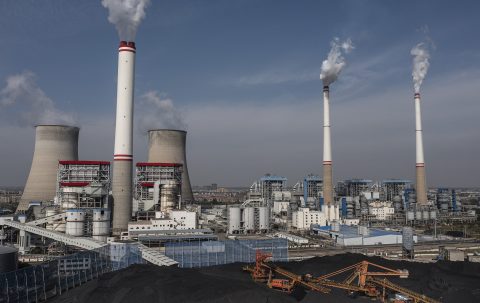
China’s coal power rebounds as record clean energy goes to waste
Long-term contracts guarantee coal plants buyers regardless of demand, crowding out renewables, report finds -
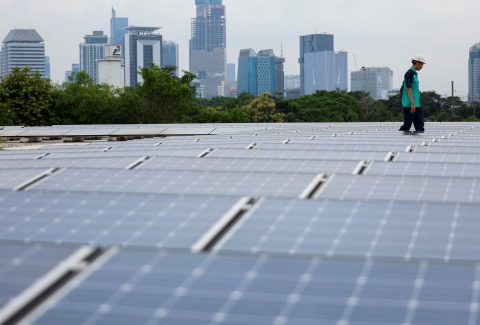
Southeast Asia’s fragile grids threaten billions in clean energy investment
Renewables developers need reliable electricity infrastructure and stable policies to help the region meet climate goals and surging demand for power
By focusing only on GDP, we’re ignoring what’s happening to the natural assets on which our prosperity ultimately depends. It’s like we’re driving a car and only looking at the speedometer, not the energy remaining in the battery.
That is the difference between measuring income versus measuring wealth.
The answer to this dilemma lies in looking beyond GDP. We must start considering a broader range of indicators when making policy decisions.
From an environmental perspective, that means measuring and valuing natural assets like forests, water, soil, biodiversity and clean air. By assigning a value to nature, decision-makers can better understand the economic consequences of, say, strip-mining a mountain top or letting plastic waste overwhelm a river.
There is still some debate over how exactly to do this kind of natural capital accounting. But that’s not a reason to dismiss it, as many have done. It took years of refinement to end up with the GDP formula we have today.
Costa Rica’s example
The idea of looking beyond GDP isn’t only a theoretical debate. Countries and communities around the world have started to make economic decisions based on their natural assets. A prime example is Costa Rica, a biodiversity hotspot where a years-long effort to conserve land and seascapes has led to a boom in tourism. That in part helped elevate the country into the club of high-income nations.
This kind of environmentally focused economic decision making can pay huge dividends. By stabilizing the climate, ending pollution and halting the loss of the natural world, humanity could save millions of lives a year and create US$20 trillion in economic benefits annually by 2070, found the Global Environment Outlook 7, a 2025 report from the United Nations Environment Programme (UNEP). The report was funded by the European Union among others.
I began my career as an economist before moving to UNEP, which focuses on solving the world’s thorniest environmental problems. During that time, I’ve come to appreciate that “wealth” means more than simply “income.” True prosperity means being able to provide for ourselves now and into the future. Anything short of that is an empty kind of affluence – and ultimately doomed to be short-lived.
As deadly heat blankets our cities, species slip into extinction and the planet struggles with rising toxicity and pollution, I am convinced that we can do better at measuring what matters. And that means updating and expanding how we measure economic progress.
The post As fires burn and temperatures soar, it’s time to imagine a world beyond GDP appeared first on Climate Home News.
As fires burn and temperatures soar, it’s time to imagine a world beyond GDP
Amira Odeh Quiñones is a hydrologist and Caribbean organiser for the 350.org climate campaign group
El Niño, likely to be one of the strongest in modern history, has arrived on Caribbean shores.
Drought is slowly creeping up on our islands. But unlike the fiery wildfires ravaging parts of Europe, there’s no smoke signalling the damage being done, no sirens to warn of the danger. Only announcements from public health officials to stay indoors and remain hydrated — as if outdoor workers and farming communities have the luxury to heed such advice.
During El Niño, strong atmospheric winds alter rain patterns and trap heat across the Caribbean. But while we have experienced El Niño many times before, it has become very visible in recent years how climate change is making this natural phenomenon worse.
Across the Greater Antilles, temperatures are soaring past 38°C (100°F), with real-feel indexes reaching a gruelling 43°C in parts of Puerto Rico where I live. Cuba has it worse. Widespread power outages mean that methods for cooling down are unavailable for most of the day, leaving millions of vulnerable people at risk of heat stroke when temperatures hit 38°C.
Santa Marta coalition tested as co-chair Colombia turns back to fossil fuels
During the last strong drought a decade ago, I had water only two days a week in my home. Today, there are many families whose taps are about to run completely dry. Water authorities have already begun strict rationing in some municipalities, with more on the list scheduled for rationing if conditions don’t change.
Water rationing is far more than an inconvenience; it is an immediate health risk. This means thousands of people need to constantly haul heavy buckets up flights of stairs just so they could bathe, cook, stay hydrated – the basics of survival.
Heat causes health problems
Puerto Rico is home to roughly 300,000 elderly residents. Many live alone, isolated and without support. They risk severe physical injury when carrying heavy water containers, and are wont to suffer from silent heat exhaustion in unventilated rooms.
Furthermore, when water shortages force residents to store water in open household containers, it inadvertently creates breeding grounds for Aedes aegypti mosquitoes. Paired with scorching temperatures that tend to shorten the mosquito breeding cycle, the region is facing explosive outbreaks of dengue fever that endanger our most vulnerable: children and the elderly.
The economic fallout is equally devastating. Dry fields mean millions of dollars in lost crops, forcing small agricultural businesses to collapse, needing urgent government relief to survive. Extreme fuel shortages have already paralyzed Cuba’s agricultural sector, cutting food output by 60% – the El Niño dry spell threatens to decimate it.
At sea, warmer ocean waters fuel massive influxes of sargassum seaweed. Rotting sargassum chokes our beaches, destroying the local tourism industry that so many working families rely on. Tangled seaweed also damages nets and boat engines, slashing fish catches and driving up equipment costs for local fishers.
In the south of Puerto Rico, the coastal town of La Parguera is currently witnessing a historic amount of sargassum on its shores. This has halted most of the boating activity in the area, which is the seaside town’s main tourist draw and economic driver.
All over the Caribbean, from town halls to local group gatherings, the story I hear is always the same: constant headaches, lost work hours, failing health, and a sense that quality of life is silently being stolen. The compounding effects of heatwaves, drought, and marine destruction are exhausting our people, our islands.
Climate change to blame
Climate change makes each El Niño year hotter and more damaging. Higher baseline global temperatures increase the energy and moisture available for extreme weather. Latest projections show that El Niño may push the monthly global average temperature past 2°C of warming for the first time in early 2027. In the Caribbean islands, that will not just be breaking records – it’ll be breaking lives.
Recently, I had the opportunity to share a panel with climate scientists behind what is known as the field of “attribution science” – or the science that compares today’s climate conditions to what the Earth’s climate would be like without human activity, particularly burning fossil fuels. They’re unequivocal: it’s no longer a question of whether extreme weather is caused by climate change, it’s just a question of how much.
-
Southeast Asia’s fragile grids threaten billions in clean energy investment
Renewables developers need reliable electricity infrastructure and stable policies to help the region meet climate goals and surging demand for power -
Quarter of countries still missing UN climate plans 18 months after deadline
Egypt, Vietnam, Argentina and the Philippines are among the 45 nations which have breached the Paris Agreement by not submitting their climate plan to the UN -
China’s coal power rebounds as record clean energy goes to waste
Long-term contracts guarantee coal plants buyers regardless of demand, crowding out renewables, report finds

Attribution science recently got a boost from the U.S.’ top scientific advisory body. The National Academies of Sciences, Engineering and Medicine recognized that researchers’ methods have advanced considerably in recent years, resulting in better assessments on how much extreme weather can be attributed to human-caused climate change. It noted that attribution findings could be relevant in some types of legal cases, including those seeking damages from oil companies for climate impacts.
This crisis, which is already taking a heavy toll on our communities’ survival, needs real, urgent, and structural action that goes beyond aid. With similar droughts now gripping parts of Asia and Africa, we’re falling into the familiar narrative of treating the looming humanitarian crisis as if no one was to blame, as if it is being caused solely by a natural phenomenon we can’t control.
It’s not. The world was already on fire before its regular visitor, El Niño, came. While we need humanitarian action, we need climate action too, in order to permanently put out the flames.
The post When taps run dry in the Caribbean, it’s not enough to blame El Niño appeared first on Climate Home News.
When taps run dry in the Caribbean, it’s not enough to blame El Niño



-
Climate Change12 months ago
Guest post: Why China is still building new coal – and when it might stop
-
Greenhouse Gases12 months ago
Guest post: Why China is still building new coal – and when it might stop
-

 Greenhouse Gases2 years ago
嘉宾来稿:满足中国增长的用电需求 光伏加储能“比新建煤电更实惠”
-

 Climate Change2 years ago
嘉宾来稿:满足中国增长的用电需求 光伏加储能“比新建煤电更实惠”
-
Climate Change2 years ago
Bill Discounting Climate Change in Florida’s Energy Policy Awaits DeSantis’ Approval
-

 Renewable Energy10 months ago
Sending Progressive Philanthropist George Soros to Prison?
-
Greenhouse Gases1 year ago
嘉宾来稿:探究火山喷发如何影响气候预测
-

 Carbon Footprint2 years ago
US SEC’s Climate Disclosure Rules Spur Renewed Interest in Carbon Credits