

Trump Halts Offshore Wind Projects, DJI Drone Ban Hits Industry
Allen, Joel, and Rosemary break down the Trump administration’s sudden halt of five major offshore wind projects, including Coastal Virginia Offshore Wind and parts of Vineyard Wind, over national security claims the hosts find questionable. They also cover the FCC’s ban on new DJI drone imports and what operators should do now, plus Fraunhofer’s latest wind research featured in PES Wind Magazine.
Sign up now for Uptime Tech News, our weekly email update on all things wind technology. This episode is sponsored by Weather Guard Lightning Tech. Learn more about Weather Guard’s StrikeTape Wind Turbine LPS retrofit. Follow the show on Facebook, YouTube, Twitter, Linkedin and visit Weather Guard on the web. And subscribe to Rosemary Barnes’ YouTube channel here. Have a question we can answer on the show? Email us!
The Uptime Wind Energy Podcast brought to you by Strike Tape, protecting thousands of wind turbines from lightning damage worldwide. Visit strike tape.com. And now your hosts, Alan Hall, Rosemary Barnes, Joel Saxon, and Yolanda Padron. Welcome to the Uptime Wind Energy
Allen Hall: Podcast. I’m your host, Alan Hall, and I’m here with.
Rosemary Barnes in Australia and Joel Saxon is down in Austin, Texas. Yolanda Padron is on holiday, and well, there’s been a lot happening in the past 24 hours as we’re recording this today. If you thought the battle over offshore wind was over based on some recent court cases, well think again. The Trump administration just dropped the hammer on five major offshore wind projects.
Exciting. National security concerns. The Secretary of the Interior, Doug Bergham announced. The immediate pause affecting projects from Ted Eor, CIP and Dominion Energy. So Coastal [00:01:00] Virginia, offshore wind down in Virginia, right? Which is the one we thought was never gonna be touched. Uh, the Department of War claims classified reports show these giant turbines create radar interference that could blind America’s defenses.
Half of vineyard winds, turbines are already up and running, producing power, by the way. Uh, and. I guess they, it sounds like from what I can see in more recent news articles that they turn the power off. They just shut the turbines off even though those turbines are fully functioning and delivering power to shore.
Uh, so now the question is what happens? Where does this go? And I know Osted is royally upset about it, and Eor obviously along with them, why not? But the whole Denmark us, uh, relationship is going nuclear right now.
Joel Saxum: I think here’s a, here’s a technical thing that a lot of people might not know. If you’re in the wind industry in the United States, you may know this.
There’s a a few sites in the northern corner of Colorado that are right next to Nebraska, [00:02:00] and that is where there is a strategic military installations of subsurface, basically rocket launches and. And in that entire area, there is heavy radar presence to be able to make sure that we’re watching over these things and there are turbines hundreds of meters away from these launch sites at like, I’ve driven past them.
Right? So that is a te to me, the, the radar argument is a technical mute point. Um, Alan, you and I have been kind of back and forth in Slack. Uh, you and I and the team here, Rosemary’s been in it too, like just kind of talking through. Of course none of us were happy. Right. But talking through some of the points of, of some of these things and it’s just like basically you can debunk almost every one of them and you get down to the level where it is a, what is the real reasoning here?
It’s a tit for tat. Like someone doesn’t like offshore wind turbines. Is it a political, uh, move towards being able to strengthen other interests and energy or what? I don’t know. ’cause I can’t, I’m not sitting in the Oval Office, but. [00:03:00] At the end of the day, we need these electrons. And what you’re doing is, is, is you’re hindering national security or because national security is energy security is national security, my opinion, and a lot of people’s opinions, you’re hindering that going forward.
Allen Hall: Well, let’s look at the defense argument at the minute, which is it’s, it’s somehow deterring, reducing the effectiveness of ground radars, protecting the shoreline. That is a bogus argument. There’s all kinds of objects out on the water right now. There’s a ton of ships out there. They’re constantly moving around.
To know where a fixed object is out in the water is easy, easy, and it has been talked about for more than 15 years. If you go back and pull the information that exists on the internet today from the Department of Defense at the time, plus Department of Interior and everybody else, they’ve been looking at this forever.
The only way these turbines get placed where they are is with approval from the Department of Defense. So it isn’t like it didn’t go through a review. It totally did. They’ve known about this for a long, long time. So now to bring up this [00:04:00] specious argument, like, well, all of a sudden the radar is a problem.
No, no. It’s not anybody’s telling you it’s a classified. Piece of information that is also gonna be a bogus argument because what is going along with that are these arguments as well, the Defense Department or Department of War says it’s gonna cause interference or, or some degradation of some sort of national defense.
Then the words used after it have nothing to do with that. It is, the turbines are ugly, the turbines are too tall. It may interfere, interfere with the whales, it may interfere with fishing, and I don’t like it. Or a, a gas pipeline could produce more power than the turbines can. That that has nothing to do with the core argument.
If the core argument is, is some sort of defense related. Security issue, then say it because it, it can’t be that complicated. Now, if you, if you knew anything about the defense department and how it operates, and also the defenses around the United States, of which I know a little bit about, [00:05:00] having been in aerospace for 30 freaking years, I can tell you that there are all kinds of ways to detect all kinds of threats that are approaching our shoreline.
Putting a wind turbine out there is not
Joel Saxum: gonna stop it. So the, at the end of the day, there is a bunch, there’s like, there’s single, I call them metric and intrinsic, right? Metric being like, I can put data to this. There’s a point here, there’s numbers, whatever it may be. And intrinsic being, I don’t like them, they don’t look that good.
A pipeline can supply more energy. Those things are not necessarily set in stone. They’re not black and white. They’re, they’re getting this gray emotional area instead of practical. Right. So, okay. What, what’s the outcome here? You do this, you say that we have radar issues. Do we do, does, does the offshore substation have a radar station on it for the military or, or what does that, what does that look like?
Allen Hall: Maybe it does, maybe it doesn’t, but if the threat is what I think it is, none of this matters. None of this matters. It’s already been discussed a hundred times with the defense [00:06:00] department and everybody else is knowledgeable in this, in this space. There is no way that they started planted turbines and approve them two, three years ago.
If it was a national security risk, there is no chance that that happened. So it really is frustrating when you, when you know some of the things that go on behind the scenes and you know what, the technical rationales could be about a problem. And that’s not what’s being talked about right now that I don’t like being lied to.
Like, if you want to have a, a political argument, have a political argument, and the, if the political argument is America wants Greenland from Denmark, then just freaking say it. Just say it. Don’t tie Massachusetts, New York, Connecticut, new J, all, all these states up until this nonsense, Virginia, what are we doing?
What are we doing? Because all those states approved all those projects knowing full well what the costs were, knowing how tall the turbines were, knowing how long it was gonna take to get it done, and they all approved them. This [00:07:00] is not done in a vacuum. These states approve these projects and these states are going to buy that power.
Let them, you wanna put in a a, a big gas pipeline. Great. How many years is that gonna take, Doug? How many years is that gonna take? Doug Bergham? Does anybody know? He, he doesn’t know anything about that.
Joel Saxum: You’re not getting a gas pipeline into the east coast anytime soon whatsoever. Because the, the east, the east coast is a home of Nimbyism.
Allen Hall: Sure, sir. Like Massachusetts. It’s pretty much prohibited new gas pipelines for a long time. Okay. That’s their choice. That is their choice. They made that choice. Let them live with it. Why are you then trying to, to double dip? I don’t get it. I don’t get it. And, but I do think, Joel, I think the reason. This is getting to the level it is.
It has to do something to do with Greenland. It has something to do with the Danish, um, uh, ambassador or whoever it was running to talk to, to California and Newsom about offshore tournaments. Like that was not a smart move, my opinion, but [00:08:00] I don’t run international relations with for Denmark. But stop poking one another and somebody’s gotta cut this off.
The, the thing I think that the Trump administration is at risk at is that. Or instead, Ecuador has plenty of cash. They’re gonna go to court, and they are most likely going to win, and they’re going to really handcuff the Trump administration to do anything because when you throw bull crap in front of a judge and they smell it, the the pushback gets really strong.
Well, they’re gonna force all the discussion about anything to do with offshore to go through a judge, and they’re gonna decide, and I don’t think that’s what the Trump administration wants, but that’s where they’re headed. I’m not sure why
Joel Saxum: you’d wanna do that. Like at the end of the day, that may be the solution that has to come, but I don’t think that that’s not the right path either.
Right? Because a judge is not an SME. A judge doesn’t know all of the, does the, you know, like a, a judge is a judge based on laws. They don’t, they’re, they’re not an offshore wind energy expert, so they sh that’s hard for them to [00:09:00] decide on. However, that’s where it will go. But I think you’re correct. Like this, this is more, this is a larger play and, and this mor so this morning when this rolled out, my WhatsApp, uh, and text messages just blew up from all of my.
Danish friends, what is going on over there? I’m like, I don’t know what you want me to say. I’m not in the hopeful office. I can’t tell you what’s going on. I’m not having coffee in DC right now. I said, you know, but going back to it, like you can see the frustration, like, what, why, why is this the thing? And I think you’re right though, Alan, it is a large, there’s a larger political play in, in movement here of this Greenland, Denmark, these kind of things.
And it’s a, it’s. It’s sad to see it ’cause it just gets caught. We’re getting caught in the crossfire as a wind industry. Yeah. It’s
Allen Hall: not helping anybody. And when you set precedents like this, the other side takes note, right? So Democrats, when they eventually get back into the White House again, which will happen at some point, are gonna swing the pendulum just as hard and harder.
So what are you [00:10:00] doing? None of, none of this matters in, in my opinion, especially if you, if you read Twitter today, you’re like, what the hell? All the things that are happening right now. RFK Jr had a post a few hours ago talking about, oh, this is great. We’re gonna shut off this off shore wind thing because it kills the whales.
Sorry, it doesn’t. Sorry. It doesn’t, if you want, if you wanna make an argument about it, you have to do better than that. A Twitter post doesn’t make it fact, and everybody who’s listened to this and paying attention, I don’t want you to do your own research, but just know that you got a couple of engineers here, that that’s what we do for a living.
We source through information, making sure that it makes sense. Does it align? Is it right? Is it wrong? Is, is there something to back it up with? And the information that we have here says. It is. It’s not hurting anything out there. You may not like them, but you know what? You don’t want a coal factor in your backyard either.
Delamination and bottomline failures and blades are difficult problems to detect [00:11:00] early. These hidden issues can cost you millions in repairs and lost energy production. C-I-C-N-D-T are specialists to detect these critical flaws before they become expensive burdens. Their non-destructive test technology penetrates deep to blade materials to find voids and cracks.
Traditional inspections completely. Miss C-I-C-N-D-T Maps. Every critical defect delivers actionable reports and provides support to get your blades back in service. So visit cic ndt.com because catching blade problems early will save you millions.
Joel Saxum: When it comes down to sorting through data, I think that’s a big problem. Right? And that’s what’s happening with a lot of the, I mean, generalizing, a lot of the things that are happening in the United States in the last 10 years give it. Um, but people just go, oh, this person said this. They must be an authority.
Like, no, it’s not true. We’ve been following [00:12:00] a lot of these things with offshore wind. I mean, probably closer than most. Uh, besides the companies that are developing those wind farms, simply because it’s a part of our day job, it’s what we do. We’re, we’re, we’re looking at these things, right? So.
Understanding the risks, uh, rewards, the political side of things. The commercial side. The technical side. That’s what we’re here to kind of feed, feed the information back to the masses. And a lot of this, or the majority of all of this is bs. It doesn’t really, it doesn’t, it doesn’t play. Um, and then you go a little bit deeper into things and.
Like the, was it the new Bedford Light, Alan, that said like, now they’re seeing that the turbines have actually been turned off, not just to stop work for construction. They’ve turned the turbines off up in Massachusetts or up off of in the northeast area? No, that they have.
Allen Hall: And why? I mean, the error on the side of caution, I think if you’re an attorney for any of the wind operations, they’re gonna tell you to shut it off for a couple of days and see what we can figure out.
But the, the timing of the [00:13:00] shutdown I think is a little unique in that the US is pretty much closed at this point. You’re not gonna see anything start back up for another couple of weeks, although they were doing work on the water. So you can impose a couple hundred million. Do, well, not a hundred million dollars, but maybe a couple million dollars of, of overhead costs in some of these projects because you can’t respond quick enough.
You gotta find a judge willing to put a stay in to hold things the same and, and hold off this, uh, this, uh, b order, but. To me, you know, it’s one of those things when you deal with the federal government, you think the federal government is erratic in just this one area? No, it’s erratic in a lot of areas.
And the frustration comes with do you want America to be stronger or do you want nonsense to go on? You know? And if I thought, if that thought wind turbines were killing whales, I’d be the first one up to screaming. If I thought offshore wind was not gonna work out in term, in some long-term model, I would be the first one screaming about it.
That’s not
Joel Saxum: reality. [00:14:00] Caveat that though you said, you’re saying if I thought, I think the, the real word should be if I did the research, the math and understood that this is the way it was gonna be. Right? Because that’s, that’s what you need to do. And that’s what we’ve been doing, is looking at it and the, the, all the data points to we’re good here.
If someone wanted to do harm
Allen Hall: to the United States, and God forbid if that was ever the case. That wouldn’t be the way to do it. Okay. And we, and we’ve seen that through history, right. So it, it’s, it doesn’t even make any sense. The problem is, is that they can shield a judge from looking at it somewhat. If they classify well, the judge isn’t able to see what this classified information is.
In today’s world, AI and everything on the internet, you don’t think somebody knows something about this? I do. And to think that you couldn’t make any sort of software patch to. Fix whatever 1965 radar system they have sitting on the shorelines of Massachusetts. They could, in today’s world, you can do that.
So this whole thing, it [00:15:00] just sounds like a smoke screen and when you start poking around it, no one has an answer. That is the frustrating bit. If you’re gonna be seeing stuff, you better have backup data. But the
Joel Saxum: crazy thing here, like look at the, the, the non wind side of this argument, like you’re hurting job growth.
Everybody that goes into a, uh. Into office. One of the biggest things they run on all the time, it doesn’t matter, matter where you are in the world, is I’m gonna bring jobs and prosperity to the people. Okay. How many jobs have just been stopped? How many people have just been sent home? How much money’s being lost here?
And who’s one of the biggest companies installing these turbines in the states? Fricking ge like so. You’re, you’re hurting your own local people. And not only is this, you stand there and say, we’re doing all this stuff. We’re getting all this wind energy. We’re gonna do all these things and we’re gonna win the AI race.
To the point where you’ve passed legislation or you’ve written, uh, uh, executive order that says, Hey, individual states, if you pass legislation [00:16:00] that slows or halts AI development in your state, the federal government can sue you. But you’re doing the same thing. You’re halting and slowing down the ability for AI and data centers to power themselves at unprecedented growth.
We’re at here, 2, 3, 4, 5% depending on what, what iso you ask of, of electron need, and we’re the fastest way you could put electrons to the grid. Right now in the United States, it’s. Either one of those offshore wind farms is being built today, or one of the other offs, onshore wind farms or onshore solar facilities that are being built right now today.
Those are the fastest ways to help the United States win the AI race, which is something that Trump has loud, left and right and center, but you’re actively like just hitting people in the shins with a baseball bat to to slow down. Energy growth. I, I just, it, it doesn’t make any logical sense.
Allen Hall: And Rosemary just chime in here.
We’ve had enough from the Americans complaining about it.
Rosemary Barnes: Yeah. I mean, it’s hard for me to comment in too much detail about all of the [00:17:00] American security stuff. I mean, defense isn’t, isn’t one of my special interests and especially not American defense, but. When I talk about this issue with other Australians, it’s just sovereign risk is the, the issue.
I mean, it was, it’s similar with the tariffs. It’s just like how, and it’s not just for like foreign companies that might want to invest in America. American companies are affected just, uh, as equally, but like you might be anti wind and fine. Um, but I don’t know how any. Company of any technology can have confidence to embark on a multi-year, um, project.
Now, because you don’t know, like this government hates wind energy, but the next one could hate ai or the next one could hate solar panels, electric cars, or you know, just, just anything. And so like you just can’t. You just can’t trust, um, that your plans are gonna be able to be fulfilled even if you’ve got contracts, even if you’ve got [00:18:00] approvals, even if you are most of the way through building something, it’s not enough to feel safe anymore.
And it’s just absolutely wild. That’s, and yeah, I was actually discussing with someone yesterday. How, and bearing in mind I don’t really understand American politics that deeply, but I’m gonna assume that Republicans are generally associated with being business friendly. So there must be so many long-term Republican donors who have businesses that have been harmed by all of these kinds of changes.
And I just don’t understand how everyone is still behind this type of behavior. That’s what, that’s what I struggle to understand.
Joel Saxum: This is the problem at the higher levels in. In DC their businesses are, are oil and gas based though. That’s the thing, the high, the high power conservative party side of things in the United States politics.
The, the lobby money and the real money and the like, like think like the Dick Cheney era. Right. That was all Weatherford, right? It’s all oil and gas.
Rosemary Barnes: So it’s not like anybody [00:19:00] cares about the, you know, I don’t know, like there’d be steel fabricators who have been massively affected by this. Right? Like that’s a good, a good traditional American business.
Right. But are you saying it’s not big enough business that anyone would care that, that they’ve been screwed over?
Joel Saxum: Not anymore
Allen Hall: because all that’s being outsourced. The, the other argument, which Rosemary you touched upon is, is the one I’m seeing more recently on all kinds of social medias. It’s a bunch of foreign companies putting in these wind turbines.
Well, who the hell
Joel Saxum: is drilling your oil baby? This is something that I’ve always said. When you go go to Houston, Texas, the energy capital of the world, every one of those big companies, none of ’em are run by a Texan. They are all run by someone from overseas. Every one of ’em.
Allen Hall: You, you think that, uh, you know, the Saudis are all, you know, great moral people.
What the hell are you talking about? Are you starting to compare countries now? Because you really don’t wanna do that. If you wanna do that into the traditional energy marketplace, you’re, you’re gonna have [00:20:00] a lot of problems sleeping at night. You will, I would much rather trust a dane to put in a wind turbine or a German to put in a wind turbine than some of the people that are in, involved in oil and gas.
Straight up. Straight up. Right. And we’ve known that for years. And we, we, we just play along, look. The fact of the matter is if you want to have electrons delivered quickly to the United States, you’re gonna have to do something, and that will be wind and solar because it is the fastest, cheapest way to get this stuff done.
If you wanna try to plant some sort of gas pipeline from Louisiana up to Massachusetts or whatever the hell you wanna do, good luck. You know how many years you’re talking about here. In the meantime, all those people you, you think you care about are gonna be sitting there. With really high electricity rates and gas, gas, uh, rates, it’s just not gonna end well.
Speaker 5: Australia’s wind farms are growing fast, but are your operations keeping up? Join us February 17th and [00:21:00] 18th at Melbourne’s Poolman on the park for Wind energy o and M Australia 2026, where you’ll connect with the experts solving real problems in maintenance asset management. And OEM relations. Walk away with practical strategies to cut costs and boost uptime that you can use the moment you’re back on site.
Register now at W OM a 2020 six.com. Wind Energy o and m Australia is created by wind professionals for wind professionals because this industry needs solutions. Not speeches if
Allen Hall: you don’t have enough on your plate already. Uh, the FCC has panned the import and sale of all new drone models from Chinese manufacturers, including the most popular of all in America, DJI, uh, and they clo.
They currently hold about 70% of the global marketplace, the ban as DGI and Autel Robotics to the quote unquote covered list of entities deemed [00:22:00] a national security risk. Now here’s the catch. Existing models that are already approved for sale can still be purchased. So you can walk down to your local, uh, drone store and buy A DJI drone.
And the ones you already own are totally fine, but the next generation. Not happening. They’re not gonna let ’em into the United States. So the wind industry heavily relies on drones. And, and Joel, you and I have seen a number of DJI, sort of handheld drones that are used on sites as sort of a quick check of the health of a, or status of a blade.
Uh, you, you, I guess you will still be able to do that if you have an older dj. I. But if you try to buy a new one, good luck. Not gonna happen.
Joel Saxum: Yeah. I think the most popular drone right now in the field, of course two of ’em, I would, I would say this, it’s like the Mavic type, you know, the little tiny one that like a site supervisor or a technician may have, they have their part 1 0 7 license.
They can fly up and look at stuff. Uh, and then the [00:23:00] other one is gonna be the more industrial side. That’s gonna be the DJ IM 300. And that’s the one where a lot of these platforms, the perceptual robotics and some of the others have. That’s their base because the M 300 has, if you’re not in the, the development world, it has what’s called a pretty accessible SDK, which software development kit.
So they’re designed to be able to add your sensors, put your software, and they’re fly ’em the way you want to. So they’re kind of like purpose built to be industrial drones. So if you have an M 300 or you’re using them now, what this I understand is you’re gonna still be able to do that, but when it comes time for next gen stuff, you’re not gonna be able to go buy the M 400.
And import that. Like once it’s you’re here, you’re done. So I guess the way I would look at it is if I was an operator and that was part of our mo, or I was using a drone inspection provider, that that’s what comes on site. I would give people a plan. I would say basic to hedge your risk. I would say [00:24:00]basically like, Hey, if you’re my drone operator and I’m giving you a year to find a new solution.
Um, that integrates into your workflows to get this thing outta here simply because I can’t be at risk that one day you show up, this thing crashes and I can’t get another one. A lot of companies are already like, they’re set and ready to go. Like all the new Skys specs, the Skys specs, foresight, drone, it’s all compliant, right?
It’s USA made USA approved. Good to go. I think the new Arons drone is USA compliant. Good to go. Like, no, no issues there. So. Um, I think that some of the major players in the inspection world have already made their moves, um, to be able to be good USA compliant. Um, so just make sure you ask. I guess that’s, that.
Our advice to operators here. Make sure you ask, make sure you’re on top of this one so you just don’t get caught with your pants down.
Allen Hall: Yeah, I know there’s a lot of little drones in the back of pickup trucks around wind farms and you probably ought to check, talk to the guys about what’s going on to make sure that they’re all compliant.
[00:25:00] In this quarter’s, PES Win magazine, which you can download for free@pswin.com. There is an article by Fran Hoffer, and they’re in Germany. If you don’t know who Fran Hoffer is, they’re sort of a research institution that is heavily involved in wind and fixing some of the problems, tackling some of the more complex, uh, issues that exist in blade repair.
Turbine Repair Turbine Lifetime. And the article has a number of the highlights that they’ve been working on for the last several years, and you should really check this out, but looking at the accomplishments, Joel, it’s like, wow, fraud offer has been doing a lot behind the scenes and some of these technologies are, are really gonna be helpful in the near future.
Joel Saxum: Yeah. Think of Frown Hoffer of your our US com compadres listening. Think of frown Hoffer as and NRE L, but. Not as connected to the federal government. Right. So, but, but more connected to [00:26:00] industry, I would say. So they’re solving industry problems directly. Right. Some of the people that they get funding research from is the OEMs, it’s other trade organizations within the group.
They’re also going, they’re getting some support from the German federal government and the state governments. But also competitive research grants, so some EU DPR type stuff, um, and then some funding from private foundations and donors. But when you look at Frow, offerer, it’s a different project every time you talk to ’em.
But, and what I like to see is the fact that these projects that they’re doing. Are actually solving real world problems. I, I, I, Alan and I talk about this regularly on the podcast is we have an issue with government funding or supportive funding or even grant funding or competitive funding going to in universities, institutions, well, whoever it may be, to develop stuff that’s either like already developed, doesn’t really have a commercial use, like, doesn’t forward the industry.
But Frow Hoffer’s projects are right. So like one of the, they, they have [00:27:00] like the large bearing laboratory, so they’re test, they’ve tested over 500 pitch bearings over in Hamburg. They’re developing a handheld cure monitoring device that can basically tell you when resin has cured it, send you an email like you said, Alan, in case you’re like taking a nap on the ropes or something.
Um, but you know, and they’re working on problems that are plaguing the industry, like, uh, up working on up towel repairs for carbon fiber, spar caps. Huge issue in the industry. Wildly expensive issue. Normally RA blade’s being taken down to the ground to fix these now. So they’re working on some UPT tile repairs for that.
So they’re doing stuff that really is forwarding the industry and I love to see that.
Allen Hall: Yeah. It’s one of the resources that. We in the United States don’t really take advantage of all the time. And yeah, and there’s a lot of the issues that we see around the world that if you were able to call f Hoffer, you should think about calling them, uh, and get their opinion on it.
They probably have a solution or have heard of the problem before and can direct you to, uh, uh, a reasonable outcome. [00:28:00] That’s what these organizations are for. There’s a couple of ’em around the world. DTU being another one, frow Hoffer, obviously, uh, being another powerhouse there. That’s how the industry moves forward.
It, it doesn’t move forward when all of us are struggling to get through these things. We need to have a couple of focal points in the industry that can spend some research time on problems that matter. And, and Joel, I, I think that’s really the key here. Like you mentioned it, just focusing on problems that we are having today and get through them so we can make the industry.
Just a little bit better. So you should check out PES WIN Magazine. You can read this article and a number of other great articles. Go to ps win.com and download your articles today. That wraps up another episode of the Uptime Wind Energy Podcast. Thanks for joining us and we appreciate all the feedback and support we receive from the wind industry.
If today’s discussion sparked any question or ideas, we’d love to hear from you. Just reach out to us on LinkedIn and please don’t forget to subscribe so you [00:29:00] never miss an episode For Joel, Rosemary and Yolanda, I’m a hall. We’ll catch you next week on the Uptime Wind Energy Podcast.
Trump Halts Offshore Wind Projects, DJI Drone Ban Hits Industry

Renewable Energy
Is a Team of Is a Bunch of MAGA Thugs Beating the Snot Out of a Woman a New Low, or Is it What We Now Need to Expect?
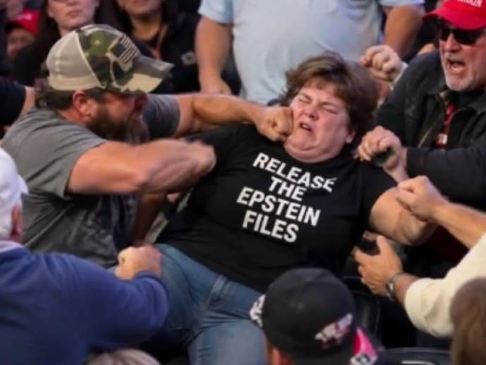 Just when we think there is a bottom, the United States sinks just a bit lower. It’s our brand nowadays.
That’s quite a left cross this thug delivered to this helpless female protestor.
It wasn’t too long ago that beating up women was taboo in America. My 11-year-old, sixth-grade son saw a male classmate of his badly bruise a girl by pushing her hard down to the ground–and proceeded to punch him in the mouth. A fellow father witnessed the scene and told me, “Your son’s fist was in that kid’s teeth within a fraction of a second.”
I had brought him up to avoid violence and achieve peaceful resolutions to conflicts, but I couldn’t fault him here.
What a disgusting bunch of turds we’ve become.
We’re starting to see intimations that stupidity like this is generated and posted by Russian data centers so as to appeal to MAGA idiots and favor the Republicans in the upcoming midterms.
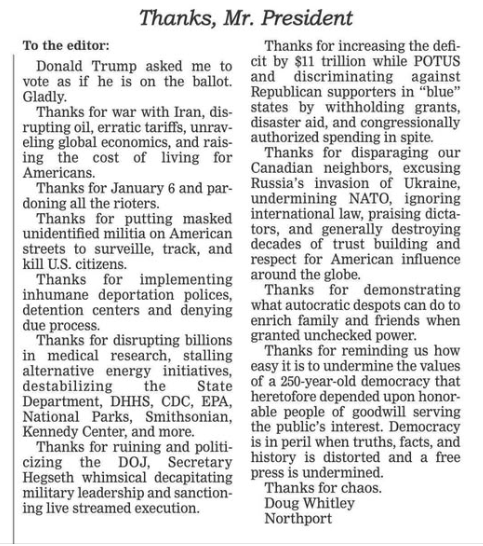 Every day, we come across articles that summarize Trump’s “accomplishments.”
I thought I’d publish this masterpiece.


Is a Team of Is a Bunch of MAGA Thugs Beating the Snot Out of a Woman a New Low, or Is it What We Now Need to Expect?
