

With governments due to announce ambitious emissions reduction targets at a UN summit in New York this week, the UN climate chief warned on Monday they will not add up to what is needed to keep global warming to the limits in the Paris Agreement.
Countries were asked by the UN climate change body to publish their new national climate plans (NDCs) by the end of September, in time to be included in a key summary report next month comparing those pledges with the global cuts scientists say are needed.
With around 110 countries lined up to speak at UN headquarters on Wednesday, a clearer picture will start to emerge on the scale of the gap between emissions-cutting targets and the reductions in planet-heating gases required to meet the 1.5C warming limit – 43% below 2019 levels by 2030 and 60% by 2035.
The European Union was unable to meet the September deadline because of political differences and will only present a range described as a “statement of intent” in New York this week.
China, meanwhile, is not expected to deliver an NDC that would align its efforts with the 1.5C limit. Heads of state from India and Indonesia are not scheduled to participate in the New York summit and so are likely to announce their plans later.
“We know [the NDCs] are going to be softer than what science dictates,” the UN’s climate head Simon Stiell told the opening of Climate Week in New York.
At the COP30 climate negotiations in Brazil in November, he added, “the focus… will not be what countries have presented, but how will they respond to those submissions – and that primary response is about accelerating implementation [of the NDCs], just getting it done.”
-
Treaty to protect deep ocean reaches key threshold for entry into force
The High Seas Treaty, now signed into law by 60 countries, is seen as crucial to achieving a global goal of protecting 30% of land and sea ecosystems by 2030 -
It’s time for majority voting at UN climate summits
The head of Greenpeace argues that the climate crisis demands urgent UN reform to facilitate an accelerated global response -
Can COP30 turn adaptation talks into real-world investments?
Brazil’s COP30 presidency team wants adaptation high on the agenda in Belem, to move from technical negotiations to action on the ground


Complex process delivering results
Despite the expected emissions gap, growing criticism of the UN climate process, and rising global temperatures, Stiell maintained that the 2015 Paris Agreement is working to curb global warming. Projections before it was adopted suggesting a 5C rise are now down to around 3C.
“It is slower than science dictates. It is a very, very complex process, but it is delivering results,” he said. His agency’s upcoming report will show how much further warming estimates can be lowered towards the 1.5C goal, he added.
“We won’t be at 1.5 but we… will have inched forward, so progress is being made,” he added.
The company tracking energy transition minerals back to the mines
Speaking alongside COP30 president André Corrêa do Lago, both men called for more effort to translate the decisions made by the UN process into stronger climate action in the world outside. For that to happen, they said, the benefits need to be communicated more clearly to the wider public.
“What I believe is important is for people to have confidence in the process,” Corrêa do Lago said. “We have to show that there are solutions, and we have to show that it is economically intelligent logic and useful to fight climate change – for jobs, for development. And I think this message is not fully perceived.”
The veteran Brazilian diplomat added that he hoped the “action agenda” at COP30, which aims to encourage businesses, cities and citizens to ramp up action on climate change, would make the mission more popular.
Stiell agreed, saying one key challenge is to “dejargonise” the COP negotiations, which are notoriously hard for those on the outside to understand, because of their long texts laden with difficult language and fractious discussions. “It is making what we’re doing more consumable in living rooms,” he said.
Spreading the renewable energy boom
In a separate speech on Monday afternoon, the UN climate chief said that, despite the negative “noise”, “the facts show a world aligning with the Paris Agreement”.
He emphasised how investment in renewable energy has increased ten-fold in the past 10 years, with investment in clean energy hitting $2 trillion last year alone and more than 90% of new renewables now costing less than the cheapest new fossil fuel option.
“But this boom is uneven. Its vast benefits are not shared by all,” he added. “Meanwhile, climate disasters are hitting every economy and society harder each year.”
Stiell called on industry to step up its efforts to decarbonise, saying the transition would lead to “stronger economies, more resilient supply chains, lower costs and lower emissions”.
IEA says some oil and gas projects must shut early to meet 1.5C limit
In particular, he urged companies running artificial intelligence (AI) platforms to “power it with renewables, and innovate to drive energy efficiency”. He warned of the need to “blunt its dangerous edges” and to use its power “to drive real-world outcomes: managing microgrids, mapping climate risk, guiding resilient planning”.
Speaking separately at the Climate Week opening, Mark Patel, a senior partner at McKinsey & Company, said the urgency to scale up AI – which is set for investment of $5.2 trillion by the end of the decade – is currently reigniting demand for fossil fuels and competing for natural resources.
But, he added, it could instead be used to drive accelerated uptake of renewables and cheap battery storage, as well as nuclear energy and more efficient semiconductors.
Stiell argued that if the real economy powers forward with climate solutions and the UN talks set a higher bar for that action, with both feeding through to the other, it could lead to “a kind of virtuous loop”.
The post UN climate chief says new national climate plans will fall short on emissions cuts appeared first on Climate Home News.
UN climate chief says new national climate plans will fall short on emissions cuts

Three countries have been named by the Paris Agreement’s compliance committee for failing to submit a nationally determined contribution (NDC) and repeatedly snubbing offers of help with their climate plans.
After months of internal debate over whether to identify serial non-responders, the Paris Agreement’s Implementation and Compliance Committee (PAICC) named the three countries which have failed to engage with it over their NDCs on Friday.
It named Democratic Republic of Congo, Senegal and North Korea in a footnote of its annual report, adding that it decided to name them “with a view to facilitating engagement”, adding that representatives of the three nations had been invited to its meeting in early 2027 “with the purpose of identifying any challenges and constraints”.
“The Committee noted the importance of Parties engaging with the Committee in a timely manner, while noting that some delays may be due to the national capabilities and circumstances of the Parties”, the report said.
-
Under US pressure, World Bank says it will back gas “where appropriate”
The US wants the World Bank to expand its gas support while climate campaigners are pushing for it to end – its head spoke this week of limited backing for the fossil fuel -
IPCC scientists vow to press on with climate reports despite political deadlock
After governments again failed to agree a timeline, nearly 120 IPCC authors pledged to complete their assessment on time and with full scientific rigour -
Paris Agreement committee snubbed over missing NDC climate plans
Many governments have still not submitted a nationally determined contribution to the UN, breaching a key requirement of the Paris Agreement

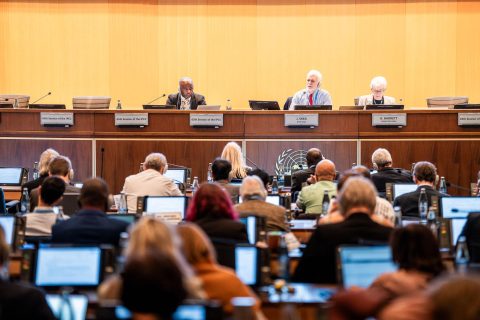

In July, PAICC said 12 countries had ignored its repeated attempts to discuss why they had not published an NDC as required every five years under the 2015 Paris accord.
Members of the committee had been divided over whether to name them, but at a September meeting decided to do so in their annual report to the annual climate COP summit.
By the time the report was published on Friday, only Congo, Senegal and North Korea “had not communicated an NDC or submitted a [Biennial Transparency Report] and had not yet responded to any of the Committee’s notifications, despite several reminders issued by the Committee in this regard”.
Rainforest and renewable energy ambitions
The silence from Congo and Senegal is notable because the former is home to much of the Congo Basin rainforest while the latter has sought billions of dollars in climate finance to support its renewable energy ambitions.
After Brazil, Congo has more rainforest than any country in the world. This forest, and the country’s peatlands, absorb huge amounts of greenhouse gas but are fast being lost to expanding farmland, charcoal production, logging and mining.
Senegal signed a Just Energy Transition Partnership with Canada and wealthy European nations in 2023, to help it meet its renewable energy targets under the-then government of Macky Sall. It was chair of the Least Developed Countries group between January 2022 and December 2023.

Tejas Rao, who is researching the PAICC as part of a doctoral thesis at Cambridge University, said the governments of the three countries should engage with the committee.
“Engagement costs these governments very little and the committee has shown it will listen,” he said.
“Silence leaves the committee with no basis to help, and it leaves the [governments] exposed to the narrative that they are simply disengaged,” he told Climate Home News.
Paris Agreement requirement
The 2015 Paris Agreement requires all parties to publish an NDC every five years outlining their emissions reduction targets, with each plan meant to be more ambitious than the country’s last NDC.
The latest set – the third round of plans, with new targets for 2035 – was due in February 2025. While most countries missed this deadline, all but around 30 – mostly small emitters but including Egypt, Vietnam and Argentina – have now submitted them.
Over the year, the PAICC – which is made up of government climate officials from developed and developing countries – has been communicating with governments that have not submitted NDCs and trying to overcome barriers to them doing so.
Some nations have cited exceptional circumstances as the reason for not submitting an NDC, a process that requires a significant amount of work in tracking emissions and consulting on how to curb them across the economy. For example, a letter from a Sudanese official to the PAICC, seen by Climate Home News, said that the country’s civil war had led to the suspension of its NDC preparation.
-
IPCC scientists vow to press on with climate reports despite political deadlock
After governments again failed to agree a timeline, nearly 120 IPCC authors pledged to complete their assessment on time and with full scientific rigour -
Under US pressure, World Bank says it will back gas “where appropriate”
The US wants the World Bank to expand its gas support while climate campaigners are pushing for it to end – its head spoke this week of limited backing for the fossil fuel -
Who shapes climate science? The equity question facing the IPCC
Early completion of the next global climate science assessment reports risks excluding research from the Global South, which is key to ensuring the findings are fair
The US and Iran are not signed up to the Paris Agreement and so do not have active NDCs, nor does Taiwan, which is not a UN member state.
Rao said that because the PAICC is “facilitative and non-punitive”, naming the countries “is meant to open a door, not close one – the invited consultation is the point”.
“In recent months, governments that explained their constraints, whether capacity, finance or domestic process, have been met with follow-up and support rather than sanction, and the number of silent governments has fallen sharply,” Rao said.
The post Paris Agreement committee names three countries snubbing it over NDCs appeared first on Climate Home News.
Paris Agreement committee names three countries snubbing it over NDCs