

The unprecedented shifts brought on by climate change ripple far beyond rising temperatures and extreme weather; they reach deep into the minds and hearts of all living beings. Anxiety, grief, and a profound sense of loss now shadow our collective experience. This climate-related mental distress is not only felt by people but also echoed in the land, waters, plants, and animals to which we are inseparably connected. As ecosystems unravel, the mental health of humans and non-human relatives becomes a shared story of vulnerability and resilience.
Climate Change and Rising Anxiety
The reality of climate change is no longer a distant worry; it is a present and palpable force shaping the mental landscapes of countless individuals. Across ages and cultures, climate anxiety, sometimes called eco-anxiety, has emerged as a defining psychological response to the accelerating devastation of the natural world. This anxiety is not simply fear of future disasters but an existential reaction to loss, uncertainty, and powerlessness.
Signs of Climate Anxiety
People experiencing climate anxiety often report:
- Persistent worry, rumination, or panic about environmental catastrophe.
- Feelings of helplessness, hopelessness, or grief, often described as “climate grief.”
- Disturbed sleep, including insomnia or nightmares, can be linked to climate crises.
- Physical symptoms may include an elevated heart rate, stomach upset, or fatigue.
- Social withdrawal, or conversely, sudden bursts of activism.
- Existential questioning about the future, meaning, and humanity’s role in planetary degradation.
- Heightened sensitivity to environmental news and changes, sometimes leading to overwhelm or burnout.
How Climate Anxiety Shapes Worldviews
Climate anxiety is shifting how people relate to themselves and the world:
- A fractured sense of security: The predictability of seasons and natural resources, as well as the scaffolding of cultural and personal identity, is disrupted.
- Heightened interdependence: For some, anxiety strengthens awareness of interconnectedness, prompting a search for meaning beyond individualism and consumerism.
- Urgency for change: Anxiety can fuel activism and demands for systemic transformation.
- Collective trauma and grief: Climate change becomes a shared mourning for lost species, landscapes, and lifeways.
- Shifts in values: Many are turning away from materialism toward ecological stewardship, simplicity, and relationality.
Climate Anxiety in the Indigenous Context
For Indigenous peoples, climate anxiety is layered with cultural grief, the loss of land, language, ceremony, and traditional livelihoods. This grief is deepened by colonial histories that severed people’s relationships with ancestral territories and more-than-human kin.
Yet, Indigenous worldviews also carry profound resilience. Seeing humans as part of a web of life provides a relational refuge, a framework for navigating climate anxiety through connection, ceremony, and stewardship. Unlike dominant Western approaches that often treat mental health in isolation, Indigenous perspectives integrate ecological realities into healing.
Supporting Mental Well-Being Amidst Climate Anxiety
Meeting climate anxiety as both a personal and collective challenge requires approaches that nurture resilience:
Land-based healing and connection: Spending time on the land, engaging in cultural practices, and restoring bonds with ecosystems.
- Community support and dialogue: Safe spaces to share fears and grief, build solidarity, and mobilize collective hope.
- Eco-literacy and empowerment: Education in climate science, Indigenous land stewardship, and practical action to counter helplessness.
- Mindfulness and grounding practices: Techniques to calm and regulate overwhelming emotions.
- Centering Indigenous knowledge: Teachings of balance, renewal, and reciprocity enrich mental health frameworks with holistic approaches.
Indigenous Ways of Knowing: Medicine for Mind, Heart, and Spirit
Indigenous worldviews offer vital teachings for healing and well-being. Central among these is interconnectedness, the recognition that humans, earth, waters, animals, plants, and ancestors form one living web. This understanding fosters a holistic approach to mental health that weaves together mind, heart, body, and spirit.
Ceremonies, storytelling, land-based practices, and seasonal cycles cultivate balance and harmony, offering medicine for both individual and collective resilience. Reconnecting with Mother Earth is a profound step toward healing, inviting us to listen deeply to the rustle of leaves, the flow of rivers, the flight of birds and, in that listening to rediscover grounding, purpose, and hope.
Empathy for More-Than-Human Relations
Climate change also affects our non-human relatives. Plants wither, animals migrate or perish, and waters warm and recede. Indigenous teachings remind us that these beings hold life, spirit, and memory. They, too, suffer displacement and loss. Cultivating empathy for them expands our circle of care and underscores that mental and environmental health are inextricably linked.
When we engage with land, waters, and wildlife not as resources but as relatives, fractured relationships begin to heal. This relational awareness lays the foundation of stewardship rooted in respect and reciprocity, integrating the need to confront climate change.
Reconnecting with the Land
Reconnection is both sacred and practical. Land-based healing, traditional ecological knowledge, and Indigenous ceremonies are increasingly recognized within Indigenous communities and beyond as powerful supports for mental health.
Spending time on the land harvesting plants, participating in a ceremony, or simply observing seasonal rhythms nurtures awareness, patience, and resilience. It roots us in the present, affirms belonging, and reminds us that we are part of a living community. Through this reconnection, humans can find strength in relationships, solace in shared struggle, and hope in reciprocal care.
Moving Forward Together
The climate crisis compels us to rethink mental health in relational terms, recognizing that human well-being is inseparable from the well-being of the land and all its beings. Indigenous knowledge offers enduring wisdom for this path. By honouring interconnectedness, embracing land-based healing, and nurturing empathy for all relations, we can cultivate mind, heart, and spirit medicines essential for resilience.
Together, human and more-than-human kin can walk toward healing, balance, and renewed hope grounded in the living teachings of the earth we call home.
Blog by Rye Karonhiowanen Barberstock
(Image Credit: Ahmed Hossam, Unsplash)
The post Healing in the Time of Climate Change: Indigenous Ways of Knowing for Mental Health and the More-Than-Human World appeared first on Indigenous Climate Hub.

Continue Reading
Three countries have been named by the Paris Agreement’s compliance committee for failing to submit a nationally determined contribution (NDC) and repeatedly snubbing offers of help with their climate plans.
After months of internal debate over whether to identify serial non-responders, the Paris Agreement’s Implementation and Compliance Committee (PAICC) named the three countries which have failed to engage with it over their NDCs on Friday.
It named Democratic Republic of Congo, Senegal and North Korea in a footnote of its annual report, adding that it decided to name them “with a view to facilitating engagement”, adding that representatives of the three nations had been invited to its meeting in early 2027 “with the purpose of identifying any challenges and constraints”.
“The Committee noted the importance of Parties engaging with the Committee in a timely manner, while noting that some delays may be due to the national capabilities and circumstances of the Parties”, the report said.
-
Under US pressure, World Bank says it will back gas “where appropriate”
The US wants the World Bank to expand its gas support while climate campaigners are pushing for it to end – its head spoke this week of limited backing for the fossil fuel -
IPCC scientists vow to press on with climate reports despite political deadlock
After governments again failed to agree a timeline, nearly 120 IPCC authors pledged to complete their assessment on time and with full scientific rigour -
Paris Agreement committee snubbed over missing NDC climate plans
Many governments have still not submitted a nationally determined contribution to the UN, breaching a key requirement of the Paris Agreement

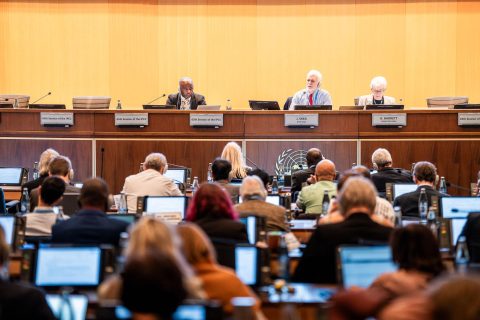

In July, PAICC said 12 countries had ignored its repeated attempts to discuss why they had not published an NDC as required every five years under the 2015 Paris accord.
Members of the committee had been divided over whether to name them, but at a September meeting decided to do so in their annual report to the annual climate COP summit.
By the time the report was published on Friday, only Congo, Senegal and North Korea “had not communicated an NDC or submitted a [Biennial Transparency Report] and had not yet responded to any of the Committee’s notifications, despite several reminders issued by the Committee in this regard”.
Rainforest and renewable energy ambitions
The silence from Congo and Senegal is notable because the former is home to much of the Congo Basin rainforest while the latter has sought billions of dollars in climate finance to support its renewable energy ambitions.
After Brazil, Congo has more rainforest than any country in the world. This forest, and the country’s peatlands, absorb huge amounts of greenhouse gas but are fast being lost to expanding farmland, charcoal production, logging and mining.
Senegal signed a Just Energy Transition Partnership with Canada and wealthy European nations in 2023, to help it meet its renewable energy targets under the-then government of Macky Sall. It was chair of the Least Developed Countries group between January 2022 and December 2023.

Tejas Rao, who is researching the PAICC as part of a doctoral thesis at Cambridge University, said the governments of the three countries should engage with the committee.
“Engagement costs these governments very little and the committee has shown it will listen,” he said.
“Silence leaves the committee with no basis to help, and it leaves the [governments] exposed to the narrative that they are simply disengaged,” he told Climate Home News.
Paris Agreement requirement
The 2015 Paris Agreement requires all parties to publish an NDC every five years outlining their emissions reduction targets, with each plan meant to be more ambitious than the country’s last NDC.
The latest set – the third round of plans, with new targets for 2035 – was due in February 2025. While most countries missed this deadline, all but around 30 – mostly small emitters but including Egypt, Vietnam and Argentina – have now submitted them.
Over the year, the PAICC – which is made up of government climate officials from developed and developing countries – has been communicating with governments that have not submitted NDCs and trying to overcome barriers to them doing so.
Some nations have cited exceptional circumstances as the reason for not submitting an NDC, a process that requires a significant amount of work in tracking emissions and consulting on how to curb them across the economy. For example, a letter from a Sudanese official to the PAICC, seen by Climate Home News, said that the country’s civil war had led to the suspension of its NDC preparation.
-
IPCC scientists vow to press on with climate reports despite political deadlock
After governments again failed to agree a timeline, nearly 120 IPCC authors pledged to complete their assessment on time and with full scientific rigour -
Under US pressure, World Bank says it will back gas “where appropriate”
The US wants the World Bank to expand its gas support while climate campaigners are pushing for it to end – its head spoke this week of limited backing for the fossil fuel -
Who shapes climate science? The equity question facing the IPCC
Early completion of the next global climate science assessment reports risks excluding research from the Global South, which is key to ensuring the findings are fair
The US and Iran are not signed up to the Paris Agreement and so do not have active NDCs, nor does Taiwan, which is not a UN member state.
Rao said that because the PAICC is “facilitative and non-punitive”, naming the countries “is meant to open a door, not close one – the invited consultation is the point”.
“In recent months, governments that explained their constraints, whether capacity, finance or domestic process, have been met with follow-up and support rather than sanction, and the number of silent governments has fallen sharply,” Rao said.
The post Paris Agreement committee names three countries snubbing it over NDCs appeared first on Climate Home News.
Paris Agreement committee names three countries snubbing it over NDCs