


- What are the benefits and challenges of using AI in weather and climate forecasting?
- What are some other current uses of AI in climate science research?
- How is AI being used to advance climate policy and action?
- How could AI be used in climate research over the coming years?
- Are there any misconceptions about the use of AI in climate science?
- Could AI improve or exacerbate inequalities in climate research?
- What are some other risks and challenges of AI in climate change research?

The UK government has slashed its hopes for electric planes and “sustainable aviation fuels” (SAFs), ahead of giving the green light to a third runway at Heathrow.
An “ambitious” rollout of new technologies and efficiency upgrades will only cut flight emissions by a quarter over the next two decades, according to forecasts quietly released in June.
This would leave aviation emissions in 2050 nearly 50% higher than expected under the “jet-zero” strategy, launched by the previous Conservative government in 2022.
The Labour government has signalled its support for a contentious third runway at Heathrow airport, with a final planning decision expected by 2029.
Ministers have justified this expansion by citing the rollout of clean-aviation technologies.
Yet, the updated forecasts suggest that rising flight numbers and a reduced role for “techno-fixes” will leave aviation emissions stubbornly high in 2050 – the UK’s legal target for net-zero.
If this is to be compatible with UK climate goals, then these higher emissions from flights in 2050 would need to be taken out of the atmosphere using costly and largely unproven “carbon dioxide removal” technologies – or by planting gigantic new forests.
Emissions up
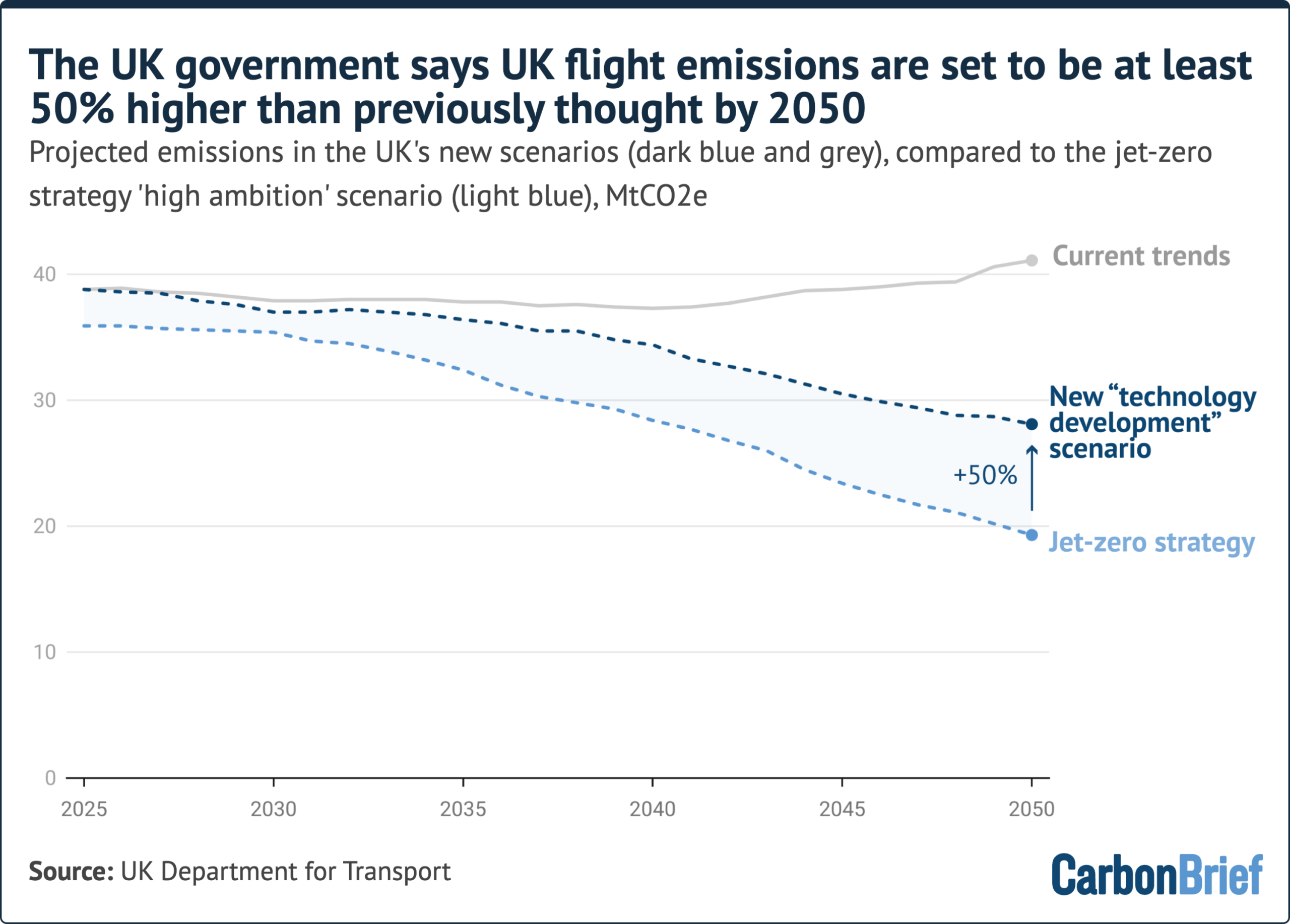
The previous government’s “jet-zero” strategy committed the UK to a “high ambition” pathway that would have seen aviation emissions peak at 38.2m tonnes of carbon dioxide equivalent (MtCO2e) in 2019 and drop to 19.3MtCO2e in 2050.
At the time, the Conservative government said this “clear goal” was achievable, alongside airport expansion and rising flight numbers.
Its strategy relied heavily on the extensive use of early-stage technologies, such as SAFs and battery-powered planes, as well as wider fuel-efficiency improvements.
In public statements, Labour has broadly continued this approach, backing new airport runways while supporting SAFs as a way to curb aviation emissions.
However, the government’s latest forecast, quietly published ahead of the formal approval of a new runway at Heathrow, sets far lower expectations for these technologies.
Its “technology development” pathway, with “ambitious carbon abatement measures”, only sees emissions drop to 28.1MtCO2e in 2050. As the chart below shows, this is around 9MtCO2e higher than the jet-zero strategy’s stated goal – a roughly 50% increase.
The shift is down to much lower expectations for SAF uptake, fuel-efficiency improvements and the roll-out of battery-powered planes, as well as lower international carbon prices.
The government now expects SAFs to make up 30% of aviation fuel by 2050, rather than 50%. It also concedes that SAFs will save less carbon over their lifecycle than previously thought.
SAFs have faced considerable criticism, due to limited supplies and uncertainty around the extent to which they cut emissions. Even meeting the UK’s relatively modest goal of 22% SAF uptake by 2040 would require enormous – potentially unattainable – volumes of waste products, which are currently the main source of the fuel.
For its new forecasts, the government commissioned a separate analysis of likely aircraft fuel-efficiency improvements over the next few decades. This analysis, from the Aviation Impact Accelerator, yielded “less optimistic” projections than earlier work.
Fuel-efficiency improvements have therefore been revised downward from 2% per year in the “jet-zero” strategy to 1.3% in the new “technology development” scenario.
There is also a reduced role for battery-powered planes, with only some of the smallest zero-emissions aircraft expected to be in use by 2035.
Crucially, even making the more limited emissions cuts in the new “technology development” pathway would require greater efforts to decarbonise the aviation sector.
If the UK fails to implement new policies or innovations, while flight numbers continue to rise, then aviation emissions would be even higher in 2050 than they are today.
This is illustrated by the pink “current trends” pathway in the chart above, in which emissions increase to 41.1MtCO2e by 2050.
This is roughly double the amount targeted by the jet-zero strategy and recommended by government climate advisors, the Climate Change Committee (CCC).
Budget ‘busting’
The new forecasts all account for the growth of several UK airports, including “planned Heathrow expansion”. Overall, passenger numbers would be at least 50% higher by 2050.
In contrast, the CCC and other experts have advised that the rise in passenger numbers may need to be limited, in order to keep emissions down.
In order to meet the UK’s net-zero target, any aviation emissions that remain in 2050 would need to be offset by planting many thousands of hectares of new forest, or by relying on costly and largely unproven CO2 removal technologies.
Tim Johnson, director at the Aviation Environment Federation (AEF), says the new forecasts present “a more honest and realistic vision of what’s possible in the next 24 years”. However, he tells Carbon Brief:
“Less reliance on cleaner technology and fuels reopens the debate about the role and scale of greenhouse gas removals and ways to tackle the projected 50% growth in demand for air travel.”
AEF calculations, based on government data and shared with Carbon Brief, suggest that emissions from the third runway at Heathrow would initially be relatively modest, reaching 3.5MtCO2e per year in 2050. Its emissions would then be expected to rise significantly beyond the legal 2050 net-zero deadline.
Previously, the Labour government has explicitly cited SAFs and other new technologies as part of its justification for expanding Heathrow airport.
Dr Lois Pennington, a research associate at the University of Manchester who has analysed Heathrow’s emissions impact, says the government’s new forecast shows “we are projected to be well over aviation’s share of the carbon budget even before a third runway is considered”.
She tells Carbon Brief:
“For Heathrow, it means expansion can no longer be waved through on the promise of technology, and any approvals will be in the full knowledge that it will bust our legally binding carbon budgets.”
The post UK aviation emissions to be 50% higher than thought by 2050, government admits appeared first on Carbon Brief.
UK aviation emissions to be 50% higher than thought by 2050, government admits
Continue Reading
Climate Change
Loss and damage fund agrees $20m for Nepal but rich nations warn it should not set precedent
The board of the UN’s Fund for Responding to Loss and Damage agreed on Thursday to set aside $20 million to help Nepal recover from the devastating climate-driven flood it suffered in August.
At an extraordinary online meeting, board members unanimously invited Nepal’s government to submit a proposal for how to use the money, which will be considered at a future board meeting.
The board’s co-chair Camila Minerva Rodriguez described the decision as “truly historic” as it is the first time the new fund has allocated any money since it was set up three years ago. It is expected to approve its first set of projects at its next board meeting in December.
Maheshwar Dhakal, a senior official at Nepal’s climate ministry, told the meeting the decision was “a powerful expression of humanity, compassion, solidarity and hope” and, for the flood victims, a “recognition of their suffering, respect for their dignity and hope that they are not alone in their darkest hour”.

While board members were united in approving the $20 million, plus $1.6 million of administrative costs, representatives of developed and developed countries were divided over the extent to which the decision should set a precedent for the fund’s long-term way of operating.
Germany and Czechia’s board members said it should not set a “precedent” while Japan’s representative said the decision is “truly exceptional” and that the fund’s support must be “in accordance with established rule and procedure”.
Learning the lessons?
Responding, Pakistan’s Ali Sheikh said the lessons from the Nepal case should “feed the long-term model and its work on rapid disbursement” of funds.
He added that he had heard Jan Dusik, Czechia’s board member saying that “we are open for learning but not in setting precedent”. “Please do not define the boundaries for learning,” he emphasised.
Sheikh complained that the decision approved by the board – the result of negotiations between a group of four developed and four developing-country representatives – was narrower than developing countries had hoped for.
“We are saying it is a one-time and Nepal-only window, a sentiment against which many developed countries have raised their voice,” he said, adding there had been no time to review the decision.
Walter Schuldt from Ecuador echoed Sheikh, saying “we should not put limits on lesson learning”. He said the decision, which he was involved in negotiating through “intense exchanges”, tells the fund’s staff to assess the lessons learned.
The fund is currently in a start-up phase and the board will debate its long-term model – including whether and how to rapidly disburse funds in response to climate-driven disasters – at its next board meeting in the Philippines in December.
At Thursday’s meeting, several developing-country board members called for wealthy nations to put more money into the fund. Recovery and reconstruction from Nepal’s flood alone is estimated to cost $4.8 billion – in comparison, the fund has only around $350 million to allocate, with a current cap of $20 million per project.
The post Loss and damage fund agrees $20m for Nepal but rich nations warn it should not set precedent appeared first on Climate Home News.
Loss and damage fund agrees $20m for Nepal but rich nations warn it should not set precedent
Artificial intelligence (AI) is developing at a rapid pace and is increasingly being used by scientists to better understand climate change.
AI is perhaps best-known for its use in “large language models”, such as ChatGPT, Claude and Gemini.
However, the field is vast.
From weather forecasting to analysing satellite images, climate scientists are using various types of AI to develop faster and more efficient ways to study the warming planet.
However, the technology comes with no shortage of risks and challenges, including overreliance on unverified results, intensive energy use and exacerbating existing inequalities in climate science.
Carbon Brief spoke to 10 experts working across a range of climate-related fields – from developing climate forecasts to analysing changes in the energy grid – about how AI is being used.
Their answers are set out below, grouped by theme.
- What are the benefits and challenges of using AI in weather and climate forecasting?
- What are some other current uses of AI in climate science research?
- How is AI being used to advance climate policy and action?
- How could AI be used in climate research over the coming years?
- Are there any misconceptions about the use of AI in climate science?
- Could AI improve or exacerbate inequalities in climate research?
- What are some other risks and challenges of AI in climate change research?
What are the benefits and challenges of using AI in weather and climate forecasting?
Dr Doug McNeall, science lead in data-driven climate modelling at the UK Met Office:
One of the most significant recent developments has been the success of AI weather-prediction models, which learn from large volumes of weather data to predict the next few hours ahead and then repeatedly feed those predictions back into themselves to generate forecasts up to two weeks into the future.
These models have demonstrated that AI can provide accurate predictions while requiring far less computing power than existing numerical models [which rely on mathematical equations to simulate the climate].
One of the main challenges is that AI weather-prediction models have been developed for relatively short timescales, where large amounts of observational data [for example, temperature, rainfall or sea ice extent data] is available and model performance can be evaluated quickly and rigorously.
Climate prediction is fundamentally different. To provide useful climate information, we need to make projections for future climates that lie outside the observational record.
One promising route forward is, therefore, to use AI to emulate or accelerate these existing models, rather than relying solely on purely data-driven approaches. This blended approach could make climate risk information far more accessible and affordable to produce, while retaining the physical understanding [based on mathematical and scientific principles] that underpins confidence in climate projections.
Prof William Collins, professor of AI for climate science at the University of East Anglia:
We’re seeing a really exciting renaissance in both weather and climate science…Machine learning [a subset of AI that uses algorithms to let computers learn from data and make predictions without being explicitly programmed] has had an enormous impact on numerical weather prediction.
So, for example, the European Center for Mid-Range Weather Forecasts is now deploying an AI forecast system as part of their official communication of weather predictions to the European community, alongside the traditional forecast system. AI systems have become good enough that they’re absolutely competitive with the world’s leading numerical weather prediction…So that’s been quite remarkable.
Much of machine learning and AI involves learning from data and climate represents a future for which we do not have data. We’re literally trying to predict the future. We don’t have observations of it. So, where does the data come from to inform the models? That is, at the moment, the central challenge that the climate community is attempting to overcome.
Dr Amirpasha Mozaffari, researcher in Earth artificial intelligence at the Barcelona Supercomputing Centre:
AI forecast models do well on typical weather, but underperform physics-based models on record-breaking and unprecedented extremes – precisely the events that matter most for adaptation [to climate change].
Solving that – whether through hybrid models [which combine AI with traditional models], physical constraints [in which rules are implemented based on the laws of physics to help the models make realistic forecasts] or new ways of evaluating models on what they have not seen – is the central open problem for the field.
What are some other current uses of AI in climate science research?
Dr Stefano Materia, researcher in climate variability and change at the Barcelona Supercomputing Centre:
Besides the climate modelling and prediction framework, the proliferation of Earth-observation satellites has created a massive influx of geospatial data (for example, images showing deforestation or sea ice melt). AI is used to translate raw pixel data into actionable climate intelligence.
Methane tracking and ecosystem monitoring are two