
On February 12, President Donald Trump and the U.S. Environmental Protection Agency (EPA) Administrator Lee Zeldin announced what they called the largest deregulation in U.S. history in the White House’s Roosevelt Room.
The EPA finalized a rule that removes the 2009 Greenhouse Gas (GHG) Endangerment Finding. The Obama administration created this finding, and it gave the federal government the legal authority to regulate greenhouse gas emissions under the Clean Air Act for more than a decade.
The new rule also removes all federal greenhouse gas standards for cars, trucks, and engines built from model year 2012 through 2027 and beyond. In addition, the EPA ended compliance credits tied to certain technologies, including start-stop systems.
In short, the administration rolled back the key rule that supported federal climate regulations on vehicles.
The Role of the 2009 Endangerment Finding
In 2009, the EPA said that six major greenhouse gases—including carbon dioxide—harm public health and the environment. The agency concluded that these gases drive climate change and damage air quality. That decision gave the federal government the authority to set emission limits for light-, medium-, and heavy-duty vehicles. It also supported climate rules for power plants and the oil and gas industry.
Because of this finding, the EPA introduced several greenhouse gas standards over the past decade. These rules shaped vehicle design, fuel economy targets, and broader climate policy across multiple sectors.
Why the EPA Repealed It Now
In 2025, the Trump administration began reviewing the 2009 decision. Officials argued that some of the science behind the finding was weaker than originally believed. They also said earlier climate projections were too pessimistic.
Now that the repeal is final, the EPA says it no longer has authority under Section 202(a) of the Clean Air Act to regulate greenhouse gases the way it did before. The agency believes Congress—not federal regulators—should decide major climate policy.
EPA leaders say this move restores a strict reading of the law and ends what they call regulatory overreach. Critics strongly disagree. Many scientists and public health experts argue that the repeal removes an important tool that protects Americans and helps address climate change.
Most importantly, the EPA estimates the final rule will save more than $1.3 trillion. It removes requirements for automakers to measure, report, certify, and comply with federal greenhouse gas standards. The agency says the rollback will lower vehicle prices, expand consumer choice, and reduce transportation costs for families and businesses.
Administrator Zeldin commented,
“The Endangerment Finding has been the source of 16 years of consumer choice restrictions and trillions of dollars in hidden costs for Americans. Referred to by some as the ‘Holy Grail’ of the ‘climate change religion,’ the Endangerment Finding is now eliminated. The Trump EPA is strictly following the letter of the law, returning commonsense to policy, delivering consumer choice to Americans and advancing the American Dream. As EPA Administrator, I am proud to deliver the single largest deregulatory action in U.S. history on behalf of American taxpayers and consumers. As an added bonus, the off-cycle credit for the almost universally despised start-stop feature on vehicles has been removed.”
U.S. Emissions Trends in 2025: Mixed Signals
At a climate crossroads, the United States saw a rebound in greenhouse gas emissions in 2025 after years of overall decline. According to estimates from the Rhodium Group, total U.S. emissions rose about 2.4% in 2025, reaching roughly 5.9 billion tons of CO₂ equivalent—139 million tons higher than in 2024. This uptick ended a two‑year downward trend that had been driven by cleaner energy and transportation shifts.
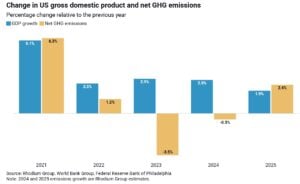
Several factors pushed emissions higher: colder winter weather increased demand for heating; rising electricity demand from data centers and cryptocurrency mining boosted fossil fuel use; and higher natural gas prices led utilities to burn more coal. The power sector alone saw a 3.8% rise in emissions, while buildings’ emissions jumped 6.8%. Transportation emissions, the largest U.S. source, remained largely flat, increasing only modestly due to continued adoption of hybrid and electric vehicles.
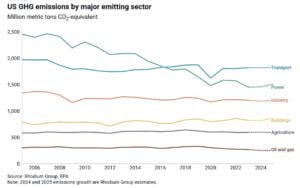
Despite the 2025 increase, total emissions are still below pre‑pandemic levels and well under 2005 baselines—roughly 18% below 2005 levels—showing that long‑term trends toward decarbonization have not entirely reversed yet.
Preliminary sector data from Climate TRACE also indicates that U.S. emissions continued rising throughout 2025, adding more than 71 million tonnes of CO₂ equivalent through the first three quarters of the year.
The EV Market in 2025: Growth and Slowdowns
In contrast to emissions trends, the U.S. electric vehicle (EV) market continued to grow in 2025, though the pace and dynamics evolved. EVs made notable gains in sales and market share, reflecting both consumer demand and industry transitions.
In the first quarter of 2025, nearly 300,000 battery‑electric vehicles were newly registered, marking over a 10% year‑over‑year increase. EVs accounted for about 7.5% of all new car registrations during that period.
By the third quarter, sales surged again. Cox Automotive reported that EV sales jumped nearly 30% year‑over‑year, pushing EV market share to a record 10.5% of total vehicle sales in Q3 2025—a milestone reflecting strong consumer uptake in several segments.
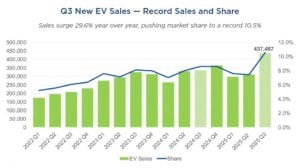
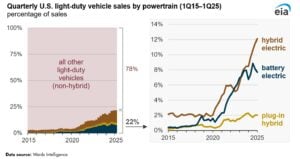
Even so, EV adoption remains far from dominating the U.S. market. Estimates show that electric vehicles comprised around 8–10% of total U.S. new car sales in 2025, with internal‑combustion engine vehicles still accounting for the large majority of the fleet.
Tesla remained the largest EV brand in the U.S. in 2025, holding about 46% market share, though this marked a slight decline from previous years. Rivals like Chevrolet and Hyundai grew their shares, reflecting broader model availability and shifting consumer preferences.
Market analysts also project that by 2025, the U.S. EV market’s size, sales, and technology focus will continue expanding—with battery‑electric vehicles expected to dominate EV segments. The broader EV market size had substantial growth in 2025, with further expansion expected toward the end of the decade.
Balancing Regulation, Consumer Choice, and Emissions Goals
EPA officials say that removing federal GHG standards and related compliance credits will lower vehicle costs by about $2,400 per car. This will ease financial pressure on families and businesses and give buyers more choice. The agency calls it a step toward restoring the American Dream, making transportation more affordable without high regulatory costs.
Supporters argue the rollback removes artificial mandates, letting automakers and consumers focus on market-driven solutions. The EPA also ended “off-cycle” credits, which allowed carmakers to meet emission targets with minor technology changes. Critics called these credits gimmicks with little real environmental benefit.
Litigation and Future Policy
Environmental groups, scientists, and several states sharply criticized the move. They warn that it weakens climate action, public health protections, and emission reductions. Many fear that removing these rules while emissions are rising could set back U.S. climate goals.
Legal challenges are expected, with lawsuits likely to block or reverse the repeal. As federal rules change, state policies, corporate commitments, and Congress may play a larger role. Some states have already set carbon standards and EV incentives, creating a patchwork of climate policies across the country.
In conclusion, the 2026 repeal of the GHG Endangerment Finding marks a major shift in U.S. climate policy. With emissions rising and clean technology markets evolving, the country faces tough choices about balancing economic growth, innovation, and climate risk. The coming years will be shaped by lawsuits, state leadership, private investments, and the global move toward low-carbon economies.
- INTERESTING READ: Princeton Study Shows How Trump’s “One Big Beautiful Bill” Derails U.S. Climate Goals
The post Trump EPA’s Largest Climate Deregulation: What the 2009 “Endangerment Finding” Repeal Means for U.S. Emissions and the EV Market appeared first on Carbon Credits.
Carbon Footprint
Japan’s J-Credit Scheme Powers New Era of Sustainable Rice in Fukushima’s Hirono Town
On February 16, Hirono Town signed a comprehensive partnership agreement with Fager Co., Ltd. to promote decarbonized agriculture and strengthen the local rice brand. The agreement focused on cutting greenhouse gas emissions while improving rice quality and farmer incomes.
Hirono’s mayor, Kazuma Komatsu, and Fager’s CEO, Takahiro Ishizaki, formalized the deal at a ceremony marking a new step toward linking climate action with rural economic revival.
A Climate Challenge Turns Into Opportunity
Rice farmers across Japan have struggled with extreme heat in recent years. High temperatures during the growing season have reduced grain quality and increased the risk of damage. In Fukushima’s coastal Hamadori region, growers have felt this pressure directly.
At the same time, Japan’s agricultural sector has begun to see decarbonization not just as an environmental duty but also as a business opportunity. Farmers can now generate carbon credits by reducing emissions from rice paddies and other farm activities. These credits create a new income stream while supporting national climate targets.
Hirono Town had already declared its ambition to become a Zero Carbon City by 2050. This partnership aligned with that goal. It aimed to make local agriculture more resilient, profitable, and climate-friendly.

How the Carbon Credit Model Works
Under the agreement, farmers in Hirono will adopt proven methods to reduce methane emissions from rice paddies. One key technique involves extending the mid-season drainage period. Farmers temporarily drain water from paddy fields during cultivation. This process lowers methane emissions, which normally form in flooded conditions.
Growers will also consider using biochar, a carbon-rich material that stores carbon in soil and improves soil health. Together, these measures can generate government-certified J-Credits.
Japan’s J-Credit system is a national carbon offset program. It certifies emission reductions or removals from activities such as renewable energy use, energy efficiency, forest management, and low-emission farming. Companies buy these credits to offset their emissions or meet climate goals. As a result, farmers and local governments gain a new source of revenue.
Fager has built strong experience in this field. The company supports J-Credit creation in 36 prefectures across Japan. In 2024 alone, it generated about 136,000 tons of CO₂ credits from agricultural projects. Now, it will bring that expertise to Hirono.
Reinventing “Hirono Rice”
Beyond carbon markets, the initiative aims to build a strong premium brand. Farmers will market locally grown Koshihikari rice as “Hirono Rice.” The brand will highlight three features: environmentally friendly cultivation, heat resilience, and high quality.
As extreme heat becomes more common, Japanese consumers are paying closer attention to how food is produced. Climate-smart branding could give Hirono’s rice a competitive edge.
One participating farmer, Toshirei Suzuki, already extended the mid-season drainage period in his paddies. He reported no negative impact on yield or grain quality. In fact, his rice ranked first in taste within Hirono Town, and all of his harvest met first-class standards. He said he joined the program smoothly and wants to continue if it benefits the environment.
His experience offered early proof that emission reductions and quality improvements can go hand in hand.
Digital Tools and Heat Countermeasures
The agreement goes beyond carbon credits as it also promotes agricultural digital transformation, often called agricultural DX.
Hirono and Fager will explore installing water-level and water-temperature sensors in paddy fields. These tools help farmers monitor conditions in real time. With better data, growers can respond quickly to heat stress and water management challenges.
Revenue from carbon credits will fund these upgrades. The partners aim to create a circular model. Farmers reduce emissions, generate credits, sell them, and reinvest the proceeds into better cultivation systems and climate adaptation measures.
This cycle connects environmental action directly to farm income and resilience.
A Model Linked to National Reconstruction
The partnership also fits into broader reconstruction efforts in Fukushima. Fager joined the national “Fukushima Reconstruction Living Lab” initiative led by Japan’s Reconstruction Agency. The program matches private firms with local governments to solve regional challenges.
In this case, agriculture stood at the center. By combining decarbonization, branding, and digital tools, Hirono aims to strengthen its rural economy while supporting recovery in the Hamadori area.
If successful, the model could expand beyond Hirono to other parts of Fukushima and eventually across Japan.
Japan Scales Up Carbon Markets to Hit 2050 Net Zero
Japan has pledged to achieve carbon neutrality by 2050. It also aims to cut greenhouse gas emissions by 46 percent from 2013 levels by 2030. To reach these goals, the government has steadily expanded carbon markets and sector-based policies.
In April 2026, Japan will introduce a full-scale emissions trading scheme (ETS). Around 300 to 400 companies that emit more than 100,000 tons of greenhouse gases per year must participate. The system is expected to cover roughly 60 percent of national emissions.

To support this shift, the government launched the Green Transformation (GX) Promotion Strategy. The plan outlines more than 150 trillion yen in public and private climate investment over the next decade. It includes a 20 trillion yen early-stage package backed by GX Economic Transition Bonds. The goal is to stimulate new markets while keeping economic growth stable.
Japan has taken a cautious and pragmatic approach. Policymakers design climate rules that businesses can realistically follow. The Japan Business Federation, known as Keidanren, plays a key role in shaping legislation. Its involvement helps ensure that new climate policies remain practical and economically viable.
The Role of the J-Credit Scheme
The J-Credit Scheme plays a central role in Japan’s domestic carbon market. Three ministries jointly manage it: the Ministry of the Environment, the Ministry of Economy, Trade and Industry, and the Ministry of Agriculture, Forestry and Fisheries.
As of May 2025, the scheme had registered 1,262 projects. It had certified a total of 12.08 million tons of CO₂ credits. The government now targets 15 million tons of certified J-Credits by fiscal year 2030.

Projects can register individually or as programmatic bundles that group many small activities into one larger project. This structure makes it easier for small farmers to participate.
Hirono’s rice initiative fits well within this framework. It visualizes emission reductions measurably and links them directly to local economic benefits.
A Blueprint for Sustainable Rural Growth
The Hirono–Fager partnership showed how climate policy can work on the ground. It connected national carbon markets with everyday farming practices. It turned methane reduction into income. It funded heat countermeasures with carbon revenue. And it built a premium rice brand around sustainability.
If the project delivers as planned, Hirono Town could become a model for climate-smart agriculture in Japan. The town’s rice would stand not only for taste and quality, but also for environmental responsibility and resilience in a warming world.
- LATEST: 2026 Could Redefine Voluntary and Compliance Carbon Market Convergence, with Japan Leading the Way
The post Japan’s J-Credit Scheme Powers New Era of Sustainable Rice in Fukushima’s Hirono Town appeared first on Carbon Credits.
Carbon Footprint
Tesla’s Carbon Credit Empire Faces a Shake-Up as Stellantis, Toyota, Subaru Exit EU Pool
A new regulatory filing in the European Union shows that several major carmakers will not join the 2026 carbon credit pool led by Tesla. The filing lists Stellantis, Toyota Motor Corporation, and Subaru Corporation as absent from the Tesla-led alliance for the coming compliance year.
The change highlights an important shift in the European auto market. Carbon credit trading has become a major financial lever for electric vehicle makers, especially Tesla. At the same time, legacy automakers are investing heavily in electric and hybrid vehicles to reduce their dependence on regulatory credits.
EU Filing Reveals Breakup in Tesla’s Carbon Credit Alliance
The European Union allows automakers to join “emissions pools” to meet strict fleet-wide carbon targets, as shown below. In these alliances, companies combine their fleets when regulators calculate average CO₂ emissions.

Carmakers with high emissions can offset them by joining a pool led by a low-emission manufacturer such as Tesla.
According to an EU filing dated February 27, 2026, Tesla is recreating its carbon credit pool for the year. However, Stellantis, Toyota, and Subaru are not currently listed as members.
The absence marks a change from 2025. That year, the Tesla pool included a large group of automakers: Tesla, Stellantis, Toyota, Subaru, Ford, Honda, Mazda, Suzuki, and Leapmotor. These partnerships helped companies comply with EU emissions targets while their EV production ramped up.
For 2026, the pool appears smaller. Current participants include Tesla alongside Ford Motor Company, Honda Motor Company, Mazda Motor Corporation, and Suzuki Motor Corporation.
However, companies can still join later. Automakers are allowed to enter pooling agreements until December 2026, leaving the door open for changes during the year.
How Tesla Turns Carbon Credits Into Billions in Revenue
Tesla’s role in carbon pools comes from its all-electric lineup. Since the company sells only zero-emission vehicles, its fleet emissions are far below EU regulatory limits. This creates excess regulatory credits. Tesla can sell those credits to other automakers that struggle to meet the limits.
Globally, Tesla has earned nearly $2 billion in 2025 from emissions credits, according to its report filings. The EV maker has earned a total of around $12.4 billion since 2017.

These revenues have historically played an important role in Tesla’s profitability. In several earlier years, regulatory credits accounted for a large share of the company’s net income.
In Europe alone, analysts previously estimated that Tesla’s pooling arrangements could generate more than €1 billion in annual credit revenue. For traditional automakers, buying credits is often cheaper than paying regulatory fines.
Under EU rules, companies that fail to meet emissions targets face penalties of €95 per gram of CO₂ above the limit for every car sold. This can add up quickly for large manufacturers selling millions of vehicles each year.

Carbon credit pooling, therefore, acts as a compliance bridge while companies transition their fleets to electric vehicles.
Why Some Automakers Are Leaving the Pool
The absence of Stellantis, Toyota, and Subaru from the 2026 pool may reflect several strategic changes across the industry.
First, the European Commission adjusted the compliance timeline. Instead of assessing emissions strictly for 2025, regulators now allow compliance based on the average emissions between 2025 and 2027.
This change gives automakers more flexibility. Companies that expect their emissions to fall in the next two years may decide they no longer need to buy credits immediately.
Second, many legacy manufacturers have expanded their production of hybrid and electric vehicles. For example:
- Toyota has one of the world’s largest hybrid fleets.
- Stellantis has expanded its EV lineup across brands such as Peugeot, Opel, Fiat, and Jeep.
- Subaru sells hybrid vehicles and is developing more EV models with Toyota.
These changes could reduce their reliance on Tesla’s credits in the short term. There are also corporate partnerships reshaping the market. Stellantis has a joint venture with Leapmotor, which sells EVs in Europe and could help offset emissions within the group.
Europe’s Strict Climate Rules Are Reshaping the Auto Market
The EU has some of the world’s strictest vehicle climate rules. Under the bloc’s current standards, automakers must steadily cut average fleet emissions. These targets support the EU’s broader climate goal of reducing greenhouse gas emissions 55% by 2030 compared with 1990 levels.
The long-term objective is even more ambitious. The EU plans to phase out sales of new gasoline and diesel cars by 2035, effectively shifting the market toward zero-emission vehicles.
As a result, the European EV market has grown rapidly. Battery-electric vehicles (BEVs) accounted for 15% in 2024. In 2025, this share rose to 19%, reflecting continued EV market growth amid stricter emissions rules.

Hybrid vehicles also play a large role in the transition. Many manufacturers use hybrids to reduce fleet emissions while EV adoption grows.
Tesla’s EV Dominance Still Anchors the Carbon Credit Market
Despite changes in the credit market, Tesla remains one of the most influential players in the global EV industry. The company delivered about 1.81 million vehicles in 2024, making it one of the largest electric car producers worldwide. However, deliveries dropped to 1.6 million in 2025.
- Tesla’s main models include: Model 3, Model Y, Model S, and Model X.
The carmaker also continues to expand its production footprint. Major factories operate in the United States, China, and Germany. The company’s Gigafactory Berlin-Brandenburg plays a key role in supplying EVs to the European market.
However, BYD has overtaken Tesla in EV sales in 2025, both in the EU market and globally.
As EV adoption rises, the role of regulatory credits may gradually shrink. More automakers will meet emissions targets using their own electric vehicles rather than buying credits. Yet, credits still provide a useful financial buffer for Tesla during the transition period.
Are Carbon Pools a Temporary Bridge for the Auto Industry?
Carbon credit pooling reflects the uneven pace of the automotive transition. Some companies, like Tesla, moved early into fully electric vehicles. Others are still shifting large gasoline and diesel fleets toward cleaner technology.
Pooling allows the industry to comply with regulations while maintaining vehicle supply and avoiding sudden price increases.
Yet, the system may evolve. As more automakers scale EV production, fewer companies will need to buy credits. This could gradually reduce the value of Tesla’s carbon credit business, as the 2025 sales drop shows.
At the same time, tightening climate policies and rising EV demand could create new market dynamics.
For now, Tesla remains at the center of the regulatory credit ecosystem. The 2026 EU filing shows that alliances are shifting, but the underlying system still plays an important role in the global transition to low-carbon transportation.
The coming years will reveal whether carbon pools remain a major financial tool or become a temporary bridge as the auto industry moves toward fully electric fleets.
- READ MORE: BYD Banks 6.2M Carbon Credits Potentially Worth US$217M Under Australia’s EV Efficiency Scheme
The post Tesla’s Carbon Credit Empire Faces a Shake-Up as Stellantis, Toyota, Subaru Exit EU Pool appeared first on Carbon Credits.
Carbon Footprint
America Backs First Manila SMR Study: The New Nuclear Roadmap for Philippine Power
The United States is stepping up its push for small modular reactors (SMRs) in the Philippines. In mid-February 2026, the U.S. Trade and Development Agency (USTDA) announced $2.7 million in technical assistance for Meralco PowerGen Corp. (MGEN). The work will review advanced U.S. SMR designs and create an implementation roadmap for what could become the country’s first SMR nuclear power plant.
USTDA framed the project as “vendor-neutral” evaluation support that can help the Philippines compare options and plan the steps needed to move from concept to construction. The goal is to speed early planning, such as technical screening and sequencing, before major capital decisions.
This is not a power plant approval. It is a funded study and planning effort. Still, it signals stronger U.S. backing for nuclear cooperation at a time when the Philippines is looking for more reliable, low-carbon power sources.
Meralco Chairman Manuel Pangilinan remarked:
“Through the generosity of the US government, we are laying the groundwork for the responsible integration of nuclear into our energy mix through small modular reactors. This offers a safe and responsible pathway towards energy security for generations to come.”
Coal Dependence and Rising Demand Drive the Debate
The Philippines still relies heavily on fossil fuels for electricity. Official DOE data show that in 2024, total power generation reached 126,941 GWh. Coal produced 79,359 GWh, which is about 62.5% of the country’s electricity that year.

- Natural gas produced 18,047 GWh (about 14%). Renewable energy produced 28,193 GWh (about 22%). Oil produced 1,342 GWh (about 1%).
On the capacity side, the DOE reported 29,706 MW of total installed generating capacity in 2024, with the following breakdown:
- Coal capacity was 13,006 MW (about 44%);
- Renewable energy capacity was 9,520 MW (about 32%);
- Natural gas was 3,732 MW (more than 12%); and
- Oil was 3,448 MW (almost 12%).

Demand growth also shapes this debate. In the DOE’s power planning materials, the country’s peak demand is projected to rise from 16,596 MW in 2022 to 68,483 MW by 2050, which the DOE notes equals an average annual growth rate of 5%.
These numbers help explain why policymakers and utilities are reviewing many options at once. They include grid upgrades, energy efficiency, renewables, storage, gas, and now nuclear.
SMRs Explained: Smaller Reactors, Big Expectations
An SMR is a nuclear reactor designed to be smaller than traditional large reactors. The International Atomic Energy Agency (IAEA) defines SMRs as reactors with a capacity of up to 300 MW(e) per unit. That is roughly one-third of the size of many conventional reactors.
The image is an example of an SMR design by NuScale Power, an American SMR company.

Supporters point to three practical features. First, SMRs aim for modular construction. Developers may build parts in factories and assemble them on site. Second, SMRs can be scaled by adding modules over time. Third, SMRs can provide steady output that does not depend on weather, which can help a grid manage variability from wind and solar.
At the same time, SMRs do not remove hard requirements. Any nuclear project still needs a strong regulator, safe site selection, trained staff, emergency planning, fuel and waste plans, and long-term financing. These items often drive timelines and costs, especially for a first plant in a country that is new to commercial nuclear power.
Small Reactors, Big Global Ambitions
Around the world, interest in small modular reactors is growing fast. Designers have created more than 120 SMR designs in recent years, with dozens in early review or licensing stages.
The global market for SMRs is also expanding. Analysts estimate the value of SMR markets at several billion U.S. dollars today, and rising over the next decade. Some forecasts show markets increasing to roughly double or more by the early 2030s, around $10–16 billion.
Installed SMR capacity is also expected to rise. Industry reports project several hundred megawatts of capacity by 2030, with further growth as more designs reach construction, up to 2.0 GW per IEA forecast.

Countries in North America, Europe, and the Asia Pacific are leading deployment and planning. Many governments see SMRs as a way to add reliable, low-carbon power alongside renewables.
Global forecasts to 2050 show SMRs could play a bigger role in clean energy systems, especially under scenarios that aim for low emissions and stable power. However, real deployment depends on licensing, investment, and supply chain development.
The 123 Agreement: Legal Groundwork for Nuclear Cooperation
A key reason U.S. firms can offer nuclear technology is the U.S.–Philippines Agreement for Cooperation in the Peaceful Uses of Nuclear Energy, often called a “123 Agreement.” The U.S. State Department said the agreement entered into force on July 2, 2024. It sets the legal framework for civil nuclear cooperation and can support exports of nuclear material, equipment, and components under U.S. rules.
In practice, this type of agreement is one building block. It does not select a reactor design and does not guarantee financing. It does create the conditions for deeper technical engagement, training, and potential commercial activity, as long as both sides meet non-proliferation and regulatory requirements.
From Planning to Licensing: Mapping the Nuclear Timeline
The Philippines began its nuclear journey after the 1973 oil crisis. It built the 621 MWe Bataan Nuclear Power Plant in 1984 at a cost of USD460 million. However, safety and financial concerns stopped it from operating. The plant was never fueled but has been maintained.
The DOE has publicly set nuclear targets in its 2022 planning. Reporting around the Philippine Energy Plan has cited a pathway that aims for at least 1,200 MW of nuclear capacity by 2032, rising to 2,400 MW by 2035, and 4,800 MW by 2050.
The DOE has also discussed regulatory readiness. In a November 2025 media release, the DOE said the Philippines aims to begin accepting nuclear power plant license applications by 2026, linked to the creation of the country’s nuclear safety regulator under Republic Act No. 12305.
International reviews add more context. In December 2024, the IAEA reported that the Philippines was making progress on nuclear infrastructure development, while still working through the many steps needed for a full nuclear power program.
Against that timeline, the USTDA-MGEN work looks like an “early stage” accelerator. It helps narrow design choices and map steps. It does not replace the national licensing process.
Geothermal’s Role in a Future Nuclear Mix
The Philippines already has a major source of steady renewable power: geothermal energy. DOE statistics list 1,952 MW of geothermal installed generating capacity in 2024. Geothermal generation reached 10,789 GWh in 2024.

This matters for the SMR discussion because many people describe nuclear as “baseload,” meaning it can run day and night. In the Philippines, geothermal already provides a similar kind of steady output in many areas. The challenge is that geothermal expansion depends on location, drilling success, and up-front exploration risk.
This is why planners often look at a mix. They can expand renewables like geothermal, hydro, wind, and solar, while adding storage and grid upgrades. They can also evaluate nuclear for future reliability needs, especially if coal plants retire over time.
For the U.S. side, the near-term goal is clear. It wants U.S. designs and services to be part of the shortlist. For the Philippines, the task is also clear. It must match any technology choice to national needs, grid limits, safety rules, and long-term affordability.
The post America Backs First Manila SMR Study: The New Nuclear Roadmap for Philippine Power appeared first on Carbon Credits.
-
Greenhouse Gases7 months ago
Guest post: Why China is still building new coal – and when it might stop
-
Climate Change7 months ago
Guest post: Why China is still building new coal – and when it might stop
-
Greenhouse Gases2 years ago嘉宾来稿:满足中国增长的用电需求 光伏加储能“比新建煤电更实惠”
-

Climate Change2 years ago
Bill Discounting Climate Change in Florida’s Energy Policy Awaits DeSantis’ Approval
-
Climate Change2 years ago
Spanish-language misinformation on renewable energy spreads online, report shows
-
Climate Change2 years ago嘉宾来稿:满足中国增长的用电需求 光伏加储能“比新建煤电更实惠”
-
Climate Change Videos2 years ago
The toxic gas flares fuelling Nigeria’s climate change – BBC News
-
Carbon Footprint2 years agoUS SEC’s Climate Disclosure Rules Spur Renewed Interest in Carbon Credits


