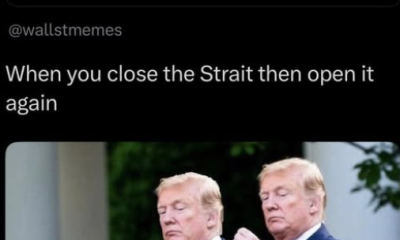
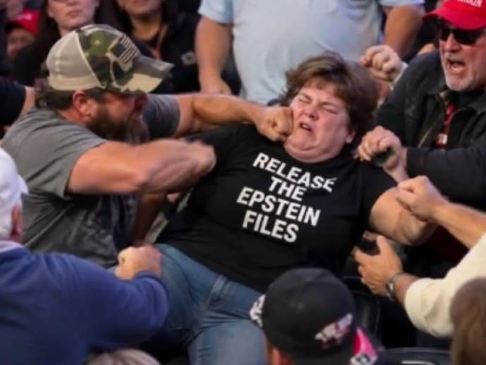
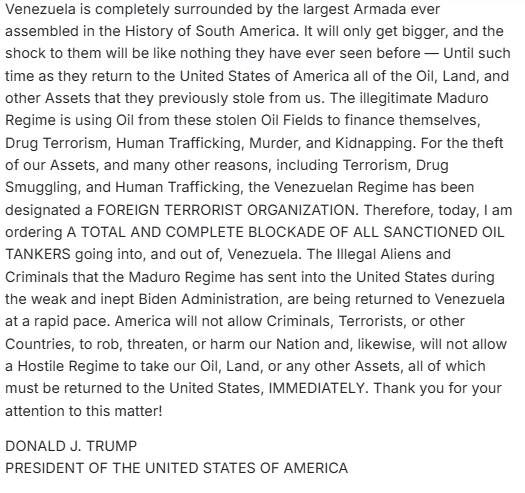
Even the most hate-filled and stupid Americans are starting to realize that the United States is being led by a psychopath. If anything can serve as compelling evidence of this, the social media post below just may help to get the job done.
Venezuela? The country colonized by the Spanish and French? The one that’s been independent for almost 200 years? There are elementary school kids all over the country asking, “WTF?”
Yes, we’re aware that Trump needs to distract us from the many criminal accusations against him, but does he really think this will fly?
The United States Needs a Little More Insanity. Could We Have it, Please?
Renewable Energy
WindQuest Advisors on Repowering and Rising O&M Costs
Weather Guard Lightning Tech

WindQuest Advisors on Repowering and Rising O&M Costs
Dan Fesenmeyer, Managing Partner at WindQuest Advisors, joins to discuss the repowering rush and the FAA permitting stall, rising O&M costs on larger turbines, tariff pass-throughs, and AI data center demand.
Sign up now for Uptime Tech News, our weekly newsletter on all things wind technology. This episode is sponsored by Weather Guard Lightning Tech. Learn more about Weather Guard’s StrikeTape Wind Turbine LPS retrofit. Follow the show on YouTube, Linkedin and visit Weather Guard on the web. And subscribe to Rosemary’s “Engineering with Rosie” YouTube channel here. Have a question we can answer on the show? Email us!
Welcome to Uptime Spotlight, shining light on wind energy’s brightest innovators. This is the progress powering tomorrow
Allen Hall: Dan, welcome back to the podcast.
Dan Fesenmeyer: It’s great to be here. Great to see you again.
Allen Hall: There is so much happening in your particular area. Your name pops up quite a bit within Weather Guard because, uh, we’re dealing with a lot of operators and- A number of times we’ll ask them, “Have you read your turbine supply agreement?”
“No.” “Have you read your full service agreement?” “No.” “Well, maybe you should do that.” And then we say, “Have you talked to Dan? You should call Dan, ’cause he can help you understand what you have signed.” Mm-hmm. “Oh, that’s probably a good idea.” So now that you’re here, WindQuest Advisors, of course, obviously is your company.
Mm-hmm. And you’re talking to a number of operators. The, the big hurdle at the minute, the nearest short-term hurdle, is repowering. There’s just a lot of [00:01:00] repowering efforts going on- Mm-hmm … trying to get turbines in, start a project. There’s a July 4th deadline and an end of the year deadline. There’s a couple deadlines after that.
What are you seeing right now from operators i- in terms of repowering? What’s the effort happening?
Dan Fesenmeyer: Well, there was a ton of effort to start physical work. That window’s obviously closing-
Allen Hall: Yes …
Dan Fesenmeyer: very quickly, but it’s still open. Uh, and then once you’re past that window, my understanding is if you get your repower completed by the end of ’27, you didn’t really need to have started physical work.
But I think most folks, start physical work is kind of the insurance piece of it-
Allen Hall: Sure …
Dan Fesenmeyer: if things take longer. Uh, another thing that’s popped up is obviously FAA and other permitting.
Allen Hall: On the permitting side, from the federal’s, uh, standpoint, is that stopped? Or, or are projects able to continue putting turbines in the ground, or what’s the status?
Dan Fesenmeyer: My- From what I’ve seen, I think on the opening session here at [00:02:00] ACP, it was said, they said that there’s, like, 130 projects that are-
Allen Hall: At least …
Dan Fesenmeyer: caught. Yes. And I’m, I’m involved with some of them, and I have a fairly small shop, and there’s just no FAA variances or permits or- They’re not issuing- … mitigation studies.
Everything seems to have stopped.
Allen Hall: So they’re not even reviewing the documentation that’s been submitted by the operators at all?
Dan Fesenmeyer: That’s what it seems, yes. Yeah.
Allen Hall: Is that legal? Uh, uh, usually those federal requirements have a timeline which they’re able to review those permits and get them approved or disapproved them.
You’re s- Right … I think what I’m hearing is, what you’re saying is they’re not even looking at them.
Dan Fesenmeyer: That’s correct. That’s what I’ve heard and seen.
Allen Hall: Okay.
Dan Fesenmeyer: Yeah. Yeah.
Allen Hall: So what is an operator to do then? How does this, how do they meet some of these deadlines if they can’t get the permit?
Dan Fesenmeyer: Well, I mean, it stalled a lot of projects ’cause of the associated risk with it.
Although I’ve seen some, uh, you know, some repower folks think, “Well, you know, I’m just repair- repowering like for like, or I’m not changing much.” [00:03:00] But if your, if your rotor’s changing or pad location’s changing, you need to update those permits.
Allen Hall: So the, the groups and the operators that are repowering the existing turbines are putting basically the same turbine in the same hole.
Dan Fesenmeyer: Well,
Allen Hall: I- Would that be okay?
Dan Fesenmeyer: I would say originally- The initial push on repower was kind of your larger rotors- Sure … new drivetrain, et cetera. Yes. The market seemed to shift more towards, “Hey, let’s do smaller upgrades, component exchanges.”
Allen Hall: Okay.
Dan Fesenmeyer: Getting more towards the minimal investment, so to speak.
Allen Hall: The 80% investment portion.
Dan Fesenmeyer: Yes.
Allen Hall: Right.
Dan Fesenmeyer: Yeah. And less about, you know, a big new machine head, for example.
Allen Hall: Well, if that gets you through and gets you the, the, uh, tax credit started back up again, which is the whole point- Right … there would be a reason to do that.
Dan Fesenmeyer: That’s right.
Allen Hall: Is there a marketplace then for those components if you’re gonna repower a GE 1.5 machine, which there’s a lot of them- Mm-hmm
in the United States? Are you seeing a big emphasis to go get a new gearbox, [00:04:00] to upgrade the blades- Yeah, and, and- … kind of
Dan Fesenmeyer: thing? Or just do maybe a drivetrain and s- Okay … and leave the rotor or, or-
Allen Hall: So do a gearbox and-
Dan Fesenmeyer: Yeah. Gear or just full drivetrain- Or generator … or yeah, s- things like that. And, um- Wow
people are comfortable doing it, and then it’s e- it’s easier, obviously.
Allen Hall: Sure. It’s faster.
Dan Fesenmeyer: And faster, and you don’t necessarily have to touch permits or, yeah.
Allen Hall: And is part of that repowering, I know one of the questions- Mm-hmm … that’s been bandied about quite a bit is, do I have to buy a, a new generator or a new gearbox, or is a refurbished gearbox enough to check the box in terms of upgrading or putting 80% of the value back into the turbine to qualify for those tax credits?
Dan Fesenmeyer: I’m not a tax expert, but I’ve seen people do both.
Allen Hall: Okay. Well, that’ll tell you.
Dan Fesenmeyer: Yeah. Yeah.
Allen Hall: They’ve obviously talked to- Right … tax advisors about that.
Dan Fesenmeyer: It’s, it’s their level of risk and whether they have outside tax money or whether- … they’re kind of balance sheet or taking it themselves. It’s, it’s- Yeah … more of a risk profile that [00:05:00] everybody’s different on.
Allen Hall: Okay. So that has changed the landscape quite a bit. So now it’s, once this window of opportunity passes by, we’re into brave new world. Mm-hmm. And operating turbines now not really 10 years, operating till end of life, which could be 20, 25 years. Have operators started thinking about that and starting to address some of the, the, especially the contracts around that?
Are they starting to rethink contracts? Are they starting to approach full service agreements differently? Is, is the marketplace changing in the US?
Dan Fesenmeyer: Yeah, I think so. I mean, it, it, depending what you have and what you’re doing, whether you have an existing agreement or you need a new one, and whether it’s a renewal or if you’re doing, let’s say, a drivetrain or new machine head, then there’s usually a service contract that’s going to come with it- Sure
’cause it’s essentially a new machine. Largely a new machine. Largely,
Allen Hall: yeah.
Dan Fesenmeyer: But in the case of a gearbox, right, you’re probably out of your longterm O&M agreement anyway, and, uh, whether you’re… And you probably [00:06:00] have, you don’t have the unplanned coverage anymore. Right. So it’s really, you’re on, you’re kind of on your own risk.
Allen Hall: Okay, so that’s the repower scenario. Mm-hmm. What’s happening new turbine-wise? It seems like the, a lot of the operators are choosing six megawatt, seven megawatt, eight megawatt machines tends to be the, the, the band of opportunity for a lot of operators. What are they working on right now in terms of, uh, TSAs, full service agreements?
What are you seeing out on the landscape US-wise?
Dan Fesenmeyer: Well, I think, um, the TSAs haven’t changed much.
Allen Hall: Okay.
Dan Fesenmeyer: But the- The, the scope and the risk has changed a bit, and the, the OEMs are, you know, holding their cards closer, and it’s hard to get to certain terms that– harder than it used to be.
Allen Hall: So let’s, let’s talk about that for a minute because, uh, there’s been some recent reports speaking to the O&M costs for larger machines.
And so the, the goal was if I went from a [00:07:00] two-megawatt machine to a six-megawatt machine, my O&M cost may be 3x because of the size of the turbine, but ideally they drop. That, uh, the same amount of effort into a larger, m- newer machine, uh, so, uh, my spend wouldn’t go up that much. In, in some places on the planet that I’ve seen feedback about that is that the O&M costs are not 3x, they’re 5x.
So the, the cost to operate the turbine, the six and eight megawatt machines, is higher than it would be proportionally to a two-megawatt machine. I think operators are just trying to start to figure that out. Are the OEMs already knowledgeable of that fact and are s- trying- I, in, in- … to phrase the conversation
I
Dan Fesenmeyer: mean, in the pricing that you get from the OEMs for the full scope agreements, that’s largely in there already.
Allen Hall: Yes.
Dan Fesenmeyer: And I always tell people look at it on a dollar per kWh or dollar per megawatt hour- Ah … basis versus a dollar per turbine, and you- Sure … you’ll see a different number.
Allen Hall: Different calculation done.
Dan Fesenmeyer: Right. But [00:08:00] these, these larger machines, they need larger cranes. They need tall– Yeah, they have taller towers, so a different crane setup, and these components become very, very large. So- Everything gets harder … everything gets d- more difficult. In a basic sense, it’s still oil and gearbox and, you know, tho- tho- Right
that kind of basic service. But when you get into major components and more major maintenance items, then it’s bigger, it can be harder.
Allen Hall: So what does a operator think about that now that they have a little bit of experience? Obviously SunZia, which is a huge project, three and a half gigawatts, uh, a l- several hun- like around 900 turbines, all of them bigger turbines.
It’s a r- for, uh, really the first real taste in America of larger turbines. What are the operators thinking about that, and how are they thinking about what sizes to go with in the future? Or, or, or do they not really have a choice? Like, GE offers six, Vestas offers six, Siemens will offer a six or a seven, [00:09:00] so those are your choices.
They’re– You’re not able to get a two megawatt machine anymore.
Dan Fesenmeyer: I mean, I think, uh, it really comes down to your, your site. Okay. And the larger machines are generally better when you have land constraints or, uh, y- your, your wind resource varies very differently. Think of a ridgeline, and you only have a certain number of pads.
But generally, it’s kind of a pad constraint to push you to the larger, and then your smaller, “smaller,” four and four to four and a half- … megawatt machines, those are still kind of the workhorses of, of the US, in my opinion. Their NCS better, they’re e- they’re lower cost, but you need more pads. So it’s always that trade-off of pads versus space, spacing, uh, and in the end, you just want to get the most AEP out of that site.
Allen Hall: In terms of marketplace, are you seeing prices generally rise dollars per megawatt on [00:10:00] new turbines? ‘Cause the, at least the market indication is that, uh, some of the OEMs have- Real strength in the marketplace today. This is an, an OEM-strong market. They can set- Mm-hmm … prices now. There’s fewer players. China has been eliminated from a lot of lo- locales.
Mm. So they don’t have the competition. That allows them to raise prices. Are you starting to see that flow down in some of the contracts, that, hey, the prices are going up? But, but i- inflation has been a big part of that, too. Well,
Dan Fesenmeyer: yeah, yeah. I mean, there’s… And tariffs, right? The, uh, that, that’s the most interesting one right now, and you have to kind of peel apart what’s my pre-tariff price versus my post, and then what’s the exposure if these tariffs change?
And-
Allen Hall: Is that in the contracts now? Are they able to write contracts that tie them to what the tariffs could be, so your final price really depends on what the tariffs are today or tomorrow?
Dan Fesenmeyer: It’s generally… Well, things have changed and, and things are always fluid, but, [00:11:00] but most recently it’s, “Well, here’s what the tariffs are today,” and when we either bring in the component or when the OEM’s actually paying that tariff, it’s kind of a pass-through
Allen Hall: in essence.
So they’re just handing you the, the bill for the tariff- Yeah … in a sense.
Dan Fesenmeyer: I mean, that- that’s it. And then you can maybe negotiate and do some things around that to share risk a little bit. Mm-hmm. But the basic premise is, you know, there’s transparency on here’s the countries and the tariff rates. If these change, that’s on the buyer.
Allen Hall: So the OEMs are trying to address that in, in some form w- by moving production into the United States. Vestas has a large blade facility in Colorado. They’ve been expanding that over the last several months. They’ve been hiring quite a bit. Uh, GE with LM up in North Dakota and TPI, and all the discussions around TPI at the minute is to really bolster their supply chain.
Uh, they’re trying to get away from the tariffs as much as they can. Are, [00:12:00] are you… You think you’re still gonna see more of that where a Siemens, a GE, a Vestas are gonna be investing more in the United States to avoid that tariff, or is it just impossible?
Dan Fesenmeyer: I, I mean, I think you… What they’ve done, I… It seems to me, I’m not obviously an expert on that, but it- they’ve moved things where they can And to capture- Mm
you know, where you already have capacity. But starting, yeah, building a new plant somewhere, I’m not sure how wise that is in the environment that we’re in.
Allen Hall: Yeah, you saw a lot of plants that were proposed two, three years ago that have, were never built. It does seem like existing plants that were on site that were closed got reopened.
Kansas, Iowa- Mm-hmm … some of those plants got- Mm-hmm … started over again, which is easier to do, which makes a lot of sense. So they’re going after the, the easiest things first still. We’re in that phase of we’re not gonna put a lot of money into the United States however. We’re gonna utilize what we have and maybe grow what we have.
Dan Fesenmeyer: Right. Or, or similarly, you can move from, if you have more of a… All these supply [00:13:00] chains are global at this point.
Allen Hall: Sure.
Dan Fesenmeyer: But if you happen to have a factory in a country with a lower tariff and versus one that’s higher, maybe you move that. You’re not bringing it over to the US, but you’re moving from, let’s say, India to the UK.
Allen Hall: Sure. So, so- Okay, so there, there’s a lot of sh- card shuffling going on- Yeah … to avoid tariffs.
Dan Fesenmeyer: Yeah, and unfortunately then the tariffs change and- … perhaps you have to change back. And, and the other one, uh, that’s out there, obviously the Supreme Court had their ruling on tariffs, so folks are waiting for a Section 232, which is
Allen Hall: still- Untouchable, in a sense?
Uh-
Dan Fesenmeyer: Well, it- people are just waiting for what, what will Section 232 be. And it’s been looming for months now.
Allen Hall: Over a year.
Dan Fesenmeyer: Yes. So, and, you know, we’re waiting, I guess.
Allen Hall: Is the feeling about that in the industry, uh… I’ll, well, I’ll use a couple of good examples, I think, which, uh, offshore wind being a real stress point United States, and a lot of [00:14:00] the administration’s work to limit offshore development got stopped in the courts.
So anything that was sort of building turbines, putting, had ships out, putting- Mm … uh, monopiles in, they never got stopped. They were delayed a couple of weeks, but they were never really stopped, and it feels like from the outside looking in, is that the courts are not gonna allow some of these, uh, movements by the administration to take effect.
Is the industry in the United States seeing the tariffs and some of the more extreme things that are happening as temporary or, or are they being a little more cautious, saying, “Yes, offshore wind has won a, a number of lawsuits”? But we may not. And th- with the Department of War and 232 and all those events that are happening, what is the outcome there, and w- how are operators thinking about that?
Dan Fesenmeyer: Well, I think we’re in a, in a market where if you have a project that can get built within this window-
Allen Hall: Yeah …
Dan Fesenmeyer: and [00:15:00] you’ve safe har- Like, those projects- And you’re, you’re just in … are desperately moving forward.
Allen Hall: Okay.
Dan Fesenmeyer: Then- ‘
Allen Hall: Cause the trend has been, if you can get it in the ground, they’re gonna let it be developed.
They haven’t been able- Right … to stop anything halfway through. Well,
Dan Fesenmeyer: other, like, the FA is a good example of it-
Allen Hall: Sure …
Dan Fesenmeyer: being stopped. But- Yeah … if you have a project that’s being built, you’re moving forward, and then projects that are outside the window, it’s more of a greenfield development view of, of life.
And seems like some folks are selling p- assets, some folks are buying- A
Allen Hall: lot of that …
Dan Fesenmeyer: development assets.
Allen Hall: Let’s go down that pathway for a minute because I did think- Yeah … that’s a very interesting piece to what’s happening in the United States at the minute. There’s a lot of transactions, big dollar transactions happening for wind- Mm-hmm
on buying, selling portfolios, not just farms. It used to be farms. Right. We’ll sell a farm. Yeah. It was. We’ll swap farms, that kind of thing. Now it’s like, uh, would you like our whole portfolio, wind, solar, battery?
Dan Fesenmeyer: Mm-hmm.
Allen Hall: Is that playing into a lot of the decisions that are [00:16:00]happening on the ground right now, that a, a developer or an operator that has assets is saying, this is a prime time to sell.
There’s a l- I have my tax credits already locked in. We’re golden here- Mm-hmm … for several years. The value is never gonna get higher. I need to get out. I- is that the marketplace today, is-
Dan Fesenmeyer: I think for some. I mean- Yeah … everybody’s got different, uh, motivations, whether they wanna get into wind, get out of wind, greenfield versus repower.
Uh, it, it’s, it’s really their view of the world and their risk profile moving forward, and whether this is a short-term play, long-term. Do we wanna get out of wind? Some people are essentially doing that. Uh, it’s, it’s across the board.
Allen Hall: How’s AI data centers playing into this? What are you hearing?
Dan Fesenmeyer: Oh, I mean, that’s what everybody talks about, AI and data centers, and the demand for power is there.
And- The [00:17:00] issue that, that a lot of us see is wind and solar and battery can all help with that.
Allen Hall: Sure.
Dan Fesenmeyer: And if you want a gas turbine, that’s great, but my former colleagues at GE are gonna tell you it’s 2030- Yes … or later to get one, so what do you do between now and then? And you’re seeing prices go up, which makes these wind farms look pretty good.
Power profile’s nice. Yes. Uh, but you still have hurdles to get, like the FAA, US Fish and Wildlife, all these other hurdles to, you know, that are slowing down wind and solar for that matter too.
Allen Hall: Solar’s been slowed down for sure.
Dan Fesenmeyer: Yeah. Yeah. Yeah.
Allen Hall: Does that change, though, with the demand for power in AI data centers?
And it does seem to be a priority in the United States to, to win this AI race. Mm-hmm. Does that loosen some of the reins on renewables to let them go, like just look the other way for a while, while they put a new solar field or wind farm in?
Dan Fesenmeyer: It stands to reason that will happen. Haven’t really seen [00:18:00] it, unfortunately.
But I wo- But I think it will, right? I mean, it, it, it, it almost has to at some point.
Allen Hall: There’s a lot of pressure on Washington DC to let data centers start being developed and, and go.
Dan Fesenmeyer: Mm-hmm.
Allen Hall: But a- as you pointed out, gas turbines are hard to get, and they can’t scale up at the rate at which the demand is.
Right. So your alternative is something really simple, quick and efficient, which would be wind and solar and a little bit of battery. Yeah. I- is that change in the thinking of operators and how they’re thinking about their assets, one, and two, what they’re thinking about in the future? Or are they trying to hook up with an- a- I mean-
a Google, a Facebook, a- Yeah, I
Dan Fesenmeyer: mean, the offtake’s- … SpaceX … there, and that’s generally, you know, it used to be utility PPAs. Then it turned- Right. … into hedge things and C&I. Yeah. And now it’s more, you have this, the data center offtake.
Allen Hall: Is the data center offtake, thinking about it from a, a financial standpoint, which they’re probably not being tied to the grid.
At [00:19:00] least a lot of these, or at least the talk is right now, is the not being connected to the grid to be sort of standalone, feeding a data center, and maybe a piece of fiber optic coming out of the data center. But that’s essentially it. Maybe some backup power on the grid just in case things go horribly wrong, but standalone power for data centers does make sense.
It would, it would seem to lessen the requirements on wind and solar in terms of interacting with the federal government or the, the power company in a sense. Does that make wind and solar a little more viable because it’s not connected to the grid?
Dan Fesenmeyer: Well, I mean, it will be connected to the grid because when the wind stops blowing, the utility will usually, you know, or, and the sun stops sh- shining- Sure
uh, the utility will kind of provide that power. That w- Or the gas turbines that they have would- Gas turbine will kick
Allen Hall: in, right.
Dan Fesenmeyer: Yes. Yeah. But, but generally speaking, you’re never truly off the grid, but it does speed things up with interconnection and, and, you know, your T&D [00:20:00] line is much shorter.
Allen Hall: Right.
Dan Fesenmeyer: Or not, you know- Much
much, much shorter. Yeah. Depending where the, the resource is and versus the plant or the, the data center.
Allen Hall: So what are the things that we don’t know in the industry that you’re in touch with that we should know? ‘Cause there, there must be a lot happening behind the scenes that we don’t hear out in public or in the common spaces of some of these conferences that are happening behind the scenes.
What is, what is the status right now? What do you think the status is of wind?
Dan Fesenmeyer: I mean, it’s, I, I, I’m a big sailor, and sometimes the wind’s blowing hard- … you’re going fast, and sometimes you sail into what we call a hole- Yeah … and it’s just dead quiet. We’re not quite there yet, but, um, it, it’s kind of we’re going through a bit of a lull right now.
And I think, I think what people don’t realize is the multiple roadblocks that the industry’s facing. In the past, we’ve had PTCs lapse, and the question is when and if it [00:21:00] will be renewed. Yeah. Now you have other roadblocks, you know, whether it’s, again, FAA, Fish and Wildlife, permitting, different localities.
Some… And this goes back to the data center. A lot of local, you know, communities don’t want a data center.
Allen Hall: Right. There’s a lot of-
Dan Fesenmeyer: Right? And they’re like, “Well, wait a minute. My power prices as a citizen are gonna go up- True … because of it.”
Allen Hall: Yeah, it’s true. We’ve already seen it.
Dan Fesenmeyer: Yeah. Yeah. So, so there’s a lot of just new barriers that have come up.
Allen Hall: Okay. That-
Dan Fesenmeyer: But wind developers are an extremely resilient bunch, and-
Allen Hall: This isn’t the first rodeo-
Dan Fesenmeyer: Right …
Allen Hall: where they’ve had these issues pop up- Yeah … and PTCs stop and other world forces affect the industry. What’s the outlook over the next three to five years, do you think? Different administration in a couple years, maybe different outlook, more demand on…
for power, AI data centers. Is- it just gonna [00:22:00] overwhelm any resistance to wind and solar and battery?
Dan Fesenmeyer: I mean, it, it, that’s kind of a crystal ball, but I think if these data centers start getting built out like people think they will, there’ll be demand for power. And, now we’re talking basic economics, Supply, demand. People need power, then power plants will get built and, whether it’s gas, wind, solar-
Allen Hall: All of the above
Dan Fesenmeyer: All of the above, right? And, and I think it will ultimately follow that. I think the, administration will let you know if there’s not enough power or power gets too expensive, something has to break and fill that gap
Allen Hall: because- So let the economics play out a little bit.
Dan Fesenmeyer: Yeah, right? Yeah. ‘Cause we’re, we’re voters, right? And- Sure … and, um, people vote often with their pocketbooks.
Allen Hall: And wind and solar are cheap sources of energy, and they’re gonna come to the top of the list almost every time.
Dan Fesenmeyer: Yeah.
Allen Hall: Yeah. Yeah. Yeah. I, I agree with you. Uh, it’s good to see you again. We saw you a few months [00:23:00] ago at WOMA in Australia, and that was wonderful.
And I tell a lot of the operators we talk to, “You better be talking to Dan and WindQuest Advisors because you really need to understand what your contracts say and the contract you’re signing, and you need to have a better sense of what’s happening, a little more broader speak in the United States and elsewhere- Mm-hmm
and they should be talking to you.” So how do they call or how do they contact WindQuest Advisors to get started?
Dan Fesenmeyer: Well, www.windquestadvisors.com or reach out to Allen and his team. You’re on LinkedIn. I’m on LinkedIn as well- … both personally and my firm. And, um, ask a friend ’cause I have a, we have- … big networks that everybody…
You know, it’s, it’s a small community here. It
Allen Hall: is.
Dan Fesenmeyer: Right?
Allen Hall: It is.
Dan Fesenmeyer: And, and people bounce around different firms and, but people stay connected, so, um, that’s a great way to find each other as well.
Allen Hall: Yeah. Great to see you, Dan. Likewise. Thank you. Thanks for being on the podcast. And yeah, we’ll hopefully see you in Australia in a couple months.
Dan Fesenmeyer: Looking forward to
[00:24:00] it.
Renewable Energy
America’s Brand: Indifference to Human Pain
There are essentially two forms of government on this planet: those that care about the wellbeing of their citizens and serve their interests and those that don’t.
Until the late 20th Century, one could have plausibly argued either way re: the United States. Since about 1980, it’s been clear that we really couldn’t care less about the sufferings of the common American.
It’s really become part of our brand. Billionaires deserve tax cuts. The middle class is shrinking, and the poor deserve a kick in the ass for not working harder.
Renewable Energy
Maine Needn’t Overcomplicate This
Just nominate some well-educated businessman or city mayor — or maybe just a principled lobster fisherman.
Maine: This shouldn’t be too tough a challenge.
-
Climate Change11 months ago
Guest post: Why China is still building new coal – and when it might stop
-
Greenhouse Gases11 months ago
Guest post: Why China is still building new coal – and when it might stop
-
Greenhouse Gases2 years ago嘉宾来稿:满足中国增长的用电需求 光伏加储能“比新建煤电更实惠”
-

Climate Change2 years ago嘉宾来稿:满足中国增长的用电需求 光伏加储能“比新建煤电更实惠”
-
Climate Change2 years ago
Bill Discounting Climate Change in Florida’s Energy Policy Awaits DeSantis’ Approval
-
Renewable Energy9 months agoSending Progressive Philanthropist George Soros to Prison?
-
Carbon Footprint2 years agoUS SEC’s Climate Disclosure Rules Spur Renewed Interest in Carbon Credits
-
Greenhouse Gases12 months ago
嘉宾来稿:探究火山喷发如何影响气候预测