

By Paul Watkinson, Stefan Ruchti-Crowley, Anju Sharma, Ovais Sarmad and Benito Müller.
In the corridors of the World Conference Centre in Bonn, where the June Climate Meetings (SB64) will conclude on Thursday, the need for change is palpable.
Delegates are grappling once again with overcrowded agendas, growing demands on limited negotiating time, external geopolitical pressures that reverberate internally to test the limits of a consensus-based process, and concerns over its future financial sustainability.
Bonn Bulletin: Finance row threatens to scupper work on adaptation goal
There is growing frustration with a process that consumes vast amounts of time to produce outcomes that are often too incremental to match the accelerating reality of the climate crisis.
The climate regime has delivered. But it is in danger of not delivering enough.
More effective multilateralism
There is no denying the successes of the UN climate process. Over three decades, the UN Framework Convention on Climate Change (UNFCCC), the Kyoto Protocol and the Paris Agreement established a universal framework for climate action, created transparency and accountability mechanisms, and sent powerful signals to governments, businesses and investors.
Thanks in large part to this framework, the world is no longer on a trajectory of more than 4°C of warming, clean technology costs have fallen dramatically, and participation in the global climate effort remains nearly universal.
Yet, global temperatures continue to break records. Climate impacts are intensifying across every region. The world remains far off track to achieve the goals of the Paris Agreement. As warming approaches – and may exceed – 1.5°C, every additional fraction of a degree brings greater losses of lives, livelihoods and ecosystems, with the greatest burdens falling on the most vulnerable countries and communities.
-
Science ‘under attack’ from fossil fuel interests at UN climate talks
A coalition of some rich nations and the world’s most vulnerable have vowed to protect climate science in UN negotiations -
UN’s first Paris Agreement carbon credits face human rights and climate concerns
Civil society groups allege the cookstove project in Myanmar exaggerated its climate impact while maintaining ties with military junta

We remain convinced that the answer to the climate crisis is not less multilateralism, but more effective multilateralism.
The hard truth is that the UNFCCC remains largely organised around the logic of treaty-making, while the central challenge of climate action has shifted to implementation. A process designed to negotiate agreements and deliver decision text as the outcome is now required to support implementation on the ground—and it is struggling.
There is a structural mismatch between what the climate process was designed to do, and what it needs to do now.
Consultations on reforms
Discussions on the urgency of reform are widespread and no longer confined to the margins. Formally, the Arrangements for Intergovernmental Meetings (AIM) process is exploring ways of improving the efficiency and effectiveness of the process.
The UNFCCC Executive Secretary has also convened a High-Level Informal Consultative Roundtable for strategic reflection on how to strengthen the complementarity between the intergovernmental process and action in the real economy.
Defending multilateralism today requires adapting it.
The good news is that meaningful reform does not require reopening treaties, renegotiating the Paris Agreement, or indeed even resolving long-standing differences on the Rules of Procedure to change the consensus rule. Stefan Ruchti-Crowley and Paul Watkinson’s recent paper for ecbi (European Capacity Building Initiative), Quo Vadis COP? Reforming UNFCCC Sessions to Improve Negotiations and Support Implementation, outlines a practical toolbox of four reforms that can be pursued within the existing institutional framework.
First, the process must improve its agendas.
The formal process is burdened by crowded agendas and overlapping workstreams. Consolidating agenda items under broader thematic pillars (such as mitigation, adaptation, finance and transparency); developing good practices for agenda adoption; removing legacy “ghost” items; and concluding outstanding business on the Kyoto Protocol will create more space for substantive discussions and implementation.
Second, the process must organise its work more strategically.
The climate process currently attempts to address nearly every issue at every session. A more strategic approach would use thematic multi-year programmes of work; better align review cycles and timelines; improve coherence across the many bodies and processes that have accumulated over time, often to the extent that even insiders have lost oversight; and also make better use of inter-sessional and pre-sessional meetings.
Third, the process must focus more deliberately on implementation.
Critically, not every challenge requires a negotiated outcome. Negotiations should focus on issues that genuinely require collective decision-making. Other discussions should prioritise learning, cooperation and practical problem-solving.
Existing formats such as Talanoa Dialogues, roundtables and other facilitative approaches should be expanded. Likewise, the Enhanced Transparency Framework should become a stronger mechanism for mutual learning and accountability rather than a largely procedural reporting and “box-ticking” exercise.
Fourth, the process must make structural changes and broaden participation.
National delegations should include a broader range of practitioners and policymakers, including a Head of Implementation. The process should strengthen engagement with sectoral ministers, investors, technology providers, scientists, local authorities and non-Party stakeholders.
Stronger links are necessary between science policy and implementation, and with international institutions that shape the enabling conditions for climate action, particularly finance and development. Platforms to address systemic barriers along with AI-enabled learning by doing will equally support strengthened action.

Delivering commitments with limited resources
The case for reform is becoming even stronger as financial pressures intensify.
Improving efficiency is not simply desirable; it has become unavoidable. The UNFCCC faces growing budgetary constraints arising from delayed contributions, uncertainty surrounding major donors, and broader reductions across the UN system.
A process that is better organised, more implementation-focused and less encumbered by procedural overload will be far better equipped to navigate a future of tighter resources.
Leadership will be crucial.
Panama environment minister backs calls for reform of UN climate process
COP presidencies have an important role to play, as do the Chairs of the Subsidiary Bodies. The UNFCCC Executive Secretary and Secretariat must take a bold approach to work in coordination with the COP Bureau to implement urgent changes.
Careful diplomacy will, of course, be essential. Parties must be reassured that reform is intended to strengthen the effectiveness of the regime, not weaken its governance. The objective is not to replace mandates, but to ensure that mandates can be fulfilled more effectively. It is to ensure that negotiation is used where negotiation is needed, while other forms of cooperation are used where they can deliver better results.
The UNFCCC remains the cornerstone of international climate cooperation. No other forum combines its legitimacy, universality and legal authority. But the multilateral climate process must evolve from a system primarily designed to negotiate commitments into one that is equally capable of supporting their delivery.
The post The UN climate process was built for negotiation – now it must support implementation appeared first on Climate Home News.
The UN climate process was built for negotiation – now it must support implementation

For the first time, new-energy vehicles (NEVs) made up 67% of new car sales in China in September, according to the latest data from the China Passenger Car Association (CPCA).
The figures show that NEVs, which include battery electric cars and plug-in hybrids, captured a record share of sales, even though fewer were sold than last year.
This is because sales of combustion-engine cars are falling steeply, a trend that the CPCA has attributed to rising petrol prices following the start of the Hormuz crisis.
Indeed, sales of fuel-only cars were down 31% year-on-year in the first nine months of 2026, with plug-in hybrid sales down 26% – whereas battery EV sales were only down 4%.
One analyst tells Carbon Brief that China’s rapidly growing EV fleet has offset demand for 143m barrels of oil since the start of the Hormuz crisis.
Another says that the crisis is “reinforcing China’s electrification of road transport”.
Meanwhile, amid slowing domestic sales, Chinese carmakers’ exports of NEVs more than doubled [in 2026 to date / in September] from a year earlier.
NEV record
A record two out of every three cars sold in September in China were NEVs, according to CPCA data, as shown in the figure below.
(NEVs predominantly include battery electric vehicles – BEVs – and plug-in hybrids – PHEVs. BEVs only run on electricity, whereas PHEVs also have a combustion engine.)
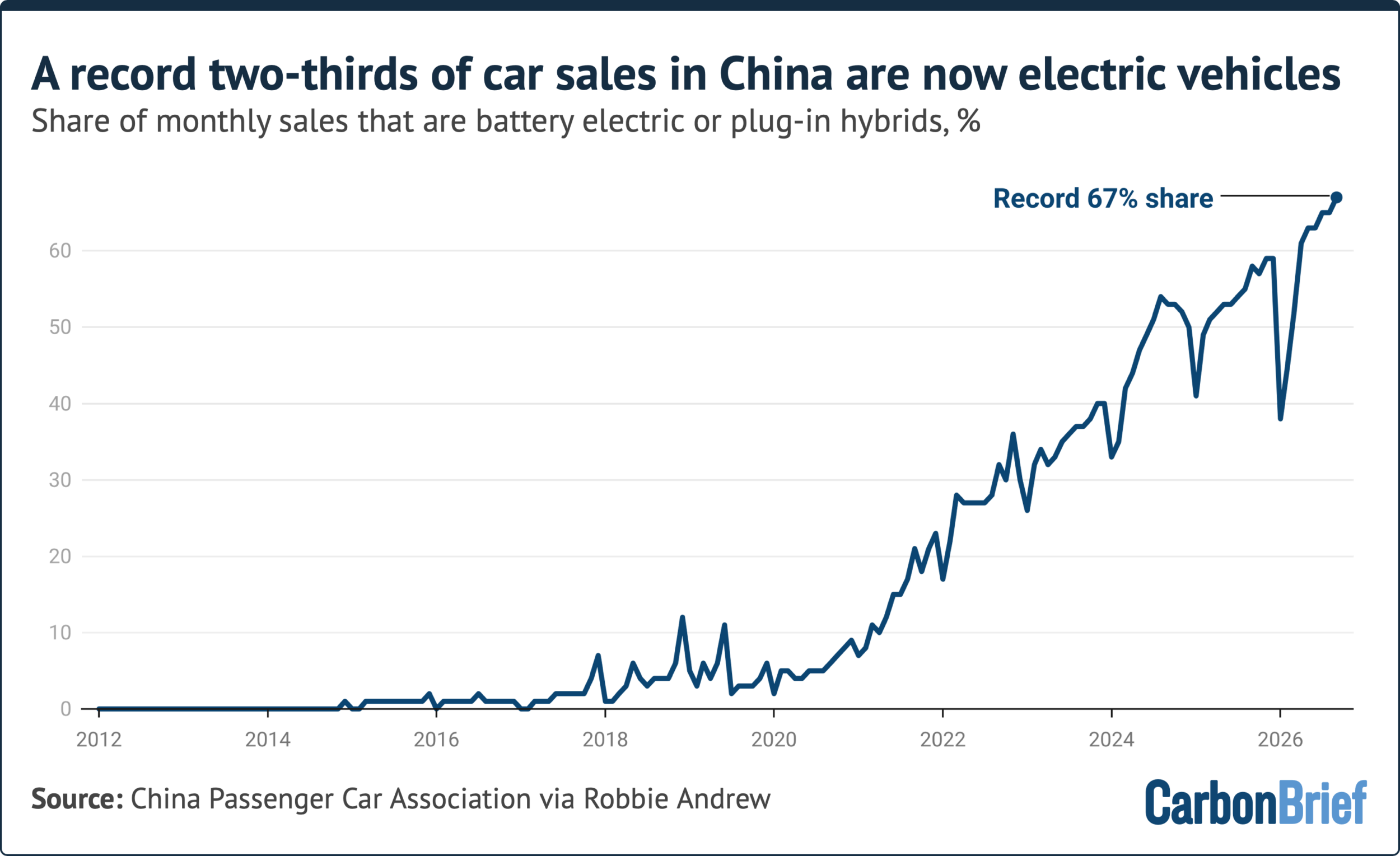
This marks a rapid rise for NEVs from just 6% of new car sales in 2020 up to 58% in 2026 to date – and a record 67% in the month of September.
This year, NEVs’ share of sales has also bounced back from a low of 39% in January, after the full purchase tax exemption that had been in place for more than a decade came to an end in December 2025.
The gain in NEV share in 2026 has come amid a slowdown across the wider domestic passenger-car market, which has hit sales of combustion-engine vehicles particularly hard.
This September, passenger-car retail sales across all categories declined, with overall sales volumes falling 28% year-on-year.
The contraction was led by combustion-engine vehicles, which saw sales fall 43% year-on-year in September and 31% in 2026 to date.
However, sales of PHEVs also fell by 36% year-on-year in September and by 26% in 2026 to date. By comparison, BEVs performed better, although sales still declined 8.5% from a year earlier in September and 4% in 2026 to date.
As a result, NEV sales overall fell by 17% in September and 13% in 2026 to date.
While the market changes in 2026 to date were particularly dramatic, they reflect a broad continuation of trends seen over the past decade.
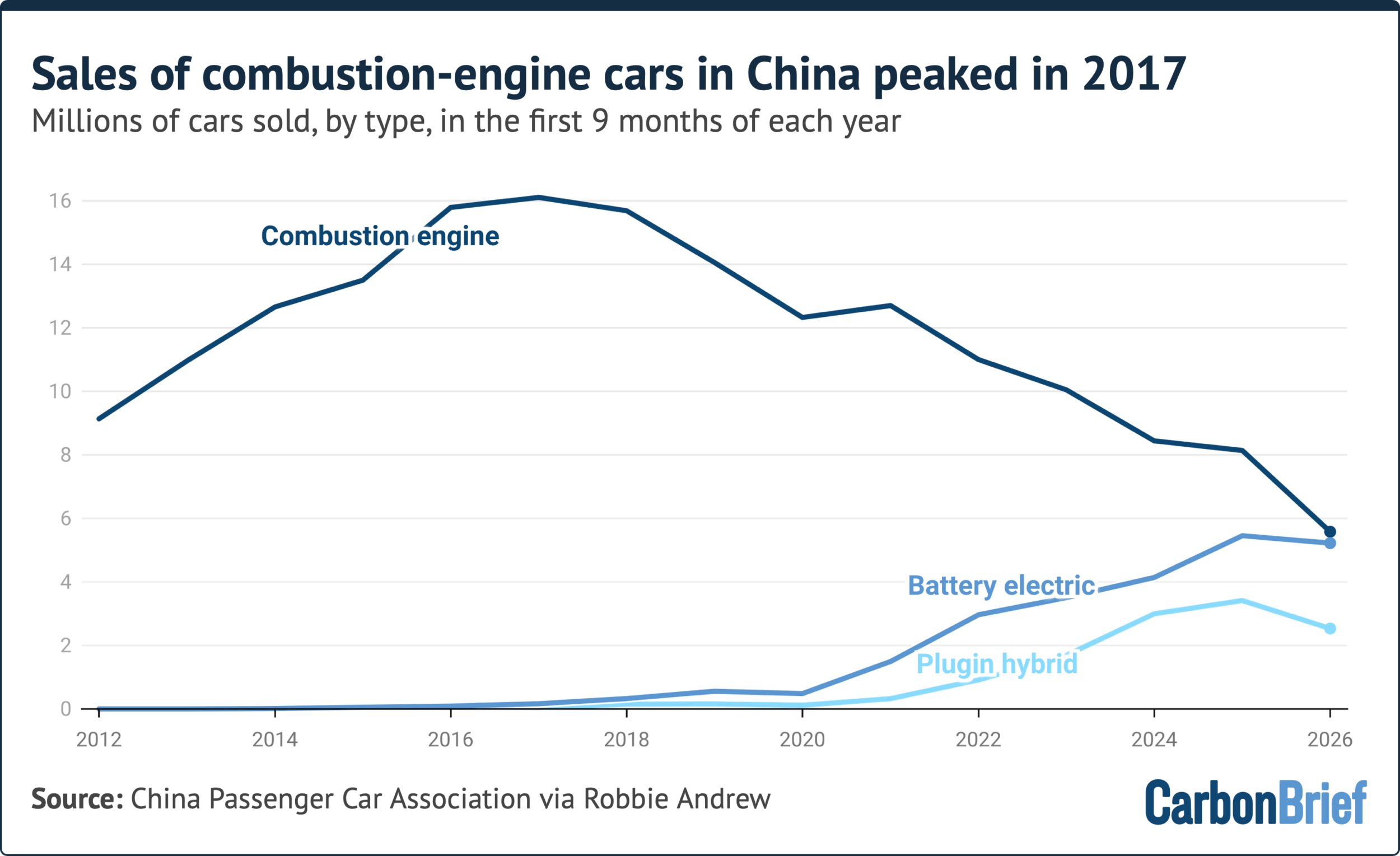
Indeed, sales of combustion-engine cars in China peaked in 2017 and they have been declining ever since, shown in the figure below.
Impact of Hormuz
Part of the reason for the advance of NEVs in 2026, said Chinese technology news outlet OFweek, was petrol cars “giving up market share” as they were outperformed by electric alternatives.
Cui Dongshu, secretary-general of the CPCA, cited higher petrol prices as an explanation for September’s weak combustion-car sales, in comments to financial news outlet National Business Daily.
Imports of oil into China in January-September have fallen 15% compared to 2025, equivalent to 470m barrels, as ongoing conflict tightened supply and drove up prices.
China’s passenger-car NEV fleet has displaced 143m barrels of oil so far during the strait of Hormuz crisis, Euan Graham, senior energy analyst at thinktank Ember, tells Carbon Brief.
EVs “accounted for 12% of the decrease in China’s oil use post-Hormuz”, according to an estimate provided to thinktank the Brookings Institute by an unnamed analyst.