

On quiet streets across the Californian city of Monterey Park, green-and-white “YES on Measure NDC” signs stood on front-yard lawns as volunteers walked door-to-door, drumming up support among residents to vote in favor of a ban on new data centers in their area.
They clarified the ballot wording in English, Spanish and Chinese, while distributing multilingual flyers warning about the rise in electricity demand, industrial infrastructure and environmental impacts associated with AI-related data center development.
Less than a month later, on June 2, Monterey Park voters overwhelmingly approved the ban in the San Gabriel Valley east of Los Angeles, with 86.4% voting in favor and 13.6% opposed, according to county election results.
Social opposition to data centers is on the rise, especially in the US, as artificial intelligence (AI) and the technology hubs needed to support it stoke competition for electricity, water and land in communities where they are based. Industry advocates say data centers bring economic benefits and do not always result in higher power prices for households.

The result in Monterey Park made it the first city in the United States to enact a citywide prohibition on data centers through a voter-approved ballot measure.
“This week our city has been celebrating the landslide results from Measure NDC,” Monterey Park Mayor Elizabeth Yang said in a phone interview.
On social media, Yang described the city’s response as the result of sustained resident organizing and civic engagement. “We want to fulfill our duty of listening to residents,” Yang told Climate Home News.
A community campaign takes shape
The vote came after months of public testimony, neighborhood outreach and organizing surrounding a proposed data center project on Saturn Street in Monterey Park. Here, developers planned to replace an existing commercial office building with a nearly 50-megawatt data center intended to serve growing demand for AI computing.
Supporters of Measure NDC (Measure No Data Centers) argued that keeping this, and other such centers, out of their community would help protect air quality, drinking water resources, public health and local infrastructure.
According to CoStar News, a real estate information platform, the backers of the Saturn Street project – Digico Infrastructure REIT and HMC Capital’s StratCap – had already withdrawn their planning application on April 3 amid growing local opposition and regulatory uncertainty, including the city’s decision to place a data center ban before voters.
Subsequently, on April 20, the Monterey Park City Council adopted an ordinance prohibiting all data centers within the city limits.
Explainer: Will AI data centres make or break the energy transition?
Company representatives later said they would explore future “productive land uses … supported by the broader community”. Potential alternatives discussed publicly have included housing, although no formal proposal has been submitted.
Reuters reported in May that DigiCo Infrastructure, an Australian company, was exploring “monetisation options” for its two Los Angeles sites after rowing back on the Monterey Park proposal. DigiCo is also selling its Chicago data center for $750 million to pay down debt and fund the development of another site in Sydney.
DigiCo and HMC Capital did not respond to requests for comment for this article.
Potential local benefits of data centers
Industry lobby groups argue that data centers can provide economic benefits to host communities. According to the US-based Data Center Coalition, which represents major operators and developers, data centers generate tax revenue, support construction and technical jobs, and provide infrastructure needed for cloud computing, scientific research and AI development.
The industry has also challenged claims that data centers necessarily raise electricity costs for households. A recent report by energy consulting firm Energy + Environmental Economics (E3), commissioned by the coalition, found no historical evidence that data centers had driven up residential electricity rates under existing utility pricing structures. It argued that factors including inflation, grid modernization costs, natural gas price volatility and investments in wildfire resilience have played a bigger role in rising electricity bills.
According to E3, large users can, under certain regulatory frameworks, reduce prices for other customers by contributing more revenue to utilities than they cost to serve. In a previous analysis of Amazon data centers, the consultancy found that payments from the facilities exceeded the incremental costs incurred by utilities. The report also noted that regulators across the US have increasingly adopted specialized pricing structures as data center demand has expanded.

Hefty carbon, water and land footprints
The concerns raised in Monterey Park mirror debates over the environmental and infrastructure demands of AI being heard in many countries around the world, from Europe to North America and Asia.
This month, a UN report estimated that the data centers required for AI globally could consume 945 terawatt-hours of electricity annually by 2030 – roughly twice France’s 2025 power consumption.
This, it calculated, would have a carbon footprint needing some 6.7 billion trees grown over 10 years to offset, a water footprint equal to the annual domestic needs of 1.3 billion people in Sub-Saharan Africa, and a land footprint of more than 14,500 square kilometers, roughly twice the Jakarta metropolitan area.
In a 2026 report, Key Questions on Energy and AI, the International Energy Agency (IEA) found that electricity consumption from AI-focused data centers grew by approximately 50% in 2025 alone.
It warned that “social acceptability is also a growing issue, as communities push back against data center projects”, citing concerns about environmental sustainability, electricity affordability, infrastructure strain and democratic participation in land-use decisions.
Global data center electricity consumption by sensitivity case, 2020-2035

AI-focused facilities consume substantially more electricity than traditional data centers and often require extensive supporting infrastructure, including cooling systems, industrial electrical equipment, backup generators running on diesel and large-scale energy storage systems.
The IEA also noted that operators are increasingly exploring onsite natural gas generation and battery infrastructure to maintain electrical reliability as AI workloads intensify.
Local concern over industrial infrastructure
Samuel Brown Vazquez, an East San Gabriel Valley community organizer, said doubts about the proposed data center in Monterey Park were informed by broader debates over industrial development in the area.
Brown cited community opposition to proposals that could bring battery energy storage facilities – and potentially data centers – to the former Puente Hills Mall site in the City of Industry, where residents have raised concerns about pollution, fire risks, and the impacts of new industrial infrastructure on nearby residential neighborhoods and schools.
Many viewed the campaign as part of a larger conversation about how communities should respond to the rapid expansion of AI-related infrastructure across Southern California.
Power-hungry AI data centres seen driving demand for fossil fuels
According to nonprofit Data Center Watch, around $64 billion-worth of data center projects nationwide were delayed or blocked between May 2024 and March 2025 amid increasing local opposition.
Mayor Yang wants Monterey Park’s experience to encourage other communities to take a more active role in decisions about AI-related infrastructure. “We’re hoping other cities can follow similarly in banning data centers with proposed ballot measures,” she said, adding that whether such efforts succeed elsewhere will depend in part on how local officials respond to residents’ concerns.


The new UN report this month called on governments and companies to address AI’s environmental impacts proactively to ensure that the technology develops sustainably and its benefits are shared fairly.
Kaveh Madani, director of the United Nations University Institute for Water, Environment and Health, who led the investigation team for the report, said AI “is a technological transformation that is improving the lives of billions of people around the world”. But, he added, it must be used “responsibly”.
“We have a narrow window to ensure that the backbone of the technological revolution of our era develops within planetary limits, and that the communities who provide the critical minerals for advancing AI and the ones that host its infrastructure and e-waste are also among those who benefit from it,” he said.
This story was developed, reported and produced under the Covering Climate Now (CCNow) Climate Journalism Student Mentorship, which connects USC student journalists with professional newsrooms in CCNow’s global network. Participants receive training, editorial mentorship, and the opportunity to report and publish original climate stories with partner outlets while being paid professional freelance rates.
The post The vote that stopped a data center: US communities query resource-hungry AI appeared first on Climate Home News.
The vote that stopped a data center: US communities query resource-hungry AI

For the first time, new-energy vehicles (NEVs) made up 67% of new car sales in China in September, according to the latest data from the China Passenger Car Association (CPCA).
The figures show that NEVs, which include battery electric cars and plug-in hybrids, captured a record share of sales, even though fewer were sold than last year.
This is because sales of combustion-engine cars are falling steeply, a trend that the CPCA has attributed to rising petrol prices following the start of the Hormuz crisis.
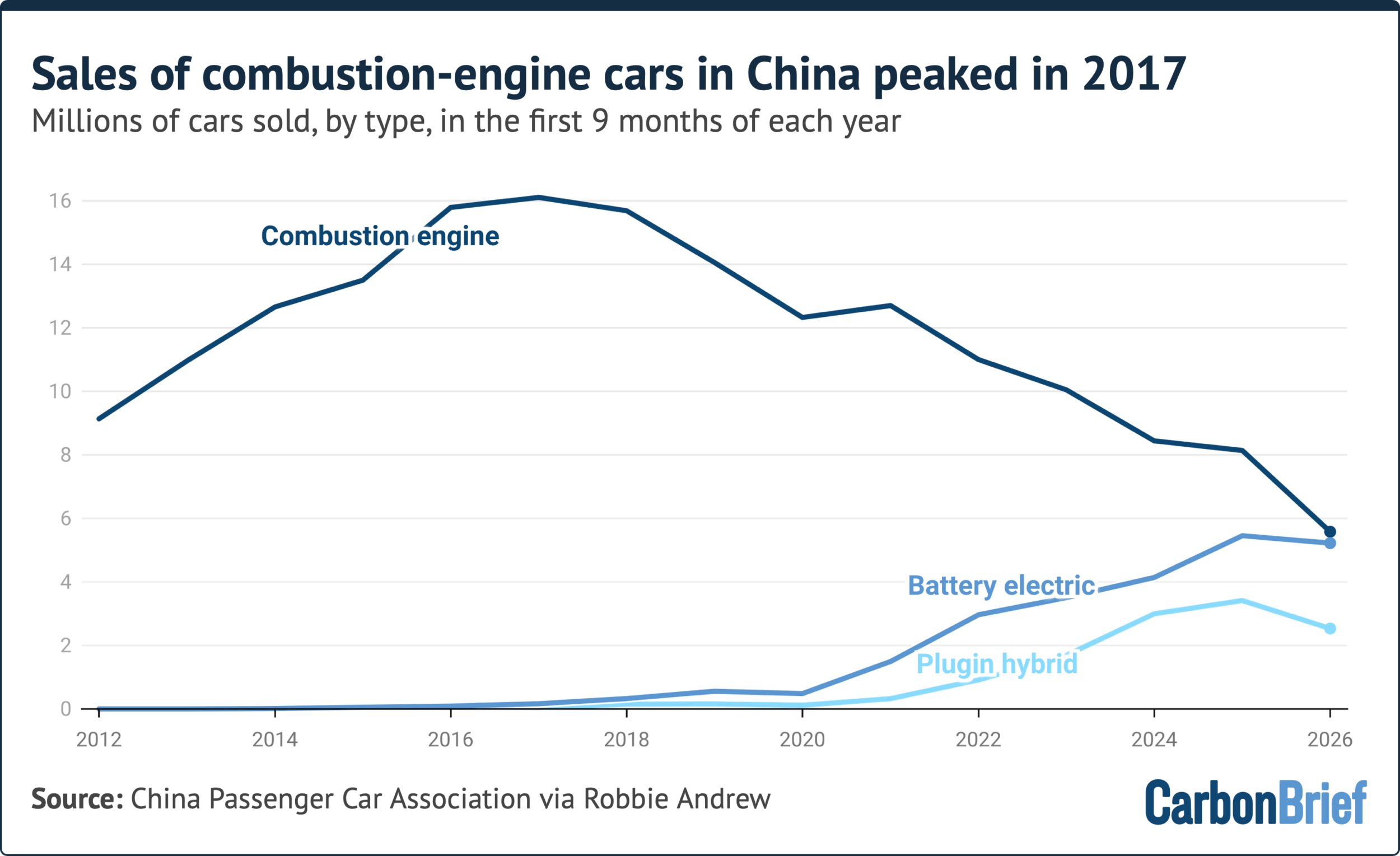
Indeed, sales of fuel-only cars were down 31% year-on-year in the first nine months of 2026, with plug-in hybrid sales down 26% – whereas battery EV sales were only down 4%.
One analyst tells Carbon Brief that China’s rapidly growing EV fleet has offset demand for 143m barrels of oil since the start of the Hormuz crisis.
Another says that the crisis is “reinforcing China’s electrification of road transport”.
Meanwhile, amid slowing domestic sales, Chinese carmakers’ exports of NEVs more than doubled [in 2026 to date / in September] from a year earlier.
NEV record
A record two out of every three cars sold in September in China were NEVs, according to CPCA data, as shown in the figure below.
(NEVs predominantly include battery electric vehicles – BEVs – and plug-in hybrids – PHEVs. BEVs only run on electricity, whereas PHEVs also have a combustion engine.)
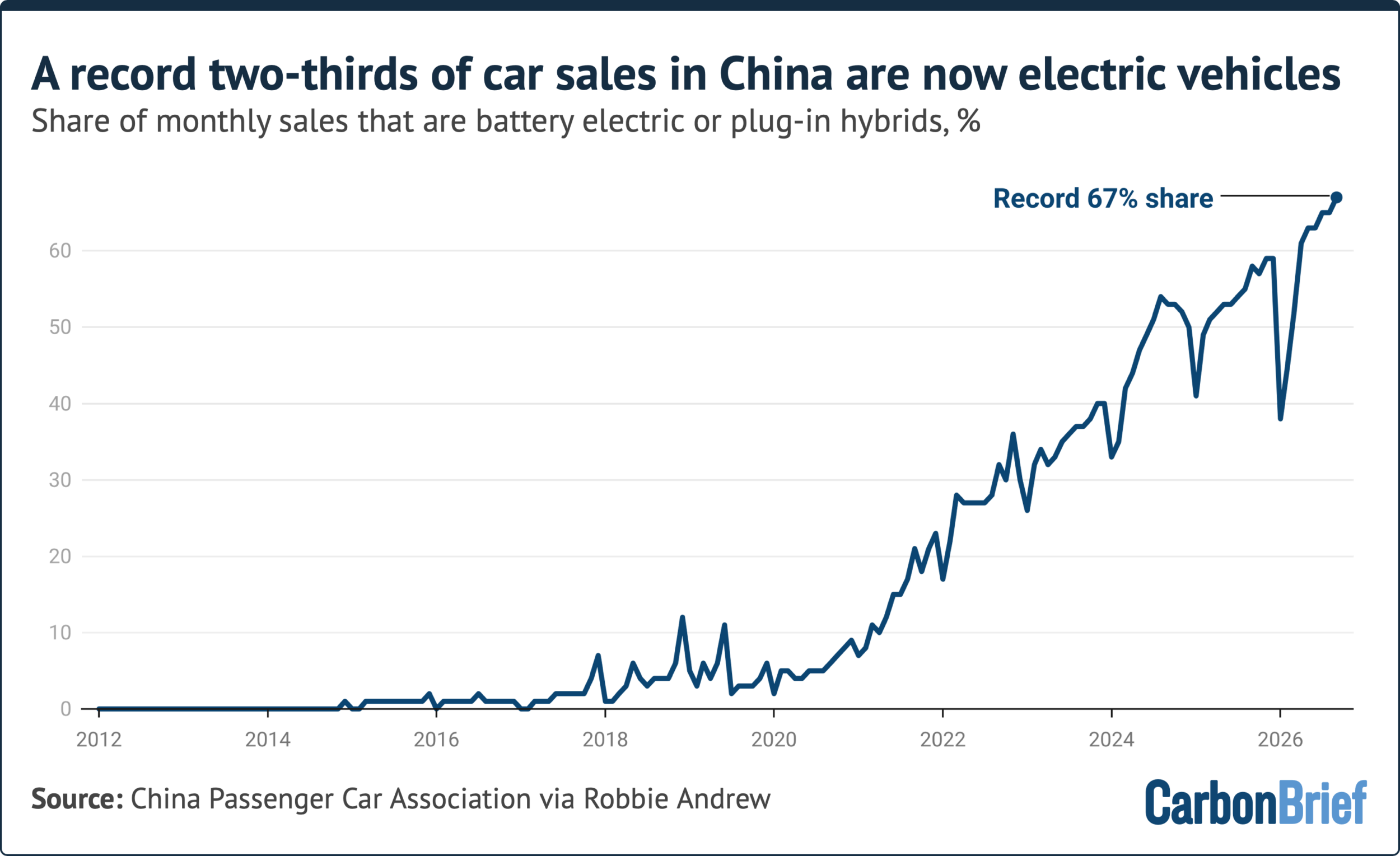
This marks a rapid rise for NEVs from just 6% of new car sales in 2020 up to 58% in 2026 to date – and a record 67% in the month of September.
This year, NEVs’ share of sales has also bounced back from a low of 39% in January, after the full purchase tax exemption that had been in place for more than a decade came to an end in December 2025.
The gain in NEV share in 2026 has come amid a slowdown across the wider domestic passenger-car market, which has hit sales of combustion-engine vehicles particularly hard.
This September, passenger-car retail sales across all categories declined, with overall sales volumes falling 28% year-on-year.
The contraction was led by combustion-engine vehicles, which saw sales fall 43% year-on-year in September and 31% in 2026 to date.
However, sales of PHEVs also fell by 36% year-on-year in September and by 26% in 2026 to date. By comparison, BEVs performed better, although sales still declined 8.5% from a year earlier in September and 4% in 2026 to date.
As a result, NEV sales overall fell by 17% in September and 13% in 2026 to date.
While the market changes in 2026 to date were particularly dramatic, they reflect a broad continuation of trends seen over the past decade.
Indeed, sales of combustion-engine cars in China peaked in 2017 and they have been declining ever since, shown in the figure below.
Impact of Hormuz
Part of the reason for the advance of NEVs in 2026, said Chinese technology news outlet OFweek, was petrol cars “giving up market share” as they were outperformed by electric alternatives.
Cui Dongshu, secretary-general of the CPCA, cited higher petrol prices as an explanation for September’s weak combustion-car sales, in comments to financial news outlet National Business Daily.
Imports of oil into China in January-September have fallen 15% compared to 2025, equivalent to 470m barrels, as ongoing conflict tightened supply and drove up prices.
China’s passenger-car NEV fleet has displaced 143m barrels of oil so far during the strait of Hormuz crisis, Euan Graham, senior energy analyst at thinktank Ember, tells Carbon Brief.
EVs “accounted for 12% of the decrease in China’s oil use post-Hormuz”, according to an estimate provided to thinktank the Brookings Institute by an unnamed analyst.