
Connect with us

Published

on

SBTi Launches Net-Zero Standard to Drive Climate Action in Banking and Finance

The Science Based Targets initiative (SBTi) has rolled out its first Financial Institutions Net-Zero Standard (FINZ). This framework offers banks, asset managers, insurers, and investors a clear path to aligning their portfolio activities—including lending, underwriting, and investments—with net‑zero emissions by 2050.

The FINZ standard sets clear rules on:

  • Portfolio emissions

  • Fossil fuel finance

  • Deforestation risk, and

  • Reporting

It aims to transform how the finance industry aligns with global climate goals and steers clean capital flows.

Why the New Standard Matters to Climate and Finance

Financial institutions are hugely influential. Their financed emissions—the greenhouse gases tied to the companies they finance—are typically hundreds to thousands of times higher than their own operational emissions.

They account for over 99% of financed emissions through loans, underwriting, and investments. One study found financed emissions can be 750 times greater, and for North American banks that rose to 11,000 times more than their own direct output.
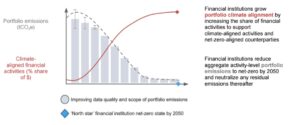
Financed emissions
Source: SBTi

Yet until now, most net‑zero frameworks focused on operational emissions (Scope 1 and 2). The FINZ Standard tackles Scope 3 category 15 emissions—those tied to clients and invested companies. It offers a sector‑specific roadmap for carbon impact across financial services.

Moreover, it strengthens transparency and accountability in financed emissions, including underwriting and capital markets. The UN-backed SBTi aims to drive major reductions. This tool targets not only corporate operations but also global capital markets.

Alberto Carrillo Pineda, SBTi’s Chief Technical Officer, noted:

“Financial Institutions have the ability to play a transformative role in the transition to net-zero. Their influence on the global economy and ability to engage with their portfolios is unparalleled to accelerate the net-zero transition. With its broad applicability and flexibility, this robust, science-based Standard will help financial institutions drive the net-zero transformation all over the world.”

Key Requirements: What FINZ Demands

Here are the major requirements set by the new standard:

Fossil Fuel Finance Phase‑out

Signatories must immediately stop financing new coal and oil field expansion. Financing for new oil and gas projects must also end by 2030. This shift separates general-purpose finance from investment that supports fossil fuel growth.

Portfolio Emissions Targets

Institutions need to measure and set science-based targets. These targets must cover all lending, investment, underwriting, and capital market operations (Scope 3 category 15+). They must align with a 1.5 °C pathway and match the ambition of SBTi’s corporate standard. Public targets and interim milestones are required.

Deforestation and Real Estate Risk Reporting

Banks and asset managers must assess exposure to deforestation and real estate. Those with significant risk must publish mitigation plans. This broadens climate accountability beyond just fossil fuel financing.
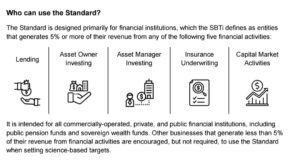
Users of SBTi FINZ standard
Source: SBTi

Stakeholder Response: Support and Criticism

Over 150 institutions contributed to public consultations, and 33 firms pilot‑tested the standard.

Over 150 financial institutions contributed to public consultations, and 33 firms pilot-tested the draft standard. Also, nearly 135 institutions across six continents have committed to align with FINZ already.

SBTi has validated the most near-term institution targets to date—a nearly 50% increase year-on-year. It also expects more growth under new CEO David Kennedy, with ambitions to scale to 20,000 companies by 2030.

Many praised the approach as both rigorous and practical. The Sustainable Finance Observatory welcomed the initiative’s wider focus. It includes loans, insurance, capital markets, and portfolio investment.

Yet critics highlight a major tension: the delay in phasing out fossil fuel finance until 2030. A recent report found that nearly 95% of bank fossil-fuel financing in 2024 went via general-purpose loans, not project-specific funding—potentially locking in more fossil fuel use this decade.

Some experts argue that progress toward net‑zero demands an immediate cutoff. SBTi believes that slower advocacy could allow more institutions to join in. This might lead to a bigger overall impact.

Major banks like HSBC and Standard Chartered left the SBTi climate approach. They had worries about the new standard’s strictness and how practical it is.

Meanwhile, ING is the first global bank to have validated SBTi targets. It has also promised to stop financing new fossil fuel projects by 2040. It will also cut coal power finance close to zero by 2025.

What It Means for the Carbon Credit Market

The FINZ Standard raises the bar for carbon credit demand. It is also likely to shape the future of the voluntary carbon credit market. Financial institutions are facing stricter rules on financed emissions. So, many will seek verified carbon removal solutions to hit their climate targets.

The SBTi usually doesn’t let carbon offsets replace real emissions cuts but it does see a small role for carbon removals. This is especially true for options like direct air capture or biochar that store carbon long-term.

This creates new demand for high-quality, science-based carbon credits, especially those tied to durable removal projects. Nature-based credits, like forest restoration, may increase in value. This is true if they meet strict verification and permanence standards.

Moreover, financial firms can help fund new carbon projects by investing in climate mitigation. This is especially important in emerging markets, where capital is often hard to find.

Overall, the new standard brings greater credibility to net-zero claims. This could lead to more serious investment in carbon markets. It may focus on removal and insetting instead of just short-term offsets. The standard might also lead buyers to choose credits certified by third-party groups. These should align with international standards like ICVCM and VCMI.

Looking Ahead: Adoption and Market Shifts

The FINZ Standard has been published in July 2025, with a global consultation now closed. It is expected to become mandatory for SBTi‑aligned institutions over the coming years. Here are major development to watch:

  • The Financial Institutions Near-Term Criteria (FINT) will stay valid until 2026. New institutions should adopt the FINZ standard now.
  • By early 2026, SBTi plans to fully roll out the standard under new CEO David Kennedy. As climate risk grows, it will impact financial stability.
  • FINZ might set regulatory standards and change how banks are monitored for climate-related issues.
  • Over time, institutions that meet FTIN 1.5 °C‑aligned targets and halt fossil fuel expansion financing will likely enjoy reputational gains and stronger ESG investor support. Conversely, those lagging could face legal, regulatory, and financial scrutiny.

SBTi’s Financial Institutions Net‑Zero Standard is a landmark tool for holding banks and investors accountable for financed emissions. Clear standards on fossil fuel finance, portfolio coverage, and disclosure help align financial flows with net‑zero pathways.

Some critics worry about the slow phase-out of fossil fuel financing. However, many view the new Financial Institutions Net-Zero Standard as a practical method that helps engage institutions and improve climate alignment sooner.

As more firms join, purchase high-quality carbon removals, and report robust financed-emissions targets, the standard could accelerate real emissions cuts. FINZ standard signals a change for those tracking ESG investments, carbon credits, and climate policy. It brings credible, science-based finance and acts as a new tool in the low-carbon market.

The post SBTi Launches Net-Zero Standard to Drive Climate Action in Banking and Finance appeared first on Carbon Credits.

Continue Reading

Carbon Footprint

From Baku to Belém: Can COP30 Deliver the $1.3 Trillion Climate Finance Pledge?

Published

on

From Baku to Belém: Can COP30 Deliver the $1.3 Trillion Climate Finance Pledge?

The world approaches COP30 in Belém, Brazil, and attention is on how countries will fund their climate commitments from the Paris Agreement. COP29’s Baku to Belém Roadmap aims for 1.3 trillion in climate finance. This goal is now the key challenge for global cooperation.

This editorial looks at how the new roadmap, Brazil’s Amazon summit, and growing carbon credit markets could change climate funding. These factors may help the world convert climate promises into actual capital.

COP29’s $1.3T Goal Sets the Stage for COP30

COP29 in Baku set a bold goal for climate finance. The aim is to boost funding for developing countries to at least $1.3 trillion annually by 2035.

The New Collective Quantified Goal (NCQG) and the “Baku to Belém Roadmap to 1.3T”, while not a binding report, prepare the world for COP30 in Belém, Brazil.

The roadmap was not intended to be a formal agreement under the UN climate negotiations. Instead, the two COP presidencies took the initiative to design a plan for expanding climate finance.

The Belém summit will see if political will, financial reform, and private capital can work together to meet this challenge. As stated in the roadmap:

“Scaling up climate finance has become a matter of necessity, not merely an enabler of ambition, as responding to climate change demands urgency, not incrementalism. The Roadmap is designed to serve as a basis and a force to accelerate implementation, transforming climate finance into a decisive instrument for securing a livable and just future.”

The Roadmap organizes actions into five “Rs”:

  • Replenishing: Grants and concessional finance.
  • Rebalancing: Debt and fiscal space.
  • Rechanneling: Mobilizing private capital and lowering capital costs.
  • Revamping: Capacity and coordination.
  • Reshaping: Systems and structures for fair flows.

Reaching 1.3T needs public funding and private innovation. They must work together to change how global finance addresses climate priorities.

The Race to Close the Climate Finance Gap

The gap between what’s available and what’s needed remains vast. In 2023, international climate finance for developing economies reached about $196 billion, based on Climate Policy Initiative (CPI) data. This amount is less than one-sixth of what is needed by 2035 for global climate finance.

OECD data shows that developed countries gave $115.9 billion in 2022. This met the old $100 billion target, but it highlights how much bigger the new goal is.

global climate finance vs COP30 target

In 2024, global losses from climate-related disasters reached $320 billion. At the same time, many vulnerable nations face rising debt and interest payments, limiting their fiscal space. The math is clear: without big changes to the financial system and better teamwork, climate finance will stay far behind climate risk.

Brazil’s COP30: A Symbol for Global Climate Justice

Hosting COP30 in Belém, Brazil, places the Amazon — one of the planet’s largest carbon sinks — at the center of global diplomacy. Brazil’s presidency seeks to close the gap between rich and poor nations. It focuses on equity, adaptation, and resilience finance.

The Baku to Belém Roadmap highlights that concessional and grant-based resources should focus on the most vulnerable countries. This includes Least Developed Countries (LDCs) and Small Island Developing States (SIDS).

For Brazil, this is a chance to showcase how protecting rainforests and empowering Indigenous communities can align with financial support. This approach leads to clear climate benefits.

Can Carbon Markets Help Unlock the $1.3 Trillion?

Carbon markets, both compliance and voluntary, are positioned to play a growing role in achieving the 1.3T aspiration. COP29 improved rules under Article 6 of the Paris Agreement. This helps clarify how international carbon trading works. This clarity could unlock cross-border credit transfers and boost investor confidence.

The voluntary carbon market (VCM), meanwhile, continues to evolve toward higher standards of transparency and integrity. Market trackers say the VCM was worth $2 billion in 2024. It could grow five times by 2030 if credibility and regulation improve.

carbon credit market value 2050 MSCI

Demand is increasing for high-quality nature-based and tech-driven credits. This is especially true for carbon credits that align with the Integrity Council for the Voluntary Carbon Market (ICVCM) and the Voluntary Carbon Markets Integrity Initiative (VCMI).

However, scaling carbon markets must come with safeguards. Without strong integrity standards, carbon finance risks eroding trust rather than building it. COP30 is a chance to make sure carbon credit mechanisms support, not replace, concessional and adaptation finance.

Fixing the Financial Architecture: Debt, MDBs, and Risk Reduction

Many developing countries face a debt crisis that constrains their ability to fund climate projects. In 2023, external debt servicing in these economies hit $1.7 trillion. Many countries now pay more in interest than they do on health or education.

The Roadmap’s “Rebalancing” pillar encourages debt-for-climate swaps. It also supports climate-resilient debt clauses and wider fiscal reforms. These efforts aim to free up resources for sustainable investment.

Multilateral development banks (MDBs) are central to this effort. The Roadmap Toward Better, Bigger, and More Effective MDBs urges reforms. These reforms should boost lending capacity by optimizing balance sheets and recognizing callable capital.

If MDBs boost annual climate lending to around $390 billion by 2030, they could lower financing costs. This would benefit clean energy, adaptation, and just transitions in emerging markets.

What COP30 Needs to Deliver in Belém

To make the 1.3T goal credible, COP30 has to turn ambition into measurable actions:

  • Clear replenishment schedules for the Green Climate Fund, Adaptation Fund, and Loss and Damage Fund.
  • Time-bound MDB reform commitments, ensuring faster disbursement and lower borrowing costs.
  • Robust global standards for carbon markets, ensuring high-integrity credits that benefit local communities.
  • Debt relief and fiscal instruments that release capital for climate resilience and clean energy investments.

Each of these outcomes is politically difficult, but technically achievable. The test is whether governments, banks, and private investors can work together. They need to join forces, not act alone, to speed up climate action on a large scale.

Turning Climate Finance Into Climate Action

The Baku to Belém Roadmap, though not binding, is a technical manual for turning pledges into measurable flows. It recognizes that climate action needs more than just public funds or donations. Private investment, carbon markets, and multilateral reform must all work together.

For carbon credit developers, investors, and policymakers, the coming year offers a pivotal moment. COP30 can connect policy goals with financial action. It can reshape how global capital helps us reach a net-zero, climate-resilient future.

Belém is not only another stop on the UN climate calendar. It could also show that climate finance can finally meet the scale of the climate challenge.

The post From Baku to Belém: Can COP30 Deliver the $1.3 Trillion Climate Finance Pledge? appeared first on Carbon Credits.

Continue Reading

Carbon Footprint

Microsoft Leads on Climate: $800M CIF Drives Clean Tech and AI Energy Deals with ADNOC, Masdar, and XRG

Published

on

Microsoft’s Climate Innovation Fund (CIF) just passed its first five-year milestone, and its impact is starting to reshape how corporate climate finance scales emerging technologies. What began in 2020 as a US$1 billion commitment to back solutions that didn’t yet exist at commercial scale has now mobilized roughly US$12 billion in broader climate tech financing.

The company has deployed over US$800 million so far across 67 startups and projects focused on carbon removal, low-carbon building materials, green steel, and AI-driven energy efficiency.

Microsoft’s Chief Sustainability Officer Melanie Nakagawa says the results show how corporate capital can move markets. “Big goals need bold bets,” she explains. “We needed to invest in technologies that were not yet at commercial scale—or, in some cases, didn’t yet exist.”

Today, those early bets are maturing into real projects, commercial plants, and large-scale carbon removal contracts. And while the tech giant still faces rising emissions linked to rapid growth in AI and data centers, CIF is now shaping supply chains that could determine how green the digital economy can be.

Pushing the Frontier: Turning Climate Concepts into Scaled Solutions

When CIF launched, Microsoft (MSFT stock) had announced its plan to become carbon negative, water positive, and zero waste by 2030. But the technologies needed to meet those goals were nowhere near ready. The fund was designed not to chase short-term returns, but to bring solutions to market that could eventually work at a global scale.

This approach meant:

  • Backing early-stage innovators before mainstream capital steps in
  • Acting as a first commercial buyer to prove demand
  • Pairing investment with procurement commitments to create real offtake pipelines

This strategy is what underpins CIF’s multiplier effect. For every dollar Microsoft has invested, approximately fifteen additional dollars have followed from other investors and institutions. That shift—moving innovations from pilot stage to bankable scale—has helped de-risk markets such as carbon removal, low-carbon cement, and sustainable aviation fuel.

Nakagawa puts it simply: “We’re helping move bold ideas off the sidelines and into real-world systems.”

Targeting High-Emissions Supply Chains: Steel, Cement, and Infrastructure Materials

One of CIF’s most direct priorities is reducing emissions tied to Microsoft’s own fast-growing infrastructure footprint. The company plans to spend about US$80 billion on data centers in fiscal 2025.

Data center construction is steel- and cement-heavy, and the energy use associated with CPUs and GPUs makes operations carbon-intensive. Recent examples show this strategy in motion:

  • Green Steel for Data Centers: Microsoft signed a deal with Stegra, producing steel with up to 95% fewer emissions. This steel will be used directly in data center equipment and building structures.
  • Low-Carbon Cement: The company has backed Fortera to build a 400,000-ton-per-year commercial facility producing a cement alternative that cuts emissions by about 70% compared to the standard Portland cement process.

These are not pilot projects—they are commercial facilities aimed at reshaping global heavy industry. The real signal is scale.

Leading the Corporate Carbon Removal Market

Microsoft has also become the world’s largest corporate buyer of carbon removal. The company has secured more than 30 million tonnes of removal commitments—spanning direct air capture, enhanced weathering, biomass burial, and engineered mineralization.

Microsoft carbon removal
Source: Microsoft

The deals include:

These agreements are crucial because the voluntary carbon market remains uneven in quality. By enforcing rigorous verification standards and long-term contracts, Microsoft is shaping the market’s baseline expectations for durability and transparency.

Yet, the company’s own emissions are still rising. Scope 3 emissions have increased by 26% from their 2020 baseline. It’s largely due to the energy and materials required to build and power AI data centers. The question now is whether procurement-backed project financing can scale fast enough to help reverse that trend.

microsoft emissions
Source: Microsoft

AI as an Accelerator: Climate Intelligence at Industrial Scale

CIF’s portfolio is increasingly leaning into AI-driven solutions. The logic is simple: decarbonization requires massive system optimization—across supply chains, grids, industrial processes, and land systems. AI is one of the few tools that can do that at speed.

Microsoft has invested in companies that use AI to:

  • Model and predict wildfire and forest restoration needs
  • Improve grid efficiency and transmission line monitoring
  • Analyze soil carbon and regenerative farming impact
  • Optimize renewable power dispatch and microgrid performance

The company now argues that AI is not just powering emissions—it’s critical to reducing them. But the energy footprint of AI remains a pressing challenge, which is why Microsoft is also advancing partnerships that combine AI deployment with co-development of clean energy.

AI Partnerships with ADNOC, Masdar, and XRG to Transform Industrial Energy Systems

A new collaboration between Microsoft, ADNOC, Masdar, and XRG shows how AI can help decarbonize the energy sector. Under the agreement, Microsoft and ADNOC will co-develop AI agents to support more autonomous and efficient industrial operations, building on ADNOC’s existing AI deployment.

Microsoft will provide advanced AI tools and upskilling programs, while all partners will help create an innovation ecosystem focused on cleaner energy production, efficient data centers, and large-scale clean power development.

This partnership signals a crucial shift: AI is not just improving digital systems—it is starting to reshape physical industrial infrastructure. By aligning software innovation with clean energy development, the collaboration aims to reduce operational emissions and support the sustainable expansion of the global AI and data center economy.

Brad Smith, Microsoft’s Vice Chair, said it clearly:

“No single company or industry can meet this moment alone. Accelerating the transition to a more sustainable, secure, and inclusive energy future requires deep collaboration between governments, energy providers, technology companies, and innovators everywhere.”

The Path Forward

Microsoft’s climate investments are reshaping key segments of the decarbonization landscape. Yet the company is also confronting the reality that the AI boom is increasing its emissions faster than its solutions are reducing them.

This is the dual challenge now facing almost every technology leader:

  • AI is driving explosive demand for compute, energy, and infrastructure.
  • But the same AI systems can accelerate materials innovation, energy efficiency, and carbon removal.
Microsoft CIF AI
Source: Microsoft

The question is not whether AI will shape climate action. It already is. The real question is whether companies move quickly enough to align AI growth with a net-zero transition.

As CIF’s first five years show, early capital and clear purchasing signals can move entire markets. The next five years will determine whether those markets grow fast enough.

This is a moment for leadership. Bold bets made now will define the climate technologies the world relies on tomorrow.

The post Microsoft Leads on Climate: $800M CIF Drives Clean Tech and AI Energy Deals with ADNOC, Masdar, and XRG appeared first on Carbon Credits.

Continue Reading

Carbon Footprint

Tesla (TSLA Stock) Sparks $2.1B Samsung Battery Deal as Global EV Demand Charges Ahead

Published

on

Tesla Sparks $2.1B Samsung Battery Deal as Global EV Demand Charges Ahead

Tesla (NASDAQ:TSLA) is reportedly in advanced talks with Samsung SDI for a $2.1 billion battery deal. This shows Tesla’s push for long-term access to cutting-edge battery technology. The deal will likely focus on cylindrical battery cells. It could boost Tesla’s supply chain as the company increases electric vehicle (EV) and energy storage production.

If finalized, the agreement would make Samsung SDI one of Tesla’s key suppliers alongside Panasonic and LG Energy Solution. Samsung batteries might power the EV maker’s new models and energy storage systems, such as the Powerwall and Megapack.

Tesla’s battery demand continues to rise with expanding production at Gigafactories in the U.S., Germany, and China. The company delivered over 1.8 million vehicles in 2024. With the new mass market compact EV coming, battery demand for Tesla may hit 400 GWh each year by 2030.

Why Tesla Needs More Battery Suppliers

Battery supply is the cornerstone of Tesla’s growth. The company’s 4680 cell production is moving more slowly than expected. This limits its ability to meet internal demand fully. As a result, Tesla continues to rely on external suppliers to meet its EV and storage targets.

The chart shows the EV giant’s most recent storage deployments. It reached almost 45 GW in the third quarter of 2025.

Tesla energy storage deployment Q3 2025
Source: Tesla

Samsung SDI supplies cylindrical cells to BMW and Rivian. The company is also expanding its manufacturing in South Korea, the U.S., and Europe. Tesla can partner with Samsung to diversify its sourcing. This way, it can access high-energy-density, nickel-rich batteries. These batteries improve driving range and performance.

This deal would also help Tesla reduce its exposure to raw material price swings. Battery-grade lithium and nickel prices fell by over 40% in 2024. However, volatility is still high because global demand for energy storage is rising fast.

battery grade lithium prices

The Global Battery Boom: A Trillion-Dollar Charge

The global battery market is expanding at a record pace. According to BloombergNEF, annual battery demand could exceed 4,500 GWh by 2035, compared to around 950 GWh in 2024. Electric vehicles account for most of this growth, with stationary storage and grid applications contributing an increasing share.

global energy storage market 2030 BNEF

China remains the largest producer, led by CATL and BYD, which together control over 50% of global battery supply. However, competition from South Korea and Japan is growing. Companies like Samsung SDI and Panasonic are investing billions in new factories in the U.S. and Europe.

The U.S. Inflation Reduction Act (IRA) has been a key driver of this shift. It provides tax credits for batteries and EVs made locally. This encourages foreign suppliers to set up production in North America. Samsung SDI is already building new facilities in Indiana and Tennessee, both of which could supply Tesla in the future.

Innovation at Full Voltage: From 4680 to Solid-State

The Tesla–Samsung deal aligns with broader trends in battery chemistry. Samsung SDI is working on high-nickel NCA and NCM cells. They are also looking at solid-state batteries. These batteries could offer better safety and higher energy density.

Tesla has focused heavily on innovation through its 4680 cells, designed to lower costs by 50% per kWh and improve vehicle range. However, scaling production has been challenging. By combining internal development with supplier deals, Tesla is able to stay flexible as battery technologies evolve.

Meanwhile, global research is exploring alternatives like lithium iron phosphate (LFP) for cost savings. It’s also looking into solid-state batteries for better performance in the future.

Analysts predict that commercial solid-state cells will enter mass production between 2028 and 2030. This timing matches Tesla’s future model plans.

The Broader Battery Market: Growth and Challenges

Battery storage has become central to the global clean energy transition. The International Energy Agency (IEA) says that installed battery capacity could jump from about 20 GW in 2020 to over 1,200 GW by 2030 in net-zero scenarios.

BloombergNEF expects 2025 to add 92 GW of new grid-scale storage. This shows how quickly the sector is growing. By 2030, global investment in batteries—across EVs, homes, and the grid—could exceed $1 trillion cumulatively.

global energy storage boom BNEF

Still, the industry faces several headwinds. Supply chain risks for critical minerals like lithium, nickel, and cobalt remain high. Recycling capacity also lags behind growing demand. Governments and automakers are now working to create closed-loop supply chains to recover metals and reduce environmental impacts.

In this landscape, Tesla’s influence remains large. The company’s early push for vertical integration—mining, refining, cell production, and energy storage—has set the pace for other automakers and battery firms.

Tesla’s Expanding Battery Network and Market Influence

Tesla’s collaboration with Samsung SDI is one of many major supply deals the company has formed in recent years. It has strong partnerships with Panasonic for 2170 cells and CATL for LFP batteries. These are used in Model 3 and Model Y vehicles in China.

In 2024, Tesla signed new deals with LG Energy Solution. These agreements provide more high-nickel cells. This supports Tesla’s expanding Megapack energy storage production in California.

Tesla’s global footprint in energy storage has also expanded sharply. The company’s Energy Generation and Storage division reported a 60% increase in deployment in 2024 than the previous year.

And as seen in the first chart above, it skyrocketed to over 40 GW in Q3 2025. Its Megapack systems are now used by utilities in the U.S., U.K., and Australia to stabilize power grids and support renewable integration.

Beyond its partnerships, Tesla plays a defining role in shaping global battery trends. Tesla’s Gigafactory in Nevada led the way in large-scale lithium-ion production. Meanwhile, the Texas and Berlin plants are placing Tesla at the heart of EV battery innovation in the West.

Tesla has driven scale, standardization, and efficiency. This helped make batteries cheaper for everyone. Pack prices dropped from about $1,100 per kWh in 2010 to under $140 in 2024, says BNEF.

As more nations set targets for carbon neutrality by 2050, battery demand will continue to surge. Tesla’s push to secure long-term supply through deals like the one with Samsung SDI ensures it remains a dominant force in this transformation.

The company’s reach goes beyond cars. It also impacts energy infrastructure, manufacturing systems, and the global clean energy economy.

The chart shows that global battery supply is projected to rise sharply through 2030, driven by massive factory expansions across China, the U.S., and Europe. In contrast, Tesla’s battery demand grows at a steadier pace, reflecting its focus on efficiency and diversified supplier partnerships rather than pure volume growth.

tesla battery demand vs global supply outlook

Outlook: Securing Supply, Scaling Sustainability

If the $2.1 billion deal with Samsung SDI moves forward, Tesla will strengthen its supply resilience and technological edge. The agreement shows a bigger industry trend: Automakers are forming key partnerships because demand for EVs and storage batteries is rising fast.

Global energy storage capacity is expected to grow tenfold by the end of the decade. With battery innovation speeding up, Tesla’s strategy of multi-sourcing and co-developing advanced chemistries could be key to maintaining its leadership.

Whether through partnerships, in-house innovation, or scaling renewable energy integration, Tesla continues to help define the direction of the global battery industry.

The post Tesla (TSLA Stock) Sparks $2.1B Samsung Battery Deal as Global EV Demand Charges Ahead appeared first on Carbon Credits.

Continue Reading

Trending

Copyright © 2022 BreakingClimateChange.com

