The European Commission has put forward a plan to boost production of EU-made, low-carbon steel, cement and renewables in an effort to rely less on other countries.
The proposed “Industrial Accelerator Act” (IAA) aims to boost “resilient and decarbonised” industrial production in EU manufacturing, says the commission.
Under the proposal, a percentage of products bought from “energy-intensive industries” and other sectors under public-procurement deals would be required to be “low-carbon” and made in the EU.
This includes targets for steel, aluminium and electric vehicle (EV) parts.
Non-EU countries with trade agreements, such as the UK and Japan, could also be included in the “Made in Europe” portion of the plan.
The proposal – which must be approved by the European Parliament and EU member states – could save millions of tonnes of carbon dioxide (CO2) by 2030, claims the commission.
Much of the media coverage on the proposed policy focuses on its aim to tackle reliance on China for low-carbon technologies, while Politico calls it a “climate law in disguise”.
In this Q&A, Carbon Brief outlines the key details of the proposal, what must happen for it to take effect and what it could mean for climate change.
Where does the ‘Industrial Accelerator Act’ proposal come from?
The publication of the proposed IAA follows weeks of delays as the EU attempts to boost its manufacturing industries – which have been struggling with international competition and high energy costs – while also supporting decarbonisation.
Industries such as steel, cement and chemicals produce roughly a fifth of the EU’s emissions, so decarbonising them will be essential for achieving the bloc’s net-zero goals.
The IAA is an effort to help energy-intensive industries cut their emissions while remaining globally competitive, in part by “creating lead markets for low-carbon products”.
It was first announced in the European Commission’s 2024 political guidelines, laying out its priorities for the five years out to 2029.
In the section concerning the EU’s plans for a “clean industrial deal” – referring to broader plans to support industries and accelerate their decarbonisation – the guidelines stated:
“We will put forward an industrial decarbonisation accelerator act to support industries and companies through the transition.”
When the clean industrial deal was subsequently released in February 2025, it said the promised act would introduce “clean, resilient, circular, cybersecure” criteria that would “strengthen demand for EU-made clean products”.
The act was also intended to “speed-up permitting for industrial access to energy and industrial decarbonisation” and “develop a voluntary label on the carbon intensity of industrial products”.
Underpinning these plans was the idea of increasing demand for low-carbon products in public and private procurements – in particular, those that were “Made in Europe”.
The proportion of products that will be included under the “Made in Europe” definition remains unclear. In the final proposal, the commission notes it will “tailor requirements to the specific structure, maturity and dependencies of each sector”.
The word “decarbonisation” was dropped from the act’s title by commission president Ursula von der Leyen in her state of the EU address in September 2025, in order “to allow for a broader sectoral and technological scope”.
This reflects wider disputes within the commission itself around the coverage of the IAA. There has also been strong opposition to the proposed “made in Europe” section of the act from different groups of member states.
The debate has also taken place against the background of calls to weaken key parts of EU climate policy – in particular, the EU emissions trading system (ETS).
Environmental groups have voiced concerns about the climate focus of the IAA being sidelined, at the expense of boosting the bloc’s competitiveness.
A major issue in the discussions has been whether the “made in Europe” label should include “trusted partners” from outside the EU, such as the UK and Switzerland.
The commission’s trade directorate has reportedly pushed for a more open system that includes more countries. Germany has been among the member states warning that restrictive rules could deter foreign investment and raise prices.
Meanwhile, Politico reported that the commission’s growth directorate, supported by France, wanted “made in Europe” to be restricted to countries in the European Economic Area – the 27 EU member states alongside Iceland, Liechtenstein and Norway.
The publication of the IAA proposal – which follows on from the automotive package adopted by the EU in December 2025 – was delayed numerous times amid the disagreements.
According to Politico, “haggling” continued over the Monday and Tuesday before the proposal was released, before it could be agreed internally within the commission by the “college of commissioners”.
What is in the IAA proposal?
Following these tense internal negotiations, the European Commission released its IAA proposal on 4 March 2026. It says the proposal will “increase demand for low-carbon, European-made technologies and products”.
The act sets a goal of increasing manufacturing’s share of EU GDP to 20% by 2035, up from 14.3% in 2024.
It introduces “targeted and proportionate” low-carbon and “made in EU” requirements for public procurement and public support schemes for specific sectors.
These will initially apply to steel, cement, aluminium, cars and net-zero technologies – defined within the proposal as batteries, battery energy storage systems (BESS), solar PV, heat pumps, wind turbines, electrolysers and nuclear technologies. It also establishes a framework that could be extended to other energy-intensive sectors in the future.
The commission notes that these sectors have been chosen due to their strategic importance, as well as being “essential enablers of the clean transition and vital to downstream industries”.
However, it says they are facing declining production in Europe, slower decarbonisation investments and global competition and market distortions, such as unfair subsidies.
For steel, the proposal would introduce a requirement for public procurement and public support schemes to use low-carbon steel within the automotive and construction industries.
This will help “create market demand” and “give investors confidence and predictability, boosting innovation and making clean steel a core part of the EU’s industrial future”, says the commission.
However, this falls short of the 70% low-carbon steel requirement that had been included in an earlier draft of the act, according to Reuters. Other earlier drafts of the IAA proposal had also included an emissions label for steel.
This voluntary carbon-intensity label had previously been set out within the clean industrial deal and had originally been expected to come into effect in 2025, before being pushed back and, ultimately, excluded from the IAA.
Beyond steel, the IAA sets minimum “Made in EU” requirements for public procurement of 70% for EVs, 25% for aluminium and 25% for cement.
The European Commission will now offer the UK, Japan and other like-minded countries the opportunity to be included under the “Made in Europe” manufacturing targets, if they offer reciprocal access to EU-based manufacturers, according to the Financial Times. The outlet adds that this is being welcomed by the UK government, which had lobbied for such access for months.
The measures within the IAA are in line with the recommendations of the Draghi report on EU competitiveness, says the commission. As such, it says they are designed to “increase value creation in the EU, strengthening our industrial base against the backdrop of growing unfair global competition and increasing dependencies on non-EU suppliers in strategic sectors”.
Alongside the introduction of requirements on public procurement within the bloc, the IAA proposal highlights that the EU is “committed to maintaining that openness as a key source of economic strength and resilience”.
The EU hosted almost a quarter of global foreign direct investment in 2024.
To further support such investment and ensure the benefits extend to technology transfer and job creation, the IAA introduces additional conditions for international investments.
These would apply for investments of more than €100m in emerging sectors such as batteries, EVs, solar PV and critical raw materials by companies that hold more than 40% of global production capacities.
Conditions would include EU companies holding a majority share, technology transfer, integration into EU value chains and job creation, according to the European Commission. There would also need to be a guarantee that a minimum of 50% of employees are European.
The introduction of common conditions across the bloc would mean the IAA “strike[s] a carefully calibrated balance by ensuring that strategic foreign investments contribute to Europe’s competitiveness, resilience and industrial transformation, while preventing fragmentation”, according to the commission.
Additionally, EU member states would be required to set up a single digital permitting process to “speed up and simplify manufacturing projects” under the IAA.
This would include dedicated single points of contact and maximum timelines of 18 months for certain projects, such as energy-intensive industry decarbonisation projects or those located in “industrial acceleration areas”.
Member states would designate these areas to encourage strategic manufacturing clusters, it says. The commission adds that projects within these areas would benefit from improved coordination and access to infrastructure, finance and skills ecosystems, as well as faster permitting.
What comes next?
The commission’s proposal will now be negotiated by members of the European Parliament and then by country ministers at the Council of the EU.
After these negotiations take place, the proposal can be adopted and the act can take effect.
But this may not be a simple process, as many countries remain divided on the key terms of the proposed law. (See: Where does the ‘Industrial Accelerator Act’ proposal come from?)
Nine EU countries pushed back on the proposal last December, reported Politico. The UK has been “lobbying” countries including Germany, Italy and the Netherlands to oppose it, according to Bloomberg. Reuters noted that the plan is backed by France.
EU commissioner for internal market and services, Stéphane Séjourné, told a press conference on 4 March that the “faster” the proposal moves through the EU lawmaking stages, the “more stability we will actually have”.
After the law takes effect, the commission says it will evaluate the key results three years later. A full review is then proposed after five years.
What could the act mean for carbon emissions?
The IAA could save around 30.6m tonnes of CO2 (MtCO2) in 2030, according to the European Commission.
According to the impact assessment published alongside the proposed act, the changes brought in for the steel, cement, aluminium, battery and vehicle sectors would drive significant CO2 reductions by 2030.
The document breaks down these emissions savings for 2030 as follows:
- Producing more batteries in the EU, rather than relying on imports from China, could save 25.6MtCO2.
- The 25% low-carbon steel target in the automotive and construction sectors could save around 3.4MtCO2.
- Vehicle manufacturing emissions could drop by 0.7MtCO2 due to “shifts in production”.
- The 5% low-carbon cement target could save 0.69MtCO2.
- The 25% low-carbon aluminium target could save 0.22MtCO2.
According to the impact assessment, the emissions required to produce a battery in the EU are around 25% lower than a “Chinese manufactured battery using the average Chinese grid”. This is due to “strict” EU environmental standards, it adds.
The report estimates that all of these savings in CO2 would be worth more than €3bn in avoided climate damages.
Streamlining the process for permitting to “accelerate” decarbonisation projects should also “lea[d] to an accelerated pace of GHG [greenhouse gas] savings”, the document says, but does not list a figure for this.
The impact assessment for the IAA proposal notes that there is currently a “structural imbalance” in the EU’s industrial transition.
It states that although emissions associated with industrial production are declining, this is “largely driven by shrinking production”, rather than improved carbon efficiency.
Carbon emissions and production volumes in the EU iron and steel sectors have dropped “almost in parallel” between 2005 and 2023, says the report.
It adds that projections show that these emissions will need to decline “much faster” to meet future EU climate targets.
The “competitiveness and decarbonisation” of EU manufacturing is “unlikely to improve” without further action, such as the IAA, says the report.
In other words, the IAA effectively aims to ensure that emissions cuts can accelerate while maintaining – or even increasing – industrial production within the EU.
What has the reaction to the IAA been?
While many welcomed the IAA proposal as a “first step”, others criticised the final proposal for walking back on the ambition in earlier drafts.
In a statement released alongside the proposal, Stéphane Séjourné, executive vice-president for prosperity and industrial strategy at the European Commission, said the IAA marked a “major step in the renewal of the European economic doctrine”. He added:
“Facing unprecedented global uncertainty and unfair competition, European industry can count on the provisions of this Act to boost demand and guarantee resilient supply chains in strategic sectors. It will create jobs by directing taxpayers’ money to European production, decreasing our dependencies and enhancing our economic security and sovereignty.”
Others shared his sentiment that in the face of a changing international trade environment, the IAA would boost European competitiveness. Neil Makaroff, director at the European thinktank Strategic Perspectives, said in a statement:
“With its first ‘made in Europe’ policy, the EU is embracing long-overdue economic realism and adapting itself to the new brutal global trade reality. Rather than letting the single market be an open outlet for Chinese overcapacities, each euro of taxpayer money can be directed to rebuild Europe’s manufacturing base. This is how Europeans can start learning the language of industrial powers.”
Tinne van der Straeten, the CEO of WindEurope, said the IAA sent an “important political signal”, but “a simple and harmonised implementation of the new rules is crucial”.
WWF highlighted that public procurement is only a small part of the EU economy and called for complementary measures that also target private consumption.
Camille Maury, senior policy officer on industrial decarbonisation at WWF EU, said:
“The commission has finally pressed the accelerator on clean industry by opening the door to create demand for clean products. However, to win the race to decarbonise, the commission and policy makers will need to put effort into strengthening low-carbon requirement criteria and designing truly green labels for steel and cement that exclude fossil fuel-based production.”
In particular, the lack of a low-carbon label for steel within the IAA drew criticism, with, for example, Daniel Pietikainen, policy manager for steel at climate NGO Bellona Europa, saying:
“The Act no longer provides the basis for a low-carbon steel label. While we can work with the Ecodesign Regulation as the vehicle for a steel label, the commission must commit to an ambitious timeline now. Any operational labelling scheme that is contingent on a delegated act with no clear timeline is not a signal; it is a delay.”
Similarly, the exceptions for international investment in emerging sectors, such as batteries and solar, were labelled as a “very disappointing…watering-down” by Christoph Podewils, secretary general of the European Solar Manufacturing Council. In a statement, he added:
“We need ‘Made in Europe’ to ensure the continent’s long-term energy security. The current explosion in energy prices, caused by the war in Iran, demonstrates the importance of being independent of other regions.
“If the European solar industry has to wait another three years after the legislation is adopted, many companies will have disappeared in the meantime due to ongoing unfair competition from China.”
The post Q&A: What the EU’s new industry and ‘Made in Europe’ rules mean for climate action appeared first on Carbon Brief.
Q&A: What the EU’s new industry and ‘Made in Europe’ rules mean for climate action

Three countries have been named by the Paris Agreement’s compliance committee for failing to submit a nationally determined contribution (NDC) and repeatedly snubbing offers of help with their climate plans.
After months of internal debate over whether to identify serial non-responders, the Paris Agreement’s Implementation and Compliance Committee (PAICC) named the three countries which have failed to engage with it over their NDCs on Friday.
It named Democratic Republic of Congo, Senegal and North Korea in a footnote of its annual report, adding that it decided to name them “with a view to facilitating engagement”, adding that representatives of the three nations had been invited to its meeting in early 2027 “with the purpose of identifying any challenges and constraints”.
“The Committee noted the importance of Parties engaging with the Committee in a timely manner, while noting that some delays may be due to the national capabilities and circumstances of the Parties”, the report said.
-
Under US pressure, World Bank says it will back gas “where appropriate”
The US wants the World Bank to expand its gas support while climate campaigners are pushing for it to end – its head spoke this week of limited backing for the fossil fuel -
IPCC scientists vow to press on with climate reports despite political deadlock
After governments again failed to agree a timeline, nearly 120 IPCC authors pledged to complete their assessment on time and with full scientific rigour -
Paris Agreement committee snubbed over missing NDC climate plans
Many governments have still not submitted a nationally determined contribution to the UN, breaching a key requirement of the Paris Agreement

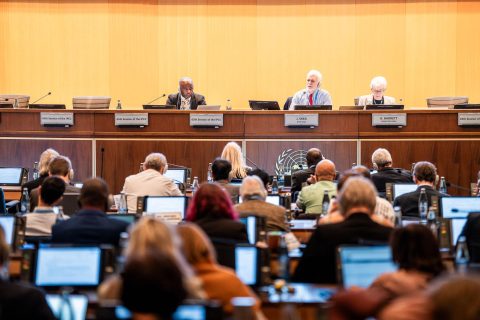

In July, PAICC said 12 countries had ignored its repeated attempts to discuss why they had not published an NDC as required every five years under the 2015 Paris accord.
Members of the committee had been divided over whether to name them, but at a September meeting decided to do so in their annual report to the annual climate COP summit.
By the time the report was published on Friday, only Congo, Senegal and North Korea “had not communicated an NDC or submitted a [Biennial Transparency Report] and had not yet responded to any of the Committee’s notifications, despite several reminders issued by the Committee in this regard”.
Rainforest and renewable energy ambitions
The silence from Congo and Senegal is notable because the former is home to much of the Congo Basin rainforest while the latter has sought billions of dollars in climate finance to support its renewable energy ambitions.
After Brazil, Congo has more rainforest than any country in the world. This forest, and the country’s peatlands, absorb huge amounts of greenhouse gas but are fast being lost to expanding farmland, charcoal production, logging and mining.
Senegal signed a Just Energy Transition Partnership with Canada and wealthy European nations in 2023, to help it meet its renewable energy targets under the-then government of Macky Sall. It was chair of the Least Developed Countries group between January 2022 and December 2023.

Tejas Rao, who is researching the PAICC as part of a doctoral thesis at Cambridge University, said the governments of the three countries should engage with the committee.
“Engagement costs these governments very little and the committee has shown it will listen,” he said.
“Silence leaves the committee with no basis to help, and it leaves the [governments] exposed to the narrative that they are simply disengaged,” he told Climate Home News.
Paris Agreement requirement
The 2015 Paris Agreement requires all parties to publish an NDC every five years outlining their emissions reduction targets, with each plan meant to be more ambitious than the country’s last NDC.
The latest set – the third round of plans, with new targets for 2035 – was due in February 2025. While most countries missed this deadline, all but around 30 – mostly small emitters but including Egypt, Vietnam and Argentina – have now submitted them.
Over the year, the PAICC – which is made up of government climate officials from developed and developing countries – has been communicating with governments that have not submitted NDCs and trying to overcome barriers to them doing so.
Some nations have cited exceptional circumstances as the reason for not submitting an NDC, a process that requires a significant amount of work in tracking emissions and consulting on how to curb them across the economy. For example, a letter from a Sudanese official to the PAICC, seen by Climate Home News, said that the country’s civil war had led to the suspension of its NDC preparation.
-
IPCC scientists vow to press on with climate reports despite political deadlock
After governments again failed to agree a timeline, nearly 120 IPCC authors pledged to complete their assessment on time and with full scientific rigour -
Under US pressure, World Bank says it will back gas “where appropriate”
The US wants the World Bank to expand its gas support while climate campaigners are pushing for it to end – its head spoke this week of limited backing for the fossil fuel -