From canola farmers in Canada to car owners in India, biofuels have become the subject of everyday debate across the world.
Liquid biofuels feature heavily in the climate plans of many countries, as governments prioritise domestic energy security amid geopolitical challenges, while looking to meet their climate targets and bolster farm incomes.
Despite a rapid shift towards electrified transportation, biofuels continue to play a leading role in efforts to reduce road-transport emissions, as they work well with many existing car engines.
At the same time, biofuels are expected to play an important role in decarbonising sectors where emissions are particularly challenging to mitigate, such as shipping, trucking and aviation.
Heated debates continue around using food sources as fuel in the face of record hunger levels, given competing demands for land and crops.
Despite these arguments, biofuels are seeing heightened demand bolstered by a strong policy push, particularly in developing countries.
They are expected to feature heavily on the COP30 agenda this year as a key feature of the host Brazil’s “bioeconomy”.
Below, Carbon Brief unpacks what biofuels are, their key benefits and criticisms, plus how they are being used to meet climate targets.
- What are biofuels?
- What are the most common biofuels being used today?
- What are the main arguments for biofuels?
- What are some of the main criticisms of biofuels?
- How are countries using biofuels to meet their climate targets?
- How could climate change impact biofuel production?
What are biofuels?
Bioenergy refers to all energy derived from biomass, a term used to describe non-fossil material from biological sources. Biofuels, in turn, are liquid fuels that are produced from biomass.
These sources are wide-ranging, but commonly include food crops, vegetable oils, animal fats, algae and municipal or agricultural waste, along with synthetic derivatives from these products.
Glossary
Biomass
Non-fossil material of biological origin
Biofuel
Fuels produced directly or indirectly from biomass
Feedstock
Types of biomass used as sources for biofuels, such as crops, grasses, agricultural and forestry residues, wastes and microbial biomass
Bioenergy
All energy derived from biofuels
Bioethanol
A biofuel used as a petrol substitute, produced from the fermentation of biomass from plants like corn, sugarcane and wheat
Biodiesel
A biofuel used as a diesel substitute, derived from vegetable oils or animal fats through a process called transesterification
The different types of biomass are referred to as “feedstocks”. They are converted to fuel through one or more processes, such as fermentation or treating them with high temperatures or hydrogen.
Biofuels are frequently blended with petroleum products in an effort to reduce emissions and reliance on fossil-fuel imports.
Experiments to test whether vegetable oils could run in combustion engines began in the early 1900s. In a 1912 paper, Rudolf Diesel – the inventor of the diesel engine – presciently noted that these oils “make it certain that motorpower can still be produced from the heat of the sun…even when all our natural stores of solid and liquid fuels are exhausted”.
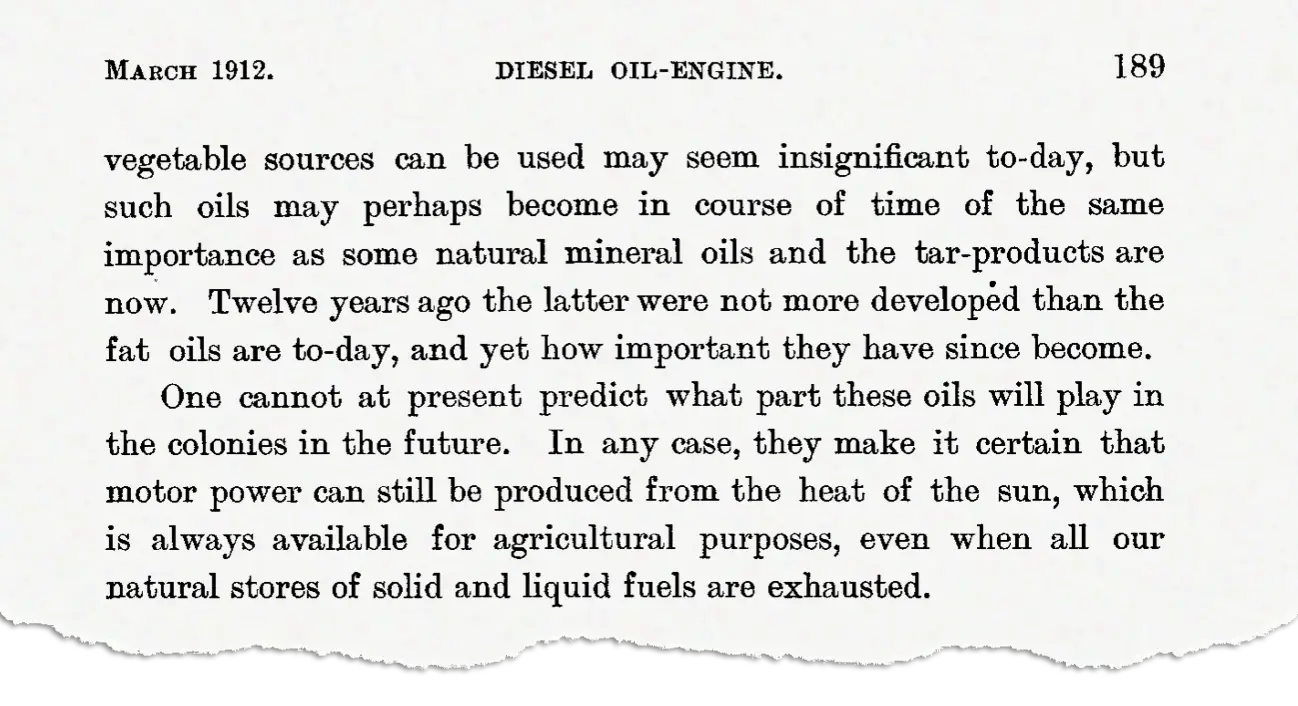
An extract from Rudolf Diesel’s 1912 paper, published in the Proceedings of the Institution of Mechanical Engineers, outlining the importance biofuels could assume in the future. Credit: Proceedings of the Institution of Mechanical Engineers (1912)
Biofuels are divided into four “generations”, based on the technologies and feedstocks used to synthesise them.
| Type of biofuel | Source |
| First-generation | Food crops (eg, sugarcane, corn, wheat, rice) |
| Second-generation | Non-edible crops and materials (eg, straw, grasses, used vegetable oil, forest residues, waste) |
| Third-generation | Aquatic materials (eg, algae) |
| Fourth-generation | Genetically modified algae, bacteria and yeast, as well as electrofuels, synthetic fuels and e-fuels |
First-generation biofuels
The first – and earliest – generation of biofuels comes from edible crops, such as corn, sugarcane, soya bean and oil palm. Large-scale commercial production of these fuels began in the 1970s in Brazil and the US from sugarcane and corn, respectively.
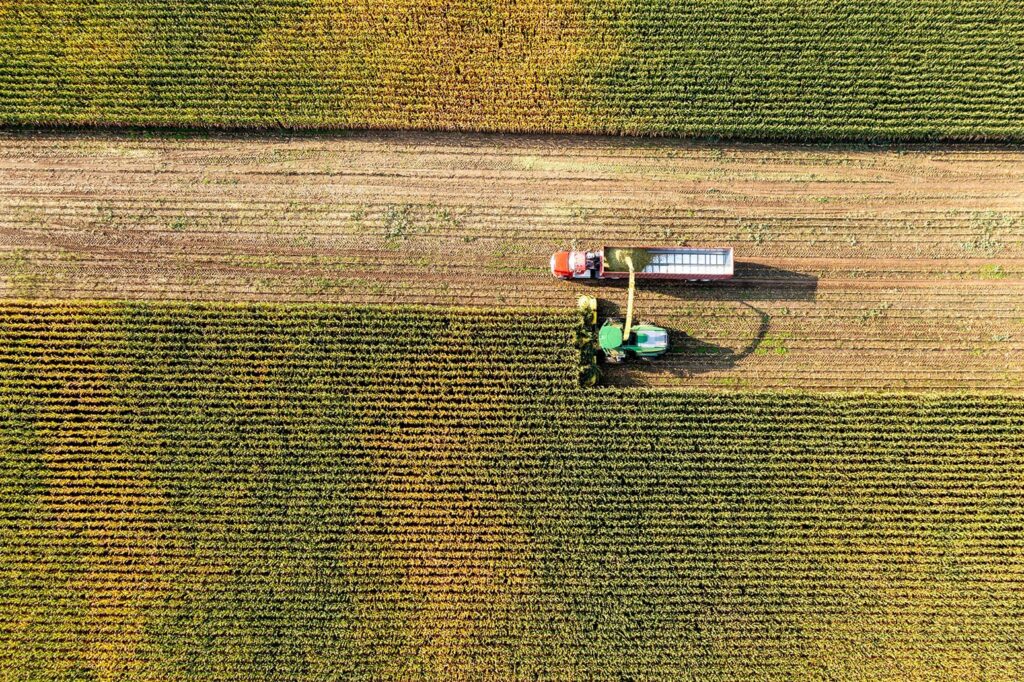
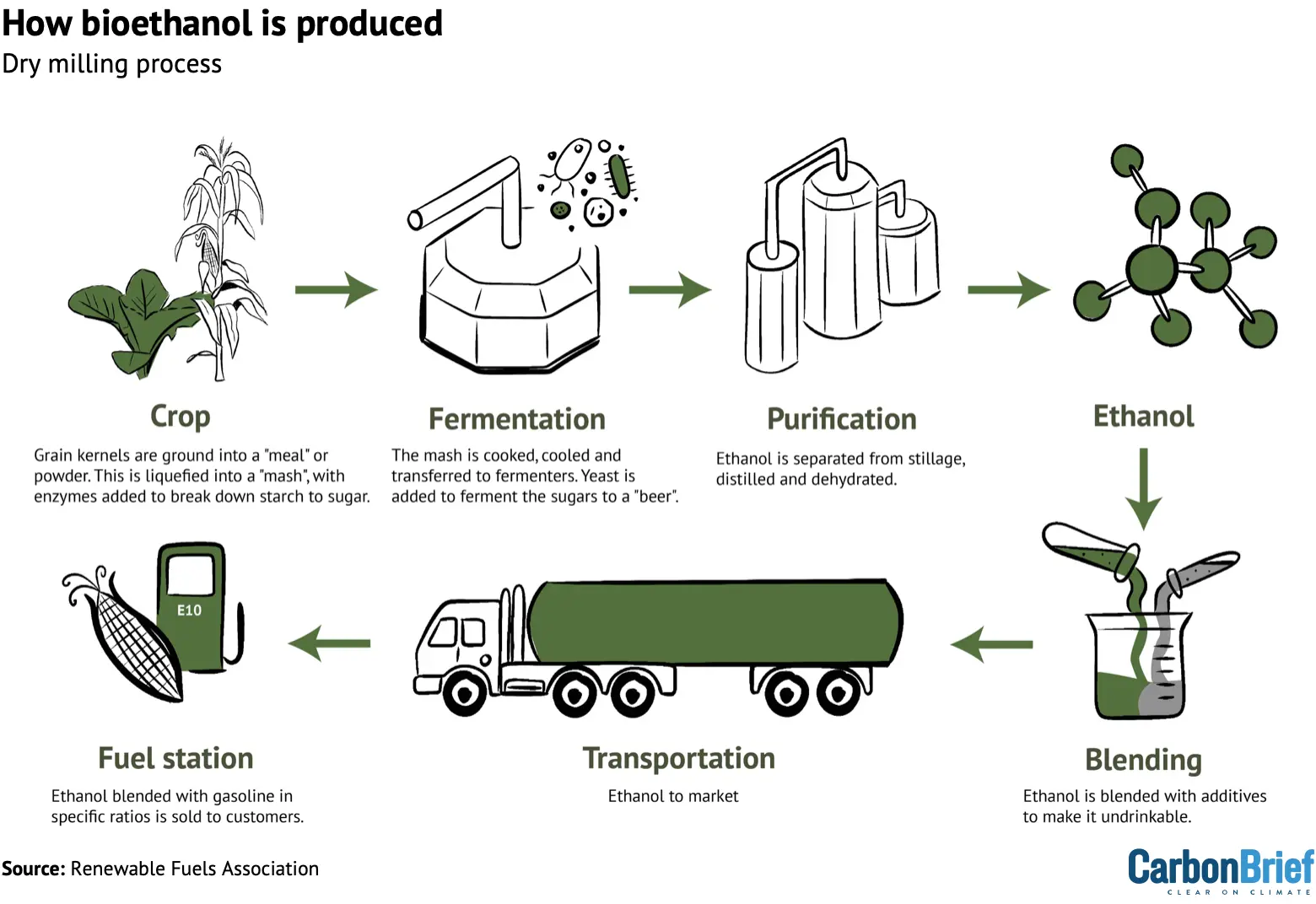
Bioethanol, for instance, is drawn from the fermentation of sugars in corn, sugarcane and rice. Biodiesel is derived from vegetable oils – such as palm, canola or soya bean oil – or animal fats, through a process called transesterification, which makes them less viscous and more suitable as fuels.
Because they are derived directly from food crops, experts and campaigners have expressed concerns over the impacts of first-generation biofuels on forests, food security and the environment, as well as indirect land-use change impacts. (See: What are some of the main criticisms of biofuels?)
Several studies have found that the land-use emissions of first-generation biofuels are severely underestimated, but other experts tell Carbon Brief that this depends on how and where the crops are grown, processed and transported.
According to Dr Angelo Gurgel, principal research scientist at the Massachusetts Institute of Technology (MIT) Center for Sustainability Science and Strategy, the “big image that biofuels are bad” is not always accurate. Gurgel explains:
“Some biofuels can be better than others, varying from place to place and feedstock to feedstock. It depends on where you produce them, how much farmers can increase yields, how effectively a country’s regulations help avoid land-use change and how closely it is connected to international markets.
“Some options may be very, very good in terms of reducing emissions and other options probably will be very bad.”
Second-generation biofuels
Second-generation biofuels are extracted from biomass that is not meant for human consumption.
Feedstocks for these biofuels are incredibly varied. They include agricultural waste, such as straw and corn stalks, grasses, forest residues left over from wood processing, used vegetable oil and solid waste. They can also be made from energy crops grown specifically to serve as biofuels, such as jatropha, switchgrass or pongamia.

Derived from “waste” or grown on “marginal” land, second-generation biofuels were developed in the early 2000s. These fuels aimed to overcome the food security and land-use issues tied to their predecessors, while increasing the amount of fuel drawn out from biomass, compared to first-generation feedstocks.
These feedstocks are either heated to yield oil or “syngas” and then cooled, or treated with enzymes, microorganisms or other chemicals to break down the tough cellulose walls of plants. They can be challenging to process and present significant logistical and land-use challenges.
Third-generation biofuels
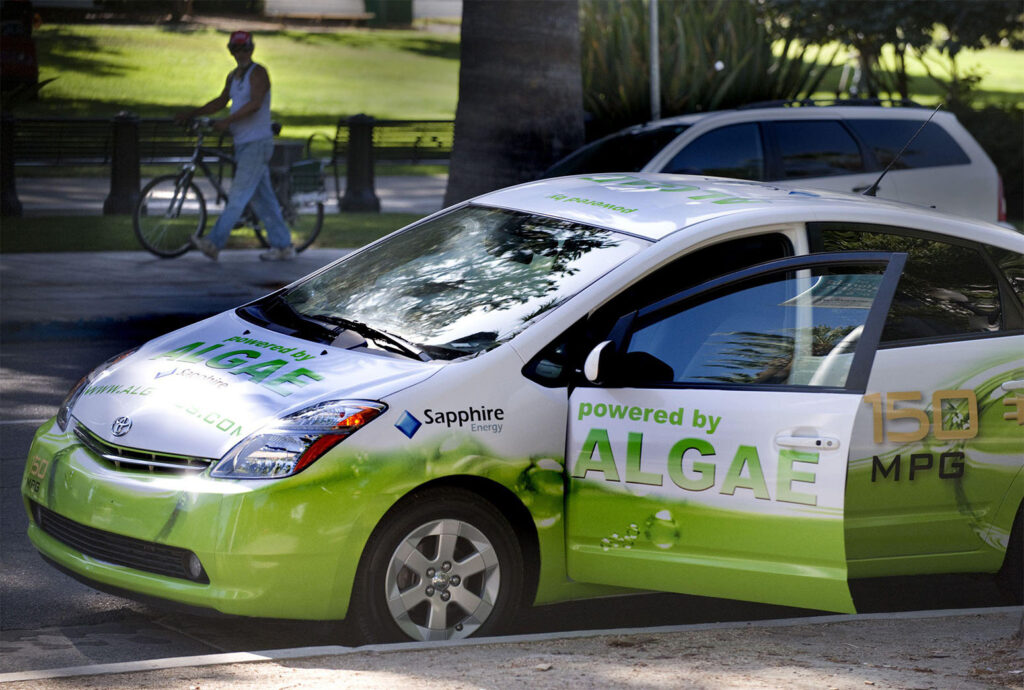
Third-generation biofuels are primarily derived from aquatic organic material, particularly algae and seaweed. While the US Department of Energy began its aquatic species programme in 1978 to research the production of biodiesel from algae, algal biofuel research saw a “sudden surge” in the 1990s and “became the darling” of renewable energy innovation in the early 21st century, says Mongabay.
Because algae grows faster than terrestrial plants, is high in lipid (fatty organic) content and does not compete with terrestrial crops for land use, many scientists and industry professionals consider third-generation biofuels an improvement over their predecessors.
However, high energy, water and nutrient needs, high production costs and technical challenges are key obstacles to the large-scale production of algae-based biofuels. Since the early 2010s, many companies, including Shell, Chevron, BP and ExxonMobil, have abandoned or cut funding to their algal biofuel development programmes.
Fourth-generation biofuels
Genetically modified algae, bacteria and yeast engineered for higher yields serve as the feedstock for fourth-generation biofuels. These fuels have been developed more recently – from the early 2010s onwards – and are an area of ongoing research and development.
Some of these organisms are engineered to directly or artificially photosynthesise solar energy and carbon dioxide (CO2) into fuel; these are called solar biofuels.
Others – called electrofuels, synthetic fuels or e-fuels – are produced when CO2 captured from biomass is combined with hydrogen and converted into hydrocarbons through other processes, typically using electricity generated from renewable sources.
Fourth-generation biofuels are technology- and CO2-intensive and expensive to produce. They also run up against public perception and legal limitations on genetically modified organisms, as well as concerns around biosafety and health.
What are the most common biofuels being used today?
Bioethanol is the most commonly used liquid biofuel in the world, followed by biodiesel.
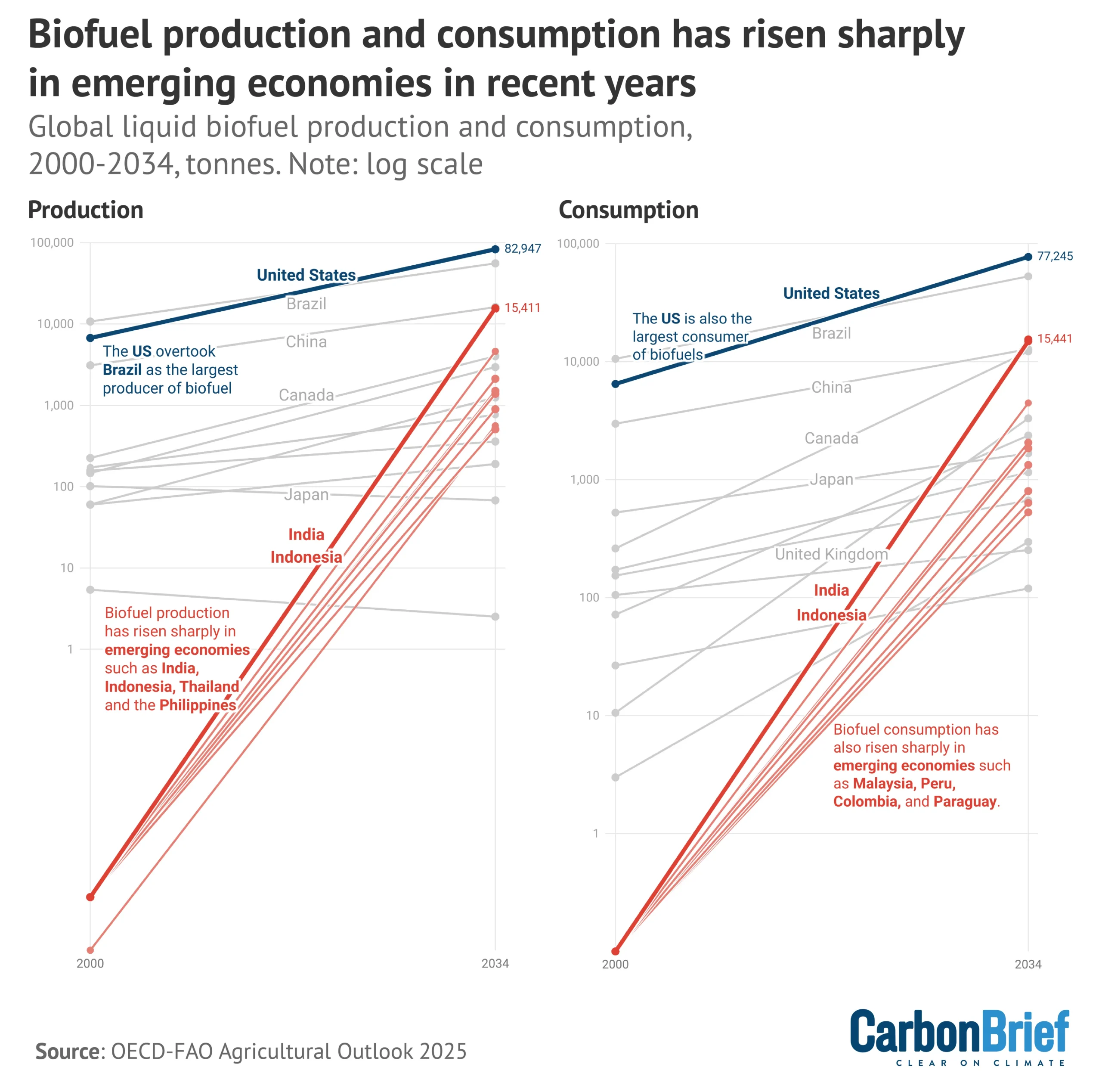
In 2024, global liquid biofuel production increased by 8% year-on-year, with the US (37%) and Brazil (22%) accounting for the largest overall share of production, according to the 2025 Statistical Review of World Energy from the Energy Institute.
Other countries that saw a notable increase in production between 2023-24 were Sweden (62%), Canada (39%), China (30%), India (26%) and Argentina (24%).
Bioethanol is the most commonly used biofuel in the world, with a consumption rate of 1.1m barrels of oil equivalent per day in 2024, according to the report. This is closely followed by biodiesel, at 1m barrels of oil equivalent per day.
In 2024, the US, Brazil and the EU accounted for nearly three-quarters of all biofuels consumed globally. However, while India’s biofuel demand grew by 38%, demand for biofuels in the EU fell by 11% in 2024, according to the review, echoing outlooks that show that middle-income countries are driving biofuel growth.
The chart below shows how biofuel production and consumption have changed since 2000, and how they are projected to change through 2034.
What are the main arguments for biofuels?
From lowered oil imports and emissions through to boosting farm livelihoods, countries that have boosted biofuels programmes cite several benefits in biofuels’ favour.
‘Renewable’ energy and lowered emissions
Biofuels are often described as “renewable” fuels, since crops can be grown over and over again.
In order to achieve this, crops for biofuels must be continuously replanted and harvested to meet energy demand. Growing crops – particularly in the monoculture plantations typically used for growing feedstocks – can require high use of fossil fuels, in the form of machinery and fertiliser. Furthermore, in the case of wood as a feedstock, regrowth can take decades.
While some biofuels offer significant emissions reductions, others, such as palm biodiesel, generate similar or sometimes higher emissions as fossil fuels when burned. However, ancillary emissions for biofuels are much smaller than for oil and gas operations.
One of the main cited benefits of biofuels is that plants capture CO2 from the atmosphere as they grow, potentially serving to mitigate emissions. However, several lifecycle-assessment studies have questioned just how much plants can offset emissions. These studies come up with varying estimates based on feedstock types, geography, production routes and methodology.
This divergence is echoed in the UN Intergovernmental Panel on Climate Change’s (IPCC) Sixth Assessment Report (AR6), which points to “contrasting conclusions” even when similar bioenergy systems and conditions are analysed.
Per the report, there is “medium agreement” on the emissions-reduction potential of second-generation biofuels derived from wastes and residues by 2050.
At the same time, the IPCC adds that “technical land availability does not imply that dedicated biomass production for bioenergy…is the most effective use of this land for mitigation”.
It also warns that larger-scale biofuel use “generally translates into higher risk for negative outcomes for greenhouse gas emissions, biodiversity, food security and a range of other sustainability criteria”.
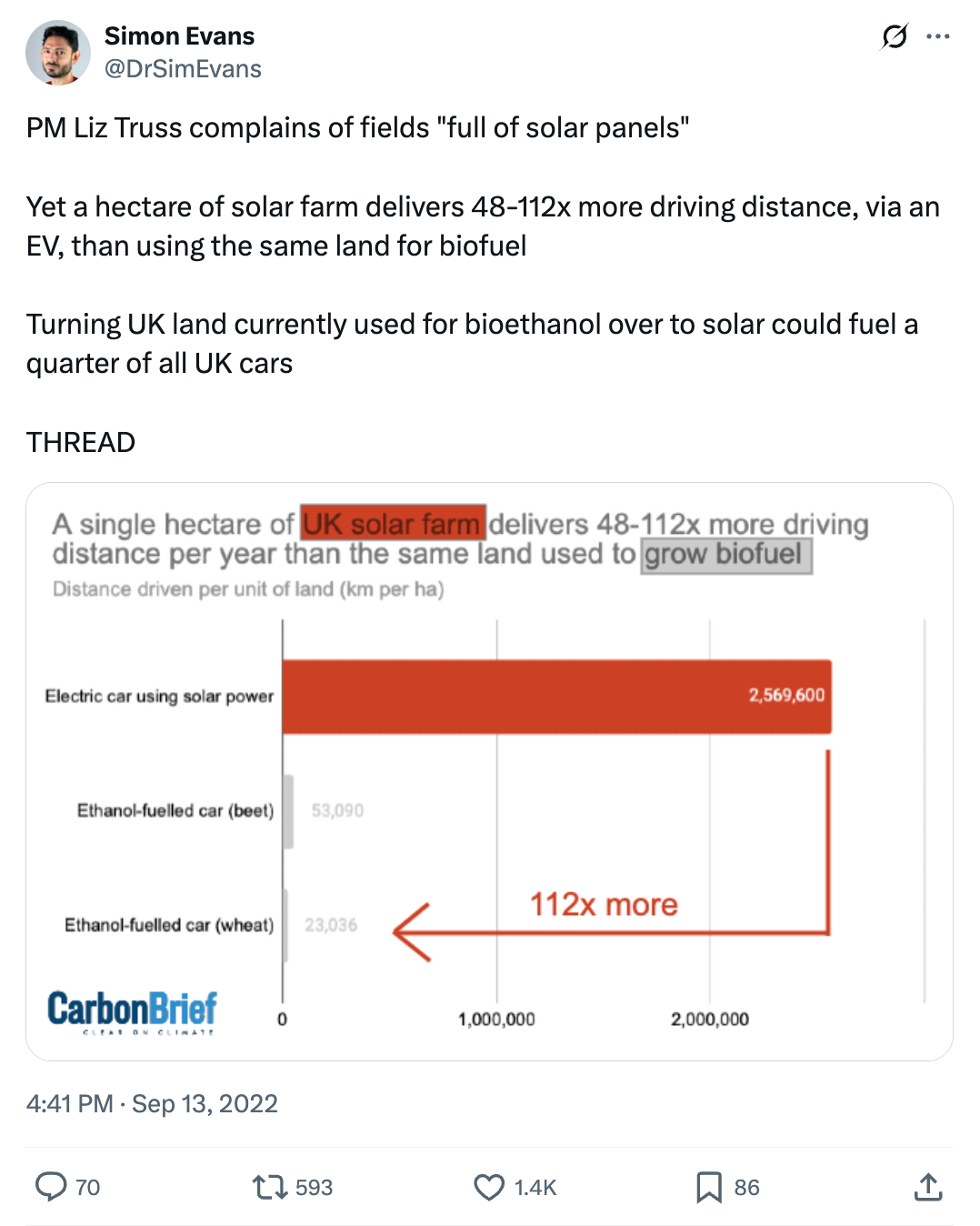
Along with the IPCC, many other groups and experts – including the UK’s Climate Change Commission – have called for a “biomass hierarchy”, pointing to a limited amount of sustainable bioenergy resources available and how best to prioritise their use.
Use in hard-to-abate sectors
In many countries, such as the US and UK, biofuels are part of a standard grade of diesel and petrol (gasoline) available at most fuel pumps.
Biofuels have also been the leading measure for decarbonising road transport in emerging economies, where electric vehicle systems were not as developed as in many western nations.
According to the International Energy Agency (IEA), most new biofuel demand is coming from these countries, including Brazil, India and Indonesia.
Biofuels are also one of the key options being explored to decarbonise the emissions-heavy, but “hard-to-abate”, sectors of aviation and shipping.
The AR6 report notes that the “faster-than-anticipated adoption of electromobility” has “partially shifted the debate” from using biofuels primarily in land transport towards using them in shipping and aviation.
At the same time, experts question how this can be done sustainably, given the limited availability of advanced biofuels and the rising demand for them.
Government reports – such as those released by the EU Commission – recognise that, in some circumstances, so-called sustainable aviation fuels (SAFs) could produce just as many emissions as fossil fuels when burned in order to power planes.
However, SAFs do generally – although not always – have a lower overall “lifecycle” carbon footprint than petroleum-based jet fuel. This is due to the CO2 absorbed when growing plants for biofuels, or emissions that are avoided by diverting waste products to be used as fuels.
Unlike the road sector, where “electrification is mature…aviation and shipping cannot be electrified so easily”, says Cian Delaney, fuels policy officer at the Brussels-based advocacy group Transport & Environment (T&E).
According to a 2025 T&E briefing, the 2030 demand for biofuels from global shipping alone could require an area the “size of Germany”. Delaney tells Carbon Brief:
“In aviation in particular, where you still need some space to transition, you still need a certain amount of biofuels. But these biofuels should be advanced and waste biofuels derived from true waste and residues, and they are available in truly limited amounts, which is why, in parallel, we need to upscale the production of e-fuels [synthetic fuels derived from green hydrogen] for aviation.”
In February this year, more than 65 environmental organisations from countries including the US, Indonesia and the Netherlands wrote to the International Maritime Organization, urging its 176 member states to “exclude biofuels from the industry’s energy mix”.
The organisations cited the “devastating impacts on climate, communities, forests and other ecosystems” from biofuels, cautioning that fuels such as virgin palm oil are often “fraud[ulently]” mislabelled as used cooking oil – a key feedstock for SAF.
Meanwhile, the AR6 report has “medium confidence” that heavy-duty trucks can be decarbonised through a combination of batteries and hydrogen or biofuels. And despite growing interest in the use of biofuels for aviation, it says, “demand and production volumes remain negligible compared to conventional fossil aviation fuels”.
Energy security and reducing import dependence
In many countries, such as India and Indonesia, biofuels are seen as a part of a suite of measures to increase energy security and lessen dependence on fossil-fuel imports from other countries. This imperative received increasing emphasis after the Covid-19 pandemic and Russia’s war on Ukraine.
In developing countries, the “main motivation” behind biofuel policy is to find an alternative to excessive dependence on imported fossil fuels that are a “major drain” on foreign exchanges and subject to volatility and price shocks, says Prof Nandula Raghuram, professor of biotechnology at the Guru Gobind Singh University in New Delhi.
Raghuram, who formerly chaired the International Nitrogen Initiative, tells Carbon Brief that, in order for developing countries to “earn those precious dollars to finance our petroleum imports”, they have to export “valuable primary commodities”, such as grain and vegetables, at the cost of nutritional self-reliance. He adds:
“And so we have to see the biofuel approach as not so much a proactive strategy, but as a sort of reactive strategy to use whatever domestic capacity we have to produce whatever domestic fuel, including biofuels, to reduce that much burden on the exchequer for imports.”
Boost to agriculture
Many governments also see biofuels as an alternative income stream for farmers and a means to revitalise rural economies.
An increasing demand for biofuels could, for example, offer farmers higher returns on their crops, attract industry and services to agrarian areas and help diversify farm incomes.
In 2023, a report by the International Labour Organization (ILO) and the International Renewable Energy Agency (IRENA) estimated that the liquid biofuel industry employed approximately 2.8 million people worldwide.
The bulk of these jobs were in Latin America and Asia, where farming is more labour-intensive and relies on informal and seasonal employment. Brazil’s biofuel sector alone employed nearly one million people in 2023, according to the report.
Meanwhile, North America and Europe accounted for only 12% and 6% of biofuel jobs in 2023, respectively, according to the report.
The chart below shows the number of jobs in the biofuel sector in the top 10 biofuel-producing countries.
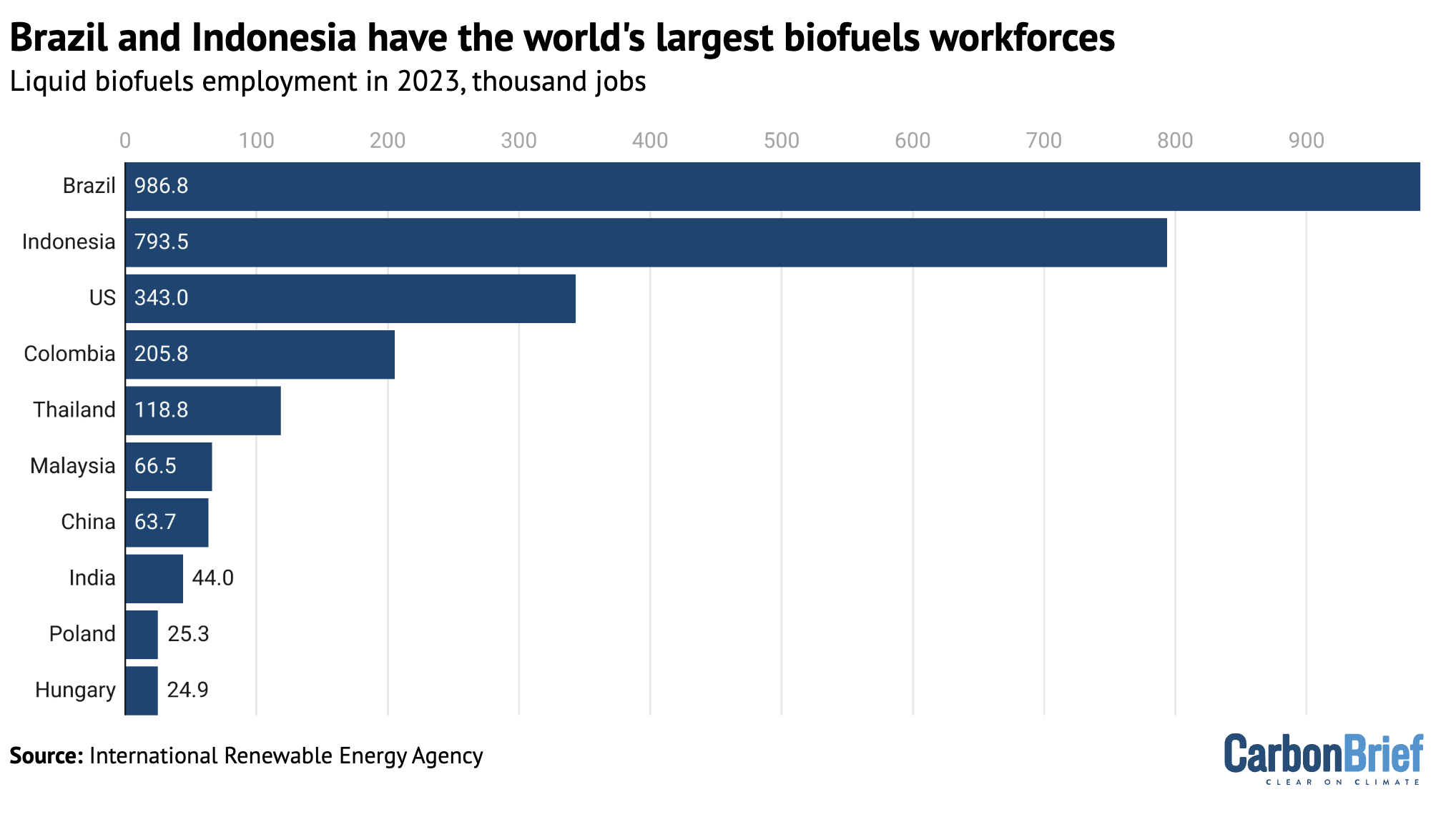
Delaney points out that biofuel-related jobs account for less than 1% of all jobs in the EU, adding that the “most-consumed biofuel feedstocks” in the bloc are vegetable oils that are imported from countries such as Brazil and Indonesia. (See: How are countries using biofuels to meet their climate targets?)
He tells Carbon Brief:
“Despite strong biofuels mandates in the EU, the sector didn’t create as many jobs in the end for EU farmers, but, instead, benefited the big fuel suppliers and industry players.”
What are some of the main criticisms of biofuels?
Despite their widespread use and increasing adoption, experts recognise that biofuels “may also carry significant risks” and cause impacts that can undermine their sustainability, if not managed carefully.
Production emissions, land-use change and deforestation
The different chemical processes involved in making biofuels require varying amounts of energy and, therefore, the associated emissions depend on how “clean” a producer country’s energy mix is.
At the same time, growing biofuel crops often relies on emissions-intensive fertilisers and pesticides to keep yields high and consistent. (See Carbon Brief’s detailed explainer on what the world’s reliance on fertilisers means for climate change.)
Biofuel production processes, such as fermentation, also release CO2 and other greenhouse gases, including methane and nitrous oxide.
MIT’s Gurgel tells Carbon Brief that it is “relatively straightforward” to measure these direct emissions from biofuel production.
However, given how different countries account for deforestation, tracking direct land-use change emissions related to biofuel production is slightly more challenging – although still possible, Gurgel says. These emissions can come from clearing forests or converting other land specifically for growing energy crops.
For example, in many tropical forest countries, native rainforests and peatland have been cleared to grow oil palm for biodiesel or sugarcane for bioethanol.
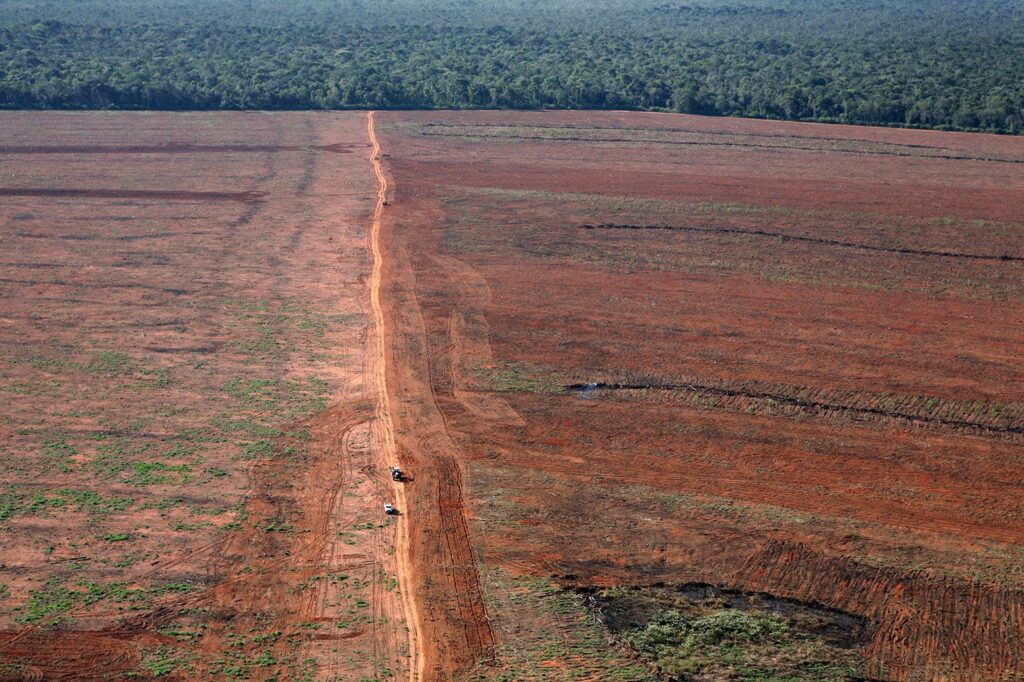
According to one 2011 study by the Centre for International Forestry Research and World Agroforestry (CIFOR-ICRAF), it could take more than 200 years to reverse the carbon emissions caused by clearing peatland to grow palm oil.
Gurgel tells Carbon Brief:
“What is really very hard – I would say impossible – to measure are the indirect impacts of biofuels on land.”
Indirect land-use change occurs when a piece of land used to grow food crops is used instead for biofuels. This can, in turn, require deforestation somewhere else to produce the same amount of crops for food as the original piece of land.
Indirect land-use change can mean a loss of natural ecosystems, with “significant implications for greenhouse gas emissions and land degradation”, according to a 2024 review paper.
Gurgel explains:
“If you provoke a chain of reactions in the market, that can lead to expansion of cropland in another region of the world and then this can push the agricultural frontier further and cause some deforestation…It’s quite hard to know exactly what’s going to happen and those things are interactions in the market that are impossible to measure.”
The “best that scientists can do” to determine if such a “biofuel shock” could indeed cause land-use change in a forest or grassland elsewhere “is try to project those emissions using models, or do very careful statistical work that will never be complete”, he adds.
Delaney, from Transport and Environment, contends that there is enough scientific research to “show that indirect land-use change is real” and to quantify the expansion of “certain food and feedstocks into high-carbon stock” areas, such as forests.
While this is “not easy” to do, he points to the European Commission’s indirect land-use change directive, the accompanying methodology and its scientific teams who study agricultural expansion rates. Delaney continues:
“What we all agree with at this point is that indirect land-use change exists, that it’s a problem, that certain feedstocks like palm and soya are particularly problematic from this perspective and that it is an issue that we need to tackle and capture in the best possible way.
“You cannot just be vague and descriptive without having proper figures behind it – and I think that’s something that at least the EU have tried and that they continue trying to implement. And I hope that, at the global level as well, this will be more recognised.”
Impacts on food, biodiversity and water security
Biofuel-boosting policies have been subjected to intense scrutiny during periods of global food-price spikes in 2008, 2011 and 2013.
Following the spikes, critics attributed increasing biofuel production as a major factor in the near-doubling of cereal prices. Studies have shown that they played a more “modest” role in some of these spikes and a more substantial one in others.
Severalexperts have linked food-price spikes to protests in north Africa and the Middle-East, including the Arab Spring.

In more recent years, the “food vs fuel debate” has come back to the fore since the start of the war in Ukraine in 2022.
This was in part due to the world’s reliance on Ukraine and Russia’s food and energy systems – particularly some of the most food-insecure countries, who had to contend with record-high food prices that peaked in March 2022, but still persist. The war also saw heightened calls for the US and EU to overturn biofuel-boosting policies to free up land to increase domestic food production and bring down food prices.
In developing countries, such as India, the use of cereals and oils to make biofuels while large sections of the population still lack access to adequate nutrition has attracted criticism from experts.
While first-generation biofuels rely on fertilisers to guarantee consistently high yields, second-generation biofuels could directly compete with feed for livestock or their return to soil as nutrients.
According to a 2013 report by the panel of scientists that advises the UN Committee on World Food Security (CFS):
“All crops compete for the same land or water, labour, capital, inputs and investment, and there are no current magic non-food crops that can ensure more harmonious biofuel production on marginal lands.”
This competition, along with clearing forests and other ecosystems for cropland, has consequences not just for emissions, but also for biodiversity, water and nutrients.
According to one 2021 review paper, local species richness and abundance were 37% and 49% lower, respectively, in places where first-generation biofuel crops were being grown than in places with primary vegetation. Additionally, it found that soya, wheat, maize and palm oil had the “worst effects” on local biodiversity, with Asia and central and South America being the most-impacted regions.
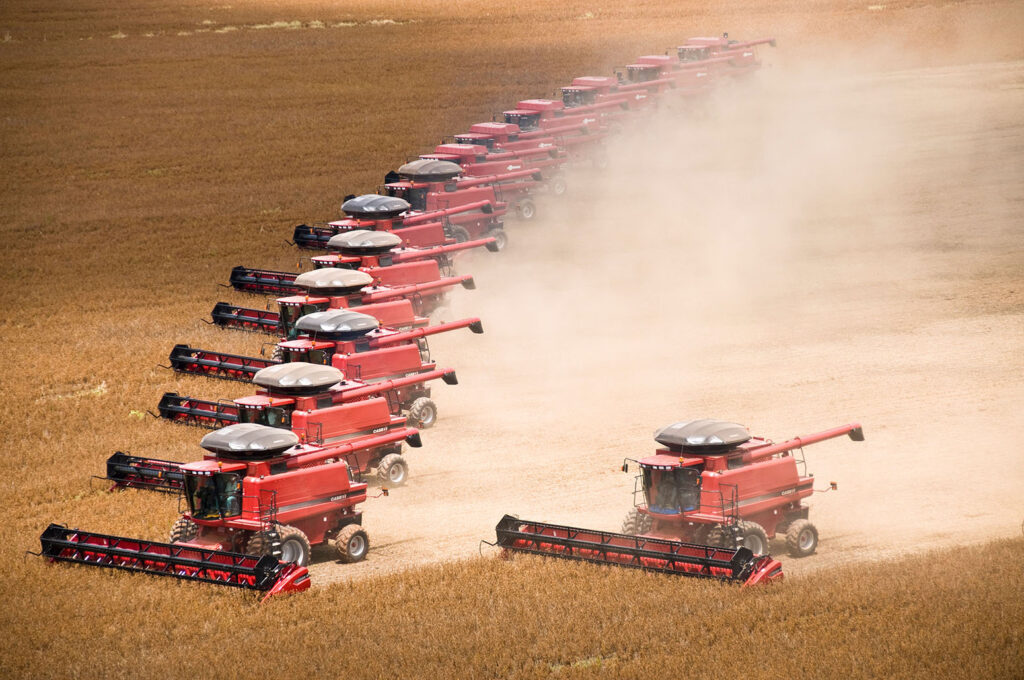
Biofuels’ impact on water resources, similarly, is highly crop- and location-specific.
For instance, growing a “thirsty” crop such as sugarcane in Brazil could have minimal impacts on local water resources, due to the region’s abundant rainfall. But in drought-prone India, experts have estimated that a litre of sugarcane ethanol requires more than 2,500 litres of water to produce and relies entirely on irrigation. Research has also found that nearly half of China’s maize crop requires irrigation to grow.
According to agricultural economist Dr Shweta Saini, meeting India’s 2025-26 biofuels target will require 275m tonnes of sugarcane, 6m tonnes of maize and 5.5m tonnes of rice. According to one 2020 study cited by Bloomberg columnist David Fickling, increasing sugarcane production to meet India’s biofuel targets “could consume an additional 348bn cubic metres of water…around twice what is used by every city” in the country.
Prof Raghuram tells Carbon Brief:
“Water resources are drying up everywhere in the country and by incentivising, through policy, a water-guzzling industry like this, we are inviting a sustainability crisis.”
‘Feedstock crunch’
Another concern surrounding biofuels is that there may not be enough supply to go around to meet rising demand. The IEA described the potential shortfall as a “feedstock supply crunch” in a 2022 report.
Fuels derived from the most commonly used waste and residues, in particular, could be approaching supply limits, the IEA warns, as these fuels satisfy both sustainability and feedstock policy objectives in the US and EU.
Consumption of vegetable oil for biofuel production is expected to soar by 46% over 2022-27, the report says. Meanwhile, the world is estimated to “nearly exhaust 100% of supplies” of used cooking oil and animal fats within the decade.
For the world to stay on a net-zero trajectory, “a more than three times production increase” would be required, the report adds. It warns that if the limited availability of second-generation feedstocks continues unchanged, “the potential for biofuels to contribute to global decarbonisation efforts could be undermined”.
The chart below shows the biofuel demand share of global crop production from 2022-27.

How are countries using biofuels to meet their climate targets?
Broadly, biofuel policies are divided into two categories.
Technology “push” policies focus on the research and development of new technologies and include measures such as research funding, pilot plants and government support for commercialising nascent technologies.
Meanwhile, market “pull” policies drive demand for existing and emerging biofuels through measures such as “biofuel blending mandates” – where countries prescribe a certain percentage of biofuel with fossil fuels – and tax breaks for producers and vehicle owners.
US
The US Renewable Fuel Standard (RFS) is the world’s largest existing biofuel programme. Its mandates are keenly watched and contested by the country’s farm and petroleum lobbies.
Under RFS, the US Environmental Protection Agency sets out minimum levels of biofuels that must be blended into the US’s transport, heating and jet fuel supplies.

Under the policy, oil refiners can either blend mandated volumes of biofuels into the nation’s fuel supply or buy credits – called Renewable Identification Numbers (RINS) – from those that do.
While the programme sets out emissions reduction targets, the environmental impacts of cropland expansion and monoculture driven by the policy have been cause for concern by experts.
According to one 2022 study, the RFS programme increased US fertiliser use by 3-8% each year between 2008-16 and caused enough domestic emissions from land-use change that the carbon intensity of corn ethanol was “no less than that of gasoline and likely at least 24% higher”. Additionally, the programme’s impacts on biodiversity have not yet been fully assessed.
In June 2025, the Trump administration announced plans to expand the biofuel mandate to a “record 24.02bn gallons” next year – an 8% increase from its 2025 target – while seeking to discourage imported biofuels.
EU
In the EU, policymakers have promoted biofuels since 2003 to reduce emissions in the transport system. As part of the EU’s Renewable Energy Directive (RED), biofuels have been explicitly linked to emissions targets.
Under the current iteration of RED (REDIII) – revised as part of the EU’s Fit for 55 package – EU countries are required to either achieve a share of 29% of renewable energy in transport or to reduce the emissions intensity of transport fuels by 14.5%. Additionally, it sets out a sub-target for “advanced biofuels” of 5.5% and excludes the use of food and feed-based biofuels in aviation and shipping.
In 2015, the European Commission acknowledged that the indirect land-use change emissions of first-generation biofuels could “fully negate” any emission savings by biofuels. The commission capped the use of first-generation biofuels in each member country at 7% of all energy used in transport by 2020, but did not announce plans to phase them out.
As of 2021, nearly 60% of all biofuels used in the EU were still made from food and feed crops, according to analysis by Oxfam. While the latest RED legislation continues to push for the use of advanced and waste biofuels, campaigners warn that a lack of clear definitions could increase the risk of “loopholes” and fraud, exacerbated by increased demand.
T&E’s Delaney tells Carbon Brief:
“You’re putting a lot of pressure on the land – you might require a lot of pesticides and irrigation – and there is not even enough land in Europe for this. How can you make sure true sustainability safeguards are in place so that you’re not actually driving additional demand for land in [biodiverse countries such as] Brazil?”
Brazil
Brazil has the world’s oldest biofuels mandate, dating back to the 1970s, established in a bid to insulate the country from expensive oil imports.
In 2017, Brazil announced a state policy called RenovaBio that set out national carbon intensity reduction targets for transport, decided biofuel mandates and created an open market for biofuel decarbonisation carbon reduction credits called CBIO.
In October 2024, Brazil enacted a “Fuels of the Future” law that replaced RenovaBio, with president Lula declaring that “Brazil will lead the world’s largest energy revolution”. The law aims to boost biofuel and sustainable aviation fuel (SAF) use, increasing biodiesel blending mandates by 1% every year starting in 2025 until it reaches 20% by March 2030.
Biofuels now account for 22% of the energy that fuels transport in Brazil and its ethanol market is “second in size only” to the US.
In June this year, Brazil announced that the country was increasing its biofuel blending mandates from 1 August in a bid to make the country “gasoline self-sufficient for the first time in 15 years”, reported Reuters.
Indonesia
As the world’s biggest palm oil producer, Indonesia has continued to raise its biodiesel blending mandates to meet its domestic energy needs.
The country first introduced mandatory biodiesel blending in 2008, at 2.5%. The mandate is currently at 40% in 2025 and, starting next year, could go up to 50% with an eventual goal of 100%.
While Indonesia’s president Prabowo Subianto has stated that implementing 50% blending could save the country $20bn in reduced diesel imports, the move would need an estimated 2.3m hectares of land, including protected forests, resulting in the “country’s largest-ever deforestation project”, according to Mongabay.
It could also compete with palm oil meant for domestic and international food markets, impacting already soaring prices and signalling the “end of cheap palm oil”.
India
India has quickly joined the ranks of major biofuel producers, due to high-level political support, policies and a diversity of feedstocks. In 2023, India launched the Global Biofuels Alliance as one of its key priorities of its G20 presidency.

Biofuel mandates are outlined in the country’s National Policy on Biofuels, first published in 2009 and subsequently amended in 2018 and 2022. In 2022, India achieved its 10% ethanol blending target ahead of schedule and is pursuing a 20% blending target by 2025, as well as a 5% biodiesel blending target by 2030.
India’s rapid biofuel push, however, has been criticised by food security experts as hunger levels rise, for its impact on endemic rainforests and, most recently, by vehicle owners for the impact of blended fuel on car engines.
Prof Raghuram says:
“From a sheer governance angle and sustainability angle, there are a lot of compromises being made to somehow push this whole thing. Even the land available in India is shrinking, as various reforms and dilution of environmental safeguards in the last 10 years have made it relatively easier to convert farm and forest land for non-agricultural purposes.”
China
China developed its first biofuel policies over 20 years ago and is one of the world’s biggest biofuel producers.
In 2017, China announced a new mandate expanding the use of fuel including bioethanol from 11 trial provinces to the entire country by 2020. However, Reuters and South China Morning Post reported that this was suspended in 2020. Only 15 provinces still maintain biofuel mandates, according to the US Department of Agriculture, which notes that a “lack of meaningful support for domestic biofuel consumption while aggressively promoting electric vehicles indicates a strategic choice to pursue transportation decarbonisation through electrification rather than liquid biofuels”.
At the same time, biofuel production in China grew by 30% in 2024, according to the Energy Institute’s Statistical Review.
While most of China’s biofuel production is grain-based, tax incentives for ethanol production have been gradually phased out and alternative biofuels have been incentivised, according to the IEA. China is currently piloting a scheme to increase biodiesel consumption at home, even as it exports biodiesel and used cooking oil to the EU and US.
How could climate change impact biofuel production?
Despite the well-documented impacts of climate change-induced extreme weather on land, agriculture and forests, there is currently little scientific literature examining how continued warming will impact global biofuel production.
One 2020 study found that bioethanol availability globally could drop – by 23% under a “very high emissions scenario” and by 4.3% under a “low emissions” scenario by 2060 – “if climate change risk is not adequately mitigated” and corn continues to be the dominant feedstock.
The study “encourages” changing out corn for switchgrass as a key source of bioethanol.

Another 2021 study examining the viability of China’s planned biofuel targets estimated that energy crop yields in China in the 2050s will decrease significantly compared to the 2010s, due to the impacts of climate change.
It found that climate change is expected to have a “substantial impact” on the land available for biofuel production in the 2050s, under both scenarios used in the study.
Gurgel, from MIT, tells Carbon Brief that it is “very hard to take into account how much climate change will damage bio-energy production” at this point, given the uncertainty of what emissions pathway the world will follow.
While most climate models “do a very good job” at forecasting average temperature change in the future, they do an “average job” at projecting rainfall change, or how many extreme weather events countries will see in the future, he says.
This is important because many biofuel crops, such as sugarcane and palm oil, are water-intensive and thrive in regions with abundant rainfall, but yields may fail in drier parts of the world that could see more drought.
Given this “cascade of uncertainties”, he continues, “we don’t have a clear picture of how bad the future [of agriculture] will be – we just know it will be more challenging than today”.
Delaney, meanwhile, asks whether investing in biofuels, which will be impacted by climate change, is a “good investment” for the long term. He tells Carbon Brief:
“I think these are the questions that we need to ask ourselves when we see – not just in India, but Indonesia, Brazil, everywhere around the world right now – this growing appetite for biofuels. Can we really keep the promises that we made at the end of the day?”
The post Q&A: How countries are using biofuels to meet their climate targets appeared first on Carbon Brief.
Q&A: How countries are using biofuels to meet their climate targets
Greenhouse Gases
Analysis: Fossil-fuel CO2 emissions to set new record in 2025, as land sink ‘recovers’
Carbon dioxide (CO2) emissions from fossil fuels and cement will rise around 1.1% in 2025, reaching a record 38.1bn tonnes of CO2 (GtCO2), according to the latest figures from the Global Carbon Project.
However, falling land-use emissions means that global CO2 emissions in 2025 will remain relatively unchanged compared to 2024 levels.
The 20th edition of the annual Global Carbon Budget report, published today, also finds that the land carbon sink – the portion of human-caused CO2 emissions absorbed by plants and soils – appears to have recovered to its pre-El Niño strength after two unusually weak years.
However, research published alongside the report by the same team also suggests that climate change has caused a long-term decline in land and ocean carbon sinks, with sinks being about 15% weaker over the past decade than they would have been without climate impacts.
The study, published in Nature, finds that the decline of carbon sinks has contributed about 8% to the rise in atmospheric CO2 concentration since 1960.
The 2025 Global Carbon Budget report also estimates that:
- Emissions in China and India are projected to grow much less in 2025 compared to the past decade, while emissions in the US and EU are projected to grow this year after years of decline.
- Global CO2 emissions from land-use change are expected to decrease by nearly 10% in 2025, driven by reductions in deforestation and forest degradation in South America.
- Total CO2 emissions – fossil and land use – have grown more slowly over the past decade (0.3% per year on average) compared to the previous decade (1.9% per year).
- The remaining carbon budget to limit global warming to 1.5C is virtually exhausted and is equivalent to only four years of current emissions. Carbon budgets to limit warming to 1.7C and 2C would similarly be used up in 12 and 25 years, respectively.
- The concentration of CO2 in the atmosphere is set to reach 425.7 parts per million (ppm) in 2025, 2.3ppm above 2023 and 52% above pre-industrial levels.
(For detailed coverage of previous editions of the report, see Carbon Brief’s coverage for 2024, 2023 and 2022.)
Global emissions remain flat
The Global Carbon Budget (GCB) finds that total global CO2 emissions in 2025 – including those from fossil fuels and land use – are projected to remain approximately flat at 42.2GtCO2, falling by a negligible -0.04% compared to last year.
This means 2025 is effectively tied with 2024 as the highest global CO2 emissions on record.
Flat total CO2 emissions in 2025 reflect a combination of continued rising emissions from fossil fuel and industry and declining emissions from land-use change. Fossil CO2 emissions rose 1.1% to 38.1GtCO2, while land-use emissions declined by -9.8% to 4.1GtCO2 (albeit with large uncertainties).
The figure below shows the 2025 global CO2 emissions update (red solid line) alongside 2024 (dark blue dotted), 2023 (mid blue dotted) 2022 (light blue dotted), 2021 (light grey dotted) and 2020 (dark grey dotted). The shaded area indicates the uncertainty around the new 2025 budget.
(Each year, the GCB is updated to include the latest data as well as improvements to modelling sources and sinks, resulting in some year-to-year revisions to the historical record.)

The 2025 figures are notably higher than those in the prior five GCB reports, reflecting an upward revision in historical land-use emissions. (This is discussed in more detail in the land-use emissions section below.)
Total global CO2 emissions have notably flattened in the past decade (2014-25), growing at only 0.3% per year compared to the 1.9% rate of growth during the prior decade (2004-13) and the longer-term average growth rate of 1.6% over 1959-2014.
This apparent flattening is due to declining land-use emissions compensating for continued – but slow – increases in fossil CO2 emissions. Fossil emissions grew around 0.2GtCO2 per year over the past decade, while land-use emissions decreased by a comparable amount.
However, despite the emissions plateau, there is still no sign of the rapid and deep decrease in CO2 emissions needed to reach net-zero and stabilise global temperatures in-line with the Paris Agreement temperature goal.
If global emissions remain at current levels, the remaining carbon budget to limit warming to 1.5C (with a 50% chance) will be rapidly exhausted.
(The carbon budget is the total amount of CO2 that scientists estimate can be emitted if warming is to be kept below a particular temperature threshold. Earlier this year, the Indicators of Global Climate Change report estimated the remaining carbon budget had declined by three-quarters between the start of 2020 and the start of 2025.)
With human-caused global warming sitting at around 1.36C above pre-industrial levels in 2024, the remaining budget for 1.5C is 170GtCO2, equivalent to four years of current emissions.
The GCB report finds that the remaining carbon budgets to limit warming to 1.7C and 2C have been reduced to 525GtCO2 (12 years at current emissions levels) and 1,055GtCO2 (25 years), respectively.
Global fossil CO2 emissions also grew more slowly in the past decade (0.8% per year) compared to the previous decade (2.1%). This was driven by the continued decarbonisation of energy systems – including a shift from burning coal to gas and replacing fossil fuels with renewables – as well as slightly weaker global economic growth during the past decade.
The figure below breaks down global emissions (dark blue line) in the 2025 budget into fossil (mid blue) and land-use (light blue) components. Fossil CO2 emissions represent the bulk of total global emissions in recent years, accounting for approximately 90% of emissions in 2025 (compared to 10% for land use). This represents a large change from the first half of the 20th century, when land-use emissions were approximately the same as fossil emissions.
Global fossil emissions include CO2 emitted from burning coal, oil and gas, as well as the production of cement. However, to determine total fossil emissions, the Global Carbon Budget also subtracts the cement carbonation sink – CO2 slowly absorbed by cement once it is exposed to the air – from fossil emissions.

Global emissions can also be expressed on a per-capita basis, as shown in the figure below.
While it is ultimately total global emissions that matter for the Earth’s climate – and a global per-capita figure glosses over a lot of variation among, and within, countries – it is noteworthy that global per-capita fossil emissions peaked in 2012 and have been slightly declining in the years since.

Land-use emissions continue downward trend
Global land-use emissions stem from deforestation, forest degradation, loss of peatlands and harvesting trees for wood. They averaged around 5.0GtCO2 over the past decade (2015-24) and the Global Carbon Budget provides an initial projection for 2025 of 4.1GtCO2.
This represents a 0.5GtCO2 decrease in land-use emissions relative to 2024. The GCB report suggests that this was largely driven by a combination of reductions in deforestation and forest degradation in South America and by the end of the dry 2023-24 El Niño conditions.
Overall, land-use emissions have decreased by around 32% compared to their average in the 2000s, with a particularly large drop in the past decade. This decline is statistically significant and is due both to decreasing deforestation and increasing levels of reforestation and afforestation globally.
Three countries – Brazil, Indonesia and the Democratic Republic of the Congo (DRC) – collectively contribute approximately 57% of the global land-use emissions. In the past, China has been a meaningful contributor to land-use emissions, but in recent years its land-use emissions have turned net-negative as more trees have been planted than cut down.
The figure below shows changes in emissions over time in these countries, as well as land-use emissions in the rest of the world (grey).

Historical land-use emissions have been revised upward in the 2025 GCB report compared to prior estimates. This reflects a combination of two factors:
- The discontinuation of one of the four bookkeeping models that GCB has historically relied on for land-use emissions estimates. This model tended to show lower land-use emissions than the others.
- The inclusion of the impacts from CO2 fertilisation on global biomass densities. Because forests have higher biomass densities now than in the past, due to increasing CO2, this tends to increase the estimate of land-use emissions for recent years.
Fossil-fuel CO2 hits record highs
Global emissions of fossil CO2 – including coal, oil, gas and cement – increased by around 1.1% in 2025, relative to 2024, with an uncertainty range of 0.2-2.2%. This represents a new record high and surpasses the prior record set in 2024.
The figure below shows global CO2 emissions from fossil fuels, divided into emissions from major emitting countries including China (dark blue shading), the US (mid blue), the EU (light blue), India (light blue) and the remainder of the world (grey).

China represents 32% of global CO2 emissions today. Its 2025 emissions are projected to increase by a relatively small 0.4% (with an uncertainty range of -0.9% to 2%), driven by a small rise in emissions from coal (0.3%), a modest rise in gas (1.3%) and a larger rise in oil (2.1%).
Given the uncertainty range, a decrease in Chinese emissions is also a possibility, but this will not be confirmed until the full 2025 data is available.
Similarly, recent analysis for Carbon Brief found that China’s emissions were “finely balanced between a small fall or rise” in 2025. However, it said that a drop in the full-year total became more likely after a 3% decline in September. (The Global Carbon Project estimates are based on data covering January through to August, which point towards a small rise in 2025.)
Whether China’s emissions see small rise or fall in 2025, the outcome will be due to moderate growth in energy consumption combined with an extraordinary growth in renewable power generation. This would represent the second year in a row where Chinese emissions growth was well below the average rate over the past decade.
The US represents 13% of global emissions and emissions in 2025 are projected to increase by 1.9% (-0.2 to +4.1%) compared with 2024. This marks a reversal from recent trends in declining CO2 emissions.
The projected growth of emissions in the US is likely driven by a combination of three factors: a colder start to the year after a mild 2024, which led to greater heating requirements, higher gas prices, which led to more coal being used in power generation, as well as an increase in total demand for electricity.
US emissions from coal are expected to increase by a substantial 7.5% in 2025, emissions from both oil and gas by a more modest 1.1% and emissions from cement to fall by -8.0%.
While policies enacted by the current US administration may increase CO2 emissions going forward, their impact on national emissions levels in 2025 were likely relatively modest compared to other factors.
India represents 8% of global emissions. In 2025, its emissions are projected to increase by 1.4% (-0.3% to +3.1%) on 2024 levels, significantly below recent trends.
An early monsoon with the highest-ever May rainfall substantially reduced cooling requirements in May and June, the hottest months of the year. Strong growth or renewables – particularly solar – has also helped limit the growth of Indian emissions.
Indian emissions from coal are expected to grow 1.7%, with oil growing 0.1%, gas shrinking by -6.4% and cement growing by 9.9%.
The EU represents 6% of global emissions. Its emissions are projected to increase by 0.4% in 2025, with an uncertainty range of -2.1 to +2.8%. This represents a divergence from a past decline in emissions (albeit with large uncertainties).
EU emissions from coal are expected to decline by -0.3%, whereas emissions from oil and gas are projected to increase by 0.6% and 0.9%, respectively. Cement emissions are expected to fall by -4.1%.
The increase in EU emissions is in part from weather-related low hydropower and wind generation which – despite increases in solar – have led to an increase in electricity generation from gas. In addition, a relatively cold February led to increased use of natural gas for space heating.
International aviation and shipping (included in the “rest of world” in the chart above) are responsible for 3% of global emissions. They are projected to increase by 6.8% for aviation, but remain flat for international shipping. This year will be the first time that aviation emissions have exceeded pre-Covid levels.
The rest of the world (excluding aviation) represents 38% of global emissions. Emissions are expected to grow by 1.1% in 2025 (ranging from -1.1% to +3.3%), with increases in emissions from coal (1%), oil (0.5%), gas (1.8%) and cement (2.4%).
The total emissions for each year over 2022-25, as well as the countries and regions that were responsible for the changes in absolute emissions, are shown in the figure below.
Annual emissions for 2022, 2023, 2024 and estimates for 2025 are shown by the black bars. The smaller bars show the change in emissions between each set of years, broken down by country or region – the US (dark blue), EU (mid blue), China (light blue), India (pale blue) and the rest of the world (grey). Negative values show reductions in emissions, while positive values reflect emission increases.

The US represented a large part of the rise in global fossil-fuel emissions in 2025. US emissions increases over 2024-25 contributed about 40% of the total global increase – more than the EU, China and India contributions combined.
The Global Carbon Project notes that emissions have declined over the past decade (2015-24) in 35 nations, which collectively account for 27% of global emissions. This is up from 18 countries during the prior decade (2005-14).
The decrease in emissions in those countries comes despite continued domestic economic growth and represents a long-term “decoupling” of CO2 emissions and the economy.
The carbon intensity of energy has consistently decreased over the past decade in China, the US, the EU – and, to a lesser extent, globally.
However, peaking CO2 emissions requires that the rate of decarbonisation exceeds the growth in energy demand. This has happened in some regions, including the US and EU, but not yet globally.
Modest growth in emissions from coal, oil, gas and cement
Global fossil-fuel emissions primarily result from the combustion of coal, oil and gas.
In 2025, coal is responsible for more emissions than any other fossil fuel, representing approximately 42% of global fossil-fuel CO2 emissions. Oil is the second largest contributor at 33% of fossil CO2, while gas comes in at 21%.
The production of cement is responsible for around 3.8% of global emissions, but this is reduced to 1.9% once the carbonation sink – the drawdown of atmospheric CO2 by concrete – is taken into account.
These percentages reflect both the amount of each fossil fuel consumed globally, but also differences in CO2 intensities. Coal results in the most CO2 emitted per unit of heat or energy produced, followed by oil and gas.
The figure below shows global CO2 emissions from different fuels over time, covering coal (dark blue), oil (mid blue) and gas (light blue), as well as cement production (pale blue) and other sources (grey).
While coal emissions increased rapidly in the mid-2000s, they have largely flattened since 2013. However, coal use increased significantly in 2021 and then more modestly in the subsequent four years.

Global emissions from coal increased by 0.8% in 2025 compared to 2024, while oil emissions increased 1.0% and gas emissions increased by 1.3%.
Despite setting a new record this year, global coal use is only 6% above 2013 levels – a full 13 years ago. By contrast, during the 2000s, global coal use grew at a rate of around 4% every single year.
The figure below shows the total emissions for each year over 2022-25 (black bars), as well as the absolute change in emissions for each fuel between years.

Global oil emissions were suppressed for a few years after the 2020, but rebounded to pre-pandemic levels as of 2024 and have continued to grow in 2025.
This reflects that, despite falling sales of internal combustion engine vehicles, not enough electric vehicles (EVs) have yet been sold to result in peak oil demand.
The global carbon budget
Every year, the Global Carbon Project provides an estimate of the overall “global carbon budget”. This is based on estimates of the release of CO2 through human activity and its uptake by the oceans and land, with the remainder adding to atmospheric concentrations of the gas.
(This differs from the commonly used term “remaining carbon budget”, which refers to the amount of CO2 that can be released while keeping warming below global limits of 1.5 or 2C.)
The most recent budget, including estimated values for 2025, is shown in the figure below.
Values above zero represent sources of CO2 – from fossil fuels and industry (dark blue shading) and land use (mid blue) – while values below zero represent carbon sinks that remove CO2 from the atmosphere. Any CO2 emissions that are not absorbed by the oceans (light grey) or land vegetation (mid grey) accumulate in the atmosphere (dark grey). In addition, a dashed black line is shown to represent the expected sum of sinks based on estimated emissions.

Over the past decade (2015-24), the world’s oceans have taken up approximately 29% of total human-caused emissions, or around 11.8GtCO2 per year.
The ocean CO2 sink has been relatively flat since 2014 after growing rapidly over the prior decades, reflecting the flattening of global emissions during that period.
This estimate for carbon sinks has been revised up from 26% in prior versions of the GCB, reflecting a major update to carbon budgets driven by new data and modelling of carbon sink behavior.
The land sink takes up around 21% of global emissions, or 8.7GtCO2 per year on average over the past decade – discussed in more detail in the section below. This is down from 29% in prior budgets.
The atmosphere continues to accumulate the bulk of human-caused CO2 emissions, with about 49% going into the atmosphere on average over the past decade – a rate of 20.4GtCO2 per year.
The growth rate of atmospheric CO2 in 2025 is expected to be around 2.3ppm, which is a bit below the decadal average rate of 2.6ppm over the past decade (2015-24). This is well below the record-setting rise of 3.7ppm in 2024, which was primarily driven by the effect of the 2023-24 El Niño conditions weakening the land sink.
Atmospheric CO2 concentrations are set to reach an annual average of 425.7ppm in 2025, representing an increase of 52% above pre-industrial levels of 280ppm.
There remains an unusual imbalance in the carbon budget in 2024, where the sum of the sinks is notably larger than estimated emissions. This can be seen in the figure above, where the dashed line is below the shaded area.
Budget imbalances are not unprecedented – there are large uncertainties in both emissions data and sink estimates. But the rise in the amount of CO2 accumulating in the atmosphere in 2024 is larger than would be expected based on emissions.
There are a number of potential explanations for this 2024 imbalance. The land cover data for 2024 is not yet complete and it is possible that some fire emissions data might be missing from the record. This might result in either higher land-use emissions or lower land sinks than currently estimated.
Alternatively, it could be due to the CO2 growth rate – captured by surface stations managed by the US National Atmospheric and Oceanic Administration (NOAA) – being slightly high. CO2 records for 2024 from these stations are higher than those obtained from satellite-based sensors, though it remains unclear which provides the most accurate measurement.
A declining, but not collapsing, land sink
After an usually weak land carbon sink in 2023, there were a number of media articles about its potential collapse.
For example, in October 2024, the Guardian wrote that “the sudden collapse of carbon sinks was not factored into climate models – and could rapidly accelerate global heating”.
The truth is a bit more complicated. While the impending collapse of the land carbon sink has been greatly exaggerated, there is growing evidence of a long-term weakening of both the land and ocean carbon sinks due to human activity.
And while the land sink has recovered to its pre-El Niño strength in 2025, aided by relatively low global fire CO2 emissions, it will continue to gradually weaken as global temperatures rise. This is not unexpected – scientists have long foreseen a weaker carbon sink in a warmer world.
A weaker land sink will contribute to higher global temperatures in the future as more CO2 emissions from burning fossil fuels and land use change will accumulate in the atmosphere.
The figure below shows the percentage of human emissions absorbed by the land sink in every year since 1959, with a recovery upwards in 2025 after two relatively low years.

In a study published in Nature alongside the release of the 2025 Global Carbon Budget, the same team of researchers provide a detailed estimate of exactly how the land and ocean sinks have changed as a result of human activity.
The research finds that the land and ocean sinks are 25% smaller and 7% smaller, respectively, than they would have been without the effects of climate change over 2015-24.
This amounts to a nearly 20% reduction in the efficacy of current global carbon sinks – that is, both the land and ocean – and a 15% reduction compared to how large they would be without the effects of climate change.
The figure below, from the new paper, shows the impact of climate change on the ocean sink (blue), the land sink (green) and atmospheric CO2 concentrations (grey) since 1960.

The weakening of carbon sinks due to human activity has led to an increase of atmospheric CO2 of more than 8ppm since 1960. The combined effects of climate change and deforestation have turned tropical forests in south-east Asia and in large parts of South America from CO2 sinks to sources.
And these sinks will likely continue to weaken as long as atmospheric CO2 concentrations continue to rise and the world continues to warm. There are a wide range of estimates of carbon cycle feedbacks among climate models, but a large carbon cycle feedback could result in a few tenths of a degree of future warming.
The post Analysis: Fossil-fuel CO2 emissions to set new record in 2025, as land sink ‘recovers’ appeared first on Carbon Brief.
Analysis: Fossil-fuel CO2 emissions to set new record in 2025, as land sink ‘recovers’
Greenhouse Gases
IEA: Fossil-fuel use will peak before 2030 – unless ‘stated policies’ are abandoned
The world’s fossil-fuel use is still on track to peak before 2030, despite a surge in political support for coal, oil and gas, according to data from the International Energy Agency (IEA).
The IEA’s latest World Energy Outlook 2025, published during the opening days of the COP30 climate summit in Brazil, shows coal at or close to a peak, with oil set to follow around 2030 and gas by 2035, based on the stated policy intentions of the world’s governments.
Under the same assumptions, the IEA says that clean-energy use will surge, as nuclear power rises 39% by 2035, solar by 344% and wind by 178%.
Still, the outlook has some notable shifts since last year, with coal use revised up by around 6% in the near term, oil seeing a shallower post-peak decline and gas plateauing at higher levels.
This means that the IEA expects global warming to reach 2.5C this century if “stated policies” are implemented as planned, up marginally from 2.4C in last year’s outlook.
In addition, after pressure from the Trump administration in the US, the IEA has resurrected its “current policies scenario”, which – effectively – assumes that governments around the world abandon their stated intentions and only policies already set in legislation are continued.
If this were to happen, the IEA warns, global warming would reach 2.9C by 2100, as oil and gas demand would continue to rise and the decline in coal use would proceed at a slower rate.
This year’s outlook also includes a pathway that limits warming to 1.5C in 2100, but says that this would only be possible after a period of “overshoot”, where temperature rise peaks at 1.65C.
The IEA will publish its “announced pledges scenario” at a later date, to illustrate the impact of new national climate pledges being implemented on time and in full.
(See Carbon Brief’s coverage of previous IEA world energy outlooks from 2024, 2023, 2022, 2021, 2020, 2019, 2018, 2017, 2016 and 2015.)
World energy outlook
The IEA’s annual World Energy Outlook (WEO) is published every autumn. It is regarded as one of the most influential annual contributions to the understanding of energy and emissions trends.
The outlook explores a range of scenarios, representing different possible futures for the global energy system. These are developed using the IEA’s “global energy and climate model”.
The latest report stresses that “none of [these scenarios] should be regarded as a forecast”.
However, this year’s outlook marks a major shift in emphasis between the scenarios – and it reintroduces a pathway where oil and gas demand continues to rise for many decades.
This pathway is named the “current policies scenario” (CPS), which assumes that governments abandon their planned policies, leaving only those that are already set in legislation.
If the world followed this path, then global temperatures would reach 2.9C above pre-industrial levels by 2100 and would be “set to keep rising from there”, the IEA says.
The CPS was part of the annual outlook until 2020, when the IEA said that it was “difficult to imagine” such a pathway “prevailing in today’s circumstances”.
It has been resurrected following heavy pressure from the US, which is a major funder of the IEA that accounts for 14% of the agency’s budget.
For example, in July Politico reported “a ratcheted-up US pressure campaign” and “months of public frustrations with the IEA from top Trump administration officials”. It noted:
“Some Republicans say the IEA has discouraged investment in fossil fuels by publishing analyses that show near-term peaks in global demand for oil and gas.”
The CPS is the first scenario to be discussed in detail in the report, appearing in chapter three. The CPS similarly appears first in Annex A, the data tables for the report.
The second scenario is the “stated policies scenario” (STEPS), featured in chapter four of this year’s outlook. Here, the outlook also includes policies that governments say they intend to bring forward and that the IEA judges as likely to be implemented in practice.
In this world, global warming would reach 2.5C by 2100 – up marginally from the 2.4C expected in the 2024 edition of the outlook.
Beyond the STEPS and the CPS, the outlook includes two further scenarios.
One is the “net-zero emissions by 2050” (NZE) scenario, which illustrates how the world’s energy system would need to change in order to limit warming in 2100 to 1.5C.
The NZE was first floated in the 2020 edition of the report and was then formally featured in 2021.
The report notes that, unlike in previous editions, this scenario would see warming peak at more than 1.6C above pre-industrial temperatures, before returning to 1.5C by the end of the century.
This means it would include a high level of temporary “overshoot” of the 1.5C target. The IEA explains that this results from the “reality of persistently high emissions in recent years”. It adds:
“In addition to very rapid progress with the transformation of the energy sector, bringing the temperature rise back down below 1.5C by 2100 also requires widespread deployment of CO2 removal technologies that are currently unproven at large scale.”
Finally, the outlook includes a new scenario where everyone in the world is able to gain access to electricity by 2035 and to clean cooking by 2040, named “ACCESS”.
While the STEPS appears second in the running order of the report, it is mentioned slightly more frequently than the CPS, as shown in the figure below. The CPS is a close second, however, whereas the IEA’s 1.5C pathway (NZE) receives a declining level of attention.

US critics of the IEA have presented its stated policies scenario as “disconnected from reality”, in contrast to what they describe as the “likely scenario” of “business as usual”.
Yet the current policies scenario is far from a “business-as-usual” pathway. The IEA says this explicitly in an article published ahead of the outlook:
“The CPS might seem like a ‘business-as-usual’ scenario, but this terminology can be misleading in an energy system where new technologies are already being deployed at scale, underpinned by robust economics and mature, existing policy frameworks. In these areas, ‘business as usual’ would imply continuing the current process of change and, in some cases, accelerating it.”
In order to create the current policies scenario, where oil and gas use continues to surge into the future, the IEA therefore has to make more pessimistic assumptions about barriers to the uptake of new technologies and about the willingness of governments to row back on their plans. It says:
“The CPS…builds on a narrow reading of today’s policy settings…assuming no change, even where governments have indicated their intention to do so.”
This is not a scenario of “business as usual”. Instead, it is a scenario where countries around the world follow US president Donald Trump in dismantling their plans to shift away from fossil fuels.
More specifically, the current policies scenario assumes that countries around the world renege on their policy commitments and fail to honour their climate pledges.
For example, it assumes that Japan and South Korea fail to implement their latest national electricity plans, that China fails to continue its power-market reforms and abandons its provincial targets for clean power, that EU countries fail to meet their coal phase-out pledges and that US states such as California fail to extend their clean-energy targets.
Similarly, it assumes that Brazil, Turkey and India fail to implement their greenhouse gas emissions trading schemes (ETS) as planned and that China fails to expand its ETS to other industries.
The scenario also assumes that the EU, China, India, Australia, Japan and many others fail to extend or continue strengthening regulations on the energy efficiency of buildings and appliances, as well as those relating to the fuel-economy standards for new vehicles.
In contrast to the portrayal of the stated policies scenario as blindly assuming that all pledges will be met, the IEA notes that it does not give a free pass to aspirational targets. It says:
“[T]argets are not automatically assumed to be met; the prospects and timing for their realisation are subject to an assessment of relevant market, infrastructure and financial constraints…[L]ike the CPS, the STEPS does not assume that aspirational goals, such as those included in the Paris Agreement, are achieved.”
Only in the “announced pledges scenario” (APS) does the IEA assume that countries meet all of their climate pledges on time and full – regardless of how credible they are.
The APS does not appear in this year’s report, presumably because many countries missed the deadlines to publish new climate pledges ahead of COP30.
The IEA says it will publish its APS, assessing the impact of the new pledges, “once there is a more complete picture of these commitments”.
Fossil-fuel peak
In recent years, there has been a significant shift in the IEA’s outlook for fossil fuels under the stated policies scenario, which it has described as “a mirror to the plans of today’s policymakers”.
In 2020, the agency said that prevailing policy conditions pointed towards a “structural” decline in global coal demand, but that it was too soon to declare a peak in oil or gas demand.
By 2021, it said global fossil-fuel use could peak as soon as 2025, but only if all countries got on track to meet their climate goals. Under stated policies, it expected fossil-fuel use to hit a plateau from the late 2020s onwards, declining only marginally by 2050.
There was a dramatic change in 2022, when it said that Russia’s invasion of Ukraine and the resulting global energy crisis had “turbo-charged” the shift away from fossil fuels.
As a result, it said at the time that it expected a peak in demand for each of the fossil fuels. Coal “within a few years”, oil “in the mid-2030s” and gas ”by the end of the decade”.
This outlook sharpened further in 2023 and, by 2024, it was saying that each of the fossil fuels would see a peak in global demand before 2030.
This year’s report notes that “some formal country-level [climate] commitments have waned”, pointing to the withdrawal of the US from the Paris Agreement.
The report says the “new direction” in the US is among “major new policies” in 48 countries. The other changes it lists include Brazil’s “energy transition acceleration programme”, Japan’s new plan for 2040 and the EU’s recently adopted 2040 climate target.
Overall, the IEA data still points to peaks in demand for coal, oil and gas under the stated policies scenario, as shown in the figure below.
Alongside this there is a surge in clean technologies, with renewables overtaking oil to become the world’s largest source of energy – not just electricity – by the early 2040s.

In this year’s outlook under stated policies, the IEA sees global coal demand as already being at – or very close to – a definitive peak, as the chart above shows.
Coal then enters a structural decline, where demand for the fuel is displaced by cheaper alternatives, particularly renewable sources of electricity.
The IEA reiterates that the cost of solar, wind and batteries has respectively fallen by 90%, 70% and 90% since 2010, with further declines of 10-40% expected by 2035.
(The report notes that household energy spending would be lower under the more ambitious NZE scenario than under stated policies, despite the need for greater investment.)
However, this year’s outlook has coal use in 2030 coming in some 6% higher than expected last year, although it ultimately declines to similar levels by 2050.
For oil, the agency’s data still points to a peak in demand this decade, as electric vehicles (EVs) and more efficient combustion engines erode the need for the fuel in road transport.
While this sees oil demand in 2030 reaching similar levels to what the IEA expected last year, the post-peak decline is slightly less marked in the latest outlook, ending some 5% higher in 2050.
The biggest shift compared with last year is for gas, where the IEA suggests that global demand will keep rising until 2035, rather than peaking by 2030.
Still, the outlook has gas demand in 2030 being only 7% higher than expected last year. It notes:
“Long-term natural gas demand growth is kept lower than in recent decades by the expanding deployment of renewables, efficiency gains and electrification of end-uses.”
In terms of clean energy, the outlook sees nuclear power output growing to 39% above 2024 levels by 2035 and doubling by 2050. Solar grows nearly four-fold by 2035 and nearly nine-fold by 2050, while wind power nearly triples and quadruples over the same periods.
Notably, the IEA sees strong growth of clean-energy technologies, even in the current policies scenario. Here, renewables would still become the world’s largest energy source before 2050.
This is despite the severe headwinds assumed in this scenario, including EVs never increasing from their current low share of sales in India or the US.
The CPS would see oil and gas use continuing to rise, with demand for oil reaching 11% above current levels by 2050 and gas climbing 31%, even as renewables nearly triple.
This means that coal use would still decline, falling to a fifth below current levels by 2050.
Finally, while the IEA considers the prospect of global coal demand continuing to rise rather than falling as expected, it gives this idea short shrift. It explains:
“A growth story for coal over the coming decades cannot entirely be ruled out but it would fly in the face of two crucial structural trends witnessed in recent years: the rise of renewable sources of power generation, and the shift in China away from an especially coal-intensive model of growth and infrastructure development. As such, sustained growth for coal demand appears highly unlikely.”
The post IEA: Fossil-fuel use will peak before 2030 – unless ‘stated policies’ are abandoned appeared first on Carbon Brief.
IEA: Fossil-fuel use will peak before 2030 – unless ‘stated policies’ are abandoned
Greenhouse Gases
Analysis: Which countries have sent the most delegates to COP30?
For the first time in the history of COP climate summits, the US – the world’s largest historical emitter – has not sent a delegation to the talks.
Back in January, newly inaugurated US president Donald Trump signed a letter to the UN to trigger the start of a US withdrawal from the Paris Agreement for a second time.
Although this process is not yet complete, the White House confirmed earlier this month that no “high-level officials” would be attending COP30 in Belém, Brazil.
The US joins Afghanistan, Myanmar and San Marino as the only countries not registering a delegation for the summit, according to Carbon Brief’s analysis of the provisional lists of delegates published by the United Nations Framework Convention on Climate Change (UNFCCC).
Despite these absences, more than 56,000 delegates have signed up to COP30, provisionally placing the summit as one of the largest in COP history.
This is despite the run-up to the negotiations being dogged by reports of a shortage of beds and “sky-high” accommodation costs.
Brazil even offered free cabins on cruise ships moored in Belém to delegations from low-income nations who were otherwise unable to attend.
According to the provisional figures, 193 countries, plus the European Union, have registered a delegation for the summit.
Unsurprisingly, the largest delegation comes from COP30 hosts Brazil, with 3,805 people registered.
This is followed, in order, by China, Nigeria, Indonesia and the Democratic Republic of the Congo.
This year also sees the largest number of “virtual” delegates, with more than 5,000 people signed up to attend the talks online.
Party delegations
With 56,118 delegates registered, COP30 is provisionally the second-largest COP in history, behind only COP28 in Dubai, which was attended by more than 80,000 people.
This is the provisional total, based on the delegates that have registered to be at the summit in person. At recent COPs, the final total is at least 10,000 lower, which would drop COP30 down to the fourth largest.
(The UNFCCC releases the final figures – based on participants collecting a physical badge at the venue – after the summit has closed.)
The chart below shows how the provisional figures for COP30 compare to the final totals in past COPs – going back to COP1 in Berlin in 1995.

The participant lists provided by the UNFCCC are divided between the different types of groups and organisations attending the summit. The largest group at COP30 is for delegates representing parties. These are nation states, plus the European Union, that have ratified the convention and play a full part in negotiations.
This group adds up to 11,519 delegates – the fourth largest behind the past three COPs.
(In keeping with recent COPs, the UNFCCC has published spreadsheets that name every single person that has registered for the summit – excluding support staff. Previously, COPs have typically included thousands of “overflow” participants in which countries and UN agencies could nominate delegates without their names appearing on their official lists.)
For consistency with Carbon Brief’s analysis of previous COPs, the above chart includes overflow delegates as a single group. However, the participant lists do divide the overflow delegates between parties and observer groups. Including the overflow numbers approximately doubles the total for party representatives to 23,509.
US no-show
Overall, of the 198 parties to the UNFCCC, 194 have registered delegations for COP30.
The most notable absentee is the US, which has been present at every other COP in history – even throughout Donald Trump’s first presidency.
On average, the US sends a delegation of around 100 people, typically making it one of the larger groups at the talks.
The absent parties – Afghanistan, Myanmar and San Marino – have been more sporadic attendees at past COPs.
Despite reports of a “logistical nightmare” hosting a COP summit in the Amazon, there has been no drop-off in the number of countries registering delegations for COP30.
In addition to hotel rooms and rental properties in Belém, beds have been made available on cruise ships, in converted shipping containers and in motels that Reuters primly described as being typically “aimed at amorous couples”.
Reports suggested that many developing nations considered scaling back their presence at COP30, with smaller delegations or attendees only coming for a few days.
While the average party delegation size of 59 (excluding overflows) is lower than the previous two COPs, it is similar to the average in COP26 in Glasgow and COP27 in Sharm el-Sheikh.
The map and table below present the delegation size – split between party and overflow badges – for all the countries registered for COP30. The darker the shading, the more delegates that country has signed up. Use the search box to find the data for a specific party.
The largest delegation comes from host country Brazil, with 3,805 people registered. China (789) and Nigeria (749) follow with the second- and third-largest, respectively.
Making up the rest of the top 10 are Indonesia (566), the Democratic Republic of the Congo (556), France (530), Chad (528), Australia (494), Tanzania (465) and Japan (461).
The UK comes someway down the list with a delegation of 210.
(It is worth noting that some countries – such as Brazil – allocate some of their party badges to NGOs, which can artificially inflate the size of their official delegation.)
The smallest delegation is the one person registered to represent Nicaragua. There are five delegations of two people (North Korea, Latvia, Liechtenstein, Saint Vincent and the Grenadines and Slovakia).
Ahead of COP30, Latvia's climate minister, told Reuters that the country had asked if its negotiators could dial into the summit by video call. However, Latvia does not appear to have registered any delegates to attend virtually.
In total, 40 parties registered virtual delegates. Party totals are all in single figures apart from the Philippines (31), Costa Rica (21) and Turkey (16).
Changing gender balance
The UNFCCC’s participant lists typically provide a title – such as Mr, Ms, Sr or Sra – for each registered delegate. In the past, this has allowed Carbon Brief to work out the balance of men to women in the delegations that each country has sent to a COP.
(This analysis always carries the caveat that the titles are designated by UNFCCC and not by Carbon Brief. In addition, Carbon Brief recognises that gender is not best categorised using a binary “man” or “woman” label and appreciates that the UNFCCC’s lists may not be wholly accurate.)
Overall, the COP30 provisional list suggests an average gender balance of party delegations of 57% men to 43% women.
As the chart below shows, this makes COP29 the most balanced COP in history. For consistency, the COP28, COP29 and COP30 figures only include those on party badges, not overflow ones.
(Note: Since COP28 last year, the UNFCCC has also used titles that do not indicate gender – such as Dr, Prof, Ambassador and Honourable. Therefore, for this analysis, these non-gendered titles – which make up 1% of all the people at COP30, for example – have not been included.)

There are four party delegations this year that are all men – Tuvalu (three delegates), Niger (three), North Korea (two) and Nicaragua (one) – and one that is all women (Nauru, with five delegates).
The full list of COP30 party delegation sizes can be found here.
(For previous COPs, see Carbon Brief’s delegate analysis for COP21, COP23, COP24, COP25, COP26, COP27, COP28, COP29)
The post Analysis: Which countries have sent the most delegates to COP30? appeared first on Carbon Brief.
Analysis: Which countries have sent the most delegates to COP30?
-
Climate Change3 months ago
Guest post: Why China is still building new coal – and when it might stop
-
Climate Change2 years ago
Spanish-language misinformation on renewable energy spreads online, report shows
-
Greenhouse Gases3 months ago
Guest post: Why China is still building new coal – and when it might stop
-
Climate Change Videos2 years ago
The toxic gas flares fuelling Nigeria’s climate change – BBC News
-
Greenhouse Gases1 year ago嘉宾来稿:满足中国增长的用电需求 光伏加储能“比新建煤电更实惠”
-
Climate Change1 year ago嘉宾来稿:满足中国增长的用电需求 光伏加储能“比新建煤电更实惠”
-
Carbon Footprint2 years agoUS SEC’s Climate Disclosure Rules Spur Renewed Interest in Carbon Credits
-
Renewable Energy4 months ago
US Grid Strain, Possible Allete Sale


