

We handpick and explain the most important stories at the intersection of climate, land, food and nature over the past fortnight.
This is an online version of Carbon Brief’s fortnightly Cropped email newsletter. Subscribe for free here.
Key developments
Forest fund delays and cuts
TFFF BEHIND SCHEDULE: Brazil’s flagship forest fund, the Tropical Forest Forever Facility (TFFF), is “running behind schedule as officials deliberate on how to structure the complex financial vehicle” in time for COP30, Bloomberg reported. The “ambitious” fund aims to raise $125bn to help countries protect rainforests “using investment returns from high-yielding fixed-income assets”, it explained. However, the outlet reported that investor events have either not been held or cancelled, while officials are still mulling “possible structures” for the fund.
CUTS DEEP: Environmentalists fear that “sweeping spending cuts for forest protection” by Argentina’s “pro-business libertarian” president, Javier Milei, could endanger the country’s forests, Climate Home News reported. The impacts of these cuts are “already becoming evident”, contributing to deforestation – particularly in the northern Gran Chaco region, environmentalists told the outlet. According to Argentine government data, the country lost about 254,000 hectares of forest nationwide in 2024. Milei – who has said he wants to withdraw Argentina from the Paris Agreement – faces a “crucial midterm election” in October that could make environmental deregulation even easier, the outlet wrote.
BANKING ON THE AMAZON: A new report found that 298 banks around the world “channelled $138.5bn” to companies developing new fossil-fuel projects in Latin America and the Caribbean, Mongabay reported. The experts behind the study told the outlet: “Some major banks have adopted policies to protect the Amazon, but these have had little impact, as they do not apply to corporate-level financing for oil and gas companies operating in the Amazon.” Mongabay approached every bank, but only JPMorgan Chase responded, declining to comment.
-
Sign up to Carbon Brief’s free “Cropped” email newsletter. A fortnightly digest of food, land and nature news and views. Sent to your inbox every other Wednesday.
‘Green to grey’
‘600 FOOTBALL PITCHES’: Europe is losing “green space…at the rate of 600 football pitches a day”, according to a new, cross-border investigation by the “Green to Grey Project”, the Guardian reported. The outlet – part of the Arena for Journalism in Europe collaboration of journalists and scientists behind the project – added that Turkey accounted for more than a fifth of the total loss in Europe. While nature “accounts for the majority of the losses”, the research showed that the EU is also rapidly building on agricultural land, “with grave consequences for the continent’s food security and health”, it continued.
‘TWICE AS HIGH’: Conducted by 40 journalists and scientists from 11 countries, the investigation found that the “natural area” lost to construction in the EU was “twice as high as official estimates”, Le Monde reported. Despite Brussels setting a 2011 target to “reduce the EU’s yearly land take” to 800km2 – “more than 100,000 football fields” – the EU is “artificialising more than 1,000km2 of land per year”, it added.
KEY DRIVERS: While the “main drivers of land loss across Europe” are housing and road-building, Arena for Journalism in Europe found many instances of construction “that serve only a minority or that are not built based on public need”, such as luxury tourism sites. Between 2018 to 2023, “an area the size of Cyprus” in nature and cropland was lost to construction, they added. Researchers who “scrutinised millions of pixels in search of lost natural areas” found that Finland’s tourism boom is “encroaching on the last remaining sanctuaries” in Lapland, another Le Monde story reported.
News and views
‘INTRACTABLE’ OFFSETS: A new review paper found that the failure of carbon offsets to cut emissions is “not due to a few bad apples”, but “down to deep-seated systemic problems that incremental change will not solve”, the Guardian wrote. Study co-author Dr Stephen Lezak told the outlet: “We have assessed 25 years of evidence and almost everything up until this point has failed.” The worst of these “intractable problems” were with “issuing additional credits” for “non-additional”, “impermanent” and double-counted projects, the Guardian noted.
INSTITUTIONALISING AGROECOLOGY: The Cuban government issued a national decree providing a “more explicit legal framework” for the implementation of agroecological principles across the country, according to a release from the Caribbean Agroecology Institute. The decree also announced a new national fund for promoting agroecology. Yamilé Lamothe Crespo, the country’s deputy director of science, innovation and agriculture, “emphasised that agroecology is a model capable of responding to the global climate crisis”, teleSUR reported.
ZERO PROGRESS TO ZERO HUNGER: The world has “made no improvement” towards achieving the “zero hunger” Sustainable Development Goal since it was set in 2015, according to a new report from the UN Food and Agriculture Organization. The report said that “ongoing geopolitical tensions and weather-related disruptions” have contributed to “continued instability in global food markets”. Separately, a new report from the Energy and Climate Intelligence Unit thinktank estimated that a “year’s worth of bread” has been lost in the UK since 2020 due to extreme weather impacting wheat harvests, the Guardian reported.
MEATLESS MEDIA: More than 96% of analysed climate news stories across 11 (primarily US-based) outlets “made no mention of meat or livestock production as a cause of climate change”, according to analysis by Sentient Media. Sentient, a not-for-profit news organisation in the US, looked at 940 stories to assess the reported causes of greenhouse gas emissions. Around half of the stories included mention of fossil fuels, it said. Covering the report, the Guardian wrote: “The data reveals a media environment that obscures a key driver of the climate crisis.”
FRAUGHT PATH: One-fifth of migratory species “face extinction from climate change”, according to a new report by the UN’s migratory species convention, covered by Carbon Copy. The “warning” comes as climate change and extreme weather are “altering their ranges [and] shrinking habitats”, the Mail & Guardian wrote. Oceanographic Magazine noted that the North Atlantic right whale is “forced to make migratory detours into dangerous pockets of the ocean” due to warming seas. Down to Earth reported that the range of Asian elephants is “shifting east” in “response to anthropogenic land-use and climate change”.
GOODBYE, GOODALL: Dr Jane Goodall, the groundbreaking English primatologist, died at the age of 91 last week. BBC News noted that Goodall “revolutionised our understanding” of chimpanzees, our “closest primate cousins. The outlet added that she “never wavered in her mission to help the animals to which she dedicated her life”. CNBC News reported that Goodall followed a vegan diet due to factory farming and the “damage done to the environment by meat production”. She also “encouraged” others to follow her example, the outlet said.
Spotlight
What the US government shutdown means for food, forests and climate
This week, Carbon Brief explains the US government shutdown – now in its second week – and its implications for food, forests, public lands and climate change.
The US federal government shut down at 12:01 eastern daylight time on 1 October, as Congress failed to agree on a bill to keep funding the government and its services.
This is the 11th time that the government has shut down in such a fashion; previous shutdowns have lasted anywhere from a few hours to longer than a month.
As a result of the shutdown, 750,000 federal employees have been furloughed, or placed on unpaid leave. Others, whose work has been deemed “essential”, are working without pay.
(A law passed during a shutdown in US president Donald Trump’s first term guarantees back pay and benefit accrual for furloughed employees. However, the White House has argued that the law does not necessarily guarantee these benefits.)
Some agencies have seen close to 90% of their employees furloughed.
With a reopening date uncertain, Carbon Brief explored what the shutdown means for food, forests and climate.
Food and farming
According to the agency’s “lapse of funding” plan, the US Department of Agriculture (USDA) planned to furlough about half of its employees for the duration of the shutdown.
Among the activities put on hold during the funding lapse are the disbursement of disaster-assistance payments for farmers impacted by extreme weather events. The Farm Service Agency, which oversees these payments, will also not process any new loans during the shutdown, such as those that provide assistance to farmers during the harvest.
The Natural Resources Conservation Service, an arm of the USDA with a mission to help private landowners “restore, enhance and protect forestland resources”, has seen more than 95% of its staff furloughed, effectively halting all conservation efforts within the agency.
Certain animal-health programmes – such as the one addressing the highly pathogenic avian influenza outbreak – will continue, but others will shutter for the duration of the funding lapse. Long-term research on animal and plant diseases will also cease.
Forests and fires
The US Forest Service falls under the purview of the USDA. Employees responsible for “responding [to] and preparing for wildland fires” will continue to work during the shutdown; however, “hazardous fuels treatments” – such as prescribed burns or pruning to reduce fuel loads – will be reduced under the agency’s plan. Furthermore, state grants for fire preparedness and forest management “may be delayed”.
Work on forest restoration projects may potentially continue “on a case-by-case basis”, the plan said.
The Bureau of Land Management (BLM), a subdivision of the Department of the Interior, will furlough around 43% of its employees, according to its contingency plan. Staff dedicated to fire management will continue to work while “carryover balances” are available, but the number of staff working will be reduced once these funds are exhausted.
Climate change and research
Across the federal government, most research activities are being put on hold, including conference travel and the issuing of new grants.
Grant recipients may continue carrying out research “to the extent that doing so will not require federal staff” and while funds are available, according to the National Science Foundation’s operational plan. This does not include researchers at federal agencies, such as the Environmental Protection Agency, US Geological Survey and the National Oceanic and Atmospheric Administration (NOAA).
The funding-lapse plan set out by the Department of Commerce said that NOAA will continue its prediction and forecasting activities, as well as maintain “critical and mission-related” programmes related to research satellites. However, “most research activities” will cease.
Similarly, NASA’s shutdown plan indicates continuing support for satellite operations, but a pause on research activities – except for those “aligned with presidential priorities”.
Watch, read, listen
MORAINE DILEMMA: A new PBS documentary walked through ancient Inca paths in the Andes to understand how modern communities are confronting the loss of Peru’s glaciers.
SUBSIDISING ‘EXPLOITATION’: A DeSmog investigation revealed how farmers convicted of “exploiting migrant workers” continue to claim “millions in taxpayer-funded subsidies”.
GROUND TRUTHING: A podcast from the Hindu looked back at 20 years of India’s Forest Rights Act, meant to “address historic injustices” towards the country’s Indigenous communities.
DEEP DIVE MANUAL: Mongabay journalists shared how they investigated Brazil’s shark-meat purchases that were subsequently served in schools, prisons and hospitals.
New science
- The frequency of “economically disastrous” wildfires increased sharply after 2015, with the highest disaster risk in “affluent, populated areas” in the Mediterranean and temperate regions | Science
- A “strictly protected” forest in Tuscany had maximum summertime temperatures that were, on average, nearly 2C cooler than those of nearby productive forests over 2013-23 | Agricultural and Forest Meteorology
- Between 2010 and 2020, the water consumed by global crop-growing increased by 9%, putting “additional pressure on limited water resources” | Nature Food
In the diary
- 9-15 October: 2025 World Conservation Congress of the International Union for Conservation of Nature (IUCN) | Abu Dhabi, United Arab Emirates
- 10-17 October: World Food Forum 2025 | Rome
- 16 October: World Food Day | Global
- 25 October: Ivory Coast presidential election
Cropped is researched and written by Dr Giuliana Viglione, Aruna Chandrasekhar, Daisy Dunne, Orla Dwyer and Yanine Quiroz. Please send tips and feedback to cropped@carbonbrief.org

The post Cropped 8 October 2025: US government shutdown; EU loses green space; Migratory species extinction threat appeared first on Carbon Brief.

Drought and heatwaves occurring together – known as “compound” events – have “surged” across the world since the early 2000s, a new study shows.
Compound drought and heat events (CDHEs) can have devastating effects, creating the ideal conditions for intense wildfires, such as Australia’s “Black Summer” of 2019-20 where bushfires burned 24m hectares and killed 33 people.
The research, published in Science Advances, finds that the increase in CDHEs is predominantly being driven by events that start with a heatwave.
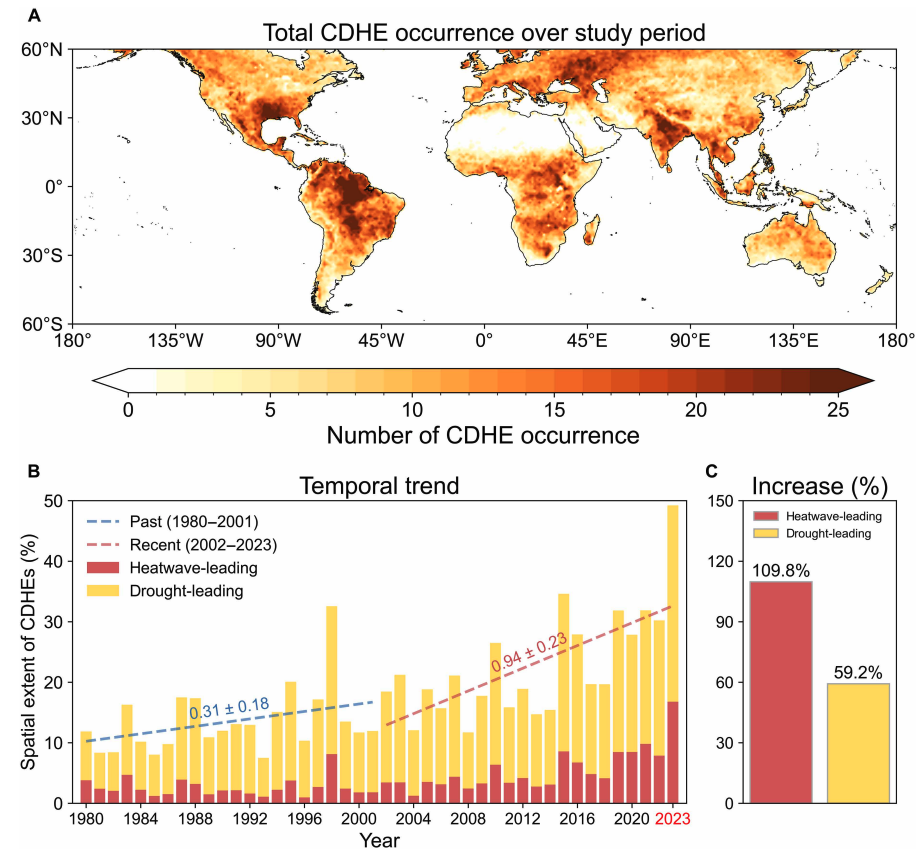
The global area affected by such “heatwave-led” compound events has more than doubled between 1980-2001 and 2002-23, the study says.
The rapid increase in these events over the last 23 years cannot be explained solely by global warming, the authors note.
Since the late 1990s, feedbacks between the land and the atmosphere have become stronger, making heatwaves more likely to trigger drought conditions, they explain.
One of the study authors tells Carbon Brief that societies must pay greater attention to compound events, which can “cause severe impacts on ecosystems, agriculture and society”.
Compound events
CDHEs are extreme weather events where drought and heatwave conditions occur simultaneously – or shortly after each other – in the same region.
These events are often triggered by large-scale weather patterns, such as “blocking” highs, which can produce “prolonged” hot and dry conditions, according to the study.
Prof Sang-Wook Yeh is one of the study authors and a professor at the Ewha Womans University in South Korea. He tells Carbon Brief:
“When heatwaves and droughts occur together, the two hazards reinforce each other through land-atmosphere interactions. This amplifies surface heating and soil moisture deficits, making compound events more intense and damaging than single hazards.”
CDHEs can begin with either a heatwave or a drought.
The sequence of these extremes is important, the study says, as they have different drivers and impacts.
For example, in a CDHE where the heatwave was the precursor, increased direct sunshine causes more moisture loss from soils and plants, leading to a drought.
Conversely, in an event where the drought was the precursor, the lack of soil moisture means that less of the sun’s energy goes into evaporation and more goes into warming the Earth’s surface. This produces favourable conditions for heatwaves.
The study shows that the majority of CDHEs globally start out as a drought.
In recent years, there has been increasing focus on these events due to the devastating impact they have on agriculture, ecosystems and public health.
In Russia in the summer of 2010, a compound drought-heatwave event – and the associated wildfires – caused the death of nearly 55,000 people, the study notes.

The record-breaking Pacific north-west “heat dome” in 2021 triggered extreme drought conditions that caused “significant declines” in wheat yields, as well as in barley, canola and fruit production in British Columbia and Alberta, Canada, says the study.
Increasing events
To assess how CDHEs are changing, the researchers use daily reanalysis data to identify droughts and heatwaves events. (Reanalysis data combines past observations with climate models to create a historical climate record.) Then, using an algorithm, they analyse how these events overlap in both time and space.
The study covers the period from 1980 to 2023 and the world’s land surface, excluding polar regions where CDHEs are rare.
The research finds that the area of land affected by CDHEs has “increased substantially” since the early 2000s.
Heatwave-led events have been the main contributor to this increase, the study says, with their spatial extent rising 110% between 1980-2001 and 2002-23, compared to a 59% increase for drought-led events.
The map below shows the global distribution of CDHEs over 1980-2023. The charts show the percentage of the land surface affected by a heatwave-led CDHE (red) or a drought-led CDHE (yellow) in a given year (left) and relative increase in each CDHE type (right).
The study finds that CDHEs have occurred most frequently in northern South America, the southern US, eastern Europe, central Africa and south Asia.
Threshold passed
The authors explain that the increase in heatwave-led CDHEs is related to rising global temperatures, but that this does not tell the whole story.
In the earlier 22-year period of 1980-2001, the study finds that the spatial extent of heatwave-led CDHEs rises by 1.6% per 1C of global temperature rise. For the more-recent period of 2022-23, this increases “nearly eightfold” to 13.1%.
The change suggests that the rapid increase in the heatwave-led CDHEs occurred after the global average temperature “surpasse[d] a certain temperature threshold”, the paper says.
This threshold is an absolute global average temperature of 14.3C, the authors estimate (based on an 11-year average), which the world passed around the year 2000.
Investigating the recent surge in heatwave-leading CDHEs further, the researchers find a “regime shift” in land-atmosphere dynamics “toward a persistently intensified state after the late 1990s”.
In other words, the way that drier soils drive higher surface temperatures, and vice versa, is becoming stronger, resulting in more heatwave-led compound events.
Daily data
The research has some advantages over other previous studies, Yeh says. For instance, the new work uses daily estimations of CDHEs, compared to monthly data used in past research. This is “important for capturing the detailed occurrence” of these events, says Yeh.
He adds that another advantage of their study is that it distinguishes the sequence of droughts and heatwaves, which allows them to “better understand the differences” in the characteristics of CDHEs.
Dr Meryem Tanarhte is a climate scientist at the University Hassan II in Morocco, and Dr Ruth Cerezo Mota is a climatologist and a researcher at the National Autonomous University of Mexico. Both scientists, who were not involved in the study, agree that the daily estimations give a clearer picture of how CDHEs are changing.
Cerezo-Mota adds that another major contribution of the study is its global focus. She tells Carbon Brief that in some regions, such as Mexico and Africa, there is a lack of studies on CDHEs:
“Not because the events do not occur, but perhaps because [these regions] do not have all the data or the expertise to do so.”
However, she notes that the reanalysis data used by the study does have limitations with how it represents rainfall in some parts of the world.
Compound impacts
The study notes that if CDHEs continue to intensify – particularly events where heatwaves are the precursors – they could drive declining crop productivity, increased wildfire frequency and severe public health crises.
These impacts could be “much more rapid and severe as global warming continues”, Yeh tells Carbon Brief.
Tanarhte notes that these events can be forecasted up to 10 days ahead in many regions. Furthermore, she says, the strongest impacts can be prevented “through preparedness and adaptation”, including through “water management for agriculture, heatwave mitigation measures and wildfire mitigation”.
The study recommends reassessing current risk management strategies for these compound events. It also suggests incorporating the sequences of drought and heatwaves into compound event analysis frameworks “to enhance climate risk management”.
Cerezo-Mota says that it is clear that the world needs to be prepared for the increased occurrence of these events. She tells Carbon Brief:
“These [risk assessments and strategies] need to be carried out at the local level to understand the complexities of each region.”



The post Heatwaves driving recent ‘surge’ in compound drought and heat extremes appeared first on Carbon Brief.
Heatwaves driving recent ‘surge’ in compound drought and heat extremes
Greenhouse Gases
DeBriefed 6 March 2026: Iran energy crisis | China climate plan | Bristol’s ‘pioneering’ wind turbine