

China has seen a series of temperature records broken this summer, as heatwaves have struck various regions across the country.
Between mid-March and mid-July 2025, it was hit by an unprecedented number of “hot days” – where temperatures reach or exceed 35C – according to the China Meteorological Administration (CMA) .
In both May and June, heatwaves swept across northern regions, with temperatures in Xinjiang reaching as high as 46.8C.
Such a record-breaking summer is becoming increasingly common, with the CMA’s annual Climate Bulletins showing that hundreds of local heat records have been surpassed over the past decade.
The CMA says that “extreme high temperatures” have shown an “increasing trend” in China since its records began in 1961.
Experts tell Carbon Brief that heatwaves strongly affect public health, agricultural output and economic activity.
They also put significant strain on the electricity system.
In this Q&A, Carbon Brief looks at how heat extremes are changing in China, the role of climate change in making these worse and how the country is adapting to the impacts.
How are heat extremes changing in China?
The latest science report from the Intergovernmental Panel on Climate Change (IPCC) states that it is “virtually certain” that “the frequency and intensity of hot extremes have increased” across the world since 1950.
The IPCC adds that it is “virtually certain” that human-caused greenhouse gas emissions are “the main driver”.
China is no exception. In a press release for its latest 2025 “blue book on climate change in China”, the CMA says China is “susceptible to the impacts of global climate change”, noting:
“[China’s] warming rate is higher than the global average…and extreme weather and climate events are becoming more frequent and intense.”
Data from the CMA’s Climate Bulletins show how the average annual temperature in China is rising and how 2024 was the hottest year on record, as shown in the chart below.
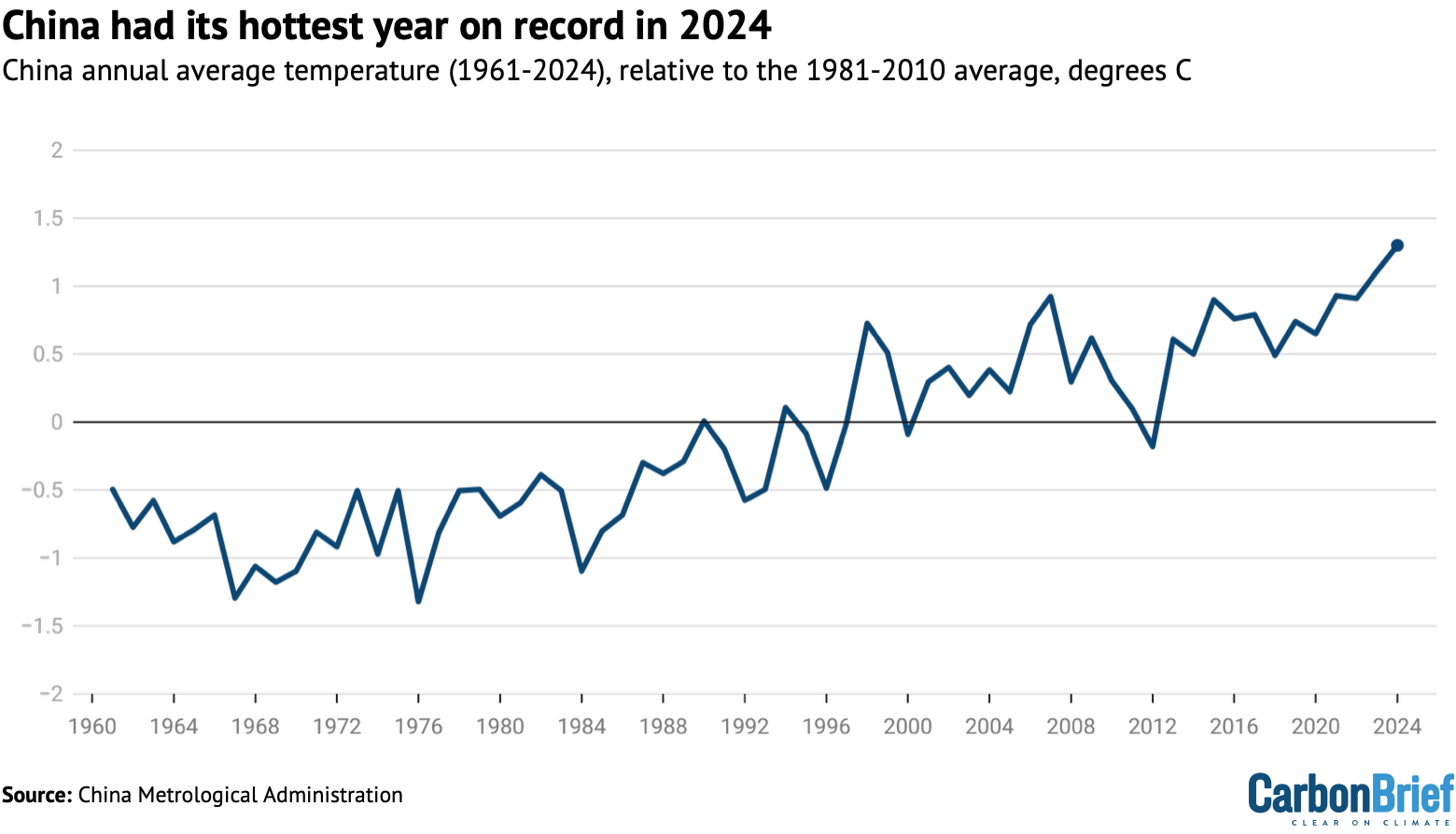
While 2024 was the hottest year on record overall, this was a result of consistently high temperatures throughout the seasons.
At a CMA press conference in 2025, Chan Xiao, deputy director of the CMA commented:
“Temperatures were consistently high throughout the year, with significant fluctuations in temperature during winter. Spring, summer and autumn temperatures were all record highs for the same period.”
In contrast, more heat records were broken during 2022, even though it was not quite as hot overall. Explaining this, Prof Yang Chen from Chinese Academy of Meteorological Sciences, which falls under the CMA, tells Carbon Brief:
“[For] the annual mean air temperatures, every day counts. So even if the 2022 was exceptional for its large number – actually also very long duration-consecutive days and high-magnitude – of hot extremes, mainly during summer and in the Yangtze River Valley, it does not mean the remaining days were hotter than the counterparts in 2024.”
The CMA defines a “hot day” or “high temperature day” as one that reaches or exceeds 35C. It adds that “high temperatures for several consecutive days constitute a heatwave”.
As the global climate has warmed, the number of “hot days” that China is experiencing has been on the rise, shown in the figure below.
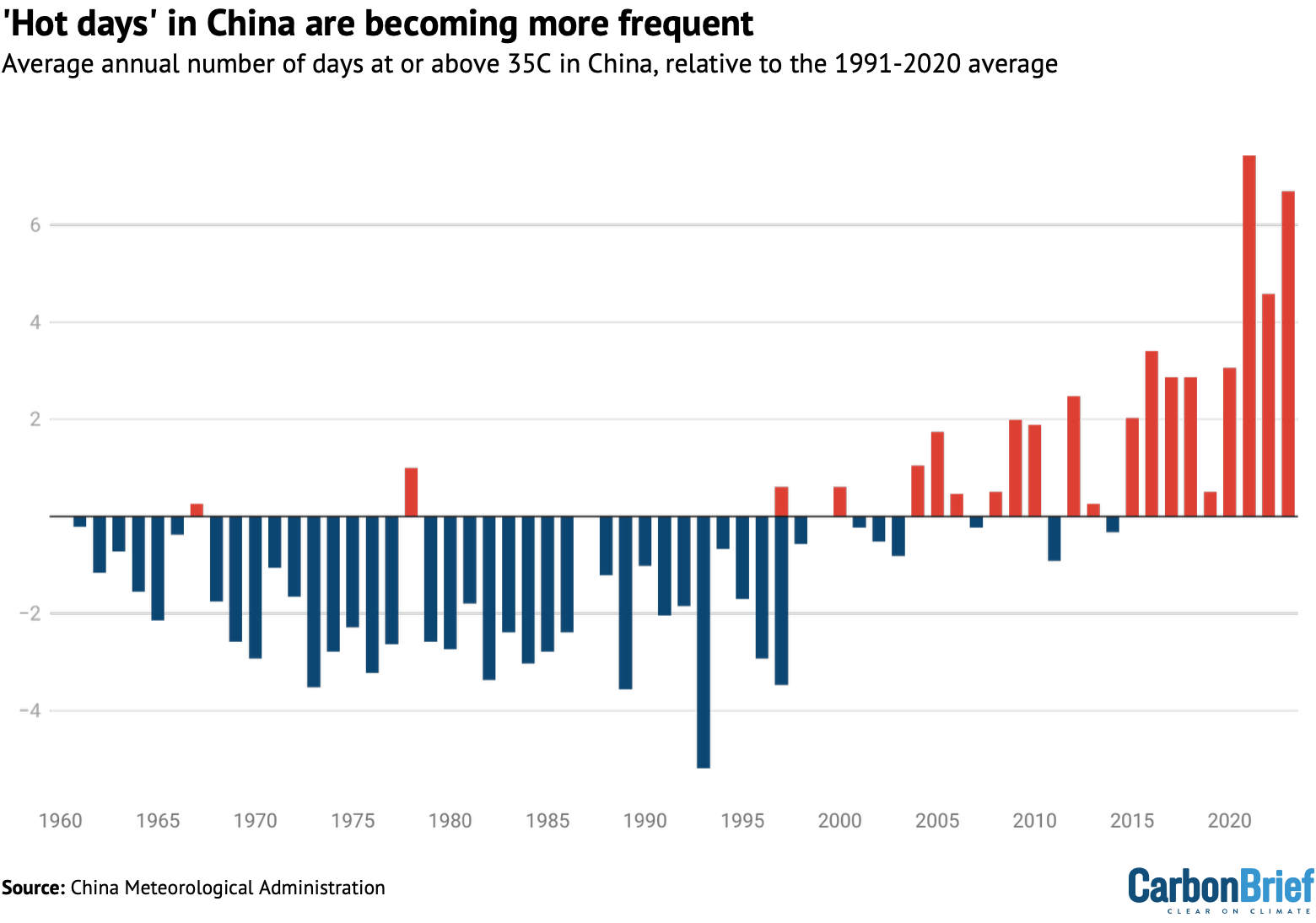
The year 2022 set a new record, with meteorological stations in China recording an average of 16.4 hot days. This was 7.3 more than the average for 1991-2020. The year 2024 came close to this record, with 15.6 hot days. These two years have also seen China’s hottest summers on record.
In 2022, more than 1,000 meteorological stations in China reported heatwaves, with 441 breaking “historical records”. For 2024, 74 stations reported “consecutive high temperature days” and 81 of them broke records.
Xiao said at a press conference in 2023 that “continuous high temperatures” in China’s central and eastern regions lasted for 79 days in the summer of 2022. The provinces of Gansu and Xinjiang in north-west China, Hubei in central China and Sichuan in south-west China all reported their “highest temperatures since 1961”.
In addition, the “maximum daily temperature [in the summer of 2022] at 361 national meteorological stations – accounting for 14.9% of the total number of stations in the country – reached or exceeded historical extremes”, Xiao added.
The CMA has also highlighted that summer is arriving earlier for much of China. In 2024, for example, summer in regions including most of Hainan province in south China, central Yunnan province in south-west China as well as central and southern Xinjiang province in north-west China arrived more than 20 days earlier than average.
“If a year’s spring and summer are longer, the potential heatwaves…will also be longer,” Prof Wenjia Cai, from the department of earth system science of Tsinghua University, tells Carbon Brief.
Cai notes that there are more ways to define heatwaves than CMA’s absolute threshold of 35C.
For example, a heatwave can also be defined by how long the hot weather persists, or based on “the daily maximum temperature, daily average temperature, or even nighttime temperature”, she tells Carbon Brief.
However, regardless of the definition used, the “number of heatwave days is definitely increasing as a result of climate change”, she adds.
What role does human-caused climate change play?
A field of climate science called “attribution” has emerged over the past two decades to establish the role that human-caused warming plays in individual extreme weather events, including heatwaves, floods, droughts and storms.
Attribution studies can also be used to find the “fingerprint” of human-caused climate change in longer-term trends, such as the gradual increase in surface temperatures over multiple decades.
Heat is the most-studied extreme event in attribution literature, as it is mainly driven by thermodynamic influences – in other words, it is relatively easy to study.
In contrast, storms and droughts are more strongly affected by complex atmospheric dynamics and, as such, can be trickier to simulate in a model. Cai tells Carbon Brief:
“High temperature is the most obvious trend against the background of climate change. Heatwaves, in comparison to events such as rainfall and typhoons, are also more predictable.”
Carbon Brief has produced an interactive map showing every attribution study published up to November 2024. In total, 114 extremes and trends in China have been the subject of an attribution study, including more than 20 relating specifically to extreme heat.
One study included on the map looks at the change in the intensity and frequency of extreme temperatures across China over 1951-2018. The authors say that, over this time period, “more intense and more frequent warm extremes” were observed across “most regions” in China – and that “greenhouse gas forcing plays a dominant role” in this.
Looking at individual extreme events, one analysis by the “rapid attribution” group World Weather Attribution investigates the then-record-breaking heat across China in July 2023. The analysis says that temperatures exceeded 50C in north-west China, adding that Sanbao, in Xinjiang, hit 52.2C on 16 July of that year.
The study finds that, in a world without climate change, such an extreme heat event would have been “extremely rare” and would only have happened once every 250 years. However, in today’s climate, as a result of human-caused climate change, a heatwave of this intensity is now expected once every five years.
This means China’s extreme heat of July 2023 was 50 times more likely due to climate change. The study also finds that in a world without climate change, the heatwave over China would have been 1C cooler.
A separate study finds that human-caused climate change also caused a more than 60-fold increase in the likelihood of the extremely warm 2013 summer, compared to the early 1950s.
It adds that other factors such as urbanisation and changes in atmospheric circulation patterns can also make heat extremes more intense and frequent.
What impact are these heatwaves having?
Heatwaves have a wide variety of impacts on human activities, such as public health, crop yields and economic output.
Older people are particularly vulnerable to extreme heat. The 2024 report from the Lancet Countdown on Health and Climate Change found that, in 2023, demographic changes alone could have driven a 65% increase in heat-related deaths among over-65s, compared to the 1990-99 average.
Cai, who is also the lead author of the Lancet Countdown’s China report, tells Carbon Brief that older people are the “most commonly mentioned vulnerable group” and that the number of people affected by heatwaves will grow as societies age.
However, heatwaves also “affect outdoor activities” regardless of age group, she adds, as well as having impacts on sleep and allergies:
“We don’t want anyone to think they are in a group of people unaffected by heatwaves.”
Cai says that heat exposure can increase the incidence of certain dangerous behaviours, such as domestic violence, as well as a wide range of diseases – including cardiovascular diseases and respiratory diseases – and mental health disorders.
In 2023, more than 30,000 deaths were related to heatwaves in China – 1.9 times higher than the average over 1986-2005, according to Cai and her colleagues’ China report.
This was a result of increased heat exposure – the average number of “heatwave exposure days” per person reached 16 days in 2023, more than three times the historical average (1986-2005), the report adds.
A 2022 attribution study on China notes that extreme heat can also increase the risk of preterm births. The authors find that over 2010-20, an average of 13,262 premature births were recorded in China due to heatwave exposure. The study linked one-quarter of these early births to climate change.
Another profound impact of heatwaves is that they can exacerbate droughts, with knock-on impacts for agriculture.
Reuters reported last June that “China’s agriculture ministry said…searing temperatures have adversely impacted summer planting and that fighting drought and protecting summer planting were arduous tasks”.
Droughts in 2024 hit more than 11 million people in China, with more than 1.2m hectares of affected crops and direct economic losses topping nearly 8.4bn yuan ($1.2bn), the Ministry of Emergency Management said in early 2025.
Heat-related economic losses could reach nearly 5% of China’s GDP by 2060, according to a recent guest post for Carbon Brief. Authors Prof Guan Dabo and doctoral student Sun Yida from Tsinghua University wrote:
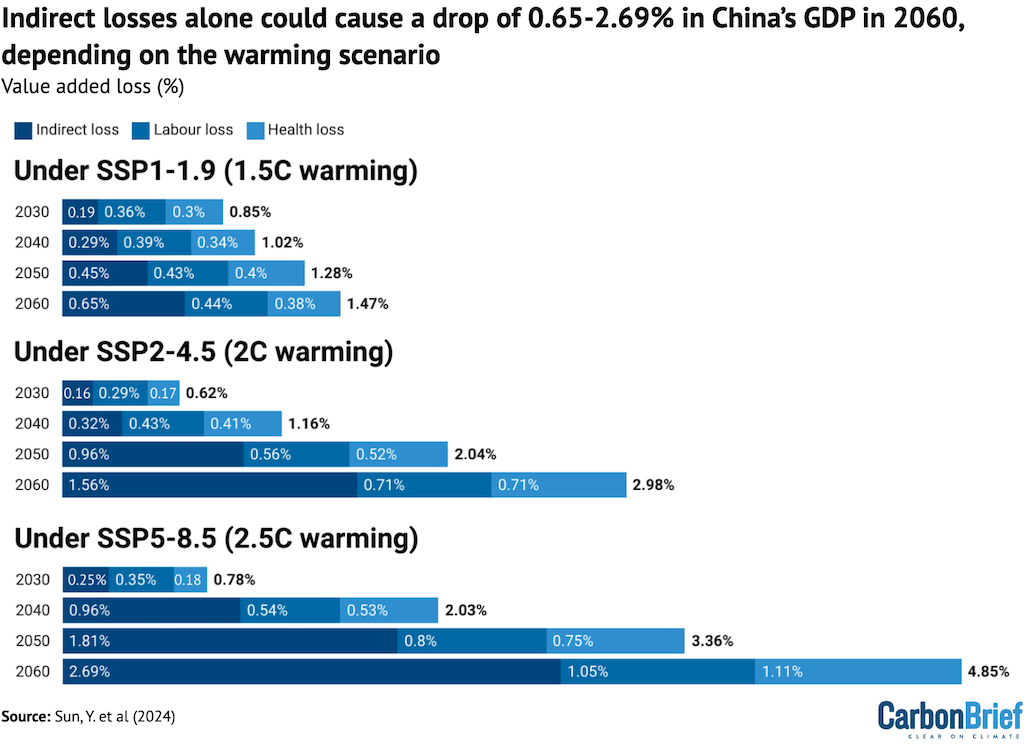
“By 2060, China’s heat-induced economic losses could total about 1.5% of total GDP under 1.5C of global warming, 3% under 2C of warming and 4.9% under 2.5C of warming.”
Those predicted losses include “indirect economic losses”, which “could be due to changes in production, consumption or employment” in the global supply chain, including crop failures and labour slowdowns, they explained.
The figure below, based on their study, shows Chinese GDP losses under three different scenarios of future emissions, called “shared socioeconomic pathways” (SSPs).
The SSP1-1.9, SSP2-4.5 and SSP5-8.5 scenarios project average global temperature rises of around 1.5C, 2C and 2.5C by mid-century, respectively.
Economic losses are split into indirect losses (dark blue), labour losses (blue) and health losses (light blue).
Sectors such as the extractive industries, construction and non-metallic manufacturing “could see the highest losses” of about 4.6-6.4% of their “value-added” – the increase in worth of a product or service as it moves through different stages of production – largely because they are in Chinese “regions with significant warming”, according to Guan and Sun.
Those industries also have close business connections with south-east Asia, Africa and South America, which are “expected to face heightened exposure to production volatility caused by high temperatures”, they add.
The total economic loss globally could reach up to 4.6% by 2060, according to their study, and manufacturing-heavy countries such as China and the US, in particular, could be “strong[ly] hit”.
Other than manufacturing, electricity supplies in China have also been frequently reported to be affected by hot days.
Chinese news outlet China Business Network reports that China’s National Energy Administration said last year that summer was the hardest time to ensure sufficient electricity supply during a year and that extreme weather would make the supply even harder.
For 2025, China’s State Grid Corporation expected maximum electricity demand to exceed 1,200 gigawatts (GW), a new record.
Dr Muyi Yang, senior energy analyst at thinktank Ember, tells Carbon Brief that “when temperatures soar, electricity demand spikes – mainly due to air conditioning – and that can stretch the grid, especially in already tight systems”.
Biqing Yang, energy analyst at Ember, adds:
“In the third quarter of last year, for example, China’s residential electricity consumption rose significantly, by 17.8% year-on-year, largely due to elevated temperatures…It is clear that we are now entering an era [w]here climate change is having a real-time impact on our energy system.”
China’s electricity demand reached a new record in July 2025 after year-on-year growth of 8.6%, consuming more power in one month than Japan did in all of 2024, according to David Fishman, Shanghai-based principal at consultancy the Lantau Group.
The “staggering” July 2025 figures – including another 18% year-on-year rise in residential demand, partly due to rising household incomes, as well as air conditioning use – illustrates the impact of climate change on China’s power sector, Fishman writes on LinkedIn:
“We know it’s hot out and everyone knows every summer the intense heat seems to last for longer and longer. But these power consumption numbers are telling a story about China’s climate patterns like few other datasets can…and it’s a scary story.”
Yang, Chen and Cai tell Carbon Brief that it is important for China to adapt to the rising temperature and intensive heatwaves.
Chen specifically describes “successful” forecasts and early warnings as “critical” , saying that they are the “very first step toward adaptation”.
In his LinkedIn post, Fishman notes that the rapidly rising demand for electricity, including as a result of growing air conditioning use, also poses a “considerable challenge to China’s ability to meet rising demand solely with clean power sources”.
How is China adapting to heatwaves?
In recent years, China has implemented more and more policies aimed at adapting to heatwaves.
For example, weather forecasts and heatwave alerts have been provided.
Central and local governments have also issued labour policies aimed at protecting workers against extreme heat.
Under a policy from the Ministry of Human Resources and Social Security, for instance, outdoor works are not expected to be undertaken when temperatures exceed 40C. In addition, outdoor working hours should be shorter than six hours when the temperature is 37-40C.
Similarly, school students in some cities, such as Wuhan and Chengdu, have been advised to study from home during hot days in recent years.
Since 2021, the city of Tianjian has been sending text warnings of heatwaves to its residents, reminding people of the health risks it poses. The messages, according to Southern Metropolis Daily, warn that strokes might be triggered in the coming hot days and advises people to avoid outdoor activities and take medication if needed.
These text reminders have “significantly” reduced the number of hospitalised people in Tianjin, saving the city 140m yuan ($19.5m) since being introduced, adds the outlet.
In 2013, the central government published its first “national climate change adaptation strategy” – an attempt to implement the “clear requirement” of “enhancing our ability to adapt to climate change” included in the 12th “five-year plan” (2011-15).
In the latest version for 2035, heatwaves appear in sections related to the power sector, as well as agriculture and health.
The strategy aims to “improve” and “reinforce” nationwide “labour protection standards”, as well as “work system[s] that adapt to change and reduce agricultural disasters”. Its purpose is also to ensure the energy and electricity sectors’ abilities to “withstand extreme weather and climate events” in relation to heatwaves.
The strategy says that “health-risk assessment guidelines” and public health-related “implementation plans for adaptation under major extreme weather and climate events”, such as heat and heatwaves,in “various regions”, will be developed.
Last year, following the release of the latest overall adaptation strategy, China published the “national climate change health adaptation action plan (2024-30)”.
Cai calls the document a “very very important” blueprint for health risk management, bringing together a range of organisations, including hospitals, to form a “system related to climate change and health” that has “monitoring and early warning capabilities”.
She adds that this plan will also see heat-health alerts being issued nationwide:
“It is worth mentioning that the National Administration of Disease Control and Prevention and the China Meteorological Administration signed a joint agreement [in May 2025] on issuing [nationwide] health alerts – and that the first product is related to heatwaves.”
Ember’s Yang says that in terms of electricity, China is moving toward building a “‘new electricity system (新型电力系统)’ that is more compatible with high shares of renewables”. But, he adds, the old “planning psychology” needs to change so that it can better cope with extreme heat:
“Traditionally, the mindset has been very supply-driven – just keep adding enough generation and network capacity to meet demand…[With the new system] the demand side has to become an active player – a prosumer – that can actually support grid reliability.
“For example, during extreme heat, instead of just ramping up supply, we should also be encouraging users to reduce or shift their electricity use during peak hours, using price signals or incentives…This is the essence of what we call ‘coordinating generation, grid, load, and storage’ (源网荷储一体化) – a system that works together [and works] more efficiently and flexibly.”



The post Q&A: How China is adapting to ‘more frequent and intense’ heat extremes appeared first on Carbon Brief.
Q&A: How China is adapting to ‘more frequent and intense’ heat extremes

Three countries have been named by the Paris Agreement’s compliance committee for failing to submit a nationally determined contribution (NDC) and repeatedly snubbing offers of help with their climate plans.
After months of internal debate over whether to identify serial non-responders, the Paris Agreement’s Implementation and Compliance Committee (PAICC) named the three countries which have failed to engage with it over their NDCs on Friday.
It named Democratic Republic of Congo, Senegal and North Korea in a footnote of its annual report, adding that it decided to name them “with a view to facilitating engagement”, adding that representatives of the three nations had been invited to its meeting in early 2027 “with the purpose of identifying any challenges and constraints”.
“The Committee noted the importance of Parties engaging with the Committee in a timely manner, while noting that some delays may be due to the national capabilities and circumstances of the Parties”, the report said.
-
Under US pressure, World Bank says it will back gas “where appropriate”
The US wants the World Bank to expand its gas support while climate campaigners are pushing for it to end – its head spoke this week of limited backing for the fossil fuel -
IPCC scientists vow to press on with climate reports despite political deadlock
After governments again failed to agree a timeline, nearly 120 IPCC authors pledged to complete their assessment on time and with full scientific rigour -
Paris Agreement committee snubbed over missing NDC climate plans
Many governments have still not submitted a nationally determined contribution to the UN, breaching a key requirement of the Paris Agreement



In July, PAICC said 12 countries had ignored its repeated attempts to discuss why they had not published an NDC as required every five years under the 2015 Paris accord.
Members of the committee had been divided over whether to name them, but at a September meeting decided to do so in their annual report to the annual climate COP summit.
By the time the report was published on Friday, only Congo, Senegal and North Korea “had not communicated an NDC or submitted a [Biennial Transparency Report] and had not yet responded to any of the Committee’s notifications, despite several reminders issued by the Committee in this regard”.
Rainforest and renewable energy ambitions
The silence from Congo and Senegal is notable because the former is home to much of the Congo Basin rainforest while the latter has sought billions of dollars in climate finance to support its renewable energy ambitions.
After Brazil, Congo has more rainforest than any country in the world. This forest, and the country’s peatlands, absorb huge amounts of greenhouse gas but are fast being lost to expanding farmland, charcoal production, logging and mining.
Senegal signed a Just Energy Transition Partnership with Canada and wealthy European nations in 2023, to help it meet its renewable energy targets under the-then government of Macky Sall. It was chair of the Least Developed Countries group between January 2022 and December 2023.

Tejas Rao, who is researching the PAICC as part of a doctoral thesis at Cambridge University, said the governments of the three countries should engage with the committee.
“Engagement costs these governments very little and the committee has shown it will listen,” he said.
“Silence leaves the committee with no basis to help, and it leaves the [governments] exposed to the narrative that they are simply disengaged,” he told Climate Home News.
Paris Agreement requirement
The 2015 Paris Agreement requires all parties to publish an NDC every five years outlining their emissions reduction targets, with each plan meant to be more ambitious than the country’s last NDC.
The latest set – the third round of plans, with new targets for 2035 – was due in February 2025. While most countries missed this deadline, all but around 30 – mostly small emitters but including Egypt, Vietnam and Argentina – have now submitted them.
Over the year, the PAICC – which is made up of government climate officials from developed and developing countries – has been communicating with governments that have not submitted NDCs and trying to overcome barriers to them doing so.
Some nations have cited exceptional circumstances as the reason for not submitting an NDC, a process that requires a significant amount of work in tracking emissions and consulting on how to curb them across the economy. For example, a letter from a Sudanese official to the PAICC, seen by Climate Home News, said that the country’s civil war had led to the suspension of its NDC preparation.