In the early 2000s, a new field of climate-science research emerged that began to explore the human fingerprint on extreme weather, such as floods, heatwaves, droughts and storms.
Known as “extreme event attribution”, the field has gained momentum, not only in the science world, but also in the media and public imagination. These studies have the power to link the seemingly abstract concept of climate change with personal and tangible experiences of the weather.
Scientists have published more than 400 peer-reviewed studies looking at weather extremes around the world, from wildfires in the US and heatwaves in India and Pakistan to typhoons in Asia and record-breaking rainfall in the UK. The result is mounting evidence that human activity is raising the risk of some types of extreme weather, especially those linked to heat.
To track how the evidence on this fast-moving topic is stacking up, Carbon Brief has mapped – to the best of our knowledge – every extreme-weather attribution study published to date.
Carbon Brief’s analysis reveals:
- 71% of the 504 extreme weather events and trends included in the map were found to be made more likely or more severe by human-caused climate change.
- 9% of events or trends were made less likely or less severe by climate change, meaning 80% of all events experienced some human impact. The remaining 20% of events and trends showed no discernible human influence or were inconclusive.
- Of the 152 extreme heat events that have been assessed by scientists, 93% found that climate change made the event or trend more likely or more severe.
- For the 126 rainfall or flooding events studied, 56% found human activity had made the event more likely or more severe. For the 81 drought events studied, it’s 68%.
First published in July 2017, this article is the fifth annual update (see endnote) to incorporate new studies. The aim is that it serves as a tracker for the evolving field of “extreme event attribution”.
Using the map
The map above shows 504 extreme weather events and trends across the globe for which scientists have carried out attribution studies. The different symbols show the type of extreme weather; for example, a heatwave, flood or drought. The colours indicate whether the attribution study found a link to human-caused climate change (red), no link (blue) or was inconclusive (grey).
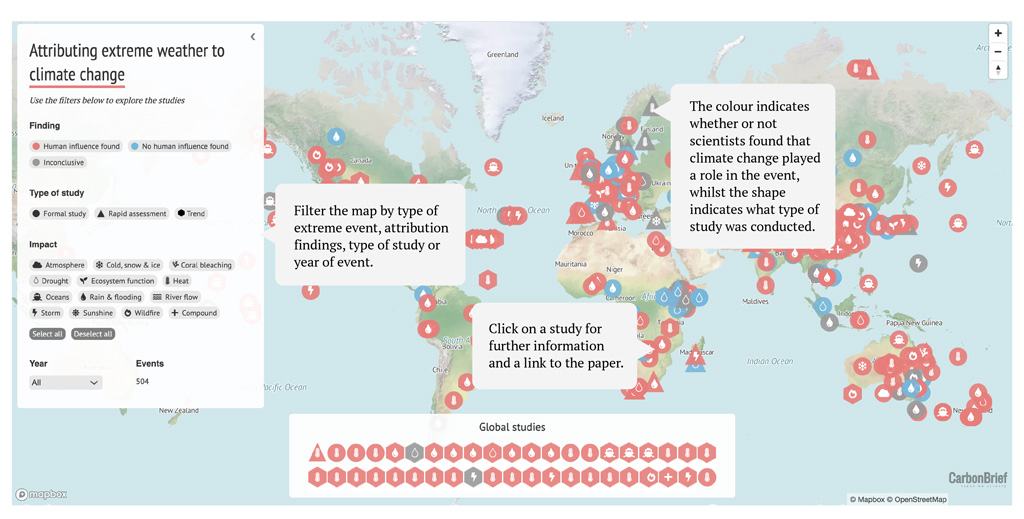
Use the plus and minus buttons in the top-left corner, or double click anywhere, to zoom in on any part of the world. Click on a symbol to reveal more information, including a quote from the original paper to summarise the findings and a link to the online version.
The filter on the left allows users to select a specific type of weather event to look at or, for example, only those found to be influenced by climate change.
The filter can also be used to highlight extreme events from a particular year. (Note: earlier versions of this map classified events by the year that the study or analysis was published.) To isolate studies that assess the changing trends of weather extremes, click the “trend” box in the filter.
The software used to make the map currently only works with a Web Mercator projection (as used by virtually all major online map providers). It is worth noting that this – like all map projections – offers a somewhat distorted view of the world.
It is important to note that the weather events scientists have studied so far are not randomly chosen. They can be high-profile events, such as Hurricane Harvey, or simply the events that occurred nearest to scientific research centres. (More on this below.)
The map includes three different types of studies. The circles and hexagons on the map indicate papers published in peer-reviewed journals. The different shapes refer to whether the study considers an individual extreme event (circles), such as a wildfire or storm, or whether it analyses longer-term trends in extreme weather (hexagons), such as the change in frequency of flooding or marine heatwaves over time.
The third shape – triangles – indicate rapid attribution studies. These are quickfire assessments of the climate change contribution to extreme weather events, published online shortly after an event concludes. (More on this below.)
Finally, it is worth noting that some of the icon locations are approximate – particularly for studies that cover large regions. For example, global studies can be found grouped together in the middle of the Atlantic Ocean.
Extreme weather types
The events and trends shown on the map are covered by 431 individual scientific papers or rapid studies. Where a single study covers multiple events or locations, these have been separated out into individual entries on the map.
Combining the evidence over the past 20 years, the literature is heavily dominated by studies of extreme heat (30%), rainfall or flooding (25%) and drought (16%). Together, these make up more than two-thirds of all published studies (71%). The full list is available in this Google sheet.
As the chart below shows, the number of extreme events studied has grown substantially over the past 10-15 years. Note that formal studies typically follow a year or so after the event itself as the writing and peer-review process for journal papers can take many months.
The majority of studies included here have been published in the annual “Explaining extreme events” special issues of the Bulletin of the American Meteorological Society (BAMS). Each bumper volume typically contains around 15-30 peer-reviewed studies of events from the previous year. Other studies have been found through the Climate Signals database and online searches through journals. This update includes studies published up to the end of May 2022.
(Note: The map currently only includes studies published in English.)
Specific types of event can be displayed in the chart below by clicking on the category names at the top.
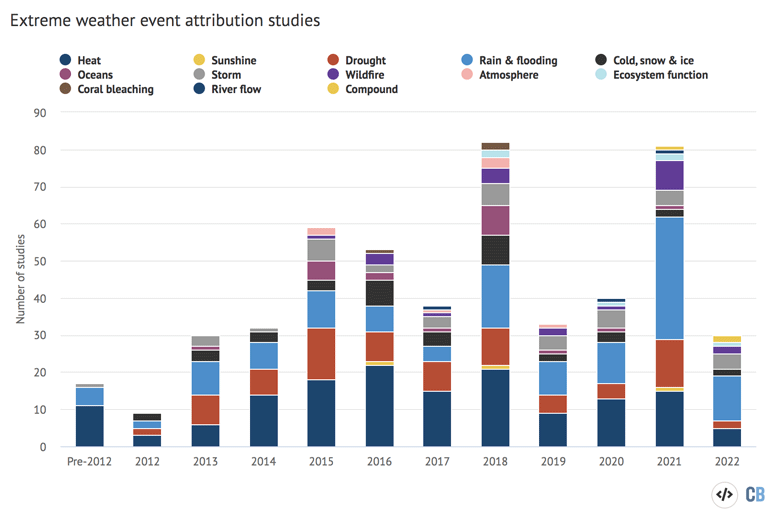
Number of attribution studies by extreme weather event type and year. Note: the total number of events dipped in 2017 because the Bulletin of the American Meteorological Society special report for that year was published in early 2018 rather than late 2017. Chart by Carbon Brief using Highcharts.
Most of the categories of extreme weather are self-explanatory, but “storms” and “oceans” require a bit of explanation.
For ease of presentation, the “storms” category includes both tropical cyclones – such as hurricanes and typhoons – and extratropical storms. The “oceans” category encompasses studies looking at marine heatwaves, storm surges and the strength of El Niño events.
Newer categories include “coral bleaching” and “ecosystem services”, reflecting the ongoing developments in attribution science. For example, a rapid attribution study concluded that climate change had “drastically” increased the likelihood of the conditions leading to bleaching of the Great Barrier Reef in 2016 – by at least 175 times. And a 2022 study found that “extremely early” cherry-tree flowering in Kyoto in March 2021 was made “15 times more likely” by climate change.
For this latest iteration of the map, a new category of “compound” extreme events has also been added. This includes, for example, a 2021 study that found climate change had contributed to the “high likelihood” of combined dry and hot events in recent decades over most of China.
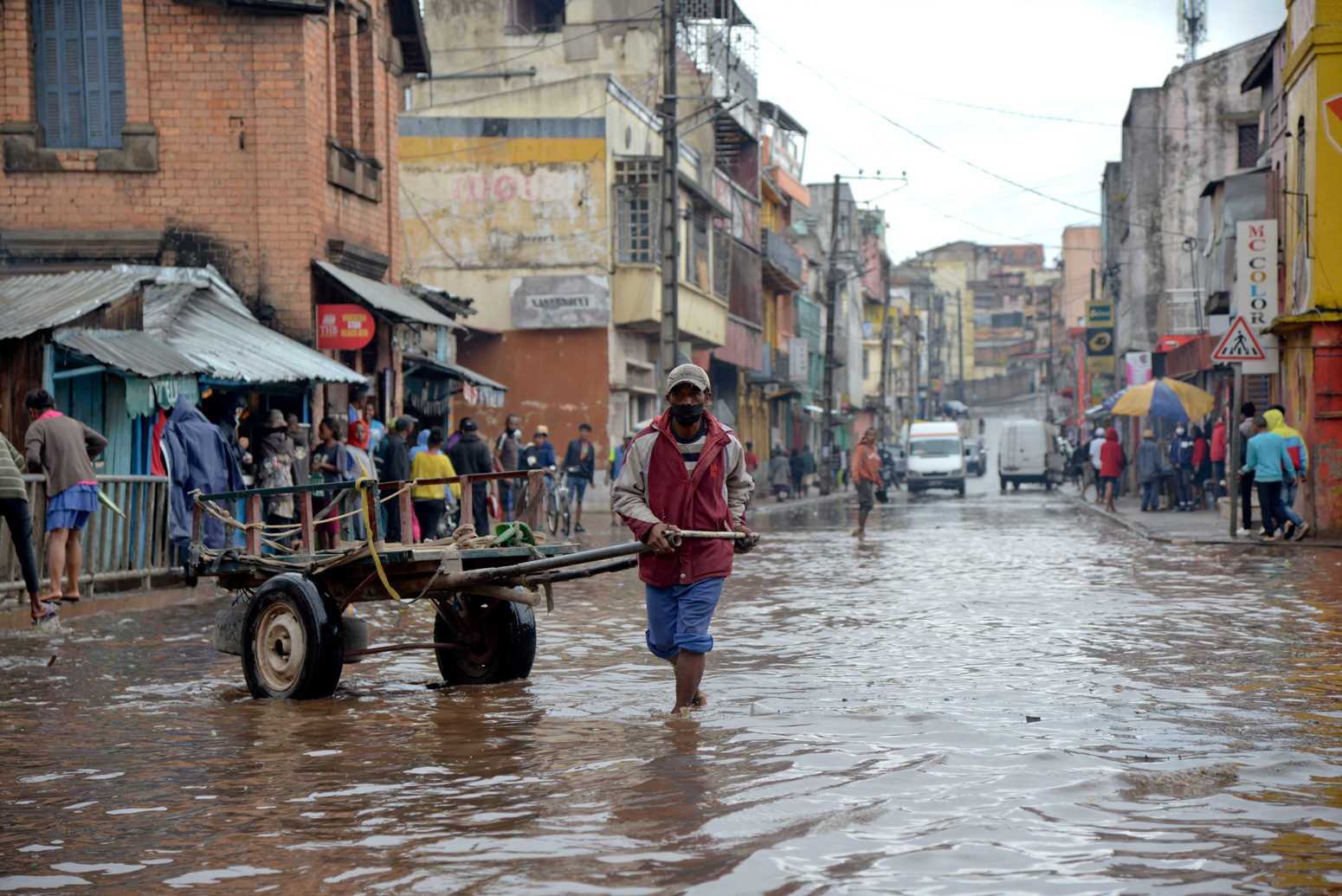
Such studies show that attribution studies are increasingly considering the impacts of extremes, rather than focusing purely on the weather event.
One of the first of these “impact attribution” studies was published in 2016. It estimated that 506 of the 735 fatalities in Paris during the 2003 European heatwave were down to the fact that climate change had made the heat more intense than it would otherwise have been. The same was true for 64 of the 315 fatalities in London, the study said. Health impacts have increasingly become a focus of attribution studies.
Similarly, a 2021 study found that 37% of “warm-season heat-related deaths” across 43 countries between 1991 and 2018 “can be attributed to anthropogenic climate change and that increased mortality is evident on every continent”. Another 2021 study, which the authors unpacked in a Carbon Brief guest post, found that climate change was a “critical driver” of the drought that led to a food crisis in Lesotho in 2007. And a third 2021 study – also the subject of a Carbon Brief guest post – on the rising threat of an “outburst flood” from glacial lakes in the Peruvian Andes found that the retreat of the region’s glaciers was “entirely attributable” to human-caused warming.
This shift towards impacts “is quite significant”, says Prof Peter Stott, who leads the climate monitoring and attribution team at the Met Office Hadley Centre and has been a co-editor of the BAMS reports since they began in 2012. He tells Carbon Brief:
“Impacts are hard to do because you have to establish a significant link between the meteorology and the impact in question. As editors, we’ve been trying to encourage more studies on impacts because it’s the impacts rather than the meteorology per se that tends to motivate these types of study – and if we only have the attribution on the meteorological event then we only have an indirect link to the relevant impact.”
Attribution of climate impacts could even be used in the courts, one 2021 study explained. The authors wrote a Carbon Brief guest post explaining how attribution science can be “translated into legal causality”. They wrote:
“Attribution can bridge the gap identified by judges between a general understanding that human-induced climate change has many negative impacts and providing concrete evidence of the role of climate change at a specific location for a specific extreme event that already has led or will lead to damages.”
Finally, attribution research has also identified the “signal” of human influence in other indicators of climate change, such as increasing average temperature, rising lake temperatures or sea level rise. Recent research has even been able to detect the fingerprint of climate change “from any single day in the observed global record since early 2012, and since 1999 on the basis of a year of data”. These types of studies have not been included in the attribution map as the focus here is on extremes.
Human influence on extreme weather
Of the attribution studies included here, scientists found that human-caused climate change has altered the likelihood or severity of an extreme weather event in 80% of cases studied (71% made more severe or likely and 9% made less so).
In Carbon Brief’s first edition of this analysis in 2017, 68% of events were found to have a human impact (with 63% made more severe or likely and 6% less so).
While these figures are not representative of all extreme weather events – attribution studies have only been conducted on a relatively small number – previous research has taken this broader view. For example, a 2015 study estimated the fraction of all globally occurring heat and heavy rainfall extremes that was attributable to warming. The authors found that around 75% of “moderate daily hot extremes over land” and 18% of “moderate daily precipitation extremes over land” were attributable to the observed temperature increase since pre-industrial times. These fractions are expected to increase with further warming, the authors noted.
There are several ways of carrying out an attribution analysis. (A team of attribution scientists wrote a Carbon Brief guest post in 2021 that unpacks their methods.) One of the most common is to take observations and/or climate model simulations of an extreme event in the current climate and compare them with idealised model runs of that event in a world without human-caused global warming. The difference between the “with” and “without” climate change simulations indicates how the likelihood or severity of that extreme event has changed.
Note that events are classified here as having an human impact if climate change is found to have influenced at least one aspect of that event. For example, a study of the 2011 East Africa drought found that climate change contributed to the failure of the “long rains” in early 2011, but that the lack of “short rains” in late 2010 was down to the climate phenomenon La Niña. This event is, thus, designated as having a human impact.
For the majority of events affected by climate change, the balance has shifted in the same direction. That is, rising temperatures made the event in question more severe or more likely to occur. These events are represented by the red in the chart below. Clicking on the red “slice” reveals that heatwaves account for 40% of such events, rainfall or flooding for 20%, and droughts for 15%. Return to the original chart, and do the same with the other slices to see the proportion of different weather types in each category.
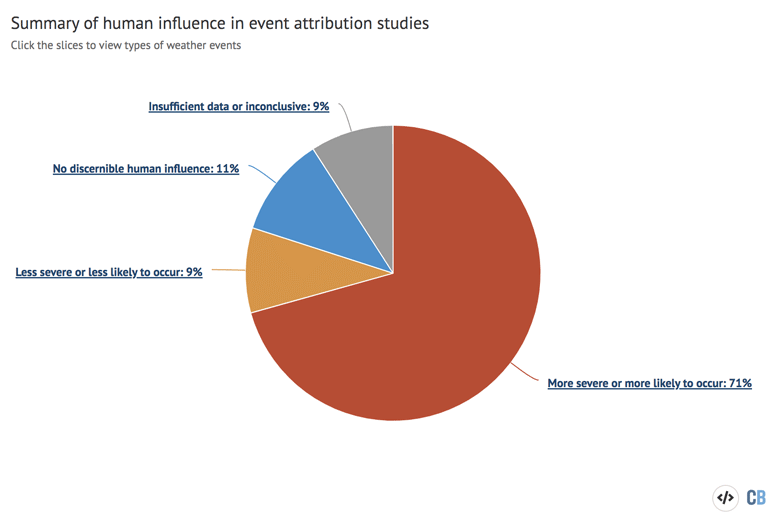
Pie chart showing the proportion of extreme events/studies that were found to have been made more likely/severe by climate change (red segment), less likely/severe (orange), had no link identified (blue) and were inconclusive or lacked sufficient data (grey). Clicking on a segment reveals the makeup of different types of extremes within that category. Chart by Carbon Brief using Highcharts.
In 11% of extreme weather events and trends studied, scientists found no discernible influence from human activity. These are coloured blue in the map and the chart above. For a further 9%, the observational data or modelling techniques used in the study were insufficient to reach a reliable conclusion (shown as grey in the map and pie chart).
In 9% of studied weather events and trends, scientists found climate change had made the event less likely or less severe (pale orange in the chart above).
Unsurprisingly, this category includes blizzards and extreme cold snaps. However, it also features a few studies that suggest climate change has lessened the chances of heavy rainfall, and another that found rising temperatures have made agricultural drought in California less likely.
Drought is complicated (more on this below). Briefly, though, it is worth noting that five other studies looking at different aspects of the California drought over 2011-17 found climate change had played a role. Two found no discernible link (pdf, p7-15), while one was inconclusive (pdf, p3).
Interestingly, a 2020 study analysed the way links between climate change and the California drought were portrayed in US media. It finds that the links were “covered widely in both local and national news”, but notes:
“However, legitimate differences in the methods underpinning the attribution studies performed by different researchers often resulted in a frame of scientific uncertainty or disagreement in the media coverage.”
As the case of California’s drought shows, it is often necessary to dig deeper to understand the full picture. The rest of this article looks at the evidence for the three most-studied types of extreme weather – heatwaves, heavy rain and floods, and droughts – as well as some of the main issues in event attribution, and where the field as a whole is heading.
Heatwaves
The attribution map includes studies of 152 extreme heat events, of which 142 (93%) have been made more likely or more severe because of climate change. No studies have found a heatwave that has been made less severe by climate change, while studies of two events (1%) identified no influence and a further eight (5%) were inconclusive.
In recent years, studies have shown that several heat extremes would have been impossible or virtually impossible without human influence on the climate. These include Siberia’s heatwave of 2020, the Pacific north-west “heat dome” event of 2021 and Europe’s record-breaking summer of 2021.

The studies on extreme heat that did not find a role for climate change were an analysis of the Russian heatwave in 2010 and a rapid attribution study of the all-time high temperatures recorded in Rajasthan, India in May 2016. For the latter, the authors suggested that “the lack of a detectable trend may be due to the masking effect of aerosols on global warming and increased use of irrigation”.
While heatwaves are the most-studied extreme event in attribution literature, they are becoming “less and less interesting for researchers”, notes a Bloomberg article from 2020. Dr Friederike Otto is a senior lecturer at the Grantham Institute for Climate Change and the Environment at Imperial College London and co-leader of World Weather Attribution, a consortium of scientific organisations founded in 2014 to deliver “timely and scientifically reliable information on how extreme weather may be affected by climate change”. She told Bloomberg that the consortium chose not to investigate California’s record-breaking summer 2020 heatwave as “the evidence is so strong already”.
A particularly well-studied region for heatwaves in the literature is Australia, which accounts for 10% of the heat-related events included here. And climate change was found to play a role in all but one of the 15 Australian heat events studied. It is worth noting for that one event, however, that although the study (pdf, p145) was inconclusive for the city of Melbourne in south-east Australia, the authors did detect a human influence on extreme heat up the coast in Adelaide.
This raises a few important points. First, finding that climate change contributed to an event is not the same as saying it “caused” that event. Attribution is about working out if the likelihood or magnitude of a particular event happening now is different from what it would be in a world that was not warming.
A useful analogy – as explained in the first BAMS report in 2012 – is of a baseball player who starts taking steroids. If the player begins hitting 20% more home runs than before, it would not be possible to say for sure whether a particular home run is because of the steroids or the player’s spontaneous skill. But it is possible to say how the steroids have altered the likelihood that the player hits a home run, by comparing their current and historical performances. As the report put it:
“Given that steroids have resulted in a 20% increased chance that any particular swing of the player’s bat results in a home run, you would be able to make an attribution statement that, all other things being equal, steroid use had increased the probability of that particular occurrence by 20%.”
Another important point is that in cases where attribution science finds that climate change is making a given type of extreme weather more likely, it does not necessarily follow that the chance of experiencing that kind of weather gets incrementally higher each year. Natural variability means that there will still be ups and downs in the strength and frequency of extreme events.
Finally, there is usually a level of confidence attached to attribution results. So, while two studies might both find a role for human influence in a given weather event, the signal may be stronger for one than the other. For the purposes of this analysis, the attribution map does not distinguish between high- and low-confidence results, but users can click through to each study for more details.
Heavy rain and flooding
Of the 126 rainfall or flooding events included in the attribution map, 71 (56%) found human activity had made the event more likely or more severe – a far smaller proportion than for heat-related studies. Nineteen studies (15%) found that climate change had made the whole event less likely to occur. Of the remaining heavy rainfall events, studies of 24 (19%) found no evidence of a link to climate change, while 12 (10%) were inconclusive.
That there is a more divided set of results for extreme rainfall than for heatwaves could suggest several things. In some cases, limited data might make it difficult to detect a clear “signal” of climate change above the “noise” of weather considered normal for a particular region. In other cases, an inconclusive result could reflect the fact that rainfall or flooding events are inherently more complex than heatwaves, with many ways for natural variability to play a role. Human factors, such as land use and drainage, also play a part in whether heavy rain leads to flooding.

Take the UK, for example. While one study found climate change had increased the risk of floods in England and Wales in Autumn 2000 by at least 20% (and even up to 90%), another found little influence on summer rainfall in 2012 (pdf, p36).
This raises another important point. When it comes to interpreting the results of event attribution studies, it matters what the question is. For example, a 2013 study asked whether recent wet summers in north-western Europe were a response to retreating Arctic sea ice (pdf, p32). The answer from the study was “no”. But, as a foreword from that year’s BAMs report explains:
“Given the numerous ways climate change could influence precipitation in this region, a ‘no’ result for the role of Arctic sea ice should not be interpreted as an absence of any role at all for climate change.”
This is similar to an argument made by Dr Kevin Trenberth, distinguished senior scientist at the National Center for Atmospheric Research, and colleagues in a Nature Climate Change “perspective” article in 2015.
The paper notes that, in a chaotic weather system, the complex dynamics of the atmosphere mean the size and path of a storm or heavy rainfall event has a large element of chance. This can make it tricky to identify where climate change fits in, potentially underestimating its influence.
Therefore, rather than analysing the weather patterns that bring a storm to an area, the authors argue that scientists should be looking at how the impact of that storm has been boosted by temperature changes – known as “thermodynamic” effects. Higher temperatures mean warmer seas, higher sea levels and more moisture evaporating into the atmosphere. These are changes that scientists can be more confident in, the authors wrote, and so should be the focus for attribution studies – rather than looking at changes to circulation patterns in the atmosphere.
For example, the paper reexamines an earlier study (pdf, p15) that suggested climate change had reduced the chances of the five-day heavy rainfall event that hit north-east Colorado in September 2013. Trenberth and colleagues argue that while climate change might not have made the specific weather system that brought the rain more likely, it will have contributed to the sheer volume of moisture in the atmosphere.

Chart shows the number of studies for each type of extreme event that fall within each category of human influence: More severe/likely (red), less severe/likely (yellow), no influence (blue) and inconclusive (grey). Chart by Carbon Brief using Highcharts.
While attribution studies of heatwaves are generally more straightforward than storms – as they focus on thermodynamic influences – the type of question they are asking is still important. The Russian heatwave in 2010 is a good example of this. One study looking at the severity of the event did not find a role for climate change. Yet another one, which did find an influence, looked at the likelihood of the event.
This apparent contradiction is tackled by a third study that reconciles the other two. It explains that “the same event can be both mostly internally-generated [i.e. by natural variability] in terms of magnitude and mostly externally-driven [i.e. by human-caused climate change] in terms of occurrence probability”.
Otto, who is lead author of the third study, tells Carbon Brief:
“The studies, thus, only appear to be contradictory, but are, in fact, complementary.”
It is also important to stress that the absence of evidence for a link to climate change is not the same as evidence of absence. In other words, it does not necessarily mean there was no human influence, just that a particular analysis did not find one. This is why a single study should never be considered the final word on how climate change influences a given type of extreme weather.
Drought
Of the 81 drought events and trends considered here, climate change was found to have increased the severity or likelihood of 55 (68%). Of the remainder, the likelihood or severity was reduced for one event (1%), while no discernible link with human activity was found for 15 (19%) and 10 (12%) were inconclusive.
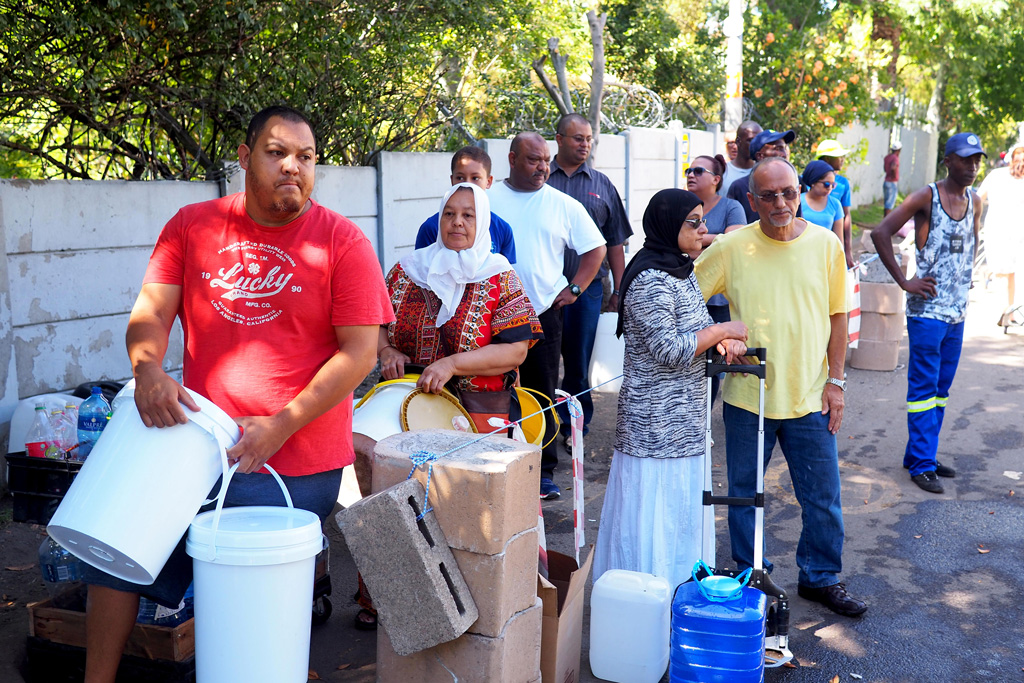
Capetonians queue for water at natural springs around the city during the water crisis, January 2018. Credit: tim wege / Alamy Stock Photo
This mixed bag of results reflects the inherent complexity of droughts. And, again, the specific question matters. Conclusions about the role of climate change in a specific drought could depend on whether a study looks at temperature, rainfall or soil moisture, for example.
As the 2015 BAMS report explains:
“Drought continues to be an event type where the results require significant context, and easy answers often remain elusive because of the many meteorological, hydrological, and societal drivers that combine to cause drought.”
(For more on the different ways that droughts can be categorised, see this Carbon Brief guest post from 2018.)
Geographical reach
While much has been achieved in the field of extreme event attribution in a short space of time, scientists are constantly looking for ways to tailor their work to suit the people who might use it.
One major goal since the early days of the field has been to expand extreme event attribution to cover a larger and more diverse geographical area.
Where in the world scientists can carry out attribution studies – and for what kind of events – will always be limited by the quality and availability of observed data and appropriate models. The attribution map highlights, for example, that there are relatively few studies of extreme weather in Africa and South America.
In another example, scientists hoping to analyse Super Typhoon Mangkhut – which hit the Philippines in September 2018 – were unable to in part because of “very poor quality” observed data in publicly available datasets and a lack of models.
At the moment, there is also a heavy leaning towards weather events that are local to the modelling groups, or that have a particular scientific interest. Otto explains:
“For example, scientists often do attribution studies because an event occurs on their doorstep. The UK, California and Boulder [in Colorado] are, therefore, studied much more than other parts of the world, but that does not necessarily make them places particularly impacted by climate change.”
This means that while the studies carried out so far are indicative of the role climate change is playing in extreme weather around the world, they should not be considered representative of all types of extreme weather everywhere, says Otto. She tells Carbon Brief:
“[The studies so far] are part of a picture, but we don’t know what’s on the missing puzzle pieces. And, crucially, we don’t know how many pieces are missing.”
For example, Otto recently penned a Carbon Brief guest post on how the lack of monitoring of heatwaves in Africa means they are a “forgotten impact” of climate change.
Real-time extreme weather attribution
As well as expanding the science to cover different types of weather and more of the world, scientists are getting faster at turning the handle on extreme event attribution studies – sometimes crunching the numbers just days after an event has occurred.
The rapid studies included here are all produced by the World Weather Attribution (WWA) initiative, described earlier, or the UK Met Office.
An example of analysis performed by the latter includes their review of the UK’s weather in 2020, which was published by Carbon Brief. This showed that climate change increased the likelihood of the UK’s warm year by approximately a factor of 50.
While the WWA individual rapid assessments are not individually peer-reviewed, they are conducted using methods that have been through the peer-review process. As the 2014 BAMS report explains:
“Much like other routine analysis, such as an operational seasonal forecast, statements made about heat events using these methods do not necessarily need to go through the peer-reviewed literature to be considered credible.”
By conducting the analysis in the immediate aftermath of a weather event, these rapid studies provide almost-real-time information on the influence of climate change, rather than having to wait many months for a formal study.
(In some cases, these rapid assessments are later published in peer-reviewed journals. In these instances, the formal study is included in the attribution map, rather than the initial analysis. In some cases, this means earlier rapid assessments are removed from the Carbon Brief map in order to add in the relevant peer-reviewed paper once it is published.)

The European Centre for Medium-Range Weather Forecasts (ECMWF) has been working on a pilot “operational attribution service” through the Copernicus Climate Change Service (C3S).
This collaboration between the UK Met Office, German weather service (DWD), Meteo France, Dutch weather service (KNMI) and the University of Oxford will “demonstrate how attribution of extreme weather events can be carried out operationally by national meteorological services”, Prof Stott tells Carbon Brief:
“In this project we are developing and testing the protocols we will need to enable rapid and reliable assessments of the extent to which recent extreme weather events have been made more or less intense or more or less likely by climate change. We started at the beginning of the year and so far we have tested our procedures on an analysis of the 2018 heatwave in Europe.”
The progress to date has “demonstrated the importance of international collaboration for developing new techniques and processes”, says Stott. But “national meteorological services across Europe will continue to have a particular remit to deliver advice on weather and climate in their own countries”, he adds:
“At the Met Office in the UK we are developing our operational attribution capability to help inform the public, policymakers and journalists about the extent to which damaging extreme weather events like the floods in Yorkshire [in 2019] have been affected by climate change.”
An evolving science
As the science of extreme event attribution has matured and become more nuanced, so has the choice of terminology around extreme weather and climate change.
While some attest that all extreme weather must be affected by a world that is warming, this warrants some caution. As the first BAMS report in 2012 noted:
“While it has been argued that in the Anthropocene, all extreme weather or climate events that occur are altered by human influence on climate…this does not mean that climate change can be blamed for every extreme weather or climate event. After all, there has always been extreme weather.”
But while it would be premature to suggest that any single study is the last word, it is clear that – in many cases – the science can do better than that. Similarly, scientific thinking has clearly moved on from the unsatisfactory statement that it is not possible to attribute any individual weather event to climate change. Indeed, as mentioned earlier, there have been some studies that have concluded that an event – or aspect of an event – would have been impossible without climate change.
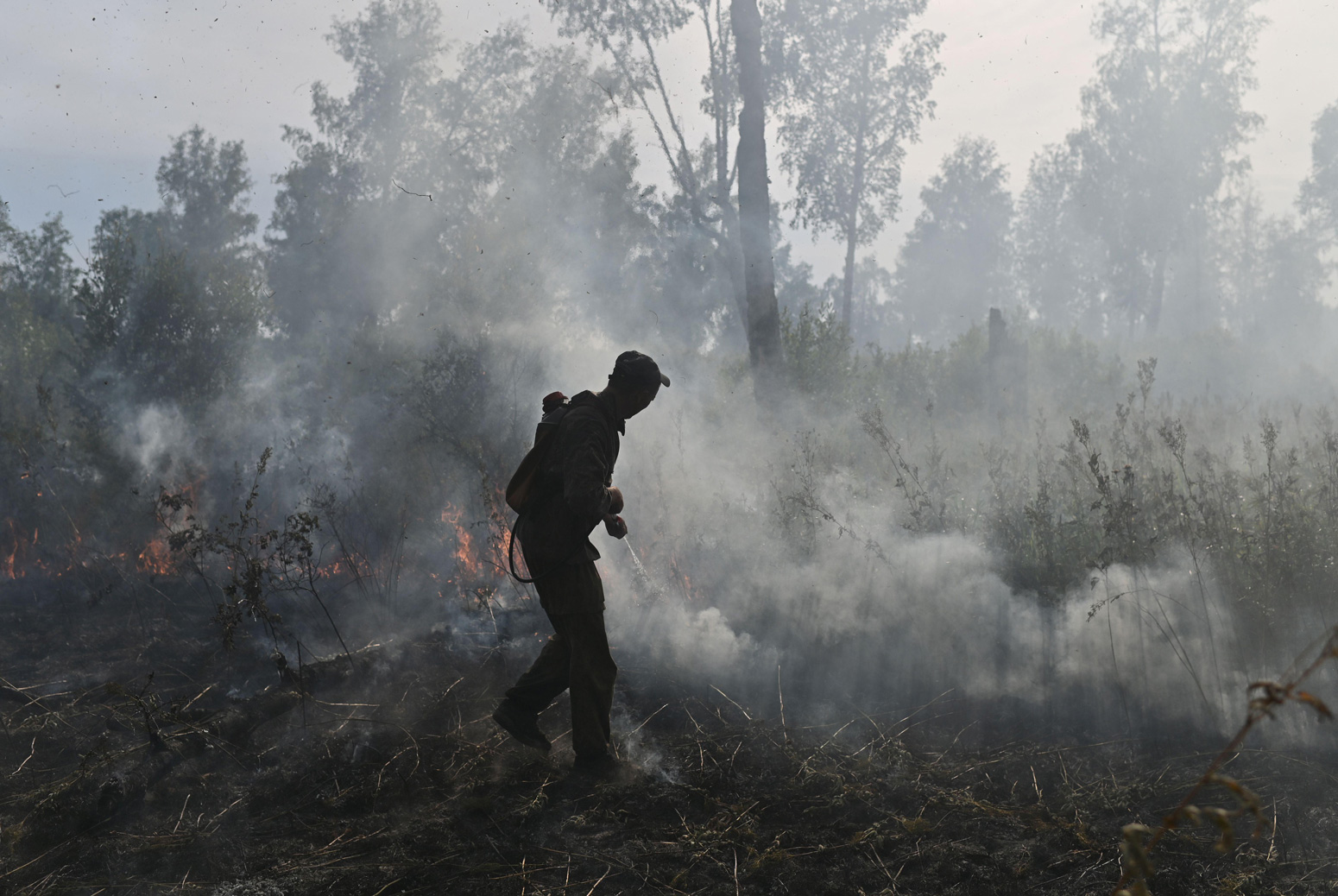
Ultimately, there are no blanket rules in attribution. Scientists need to examine the circumstances of each individual weather event – or a longer pattern of events for trend studies. It is only by combining evidence from all around the world that they can begin to draw broader conclusions.
Attribution studies, therefore, rely heavily on the quality and availability of observational data and climate model simulations. In a short paper for the journal Weather, Dr Otto says that “the models used for attribution need to be able to reliably estimate the likelihoods of the types of events being attributed”.
As discussed earlier, attribution studies of heatwaves tend to be more straightforward because of their focus on thermodynamic effects, rather than atmospheric circulation. Yet, Otto tells Carbon Brief that recent studies suggest models overestimate the year-to-year variability of heat extremes in some parts of the world, and thus underestimate the trend and the role of climate change.
In a rapid attribution study of the western Europe summer heatwave in 2019, for example, Otto and her colleagues found that, for the month of June, the models “show about 50% smaller trends than observations in this part of Europe and much higher year-to-year variability than the observations”. Similarly, a study of the 2019-20 Australian bushfires noted that “models underestimate the observed trend in heat” and so the “real increase could be much higher”.
These findings emphasise how important it is to analyse models and observations together, Otto says:
“This made me realise just how important attribution is for the scientific community – and everyone using climate science – at bringing observations and models together in a very concrete real-world test case.
Attribution can, therefore, be used to help scientists “identify where the models are doing well and for what they are not in a much more direct way than the classical skill assessment of climate projections does”, adds Otto.
Forecasted attribution
One attempt to move attribution science forward was the very first “advance forecasted” attribution analysis, which quantified the impact of climate change on the size, rainfall, and intensity of Hurricane Florence before it made landfall in North Carolina in September 2018.
The analysis ran two sets of short-term forecasts for the hurricane: one as the climate is today and the other in a simulated world without human-caused climate change. The researchers concluded at the time:
“We find that rainfall will be significantly increased by over 50% in the heaviest precipitating parts of the storm. This increase is substantially larger than expected from thermodynamic considerations alone. We further find that the storm will remain at a high category on the Saffir-Simpson scale for a longer duration and that the storm is approximately 80km in diameter larger at landfall because of the human interference in the climate system.”
The analysis received a mixed reaction. Prof Stott told Carbon Brief that it was “quite a cool idea”, but would be dependent on being able to forecast such events reliably. Dr Kevin Trenberth, distinguished senior scientist at the National Center for Atmospheric Research, described it as “a bit of a disaster”. He told Carbon Brief that the quality of the forecast was questionable for the assessment:
“The forecasts made were not good: the intensity of the forecast storm at landfall was category 4 or 5 as I recall, instead of category 2. And so the statements made were based on quite flawed assumptions: namely, that they had a good forecast.”
A key requirement for a reliable attribution study is for models to accurately replicate the extreme event, Trenberth added, but “obviously one can not assess the goodness of the forecast if one does this in advance”.

The authors subsequently published a paper in Science Advances that “reviews the forecasted attribution with the benefit of hindsight”. The findings show that climate change increased rainfall amounts “associated with the forecasted storm’s core” by around 5%, and contributed to Hurricane Florence being “about 9km larger in mean maximum diameter (or a 1.6% increase in storm area) due to climate change”.
The authors acknowledged that the “quantitative aspects of our forecasted attribution statements fall outside broad confidence intervals of our hindcasted statements and are quite different from the hindcasted best estimates”. In short, the results are quite a way off what they forecasted.
However, the authors also said they have identified what went wrong with their forecasted analysis. Problems with the way their “without climate change” model runs were set up created a larger contrast against their real-world simulations. The results thus suggested that climate change would have a bigger impact than it actually did.
Nonetheless, the study did identify a quantifiable impact of climate change on Hurricane Florence, adding to the evidence from studies by other author groups, the researchers concluded:
“As the climate continues to warm, it is expected that extreme tropical cyclone precipitation events and resulting inland flooding will become yet more frequent.”
In addition, a 2021 study of the record Australian heat event of October 2015 noted the potential of their methods “to provide attribution statements for forecast events within an outlook period”. This will “allow for informed messaging to be available as required when an extreme event occurs, which is of particular use to weather and climate services”, the authors wrote.
On the topic of forecasts, a 2021 study showed how it was possible to use a weather forecast model for attribution. The researchers, who penned a Carbon Brief guest post about their work, tested their methods using the European heatwave of February 2019 – an event their model successfully predicted:
“We find that the direct impact of the extra carbon dioxide (CO2) that humans have pumped into the atmosphere made the event 42% more likely for the British Isles and at least 100% (two times) more likely for France.”
Their work “so far represents just the first few steps towards an operational forecast-based attribution system”, they noted.
Finally, as well as casting forwards, attribution can also look back in time. A 2020 study on the US “Dust Bowl” heat and drought events of the 1930s takes an unconventional approach of looking at how the past event “would behave” with present-day levels of greenhouse gases.
The researchers find that “the return period of a 1-in-100-year heatwave summer (as observed in 1936) would be reduced to about 1-in-40 years” in today’s climate.
Carbon Brief will continue to add new extreme event attribution studies to the map and update the accompanying analysis every year. Please get in touch with any suggestions of attribution studies that could be included.
The post Mapped: How climate change affects extreme weather around the world appeared first on Carbon Brief.
https://www.carbonbrief.org/mapped-how-climate-change-affects-extreme-weather-around-the-world/
Greenhouse Gases
DeBriefed 12 December: EU under ‘pressure’; ‘Unusual warmth’ explained; Rise of climate boardgames
Welcome to Carbon Brief’s DeBriefed.
An essential guide to the week’s key developments relating to climate change.
This week
EU sets 2040 goal
CUT CRUNCHED: The EU agreed on a legally binding target to reduce greenhouse gas emissions by 90% from 1990 levels by 2040, reported the EU Observer. The publication said that this agreement is “weaker” than the European Commission’s original proposal as it allows for up to five percentage points of a country’s cuts to be achieved by the use of foreign carbon credits. Even in its weakened form, the goal is “more ambitious than most other major economies’ pledges”, according to Reuters.
PETROL CAR U-TURN: Commission president Ursula von der Leyen has agreed to “roll back an imminent ban on the sale of new internal combustion-engined cars and vans after late-night negotiations with the leader of the conservative European People’s Party,” reported Euractiv. Car makers will be able to continue selling models with internal combustion engines as long as they reduce emissions on average by 90% by 2035, down from a previously mandated 100% cut. Bloomberg reported that the EU is “weighing a five-year reprieve” to “allow an extension of the use of the combustion engine until 2040 in plug-in hybrids and electric vehicles that include a fuel-powered range extender”.
CORPORATE PRESSURE: Reuters reported that EU countries and the European parliament struck a deal to “cut corporate sustainability laws, after months of pressure from companies and governments”. It noted that the changes exempt businesses with fewer than 1,000 employees from reporting their environmental and social impact under the corporate sustainability reporting directive. The Guardian wrote that the commission is also considering a rollback of environment rules that could see datacentres, artificial intelligence (AI) gigafactories and affordable housing become exempt from mandatory environmental impact assessments.
Around the world
- EXXON BACKPEDALS: The Financial Times reported on ExxonMobil’s plans to “slash low-carbon spending by a third”, amounting to a reduction of $10bn over the next 5 years.
- VERY HOT: 2025 is “virtually certain” to be the second or third-hottest year on record, according to data from the EU’s Copernicus Climate Change Service, covered by the Guardian. It reported that global temperatures from January-November were, on average, 1.48C hotter than preindustrial levels.
- WEBSITE WIPE: Grist reported that the US Environmental Protection Agency has erased references to the human causes of climate change from its website, focusing instead on “natural processes”, such as variations in the Earth’s orbit. On BlueSky, Carbon Brief contributing editor Dr Zack Labe described the removal as “absolutely awful”.
- UN REPORT: The latest global environment outlook, a largest-of-its-kind UN environment report, “calls for a new approach to jointly tackle the most pressing environmental issues including climate change and biodiversity loss”, according to the Associated Press. However, report co-chair Sir Robert Watson told BBC News that a “small number of countries…hijacked the process”, diluting its potential impact.
$80bn
The amount that Chinese firms have committed to clean technology investments overseas in the past year, according to Reuters.
Latest climate research
- Increases in heavy rainfall and flooding driven by fossil-fuelled climate change worsened recent floods in Asia | World Weather Attribution
- Human-caused climate change played a “substantial role” in driving wildfires and subsequent smoke concentrations in the western US between 1992-2020 | Proceedings of the National Academy of Sciences
- Thousands of land vertebrate species over the coming decades will face extreme heat and “unsuitable habitats” throughout “most, or even all” of their current ranges | Global Change Biology
(For more, see Carbon Brief’s in-depth daily summaries of the top climate news stories on Monday, Tuesday, Wednesday, Thursday and Friday.)
Captured

The years 2023 and 2024 were the warmest on record – and 2025 looks set to join them in the top three. The causes of this apparent acceleration in global warming have been subject to a lot of attention in both the media and the scientific community. The charts above, drawn from a new Carbon Brief analysis, show how the natural weather phenomenon El Niño, sulphur dioxide (SO2) emissions from shipping, Chinese SO2, an eruption from the Hunga Tonga-Hunga Ha’apai volcano and solar cycle changes account for most of the “unusual warmth” of recent years. Dark blue bars represent the contribution of individual factors and their uncertainties (hatched areas), the light blue bar shows the combined effects and combination of uncertainties and the red bar shows the actual warming, compared with expectations.
Spotlight
Climate change boardgames
This week, Carbon Brief reports on the rise of climate boardgames.
Boardgames have always made political arguments. Perhaps the most notorious example is the Landlord’s Game published by US game designer and writer Lizzie Magie in 1906, which was designed to persuade people of the need for a land tax.
This game was later “adapted” by US salesman Charles Darrow into the game Monopoly, which articulates a very different set of values.
In this century, game designers have turned to the challenge of climate change.
Best-selling boardgame franchise Catan has spawned a New Energies edition, where players may choose to “invest in clean energy resources or opt for cheaper fossil fuels, potentially causing disastrous effects for the island”.
But perhaps the most notable recent release is 2024’s Daybreak, which won the prestigious Kennerspiel des Jahre award (the boardgaming world’s equivalent of the Oscars).
Rolling the dice
Designed by gamemakers Matteo Menapace and Matt Leacock, Daybreak sees four players take on the role of global powers: China, the US, Europe and “the majority world”, each with their own strengths and weaknesses.
Through playing cards representing policy decisions and technologies, players attempt to reach “drawdown”, a state where they are collectively producing less CO2 than they are removing from the atmosphere.
“Games are good at modelling systems and the climate crisis is a systemic crisis,” Daybreak co-designer Menapace told Carbon Brief.
In his view, boardgames can be a powerful tool for getting people to think about climate change. He said:
“In a video game, the rules are often hidden or opaque and strictly enforced by the machine’s code. In contrast, a boardgame requires players to collectively learn, understand and constantly negotiate the rules. The players are the ‘game engine’. While videogames tend to operate on a subconscious level through immersion, boardgames maintain a conscious distance between players and the material objects they manipulate.
“Whereas videogames often involve atomised or heavily mediated social interactions, boardgames are inherently social experiences. This suggests that playing boardgames may be more conducive to the exploration of conscious, collective, systemic action in response to the climate crisis.”
Daybreak to Dawn
Menapace added that he is currently developing “Dawn”, a successor to Daybreak, building on lessons he learned from developing the first game, telling Carbon Brief:
“I want the next game to be more accessible, especially for schools. We learned that there’s a lot of interest in using Daybreak in an educational context, but it’s often difficult to bring it to a classroom because it takes quite some time to set up and to learn and to play.
“Something that can be set up quickly and that can be played in half the time, 30 to 45 minutes rather than an hour [to] an hour and a half, is what I’m currently aiming for.”
Dawn might also introduce a new twist that explores whether countries are truly willing to cooperate on solving climate change – and whether “rogue” actors are capable of derailing progress, he continued:
“Daybreak makes this big assumption that the world powers are cooperating, or at least they’re not competing, when it comes to climate action. [And] that there are no other forces that get in the way. So, with Dawn, I’m trying to explore that a bit more.
“Once the core game is working, I’d like to build on top of that some tensions, maybe not perfect cooperation, [with] some rogue players.”
Watch, read, listen
WELL WATCHERS: Mother Jones reported on TikTok creators helping to hold oil companies to account for cleaning up abandoned oil wells in Texas.
RUNNING SHORT: Wired chronicled the failure of carbon removal startup Running Tide, which was backed by Microsoft and other tech giants.
PARIS IS 10: To mark the 10th anniversary of the Paris Agreement, climate scientist Prof Piers Forster explained in Climate Home News “why it worked” and “what it needs to do to survive”.
Coming up
- 15-19 December: American Geophysical Union (AGU) annual meeting, New Orleans
- 15-19 December: 70th Meeting of the Global Environment Facility (Gef) Council, online
- 16 December: International Energy Agency: Future of electricity in the Middle East and North Africa webinar, online
Pick of the jobs
- Natural Resources Wales, senior strategic environmental policy specialist | Salary: Unknown. Location: Wales (hybrid)
- The Nature Conservancy, director of conservation – Mata Atlântica | Salary: Unknown. Location: São Paulo, Belo Horizonte, Rio de Janeiro and nearby cities, Brazil
- Barcelona Supercomputing Centre, postdoctoral researcher – downscaling for climate services | Salary: Unknown. Location: Barcelona, Spain
DeBriefed is edited by Daisy Dunne. Please send any tips or feedback to debriefed@carbonbrief.org.
This is an online version of Carbon Brief’s weekly DeBriefed email newsletter. Subscribe for free here.
The post DeBriefed 12 December: EU under ‘pressure’; ‘Unusual warmth’ explained; Rise of climate boardgames appeared first on Carbon Brief.
DeBriefed 12 December: EU under ‘pressure’; ‘Unusual warmth’ explained; Rise of climate boardgames
Greenhouse Gases
‘Cali Fund’ aiming to raise billions for nature receives first donation – of just $1,000
A major biodiversity fund – which could, in theory, generate billions of dollars annually for conservation – received its first donation of just $1,000 in November.
The Cali Fund was created under the UN Convention on Biological Diversity (CBD) at the COP16 nature negotiations in Cali, Colombia, last year.
On 19 November, nine months after the fund officially launched, UK start-up TierraViva AI put forward the first contribution.
The $1,000 payment is an “ice-breaker”, the company’s chief executive tells Carbon Brief, aimed at encouraging others “who may be hesitating” to pay in.
The fund is designed to be a way for companies that rely on nature’s genetic resources to share some of their earnings with the developing, biodiverse countries where many of the original resources are found.
Companies use genetic data from these materials to develop products, such as vaccines and skin cream.
One expert describes the $1,000 as a good “first step”, but says it is “time for larger actors to step forward”. Another says it “squarely points the finger to the profit-making enterprises that are not contributing”.
The CBD is “pleased” about the first payment, a spokesperson tells Carbon Brief, adding that “many discussions” are ongoing about future donations.
Funding biodiversity action
Companies all around the world use genetic materials from plants, animals, bacteria and fungi often found in biodiversity-rich, global south countries to develop their products.
There are existing rules in place to secure consent and ensure compensation if companies or researchers travel to a country to physically gather these materials.
Today, however, much of this information is available in online databases – with few rules in place around access. This genetic data is known as digital sequence information (DSI).
The Cali Fund is part of an effort to close this loophole.
The COP16 agreement on the creation of the fund outlined that large companies in several sectors, including pharmaceutical, cosmetic, biotechnology, agribusiness and technology, “should” contribute a cut of the money they earn from the use of these materials. (See: Carbon Brief’s infographic on DSI.)
The money is intended to fund biodiversity action, with 50% of resources going to Indigenous peoples and local communities who protect vast swathes of the world’s nature and biodiversity.
These contributions, however, are voluntary.
The fund officially launched at the resumed COP16 negotiations in Rome in February 2025, where a spokesperson for the CBD said that first contributions could be announced in spring.
However, Carbon Brief reported in August that the fund was still empty.
On 19 November, the first contribution was announced during the COP30 UN climate summit. At $1,000, the amount was significantly lower than the potential millions that larger companies could pay in.
A UK government press release described it as a “major milestone” that will “pav[e] the way for others to do the same and mobilise private sector finance for nature at scale”.

The payment was an “expression of our commitment to the objectives of the Cali Fund”, TierraViva AI chief executive Dr Paul Oldham wrote in a letter to the executive secretary of the CBD, Astrid Schomaker.
The $1,000 is an “initial contribution”, Oldham said, and the company plans to give more “as our business grows”. Based in the UK with a team of programmers in Nairobi, TierraViva AI was set up in 2023 and uses AI to support conservation.
An anthropologist who worked on Indigenous peoples’ rights in the Amazon, Oldham’s research helped inform the list of sectors most likely to “directly or indirectly benefit from the use of DSI”, including “generative biology” and AI companies.
Oldham noted in a speech at the sidelines of COP30 that although the company’s earnings are not large enough to meet the contribution thresholds set out in the Cali Fund agreement, its contribution showed that companies “of any size” can pay in.

He tells Carbon Brief that while “some” companies “are not serious about contributing and are seeking to delay” paying into the fund, others have different concerns, including the “need for a level playing field” and positive incentives to contribute:
“This will be hard-earned company money, so it’s reasonable enough to imagine that one of the first questions companies will want an answer to is: ‘well, what is this actually going to be spent on?’ And: ‘what is the benefit of this to us’, which is likely to vary by sector.
“In my view, the best way forward would be for companies that can to make contributions. That would give everybody, including governments, confidence that there might be constructive ways to address difficult topics.”
Future contributions
A spokesperson for the CBD tells Carbon Brief:
“We are pleased that the Cali Fund is not only ‘open for business’, but that this first contribution also demonstrates it is fully operational. We thank and congratulate TierraViva AI for being the first company to step up.”
“Many discussions” are ongoing around future donations to the fund, the spokesperson says, and the CBD is “hopeful that further announcements can be made soon”, ahead of the next UN biodiversity summit, COP17, in October 2026.
Asked whether the CBD was expecting more contributions at this stage, the spokesperson says the fund was set up in “very short order” and that the first payment shows that companies are “able to contribute”.
US biotechnology company Ginkgo Bioworks was the first to pledge to contribute to the fund earlier this year, but has so far not put forward any money. The company did not respond to Carbon Brief’s request for comment.
Carbon Brief reported earlier this year that at least two companies were contacted by a UK department with opportunities to be involved in the Cali Fund before its launch in February, but no company took up on the offer.

The first contribution coming from a “startup that has just begun operations squarely points the finger to the profit-making enterprises that are not contributing”, Dr Siva Thambisetty, associate professor of law at the London School of Economics, tells Carbon Brief. Thambisetty adds:
“Strident cries of lack of legal certainty, unfairness or stacking obligations [combining responsibilities from different agreements and laws] would be more credible if industry organisations encouraged large firms that use DSI to begin contributing, instead of denying the last 20 years of multilateral [negotiations] that have led to this point.”
Dr June Rubis – Indigenous peoples and local communities (IPLC) lead from Asia on the Cali Fund’s steering committee – welcomes TierraViva AI’s “first step”, but tells Carbon Brief that the “real test lies ahead” and that it is “now time for larger actors to step forward”.
She says the Cali Fund offers “clarity” on how the private sector can directly increase support to UN-backed funds at a time when “states are retreating” from their climate and biodiversity finance obligations:
“It’s not a voluntary offsetting scheme or a…risky or fringe fund; it’s a multilateral mechanism designed to meet the highest fiduciary and equity standards. We invite companies to see this not as philanthropy, but as participation in a globally endorsed system where trust is institutionalised, benefits are traceable and equity is operationalised.
“Contributing to the Cali Fund isn’t just ethical, it’s strategic. [But] It’s about more than funding: it’s about trust, power-sharing and making sure IPLCs are part of the decisions, not just the outcomes.”
The post ‘Cali Fund’ aiming to raise billions for nature receives first donation – of just $1,000 appeared first on Carbon Brief.
‘Cali Fund’ aiming to raise billions for nature receives first donation – of just $1,000
Greenhouse Gases
Net-zero scenario is ‘cheapest option’ for UK, says energy system operator
A scenario that meets the “net-zero by 2050” goal would be the “cheapest” option for the UK, according to modelling by the National Energy System Operator (NESO).
In a new report, the organisation that manages the UK’s energy infrastructure says its “holistic transition” scenario would have the lowest cost over the next 25 years, saving £36bn a year – some 1% of GDP – compared to an alternative scenario that slows climate action.
These savings are from lower fuel costs and reduced climate damages, relative to a scenario where the UK fails to meet its climate goals, known as “falling behind”.
The UK will need to make significant investments to reach net-zero, NESO says, but this would cut fossil-fuel imports, support jobs and boost health, as well as contributing to a safer climate.
Slowing down these efforts would reduce the scale of investments needed, but overall costs would be higher unless the damages from worsening climate change are “ignored”, the report says.
In an illusory world where climate damages do not exist, slowing the UK’s efforts to cut emissions would generate “savings” of £14bn per year on average – some 0.4% of GDP.
NESO says that much of this £14bn could be avoided by reaching net-zero more cheaply and that it includes costs unrelated to climate action, such as a faster rollout of data centres.
Notably, the report appears to include efforts to avoid the widespread misreporting of a previous edition, including in the election manifesto of the hard-right, climate-sceptic Reform UK party.
Overall, NESO warns that, as well as ignoring climate damages, the £14bn figure “does not represent the cost of achieving net-zero” and cannot be compared with comprehensive estimates of this, such as the 0.2% of GDP total from the UK’s Climate Change Committee (CCC).
Net-zero is the ‘cheapest option’
Every year, NESO publishes its “future energy scenarios”, a set of four pathways designed to explore how the nation’s energy system might change over the coming decades.
(Technically the scenarios apply to the island of Great Britain, rather than the whole UK, as Northern Ireland’s electricity system is part of a separate network covering the island of Ireland.)
Published in July, the scenarios test a series of questions, such as what it would mean for the UK to meet its climate goals, whether it is possible to do so while relying heavily on hydrogen and what would happen if the nation was to slow down its efforts to cut emissions.
The scenarios have a broad focus and do not only consider the UK’s climate goals. In addition, they also explore the implications of a rapid growth in electricity demand from data centres, the potential for autonomous driving and many other issues.
With so many questions to explore, the scenarios are not designed to keep costs to a minimum. In fact, NESO does not publish related cost estimates in most years.
This year, however, NESO has published an “economics annex” to the future energy scenarios. It last published a similar exercise in 2020, with the results being widely misreported.
In the new annex, NESO says that the UK currently spends around 10% of GDP on its energy system. This includes investments in new infrastructure and equipment – such as cars, boilers or power plants – as well as fuel, running and maintenance costs.
This figure is expected to decline to around 5% of GDP by 2050 under all four scenarios, NESO says, whether they meet the UK’s net-zero target or not.
For each scenario, the annex adds up the total of all investments and ongoing costs in every year out to 2050. It then adds an estimate of the economic damages from the greenhouse gas emissions that primarily come from burning fossil fuels, using the Treasury’s “green book”.
When all of these costs are taken into account, NESO says that the “cheapest” option is a pathway that meets the UK’s climate goals, including all of the targets on the way to net-zero by 2050.
It says this pathway, known as “holistic transition”, would bring average savings of £36bn per year out to 2050, relative to a pathway where the UK slows its efforts on climate change.
The overall savings, illustrated by the dashed line in the figure below, stem primarily from lower fuel costs (orange bars) and reduced climate damages (white bars).

Note that the carbon pricing that is already applied to power plants and other heavy industry under the UK’s emissions trading system (ETS) is excluded from running costs in the annex, appearing instead within the wider “carbon costs” category.
This makes the running costs of fossil-fuel energy sources seem cheaper than they really are, when including the ETS price.
Net-zero requires significant investment
While NESO says that its net-zero compliant “holistic transition” pathway is the cheapest option for the UK, it does require significant upfront investments.
The scale of the additional investments needed to stay on track for the UK’s climate goals, beyond a pathway where those targets are not met, is illustrated in the figure below.
This shows that the largest extra investments would need to be made in the power sector, such as by building new windfarms (shown by the dark yellow bars). This is followed by investment needs for homes, such as to install electric heat pumps instead of gas boilers (dark red bars).
These additional investments would amount to around £30bn per year out to 2050, but with a peak of as much as £60bn over the next decade.
These investments would be offset by lower fuel bills, including reduced gas use in homes (pale red) and lower oil use in transport (mid green).
Notably, NESO says it expects EVs to be cheaper to buy than petrol cars from 2027, meaning there are also significant savings in transport capital expenditure (“CapEx”, dark green).

Again, the biggest savings in “holistic transition” relative to “falling behind” would come from avoided climate damages – described by NESO as “carbon costs”.
Net-zero cuts fossil-fuel imports
In addition to avoided climate damages, NESO says that reaching the UK’s net-zero target would bring wider benefits to the economy, including lower fuel imports.
Specifically, it says that climate efforts would “materially reduce” the UK’s dependency on overseas gas, with imports falling to 78% below current levels by 2050 in “holistic transition”. Under the “falling behind” scenario, imports rise by 35%”, despite higher domestic production.
This finding, shown in the figure below, is the opposite of what has been argued by many of those that oppose the UK’s net-zero target.

NESO goes on to argue that the shift to net-zero would have wider economic benefits. These include a shift from buying imported fossil fuels to investing money domestically instead, which “could bring local economic benefits and support future employment”.
The operator says that there is the “potential for more jobs to be created than lost in the transition to net-zero” and that there would be risks to UK trade if it fails to cut emissions, given exports to the EU – the UK’s main trading partner – would be subject to the bloc’s new carbon border tax.
Beyond the economy, NESO points to studies finding that the transition to net-zero would have other benefits, including for human health and the environment.
It does not attempt to quantify these benefits, but points to analysis from the CCC finding that health benefits alone could be worth £2.4-8.2bn per year by 2050.
Investment is higher for net-zero than for ‘not-zero’
It is clear from the NESO annex that its net-zero compliant “holistic transition” pathway would entail significantly more upfront investment than if climate action is slowed under “falling behind”.
This idea, in effect, is the launchpad for politicians arguing that the UK should walk away from its climate commitments and stop building new low-carbon infrastructure.
As already noted, the NESO analysis shows that this would increase costs to the UK overall.
Still, NESO’s new report adds that “falling behind” would “save” £14bn a year – relative to meeting the UK’s net-zero target – as long as carbon costs are “ignored”.
Specifically, it says that ignoring carbon costs, “holistic transition” would cost an average of £14bn a year more out to 2050 than “falling behind”, which misses the net-zero target. This is equivalent to 0.4% of the UK’s GDP and is illustrated by the solid pink line in the figure below.

Some politicians are indeed now willing to ignore the problem of climate change and the damages caused by ongoing greenhouse gas emissions. These politicians may therefore be tempted to argue that the UK could “save” £14bn a year by scrapping net-zero.
However, NESO’s report cautions against this, stating explicitly that the “costs discussed here do not represent the cost of achieving net-zero emissions”. It says:
“Our pathways cannot provide firm conclusions over the relative costs attached to the choices between pathways…We reiterate that the costs discussed here do not represent the cost of achieving net-zero emissions.”
It says that the scenarios have not been designed to minimise costs and that it would be possible to reach net-zero more cheaply, for example by focusing more heavily on EVs and renewables instead of hydrogen and nuclear.
Moreover, it says that some of the difference in costs between “holistic transitions” and “falling behind” is unrelated to climate action. Specifically, it says that electricity demand from data centres is around twice as high in “holistic transitions”, adding some £5bn a year in costs in 2050.
In addition, NESO says that most of the “saving” in “falling behind” would be wiped out if fossil fuel prices are higher than expected – falling from £14bn per year to just £5bn a year – even before considering climate damages and wider benefits, such as for health.
Finally, NESO says that failing to make the transition to net-zero would leave the UK more exposed to fossil-fuel price shocks, such as the global energy crisis that added 1.8% to the nation’s energy costs in 2022. It says a similar shock would only cost 0.3% of GDP in 2050 if the country has reached net-zero – as in “holistic transition” – whereas costs would remain high in “falling behind”.
The post Net-zero scenario is ‘cheapest option’ for UK, says energy system operator appeared first on Carbon Brief.
Net-zero scenario is ‘cheapest option’ for UK, says energy system operator
-
Climate Change4 months ago
Guest post: Why China is still building new coal – and when it might stop
-
Greenhouse Gases4 months ago
Guest post: Why China is still building new coal – and when it might stop
-
Climate Change2 years ago
Spanish-language misinformation on renewable energy spreads online, report shows
-
Greenhouse Gases2 years ago嘉宾来稿:满足中国增长的用电需求 光伏加储能“比新建煤电更实惠”
-
Climate Change Videos2 years ago
The toxic gas flares fuelling Nigeria’s climate change – BBC News
-
Climate Change2 years ago嘉宾来稿:满足中国增长的用电需求 光伏加储能“比新建煤电更实惠”
-
Carbon Footprint2 years agoUS SEC’s Climate Disclosure Rules Spur Renewed Interest in Carbon Credits
-
Climate Change2 years ago
Why airlines are perfect targets for anti-greenwashing legal action


