

For several years, the UK car industry has been claiming that demand is not high enough to meet the government’s targets for sales of “zero emissions vehicles” (ZEVs).
To date, however, the car industry has actually beaten the targets under the government’s “ZEV mandate”.
This pattern of claiming demand is not high enough is being repeated in a regular cycle, following the publication of monthly statistics on new UK car sales by the Society of Motor Manufacturers and Traders (SMMT).
Each month, this messaging is amplified by large sections of the media, which have published dozens of articles stating – incorrectly – that car companies are missing their ZEV targets.
Meanwhile, the car industry is lobbying for an “urgent review” of the targets, on the basis that “natural demand is still well below the level demanded by the [ZEV] mandate”.
UK car market has ‘over-complied’ with its targets
In 2021, the UK’s then Conservative government developed the idea of a “ZEV mandate” as a way to drive sales of electric vehicles (EVs).
The idea, inspired by a similar scheme in California, is to set a rising target for the share of new car and van sales that must be “zero-emissions vehicles” (ZEVs) each year.
For cars, these targets started at 22% of sales 2024, increasing gradually each year to 80% by 2030.
Towards the end of the first year of the scheme, in November 2024, the SMMT warned that the industry was “likely to fall short”, with EVs making up “just…18.7%” of sales. It said:
“The industry looks likely to fall short of the 22% EV market share demanded, potentially creating a £1.8bn bill for compliance.”
(If manufacturers fall short of their target, they can still avoid having to pay a “bill for compliance” by trading “credits” with other firms, or “borrowing” allowances from future years.)
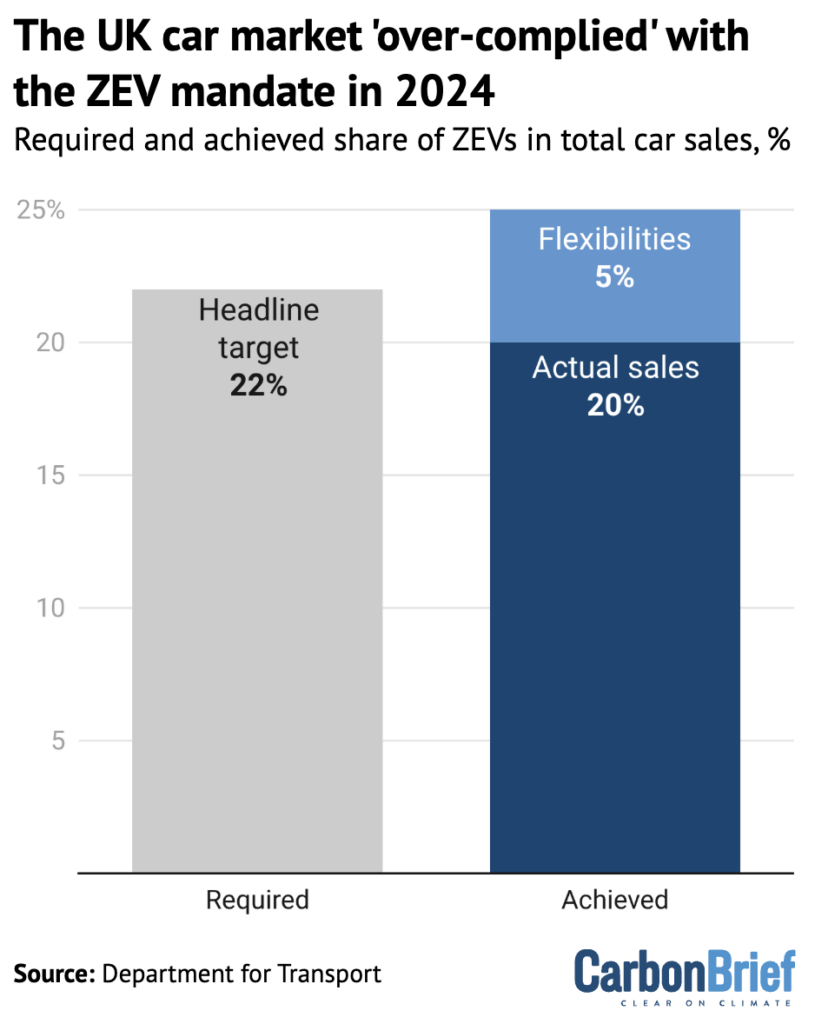
But, contrary to the industry messaging on the headline 22% goal, the car market actually “over-complied” in 2024, according to official figures published in early 2026.
As such, all carmakers in the UK avoided fines for failing to meet their ZEV-mandate targets.
This was despite only 19.8% of new sales being EVs in 2024 – a final tally that was notably more than one percentage point higher than the industry estimate from November of that year.
The industry was able to “over-comply” with the ZEV mandate because the regime has a series of “flexibilities”, which have been created and added to after lobbying by carmakers.
These “flexibilities” allow individual firms to reduce their targets for ZEV sales by selling combustion-engine cars with lower emissions, such as hybrids or plug-in EVs.
When these “flexibilities” are considered, the car market met the equivalent of a 24.5% target, according to the government, with the surplus of 2.5% being “banked” for use in future years. This is shown in the figure below.
In May 2026, the SMMT again told Carbon Brief that EV sales in 2024 had been below the headline target.
When asked by Carbon Brief to confirm that – per the official figures – the UK car market had, nevertheless, “over-complied” with the ZEV mandate in 2024, it did not respond.
Car industry continues to lobby for weaker rules
In a January 2026 release on car sales for the previous year, the SMMT said the “gap between demand [for EVs] and ambition [in the ZEV mandate] is increasing rather than diminishing”.
At the time, Carbon Brief asked the SMMT if it recognised independent estimates from thinktanks and NGOs, showing that – on the contrary – the car industry had also met its ZEV-mandate targets for 2025.
In response, the SMMT sent Carbon Brief a quote from SMMT chief executive Mike Hawes saying that “no one will know” if the industry complied with the 2025 target until official figures come out in 2027.
While this is technically true, the official figures for 2024 showed that the thinktanks and NGOs behind the independent estimates for 2025 had been accurate with their previous forecasts of compliance.
The car industry continues to repeat similar messaging.
The SMMT stated in May 2026 that there is a “persistent gap of around six percentage points against the mandate target” of 33% in 2026 and 38% in 2027. Chief executive Mike Hawes said in the statement that “natural demand is still well below the level demanded by the mandate”.
The gap that the SMMT is referring to is between the headline ZEV targets and the expected level of EV sales, which the body says will reach 27% of all new cars this year and 33% in 2027.
The car industry continues to use these figures to call for a review of the ZEV mandate.
In its latest news release, it says the UK “needs an urgent review” and quotes Hawes saying this should be used to “align policy with market realities”.
These comments are reflected in media coverage, with the Independent, for example, running a misleading headline that says the car market is “still missing government EV targets”. The article adds:
“[T]he industry is still warning that EV demand is not growing quickly enough to meet government targets.”
What neither the SMMT press release nor much of the media coverage mentions is the existing “flexibilities” under the ZEV mandate, which were already expanded last year.
This means the headline 33% goal for 2026 can be met, even if EVs only make up around 25% of sales, according to an estimate of the “real” target published by thinktank New Automotive.
Again, the SMMT expects EVs to make up around 27% of sales this year, which would be comfortably ahead of the “real” target once flexibilities are taken into account.
The government has already pledged to review the ZEV mandate, with the results due to be published in “early 2027”.
In April, car sales platform Autotrader announced that new EVs are now cheaper to buy than petrol cars on average, “for the first time”. EVs were already significantly cheaper to own.



The post Factcheck: What the UK car industry is not saying about EV targets appeared first on Carbon Brief.
Factcheck: What the UK car industry is not saying about EV targets

The board of the Fund for Responding to Loss and Damage (FRLD) will decide on Thursday on whether to “provisionally set aside” $20 million for Nepal to deal with some of the effects of the climate-driven flood it suffered in August.
The motion, seen by Climate Home News, has been drafted by a group of board members from both developed and developing countries and so is likely to pass easily at the fund’s first-ever extraordinary board meeting on October 22.
It invites the government of Nepal to submit a proposal for how to use the money, with the board then deciding at one of its regular board meetings whether to approve the proposal or not.
While Nepali officials have described $20 million as merely “symbolic” in the face of the $4.8 billion estimated costs of recovery and reconstruction, it would be the first time the new FRLD – agreed in 2022 months after devastating floods in Pakistan – has set aside money for a specific disaster.
Until now the fund has only taken requests through a single call for proposals, launched at COP30 in Belém last November, that gave countries six months to submit requests.
Most of the 180 projects the FRLD is currently considering are designed to help countries avoid damage from future climate disasters, for example by strengthening responses to floods in Bangladesh and Lagos.
The draft decision says Nepal’s proposal will serve as a pilot for how funding requests can be submitted outside of the fund’s current timetable. That could let governments seek funds quickly after a climate disaster strikes, rather than waiting for the next call.
This arrangement would set the fund apart from other United Nations funds designed for climate adaptation or cutting emissions like the Green Climate Fund.
Climate campaigners from Fill the Fund said the draft decision is “a real step forward” as it is “the first time this Fund has moved to respond to a specific disaster”.
Too little, too late
The FRLD was agreed by governments at COP27, set up and operationalised at COP28 in 2023 but has yet to award any money. The 180 funding requests it is currently considering would cost around $2.8 billion, but it only has $350 million to allocate.
The United Nations Secretary-General António Guterres has described the amount of money available in the fund as “ridiculously small” and Fill the Fund said $20 million “is a meaningful signal but it is a drop against an ocean of need”.
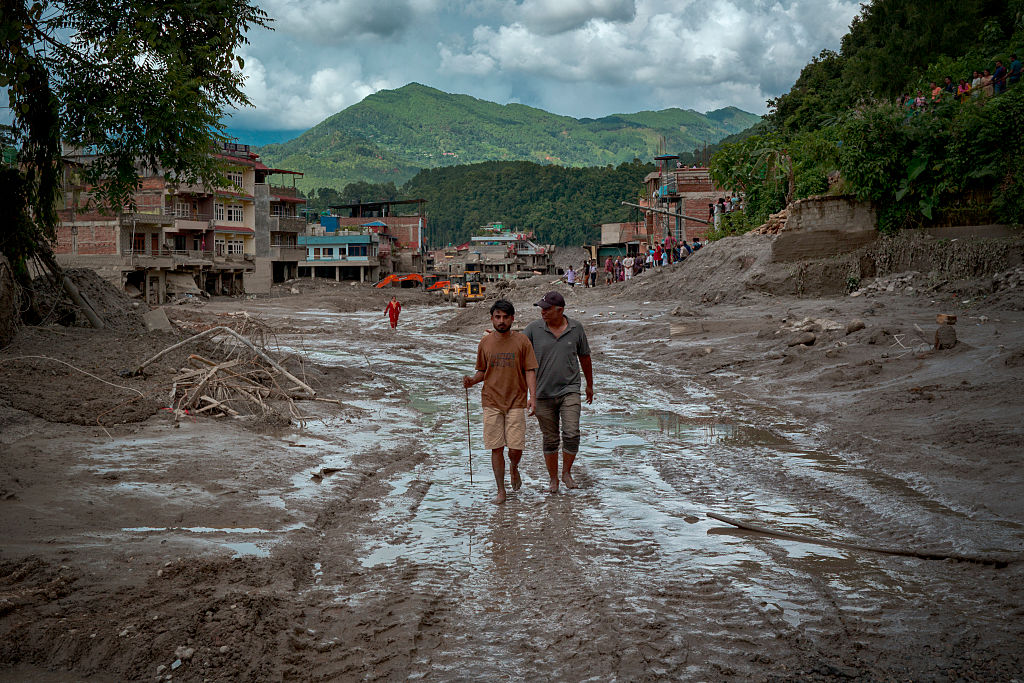
A glacial rock and ice collapse sent a torrent of water and debris through Nepal and the Chinese-administered region of Tibet on August 26. It killed more than 1,400 people, left thousands more missing and destroyed homes, bridges, roads and hydropower plants. Nepal’s finance and environment ministers quickly appealed to the FRLD board for funds, saying that “time is of the essence”.
Their call was followed swiftly by a letter from developing country FRLD board members urging the board’s co-chairs to organise an extraordinary meeting to allocate funds to Nepal.
But developed countries initially called for an informal consultation rather than a full board meeting. It took a further 45 days for the board’s co-chairs to organise an extraordinary board meeting for October 22 and to draft a motion for adoption.
Fill the Fund called for a permanent way of the fund rapid responding to disasters as “Nepal should not have required historic letters, an informal drafting group and the Fund’s first-ever extraordinary meeting simply to unlock an emergency response. The next country cannot wait two months and a bureaucratic marathon. Speed must be built in, not improvised.”
The post UN’s loss and damage fund set to give Nepal $20m for flood recovery appeared first on Climate Home News.
UN’s loss and damage fund set to give Nepal $20m for flood recovery
Some 58% of countries have met a UN call to submit new pledges on addressing nature loss – two years after the original deadline – according to Carbon Brief analysis.
Countries were asked to submit new pledges, known as national biodiversity strategies and action plans (NBSAPs), by the start of the COP16 biodiversity summit in October 2024.
After only 15% of nations met the original deadline, countries agreed at the summit to a new text that “urges” countries to release their NBSAPs “as soon as possible”.
Carbon Brief analysis shows that 113 countries have now come forward with new NBSAPs – up from 55 nations a year ago.
Countries will gather in Yerevan, Armenia, next week for COP17.
COP17 marks the halfway point of the Kunming-Montreal Global Biodiversity Framework (GBF), a landmark agreement made in 2022 to reverse nature decline by 2030.
The summit will provide the stage for the first global review of countries’ progress towards meeting the targets of the GBF.
Global review
In Montreal, Canada, in 2022, nearly every country in the world agreed to the GBF. The overall “mission” of the framework is to “halt and reverse” biodiversity loss by 2030.
The GBF includes a list of 23 targets for 2030. They cover an expansive range of topics, including restoring ecosystems, addressing climate change and providing developing nations with finance to help cover the costs of protecting nature.
As part of the GBF and its underlying documents, countries agreed to a schedule for monitoring their progress towards achieving the 2030 targets.
This included the preparation of a “global report” of progress coordinated by the UN, which will inform a “global review” undertaken by countries at COP17.
The global report draws on countries’ NBSAPs and national targets. It also draws on countries’ seventh national reports, which were due to be submitted to the UN in February of this year.
Carbon Brief analysis shows that 113 out of 196 parties (58%) have now met the call to produce a new NBSAP – up from 55 nations just a year ago.
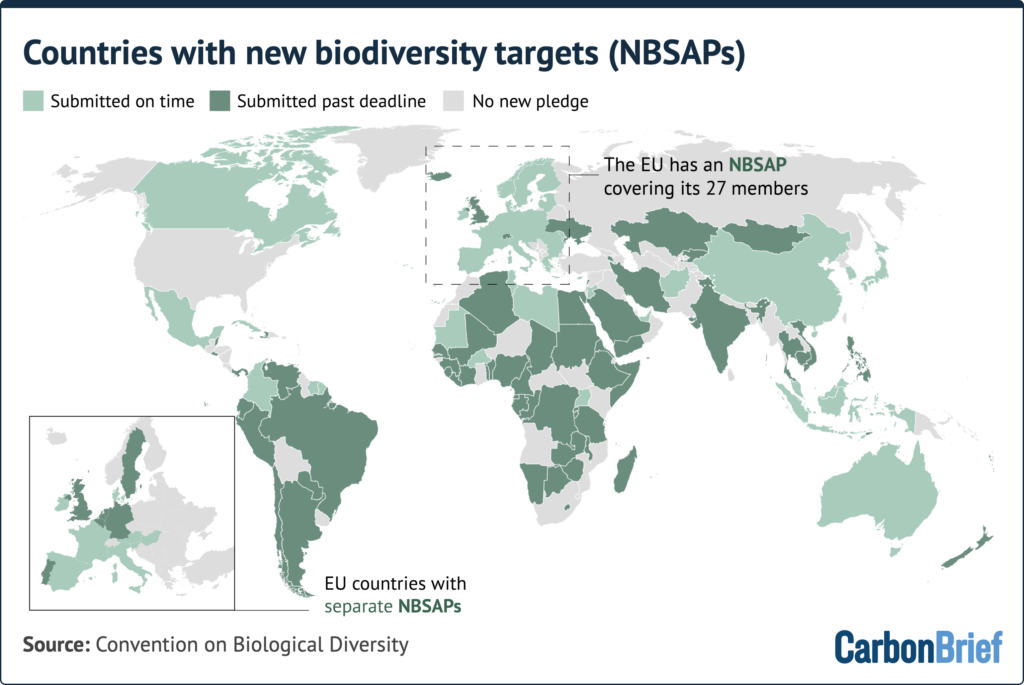
Since last year, many African nations have now published new NBSAPs.
African countries that have released new plans in the last year include: Algeria, Benin, Botswana, Cameroon, Comoros, Congo, Côte d’Ivoire, the Democratic Republic of Congo, Egypt, Equatorial Guinea, Eritrea, Ethiopia, Gabon, Gambia, Guinea, Lesotho, Liberia, Madagascar, Malawi, Mali, Namibia, Rwanda, Senegal, Sierra Leone, Somalia, Sudan, Zambia and Zimbabwe.
More South American nations have also published new NBSAPs. This includes Brazil – the world’s most biodiverse nation – as well as Belize and Chile.
COP17 host nation Armenia published its new NBSAP in April.
According to the GBF and its underlying documents, countries that were “not in a position” to meet the deadline to submit NBSAPs ahead of COP16 were requested to instead submit national targets.
Unlike NBSAPs, national targets simply list biodiversity goals that countries will aim for, without an accompanying plan for how they will be achieved.
Four of the world’s megadiverse nations – countries that account for the majority of Earth’s species – have not yet published new NBSAPs. These countries are Papua New Guinea, Peru, South Africa and the US.
The US is the only UN member country that is not a signatory to the UN Convention on Biological Diversity.
The country with the most land on Earth, Russia, has also not produced a new NBSAP.
By the end of COP16, some 119 parties had produced at least one national target. Two years later, this figure has risen to 175, or 89% of countries.
In addition, around half of countries met the deadline to produce their seventh national reports by February of this year. This figure has now risen to 73% of countries.
Over the past two years, many developing countries have expressed concerns that a lack of available funding has prevented them from publishing their NBSAPs.
A spokesperson for the Global Environment Facility (GEF), the multilateral fund that provides funding to help with the preparation of NBSAPs, told Carbon Brief in 2025 that 120 out of 139 countries that had requested financial support since COP16 had been able to access it.
The spokesperson added that the UN Environment Programme was “working to resolve outstanding issues” to allow the remaining 19 countries to access financial assistance.
Related


The post COP17: Which countries have released new pledges to tackle nature loss? appeared first on Carbon Brief.
COP17: Which countries have released new pledges to tackle nature loss?
The World Bank president said on Friday his organisation will continue to support some gas projects in developing countries alongside renewables, nuclear and hydropower, despite criticism from climate campaigners who say fossil gas is expensive and polluting.
“Homes, mines, factories, farms, and growing cities – what do they need? Reliable, affordable baseload power,” Ajay Banga told the bank’s annual meeting in Bangkok on Friday. “Our approach is balanced by design – a full mix of renewables, hydro, gas where appropriate, nuclear when it makes sense, transmission, grids, storage – the whole thing.”
His comments come in a week during which he faced pressure from the US to finance more gas projects and from climate campaigners to stop funding fossil fuels altogether, part of a tightrope he has walked on the bank’s climate policy since Donald Trump’s re-election in 2025.
The bank ended its support for coal around ten years ago and last year, for the first time, funded no oil projects. It has ended support for gas exploration but still backs some projects to do with transporting and using gas, such as a $140-million project to help Benin, Côte d’Ivoire and Togo in West Africa to import liquefied natural gas (LNG).
While its overall support for fossil fuels wanes, the bank’s support for clean energy has been at historic highs over the last few years, with funding of just under $10 billion a year in 2023, 2024 and 2025 – compared to under $1.5 billion a year for fossil fuels.
On Monday, the head of Pakistan’s Indus Consortium, Hussain Jarwar, asked Banga at a civil society townhall meeting why the bank is supporting a “volatile” energy source like LNG, which is pushing economies and consumers into debt “when real renewable energy solutions like solar [are] available and supporting communities and industries for clean, accessible and affordable energy source”. Global LNG prices hit record highs earlier this year as the Iran war squeezed supplies.
Banga replied that the bank is working with countries to source “baseload productive power” and that “if Pakistan wants to build an energy system that is more self-reliant by going further on different forms of baseload plus top-up energy, we’re more than happy to work with it”. “We’ve got no biases in the system – our job is that electricity and water are human rights,” he added.
His answer did not satisfy climate campaigners. Sunil Acharya, just transition