

Nations are “back on track” to adopt a framework for curbing global shipping emissions, following the latest International Maritime Organization’s (IMO) meeting in London, UK.
The proposed “net-zero framework” had been expected to be approved by countries at the IMO towards the end of 2025.
Instead, the Trump administration was accused of “bully-boy” tactics as the US led a concerted effort to reject the framework, leading to its approval being delayed.
Since then, the US, other fossil-fuel producers and some industry groups have called for the framework to be stripped of its carbon-pricing mechanism, or abandoned entirely.
At the Marine Environment Protection Committee (MEPC84) meeting in London, UK, last week, nations tried once again to reach an agreement on the framework.
Opponents said they were trying to seek consensus, but supporters, such as Brazil, the EU and Pacific islands, pointed out the framework was already a “careful balance of interests”.
Liberia and Panama – “flag states” for a third of the world’s commercial shipping – led a counter-proposal, alongside Argentina, which effectively cut carbon pricing from the framework.
Ultimately, however, the meeting ended with a reconfirmation that delegations are committed to rebuilding consensus on global shipping emissions.
The framework survived the negotiations and the committee will now try to adopt it at its December 2026 meeting.
Below, Carbon Brief explains why the framework has proved so contentious, who the major players have been and what the final outcome was at the latest IMO meeting.
- Why was the net-zero framework delayed last year?
- Why do some countries oppose the net-zero framework?
- What ‘alternative frameworks’ were discussed?
- What do supporters of the net-zero framework want?
- What was the final outcome from the IMO meeting?
Why was the net-zero framework delayed last year?
In April 2025, nations at the IMO had agreed on a “net-zero framework” at their MEPC83 meeting in London, despite the US withdrawing halfway through.
Later that year, in October 2025, they failed to formally adopt the framework after a fraught meeting that saw US negotiators accused of “bully-boy tactics”.
The framework was meant to be a practical set of measures to achieve the global net-zero target for shipping, agreed at the IMO in 2023. The target is significant, as international shipping is responsible for more than 2% of emissions and is not covered by the Paris Agreement.
Following a week of negotiations at the April 2025 meeting, the remaining nations had voted on approving a compromise proposal for an emissions levy – effectively a carbon tax on global shipping – and a credit-trading system.
A majority of nations had agreed to this framework that would have set a lower emissions-intensity reduction target of 4% in 2028, rising to 30% in 2035. It had also included an upper target that would have increased from 17% in 2028 to 43% in 2035.
Ships that failed to lower their emissions intensity in line with these limits would have needed to purchase “remedial units” for $380 per “tier two” unit. This would have fed into a new IMO “net-zero fund”.
Those who met the lower target, but fell short of the more difficult upper target, would have had to pay into the IMO fund, but at the lower rate of $100 per “tier one” unit.
The number of compliant ships had been expected to grow under this framework, reducing the number of vessels reliant on buying units and helping to reduce emissions intensity by over 40%, as the chart below shows.

The purchase of units to comply with the rules had been expected to raise $10-15bn annually in the initial years of the fund, as well as help with the development of zero and near-zero (ZNZ) greenhouse gas fuels and energy sources, according to thinktank IDDRI.
In turn, the fund would have been used to support developing countries to decarbonise shipping.
A clear majority of 80% of the eligible voters – not including those who abstained or the US – approved the framework at the April 2025 meeting.
The 63 countries that voted in favour included the EU, China, India and Brazil, while those that voted against included major fossil-fuel producers, such as Saudi Arabia, Russia and the United Arab Emirates (UAE).
Following this “landmark” agreement, countries had then been expected to formally adopt the framework at the next MEPC session in October 2025.
However, the meeting proved challenging. The US “unequivocally rejected” the proposal and lobbied extensively against adoption, including by threatening governments, individual diplomats and shipping companies with sanctions, visa restrictions, tariffs and port fees.
During the October meeting, the US and its allies pushed for a shift from a “tacit” approval system for the net-zero framework to one that would require explicit acceptance by governments. This would mean it would only come into force if, six months later, two-thirds of nations actively accepted the deal, Climate Home News explained at the time.
Negotiations continued throughout the week before Saudi Arabia called to adjourn the meeting, a move that was passed after it was backed by 57 countries.
As such, the decision on the adoption of the net-zero framework was pushed back by a year.
Among the 63 countries that supported the IMO net-zero framework at MEPC83 in April 2025, 15 supported the adjournment and 10 abstained – showing that some nations that had previously supported the framework had softened on the deal, following lobbying by the US, Saudi Arabia and their allies.
Going into the April 2026 MEPC84 meeting, it was clear that agreement on the framework would not be straightforward. A report ahead of the meeting from University College London (UCL) noted:
“The level of support is noticeably weaker than in April [2025] and likely reflects the effectiveness and efforts made by sides supporting or opposing the net-zero framework over the intervening period.”
In the week ahead of the MEPC84, US IMO delegation lead Wayne Arguin told a meeting that there was a “clear, strong and sizable bloc of countries opposed to the [net-zero framework]” and “no prospect of achieving consensus”, according to Politico.
As the meeting kicked off on 27 April 2026, IMO secretary-general Arsenio Dominguez called on parties to engage in “engage in constructive and pragmatic exchanges”.
Why do some countries oppose the net-zero framework?
A coalition of countries, including the US, Saudi Arabia and various fossil-fuel producers, strongly oppose the IMO net-zero framework that was agreed last year.
They were supported by a wider group of industry bodies and major flag states – countries where many ships are registered – which were instrumental in advancing “alternative frameworks” at the latest meeting. (See: What ‘alternative frameworks’ were discussed?)
Documents submitted ahead of the April 2026 meeting laid out the basis for this opposition, with the US criticising the net-zero framework’s “significant shortcomings”, concluding:
“The most appropriate path forward is to end consideration of the IMO net-zero framework entirely.”
More nuance came in a statement from a group of primarily large fossil-fuel producers, including Saudi Arabia, Russia and Algeria, which was also backed by the US.
It stressed the need for “alternative” frameworks, with an emphasis on achieving consensus, as well as “practicability, equity and trust”. In practice, this meant a system without any carbon pricing, “top-down restrictions” or “international penalties”.
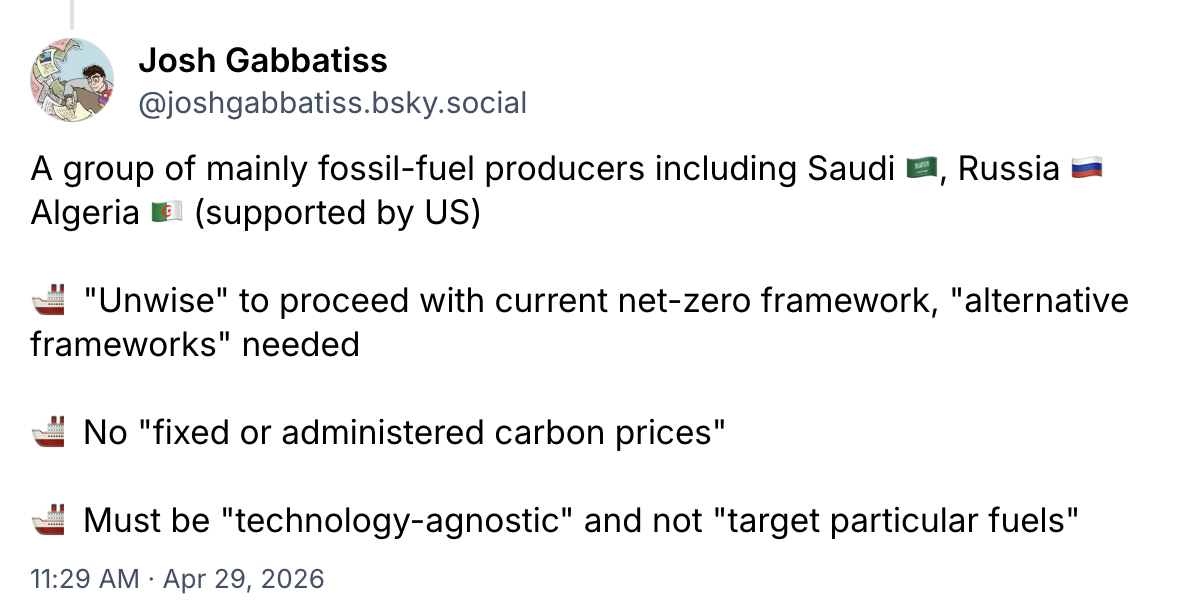
Opposing countries said any outcome should be “technology-neutral”, meaning it should not disadvantage specific fuels, potentially including liquified natural gas (LNG) and other fossil fuels.
These nations also stressed what they claimed were the potential impact of additional net-zero costs on “food and energy security”.
Much of their criticism was based on supposed economic harm that the net-zero framework would cause, particularly in developing countries.
These arguments purported to be about fairness for these countries. Yet some opponents of the framework were also calling for the IMO fund to be abandoned.
If this IMO fund were lost, then developing countries could lose out on a potential source of support for their own maritime decarbonisation, as well as potentially their broader energy transitions.
As well as supporting the fossil-fuel producers’ call for “alternative frameworks”, the UAE filed its own submission questioning the legitimacy of the IMO in establishing a new fund.
The US submission to the IMO stated that the fund would provide “pennies on the dollar compared to the economic hardship” brought about by the framework overall.
US delegates distributed flyers at the IMO meeting, emphasising the financial burden they claimed the framework would place on developing countries. While low-carbon shipping will come with substantial costs, analysts said the US figures were “not credible”.
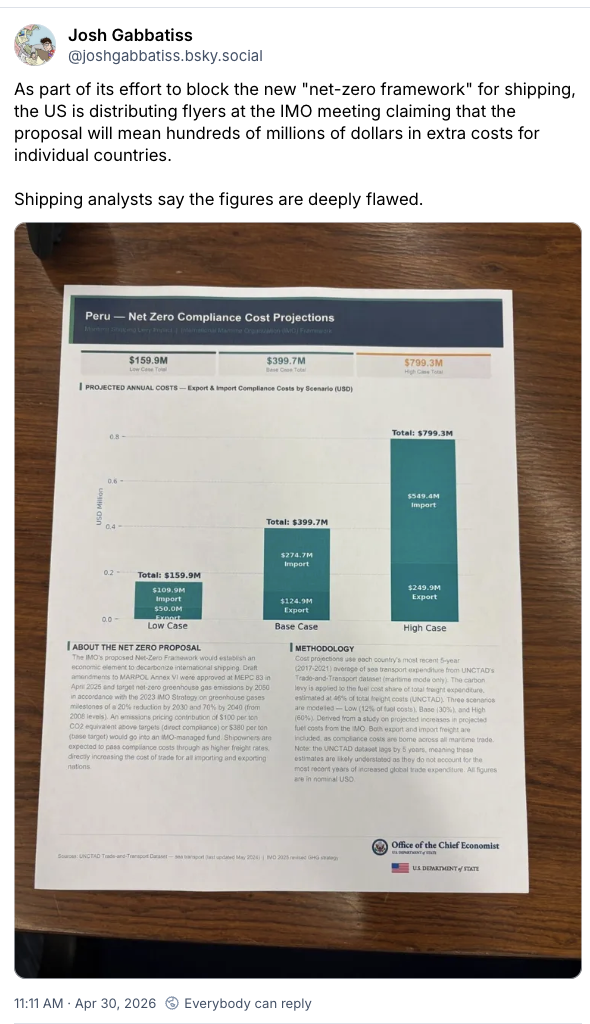
Campaigners accused the US of “pretending to care about other countries’ economies”, pointing out that the energy crisis – triggered by the US-led war on Iran – is costing the shipping industry billions.
Moreover, they stated that the Trump administration’s new port entry fees would be a far greater financial burden for the global shipping industry than the mooted net-zero rules.
Analysis by UCL shipping researchers ahead of MEPC84 concluded that the Trump administration would potentially be less able to exert “soft power and influence” at the talks than last year. Additionally, it pointed to a Supreme Court ruling that limited the US’s capacity to impose punitive tariffs.
In practice, the US was less vocal at the talks, choosing to support alternative framework ideas proposed by other IMO members.
What ‘alternative frameworks’ were discussed?
There were two main alternatives to the net-zero framework considered at MEPC84.
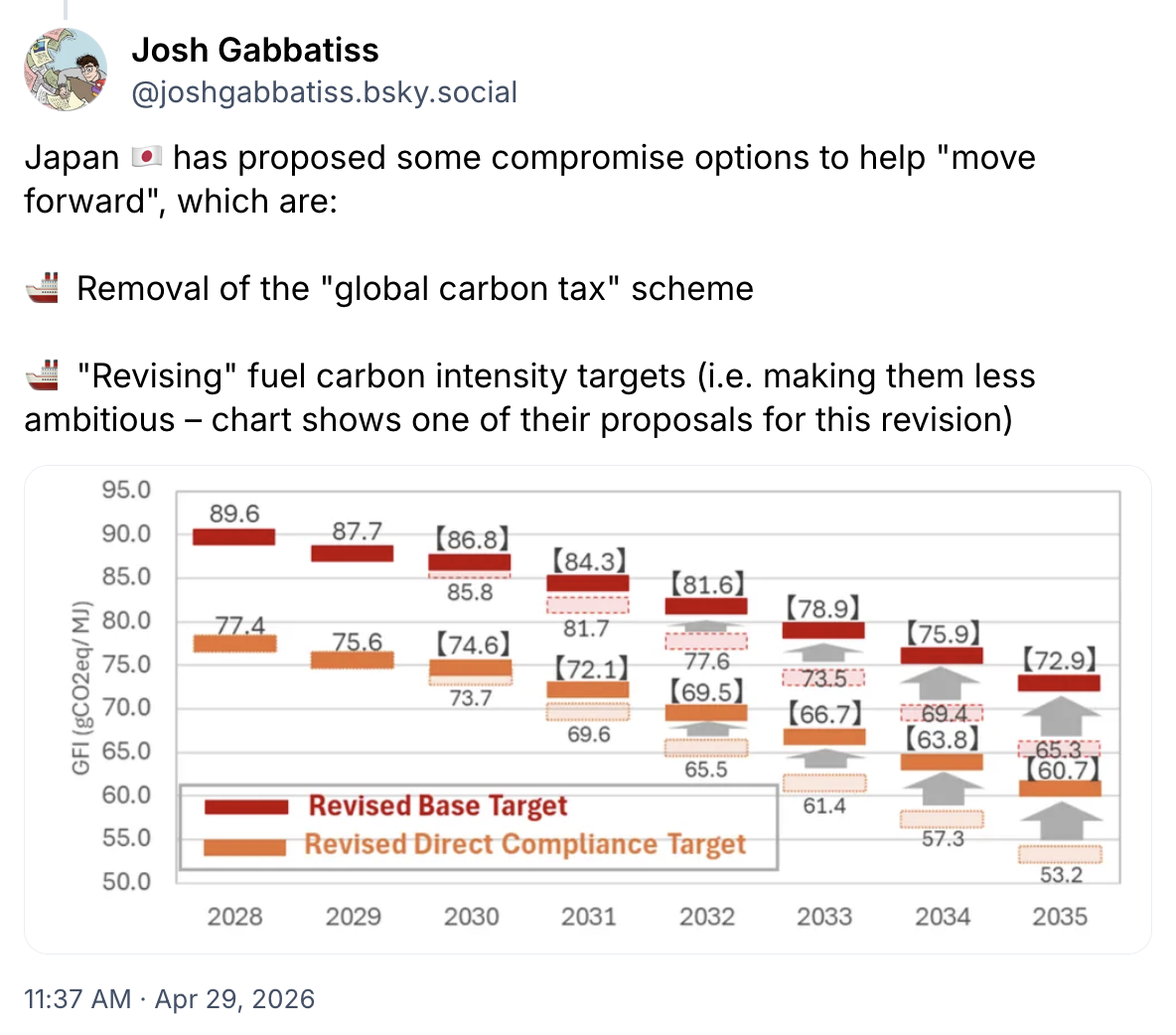
Japan suggested some ideas as a “possible basis for discussion”, which included removing the need for ships to pay into an IMO fund when they fail to meet emissions targets.
It also suggested simply relaxing the emissions targets, in order to make them easier for shipping companies to meet.
The second – and more significant – counter-proposal to the net-zero framework was not submitted by the US or its fossil-fuel producer allies.
Instead, it came from Liberia, Panama and Argentina, three countries that have strong political and historical ties with the US.
This was particularly notable given Liberia and Panama’s status as the top two “flags of convenience”, as shown in the chart below. A third of the world’s commercial shipping is registered in these small states, giving them disproportionate significance within the talks.

Their proposal, offered in the spirit of “consensus‑building”, said that only fuels already considered “commercially viable” should be included in the IMO’s carbon-intensity targets.
The Argentina-Liberia-Panama proposal was dismissed by observers as “business-as-usual”, as it removes incentives to develop clean fuels, any substantial means of enforcement and opportunities to raise funds to help developing countries.
Delaine McCullough, director of the shipping programme at the Ocean Conservancy, tells Carbon Brief:
“By removing the mandatory greenhouse gas price, you take away the ability to provide any kind of rewards or other incentives, and you also take away the regulatory incentive, so you just end up where we are today.”
This was the proposal that the net-zero framework’s most prominent opponents, including the US and the Gulf states, rallied around at MEPC84.
Among those also backing the idea during the talks were some developing countries, such as Ghana, Nigeria and Sierra Leone, that also said they wanted the IMO outcome to provide them with financial support.
This came in spite of the proposal stating there should be “no establishment of an IMO fund”. Speaking on condition of anonymity, a small-island state delegate tells Carbon Brief:
“Many countries that support the Liberia-Panama-Argentina submission also seek support for transition, capacity-building and mitigation of negative impacts. This support will not be available if [that] approach is taken.”
Some delegates questioned the decision by Liberia and Panama to lead this pushback against the net-zero framework. Both nations had previously supported an emissions levy on shipping, which would have been far more ambitious than the framework they now oppose.
Observers noted ties between nations that opposed the framework and parts of the shipping sector – including US-based interests and LNG assets.
Among the industry voices arguing strongly against the net-zero framework have been the American Bureau of Shipping and a group of international shipping companies and registries – including the national registries of Liberia and Panama.
The latter group voiced “significant concerns” and called for “alternative proposals”. Rather than a domestic entity, the Liberian registry that issued this statement is a privately owned US company.
Reflecting on these issues, Prof Tristan Smith, an energy and transport expert at UCL, wrote on LinkedIn:
“Privately owned registries have leverage over their host governments because one angry shipowner’s personal wealth is more than the flag state’s GDP and governments of low-income countries can’t easily take risks with even small volume revenues.”
Major Greek shipowners, including some with US-linked LNG interests, also opposed the net-zero framework, citing the “absence of support from major and influential states representing a significant share of global tonnage”.
Greece itself had reportedly pushed back against the framework behind the scenes, despite the EU’s public, unified position of support.
What do supporters of the net-zero framework want?
There were many vocal supporters of the net-zero framework at MEPC84, including a broad range of developed and developing countries.
Among them were the EU, Brazil, Mexico, Kenya, Pacific island states, Australia and the UK.
Having supported the net-zero framework last April, but voted to postpone its adoption in October, China expressed support for a carbon-pricing system and an IMO fund in a technical submission issued ahead of MEPC84.
The major shipping nation had remained quiet during the US-Saudi disruption in October last year, so its submission was viewed as a positive for backers of the framework.
Colombia, which was simultaneously hosting a global conference on “transitioning away” from fossil fuels, also emerged as a supporter of the net-zero framework.
There has also been support from some sections of the shipping industry, including a large coalition of ports, logistics companies and clean-fuel providers.
Supportive nations pointed out that the net-zero framework was the result of years of talks and already represented what Pacific island states called a “fragile compromise”. They framed it as the “only politically viable option” for hitting the IMO’s net-zero goal.
Pacific islands and around 50 other nations had originally called for a universal carbon levy on shipping. Ultimately, they were forced to accept the net-zero framework as a compromise, but Pacific islands said they would revert to their call for a levy if they felt the framework was being “watered down”.
The demand for a levy was strongly opposed by numerous countries, including some of the current framework’s supporters, such as Brazil and Australia.
In a bid to revive the net-zero framework, a submission by Brazil sought to “dispel any possible potential misunderstandings”, stressing that the approach is “flexible” and “should not be mistaken for a ‘global tax’”.
For example, Brazil notes that the framework “does not exclude any fuels” and that even existing “bunker” fuels and LNG could be used, as long as carbon intensity targets are met. (Ships could, for example, use carbon capture and storage to meet the goals.)
Michael Mbaru, a low-carbon shipping expert for the Kenya climate special envoy, told a briefing ahead of the conference that the net-zero framework was in developing countries’ interests:
“If the global package unravels, pressure grows for more regional and unilateral measures instead, and this is particularly difficult for African and other developing countries, because fragmented regulation raises compliance, complexity [and] transaction costs.”
In response to the Argentina-Liberia-Panama proposal that opponents of the framework had coalesced around, the Solomon Islands pointed out that, in seeking “consensus”, this group was ignoring the numerous parties that wanted more ambition, rather than less. It stated in a submission:
“There is no reason to expect that a new proposal, that differs from the IMO net-zero framework, would find a majority, much less a consensus.”
Nevertheless, supporters of the net-zero framework also acknowledged that there were some areas where greater clarity might help countries to finalise the details.
These areas include clarifying technical considerations such as: how fuel intensity is calculated; addressing the potential impacts of net-zero rules on food security; the governance of the IMO fund; and regulation of sustainable fuel certification schemes.
Given this, there was broad support for more discussions at an extra “intersessional” meeting later this year, in order to hash out these final details before attempting to approve the net-zero framework once more.
What was the final outcome from the IMO meeting?
Ultimately, the IMO’s net-zero framework was agreed and will now be negotiated further in the uutumn, ahead of the next MEPC meeting in December 2026.
The decision, as well as the general willingness to move forward noted by numerous observers, was broadly welcomed. IMO secretary-general Arsenio Dominguez said:
“We are back on track, but we have to rebuild trust. I encourage you to maintain this momentum through your intersessional work and to prepare submissions that can bring the membership together.”
Over the week of negotiations, nearly 100 delegations took to the floor to voice their opinions on the adoption of the net-zero framework.
Of these, over half were in favour of it, including countries like the EU, Brazil, Colombia, Kenya, Tuvalu and others.
Others pushed for reopening the framework for substantial changes, including the US, UAE, Saudi Arabia, Liberia and others.
On Friday 1 May, the discussion turned to the terms of reference for further negotiation and countries agreed to move the net-zero forward as the only option in the final outcome text.
Em Fenton, senior director of climate diplomacy at Opportunity Green, tells Carbon Brief:
“The framework has survived, but survival is not a victory and we cannot end up in a cycle of open-ended negotiations. Taking forward consideration of multiple proposals is only acceptable as a bridge, not a destination.
“We must now look forward to moving towards adoption of the framework later this year in a way that maintains urgency and ambition, and delivers justice and equity for countries on the frontlines of climate impacts.”
The IMO committee agreed to establish an intersessional working group to resolve a number of outstanding concerns and “drive broader convergence on a global measure” ahead of the next MEPC meeting.
Member states will be able to submit new amendments and adjustments to complement those already approved.
The two intersessional meetings will take place in September and November, ahead of MEPC85 in December.
Christiaan De Beukelaer, senior lecturer in culture and climate at the University of Melbourne, tells Carbon Brief:
“The ship is mostly built, though it’s obvious that more work needs doing on its interior. Right now, some are trying to finish the build while others are trying to scuttle it.”



The post Q&A: How countries got the global ‘net-zero’ shipping deal ‘back on track’ appeared first on Carbon Brief.
Q&A: How countries got the global ‘net-zero’ shipping deal ‘back on track’

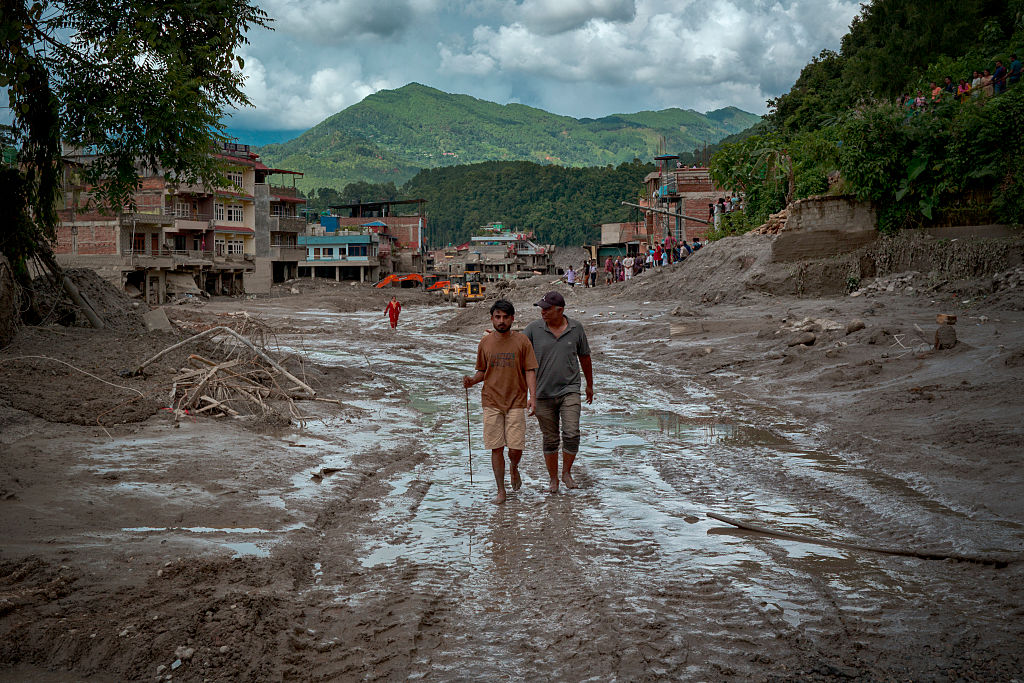
The board of the Fund for Responding to Loss and Damage (FRLD) will decide on Thursday on whether to “provisionally set aside” $20 million for Nepal to deal with some of the effects of the climate-driven flood it suffered in August.
The motion, seen by Climate Home News, has been drafted by a group of board members from both developed and developing countries and so is likely to pass easily at the fund’s first-ever extraordinary board meeting on October 22.
It invites the government of Nepal to submit a proposal for how to use the money, with the board then deciding at one of its regular board meetings whether to approve the proposal or not.
While Nepali officials have described $20 million as merely “symbolic” in the face of the $4.8 billion estimated costs of recovery and reconstruction, it would be the first time the new FRLD – agreed in 2022 months after devastating floods in Pakistan – has set aside money for a specific disaster.
Until now the fund has only taken requests through a single call for proposals, launched at COP30 in Belém last November, that gave countries six months to submit requests.
Most of the 180 projects the FRLD is currently considering are designed to help countries avoid damage from future climate disasters, for example by strengthening responses to floods in Bangladesh and Lagos.
The draft decision says Nepal’s proposal will serve as a pilot for how funding requests can be submitted outside of the fund’s current timetable. That could let governments seek funds quickly after a climate disaster strikes, rather than waiting for the next call.
This arrangement would set the fund apart from other United Nations funds designed for climate adaptation or cutting emissions like the Green Climate Fund.
Climate campaigners from Fill the Fund said the draft decision is “a real step forward” as it is “the first time this Fund has moved to respond to a specific disaster”.
Too little, too late
The FRLD was agreed by governments at COP27, set up and operationalised at COP28 in 2023 but has yet to award any money. The 180 funding requests it is currently considering would cost around $2.8 billion, but it only has $350 million to allocate.
The United Nations Secretary-General António Guterres has described the amount of money available in the fund as “ridiculously small” and Fill the Fund said $20 million “is a meaningful signal but it is a drop against an ocean of need”.
A glacial rock and ice collapse sent a torrent of water and debris through Nepal and the Chinese-administered region of Tibet on August 26. It killed more than 1,400 people, left thousands more missing and destroyed homes, bridges, roads and hydropower plants. Nepal’s finance and environment ministers quickly appealed to the FRLD board for funds, saying that “time is of the essence”.
Their call was followed swiftly by a letter from developing country FRLD board members urging the board’s co-chairs to organise an extraordinary meeting to allocate funds to Nepal.
But developed countries initially called for an informal consultation rather than a full board meeting. It took a further 45 days for the board’s co-chairs to organise an extraordinary board meeting for October 22 and to draft a motion for adoption.
Fill the Fund called for a permanent way of the fund rapid responding to disasters as “Nepal should not have required historic letters, an informal drafting group and the Fund’s first-ever extraordinary meeting simply to unlock an emergency response. The next country cannot wait two months and a bureaucratic marathon. Speed must be built in, not improvised.”
The post UN’s loss and damage fund set to give Nepal $20m for flood recovery appeared first on Climate Home News.
UN’s loss and damage fund set to give Nepal $20m for flood recovery