Drought and heatwaves occurring together – known as “compound” events – have “surged” across the world since the early 2000s, a new study shows.
Compound drought and heat events (CDHEs) can have devastating effects, creating the ideal conditions for intense wildfires, such as Australia’s “Black Summer” of 2019-20 where bushfires burned 24m hectares and killed 33 people.
The research, published in Science Advances, finds that the increase in CDHEs is predominantly being driven by events that start with a heatwave.
The global area affected by such “heatwave-led” compound events has more than doubled between 1980-2001 and 2002-23, the study says.
The rapid increase in these events over the last 23 years cannot be explained solely by global warming, the authors note.
Since the late 1990s, feedbacks between the land and the atmosphere have become stronger, making heatwaves more likely to trigger drought conditions, they explain.
One of the study authors tells Carbon Brief that societies must pay greater attention to compound events, which can “cause severe impacts on ecosystems, agriculture and society”.
Compound events
CDHEs are extreme weather events where drought and heatwave conditions occur simultaneously – or shortly after each other – in the same region.
These events are often triggered by large-scale weather patterns, such as “blocking” highs, which can produce “prolonged” hot and dry conditions, according to the study.
Prof Sang-Wook Yeh is one of the study authors and a professor at the Ewha Womans University in South Korea. He tells Carbon Brief:
“When heatwaves and droughts occur together, the two hazards reinforce each other through land-atmosphere interactions. This amplifies surface heating and soil moisture deficits, making compound events more intense and damaging than single hazards.”
CDHEs can begin with either a heatwave or a drought.
The sequence of these extremes is important, the study says, as they have different drivers and impacts.
For example, in a CDHE where the heatwave was the precursor, increased direct sunshine causes more moisture loss from soils and plants, leading to a drought.
Conversely, in an event where the drought was the precursor, the lack of soil moisture means that less of the sun’s energy goes into evaporation and more goes into warming the Earth’s surface. This produces favourable conditions for heatwaves.
The study shows that the majority of CDHEs globally start out as a drought.
In recent years, there has been increasing focus on these events due to the devastating impact they have on agriculture, ecosystems and public health.
In Russia in the summer of 2010, a compound drought-heatwave event – and the associated wildfires – caused the death of nearly 55,000 people, the study notes.

The record-breaking Pacific north-west “heat dome” in 2021 triggered extreme drought conditions that caused “significant declines” in wheat yields, as well as in barley, canola and fruit production in British Columbia and Alberta, Canada, says the study.
Increasing events
To assess how CDHEs are changing, the researchers use daily reanalysis data to identify droughts and heatwaves events. (Reanalysis data combines past observations with climate models to create a historical climate record.) Then, using an algorithm, they analyse how these events overlap in both time and space.
The study covers the period from 1980 to 2023 and the world’s land surface, excluding polar regions where CDHEs are rare.
The research finds that the area of land affected by CDHEs has “increased substantially” since the early 2000s.
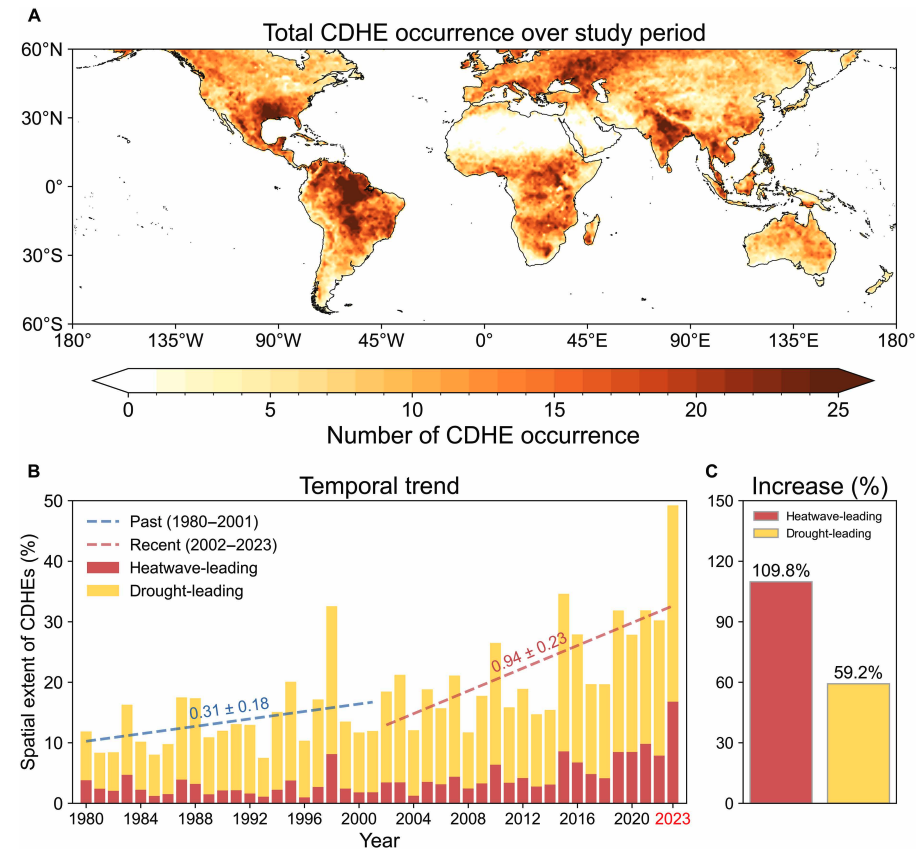
Heatwave-led events have been the main contributor to this increase, the study says, with their spatial extent rising 110% between 1980-2001 and 2002-23, compared to a 59% increase for drought-led events.
The map below shows the global distribution of CDHEs over 1980-2023. The charts show the percentage of the land surface affected by a heatwave-led CDHE (red) or a drought-led CDHE (yellow) in a given year (left) and relative increase in each CDHE type (right).
The study finds that CDHEs have occurred most frequently in northern South America, the southern US, eastern Europe, central Africa and south Asia.
Threshold passed
The authors explain that the increase in heatwave-led CDHEs is related to rising global temperatures, but that this does not tell the whole story.
In the earlier 22-year period of 1980-2001, the study finds that the spatial extent of heatwave-led CDHEs rises by 1.6% per 1C of global temperature rise. For the more-recent period of 2022-23, this increases “nearly eightfold” to 13.1%.
The change suggests that the rapid increase in the heatwave-led CDHEs occurred after the global average temperature “surpasse[d] a certain temperature threshold”, the paper says.
This threshold is an absolute global average temperature of 14.3C, the authors estimate (based on an 11-year average), which the world passed around the year 2000.
Investigating the recent surge in heatwave-leading CDHEs further, the researchers find a “regime shift” in land-atmosphere dynamics “toward a persistently intensified state after the late 1990s”.
In other words, the way that drier soils drive higher surface temperatures, and vice versa, is becoming stronger, resulting in more heatwave-led compound events.
Daily data
The research has some advantages over other previous studies, Yeh says. For instance, the new work uses daily estimations of CDHEs, compared to monthly data used in past research. This is “important for capturing the detailed occurrence” of these events, says Yeh.
He adds that another advantage of their study is that it distinguishes the sequence of droughts and heatwaves, which allows them to “better understand the differences” in the characteristics of CDHEs.
Dr Meryem Tanarhte is a climate scientist at the University Hassan II in Morocco, and Dr Ruth Cerezo Mota is a climatologist and a researcher at the National Autonomous University of Mexico. Both scientists, who were not involved in the study, agree that the daily estimations give a clearer picture of how CDHEs are changing.
Cerezo-Mota adds that another major contribution of the study is its global focus. She tells Carbon Brief that in some regions, such as Mexico and Africa, there is a lack of studies on CDHEs:
“Not because the events do not occur, but perhaps because [these regions] do not have all the data or the expertise to do so.”
However, she notes that the reanalysis data used by the study does have limitations with how it represents rainfall in some parts of the world.
Compound impacts
The study notes that if CDHEs continue to intensify – particularly events where heatwaves are the precursors – they could drive declining crop productivity, increased wildfire frequency and severe public health crises.
These impacts could be “much more rapid and severe as global warming continues”, Yeh tells Carbon Brief.
Tanarhte notes that these events can be forecasted up to 10 days ahead in many regions. Furthermore, she says, the strongest impacts can be prevented “through preparedness and adaptation”, including through “water management for agriculture, heatwave mitigation measures and wildfire mitigation”.
The study recommends reassessing current risk management strategies for these compound events. It also suggests incorporating the sequences of drought and heatwaves into compound event analysis frameworks “to enhance climate risk management”.
Cerezo-Mota says that it is clear that the world needs to be prepared for the increased occurrence of these events. She tells Carbon Brief:
“These [risk assessments and strategies] need to be carried out at the local level to understand the complexities of each region.”

The post Heatwaves driving recent ‘surge’ in compound drought and heat extremes appeared first on Carbon Brief.
Heatwaves driving recent ‘surge’ in compound drought and heat extremes
Climate Change
Indigenous groups warn Amazon oil expansion tests fossil fuel phase-out coalition
Indigenous leaders from across the Amazon have warned that stopping the expansion of oil drilling into their territories will be a crucial test for a growing international coalition committed to transitioning away from fossil fuels.
As 60 countries discussed at a landmark conference in Santa Marta, Colombia, pathways to end the world’s reliance on fossil fuels, Indigenous groups said the process risks losing credibility if governments continue opening new oil frontiers in the Amazon.
Their central demand was the establishment of fossil fuel “exclusion zones” across Indigenous territories and biodiverse areas of the rainforest, permanently barring new oil and gas expansion in one of the world’s most critical ecosystems. Indigenous representatives proposed establishing protected “Life Zones”, which they said would provide legal safeguards against governments and companies seeking to expand extraction into their lands.
But Indigenous delegates left the conference frustrated as the final synthesis report drafted by co-chairs Colombia and the Netherlands failed to include the proposal.
In a statement at the end of the conference, Patricia Suárez, from the Organization of Indigenous Peoples of the Colombian Amazon (OPIAC), said formally declaring Indigenous territories – especially those inhabited by peoples in voluntary isolation – as exclusion zones for extractive industries was “an urgent measure”.
“If the heart of the conference does not begin there, it risks remaining a set of good intentions that fails to respond to either science or our Indigenous knowledge systems,” she added.
Pushing for a new oil frontier
Campaigners say the pressure on the Amazon is intensifying just as scientists warn the rainforest is nearing irreversible collapse. Around 20% of all newly identified global oil reserves between 2022 and 2024 were discovered in the Amazon basin, fuelling renewed interest from governments and companies seeking to develop the region as the world’s next major oil frontier.
Ecuador has moved ahead with the auction of new oil blocks in the rainforest, while the country’s right-wing president Daniel Noboa has promoted the region as a “new oil-producing horizon” and backed efforts to expand fracking with support from Chinese companies.
In Santa Marta, a coalition of seven Indigenous nations from Ecuador issued a declaration condemning the government, which did not participate in the conference.
“While the world talks about energy transition, our government is pushing for more oil in the Amazon,” said Marcelo Mayancha, president of the Shiwiar nation. “Throughout history, we have always defended our land. That is our home. We will forever defend our territory.”
Indigenous groups also warned that Peru – another South American nation absent from the conference – plans to auction new oil blocks in the Yavarí-Tapiche Territorial Corridor, a highly sensitive region along the Brazilian border that contains the world’s largest known concentration of Indigenous peoples living in voluntary isolation.
COP30 host under scrutiny
Indigenous leaders also criticised Brazil, arguing that despite its international climate leadership, the country is simultaneously advancing major new oil projects in the Amazon region.
Luene Karipuna, delegate from Brazil’s coalition of Amazon peoples (COIAB), said the oil push threatens the stability of the rainforest. Not far from her home, in the northern state of Amapá, state-run oil giant Petrobras is currently exploring for new offshore oil reserves off the mouth of the Amazon river.
Brazil participated in the Santa Marta conference and was among the countries that first pushed for discussions on transitioning away from fossil fuels at COP negotiations. Yet the country is also planning one of the largest expansions in oil production in the world, according to last year’s Production Gap report.
Veteran Brazilian climate scientist Carlos Nobre told Climate Home that the country’s participation at the Santa Marta conference contrasted with its oil and gas production targets. “It does not make any sense for Brazil to continue with any new oil exploration,” he said, and noted that science is clear that no new fossil fuels should be developed to avoid crossing dangerous climate tipping points.
He added that the Brazilian government faces pressures from economic sectors, since Petrobras is one of the countries top exporting companies. “They look only at the economic value of exporting fossil fuels. Brazil has to change.”
The COP30 host also promised to draft a voluntary proposal for a global roadmap away from fossil fuels, which is expected to be published before this year’s COP31 summit.
“In Brazil, that advance has caused so many problems because it overlaps with Indigenous territories. Companies tell us there won’t be an impact, but we see an impact,” Karipuna said. “We feel the Brazilian government has auctioned our land without dialogue.”
For Karipuna and other Indigenous leaders, establishing exclusion zones across the Amazon is no longer just a regional demand, but a prerequisite to prevent the collapse of the rainforest.
“That’s the first step for an energy transition that places Indigenous peoples at the centre,” she added.
The post Indigenous groups warn Amazon oil expansion tests fossil fuel phase-out coalition appeared first on Climate Home News.
https://www.climatechangenews.com/2026/05/08/indigenous-amazon-oil-expansion-fossil-fuel-phase-out-coalition-santa-marta/
Climate Change
Kenya seeks regional coordination to build African mineral value chains
African leaders have intensified calls for governments to stop exporting raw minerals and step up efforts to align their policies, share infrastructure and coordinate investment to add value to their resources and bring economic prosperity to the continent.
In a speech to the inaugural Kenya Mining Investment Conference & Expo in Nairobi this week, Kenyan President William Ruto became the latest African leader to confirm the country will end exports of raw mineral ore. The East African nation has deposits of gold, iron ore and copper and recently launched a tender for global investors to develop a deposit of rare earths, which are used in EV motors and wind turbines, valued at $62 billion.
Kenya is among more than a dozen African nations that have either banned or imposed export curbs on their mineral resources as they seek to process minerals domestically to boost revenues, create jobs and capture a slice of the industries that are producing high-value clean tech for the energy transition.
“For too long we have extracted and exported raw materials at the bottom of the value chain, while others have processed, refined, manufactured and captured the greater share of economic value,” Ruto told African ministers and stakeholders gathered at the mining investment conference in Nairobi.
As a result, Africa currently captures less than 1% of the value generated from global clean energy technologies, he said. To address this, Kenya, in collaboration with other African nations, “will process our minerals here in the continent, we will refine them here and we will manufacture them here”, he added.
Mineral export restrictions on the rise
Africa is a major supplier of minerals needed for the global energy transition. The continent holds an estimated 30% of the world’s critical mineral reserves, including lithium, cobalt and copper. The Democratic Republic of Congo produces roughly 70% of global cobalt, a key ingredient in lithium-ion batteries, while countries such as Guinea dominate bauxite production, and Mozambique and Tanzania hold significant graphite deposits.
But African governments have struggled to attract the investment needed to turn their vast mineral wealth into a green industrial powerhouse. Recently Burundi, Malawi, Nigeria and Zimbabwe are among those that have resorted to banning the export of unrefined minerals to incentivise foreign companies to invest in value addition locally.
Outdated geological data limits Africa’s push to benefit from its mineral wealth
This week, Zimbabwe exported its first shipments of lithium sulphate, an intermediate form of processed lithium that can be further refined into battery-grade material, from a mine and processing plant operated by Chinese company Zhejiang Huayou Cobalt.
After freezing all exports of lithium concentrate – the first stage of processing – earlier this year, the government introduced export quotas and will ban all exports from January 2027.
Export restrictions on critical raw materials have grown more than five-fold since 2009, found a report by the Organisation for Economic Co-operation and Development (OECD) published this week. In 2024, a more diverse group of countries, including many resource-rich developing economies in Africa and Asia, introduced restrictions, including Sierra Leone, Nigeria and Angola.

This is “a structural shift in the wrong direction,” Mathias Cormann, the OECD’s secretary-general, told the organisations’ Critical Minerals Forum in Istanbul, Turkey, this week.
“We understand the motivations: building local industries, managing environmental impacts, capturing greater value domestically. But our research is quite clear. Export restrictions distort investment, reduce volumes and undermine supply security often while delivering limited gains in value added,” he said.
In-country barriers to success
Thomas Scurfield, Africa senior economic analyst at the Natural Resource Governance Institute, told Climate Home News that export restrictions “can look like a promising route to local value addition” for cash-strapped African mineral producers but have “rarely worked” unless countries already have reliable energy, infrastructure and competitive costs for processing.
“Without those conditions, bans may simply push companies to scale back mining rather than scale up processing,” he said.
Alaka Lugonzo, partnerships lead for Africa at Global Witness, identified gaps in practical skills and infrastructure as other major barriers. “You need engineers, geologists, marketers,” Lugonzo said, warning that graduates are increasingly unable to match the pace of industry change.
On infrastructure, she said that plentiful and stable energy supplies are vital and while Kenya has relatively robust road networks, they are insufficient for industrial-scale operations.
“Meaningful value addition and real industrialisation requires heavy machinery… and you will need better infrastructure,” she said, highlighting persistent last-mile challenges in mining regions where “there’s no railway, there’s no electricity, there’s no water”.
Export capacity is another concern, she said, particularly whether existing port systems could handle increased volumes of processed minerals.
Regional approach recommended
Scurfield said that through regional cooperation – including pooling supplies, specialising across different stages of refining and manufacturing, and building larger regional markets – “African countries could overcome many domestic constraints that make going alone difficult”.
That’s what close to 20 African governments are working to deliver as part of the Africa Minerals Strategy Group, which was set up by African ministers and is dedicated to foster cooperation among African nations to build mineral value chains and better benefit from the energy transition.
Africa urged to unite on minerals as US strikes bilateral deals
Nigerian Minister of Solid Minerals Dele Alake, who chairs the group, said “true collaboration” between countries, including aligning mining policies, sharing infrastructure, coordinating investment strategies and promoting trade across the continent, will create the conditions for long-term investments that could turn Africa into “a formidable and competitive force within the global mineral supply chain”.
“The time has come for Africa to redefine its place within the global mineral economy and that transformation must begin with regional integration and regional cooperation,” he told the mining investment conference in Nairobi.
Lugonzo of Global Witness agreed, saying that value-addition would benefit from adopting a continental perspective. “Why should Kenya build another smelter when we can export our gold to Tanzania for smelting, and then we use the pipeline through Uganda to take it to the port and we export it?” she asked.
To facilitate that, there is a need to operationalise the Africa Free Trade Continental Agreement (AFTCA), she added. “That agreement is the only way Africa is going to move from point A to point B.”
The post Kenya seeks regional coordination to build African mineral value chains appeared first on Climate Home News.
https://www.climatechangenews.com/2026/04/30/kenya-seeks-regional-coordination-to-build-african-mineral-value-chains/
Climate Change
Key green shipping talks to be held in late 2026
The future of the global shipping industry – and its 3% share of global emissions – will be decided in three weeks of talks in the third quarter of this year, after a decision taken in London on Friday.
At the International Maritime Organisation (IMO) headquarters this week, governments largely failed to substantively negotiate a controversial set of measures to penalise polluting ships and reward vessels running on clean fuels known as the Net-Zero Framework. The green shipping plan has been aggressively opposed by fossil fuel-producing nations, in particular by the US and Saudi Arabia.
This week, countries delivered statements outlining their views on the measures in a session that ran from Wednesday into Thursday. Then, late on Friday afternoon, they discussed when to negotiate these measures and what proposals they should discuss.
After a lengthy debate, which the talks’ chair Harry Conway joked was confusing, governments agreed to hold a week of behind-closed-door talks from 1 September to 4 September and from 23 November to 27 November.
Following these meetings, which are intended to negotiate disagreements on the NZF and rival watered-down measures proposed by the US and its allies, there will be public talks from November 30 to December 4.
Last October, talks intended to adopt the NZF provisionally agreed in April 2025 were derailed by the US and Saudi Arabia, who successfully persuaded a majority of countries to vote to postpone the talks by a year.
Those talks, known as an extraordinary session, are now scheduled to resume on Friday December 4 unless governments decide otherwise in the preceding weeks. While this Friday session will be in the same building with the same participants as the rest of the week’s talks, calling it the extraordinary session is significant as it means the NZF can be voted on.
Em Fenton, senior director of climate diplomacy at Opportunity Green said that the NZF “has survived but survival is not a victory” and called for it to be adopted later this year “in a way that maintains urgency and ambition, and delivers justice and equity for countries on the frontlines of climate impacts”.
NZF’s supporters
The NZF would penalise the owners of particularly polluting ships and use the revenues to fund cleaner fuels, support affected workers and help developing countries manage the transition.
Many governments – particularly in Europe, the Pacific and some Latin American and African nations – spoke in favour of it this week.
South Africa said the fund it would create is “the key enabler of a just transition” and its removal would take away predictable revenues from African countries. Vanuatu said that “we are not here to sink the ship but to man it”.
Australia’s representative called it a “carefully balanced compromise”, as it was provisionally agreed by a large majority after years of negotiations, and warned that failing to adopt it would harm the shipping industry by failing to provide certainty.
Santa Marta summit kick-starts work on key steps for fossil fuel transition
Canada’s negotiator said that if it was weakened to appease its critics like the US and Saudi Arabia, this would disappoint those who think it is too weak already like the Pacific islands.
A large group of mainly big developing countries like Nigeria and Indonesia did not rule out supporting the framework but called for adjustments to help developing countries deal with the changes. Nigeria called for developing countries to be given more time to implement the measures, a minimum share of the fund’s revenues and discounts for ships bringing them food and energy.
According to analysis from the University of College London’s Energy Institute, the countries speaking in support of the NZF include five countries which voted with the US to postpone talks in October and a further ten countries which did not take a clear position at that time. Most governments support the NZF as the basis for further talks, the institute said.
Opposition remains
But a small group of mainly oil-producing nations said they are opposed to any financial penalties for particularly polluting ships.
They support a proposal submitted by Liberia, Argentina and Panama which has proposed weakening emission targets and ditching any funding mechanism for the framework involving “direct revenue collection and disbursement”.
Argentina argued that the NZF would harm countries which are far from their export markets and said concerns over that cannot be solved “by magic with guidelines”. They added that, as a result, the NZF itself needs to be fundamentally re-negotiated.
The UCL Energy Institute said that just 24 countries – less than a quarter of those who spoke – said they supported Argentina’s proposal.
While this week’s talks did not see the kind of US threats reported in October, their delegation did leave personalised flyers on every delegate’s desk which were described by academics, negotiators and climate campaigners as misleading.
One witness told Climate Home News that junior US delegates arrived early on Wednesday and placed flyers behind governments’ name plates warning each country of the costs they would incur if the NZF is adopted.
The figures on a selection of leaflets seen by Climate Home News ranged from $100 million for Panama to $3.5 billion for the Netherlands. “They are trying to scare countries away from supporting climate action with one-sided information”, one negotiator told Climate Home News.

They added that the calculations, by the US State Department’s Office of the Chief Economist, ignore the fact that the money raised would be shared to help poorer countries’ transition as well as ignoring the economic costs of failing to address climate change.
Tristan Smith, an academic representing the Institute of Marine Engineering, Science and Technology, told the meeting that the calculations were “opaque” and flawed as they overstate the contribution of fuel cost to trade costs.
A US State Department Spokesperson said in a statement that they “firmly stand behind our estimates” which were shared “in good faith” and to “provide an additional tool to policymakers as they contemplate the true economic burden over the NZF”.
The post Key green shipping talks to be held in late 2026 appeared first on Climate Home News.
https://www.climatechangenews.com/2026/05/01/key-green-shipping-talks-to-be-held-in-late-2026/
-
Greenhouse Gases9 months ago
Guest post: Why China is still building new coal – and when it might stop
-
Climate Change9 months ago
Guest post: Why China is still building new coal – and when it might stop
-
Greenhouse Gases2 years ago嘉宾来稿:满足中国增长的用电需求 光伏加储能“比新建煤电更实惠”
-
Climate Change2 years ago
Bill Discounting Climate Change in Florida’s Energy Policy Awaits DeSantis’ Approval
-
Climate Change2 years ago嘉宾来稿:满足中国增长的用电需求 光伏加储能“比新建煤电更实惠”
-
Renewable Energy7 months agoSending Progressive Philanthropist George Soros to Prison?
-
Carbon Footprint2 years agoUS SEC’s Climate Disclosure Rules Spur Renewed Interest in Carbon Credits
-
Greenhouse Gases10 months ago
嘉宾来稿:探究火山喷发如何影响气候预测