Welcome to Carbon Brief’s DeBriefed.
An essential guide to the week’s key developments relating to climate change.
This week
Energy crisis
ENERGY SPIKE: US-Israeli attacks on Iran and subsequent counterattacks across the Middle East have sent energy prices “soaring”, according to Reuters. The newswire reported that the region “accounts for just under a third of global oil production and almost a fifth of gas”. The Guardian noted that shipping traffic through the strait of Hormuz, which normally ferries 20% of the world’s oil, “all but ground to a halt”. The Financial Times reported that attacks by Iran on Middle East energy facilities – notably in Qatar – triggered the “biggest rise in gas prices since Russia’s full-scale invasion of Ukraine”.
‘RISK’ AND ‘BENEFITS’: Bloomberg reported on increases in diesel prices in Europe and the US, speculating that rising fuel costs could be “a risk for president Donald Trump”. US gas producers are “poised to benefit from the big disruption in global supply”, according to CNBC. Indian government sources told the Economic Times that Russia is prepared to “fulfil India’s energy demands”. China Daily quoted experts who said “China’s energy security remains fundamentally unshaken”, thanks to “emergency stockpiles and a wide array of import channels”.
‘ESSENTIAL’ RENEWABLES: Energy analysts said governments should cut their fossil-fuel reliance by investing in renewables, “rather than just seeking non-Gulf oil and gas suppliers”, reported Climate Home News. This message was echoed by UK business secretary Peter Kyle, who said “doubling down on renewables” was “essential” amid “regional instability”, according to the Daily Telegraph.
China’s climate plan
PEAK COAL?: China has set out its next “five-year plan” at the annual “two sessions” meeting of the National People’s Congress, including its climate strategy out to 2030, according to the Hong Kong-based South China Morning Post. The plan called for China to cut its carbon emissions per unit of gross domestic product (GDP) by 17% from 2026 to 2030, which “may allow for continued increase in emissions given the rate of GDP growth”, reported Reuters. The newswire added that the plan also had targets to reach peak coal in the next five years and replace 30m tonnes per year of coal with renewables.
ACTIVE YET PRUDENT: Bloomberg described the new plan as “cautious”, stating that it “frustrat[es] hopes for tighter policy that would drive the nation to peak carbon emissions well before president Xi Jinping’s 2030 deadline”. Carbon Brief has just published an in-depth analysis of the plan. China Daily reported that the strategy “highlights measures to promote the climate targets of peaking carbon dioxide emissions before 2030”, which China said it would work towards “actively yet prudently”.
Around the world
- EU RULES: The European Commission has proposed new “made in Europe” rules to support domestic low-carbon industries, “against fierce competition from China”, reported Agence France-Presse. Carbon Brief examined what it means for climate efforts.
- RECORD HEAT: The US National Oceanic and Atmospheric Administration has said there is a 50-60% chance that the El Niño weather pattern could return this year, amplifying the effect of global warming and potentially driving temperatures to “record highs”, according to Euronews.
- FLAGSHIP FUND: The African Development Bank’s “flagship clean energy fund” plans to more than double its financing to $2.5bn for African renewables over the next two years, reported the Associated Press.
- NO WITHDRAWAL: Vanuatu has defied US efforts to force the Pacific-island nation to drop a UN draft resolution calling on the world to implement a landmark International Court of Justice (ICJ) ruling on climate, according to the Guardian.
98
The number of nations that submitted their national reports on tackling nature loss to the UN on time – just half of the 196 countries that are part of the UN biodiversity treaty – according to analysis by Carbon Brief.
Latest climate research
- Sea levels are already “much higher than assumed” in most assessments of the threat posed by sea-level rise, due to “inadequate” modelling assumptions | Nature
- Accelerating human-caused global warming could see the Paris Agreement’s 1.5C limit crossed before 2030 | Geophysical Research Letters covered by Carbon Brief
- Future “super El Niño events” could “significantly lower” solar power generation due to a reduction in solar irradiance in key regions, such as California and east China | Communications Earth & Environment
(For more, see Carbon Brief’s in-depth daily summaries of the top climate news stories on Monday, Tuesday, Wednesday, Thursday and Friday.)
Captured
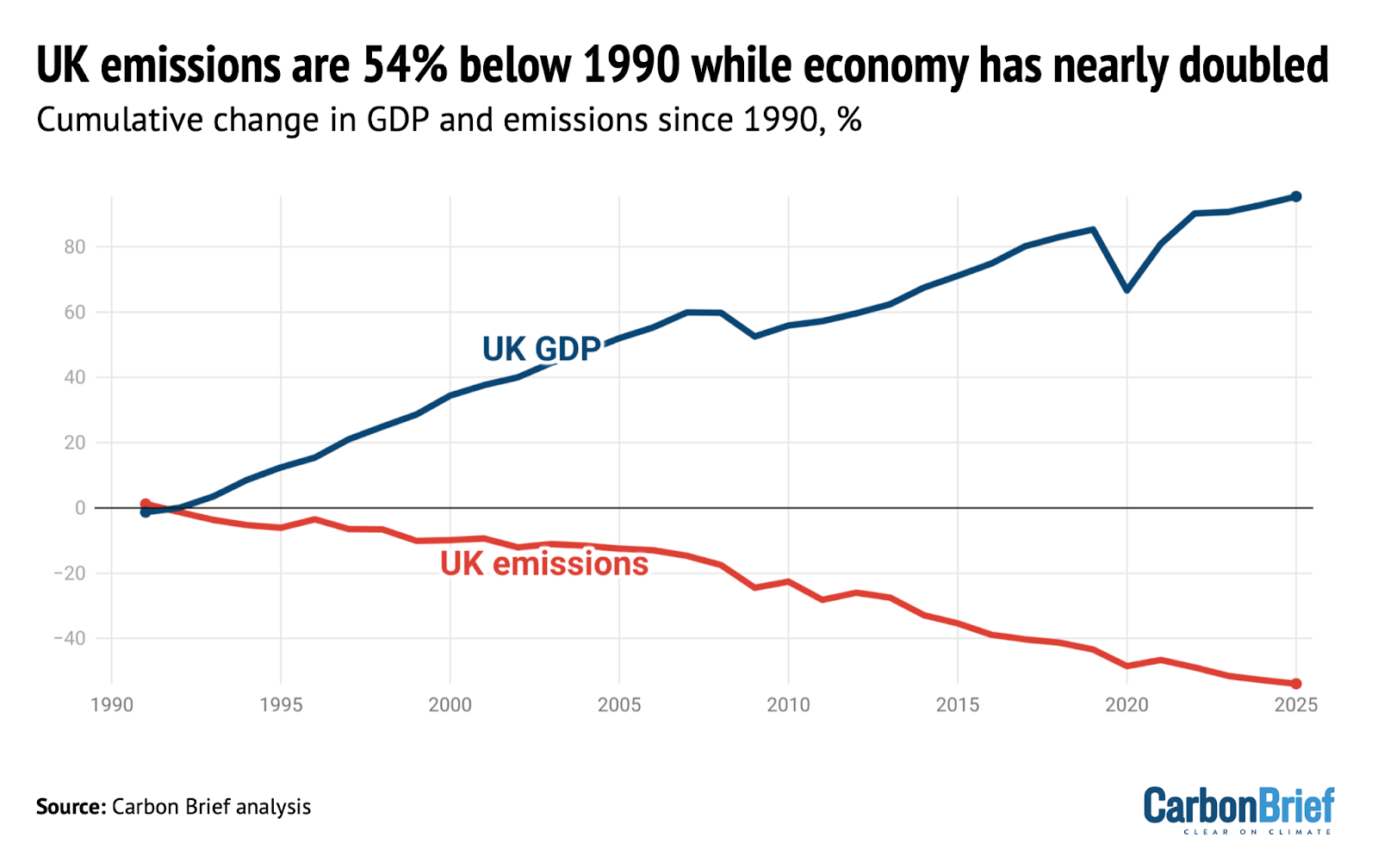
UK greenhouse gas emissions in 2025 fell to 54% below 1990 levels, the baseline year for its legally binding climate goals, according to new Carbon Brief analysis. Over the same period, data from the World Bank shows that the UK’s economy has expanded by 95%, meaning that emissions have been decoupling from growth.
Spotlight
Bristol’s ‘pioneering’ community wind turbine
Following the recent launch of the UK government’s local power plan, Carbon Brief visits one of the country’s community-energy success stories.
The Lawrence Weston housing estate is set apart from the main city of Bristol, wedged between the tree-lined grounds of a stately home and a sprawl of warehouses and waste incinerators. It is one of the most deprived areas in the city.
Yet, just across the M5 motorway stands a structure that has brought the spoils of the energy transition directly to this historically forgotten estate – a 4.2 megawatt (MW) wind turbine.
The turbine is owned by local charity Ambition Lawrence Weston and all the profits from its electricity sales – around £100,000 a year – go to the community. In the UK’s local power plan, it was singled out by energy secretary Ed Miliband as a “pioneering” project.
‘Sustainable income’
On a recent visit to the estate by Carbon Brief, Ambition Lawrence Weston’s development manager, Mark Pepper, rattled off the story behind the wind turbine.
In 2012, Pepper and his team were approached by the Bristol Energy Cooperative with a chance to get a slice of the income from a new solar farm. They jumped at the opportunity.
“Austerity measures were kicking in at the time,” Pepper told Carbon Brief. “We needed to generate an income. Our own, sustainable income.”
With the solar farm proving to be a success, the team started to explore other opportunities. This began a decade-long process that saw them navigate the Conservative government’s “ban” on onshore wind, raise £5.5m in funding and, ultimately, erect the turbine in 2023.
Today, the turbine generates electricity equivalent to Lawrence Weston’s 3,000 households and will save 87,600 tonnes of carbon dioxide (CO2) over its lifetime.

‘Climate by stealth’
Ambition Lawrence Weston’s hub is at the heart of the estate and the list of activities on offer is seemingly endless: birthday parties, kickboxing, a library, woodworking, help with employment and even a pop-up veterinary clinic. All supported, Pepper said, with the help of a steady income from community-owned energy.
The centre itself is kitted out with solar panels, heat pumps and electric-vehicle charging points, making it a living advertisement for the net-zero transition. Pepper noted that the organisation has also helped people with energy costs amid surging global gas prices.
Gesturing to the England flags dangling limply on lamp posts visible from the kitchen window, he said:
“There’s a bit of resentment around immigration and scarcity of materials and provision, so we’re trying to do our bit around community cohesion.”
This includes supper clubs and an interfaith grand iftar during the Muslim holy month of Ramadan.
Anti-immigration sentiment in the UK has often gone hand-in-hand with opposition to climate action. Right-wing politicians and media outlets promote the idea that net-zero policies will cost people a lot of money – and these ideas have cut through with the public.
Pepper told Carbon Brief he is sympathetic to people’s worries about costs and stressed that community energy is the perfect way to win people over:
“I think the only way you can change that is if, instead of being passive consumers…communities are like us and they’re generating an income to offset that.”
From the outset, Pepper stressed that “we weren’t that concerned about climate because we had other, bigger pressures”, adding:
“But, in time, we’ve delivered climate by stealth.”
Watch, read, listen
OIL WATCH: The Guardian has published a “visual guide” with charts and videos showing how the “escalating Iran conflict is driving up oil and gas prices”.
MURDER IN HONDURAS: Ten years on from the murder of Indigenous environmental justice advocate Berta Cáceres, Drilled asked why Honduras is still so dangerous for environmental activists.
TALKING WEATHER: A new film, narrated by actor Michael Sheen and titled You Told Us To Talk About the Weather, aimed to promote conversation about climate change with a blend of “poetry, folk horror and climate storytelling”.
Coming up
- 8 March: Colombia parliamentary election
- 9-19 March: 31st Annual Session of the International Seabed Authority, Kingston, Jamaica
- 11 March: UN Environment Programme state of finance for nature 2026 report launch
Pick of the jobs
- London School of Economics and Political Science, fellow in the social science of sustainability | Salary: £43,277-£51,714. Location: London
- NORCAP, innovative climate finance expert | Salary: Unknown. Location: Kyiv, Ukraine
- WBHM, environmental reporter | Salary: $50,050-$81,330. Location: Birmingham, Alabama, US
- Climate Cabinet, data engineer | Salary: hourly rate of $60-$120 per hour. Location: Remote anywhere in the US
DeBriefed is edited by Daisy Dunne. Please send any tips or feedback to debriefed@carbonbrief.org.
This is an online version of Carbon Brief’s weekly DeBriefed email newsletter. Subscribe for free here.
The post DeBriefed 6 March 2026: Iran energy crisis | China climate plan | Bristol’s ‘pioneering’ wind turbine appeared first on Carbon Brief.
Climate Change
China Briefing 16 April 2026: Billions for grid | Petrochemical plan | China’s high-seas bid
Welcome to Carbon Brief’s China Briefing.
China Briefing handpicks and explains the most important climate and energy stories from China over the past fortnight. Subscribe for free here.
Key developments
Surge in grid investment
TRILLION-YUAN ERA: China’s two largest power grid operators invested a total of 167.5bn yuan ($24.5bn) in the first quarter of 2026, reported state broadcaster CCTV. State Grid said that during this period it spent more than 10bn yuan on connecting “new energy” projects to the grid, up 50% from last year, reported Shanghai-based news outlet the Paper. The two state-owned enterprises (SOEs) plan to invest 1tn yuan ($146bn) annually over the 15th five-year plan period (2026-2030), said finance news outlet Yicai.
POWER CURBED: However, in what Bloomberg called a “clear signal that the grid is struggling to absorb all the extra power from the rapid growth in renewables”, solar and wind utilisation rates – the percentage of total power generated by a source that is used by the grid – fell again at the start of the year. They stood at 90.8% and 91.5%, respectively, in January and February 2026, according to a post by an SOE-linked research institute republished by energy news outlet International Energy Net. The rates are now “approaching [minimum] limits that the government had relaxed only two years ago”, added Bloomberg.

SIX PROVINCES SUPERVISED: A recent meeting of the National Energy Administration (NEA) concluded that China’s renewable installations had seen “steady growth” in 2026, adding that the body must make “sustained efforts” to “expand” investment in renewable power, reported International Energy Net. Separately, International Energy Net also said that the NEA will increase “supervision” of the power sectors in six provinces – Hebei, Jilin, Xinjiang, Fujian, Hunan and Guangdong. The outlet said this would entail scrutinising how they implement “energy conservation and carbon reduction” tasks, with a “focus” on coal plants, how they construct large clean-energy bases and their consumption of new energy, as well as their power infrastructure and markets.
Conflict spurred cooperation with China
CHINA ‘WINNING’: In Vienna, Chinese climate envoy Liu Zhenmin told state news agency Xinhua that the Middle East conflict has created an urgent need for countries to rethink energy security strategies and accelerate the energy transition. Xinhua also cited Liu as warning against over-reliance on a single source of energy imports. Meanwhile, state broadcaster CCTV published a segment arguing that a “greener” system will “provide a strong guarantee” for energy security, although it did not mention the conflict. Several outlets have continued to highlight how low-carbon energy has helped China weather the conflict and boosted sales of Chinese technologies, including the New York Times, Wall Street Journal, Associated Press, Indian Express, Washington Post and Bloomberg. Semafor said China was “winning the global energy war”.
MANY MEETINGS: United Arab Emirates crown prince Sheikh Khaled bin Mohamed bin Zayed Al Nahyan and Chinese president Xi Jinping discussed how to “prevent further impacts” from the conflict on energy security, said Xinhua. Australian prime minister Anthony Albanese said he addressed “regional energy security” with Chinese premier Li Qiang, reported Reuters. A post by China-Russia Information Net on nationalist media outlet Guancha quoted a Chinese diplomat in Russia telling reporters that “current dramatic changes in the international situation” are causing the two countries to discuss “further energy cooperation”. The Philippines is continuing to consider “oil and gas cooperation” with China, despite territorial disputes, Reuters also reported.
‘PROFOUND’ IMPACTS: Energy administration head Wang Hongzhi wrote a chapter in a “study guide” to the 15th five-year plan, published by industry outlet China Power News Net, in which he noted that “geopolitical conflicts are profoundly reshaping the global energy landscape”. He added that “traditional fossil fuels must continue to serve as a safety net while [China] simultaneously accelerates efforts to transition [to clean energy sources]”. Environment minister Huang Runqiu wrote in the CPPCC Daily, the official newspaper for the advisory body Chinese People’s Political Consultative Conference (CPPCC), that China will “earnestly” carry out “carbon peaking actions” in the next five years. Huang also said that, with “concerted efforts”, China’s 15th five-year plan targets are “achievable”.
Petrochemical plan published
UPGRADE DEADLINE: China issued a plan for either upgrading or phasing out “outdated” petrochemical plants by 2029, reported Reuters. It added that the plan did not confirm explicitly “how many plants may be upgraded or phased out”. The news outlet Economic Daily said that, according to the document, China would focus on upgrading or phasing out outdated capacity “as determined in 2025”, while also developing a “long-term working system” for assessing the industry. According to the full document, published on the Ministry of Industry and Information Technology (MIIT) website, carbon-emission assessments were part of the selection criteria, with policymakers planning on “developing or revising” further standards for carbon emissions under the plan.
-
Sign up to Carbon Brief’s free “China Briefing” email newsletter. All you need to know about the latest developments relating to China and climate change. Sent to your inbox every Thursday.
CHEMICAL OVERCAPACITY: The Paper quoted MIIT official Chang Guowu telling reporters that the plan will address the “low standards of design and construction” and “outdated processes” in older plants that lead to “significant” environmental risks. Xinhua said that, of China’s more than 27,000 petrochemical plants, “more than 1,600…outdated facilities” were reported in 2025, 600 of which required upgrading. Chemical news WeChat account WeLink Chemicals noted the policy was released against a backdrop of “overcapacity and declining demand for road transport fuels”, with the government having “stepped up efforts to curb overcapacity” in 2025.
More China news
- TARGET PLEDGED: China will cut the carbon intensity of its international shipping vessels by at least 15% by 2030 compared to 2025 levels, said climate outlet IdeaCarbon. It said China will also “significantly enhance” its influence in emission reduction talks at the International Maritime Organization.
- SANCHEZ VISITED: China and Spain “can contribute to finding solutions” for environmental issues, Spanish leader Pedro Sanchez told Xi Jinping, according to the Associated Press. Ahead of the meeting, Sanchez also argued China should play a more substantial role on climate change, said the Singapore-based Straits Times.
- CHINA COMMITTED: Huang Runqiu reaffirmed China’s support, “as always”, for global climate governance in a meeting with UN advisor Selwin Hart, said the Paper.
- FUNDING HALTED: The EU “quietly” approved a plan to prevent EU funds being provided to “clean technology projects containing Chinese inverters”, said the Hong Kong-based South China Morning Post.
- AI UNVEILED: Chinese researchers developed a “first-of-its-kind artificial intelligence model designed to track carbon emissions”, reported Xinhua, adding that it “could shift the balance of power” in global climate negotiations, such as by quantifying the “embedded carbon” of products that developed countries import from China.
- CONTROLS CONSIDERED: China is deliberating “limiting exports” to the US of the equipment needed to make solar panels, according to Reuters.
Spotlight
The debate over China’s bid to host the “high seas” treaty
The final preparatory commission for the Biodiversity Beyond National Jurisdiction (BBNJ) agreement has closed, laying the groundwork for the treaty’s first conference of the parties (COP1).
One key agenda item was China’s presentation of a bid to host the secretariat. In this issue, Carbon Brief examines the debate surrounding the bid.
The BBNJ agreement, also known as the High Seas Treaty, governs the sustainable use and conservation of the “high seas” – marine areas outside national jurisdictions – with a new United Nations (UN) body established to oversee enforcement.
As well as facing significant impacts from climate change, the ocean plays an important role as a carbon sink, absorbing around 29% of man-made emissions.
The treaty “recognis[es]” the need to address oceanic biodiversity loss and ecosystem degradation, according to previous Carbon Brief analysis, identifying key impacts from climate change, acidification, pollution and “unsustainable” use.
It aims to encourage conservation and sustainable use of marine biodiversity in the high seas, such as by managing “marine genetic resources”, creating protected areas in the ocean, developing environmental impact assessments and facilitating capacity-building and transfer of marine technology.
China’s bid
China’s bid to host the secretariat focused on its “sustainability efforts” and “commitment to multilateralism”, reported the Earth Negotiations Bulletin.
The country’s bid document drew attention to several of its emission-reduction efforts, including “green shipping corridors” and strengthening carbon sinks through protecting mangroves, seagrass beds and coral reefs.
In a speech, Chinese ambassador to the UN Fu Cong said that the bid “reflects China’s unwavering support” for multilateralism, adding that a successful Chinese bid would lead to the first UN-related body headquartered in the Asia Pacific region. He said:
“That means it will not only be welcomed, but also be prioritised. It will have the full backing from all levels of government in China and its people.”
Li Shuo, director at the Asia Society Policy Institute’s China climate hub, attended the meetings. He said in a note that China’s decision to bid “reportedly came from [President] Xi Jinping”, galvanising a coordinated cross-ministry effort to secure host the secretariat.
Creating debate
China entering the race has caused a stir.
As host, it could inhibit “robust environmental safeguards” by “embedding elements of its domestic governance model” into how the treaty operates, wrote Dr Chime Youdon, research fellow at India’s National Maritime Foundation, on the organisation’s platform.
But such concerns are weakened by the fact that China would “want the treaty to function” if it were host, argued Prof Philippe Le Billon and Zelda Ladefoged, professor and master’s student at the University of British Columbia, in an article for the Conversation.
Nevertheless, they noted “sustained” worries around China’s influence, given the extensive involvement of its companies in distant-water fishing and deep-sea mining, which are not covered in the treaty.
Li told Carbon Brief that, as far as he saw, no-one was “actively pushing back against” the bid on any of the above grounds. Instead, he observed “anxieties” around “accreditation, information security and visa and conference participation issues”.
Daniel Kachelriess, cross-cutting coordinator at the High Seas Alliance, an umbrella group of non-governmental organisations focused on ocean governance, echoed this in comments to Carbon Brief. He said “values like neutrality and impartiality, transparency and accountability” are important for the decision, as well as practical issues such as “reliable” internet access.
The Financial Times reported that Chinese delegates have offered immunity to attendees and flexibility around visas, citing unnamed sources.
But a successful Chinese bid could be a “significant escalation” of China’s involvement in global environmental governance, wrote Le Billon and Ladefoged.
As such, the BBNJ could prove a “case study” of sustaining environmental progress without the US and of China “learning to translate its ambitions into leadership”, said Li.
Watch, read, listen
PROFIT PRESSURE: The Economic Observer investigated how higher profit remittance requirements for state-owned enterprises is placing pressure on the balance sheets of power, coal and other energy companies.
CARNEY’S CALCULUS: The Wire China Podcast discussed how a deteriorating relationship with the US affected Canada’s approach to importing Chinese electric vehicles.
AFRICAN SOLAR: Climate Home News interviewed a renewables company working in Africa about what the end of Chinese solar export rebates could mean for the continent.
FUEL PRICE WOES: The New York Times published a video about how rising diesel prices are hitting China’s long-haul truck drivers hard.
140%
The year-on-year rise in March in exports of Chinese new-energy vehicles (NEVs, including both plug-in hybrids and pure electric vehicles), reported Bloomberg, citing renewed interest caused by the “global energy shock stemming from the Iran war”.
-14%
The year-on-year fall in March in domestic sales of Chinese NEVs, reported Yicai, citing “changes to the NEV purchase tax exemption and the overlapping effects of the Chinese New Year holiday”.
New science
- Between 1978 and 2023, emissions of “gaseous reactive nitrogen” – including ammonia and nitrous oxide – from croplands in China more than doubled | PNAS
- There are “disparities in [the] energy transition” between households in rural China, with small, low-income households and areas in the Loess plateau facing a “disproportionate energy burden and energy poverty” | Communications Earth and Environment
Recently published on WeChat
China Briefing is written by Anika Patel, with contributions from Lekai Liu, and edited by Simon Evans. Please send tips and feedback to china@carbonbrief.org
The post China Briefing 16 April 2026: Billions for grid | Petrochemical plan | China’s high-seas bid appeared first on Carbon Brief.
China Briefing 16 April 2026: Billions for grid | Petrochemical plan | China’s high-seas bid
Climate Change
US pressure puts World Bank’s climate plan at risk
The World Bank’s work to tackle climate change is under threat as the Trump administration pushes the lender to ditch its green targets and step up support for fossil fuel infrastructure in the developing world.
With the World Bank’s key climate policy framework set to expire in June, closed-door negotiations between shareholders and the bank’s management over its successor have stalled, sources familiar with the discussions told Climate Home News.
This throws into doubt the future direction of the world’s largest provider of international climate funding to developing countries. Rajneesh Bhuee, just transition lead at campaigning group Recourse, said that scrapping the bank’s climate targets and markers would be “worrying”.
First introduced in 2021, the Climate Change Action Plan (CCAP) has driven an expansion in the World Bank’s funding for emission-cutting projects and support for vulnerable communities dealing with the growing impacts of climate change.
The plan embedded climate considerations across the bank’s lending practices and committed it to directing a defined share of its annual budget – now 45% – to projects with climate benefits.
Since the plan was introduced, the World Bank’s climate funding nearly doubled from $21 billion in 2021 to $39 billion in 2025.
Bessent attack on climate
That trajectory is now under threat. Since Donald Trump’s return to the White House, the US – the bank’s largest shareholder – has waged an aggressive campaign against its climate commitments.
US Treasury Secretary Scott Bessent said on Wednesday that the World Bank should abandon its “distortionary” climate finance target, claiming without evidence that it “undermines efforts to reduce poverty and spur economic growth”.
“We welcome the coming expiration of the Climate Change Action Plan, and upon its long-overdue expiration, expect the bank to immediately shift its myopic focus on climate,” he added in the statement issued during the World Bank’s Spring Meeting in Washington DC this week.
Earlier in the week, Bessent pushed back against the scientific consensus that human activities, and the burning of fossil fuels in particular, are the dominant drivers of global warming.
Progress called into question
With negotiations heading for a crunch, battle lines are hardening. Sources familiar with discussions told Climate Home News that European countries, backed by some Latin American nations and small island states, are holding firm in their push to see a version of the climate plan extended.
But nations reliant on the production of fossil fuels, like Russia and the Gulf States, have sided with the US, they said. The decision will ultimately be taken by the bank’s management, led by Biden appointee Ajay Banga, but with powerful advice from the governments that make up the bank’s shareholders.
Jon Sward, environment project manager at the Bretton Woods Project, said that any watering down of the World Bank’s climate agenda would be damaging.
“Over the past decade until last year, the scope and depth of the bank’s climate work, though still imperfect, had been expanding. That feeling of progress is being called into question,” he told Climate Home News.
IEA slashes pre-war oil demand forecast by nearly a million barrels per day
Multilateral development banks (MDBs) led by the World Bank have been handed an increasingly central role in providing funding for climate action to developing nations, as many rich governments channel a large share of their climate finance through the MDBs.
MDBs accounted for over 40% of public international climate finance in 2022, the latest year for which data is available. Growing support from MDBs and shrinking overseas aid budgets in developed countries suggest their role is likely to have grown even bigger since then.
‘Imperfect’ plan better than no plan
The World Bank’s climate approach has faced repeated criticism. Activists accused the lender of relying heavily on loans and adding to the debt piles of vulnerable countries, and of inflating its climate finance numbers by overstating the real climate benefit of its projects.
But Recourse’s Bhuee, said that, despite its flaws, a weak climate action plan is still better than no climate action plan. “Imperfect as the current plan is, it provides a basis for accountability,” she added.
While experts do not expect an immediate drop in climate funding, the removal of formal targets could weaken internal incentives to prioritise climate projects and reduce transparency over how funds are allocated.
In the short term, it would give the US administration a big symbolic win in its wide-ranging quest to hollow out international financing for climate action and boost support for planet-warming fossil fuels.
Gas compromise
“The US strategy is to run out the clock,” an expert with knowledge of the discussions told Climate Home News. “It is using the June deadline to either get rid of the plan altogether or as leverage to extract concessions on a weakened climate plan in exchange for something else like funding upstream gas”.
The World Bank committed to stopping support for gas extraction projects in 2019, but that ban has been reconsidered since Trump’s return to office. Bessent said on Wednesday that the World Bank should support an “all-of-the-above” approach to energy, including gas, oil and coal.
“The US has outsized importance over the World Bank’s policy,” the expert said, “but it is incumbent on the European shareholders to show some spine here”.
The post US pressure puts World Bank’s climate plan at risk appeared first on Climate Home News.
Climate Change
Rising Gas Prices Make the Market Ripe for Electric Vehicles, but US Automakers Can’t Seize the Moment
If consumers want to switch to an EV, they’ll need to do it without federal incentives and with scant selection of affordable models.
Over the weekend, on a family trip in central Kentucky, I paid more than $4 per gallon for gasoline for the first time during our current price spike.
-
Climate Change8 months ago
Guest post: Why China is still building new coal – and when it might stop
-
Greenhouse Gases8 months ago
Guest post: Why China is still building new coal – and when it might stop
-
Greenhouse Gases2 years ago嘉宾来稿:满足中国增长的用电需求 光伏加储能“比新建煤电更实惠”
-
Climate Change2 years ago
Bill Discounting Climate Change in Florida’s Energy Policy Awaits DeSantis’ Approval
-
Climate Change2 years ago嘉宾来稿:满足中国增长的用电需求 光伏加储能“比新建煤电更实惠”
-
Climate Change Videos2 years ago
The toxic gas flares fuelling Nigeria’s climate change – BBC News
-
Renewable Energy6 months agoSending Progressive Philanthropist George Soros to Prison?
-
Carbon Footprint2 years agoUS SEC’s Climate Disclosure Rules Spur Renewed Interest in Carbon Credits