

For the past two decades, low-level cloud cover has been declining, increasing the amount of sunlight absorbed by Earth and amplifying global warming.
As global temperatures have reached record highs in recent years, there has been concern that the decline in cloudiness may be enhancing warming more than previously expected.
In a new study, published in Atmospheric Chemistry and Physics Letters, we investigate how the decline in global cloudiness affects the Earth’s “energy imbalance” – the difference between absorbed solar energy and heat radiated into space that results in global warming.
This imbalance has more than doubled over the past 20 years, as greenhouse gases have trapped more heat in the atmosphere.
We find that, since 2003, the decrease of cloudiness has been responsible for half of the increase of Earth’s energy imbalance.
Analysing the drivers of global changes to cloud cover, we find that the decrease in cloudiness over the past two decades has been primarily driven by humans, rather than being caused by natural variations in Earth’s climate.
Taken together, our findings mean that scientists can even more confidently attribute recent warming to human activities.
Low-level clouds and warming
Low-level clouds are those that have a base below 6,500 feet (2,000 metres) above Earth and include stratus, stratocumulus and cumulus. They are typically found over large areas of the global ocean, where there is a large moisture supply from evaporation.
These clouds have a powerful impact on the Earth’s climate because they reflect a substantial fraction of incoming sunlight back into space.
By acting as the Earth’s “sunscreen”, they keep the climate cooler than it would otherwise be.
Satellite observations reveal a global decline in these low-level clouds since the turn of the millennium. This is shown in the chart below, where the black line represents the average percentage of the Earth covered by low-level clouds and the dashed line the downward trend.
Our research shows that the decline in cloudiness over the past 20 years has played a major role in increasing the Earth’s energy imbalance and, therefore, warming.
The Earth’s energy imbalance is the difference between the amount of energy arriving at the Earth from the sun and what is reflected and radiated back to space.
Rising greenhouse gas emissions from human activity are upsetting this balance by trapping more energy in the atmosphere, leading to warming.
A less cloudy atmosphere also helps supercharge the energy imbalance, because it means more sunlight reaches the Earth.
In our research, we use a simple model to assess how changes in low-level clouds between July 2003 and June 2024 contributed to the Earth’s energy imbalance.
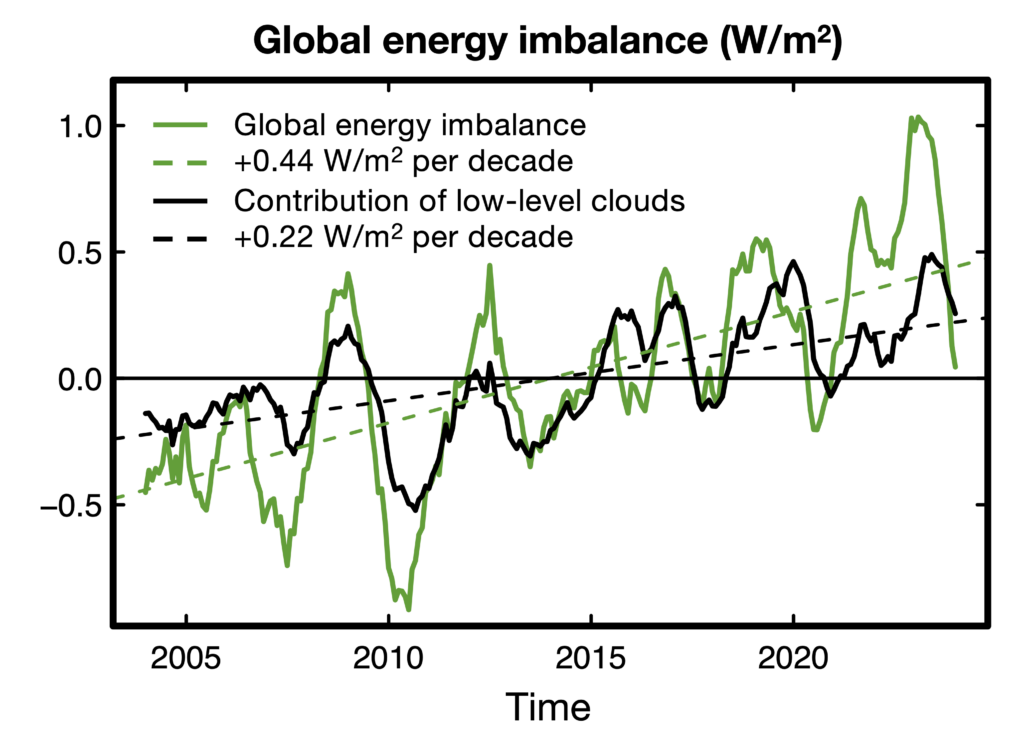
We find that, averaged globally, changes in low-level cloudiness caused an extra 0.22 watts per metre squared (W/m2) per decade of absorbed sunlight. This amounts to exactly half of the concurrent increase in Earth’s energy imbalance over the same time period.
This is shown in the chart below, where the green line represents the increase in the Earth’s energy imbalance over 2003-24 and the black line shows the contribution of low-level clouds to that trend.
Why is cloudiness changing?
Scientists have attributed declining cloud cover in the 21st century to three main causes.
The first is a decrease in human-caused aerosol emissions over recent decades. Aerosols – tiny, light‑scattering particles produced mainly by burning fossil fuels – influence the formation of clouds, by acting as “seeds” for cloud droplets to form.
In recent years, aerosol emissions have been reduced due to efforts to clean up air pollution, such as cleaner shipping fuel regulations. Cleaner air has resulted in a decline in cloudiness.
Second, increasing concentration of greenhouse gases in the atmosphere has led to a warmer and drier atmosphere, which also helps to dissipate clouds.
Although a warmer atmosphere generally holds more water vapour in absolute terms, what matters for clouds is the “relative humidity” of the air, which has been declining in many places. This is a measure of how “saturated” the air is, or how much water vapour the air contains compared to the maximum it could hold.
Finally, cloud cover decreases have also been linked to ocean surface warming, which affects atmospheric humidity and, thus, cloudiness. Reduced cloudiness leads to more sunlight being absorbed at the ocean surface – and more warming. This amplifying loop is known as a “cloud feedback”.
However, the exact strength of these three effects on cloud cover is still unclear.
In fact, cloud feedbacks are among the main uncertainties in climate model projections of global warming.
Attributing low-cloud cover changes
In the next step of our study, we explore how the three human-caused factors mentioned above – aerosols, greenhouse gases and cloud feedback – contributed to recent low-level cloud changes.
We also look at the extent to which cloud changes could be explained by natural climate variability, which causes substantial year-to-year fluctuations in cloudiness and energy imbalance.
To do this, we use a statistical technique known as “cloud-controlling factor analysis”.
This analysis involves calculating the sensitivity of clouds to their “controlling factors”, including meteorological variables, such as temperature, humidity and winds, as well as aerosol concentrations.
To calculate how each factor contributed to the bigger picture of declining cloud cover, we combine sensitivity calculations with observed trends in meteorology and aerosol emissions.
This analysis allows us to attribute trends in cloud cover to known physical drivers: either natural climate variability, or human activities linked to aerosols, greenhouse gases and cloud feedback.
Our research finds that about 40% of the low-level cloud decrease since 2003 was driven by warming of the ocean surface – in other words, the cloud feedback process. This is followed by the effects of greenhouse gases (21%) and aerosols (14%).
Natural climate variability accounts for just 3% of the low-level cloud trend.
(The remaining 23% of the trend cannot be explained by our statistical method. This could be due to the limitations of cloud, temperature, humidity and aerosol concentration observations.)
The chart below shows how human-driven factors – the sum of aerosol effects (red), greenhouse gas emissions (pink) and cloud feedback (burgundy) – were responsible for almost three quarters of the decrease in low-level cloudiness over 2003-24. Natural climate variability (blue), on the other hand, played a minor role.
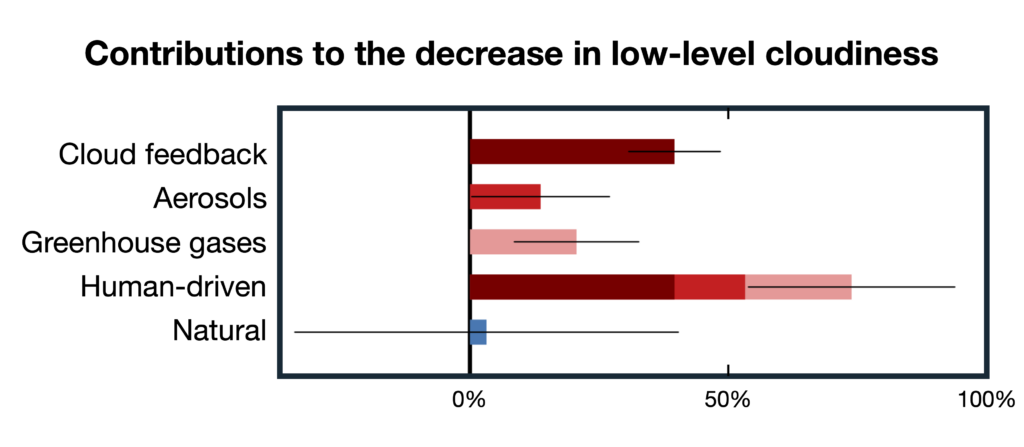
Thus, our analysis indicates that, at global scales, the observed cloud decrease is primarily driven by humans, rather than being caused by natural variations in Earth’s climate.
And, since low-level clouds contribute to half of the energy imbalance increase over the same period, it follows that a significant part of recent rises in energy imbalance can also be attributed to humans.
Clouds in climate models
So, should we be concerned that this cloudiness decrease means the Earth could see more warming than already anticipated?
To answer this, we looked at whether the climate models used by scientists to project future global warming accurately simulate recent declines in low-cloud cover.
While the models produce a wide range of outcomes, we found that, on average, the simulated changes in low-level cloudiness changes are in close agreement with real-world trends.
This is reassuring, as it means the effects of low-cloud cover are already accounted for in existing warming projections.
However, questions still remain around what is driving recent increases to the Earth’s energy imbalance, which have outpaced projections made by climate models.
Our findings rule out declines in low-level clouds as the reason that climate models have been underestimating the Earth’s energy imbalance, and, as a result, warming. But it is still possible that models are underrepresenting future global warming to some extent.
Low-level clouds are just one of several drivers of changes in energy imbalance. Future work will therefore need to assess other observed and simulated drivers of energy imbalance changes: for example, the impact of upper-level clouds, or changes in water vapour or sea ice.
Finally, it is important to stress that, while our findings are reassuring, they should certainly not make us complacent about the current global warming trend. The impacts of climate change are serious enough as they are – even if there is no evidence of a missing amplifying feedback in our projections.



The post Guest post: How declining cloudiness is accelerating global warming appeared first on Carbon Brief.
Guest post: How declining cloudiness is accelerating global warming

Countries’ climate plans would cut global emissions only half as much by 2035 as the UN projected a year ago, its annual assessment showed, after the US exit from the Paris Agreement and weaker new pledges worsened the outlook.
Taking into account the nationally determined contributions (NDCs) of 154 countries, which cover about 71% of global emissions, and current policies in the rest of the world, global emissions would fall to about 6% below 2019 levels by 2035. Last year’s update, based on 113 countries, put the figure at 12%.
According to the Intergovernmental Panel on Climate Change, emissions need to go down by 60% over the same period to limit global warming to 1.5C – a threshold that is now inevitably going to be breached, at least temporarily.
The latest NDCs put the world on course for between 2.1C and 3.2C of warming by the end of the century, depending on what countries do beyond 2035. That is slightly higher than the 1.9C–3.0C range that the UN climate body estimated in last year’s update, published during COP30.
-
Early speakers’ list suggests few powerful leaders will attend COP31
Just 77 heads of state or government are scheduled to address the COP31 climate summit in Antalya, a third less than the COP28 peak -
Paris Agreement committee names three countries snubbing it over NDCs
More than 30 countries have failed to submit an NDC, but only three have repeatedly ignored the committee’s efforts to engage with them


US exit worsens picture
A major factor is the US, the world’s second-largest emitter. Last year’s UN assessment included the pledge to cut emissions by between 61% and 66% by 2035, made under the administration of former President Joe Biden.
But, since the US has officially left the Paris Agreement, its NDC has been excluded from the tally and its emissions projections have now been derived from current policies, which point to far higher levels of pollution.
US emissions grew significantly last year as a result of growing electricity demand and the policies of President Donald Trump’s administration, which has rolled back support for clean energy and backed the burning of fossil fuels.
Weak new NDCs
Another reason for weaker emission reduction projections is that the approximately 40 new NDCs submitted since last year’s update have been less ambitious than the earlier UN modelling had hoped for.
India, the world’s third-largest emitter, submitted its NDC in April. Its plan would let emissions climb to 6.3 billion tonnes by 2035, almost 64% above 2023 levels, according to analysis by Climate Action Tracker (CAT). Its targets are weaker than India’s current policies and it could meet them as early as 2030.
-
Turkish giant sponsoring COP31 cut climate goals then cashed in on oil boom
COP31 sponsors should be screened for “climate integrity”. Yet Koç Holding has become a top partner while its oil refiner runs flat out and its climate targets slip -
Early speakers’ list suggests few powerful leaders will attend COP31
Just 77 heads of state or government are scheduled to address the COP31 climate summit in Antalya, a third less than the COP28 peak -
UK approves gas drilling despite admitting blow to “climate leadership” status
The government accepts that approving the Jackdaw field will weaken its climate reputation and downplays the legal weight of the International Court of Justice opinion

Saudi Arabia’s plan, submitted at the end of last year, sets no 2035 target, but has only a 2040 goal to reduce, avoid or remove 335 million tonnes a year against an undisclosed baseline. CAT rates it “critically insufficient”, estimating 2035 emissions at between 13% below and 18% above 2019 levels.
About 30 countries, including Egypt, Vietnam and Argentina, have still not produced an updated NDC, which all governments should have submitted more than a year and a half ago.
UN climate chief Simon Stiell said this year’s assessment report demonstrates again that collective progress remains insufficient, that global transitions are very uneven and that many countries face substantial barriers to delivering their targets and pledges.
He added that COP31 in Türkiye can help address some of the key gaps highlighted in this year’s reports, through ambitious outcomes on emission-cutting efforts, adaptation, climate finance and just transitions, as well as presidency-led initiatives on electrification, curbing methane emissions and progressing towards zero waste.
The post National climate plans now promise half the emission cuts expected by UN appeared first on Climate Home News.
National climate plans now promise half the emission cuts expected by UN
Climate Change
‘A strong start’: WA’s transition to renewable energy powerhouse aided by Premier’s announcement
PERTH, Tuesday 27 October 2026 — In response to WA Premier Roger Cook’s announcement of a doubled renewable energy target for WA’s main energy system, reported today, the following comments can be attributed to WA Campaign Lead at Greenpeace Australia Pacific, Geoff Bice:
“A Western Australian renewable energy target of 75% by 2030-31 is a welcome step in the right direction following sustained calls from across the WA community including unions, industry and advocacy groups.
“This common sense policy is a vital roadmap for WA’s shift to affordable and reliable solar and wind backed by batteries, and gives certainty to business and investors in a volatile global environment.
“Clear policy on renewable energy for WA’s main electricity grid will allow the phase out of polluting coal-fired power from the system and begin to remedy our reliance on expensive and polluting gas.
“This commitment is a positive first step for WA’s clean energy future, but the Cook Government must also address the state’s rising climate pollution driven by the gas industry and industrial processing.
“A natural step towards tackling rising emissions is rejecting any new fossil fuel projects, including Woodside’s proposal to drill for gas at Scott Reef.
“Expert advice and analysis compiled by Greenpeace and Springmount Advisory clearly lays out a viable pathway for WA to follow a staged transition away from fossil fuels and unlock almost $1 trillion of economic value by 2060 by replacing gas exports with green exports.
“The renewable energy target is a strong start — it must now be paired with emissions reduction targets to ensure climate pollution from WA starts falling urgently, and a plan for WA to become a renewable energy powerhouse must be prioritised.”
-ENDS-
Media contact
Emma Sangalli at emma.sangalli@greenpeace.org or 0431 513 465
‘A strong start’: WA’s transition to renewable energy powerhouse aided by Premier’s announcement
Climate Change
WA EPA warned Woodside of ‘serious, significant and irreversible’ harms to Scott Reef from gas plans, new documents reveal
SYDNEY/PERTH, Tuesday 27 October 2026 — In response to Western Australian Environmental Protection Authority (WA EPA) documents about Woodside’s plans to drill for gas at Scott Reef, as reported today, the following comments can be attributed to Glenn Walker, Head of Nature at Greenpeace Australia Pacific:
“These WA EPA documents show the depth of concern echoed by multiple regulators about Woodside’s plans to drill for oil and gas at Scott Reef, a proposal that flouts legislated nature protection principles.
“The WA EPA appears to have informed Woodside that the Browse project was bound for rejection based on an extensive review process and the opinion of multiple state government departments and independent experts.
“Greenpeace analyses have confirmed this year that Woodside’s gas drilling plans at Scott Reef still risk destroying vulnerable green turtle homes, further endangering pygmy blue whales with atomic bomb-level seismic blasting noise, and unleashing the worst oil spill in Australian history.
“The federal environment department raised similar red flags about oil spill risk from Woodside’s Scott Reef drilling plans in 2025 and 2026 before handing the project’s assessment over to the National Environmental Protecti