

Every year, understanding of climate science grows stronger.
With each new research project and published paper, scientists learn more about how the Earth system responds to continuing greenhouse gas emissions.
But with many thousands of new studies on climate change being published every year, it can be hard to keep up with the latest developments.
Our annual “10 new insights in climate science” report offers a snapshot of key advances in the scientific understanding of the climate system.
Produced by a team of scientists from around the world, the report summarises influential, novel and policy-relevant climate research published over the previous 18 months.
The insights presented in the latest edition, published in the journal Global Sustainability, are as follows:
- Questions remain about the record warmth in 2023-24
- Unprecedented ocean surface warming and intensifying marine heatwaves are driving severe ecological losses
- The global land carbon sink is under strain
- Climate change and biodiversity loss amplify each other
- Climate change is accelerating groundwater depletion
- Climate change is driving an increase in dengue fever
- Climate change diminishes labour productivity
- Safe scale-up of carbon dioxide removal is needed
- Carbon credit markets come with serious integrity challenges
- Policy mixes outperform stand-alone measures in advancing emissions reductions
In this article, we unpack some of the key findings.
A strained climate system
The first three insights highlight how strains are growing across the climate system, from indications of an accelerating warming and record-breaking marine heatwaves, to faltering carbon sinks.
Between April 2023 and March 2024, global temperatures reached unprecedented levels – a surge that cannot be fully explained by the long-term warming trend and typical year-to-year fluctuations of the Earth’s climate. This suggests other factors are at play, such as declining sulphur emissions and shifting cloud cover.
(For more, Carbon Brief’s in-depth explainer of the drivers of recent exceptional warmth.)
Ocean heat uptake has climbed as well. This has intensified marine heatwaves, further stressing ecosystems and livelihoods that rely on fisheries and coastal resources.
The exceptional warming of the ocean has driven widespread impacts, including massive coral bleaching, fish and shellfish mortality and disruptions to marine food chains.
The map below illustrates some of the impacts of marine heatwaves from 2023-24, highlighting damage inflicted on coral reefs, fishing stocks and coastal communities.

Land “sinks” that absorb carbon – and buffer the emissions from human activity – are under increasing stress, too. Recent research shows a reduction in carbon stored in boreal forests and permafrost ecosystems.
The weakening carbon sinks means that more human-caused carbon emissions remain in the atmosphere, further driving up global temperatures and increasing the chances that warming will surpass the Paris Agreement’s 1.5C limit.
This links to the fourth insight, which shows how climate change and biodiversity loss can amplify each other by leading to a decrease in the accumulation of biomass and reduced carbon storage, creating a destabilising feedback loop that accelerates warming.
New evidence demonstrates that climate change could threaten more than 3-6 million species and, as a result, could undermine critical ecosystem functions.
For example, recent projections indicate that the loss of plant species could reduce carbon sequestration capacity in the range of 7-145bn tonnes of carbon over the coming decades. Similarly, studies show that, in tropical systems, the extinction of animals could reduce carbon storage capacity by up to 26%.
Human health and livelihoods
Growing pressure on the climate system is having cascading consequences for human societies and natural systems.
Our fifth insight highlights how groundwater supplies are increasingly at risk.
More than half the global population depends on groundwater – the second largest source of freshwater after polar ice – for survival.
But groundwater levels are in decline around the world. A 2025 Nature paper found that rapid groundwater declines, exceeding 50cm each year, have occurred in many regions in the 21st century, especially in arid areas dominated by cropland. The analysis also showed that groundwater losses accelerated over the past four decades in about 30% of regional aquifers.
Changes in rainfall patterns due to climate change, combined with increased irrigation demand for agriculture, are depleting groundwater reserves at alarming rates.
The figure below illustrates how climate-driven reductions in rainfall, combined with increased evapotranspiration, are projected to significantly reduce groundwater recharge in many arid regions – contributing to widespread groundwater-level declines.
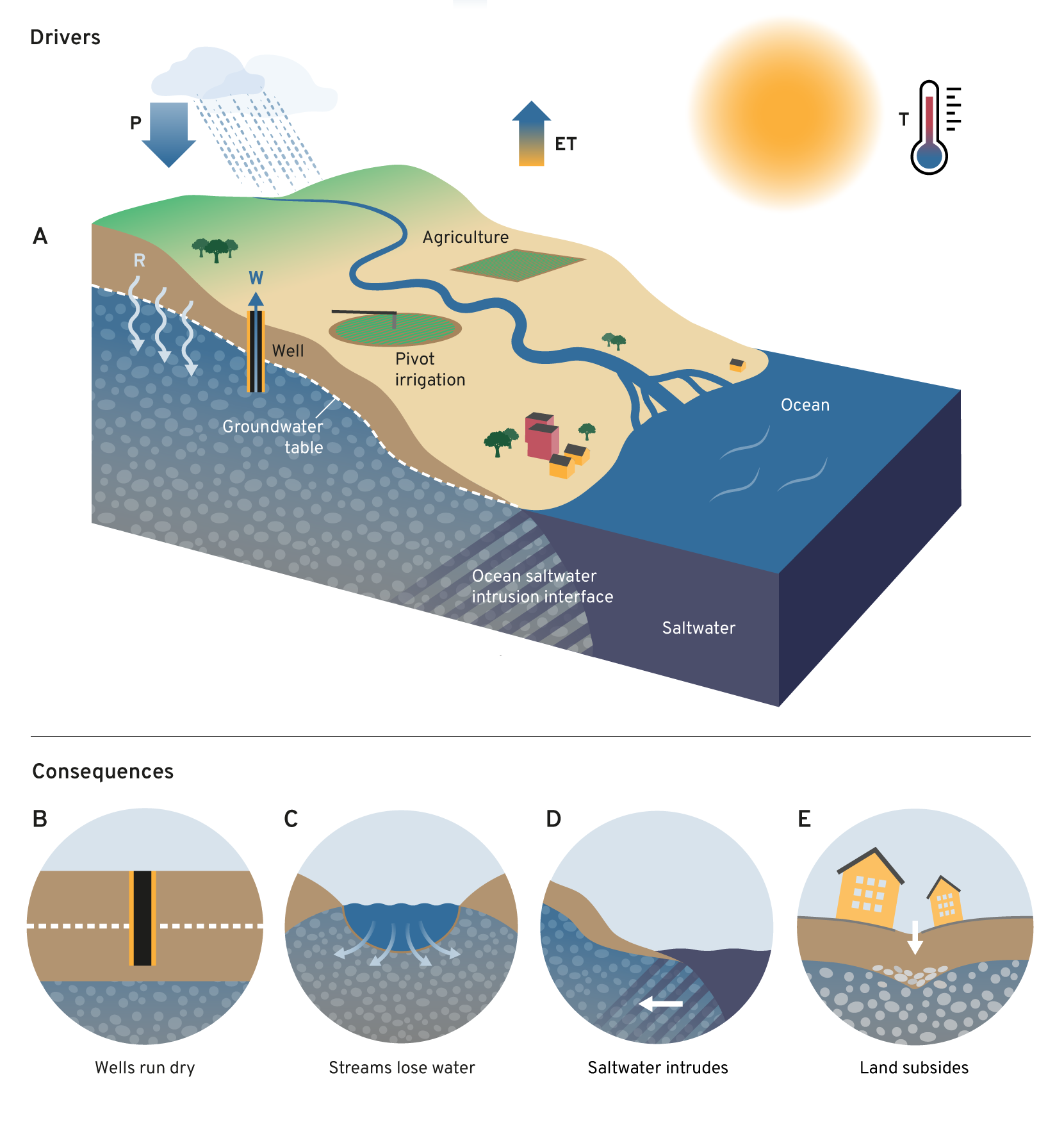
These losses threaten food security, amplifying competition for scarce resources and undermining the resilience of entire communities.
Human health and livelihoods are also being affected by changes to the climate.
Our sixth insight spotlights the ongoing and projected expansion of the mosquito-borne disease dengue fever.
Dengue surged to the largest global outbreak on record in 2024, with the World Health Organization reporting 14.2m cases, which is an underestimate because not all cases are counted.
Rising temperatures are creating more favourable conditions for the mosquitoes that carry dengue, driving the disease’s spread and increasing its intensity.
The chart below shows the regions climatically suitable for Aedes albopictus (blue line) and Aedes aegypti (green line) – the primary mosquitoes species that carry the virus – increased by 46.3% and 10.7%, respectively, between 1951-60 and 2014-23.
The maps on the right reveal how dengue could spread by 2030 and 2050 under an emissions scenario broadly consistent with current climate policies. It shows that the climate suitable for the mosquito that spreads dengue could expand northwards in Canada, central Europe and the West Siberian Plain by 2050.

The ongoing proliferation of these mosquito species is particularly alarming given their ability to transmit the zika, chikungunya and yellow fever viruses.
Heat stress is also a growing threat to labour productivity and economic growth, which is the seventh insight in our list.
For example, an additional 1C of warming is projected to expose more than 800 million people in tropical regions to unsafe heat levels – potentially reducing working hours by up to 50%.
At 3C warming, sectors such as agriculture, where workers are outdoors and exposed to the sun, could see reductions in effective labour of 25-33% across Africa and Asia, according to a recent Nature Reviews Earth & Environment paper.
Meanwhile, sectors where workers operate in shaded or indoor settings could also face meaningful losses. This drain on productivity compounds socioeconomic issues and places a strain on households, businesses and governments.
Low-income, low-emitting regions are set to shoulder a greater relative share of the impacts of extreme heat on economic growth, exacerbating existing inequalities.
Action and policy
Our report illustrates not only the scale of the challenges facing humanity, but also some of the pathways toward solutions.
The eighth insight emphasises the critical role of carbon dioxide removal (CDR) in stabilising the climate, especially in “overshoot” scenarios where warming temporarily surpasses 1.5C and is then brought back down.
Scaling these CDR solutions responsibly presents technical, ecological, justice, equity and governance challenges.
Nature-based approaches for pulling carbon out of the air – such as afforestation, peatland rewetting and agroforestry – could have negative consequences for food security, biodiversity conservation and resource provision if deployed at scale.
Yet, research has suggested that substantially more CDR may be needed than estimated in the scenarios used in the Intergovernmental Panel on Climate Change (IPCC’s) last assessment report.
Recent findings showed that a pathway where temperatures remain below 1.5C with no overshoot would require up to 400Gt of cumulative CDR by 2100 in order to buffer against the effect of complex geophysical processes that can accelerate climate change. This figure is roughly twice the amount of CDR assessed by the IPCC.
This underscores the need for robust international coordination on the responsible scaling of CDR technologies, as a complement to ambitious efforts to reduce emissions. Transparent carbon accounting frameworks that include CDR will be required to align national pledges with international goals.
Similarly, voluntary carbon markets – where carbon “offsets” are traded by corporations, individuals and organisations that are under no legal obligation to make emission cuts – face challenges.
Our ninth insight shows how low-quality carbon credits have undermined the credibility of these largely unregulated carbon markets, limiting their effectiveness in supporting emission reductions.
However, emerging standards and integrity initiatives, such as governance and quality benchmarks developed by the Integrity Council for Voluntary Carbon Markets, could address some of the concerns and criticism associated with carbon credit projects.
High-quality carbon credits that are verified and rigorously monitored can complement direct emission reductions.
Finally, our 10th insight highlights how a mix of climate policies typically have greater success than standalone measures.
Research published in Science in 2024 shows how carefully tailored policy packages – including carbon pricing, regulations, and incentives – could consistently achieve larger and more durable emission reductions than isolated interventions.
For example, in the buildings sector, regulations that ban or phase out products or activities achieve an average effect size of 32% when included in a policy package, compared with 13% when implemented on their own.
Importantly, policy mixes that are tailored to the country context and with attention to distributional equity are more likely to gain public support.
These 10 insights in our latest edition highlight the urgent need for an integrated approach to tackling climate change.
The science is clear, the risks are escalating – but the tools to act are available.



The post Guest post: 10 key climate science ‘insights’ from 2025 appeared first on Carbon Brief.

Scientists have vowed to keep working on the next flagship set of reports for the Intergovernmental Panel on Climate Change (IPCC), after a political row over the timeline for their release saw its latest session suspended on Friday evening without agreement.
During the weekend, government officials and scientists alike expressed disappointment over the inability to reach a compromise before some delegates from developing countries and small island states had to leave the week-long meeting in Ethiopia to catch flights home.
The disagreement – which has persisted since early 2024 – turns on whether the three key parts of the AR7 assessment should all be published before the conclusion of the UN’s next Global Stocktake of global climate action, which is due to be completed in late 2028.
The IPCC issued a statement after the close of the session, saying that “key agenda items” – the timelines for the three AR7 reports, as well as the IPCC budget – remain open and under discussion. It said the IPCC’s plenary session and its deliberations on the pending agenda “will resume at the earliest opportunity”, giving no further details of when.
IPCC Chair Jim Skea told delegates in closing remarks that recent months had been some of the most turbulent for the climate science panel and that, if there were stronger words than “profound disappointment” he would use them, according to a summary published by the Earth Negotiators Bulletin (ENB). IPCC discussions happen behind closed doors.
IPCC scientists remained committed
In an open letter, issued on Monday, a group of nearly 120 scientists – from a total of 664 AR7 authors – said they “stand committed to continue working to deliver the AR7 reports in a manner that is rigorous, timely and inclusive, in line with our mandate to be policy-relevant”.
“An assessment that arrives after the decisions it is meant to inform cannot serve its purpose,” they emphasised. “The second Global Stocktake in 2028 is such a decision point, and the world should not have to face it without the IPCCʼs latest assessment.”
Europe, small islands and the least developed countries, plus many Latin American and developed nations, want the IPCC to meet this deadline, arguing that the findings from the UN climate science body are irreplaceable in the UN climate policy-making process.
However, around a dozen developing countries plus Russia have argued that the reports should come later in order to allow for greater research input from the Global South – something that, in their view, would make the findings fairer. They also claim that a shorter timeline would put excessive pressure on experts.
-
Who shapes climate science? The equity question facing the IPCC
Early completion of the next global climate science assessment reports risks excluding research from the Global South, which is key to ensuring the findings are fair -
Governments that support climate science must stand firm against naysayers
The IPCC is meeting to decide the timing of its next major report, as some countries try to delay it and weaken the case for faster emissions cuts


The most vocal of this group at last week’s meeting were India and Saudi Arabia, according to the ENB summary and a developed country diplomat. Critics see this push for a longer timeline as an excuse to deprive government decision-makers of the latest science and ease pressure on emerging economies to raise their ambition, particularly on cutting emissions.
Commenting on last week’s meeting, France’s ambassador for climate negotiations Benoît Faraco said a broad coalition of developed and developing countries from all five continents, “united in their support for science and the timeline proposed by scientists”, had withstood pressure “from a few countries” seeking to slow down the process of adopting the IPCC reports.
He added that France would not back down and would “continue to fight tirelessly for science, protect the integrity of information, and convince our partners that without the best available scientific data, we will be less effective in tackling climate change and protecting our populations”.
Inclusivity proposal stalled
In a bid to unlock a solution for the AR7 timeline, countries discussed ways to improve the inclusivity of the IPCC’s work. One option put on the table was for the IPCC to expand its funding for delegates from developing countries to attend some or all of its sessions from one to two participants, according to the ENB summary and a delegate speaking to Climate Home News.
That would increase the costs for the IPCC to complete AR7 by up to a quarter, according to an assessment shared by the secretariat. The panel’s budget is under severe strain and its officials have warned that, without additional voluntary contributions, it risks running out of money before it can deliver on this assessment cycle.
Climate Home News understands that some of the IPCC’s traditional donors – which mainly include European countries, Japan and Australia – indicated a willingness to support funding for an additional developing country participant. But without an agreement over the budget or the timeline for the reports, that option was ultimately not adopted.
‘Disappointed and worried’
The three reports are managed by working groups that collate and draw overall findings from the latest scientific studies and data on the physical effects of global warming around the world, how to adapt to it, and pathways for cutting planet-heating emissions in order to meet the temperature goals of the Paris Agreement.
Winston Chow, an urban climate professor at Singapore Management University who co-chairs Working Group II on adaptation, wrote in a LinkedIn post that he was “disappointed and worried” for the IPCC authors who have worked “extraordinarily hard” to assess the relevant climate science over the past two years.
He said he shared their concern that “the rigour, time and goodwill they’ve invested are now being put at risk by the Panel’s stalemate”.
As science comes under attack at UN talks, climate movement splits over how to respond
For Working Group II, a meeting for 250 experts writing that report is scheduled for January 2027, followed by the approval of a special report on cities and climate change in Singapore next March.
But because the IPCC’s budget has not been confirmed due to uncertainty about the AR7 schedule, travel support for those researchers is at risk, wrote Chow. “If they cannot participate, our assessments will lose vital expertise, perspectives and scientific breadth, and the collective effort of our authors will be undermined,” he warned.
Scientific work continues
Despite the political holdups, he – together with French climate scientist Robert Vautard, co-chair of Working Group 1 – agreed with IPCC head Skea who told the IPCC’s closing session on Friday: “The engine room of the IPCC is working, and it’s healthy.”
Vautard commented in a separate post on LinkedIn after it ended: “The boat is at full steam.” Working groups I and II are due to start revising the first drafts of their reports, while Working Group III on reducing emissions is finalising its first draft which will be out soon, he wrote.
“The most exciting two years of the cycle are ahead, for the authors. The momentum in the engine room is here and now. Trust the engine room!” he added.
The IPCC and some scientists report that progress has been made towards achieving an equitable balance of authors from the Global North and the Global South.
The group of researchers who signed the open letter on Monday noted that “inclusivity is at the heart of how we work”, with author teams bringing together experts from developed and developing countries with diverse backgrounds and at different stages of their careers.
Plea to overcome political differences
The signatories include several scientists from some of the countries opposed to the alignment of all IPCC reports with the Global Stocktake.
“We are committed to an assessment in which the knowledge, experience and priorities of every region are fully reflected, a commitment we share with the leadership of the IPCC.
Equity is built into how our assessment is being drafted,” they added.
They appealed to governments that make up the IPCC “to overcome their political differences and work together as we do as a global scientific community, so that we can deliver the IPCC reports the world needs to hear”.
In a statement published on Monday, IPCC chair Skea said reaching consensus on the schedule for the reports is “vital”. He added that the assessments provide authoritative scientific evidence to inform national climate policies, strengthen adaptation and resilience and support access to climate finance, as well as helping communicate the scale of the climate crisis and the urgency of efforts to tackle it.
The post IPCC scientists vow to press on with climate reports despite political deadlock appeared first on Climate Home News.
IPCC scientists vow to press on with climate reports despite political deadlock
An Lambrechts is a biodiversity politics expert at Greenpeace International with extensive experience in biodiversity-related multilateral negotiations. She is the head of the Greenpeace delegation at the Convention on Biological Diversity (CBD) COP17 happening in Yerevan, Armenia.
In 2022, COP15 delivered the landmark Kunming-Montreal Global Biodiversity Framework to halt and reverse biodiversity loss by 2030. With COP17 starting in Yerevan, we are now halfway to the deadline, and according to the first Global Review of progress, countries are not on track to meet the biodiversity targets, and implementation must accelerate fast.
One of the main findings of the Global Review is that funding falls far short of the scale needed to halt and reverse nature loss. But the crisis facing the world’s biodiversity is not an absolute scarcity of capital – it is a profound public policy distortion.
The global economy currently spends roughly $30 destroying nature for every single dollar invested in its protection. According to a report from the Intergovernmental Science-Policy Platform on Biodiversity and Ecosystem Services, a staggering $2.4 trillion is spent in public subsidies for fossil fuels, agriculture and water use, while global investment in biodiversity conservation and restoration stands at a mere $220 billion.
Countries urged to ramp up “insufficient” nature policies at COP17
Yet, discussions about how to close the biodiversity finance gap continue to claim that salvation lies in mobilising private capital, scaling offsets and “derisking” investments in nature. Thi