

Ralph Regenvanu is Vanuatu’s Minister for Climate Change Adaptation, Energy, Environment, Meteorology, Geohazards and Disaster Management.
A few weeks ago, leaders of Small Island Developing States (SIDS) met in Antigua & Barbuda to discuss our next decade of action. This, for us, is the critical decade, no less. We have a few years to change the tides that are swallowing our islands and extinguishing our culture and our identity.
Pacific Island communities are unwilling witnesses of the climate crisis – emitting minuscule amounts of greenhouse gases while bearing the brunt of the extreme and devastating consequences of the world’s failure to break its addiction to fossil fuels.
During that meeting, we heard from some G7 leaders that they will support our priorities, that a fossil fuel phase-out and a just and equitable transition is necessary. But these cannot be hollow words. As the single greatest security threat for our region, it is time to implement your commitments or be held accountable for your lack of inaction by carrying the loss of our future generations on your shoulders.
Just a few months ago, at the UN climate talks in Dubai, countries around the world finally agreed to transition away from fossil fuels. This week in Bonn, any talk of how countries plan to implement this agreement was noticeably absent.
But now, G7 nations – Canada, Japan, Italy, the United States, Germany, the United Kingdom, and France – are gathering at a historic time for climate politics, holding one of the first opportunities to show their leadership by putting the COP28 decision on fossil fuels into action.
This will also be the last time these countries meet before they are required to submit updated and enhanced climate plans through to 2035 under the Paris Agreement. It is a final chance for G7 nations to adopt the measures that are necessary to limit warming to 1.5°C.
Despite having both the capacity and the responsibility to be leaders driving forward a full, fast, fair and funded phase-out of fossil fuels, these countries are not walking the walk – at home or abroad.
Islands as “collateral damage”?
Some G7 countries have plans to massively expand fossil fuel production at home despite science telling us that no new oil, gas, or coal projects are compatible with a safe climate, while others are using billions of the public’s money to finance more fossil fuel infrastructure abroad.
We are urging G7 nations to demonstrate true leadership at the upcoming negotiations, immediately halting the approval of all new fossil fuel projects and committing to 1.5°C-aligned timelines for phasing out existing fossil fuel reliance in a just and equitable manner.
This transition must prioritise the needs of developing countries, which bear the brunt of climate change impacts despite contributing the least to its causes.
G7 countries have already committed to end international public finance for fossil fuel projects but continue approving billions of dollars for fossil fuel infrastructure. They are giving the fossil fuel industry a lifeline, indebting vulnerable countries, and delaying a just energy transition.
In the words of UN Secretary General Antonio Guterres: “The idea that an entire island state could become collateral damage for profiteering by the fossil fuel industry is simply obscene.”
There is no shortage of public money to enable a just and equitable transition to renewable energy and turn the COP28 agreement into a reality. It is just poorly distributed to the most harmful parts of the global economy that are driving climate change and inequality: fossil fuels, unfair colonial debts, and the super-rich.
We need G7 countries to pay their fair share on fair terms for fossil fuel phase-out and the other crises we face. Climate finance remains the critical enabler of action – over the course of our meetings in Antigua & Barbuda we heard some G7 countries make commitments and pledges; we also heard a lot of solutions and options that will exacerbate our debt burden.
But for us, it is clear. Climate finance must be scaled up to meet the trillions of dollars needed for adaptation, mitigation, and addressing loss and damage; and sent to where it is most needed – on fair terms that do not further burden our economies with debt.
Hold fossil fuel firms to account
The members of the G7 are among the world’s most powerful and wealthiest nations. They have a responsibility to lead the way both at home and abroad. Anything less is hypocrisy and gross negligence, and risks endangering the implementation of the COP28 decision to transition away from fossil fuels.
The Pacific Island nations have been vocal advocates for ambitious climate action and have led by example for decades. In 2023, our leaders aspired to a Fossil Fuel Free Pacific. We embedded the language of phase-out and transition in our leaders’ declaration.
Bonn talks on climate finance goal end in stalemate on numbers
We have felt the impacts of climate change more acutely than most and have consistently called for comprehensive and equitable global action for the very survival of our nations and for the good of all people and species.
For Pacific Island nations, the transition to clean and renewable energy is not just a goal but a necessity for survival. We call upon the G7 to reflect the highest possible ambition. These countries must acknowledge and support our aspiration for a fossil fuel-free future, setting an example for sustainable development that prioritizes the well-being of people and planet over profit – and ensure that the fossil fuel companies responsible for the climate crisis bear the cost of their actions.
The time for action is now. The fate of our planet hangs in the balance, and the decisions made by the G7 nations will shape our collective future. We implore them to heed the call of the Pacific Island nations and rise to the challenge of the climate crisis with boldness, ambition and urgency. Our shared future depends on it.
The post G7 countries must deliver on COP28 promise to cut fossil fuels appeared first on Climate Home News.
G7 countries must deliver on COP28 promise to cut fossil fuels

Three countries have been named by the Paris Agreement’s compliance committee for failing to submit a nationally determined contribution (NDC) and repeatedly snubbing offers of help with their climate plans.
After months of internal debate over whether to identify serial non-responders, the Paris Agreement’s Implementation and Compliance Committee (PAICC) named the three countries which have failed to engage with it over their NDCs on Friday.
It named Democratic Republic of Congo, Senegal and North Korea in a footnote of its annual report, adding that it decided to name them “with a view to facilitating engagement”, adding that representatives of the three nations had been invited to its meeting in early 2027 “with the purpose of identifying any challenges and constraints”.
“The Committee noted the importance of Parties engaging with the Committee in a timely manner, while noting that some delays may be due to the national capabilities and circumstances of the Parties”, the report said.
-
Under US pressure, World Bank says it will back gas “where appropriate”
The US wants the World Bank to expand its gas support while climate campaigners are pushing for it to end – its head spoke this week of limited backing for the fossil fuel -
IPCC scientists vow to press on with climate reports despite political deadlock
After governments again failed to agree a timeline, nearly 120 IPCC authors pledged to complete their assessment on time and with full scientific rigour -
Paris Agreement committee snubbed over missing NDC climate plans
Many governments have still not submitted a nationally determined contribution to the UN, breaching a key requirement of the Paris Agreement

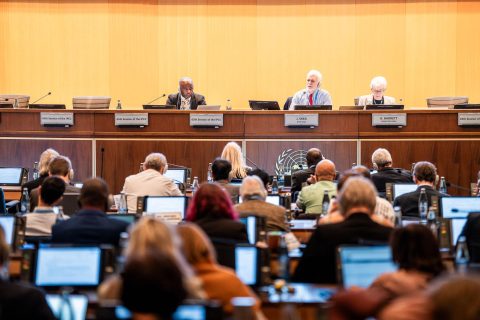

In July, PAICC said 12 countries had ignored its repeated attempts to discuss why they had not published an NDC as required every five years under the 2015 Paris accord.
Members of the committee had been divided over whether to name them, but at a September meeting decided to do so in their annual report to the annual climate COP summit.
By the time the report was published on Friday, only Congo, Senegal and North Korea “had not communicated an NDC or submitted a [Biennial Transparency Report] and had not yet responded to any of the Committee’s notifications, despite several reminders issued by the Committee in this regard”.
Rainforest and renewable energy ambitions
The silence from Congo and Senegal is notable because the former is home to much of the Congo Basin rainforest while the latter has sought billions of dollars in climate finance to support its renewable energy ambitions.
After Brazil, Congo has more rainforest than any country in the world. This forest, and the country’s peatlands, absorb huge amounts of greenhouse gas but are fast being lost to expanding farmland, charcoal production, logging and mining.
Senegal signed a Just Energy Transition Partnership with Canada and wealthy European nations in 2023, to help it meet its renewable energy targets under the-then government of Macky Sall. It was chair of the Least Developed Countries group between January 2022 and December 2023.

Tejas Rao, who is researching the PAICC as part of a doctoral thesis at Cambridge University, said the governments of the three countries should engage with the committee.
“Engagement costs these governments very little and the committee has shown it will listen,” he said.
“Silence leaves the committee with no basis to help, and it leaves the [governments] exposed to the narrative that they are simply disengaged,” he told Climate Home News.
Paris Agreement requirement
The 2015 Paris Agreement requires all parties to publish an NDC every five years outlining their emissions reduction targets, with each plan meant to be more ambitious than the country’s last NDC.
The latest set – the third round of plans, with new targets for 2035 – was due in February 2025. While most countries missed this deadline, all but around 30 – mostly small emitters but including Egypt, Vietnam and Argentina – have now submitted them.
Over the year, the PAICC – which is made up of government climate officials from developed and developing countries – has been communicating with governments that have not submitted NDCs and trying to overcome barriers to them doing so.
Some nations have cited exceptional circumstances as the reason for not submitting an NDC, a process that requires a significant amount of work in tracking emissions and consulting on how to curb them across the economy. For example, a letter from a Sudanese official to the PAICC, seen by Climate Home News, said that the country’s civil war had led to the suspension of its NDC preparation.
-
IPCC scientists vow to press on with climate reports despite political deadlock
After governments again failed to agree a timeline, nearly 120 IPCC authors pledged to complete their assessment on time and with full scientific rigour -
Under US pressure, World Bank says it will back gas “where appropriate”
The US wants the World Bank to expand its gas support while climate campaigners are pushing for it to end – its head spoke this week of limited backing for the fossil fuel -
Who shapes climate science? The equity question facing the IPCC
Early completion of the next global climate science assessment reports risks excluding research from the Global South, which is key to ensuring the findings are fair
The US and Iran are not signed up to the Paris Agreement and so do not have active NDCs, nor does Taiwan, which is not a UN member state.
Rao said that because the PAICC is “facilitative and non-punitive”, naming the countries “is meant to open a door, not close one – the invited consultation is the point”.
“In recent months, governments that explained their constraints, whether capacity, finance or domestic process, have been met with follow-up and support rather than sanction, and the number of silent governments has fallen sharply,” Rao said.
The post Paris Agreement committee names three countries snubbing it over NDCs appeared first on Climate Home News.
Paris Agreement committee names three countries snubbing it over NDCs