

Elections for the European Parliament are taking place between 6-9 June, kicking off a process that will establish a new EU leadership.
Around 360 million EU citizens are eligible to vote. They will choose between representatives of national parties, each of which is affiliated with a broader political grouping at EU level, ranging from communists to the far-right.
The grouping or coalition with the most parliamentary seats will shape the leadership of the next European Commission – the EU’s executive branch – and help to determine the bloc’s overall direction of travel for the 2024-2029 term.
The balance of power in parliament, which is one of the EU’s legislative bodies, will also play a key role in determining whether or not ambitious new climate policies are voted through.
The elections come at a critical time for climate and energy policy across Europe. Amid geopolitical turmoil, EU member states face mounting pressure to provide secure energy supplies and compete with other major powers such as China and the US.
Meanwhile, there has been widespread reporting of a “green backlash” in many EU countries, exemplified by farmers protesting against perceived injustices that include environmental policies. (Based on recent EU-wide polling, the so-called backlash has been dismissed as “largely overblown”.)
The new European Parliament, the new Commission and member states must also agree in the coming months on an emissions target for 2040, a stepping stone on the bloc’s wider path to “climate neutrality” by 2050.
These decisions will be influenced by which parties triumph in the parliamentary elections.
In the interactive grid below, Carbon Brief tracks the commitments made by each of the main European Parliament groupings in their election manifestos, across a range of issues related to climate and energy. The parties covered are:
- European People’s Party (EPP): A centre-right group that currently holds the most seats in parliament, and to which current European Commission president Ursula von der Leyen belongs.
- Progressive Alliance of Socialists and Democrats (S&D): A centre-left group that currently holds the second highest number of seats in parliament.
- Renew Europe Now: The liberal and centrist campaign platform for the European Democratic Party (EDP), the Alliance of Liberals and Democrats for Europe (ALDE) – both of which also have their own manifestos – and France’s ruling Renaissance party.
- European Green Party: Representing green parties from across Europe, the Green Party is part of a parliamentary grouping with the European Free Alliance (EFA), which represents regionalist or separatist European groups. Volt Europa, a pro-European, federalist party, is also affiliated with the group.
- European Conservatives and Reformists (ECR): A parliamentary grouping of right-wing Eurosceptics. The far-right Identity and Democracy coalition, which split off from the ECR in 2019, has not released a manifesto.
- Party of the European Left (PEL): An association of democratic socialist and communist parties that sits in a parliament grouping known as The Left in the European Parliament.
Each entry in the grid represents a direct quote from a manifesto document.
Climate targets
When the last European Parliament elections were held in 2019, a “green wave” saw climate-focused politicians winning seats across the continent. This was interpreted as a clear mandate to set ambitious, EU-wide climate targets and policies.
In the years that followed, the EU approved a European Green Deal, with goals to cut emissions by 55% from 1990 levels by 2030, and reach net-zero by 2050. It also passed a package of policies to help member states achieve these goals.
These measures have “significantly improved” the EU’s performance on tackling climate change, according to independent analysis by Climate Action Tracker. However, the group says that the bloc would need to implement further policies to align itself with the goals of the Paris Agreement.

With the 2024 election looming, forecasters predict a swing to the right in EU politics. A surge in far-right MEPs could result in a right-wing majority coalition within parliament.
This, in turn, could jeopardise the next phase of the EU’s climate ambitions, including negotiations over a European Commission proposal to reduce emissions by 90% by 2040.
For example, the right-wing ECR’s manifesto says that it will “prioritise the implementation of existing legislative requirements…before considering any new regulations”.
It also refers to “review[ing] the more problematic objectives” and “negative impacts” of “green” policies, implying it might support weakening existing climate goals.
The centre-right EPP says it is “clearly committed” to existing targets – which include the 2030 and 2050 goals – but it does not mention the mooted 2040 ambition.
There have been reports of internal disputes within the EPP over the 2040 target and broader environmental policies. An earlier draft of its manifesto illustrated these disputes, with a commitment to “rejecting” bans on any technologies and “revising” the 2035 ban on petrol and diesel cars. This language is missing from the final manifesto.
In contrast, parties that are further to the left have backed more ambitious emissions targets, as shown in the chart below.
The relatively centrist S&D and Renew Europe Now groupings support the proposed 90% goal for 2040. (While S&D only mentions achieving “strong” 2040 goals in its manifesto, elsewhere the party has voiced support for the target.)
Meanwhile, other parties have gone even further. The European Green Party has proposed a “revised EU climate law” with a 2030 target that goes “beyond” the current 55% goal and achieves net-zero by 2040. The Left specifies a 65% reduction by 2030 and net-zero by 2035.

All the major parties with manifestos broadly support the European Green Deal, with the ECR stating it backs it “in principle” while noting its concerns about a “centralised top-down approach”. (Identity and Democracy, which has not released a manifesto, broadly opposes the green deal and includes many climate sceptics in its ranks.)
Some groups appear to go further. Both S&D and the Greens mention the creation of a new “Green and Social Deal”, with a greater emphasis on affordable energy, social protections and jobs in low-carbon sectors.
In a piece reflecting on the need for a left-wing vision to combat the growing “anti-green backlash”, Politico argued that, with virtually every party emphasising the need for a “just transition”, it was “not clear” what the S&D’s new deal was “supposed to be”.
Of the major parties, only the Green party includes a target for “phasing out” fossil fuels in its manifesto. (At COP28 last year, the EU and other parties to the Paris climate regime agreed to “transition away” from fossil fuels.) The Greens target a 2030 phaseout of coal, with all fossil fuels phases out by 2040.
Farmers’ demands
From France to Romania, EU farmers have been engaging in often dramatic protests in recent months.
While their demands have been wide-ranging, many have focused on climate and environmental issues. This follows anger from farming communities about cuts to fuel subsidies and efforts to curb the use of fertilisers and pesticides.
All of the manifestos speak directly to these ongoing issues, with some calling for major reforms to the Common Agricultural Policy (CAP) – the EU’s flagship farming policy. Others try to strike a balance between supporting farmers and maintaining strong climate ambitions.
Agriculture is responsible for one-tenth of the EU’s greenhouse gas emissions. It is the only major sector that is expected to see almost no progress in emissions cuts in the coming decades.
The EPP says climate policies can be achieved “only with and not against farmers” and says more funding for agriculture will be vital to support their environmental efforts. Liberals in Renew Europe Now say they have proposals to “simplify farmer’s lives” because they “want to focus on farming, not filling out forms”.
The ECR, meanwhile, says it “reject[s] unfettered green ideology” in agriculture.
S&D says its members “fundamentally disagree with the conservatives’ approach that sustainability is the enemy of farmers”. Like the EPP, it emphasises the need for more financial support to help farmers transition to “environmentally friendly” practices.
Boosting clean energy industries
Many of the manifestos focus on promoting the EU’s economic success and competitiveness, particularly in relation to the US and China, as well as ensuring it is not reliant on other nations for resources.
This comes amid a period of instability, triggered partly by Russia’s invasion of Ukraine, which threatened the bloc’s energy security due to its reliance on Russian gas.
Often, parties explicitly make the link between these wider geopolitical struggles and the need to scale up low-carbon industries. This is exemplified by the EPP when it states:
“We are developing the home market for our clean-tech industries. We are decarbonising and revitalising our energy-intensive industries to sell clean products worldwide. Thus, we are increasing our energy independence and overall sovereignty and resilience.”
Both S&D and the Greens focus on the need for investment across industrial sectors, in order to maintain the EU’s competitive edge. ALDE, the main party in Renew Europe Now, emphasises “cross-border” public investment in order to “achieve the economies of scale that the single market offers”.
Right-wing and liberal parties stress the need for “technology neutrality” in their plans.
Greens and left-wing parties, on the other hand, either explicitly reject nuclear power or do not mention it. They also place more emphasis on developing public transport options, including improved rail networks, alongside investment in electric vehicle infrastructure.


The post EU election 2024: What the manifestos say on energy and climate change appeared first on Carbon Brief.
EU election 2024: What the manifestos say on energy and climate change

For the first time, new-energy vehicles (NEVs) made up 67% of new car sales in China in September, according to the latest data from the China Passenger Car Association (CPCA).
The figures show that NEVs, which include battery electric cars and plug-in hybrids, captured a record share of sales, even though fewer were sold than last year.
This is because sales of combustion-engine cars are falling steeply, a trend that the CPCA has attributed to rising petrol prices following the start of the Hormuz crisis.
Indeed, sales of fuel-only cars were down 31% year-on-year in the first nine months of 2026, with plug-in hybrid sales down 26% – whereas battery EV sales were only down 4%.
One analyst tells Carbon Brief that China’s rapidly growing EV fleet has offset demand for 143m barrels of oil since the start of the Hormuz crisis.
Another says that the crisis is “reinforcing China’s electrification of road transport”.
Meanwhile, amid slowing domestic sales, Chinese carmakers’ exports of NEVs more than doubled [in 2026 to date / in September] from a year earlier.
NEV record
A record two out of every three cars sold in September in China were NEVs, according to CPCA data, as shown in the figure below.
(NEVs predominantly include battery electric vehicles – BEVs – and plug-in hybrids – PHEVs. BEVs only run on electricity, whereas PHEVs also have a combustion engine.)
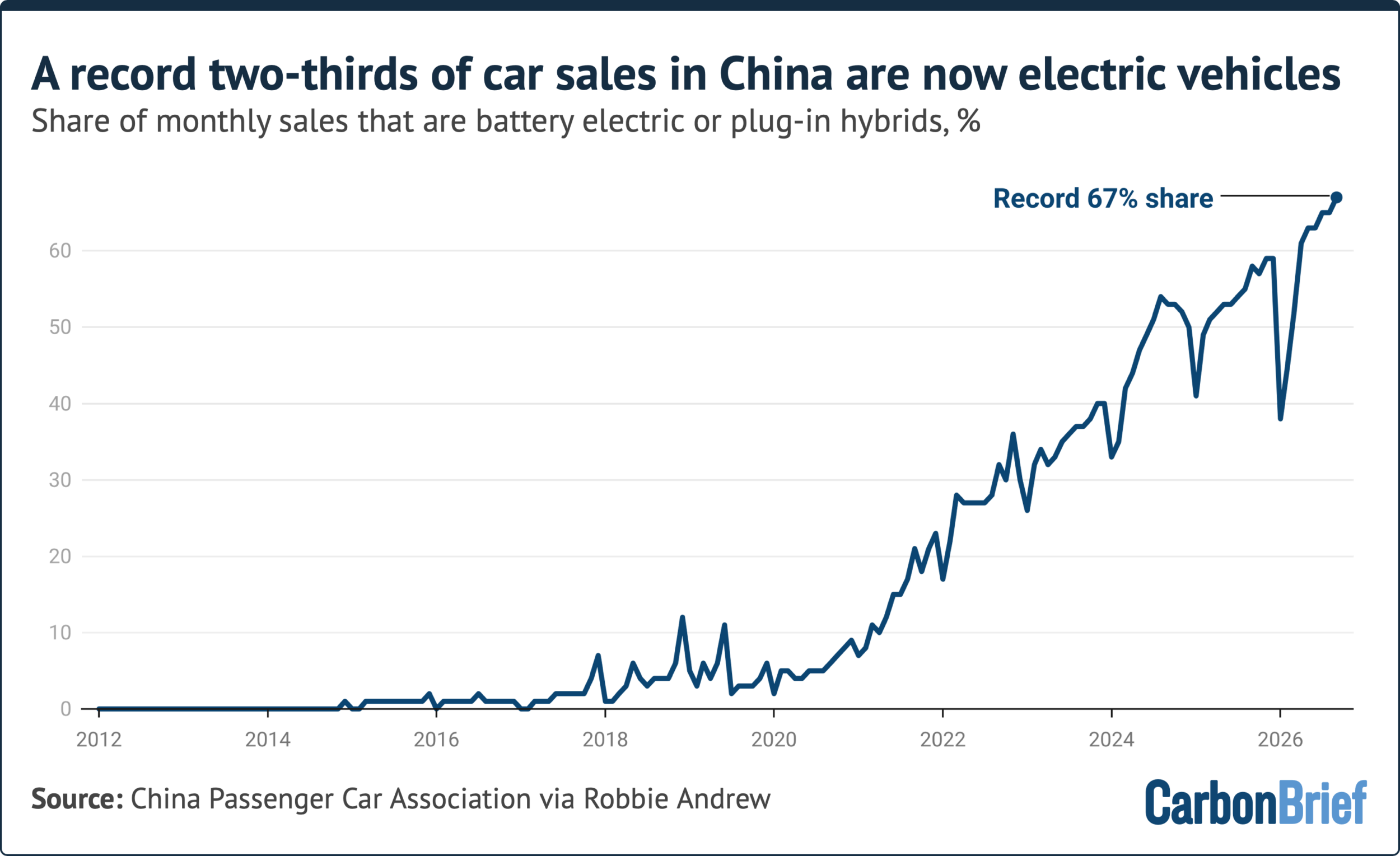
This marks a rapid rise for NEVs from just 6% of new car sales in 2020 up to 58% in 2026 to date – and a record 67% in the month of September.
This year, NEVs’ share of sales has also bounced back from a low of 39% in January, after the full purchase tax exemption that had been in place for more than a decade came to an end in December 2025.
The gain in NEV share in 2026 has come amid a slowdown across the wider domestic passenger-car market, which has hit sales of combustion-engine vehicles particularly hard.
This September, passenger-car retail sales across all categories declined, with overall sales volumes falling 28% year-on-year.
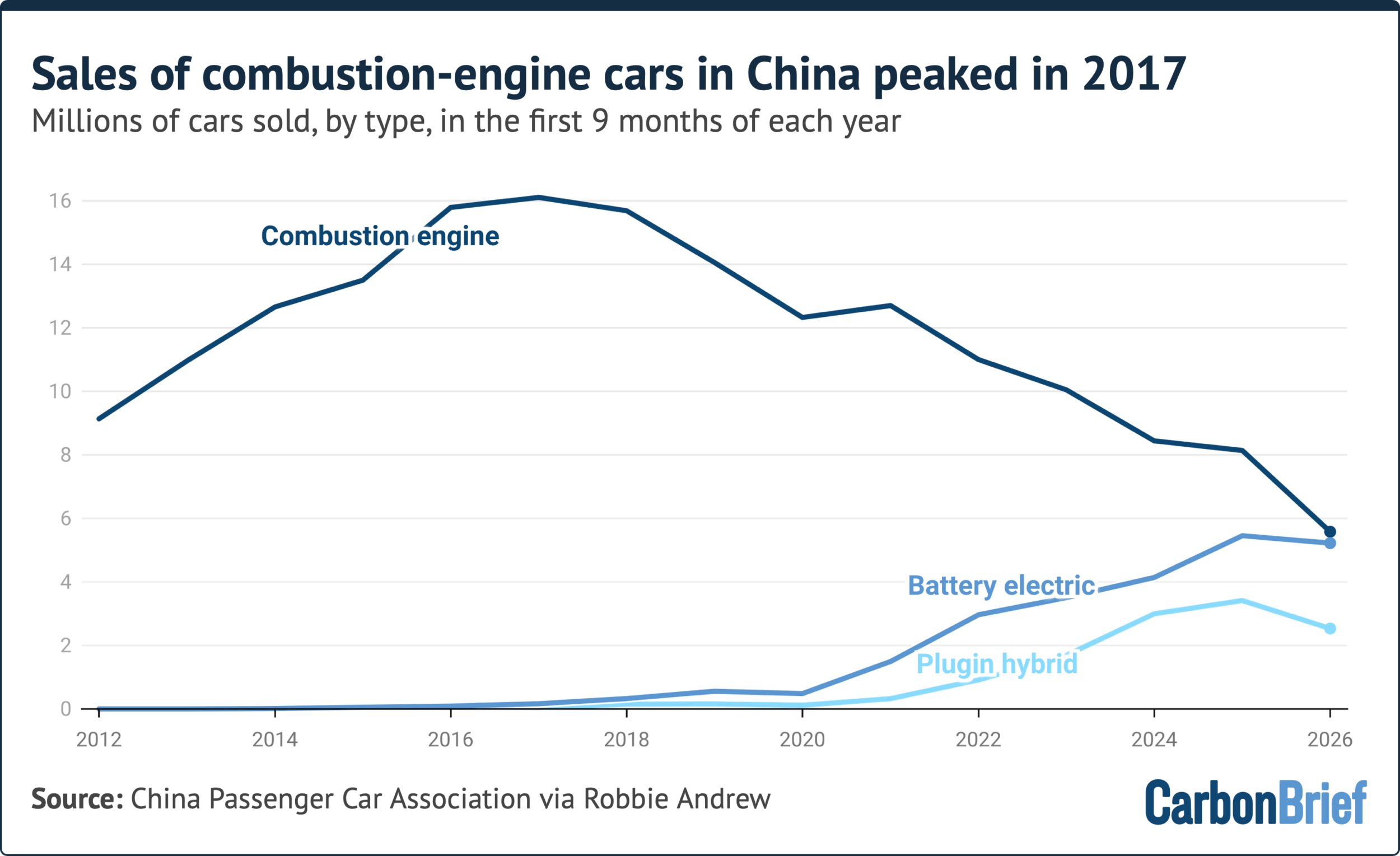
The contraction was led by combustion-engine vehicles, which saw sales fall 43% year-on-year in September and 31% in 2026 to date.
However, sales of PHEVs also fell by 36% year-on-year in September and by 26% in 2026 to date. By comparison, BEVs performed better, although sales still declined 8.5% from a year earlier in September and 4% in 2026 to date.
As a result, NEV sales overall fell by 17% in September and 13% in 2026 to date.
While the market changes in 2026 to date were particularly dramatic, they reflect a broad continuation of trends seen over the past decade.
Indeed, sales of combustion-engine cars in China peaked in 2017 and they have been declining ever since, shown in the figure below.
Impact of Hormuz
Part of the reason for the advance of NEVs in 2026, said Chinese technology news outlet OFweek, was petrol cars “giving up market share” as they were outperformed by electric alternatives.
Cui Dongshu, secretary-general of the CPCA, cited higher petrol prices as an explanation for September’s weak combustion-car sales, in comments to financial news outlet National Business Daily.
Imports of oil into China in January-September have fallen 15% compared to 2025, equivalent to 470m barrels, as ongoing conflict tightened supply and drove up prices.
China’s passenger-car NEV fleet has displaced 143m barrels of oil so far during the strait of Hormuz crisis, Euan Graham, senior energy analyst at thinktank Ember, tells Carbon Brief.
EVs “accounted for 12% of the decrease in China’s oil use post-Hormuz”, according to an estimate provided to thinktank the Brookings Institute by an unnamed analyst.