

Welcome to Carbon Brief’s DeBriefed.
An essential guide to the week’s key developments relating to climate change.
DeBriefed is edited by Daisy Dunne. Please send any tips or feedback to debriefed@carbonbrief.org.
This is an online version of Carbon Brief’s weekly DeBriefed email newsletter. Subscribe for free here.
This week
EU delay
NO NDC: The EU has “failed to agree” on a 2035 target for cutting greenhouse gas emissions in time for a climate event taking place alongside the UN general assembly next week, the Financial Times reported. On 24 September, representatives from more than 100 nations will take part in an event where they will announce or offer more details on their 2035 climate plans, known as “nationally determined contributions” (NDCs), Carbon Brief understands. The FT added that, instead of agreeing to a target, EU member states have signed up to a “statement of intent”, which noted that the bloc would aim to cut emissions somewhere in the range of 66.3% and 72.5% by 2035.
DEADLY: Meanwhile, recent analysis showed that more than 16,000 heat deaths that occurred from June to August this year in the EU can be attributed to fossil-fueled global warming, reported the Guardian. Other recent research covered by Euronews indicated that this summer’s extreme weather events will cost the region about €126bn by 2029.
Australia delivers
NEW TARGET: Australia announced an NDC target of cutting emissions to between 62% and 70% below 2005 levels by 2035, reported the Sydney Morning Herald. This is a jump from the current goal of 43% by 2030, providing a “major challenge to the government and the economy”, given that Australia’s emissions have fallen by just 28% over the past two decades, the newspaper added.
RISING THREATS: The country also published its first national climate risk assessment this week, which concluded that 1.5 million Australians living in coastal areas could be at risk from sea level rise by 2050, BBC News reported. The Guardian added that the report looks at 10 “priority hazards”, including flooding and extreme heat, forecasting a rise of 190% in annual heat-related deaths in Sydney if warming reaches 2C.
Around the world
- FURTHER CHALLENGE: Construction workers announced an indefinite strike in Belém, the Brazilian city hosting COP30 this year, to demand better wages, Folha de São Paulo reported. Reuters reported that the UN had “urge[d] its staff to limit attendance” at COP30, due to concerns over high accommodation costs.
- CUTTING EMISSIONS: India’s power sector CO2 emissions fell by 1% year-on-year in the first half of 2025, only the second such reduction in 50 years, according to new Carbon Brief analysis. The Times of India, Hindustan Times, Reuters and the Indian Express were among those to cover the analysis.
- NEW THREAT: A US Environmental Protection Agency proposal to stop collecting industrial emissions data threatens plans to capture and store CO2, reported the New York Times. Meanwhile, the US National Academies responded to the Trump administration’s misleading claims, with a report calling climate change “beyond scientific dispute”, said Politico.
- ‘REALITY CHECK’: A German government report called for cost efficiency and rapid – but limited – expansion of renewables, Clean Energy Wire reported.
- SECOND CALL: The International Energy Agency reiterated that the world would not need to invest in new oil and gas projects if demand for the fuels fell in line with the 1.5C limit on global warming, Carbon Brief reported.
1%
The percentage of global electricity consumption currently taken up by data centres, according to a new Carbon Brief explainer looking into the climate impact of artificial intelligence.
Latest climate research
- Forest specialist birds, such as the red-cockaded woodpecker and the bearded bellbird, are more diverse and abundant in undisturbed forests | Global Ecology and Biogeography
- Community-led surveillance expands protection, monitoring and defence of larger areas in Amazon forests | Nature Sustainability
- Incorporating aerosols can improve the accuracy of climate attribution studies, since aerosols “strongly influence” local heat extremes | Weather and Climate Extremes
(For more, see Carbon Brief’s in-depth daily summaries of the top climate news stories on Monday, Tuesday, Wednesday, Thursday and Friday.)
Captured
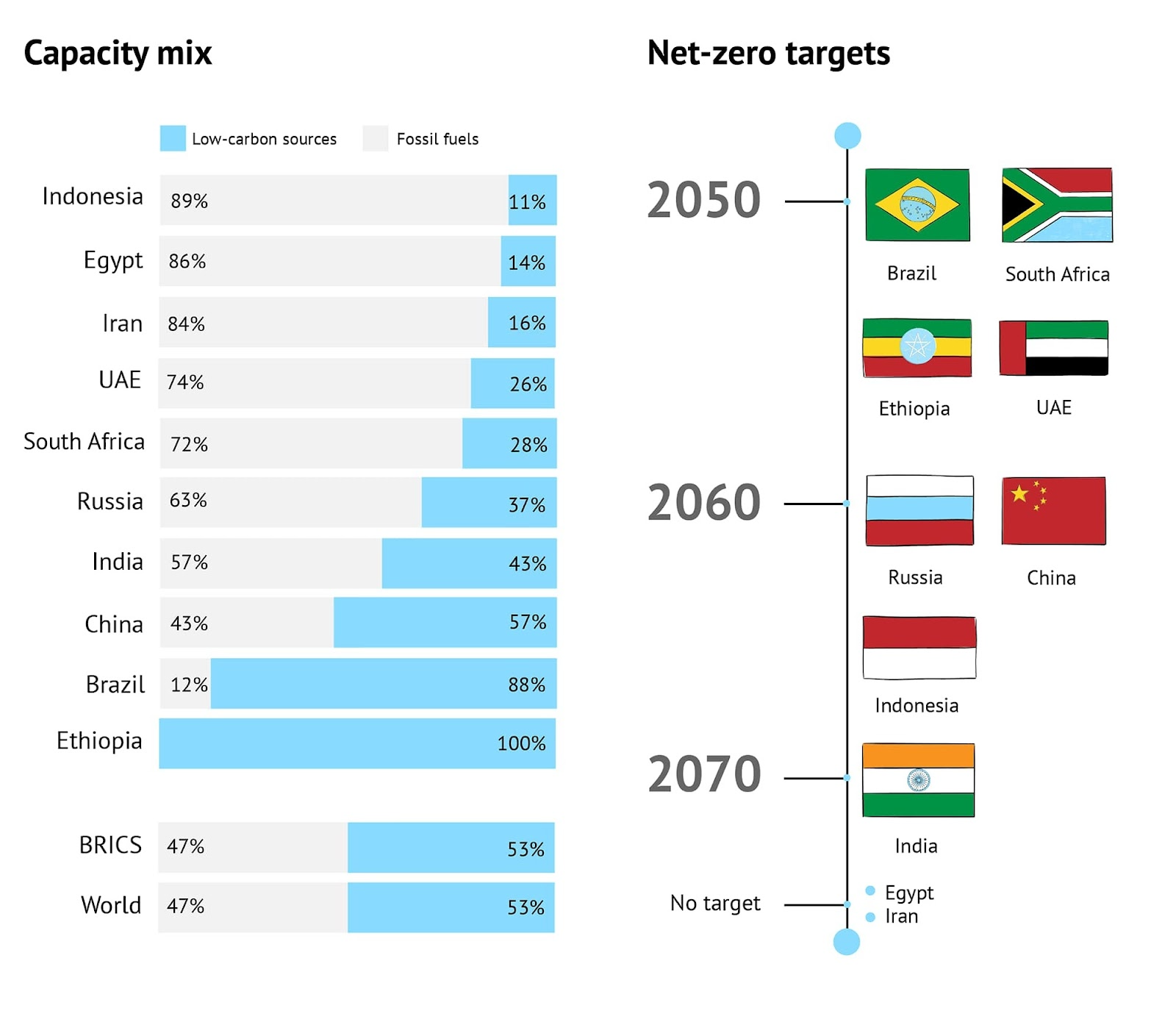
The seventh assessment cycle of the Intergovernmental Panel on Climate Change (IPCC), the world’s leading climate science authority, will include more authors from global south institutions than ever before, according to Carbon Brief analysis. A total of 660 scientists from 90 countries will write the three reports in the next assessment cycle, scheduled for publication in 2029. Some 42% of those authors belong to institutions based in the global south (see chart above), according to Carbon Brief.
Spotlight
Tracing beef in the Brazilian Amazon
In this spotlight, Carbon Brief reports from the Amazonian state of Pará, Brazil, which is implementing new measures to track the impact of beef on deforestation.
The state will host the COP30 climate summit in November.
The Amazonian state of Pará is home to 26m beef cows. The second-largest driver of deforestation in the state is cattle ranching.
Maria Gorete Rios is a small cattle producer in Pará’s municipality of Novo Repartimento. She was the first in Pará to implement individual identification of her cattle.
Of the 78 hectares of her land, 50 hectares are used for cattle and grazing, 10 hectares for her forest reserve and four hectares for producing cocoa and other crops such as cassava, beans, squash and açaí – a fruit native to the Amazon.
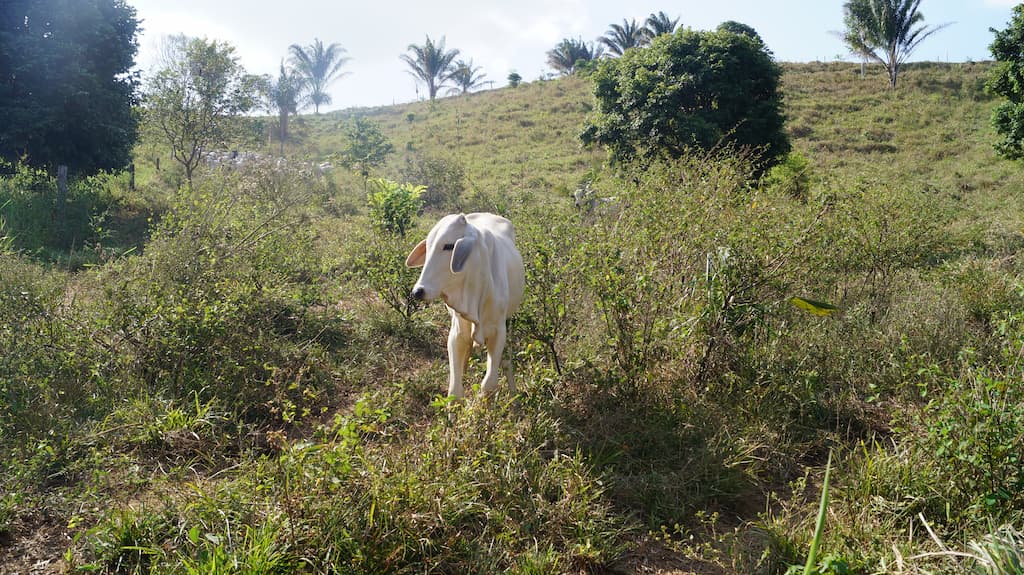
Gorete began identifying her cattle thanks to Pará’s first mandatory cattle traceability programme, announced by the state government at COP28 in 2023. The programme seeks to make the cattle supply chain more transparent and to channel incentives for producers to reduce deforestation.

To track her cows, Gorete has given each of them an ear tag tracker, which allows the programme to record which farm each cow was raised on, which slaughterhouse it went to and whether it was raised in illegally deforested areas, Rodrigo Freire, private areas leader for The Nature Conservancy (TNC) in Brazil’s Amazon, explained to Carbon Brief.
To verify that an area was not deforested for cattle production, Brazil’s government has a mandatory registry for rural farmers, which collects information on land use changes over farms, Fábio Medeiros, strategic cattle partnerships director at TNC, told Carbon Brief.
Gorete supports the traceability system because she believes that rural or small producers do not keep proper records of their property. She added:
“With traceability, they will be able to keep track. I think it’s fantastic.”
Further benefits
In addition to traceability, Gorete has begun to combine livestock farming with tree planting, under an “agroforestry” system.
She said that her land had been 100% degraded by industrial livestock farming, but now her planted trees provide shade for her livestock, as well as water availability and habitat for other animals.

Gorete told journalists visiting her farm that diversifying her agricultural production with trees and beekeeping provides her with more income. She added:
“I’m happy where I am. Livestock allows me to pay the highest fees, because livestock is what sustains us. I have açaí, I have cocoa, the basis of my diet. I also have to cultivate the land.”
Medeiros said that, with COP30 coming to the state in November, more incentives are expected for producers to comply with cattle traceability in the region.
Travel to Pará was organised by The Nature Conservancy Brazil, Instituto Clima e Sociedade (iCS) and Nature4Climate.
Watch, read, listen
10 YEARS OF PARIS: Ahead of the 10-year anniversary of the Paris Agreement, climate writer David Wallace-Wells reflected on progress and setbacks for climate action in the New York Times magazine.
COP REFORM: For the Chatham House blog, climate geopolitics expert Bernice Lee addressed the arguments for how the UN climate process should “evolve to move from pledge-making to delivery”.
‘BLACK GOLD’: A Reuters video showed how New York is turning food scraps into nutrient-rich soil, dubbed “black gold”.
Coming up
- 9-23 September: 80th session of the UN general assembly, New York
- 21-28 September: New York Climate Week
- 24 September: NDC summit at the UN general assembly
Pick of the jobs
- IPCC working group one technical support unit, communication officer | Salary: Unknown. Location: Paris
- The Economist, science and technology correspondent | Salary: Unknown. Location: London
- Rainforest Alliance, climate director | Salary: Unknown. Location: London
- Conservation International, director of natural climate solutions policy | Salary: Unknown. Location: Singapore, Japan or Australia
DeBriefed is edited by Daisy Dunne. Please send any tips or feedback to debriefed@carbonbrief.org.
This is an online version of Carbon Brief’s weekly DeBriefed email newsletter. Subscribe for free here.


The post DeBriefed 19 September 2025: EU ducks UN climate target; Australia delivers; Tracing beef’s impact on the Amazon appeared first on Carbon Brief.

Three countries have been named by the Paris Agreement’s compliance committee for failing to submit a nationally determined contribution (NDC) and repeatedly snubbing offers of help with their climate plans.
After months of internal debate over whether to identify serial non-responders, the Paris Agreement’s Implementation and Compliance Committee (PAICC) named the three countries which have failed to engage with it over their NDCs on Friday.
It named Democratic Republic of Congo, Senegal and North Korea in a footnote of its annual report, adding that it decided to name them “with a view to facilitating engagement”, adding that representatives of the three nations had been invited to its meeting in early 2027 “with the purpose of identifying any challenges and constraints”.
“The Committee noted the importance of Parties engaging with the Committee in a timely manner, while noting that some delays may be due to the national capabilities and circumstances of the Parties”, the report said.
-
Under US pressure, World Bank says it will back gas “where appropriate”
The US wants the World Bank to expand its gas support while climate campaigners are pushing for it to end – its head spoke this week of limited backing for the fossil fuel -
IPCC scientists vow to press on with climate reports despite political deadlock
After governments again failed to agree a timeline, nearly 120 IPCC authors pledged to complete their assessment on time and with full scientific rigour -
Paris Agreement committee snubbed over missing NDC climate plans
Many governments have still not submitted a nationally determined contribution to the UN, breaching a key requirement of the Paris Agreement

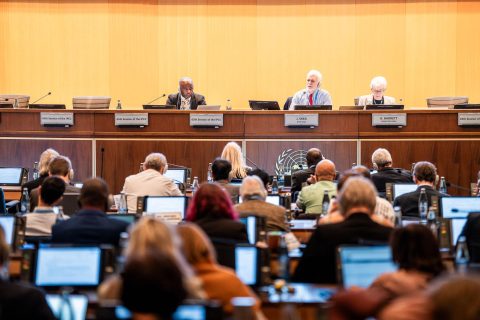

In July, PAICC said 12 countries had ignored its repeated attempts to discuss why they had not published an NDC as required every five years under the 2015 Paris accord.
Members of the committee had been divided over whether to name them, but at a September meeting decided to do so in their annual report to the annual climate COP summit.
By the time the report was published on Friday, only Congo, Senegal and North Korea “had not communicated an NDC or submitted a [Biennial Transparency Report] and had not yet responded to any of the Committee’s notifications, despite several reminders issued by the Committee in this regard”.
Rainforest and renewable energy ambitions
The silence from Congo and Senegal is notable because the former is home to much of the Congo Basin rainforest while the latter has sought billions of dollars in climate finance to support its renewable energy ambitions.
After Brazil, Congo has more rainforest than any country in the world. This forest, and the country’s peatlands, absorb huge amounts of greenhouse gas but are fast being lost to expanding farmland, charcoal production, logging and mining.
Senegal signed a Just Energy Transition Partnership with Canada and wealthy European nations in 2023, to help it meet its renewable energy targets under the-then government of Macky Sall. It was chair of the Least Developed Countries group between January 2022 and December 2023.

Tejas Rao, who is researching the PAICC as part of a doctoral thesis at Cambridge University, said the governments of the three countries should engage with the committee.
“Engagement costs these governments very little and the committee has shown it will listen,” he said.
“Silence leaves the committee with no basis to help, and it leaves the [governments] exposed to the narrative that they are simply disengaged,” he told Climate Home News.
Paris Agreement requirement
The 2015 Paris Agreement requires all parties to publish an NDC every five years outlining their emissions reduction targets, with each plan meant to be more ambitious than the country’s last NDC.
The latest set – the third round of plans, with new targets for 2035 – was due in February 2025. While most countries missed this deadline, all but around 30 – mostly small emitters but including Egypt, Vietnam and Argentina – have now submitted them.
Over the year, the PAICC – which is made up of government climate officials from developed and developing countries – has been communicating with governments that have not submitted NDCs and trying to overcome barriers to them doing so.
Some nations have cited exceptional circumstances as the reason for not submitting an NDC, a process that requires a significant amount of work in tracking emissions and consulting on how to curb them across the economy. For example, a letter from a Sudanese official to the PAICC, seen by Climate Home News, said that the country’s civil war had led to the suspension of its NDC preparation.
-
IPCC scientists vow to press on with climate reports despite political deadlock
After governments again failed to agree a timeline, nearly 120 IPCC authors pledged to complete their assessment on time and with full scientific rigour -
Under US pressure, World Bank says it will back gas “where appropriate”
The US wants the World Bank to expand its gas support while climate campaigners are pushing for it to end – its head spoke this week of limited backing for the fossil fuel -
Who shapes climate science? The equity question facing the IPCC
Early completion of the next global climate science assessment reports risks excluding research from the Global South, which is key to ensuring the findings are fair
The US and Iran are not signed up to the Paris Agreement and so do not have active NDCs, nor does Taiwan, which is not a UN member state.
Rao said that because the PAICC is “facilitative and non-punitive”, naming the countries “is meant to open a door, not close one – the invited consultation is the point”.
“In recent months, governments that explained their constraints, whether capacity, finance or domestic process, have been met with follow-up and support rather than sanction, and the number of silent governments has fallen sharply,” Rao said.
The post Paris Agreement committee names three countries snubbing it over NDCs appeared first on Climate Home News.
Paris Agreement committee names three countries snubbing it over NDCs