

Welcome to Carbon Brief’s Cropped.
We handpick and explain the most important stories at the intersection of climate, land, food and nature over the past fortnight.
This is an online version of Carbon Brief’s fortnightly Cropped email newsletter. Subscribe for free here.
Key developments
COP29 skirts nature
BIODIVERSITY BLANK: Despite taking place just days after a major UN biodiversity summit, the COP29 climate talks in Baku, Azerbaijan, produced few new commitments on food, forests, land and nature. Countries negotiated a new text “reaffirming” the “importance of conserving, protecting and restoring nature”. However, countries failed to adopt this document during COP29’s chaotic final plenary session. The COP29 presidency also organised a “high level” event on a new “Rio trio” initiative, which seeks to strengthen ties between the UN Rio conventions on climate change, biodiversity loss and desertification. But many of the event’s speakers failed to show up, as the event coincided with the start of the endgame in the negotiations.
CARBON MARKETS: Elsewhere at COP29, countries did manage to find agreement on the remaining sections of Article 6 on carbon markets, meaning all elements of the Paris Agreement have now been finalised – nearly 10 years after it was signed. The COP29 presidency hailed the agreement as a “breakthrough” that “achieves full operationalisation of Article 6”, a COP “win” that it pushed from day one of the two-week talks. Observers, however, raised concerns that the agreed rules may not do enough to ensure that past issues with carbon offsets, including human rights violations and a failure to meaningfully cut emissions, are not repeated. Read Carbon Brief’s summary of all the key takeaways for food, land, forests and nature at COP29.
CIAO, COP16: Following an abrupt end in November triggered by negotiators needing to catch flights home, the COP16 biodiversity summit will resume for a three-day session in Rome in February 2025, the Convention on Biological Diversity has confirmed. Countries will aim to agree to the remaining items on COP16’s agenda, which include a monitoring framework for tracking progress on tackling biodiversity loss, a plan for reviewing progress at future COPs and – most contentiously – the issue of developed nations mobilising enough funds to help developing countries protect nature. Carbon Brief has tracked where countries stand on these issues in an interactive grid.
Historic climate case
CLIMATE CASE: A historic legal case on who bears responsibility for climate change has begun at the UN international court of justice (ICJ) at the Hague in the Netherlands. The Guardian reported that the case “is the culmination of years of campaigning by a group of Pacific island law students and diplomacy spearheaded by Vanuatu”, an island nation at risk of losing land from sea level rise. In 2025, it will deliver a verdict on “on what obligations states have to tackle climate change and what the legal consequences could be if they fail to do so”, it added.
‘BIGGEST IN HISTORY’: Over the next two weeks, the court will hear statements from 98 countries, including small island nations and least-developed countries most vulnerable to climate impacts, as well as large historical emitters, the Guardian said. The participation of so many countries means “we can safely say that this is the biggest case in human history”, Margaretha Wewerinke-Singh, legal counsel for Vanuatu’s ICJ case and international lawyer at Blue Ocean Law, told Justice Info, an international-law news site.
‘MORAL WEIGHT’: Justice Info added that ICJ opinions are non-binding, but “do carry legal and moral weight, often taken into account by national courts”. However, “there are difficulties in dealing with states such as China, who never accepted the compulsory jurisdiction of the court, or the US who withdrew from it”, according to the outlet. As part of the advisory opinion process, the court is publishing written statements from countries, which include nations’ views on who should take responsibility for climate change and personal testimonies from those most affected.
Spotlight
‘Land’ COP underway
This week, Carbon Brief looks at what is on the agenda for the “largest ever” UN land conference that is underway in Riyadh, Saudi Arabia.
In a “triple COP” year, few expected the desertification COP to receive as much attention as its higher-profile climate and biodiversity cousins. In fact, getting international and regional media to engage with the lesser-known Rio treaty – the 30-year old UN Convention to Combat Desertification (UNCCD) – is one of the actual objectives of the talks that began in Riyadh on Monday.
The headline numbers are stark.
According to the UNCCD’s own estimates, 1.2 billion people and 1.5bn hectares of land are affected by degradation, with another 100m hectares of land degrading each year.
A new report looking at land use through the lens of “planetary boundaries” found that “a third of humanity now lives in drylands, which include three-quarters of Africa”. It added that unsustainable agricultural practices are the “main culprit” of degradation. And a newly released world drought atlas presents an even starker – but complex – picture of the state of the world’s land.
Gaining prominence
With all this daunting research placed before its delegates, the two-week Riyadh COP marks a small series of firsts. According to the UN, it is the largest land conference ever and the first to be held in the Middle East and North Africa region, “which knows first-hand the impacts of desertification”.
Mirroring what has become the norm in other COPs, it is also the first time that the conference has a separate “action agenda” for leaders to announce voluntary commitments on thematic days, in addition to the official, negotiated decisions.
Interestingly, the “land COP” has drawn several leaders and ministers to Riyadh who gave Cali and Baku a miss.
Fresh from steering his party to an election win in the drought-prone state of Maharashtra, India’s climate minister Bhupender Yadav hailed India’s “proactive drought strategy”, reiterated a 26m-hectare land restoration pledge and support for the G20’s trillion trees initiative.
Aside from high-profile ministerial discussions, delegates will have to undertake a midterm review of actions over 2018-30 and agree on what is holding back countries from implementing the drought convention.
Resources required
Finding resources to build drought resilience remains the running theme in Riyadh.
On Monday, the UNCCD’s executive secretary, Ibrahim Thiaw, quantified the cost of “restoring the world’s degraded land and holding back its deserts” for the first time, calling for “at least $2.6tn” in investment by the end of the decade, according to Reuters. Thiaw also drew attention to the fact that the world spends as much on harmful subsidies each year, Earth Negotiations Bulletin reported.
Mohlago Flora Mokgohloa, South Africa’s deputy director general of biodiversity and conservation outlined her delegation’s key negotiation priorities to Carbon Brief. She said:
“The African position is ensuring we come out with an ambitious decision on drought, which is deciding on a drought protocol. This is one convention that does not have a protocol, so it does not have an implementation mechanism.”
A protocol is a legally-binding instrument that interprets a treaty and can establish additional rights and obligations. A drought management protocol, for instance, could set up clear obligations for who should pay for restoration and could link the UNCCD to climate and biodiversity conventions.
Mokgohloa told Carbon Brief:
“We are also saying that a decision on a protocol must also come with a discussion around how it’s going to be financed, because that affects all of us, and we can’t just say ‘let’s decide on the money after’. The 54 countries of Africa are not moving on our position.”
News and views
IRA-TE FARMERS: US farmers “are urging the White House to crack down on Chinese imports of used cooking oil”, the Financial Times reported. The country’s farmers “invested in green fuel crops such as corn, camelina and soybeans” based on an expected surge in demand for low-carbon fuels after the Inflation Reduction Act (IRA) was passed, the story said. However, it points out that the IRA’s rules “have not been finalised” and the law – which does not limit incentives just to domestic farmers – “may be scrapped by Donald Trump’s incoming administration”. Meanwhile, used cooking oil imports from China “have reached record highs”, driving fears that imports could “undercut” tax credits to US farmers even before they take effect in January, according to the story.
SHOOTS, NOT BOMBS: At the recent G20 summit in Rio, Mexico’s president Dr Claudia Sheinbaum proposed “dedicating 1% of the military annual budgets of the world’s biggest economies” towards global reforestation efforts, Mongabay reported. If successful, the programme could reforest 15m hectares of land “across the globe”, according to the story. Sheinbaum also “plans to continue” the country’s existing Sembrano Vida (planting life) programme, which incentivises farmers to protect trees, it added. While that programme has “reforested 1.1bn trees” since 2018, it is currently mired in “serious allegations of corruption, labour threats and data manipulation”, a column in El Siglo De Durango pointed out.
GAZA FOOD CRISIS: Israel’s attacks on Gaza have killed more than 90% of cattle and destroyed 70% of cropland, a UN analysis of satellite imagery has found, according to the Guardian. More than three-quarters of Gaza’s orchards, known for producing olive oil and fruits, have also been destroyed, the Guardian said. Before the violence started in October last year, 40% of Gaza was covered by farms and food production met around a third of local demand, the newspaper reported. It added that aid officials in Gaza have described the situation in much of Gaza, where more than two-thirds of buildings have been destroyed or damaged, as “apocalyptic”.
‘FRANKENCHICKENS’: Fast food chain KFC has ditched a pledge in the UK to improve its animal welfare by sourcing chicken from slower-growing breeds by 2026, the publication Restaurant reported. Back in 2019, KFC committed to transition away from using so-called “Frankenchickens”, which are bred at an accelerated rate that is linked to a range of health issues, including higher mortality rates, lameness and muscle disease, the publication said. However, speaking at the UK’s egg and poultry industry conference in November, a representative of the fried-chicken giant said the UK’s poultry industry is not yet in a “commercial or operational position” to allow the delivery of such a pledge, according to Restaurant.
AMAZON AT RISK: Several Brazilian states “are trying to rid themselves of rainforest protections, bowing to pressure from cattle ranchers and soybean growers to cut down trees and expand agriculture”, the Associated Press reported. It said that the Acre state unanimously passed a new law allowing the privatisation of almost 900km2 of protected forest, an area the size of New York City. In neighbouring Rondonia state, lawmakers are seeking to annul 11 “conservation units” covering thousands of square kilometres of pristine rainforest, the publication reported. Another Amazonian state, Pará, is pushing a similar initiative, it added. Brazil is the world’s fifth-largest emitter of greenhouse gases, with deforestation accounting for more emissions than any other driver, AP noted.
MISSING MAU: Kenya’s Mau forest, which plays a key role in capturing water for millions of people, experienced a sharp rise in deforestation this year, according to satellite data reported on by Mongabay. The ecosystem, which is one of the largest forests in east Africa and is home to endangered African bush elephants, African golden cats and bongo antelopes, lost a quarter of its tree cover between 1984 and 2020. Forest loss slowed over 2021-22, but has since increased dramatically, according to Global Forest Watch data seen by Mongabay. Separately, Mongabay covered how the Kenyan government has spent years evicting Indigenous Ogiek communities from Mau forest over unfounded claims that they are to blame for deforestation.
Watch, read, listen
‘THE GREAT ABANDONMENT’: A long read in the Guardian looked at “what happens to the land left behind” when people and development are displaced by climate change.
REIMAGINING BRETTON WOODS: A talk by Dr Nicola Ranger for the Leverhume Centre for Nature Recovery explored how the global financial system can be reformed to address biodiversity loss and climate change.
COLD TURKEY: From meat-free days to making plant-based foods “taste at least as good”, Bloomberg listed strategies to “shift diets at scale away from meat-centric meals”.
‘TOXIC TRADE’: An investigation by SourceMaterial and Data Desk uncovered evidence of European companies shipping high-sulphur car fuels to west Africa, with catastrophic impacts for local people.
New science
- China’s forests increased in size by 4m hectares a year over 2000-15 and by 2m hectares a year over 2015-22, according to a new Geophysical Research Letters study. The research used high-resolution satellite data to examine how tree cover has changed in the world’s fastest “greening” nation.
- A Science Advances study uncovered “compelling evidence” that temperature can affect the immune performance of wild capuchin monkeys. The results “offer insight into how climate change will affect the immune system of wild mammals”.
- Reducing deforestation pressure and forest fires in the Amazon region “leads to a reduction” in hospitalisation and deaths arising from respiratory health problems, a new study in Communications Earth & Environment found. Researchers estimated a decrease of 678 deaths and almost $6m in savings from hospitalisation costs each year.
In the diary
- 2-13 December: UN Desertification Conference, Riyadh, Saudi Arabia
- 2-13 December: International court of justice hearings on the obligations of states in respect of climate change, The Hague, Netherlands
- 9-16 December: Intergovernmental Science-Policy Platform for Biodiversity and Ecosystem Services (IPBES) Plenary, Windhoek, Namibia
Cropped is researched and written by Dr Giuliana Viglione, Aruna Chandrasekhar, Daisy Dunne, Orla Dwyer and Yanine Quiroz. Please send tips and feedback to cropped@carbonbrief.org

The post Cropped 4 December 2024: Climate talks omit nature; Land COP underway; ‘Frankenchickens’ appeared first on Carbon Brief.
Cropped 4 December 2024: Climate talks omit nature; Land COP underway; ‘Frankenchickens’

Drought and heatwaves occurring together – known as “compound” events – have “surged” across the world since the early 2000s, a new study shows.
Compound drought and heat events (CDHEs) can have devastating effects, creating the ideal conditions for intense wildfires, such as Australia’s “Black Summer” of 2019-20 where bushfires burned 24m hectares and killed 33 people.
The research, published in Science Advances, finds that the increase in CDHEs is predominantly being driven by events that start with a heatwave.
The global area affected by such “heatwave-led” compound events has more than doubled between 1980-2001 and 2002-23, the study says.
The rapid increase in these events over the last 23 years cannot be explained solely by global warming, the authors note.
Since the late 1990s, feedbacks between the land and the atmosphere have become stronger, making heatwaves more likely to trigger drought conditions, they explain.
One of the study authors tells Carbon Brief that societies must pay greater attention to compound events, which can “cause severe impacts on ecosystems, agriculture and society”.
Compound events
CDHEs are extreme weather events where drought and heatwave conditions occur simultaneously – or shortly after each other – in the same region.
These events are often triggered by large-scale weather patterns, such as “blocking” highs, which can produce “prolonged” hot and dry conditions, according to the study.
Prof Sang-Wook Yeh is one of the study authors and a professor at the Ewha Womans University in South Korea. He tells Carbon Brief:
“When heatwaves and droughts occur together, the two hazards reinforce each other through land-atmosphere interactions. This amplifies surface heating and soil moisture deficits, making compound events more intense and damaging than single hazards.”
CDHEs can begin with either a heatwave or a drought.
The sequence of these extremes is important, the study says, as they have different drivers and impacts.
For example, in a CDHE where the heatwave was the precursor, increased direct sunshine causes more moisture loss from soils and plants, leading to a drought.
Conversely, in an event where the drought was the precursor, the lack of soil moisture means that less of the sun’s energy goes into evaporation and more goes into warming the Earth’s surface. This produces favourable conditions for heatwaves.
The study shows that the majority of CDHEs globally start out as a drought.
In recent years, there has been increasing focus on these events due to the devastating impact they have on agriculture, ecosystems and public health.
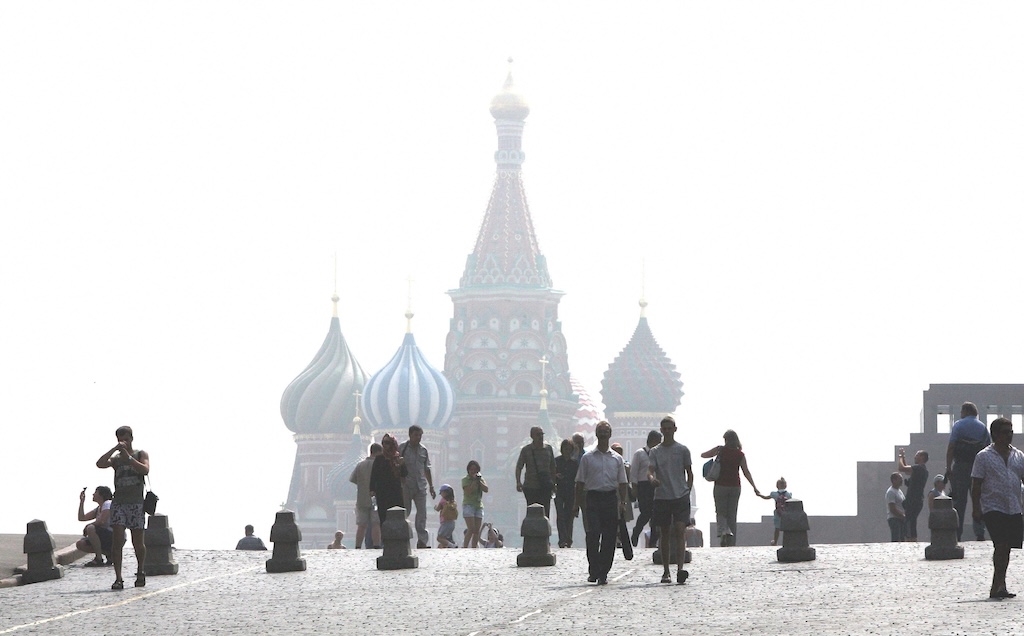
In Russia in the summer of 2010, a compound drought-heatwave event – and the associated wildfires – caused the death of nearly 55,000 people, the study notes.
The record-breaking Pacific north-west “heat dome” in 2021 triggered extreme drought conditions that caused “significant declines” in wheat yields, as well as in barley, canola and fruit production in British Columbia and Alberta, Canada, says the study.
Increasing events
To assess how CDHEs are changing, the researchers use daily reanalysis data to identify droughts and heatwaves events. (Reanalysis data combines past observations with climate models to create a historical climate record.) Then, using an algorithm, they analyse how these events overlap in both time and space.
The study covers the period from 1980 to 2023 and the world’s land surface, excluding polar regions where CDHEs are rare.
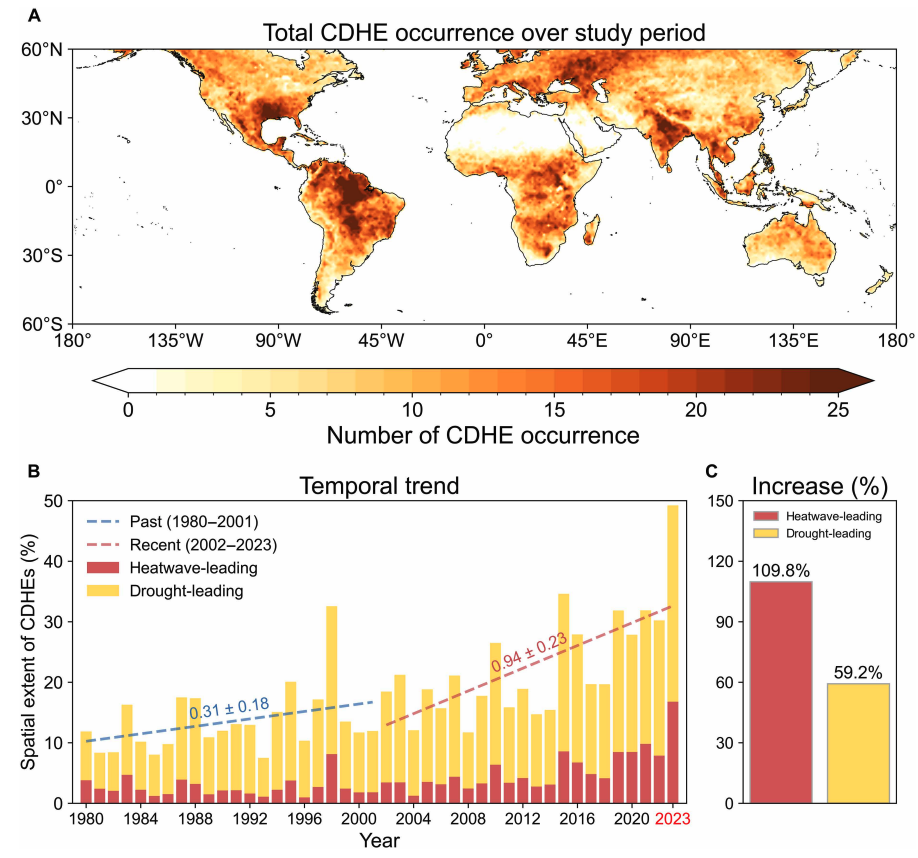
The research finds that the area of land affected by CDHEs has “increased substantially” since the early 2000s.
Heatwave-led events have been the main contributor to this increase, the study says, with their spatial extent rising 110% between 1980-2001 and 2002-23, compared to a 59% increase for drought-led events.
The map below shows the global distribution of CDHEs over 1980-2023. The charts show the percentage of the land surface affected by a heatwave-led CDHE (red) or a drought-led CDHE (yellow) in a given year (left) and relative increase in each CDHE type (right).
The study finds that CDHEs have occurred most frequently in northern South America, the southern US, eastern Europe, central Africa and south Asia.
Threshold passed
The authors explain that the increase in heatwave-led CDHEs is related to rising global temperatures, but that this does not tell the whole story.
In the earlier 22-year period of 1980-2001, the study finds that the spatial extent of heatwave-led CDHEs rises by 1.6% per 1C of global temperature rise. For the more-recent period of 2022-23, this increases “nearly eightfold” to 13.1%.
The change suggests that the rapid increase in the heatwave-led CDHEs occurred after the global average temperature “surpasse[d] a certain temperature threshold”, the paper says.
This threshold is an absolute global average temperature of 14.3C, the authors estimate (based on an 11-year average), which the world passed around the year 2000.
Investigating the recent surge in heatwave-leading CDHEs further, the researchers find a “regime shift” in land-atmosphere dynamics “toward a persistently intensified state after the late 1990s”.
In other words, the way that drier soils drive higher surface temperatures, and vice versa, is becoming stronger, resulting in more heatwave-led compound events.
Daily data
The research has some advantages over other previous studies, Yeh says. For instance, the new work uses daily estimations of CDHEs, compared to monthly data used in past research. This is “important for capturing the detailed occurrence” of these events, says Yeh.
He adds that another advantage of their study is that it distinguishes the sequence of droughts and heatwaves, which allows them to “better understand the differences” in the characteristics of CDHEs.
Dr Meryem Tanarhte is a climate scientist at the University Hassan II in Morocco, and Dr Ruth Cerezo Mota is a climatologist and a researcher at the National Autonomous University of Mexico. Both scientists, who were not involved in the study, agree that the daily estimations give a clearer picture of how CDHEs are changing.
Cerezo-Mota adds that another major contribution of the study is its global focus. She tells Carbon Brief that in some regions, such as Mexico and Africa, there is a lack of studies on CDHEs:
“Not because the events do not occur, but perhaps because [these regions] do not have all the data or the expertise to do so.”
However, she notes that the reanalysis data used by the study does have limitations with how it represents rainfall in some parts of the world.
Compound impacts
The study notes that if CDHEs continue to intensify – particularly events where heatwaves are the precursors – they could drive declining crop productivity, increased wildfire frequency and severe public health crises.
These impacts could be “much more rapid and severe as global warming continues”, Yeh tells Carbon Brief.
Tanarhte notes that these events can be forecasted up to 10 days ahead in many regions. Furthermore, she says, the strongest impacts can be prevented “through preparedness and adaptation”, including through “water management for agriculture, heatwave mitigation measures and wildfire mitigation”.
The study recommends reassessing current risk management strategies for these compound events. It also suggests incorporating the sequences of drought and heatwaves into compound event analysis frameworks “to enhance climate risk management”.
Cerezo-Mota says that it is clear that the world needs to be prepared for the increased occurrence of these events. She tells Carbon Brief:
“These [risk assessments and strategies] need to be carried out at the local level to understand the complexities of each region.”



The post Heatwaves driving recent ‘surge’ in compound drought and heat extremes appeared first on Carbon Brief.
Heatwaves driving recent ‘surge’ in compound drought and heat extremes
Greenhouse Gases
DeBriefed 6 March 2026: Iran energy crisis | China climate plan | Bristol’s ‘pioneering’ wind turbine
Welcome to Carbon Brief’s DeBriefed.
An essential guide to the week’s key developments relating to climate change.
This week
Energy crisis
ENERGY SPIKE: US-Israeli attacks on Iran and subsequent counterattacks across the Middle East have sent energy prices “soaring”, according to Reuters. The newswire reported that the region “accounts for just under a third of global oil production and almost a fifth of gas”. The Guardian noted that shipping traffic through the strait of Hormuz, which normally ferries 20% of the world’s oil, “all but ground to a halt”. The Financial Times reported that attacks by Iran on Middle East energy facilities – notably in Qatar – triggered the “biggest rise in gas prices since Russia’s full-scale invasion of Ukraine”.
‘RISK’ AND ‘BENEFITS’: Bloomberg reported on increases in diesel prices in Europe and the US, speculating that rising fuel costs could be “a risk for president