

Welcome to Carbon Brief’s Cropped.
We handpick and explain the most important stories at the intersection of climate, land, food and nature over the past fortnight.
This is an online version of Carbon Brief’s fortnightly Cropped email newsletter. Subscribe for free here.
Key developments
Nature at COP28
BIODIVERSITY LINKS: COP28 came to a close last week and the interconnections between climate change and biodiversity featured heavily in the two-week summit. As Carbon Brief noted in an in-depth summary of the event, the global stocktake – the periodic global review of progress towards the aims of the Paris Agreement – contained eight references to “nature” and five to “biodiversity”. It also noted “the urgent need” to address climate change and biodiversity together and meet targets for both “in line” with the Kunming-Montreal Global Biodiversity Framework, the landmark agreement of the 2022 COP15 biodiversity summit. COP28 president UAE and COP15 president China released a Joint Statement on Climate, Nature and People, where countries committed to aligning their national climate plans and their national nature plans ahead of COP30 and COP16, respectively.
FOCUS ON ECOSYSTEMS: The global stocktake also noted the importance of “ensuring the integrity of all ecosystems”, including oceans, mountains and the cryosphere. During the summit, the Guardian reported that, even if the world reaches a phase-out of fossil fuels, achieving the 1.5C target will be impossible if humanity fails to conserve nature, according to Prof Johan Rockström, a leading climate scientist. Speaking to Carbon Brief in Dubai, David Cooper, acting executive secretary of the UN Convention on Biological Diversity (CBD), said that while nature has featured in many pledges and voluntary announcements at climate COPs in recent years, COP28 saw “more recognition in the actual official texts”. This included a greater focus on ecosystems, he said, adding: “What I’d like to see more is greater recognition of the role of ecosystems beyond their role as carbon sinks.”
ROAD TO COLOMBIA: Shortly after COP28 ended, the CBD confirmed that the next UN biodiversity summit, COP16, will be held in a yet-to-be-announced city in Colombia from 21 October to 1 November 2024. Cooper told Carbon Brief that he was “very excited” for Colombia to host the event, as it is a “megadiverse country, it has very strong Indigenous peoples’ organisations [and] a very strong scientific base”. Colombia’s environment minister, Susana Muhamad, said in a statement: “This event sends a message from Latin America to the world about the importance of climate action and the protection of life.” At COP16, governments will review the implementation of nature goals and targets and also update their national biodiversity plans.
Food at COP28
ROADMAP: COP28 “confronted” the question of balancing the need to reduce emissions and to feed a growing population “like never before”, wrote New York Times international climate correspondent Somini Sengupta. She cited a number of “small, but significant steps” made at the summit, from the leaders’ declaration on food systems – covered in the previous issue of Cropped – to the UN Food and Agriculture Organization’s first-ever roadmap to 1.5C. That roadmap is “the most significant nudge” of the summit, the New York Times said, but added: “Roadmaps, of course, are only that until someone starts following the directions.” Action Aid’s climate justice lead Teresa Anderson told Carbon Brief that the roadmap’s “big problem is that it can’t bring itself to name the real issues at stake” and by “failing to name chemical fertilisers, factory farming or industrialised agriculture as the major sources of emissions and deforestation, its recommendations boil down to protecting the status quo”.
WASTE NOT: Among the recommendations in the roadmap is the need to reduce food loss and waste by 50% per capita by 2030, and to integrate all such waste “in a circular bioeconomy” by 2050. According to the not-for-profit Modern Farmer, the US Department of Agriculture released a draft of its new national strategy on food loss and waste at COP28. The announcement was accompanied by an initial investment of $30m and sets out goals for the federal government, including preventing food loss and waste, increasing the recycling of organic wastes and “to support policies that echo those aims”.
TAKING STOCK: Another major outcome for food at COP28 was the inclusion of “resilient food systems” in the global stocktake. Ag Insider noted that, although the stocktake “urges” countries to implement solutions towards resilience, it did so “without setting goals for the sector that produces one-third of global greenhouse gases”. A report published by WWF that assessed COP28’s action on food systems noted that a stocktake “that directly calls for food systems transformation to mitigate climate change would likely lead to higher prioritisation and increased amounts of climate finance for food”. The report said the summit “[fell] short of delivering robust outcomes [for food] in the negotiating rooms”. But, WWF added, “there are still grounds for optimism”, such as “the breadth of stakeholders determined to drive change” in the agrifood sector.
CONTRADICTORY AGENDA: An editorial in Nature Food cast doubt on Brazil’s ability to drive a sustainable agenda on food and climate after the nation announced its intention to join the Organization of the Petroleum Exporting Countries (Opec+) at COP28. The piece noted that Brazilian president Luiz Inácio Lula da Silva (Lula) “has set the protection of the Amazon and Cerrado biomes as a priority” since regaining office. But the announcement that the country will join Opec+ in January, as well as its intention to auction several new blocks for oil drilling, “had a negative repercussion among environmentalists”. Nature Food noted that COP30 is set to be held in “the heart of the Amazon”, saying: “Domestically, this is an opportunity for Brazil to put itself on a different development pathway, fostering more sustainable food production and managing natural resources in a just and inclusive way.”
COP28 round-up
GLASGOW RECEIPTS: COP26 in Glasgow saw several major political declarations around deforestation. While deforestation was lower on the agenda this year, it achieved one notable first: the global stocktake was the first time the need for “halting and reversing deforestation and forest degradation by 2030” was enshrined in a major negotiated text under UN climate change. But, despite this, “countries are still no nearer to closing the ‘finance gap’ necessary to stop the destruction of rainforests”, Mongabay reported. The outlet added that the Democratic Republic of the Congo “says it has not seen any of the $500m pledged to it two years ago [at COP26] to protect the Congo Basin rainforest”. As Cropped editor Dr Giuliana Viglione reported at COP28, a group of NGOs released a call to create a “Glasgow Declaration Accountability Framework” to hold countries accountable for their deforestation pledges from COP26.
RESTORATION RECOGNISED: The global stocktake underlines the “vital importance of protecting, conserving, restoring and sustainably using nature and ecosystems” and encourages the implementation of nature-based solutions and ecosystem-based approaches, Carbon Brief reported. COP28 saw the announcement of updates to both the Mangrove Breakthrough and the Freshwater Challenge, two global commitments to restoring mangroves and rivers and wetlands, respectively. Another big outcome of the summit was the global goal on adaptation, a framework meant to help countries build resilience to climate change. The text included topics such as water, health and ecosystems, the Spanish outlet Climática reported. But, it added, the global goal on adaptation will not guarantee that 30% of ecosystems will be “maintained, improved or restored”, relying instead on targets such as “reach resilience” or “reduce impacts”.
INDIGENOUS RIGHTS: Despite being the UN climate summit with the largest delegation of Indigenous peoples ever, they remained marginalised in the discussions regarding financing, the Brazilian outlet InfoAmazonia reported. The outlet added that concerns about oil and gas auctions in the Amazon and the arrival of agricultural projects on Indigenous lands overshadowed the result of the summit. Carbon Brief reported that the global stocktake included nine mentions of Indigenous peoples; however, language in the text was considered weaker than hoped by experts. For example, the texts lack recognition of Indigenous people’s rights to give or withhold free, prior and informed consent to approve projects within their territories.
METHANE ROUNDUP: Several voluntary pledges and finance pushes at COP28 focused on cutting methane emissions – and while many centred on fossil-fuel production, some homed in on food systems and agriculture. On 5 December, six major food companies, including Danone, Nestlé and Kraft Heinz, committed to release information on methane emissions within their dairy supply chains and to put in place methane action plans by the end of 2024. There were also several announcements of funds aimed at cutting emissions of the potent greenhouse gas, including more than $200m in public and private finance for research into reducing methane from livestock.
News and views
JUMBOS IN JEOPARDY: Drought has killed “at least 100 elephants” in Zimbabwe’s largest national park in recent weeks, the Associated Press reported. Conservation groups and wildlife authorities have attributed the deaths to “the impact of climate change and El Niño”, while authorities warn that “more could die as forecasts suggest a scarcity of rains and rising heat” in areas including the Hwange National Park. Separately, the Hindu Business Line reported that nearly 500 elephants in India have died from “unnatural causes” over the past five years, mainly due to electrocution and train collisions. India’s power ministry, while continuing to expand its infrastructure in elephant habitat, has issued an advisory to “mitigate the impact of power transmission lines and other power infrastructure on elephants and other wildlife”, the outlet said.
TRILLION APOLOGIES: At COP28, ecologist and former chief scientific adviser to the UN’s Trillion Trees Campaign Prof Thomas Crowther “begg[ed] environmental ministers to stop planting so many trees”, Wired reported. Crowther’s 2019 study that suggested “global tree restoration as our most effective climate change solution to date” sparked a global “tree-planting craze by companies and leaders…from Shell to Donald Trump” who were “keen to burnish their green credential”, but not cut actual emissions, the story said. Crowther told Wired his “message was misinterpreted”. He added that he brought results from a new paper on preserving existing forests to COP28 in an attempt to “kill greenwashing”. One scientist on Twitter commented that Crowther should “retract the [original trillion trees] paper instead of doing PR”.
START YOUR ENGINES: Tractors took over the streets of Berlin as hundreds of farmers protested against German government plans to get rid of some agricultural subsidies and tax breaks, Reuters reported. The plans are part of wider federal government efforts to fill a €60bn hole in the country’s 2024 budget, the newswire said. The government said it will remove a partial tax refund on diesel for farm machinery and a tax exemption for agricultural vehicles, Reuters noted – adding that this is something “farmers said would threaten their livelihood”. The newswire said that the plans are aimed to reduce emissions from the agricultural sector, which amounted to “55.5m metric tonnes of greenhouse emissions last year, roughly 7.4% of the country’s total”.
TO BEE OR NOT TO BEE: Indigenous peoples in south-east Mexico are calling for the recognition of bees as legal persons, with Mayan communities as their guardians, the Spanish-language version of Wired reported. This came after rainforests in the region experienced “devastation” due to soya agriculture and the excessive use of pesticides, leading to “more and more” bees dying. Indigenous communities criticised the state for not yet granted such recognition. The outlet said that protecting bees “for their intrinsic value” is an “idea [that] comes naturally” to Indigenous peoples. This would not be the first time that nature received legal recognition, as the constitutions of Ecuador and Bolivia both consider nature as a separate and living entity.
DIET IMPACTS: Halving meat and dairy consumption alongside reducing fertiliser use and food waste are some of the best ways to cut agricultural nitrogen pollution in Europe, a new report found. The report – produced for the UN by the UK Centre for Ecology & Hydrology and other researchers – said that significant amounts of the nitrogen used to boost crop growth ends up leaking into the air, water and soils. The researchers looked at 144 scenarios and outlined ways to reduce these losses, which included halving the amount of meat and dairy the average European eats.
Watch, read, listen
IMPROVING CONNECTIVITY: El Espectador looked at how the movement of 26 bird species helped scientists identify key sites for conserving ecological connectivity in Colombia’s protected areas.
BIODIVERSITY PATTERNS: What makes a place more biodiverse? Jaron Adkins, a scientist at Utah State University, explored this question for Utah Public Radio.
KEEPING PACE: In her newsletter, Sustainability by numbers, Dr Hannah Ritchie examined whether agricultural innovation can keep up with climate change.
ROAD REVAMP: Ben Goldfarb, writing for Yale Environment 360, looked at “green roads” – a way of redesigning roads to reduce floods and catch excess water for irrigation.
FORAGING THROUGH FEAR: Writing for Vittles, anthropologist Dolly Kikon and writer Joel Fernandes connected the dots between land rights, new climate laws, conflict and foraging in landscapes of loss in India’s north-eastern state of Nagaland.
New science
COP28 initiatives will only reduce emissions if followed through
Climate Action Tracker
A new analysis of COP28 pledges found the “plausible” impact of its food and agriculture declaration on global emissions to be around 500m tonnes of CO2-equivalent by 2030. Climate Action Tracker assessed the emissions-reduction potential of five non-binding pledges made at COP28 and the extent to which those pledges overlap with already-promised reductions. The lack of “quantifiable targets in the initiative text” and “targets directly targeting emissions reductions”, result in a commitment “so vague as to risk becoming another talking shop”, the authors wrote. On deforestation, the assessment found that funding declarations in the hundreds of millions of dollars, as opposed to the billions needed to end deforestation in this decade, “are not truly new” and represent a “repeat of the commitments already made at COP26 in Glasgow”.
Towards equity and justice in ocean sciences
npj Ocean Sustainability
A new review article examined progress towards equity in the ocean sciences and presented a pathway to addressing the gaps that remain in the field. A group of ocean scientists examined dozens of scientific papers on ocean equity and justice. They found that while the community has begun to identify and tackle existing power imbalances in ocean sciences over the past few years, “many issues still need to be addressed”. The authors called for “honest and transparent dialogue”, accompanied by “a significant shift in institutional cultures and norms” from scientists, professional societies, funders and other groups.
Are climate neutrality claims in the livestock sector too good to be true?
Environmental Research Letters
A number of scientific studies have “distorted understanding of the climate impact of livestock production”, a new “perspective” paper suggested. The researchers focused on the use of global warming potential (GWP) metrics, which standardise different greenhouse gases into one CO2-equivalent (CO2e). The “policymakers who wrote the Paris Agreement text” based its goals on “emissions pathways aggregated using GWP100”, the authors explained, which accounts for the warming caused by GHGs over a 100-year period and “does not differentiate between long-lived climate pollutants (LLCPs) and short-lived climate pollutants (SLCPs)”. However, some recent studies “claiming that ruminant livestock sectors in developed economies are, or could readily be, climate neutral” have used the GWP* metric, which “accounts for the effect of changes in the rate of SLCP emissions on warming over time”. While the GWP* is a “useful complement” to other metrics, the claimed states of climate neutrality in specific sectors based on its use are “temporary and are not aligned to the wider outcomes of the Paris Agreement”, the paper concludes.
In the diary
- 20 December: Democratic Republic of the Congo general election
- 3-5 January 2024: Oxford Farming Conference | Oxford, England
- 15-19 January: World Economic Forum annual meeting | Davos, Switzerland
Cropped is researched and written by Dr Giuliana Viglione, Aruna Chandrasekhar, Daisy Dunne, Orla Dwyer and Yanine Quiroz. Please send tips and feedback to cropped@carbonbrief.org
The post Cropped 20 December 2023: COP28 special edition appeared first on Carbon Brief.

The UK has avoided the need for gas imports worth £5.9bn since the start of the Hormuz crisis as a result of record electricity generation from wind and solar, reveals Carbon Brief analysis.
While gas prices are surging towards levels not seen since the 2022 energy crisis, the UK has been generating record amounts of power from wind and solar, up 14% year-on-year.
This unprecedented clean-power generation is directly cutting the need for gas-fired electricity, which is down by nearly 10% year-on-year in 2026 to date.
In total, wind and solar have generated a record 41% share of the UK’s electricity needs in 2026 to date, compared with 25% from gas, according to Carbon Brief’s analysis.
The figure below shows that wind and solar generation has avoided the need for UK gas imports worth a total of £5.9bn since the outbreak of war between the US and Iran in February 2026.
The analysis shows that these avoided gas imports would have required the UK to secure the equivalent of more than 100 additional tanker deliveries of liquefied natural gas (LNG).
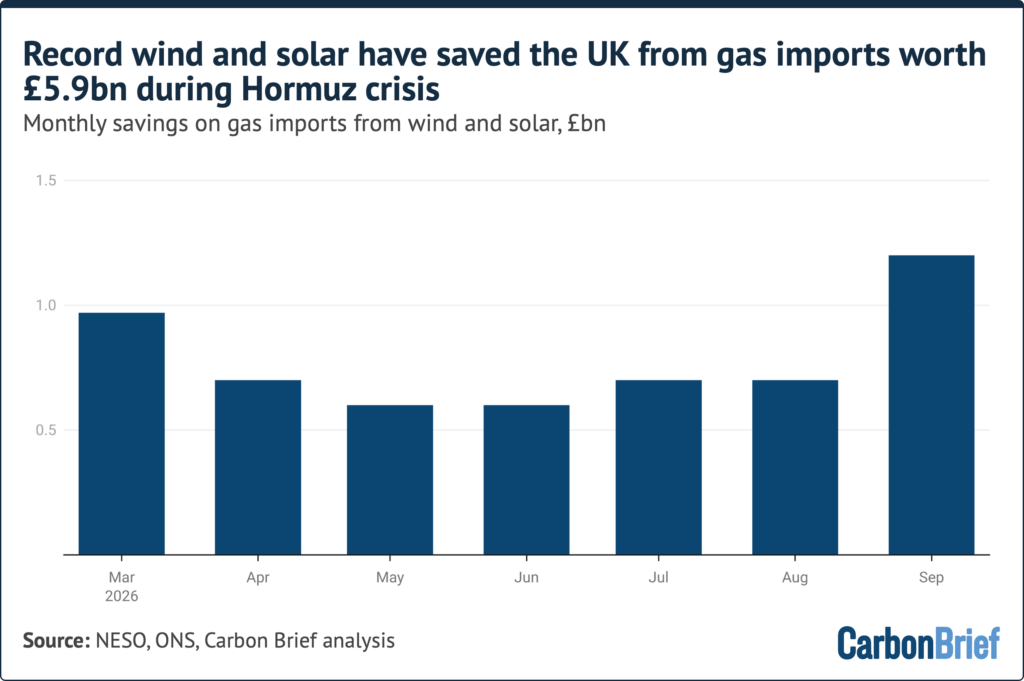
The £1.3bn import saving in September 2026 to date is the result of record wind and solar output, at nearly 10 terawatt hours (TWh), combined with surging gas prices.
Wholesale gas prices in the UK have remained elevated ever since Russia cut off supplies to Europe in the wake of its invasion of Ukraine in 2022. Gas averaged 90p per therm from 2023 until the start of this year, roughly three times above 2019 prices, before the Covid and Ukraine crises.
Since the outbreak of war in the Middle East in March, gas prices have climbed higher still, averaging 134p per therm or nearly four times the level seen in 2019.
In September 2026 to date, gas prices have averaged 189p per therm, reaching their highest level since the global energy crisis in 2022, as shown in the figure below.
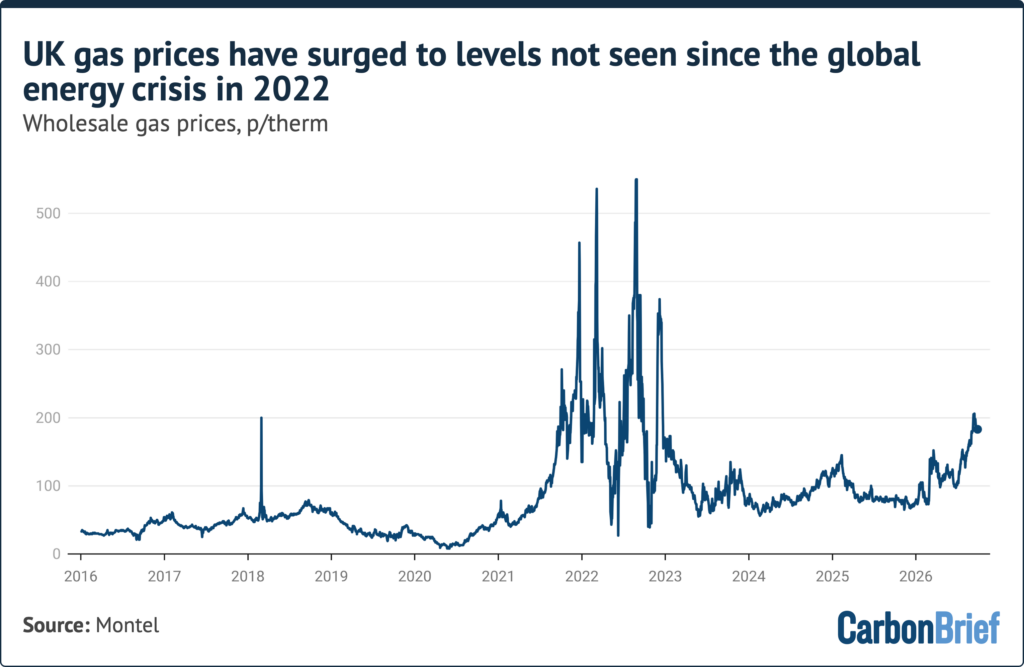
UK gas prices are spiking again because winter is approaching – meaning higher demand for heating – and there is no end in sight for the Hormuz crisis.
At the same time, European gas stocks are low. This means Europe will have to compete with Asia to secure the cargoes of LNG needed to keep warm.
In the UK, high wholesale gas prices are hitting household gas bills under the price cap set by energy regulator Ofgem – but thanks to clean energy, electricity bills have barely increased.
From this Thursday, 1 October, typical household gas bills will be 33% higher than they were in April, some £200 per year, according to thinktank Nesta.
In contrast, household electricity bills will only have risen 4%, according to Nesta’s analysis.
Andrew Sissons, director for sustainable future at Nesta, explained in a social media post that “the link between electricity and gas prices has already begun to break”.
The UK and other fossil-fuel importing nations are being hit not only by high gas prices, but also by high prices for oil, diesel and other refined fuels. The EU has reportedly had to pay an extra €100bn for fossil-fuel imports since the start of the crisis.
For example, UK diesel prices this week hit record levels of nearly £2 per litre. In contrast, recent Carbon Brief analysis shows that electric cars are up to nine times cheaper to drive.
In her speech to the Labour party conference this week, energy secretary Miatta Fahnbulleh said that energy bills were high because the UK is “exposed to global fossil-fuel markets”.
In his own conference speech, prime minister Andy Burnham said the expansion of clean energy was easing the impact of high gas prices on electricity bills. He said:
“We are already taking more control of our electricity prices with a massive expansion of home-grown renewables and nuclear. I have asked Miatta to speed up the breaking of the link between what we pay for power at home and the international gas market, to get bills down.”
The post Analysis: Wind and solar save UK from gas imports worth £5.9bn during Hormuz crisis appeared first on Carbon Brief.
Analysis: Wind and solar save UK from gas imports worth £5.9bn during Hormuz crisis
The deadly flash flood that thundered down Nepal’s Bhote Koshi valley a month ago may have been hard to predict given the complexity of monitoring glacial slopes in the high mountains. But it should come as a surprise to no one that such a disaster could happen in a world set to barrel past the 1.5C warming limit governments agreed to in 2015.
I say this with confidence because even before the ink was dry on the Paris Agreement, former colleagues and I were writing extensively about the dangers posed by accelerating glacier melt in the Himalayas. I went back to look at what we covered, often working with local journalists in Pakistan, India and Nepal. It was substantial.
Comment: The response to Nepal’s disaster is a test for global climate institutions
In one story from a conference on climate change and geology, Bill McGuire, a professor who then led the Benfield Hazard Research Centre at University College London, was quoted as saying: “The most likely thing we are going to see soon is an increased level in giant landslides in mountainous terrains, huge collapses, millions of cubic metres of rock.”
That is precisely what unleashed Nepal’s most recent disaster, some 13 years later.
Other articles zoomed in on internationally funded programmes to prevent glacial lake outburst floods; studies warning of the rising risks to downstream communities; and cross-border efforts (or lack of them) to set up monitoring systems. But information has not led to sufficient action.
Falling behind growing impacts
Reporting on climate-related disasters over the past 20 years (it was way back then that UN aid chief John Holmes started referring to extreme weather as the “new normal”) has been a pretty frustrating beat, as things have gotten dramatically worse.
There’s no question that our understanding of the risks has grown hugely – alongside our knowledge of how to protect people and infrastructure in the face of fast-growing threats.
Yet governments and businesses have dragged their feet on adaptation policies and practical measures, even when confronted with the numbers showing it’s far cheaper to prevent and prepare than to clean up and rebuild after a flood or a storm. This intransigence has left a yawning chasm in the world’s ability to deal with climate change-driven impacts.
Let’s call it the adaptation accountability gap.
-
UN Climate Summit: UN chief says world has tools to end fossil fuel age
At the UN Secretary-General’s climate summit in New York, countries shared their energy transition plans while Nepal and island nations advocated for more international support -
Threatened by rising seas, small islands secure right to keep their statehood
Efforts to protect marine ecosystems and coastal communities have risen up the political agenda at the UN General Assembly in New York
These days we see the effects all around us – in hospital emergency rooms where workers and older people struggle with heat exhaustion; in campsites and hotels abandoned by holidaymakers fleeing forest fires; in flooded streets piled high with mud, broken furniture and twisted cars.
The only bright side to the growing climate chaos we’re experiencing is that it’s become practically impossible for politicians and corporate bosses to ignore the evidence – and the rising cost to their balance sheets. Voters who can no longer afford to shoulder the economic and social burden of this damage need to let their leaders know time’s up.
1.5C overshoot means adapting differently
Last week, during Climate Week NYC, I moderated an event packed with experts who work on adapting to climate change – from Nepal to Brazil, from Sierra Leone to the Marshall Islands, and from communities to the top of governments and UN agencies. They spoke of tree-planting to stabilise slopes, heat insurance for informal workers, a climate risk guide for midwives, drought-resistant seeds and solar panels to irrigate farmland along the Nile.
Amid the diversity of experiences and approaches, there were two common threads: first, as underlined by the UN Environment Programme’s new report on overshooting 1.5C, we may have missed the boat to catch up on adaptation as we know it.
With global warming continuing apace, we’ll need to come up with new “transformational” strategies if the coral reefs, ice sheets, oceans and other natural systems on which we rely cross tipping points and unleash cascading consequences. Nepal’s flash flood is being flagged as an example of the kind of disaster that requires a major change in how we think about adaptation.
Second, the investment required to adapt to intensifying climate shocks and stresses can no longer be seen as something to be squeezed out of shrinking foreign aid budgets. There are a growing number of tried-and-tested funds and mechanisms for channelling finance at the local, national and global levels – these must be filled, replenished and used without delay.
Businesses need to get stuck in too, not least to safeguard their assets, operations and profits – but also because in some sectors like agriculture or water there are opportunities for a return. Despite this, there are many activities governments will have no choice but to pay for, such as moving people out of the path of rising seas.
Finance not flowing where needed
Mikko Ollikainen, who heads up the UN’s pioneering Adaptation Fund for developing countries, told the event the fund has a portfolio of projects worth $1.6 billion but a pipeline waiting to be financed to the tune of $1.8 billion. Yet, in recent years, as needs balloon, donor nations have failed to meet its annual fundraising target of $300 million at COP climate summits.
The chair of the UN climate body for implementation, Julia Gardiner, said she expects to see more pressure on governments at November’s COP31 summit in Türkiye to show how they will meet a goal to triple adaptation finance by 2035 and fill the under-resourced coffers of the fledgling Fund for Responding to Loss and Damage (FRLD).
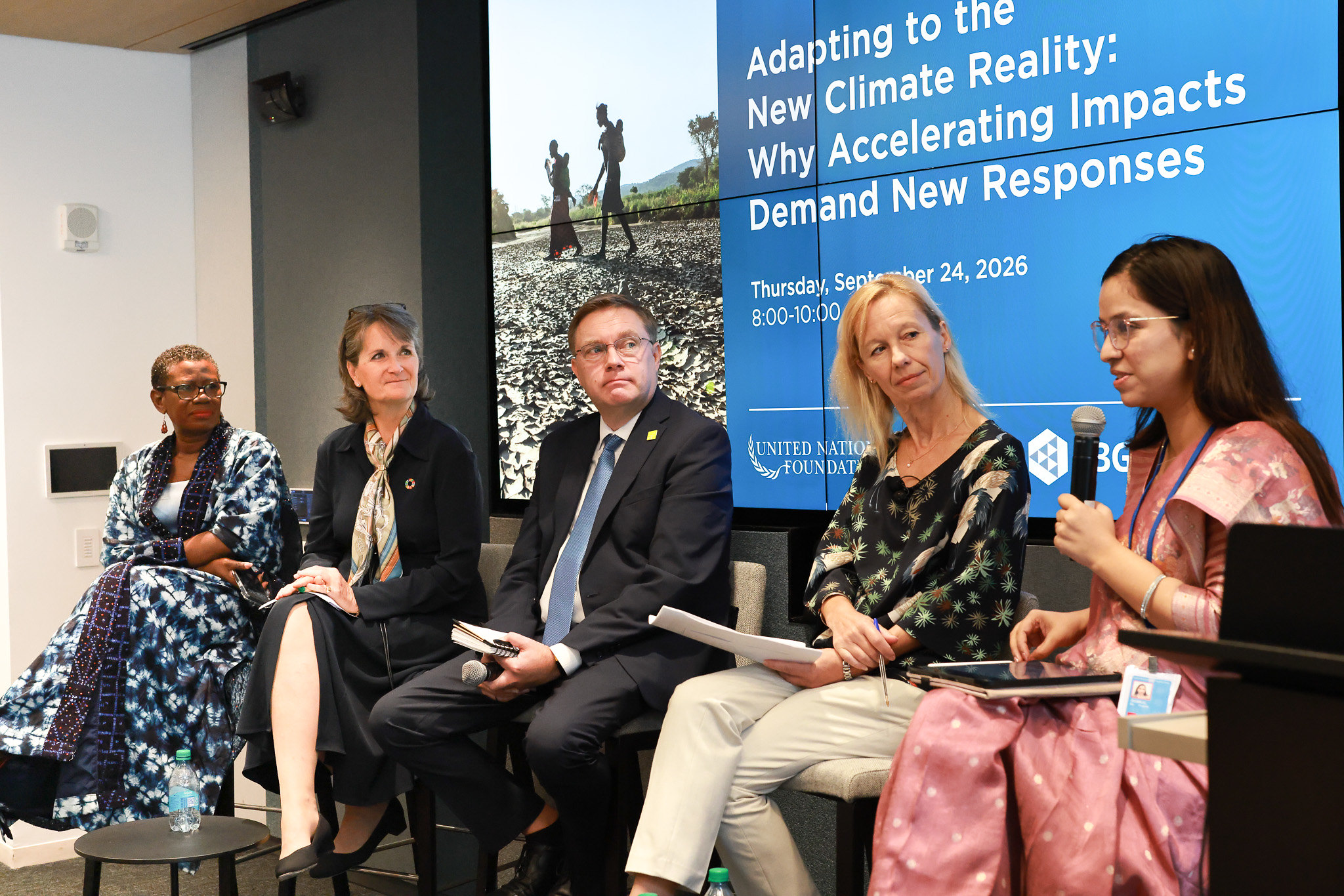
Nepal, meanwhile, is still waiting for a formal response to its request to the FRLD for urgent support to tackle the aftermath of the flood. Manjeet Dhakal, a Nepali scientist who advises least-developed countries in the UN climate process, said the disaster – which killed over 1,450 people and left nearly 6,000 missing – cannot be treated as just the latest climate crisis that grabs the headlines before it’s replaced by another.
That was backed up by Prakriti Dhakal, personal under-secretary to Nepal’s prime minister, who has been working closely on the emergency response. She said she had received many condolences and warm words of support during her meetings in New York.
But, she asked, “when you go home, will you continue having that sympathy for us that translates into something rational, something long-term, to strengthen the communities in Nepal?” A fitting response would be for governments to get behind a new Himalayan Climate Resilience Mechanism, proposed by Nepal’s leader at the UN last week, as one way to start closing the adaptation accountability gap.
The post Nepal’s disaster has laid bare the world’s adaptation accountability gap appeared first on Climate Home News.
Nepal’s disaster has laid bare the world’s adaptation accountability gap
Brazil’s environment minister says he is “very optimistic” that the Tropical Forest Forever Facility (TFFF) – a new rainforest fund to channel private and public finance to developing nations – can meet a key $10 billion funding target this year, and is not at risk from his country’s elections next month.
The TFFF, launched by Brazil at COP30 in the Amazon last November and co-led by Norway, is intended as an alternative to traditional grant-based forest finance. The fund aims to raise $125bn in public and private capital, invest it in bond markets, and then pay countries that keep their forests standing from the annual returns. Donor contributions needed to get it going have tailed off after an initial burst.
Speaking to Climate Home News on the sidelines of Climate Week in New York, Brazilian environment minister João Paulo Capobianco pointed out that in less than a year since its official launch, the TFFF has already secured $7.3bn from governments.
“How many other initiatives can say that?” he asked. “Of course, if you have $7 billion, it’s easier for more countries to consider their own contribution. And not just countries – non-governmental organisations also. We are expecting even more support.”
-
As El Niño intensifies, we should be investing more in the world’s farmers
Finance to help agriculture adapt to a hotter world and more extreme weather is vital for food security – but new data shows it’s on a downward trend -
COP31 attendees told not to interfere in Türkiye’s “internal affairs”
Amnesty International says the provision in the hosting agreement could have a “chilling effect” on free expression in Antalya -
Threatened by rising seas, small islands secure right to keep their statehood
Efforts to protect marine ecosystems and coastal communities have risen up the political agenda at the UN General Assembly in New York


As its initial target, the TFFF aims to raise $10bn in seed capital from governments by the end of 2026, and still needs to fill a gap of $2.7bn. Its backers say that for each dollar in public funding, they can secure $4 from the private sector. Critics say the $10bn goal barely covers the fund’s expenses and would not allow it to make any significant payments to forest countries.
Because setting up its financial architecture, raising the starting capital and making the first investments will take time, experts say the TFFF is unlikely to generate any payments for developing countries before 2028.
Seeking new pledges
Capobianco told Climate Home News that Brazil is still in talks with potential new contributors to the fund, among them China, Korea and Japan, and said he hoped to see more pledges announced at the upcoming biodiversity and climate COPs in October and November. The Netherlands is expected to up its first small contribution and Canada may also come in, according to other sources close to the TFFF.
Because the fund was not created as part of the UN climate talks and is hosted by the World Bank, developing countries can contribute without taking on wider donor responsibilities for climate finance. Brazil and Indonesia – both large emerging rainforest nations – have each pledged $1bn to the TFFF.
Earlier in September, the UK became the latest country to pledge funding – promising a loan of £400 million (about $540 million). Capobianco welcomed the contribution and noted that Britain has also said it will keep “under review” the possibility of putting in more.
Currently the largest donor is Norway, which announced a $3bn pledge last year at COP30 in Belém. However, that pledge came with conditions, among them that the fund must reach $10bn in sponsor capital by 2026, and that Norway’s contribution can’t make up more than 20% of that total. Over the longer term, this means the fund must raise $15bn from governments to unlock Norway’s full investment.
Comment: UK’s budget juggling trick with rainforest loan for bus-fare cap needs transparency
Speaking at a forest finance event in New York, Norway’s environment minister Sigrun Aasland said the country’s pledge was made not “only out of solidarity but because of shared interests”, adding that protecting rainforests is critical for climate and biodiversity goals as well as for national security.
“Tropical deforestation matters to people in the Amazon and in the Congo. But let’s not forget that it also matters to global food production and to the cost of living in Oslo or in London,” she said.
At the event, Guyana’s minister of natural resources Vickram Bharrat said the TFFF is “one in a menu of options” to finance forest protection in developing countries. He added that to boost its capital “maybe we should put some amount of pressure on oil companies to contribute to the fund”.
Upcoming election “not a risk”
Brazil, which has been pivotal to getting the fund off the ground, is now heading into a national election that could see the country swing back to an anti-climate stance if right-wing candidate Flávio Bolsonaro beats current left-wing President Luiz Inacio Lula da Silva. Capobianco, however, said the election result does not pose a risk to the TFFF.
“It’s a global initiative, not a Brazilian initiative. We proposed the first idea, but nowadays it’s a global initiative,” he said. “We believe the investor countries and the tropical countries together have the possibility to continue this process.”
In Brazil, the first round of voting is scheduled for Sunday, October 4. If no candidate wins more than 50% of valid votes, a run-off ballot will take place on October 25.
COP30 roadmap to end deforestation will invite countries to draft domestic plans
In July, the TFFF board adopted a charter, which outlines the instrument’s objectives and values, including that 20% of the payments made to tropical countries will go directly to Indigenous people and local communities.
The charter also says the TFFF board may comprise up to 12 member countries during the initial phase. Currently, seven seats are filled by the Democratic Republic of Congo (DRC), Germany, Brazil, France, the Netherlands, Norway and Indonesia.
The board has also formally incorporated the Tropical Forest Investment Fund (TFIF) – the TFFF’s investment arm that will trade bonds in financial markets – hosted in Luxembourg.
The post Brazil confident new rainforest fund will reach $10bn donor milestone appeared first on Climate Home News.
Brazil confident new rainforest fund will reach $10bn donor milestone



-
Climate Change1 year ago
Guest post: Why China is still building new coal – and when it might stop
-

 Greenhouse Gases2 years ago
嘉宾来稿:满足中国增长的用电需求 光伏加储能“比新建煤电更实惠”
-
Greenhouse Gases1 year ago
Guest post: Why China is still building new coal – and when it might stop
-

 Climate Change2 years ago
嘉宾来稿:满足中国增长的用电需求 光伏加储能“比新建煤电更实惠”
-

 Renewable Energy11 months ago
Sending Progressive Philanthropist George Soros to Prison?
-
Climate Change2 years ago
Bill Discounting Climate Change in Florida’s Energy Policy Awaits DeSantis’ Approval
-
Greenhouse Gases1 year ago
嘉宾来稿:探究火山喷发如何影响气候预测
-

 Climate Change2 years ago
Analysis: China’s CO2 falls 1% in Q2 2024 in first quarterly drop since Covid-19