

Plans to “draw down” CO2 from the atmosphere – known as carbon dioxide removal (CDR) – “fall short” of the quantities needed to limit global warming to 1.5C above pre-industrial levels, new research warns.
Keeping global temperatures below the limit set in the 2015 Paris Agreement requires rapid cuts in greenhouse emissions.
However, scenarios consistent with the Paris limit also assume heavy reliance on CDR, particularly in the second half of the 21st century.
The study, published in Nature Climate Change, quantifies the “CDR gap” – the difference between the amount of CDR included in national climate plans and what would be needed to limit warming to 1.5C.
CDR currently removes about 3bn tonnes of CO2 from the air every year, of which almost 100% comes from land-based methods, such as afforestation and reforestation, the study says.
The authors estimate that if countries implement their national targets, CDR will increase by up to 1.9bn tonnes of CO2 per year by 2050.
However, assessing a range of scenarios for limiting warming to 1.5C, the authors find a “CDR gap” in 2050 of 0.4bn-5.5bn tonnes of CDR per year.
One scientist, who was not involved in the study, tells Carbon Brief that framing the lack of additional plans for CDR as a “gap” is an “interesting idea”. However, he says it may not reflect a “definitive need for action” because the future role of CDR is debated.
Some scientists argue that reliance on CDR should be avoided, because land-based CDR can cause significant ecological and societal risks. Others worry that the promise of being able to use CDR in the future might dilute incentives to cut fossil-fuel use today.
The lead author of the study tells Carbon Brief that he recognises these concerns and made an effort to discuss them in the paper.
However, he says that calculating the CDR gap is important for assessing nations’ progress – and will provide a way of knowing whether countries are under- or over-committing to CDR in the future.
CO2 removal
CO2 removal (CDR) refers to methods that draw down CO2 from the air and store it indefinitely on land, in the ocean, in geological formations or in products.
The study authors note that the term CDR “includes human enhancement of natural removal processes, but excludes natural uptake not caused directly by human activities”. The latter includes the huge amounts of CO2 absorbed by the land and oceans each year.
The paper groups CDR into two categories:
- Conventional CDR on land: This includes afforestation, in which trees are planted when previously there were none, and reforestation, which means restoring areas where the trees have been cut down or degraded.
- Novel CDR: This includes all CDR methods that are not based on forestry and land-use change, such as biochar, direct air capture and bioenergy with carbon capture and storage (BECCS).
Using data collected over 2011-20, the authors estimate that total human emissions of all greenhouse gases have reached 60bn tonnes per year. Of this, CDR efforts currently remove around 3bn every year, they find. The study calculates global emissions in CO2 equivalent (CO2e).

The plot below shows current global greenhouse gas emissions and removals. The bar on the left shows emissions of CO2 (blue) and non-CO2 (pink) gases, as well as land emissions (brown). CO2 removal is shown in yellow.
The bars on the right show that 99.9% of CDR comes from conventional CDR on land (dark yellow), while “novel” CDR (light yellow) has a negligible contribution.

In 2015, countries agreed under the Paris Agreement to keep warming “well below 2C” above pre-industrial temperatures, with an aspiration of limiting warming to 1.5C.
Rapid cuts in emissions are crucial to meet this goal. To make progress, countries are required to submit – and regularly update – their plans for reducing emissions. There is currently a sizeable “emissions gap” between the cuts included in these national proposals and those needed to limit warming to 1.5C.
In many future scenarios that meet the Paris limit, CDR features heavily. For example, in scenarios where global temperatures initially “overshoot” 1.5C, before falling below the limit by 2100, large-scale CDR would be used to remove carbon from the atmosphere and allow global temperatures to decline.
In its most recent assessment, the Intergovernmental Panel on Climate Change (IPCC) modelled 541 pathways that hold warming to 1.5C or 2C. All of these pathways involve CDR implementation between 2020 and 2100, ranging from a total of 450bn to 1.1tn tonnes of CO2, in addition to deep emissions cuts.
However, there are currently no rules requiring governments to clearly report their CDR plans.
To assess the amount of CDR proposed by governments, the authors therefore had to analyse a range of documents submitted to the UN Framework Convention on Climate Change (UNFCCC), such as countries’ nationally determined contributions (NDCs) and their long-term low-emissions development strategies.
The authors find that if countries implement their national targets, CDR could expand by 1.5-1.9bn tonnes of CO2 per year, compared to levels in 2020. The paper notes that many countries plan to expand land-based removals, but none has yet committed to “substantively scaling” novel CDR methods.
Warming threshold
To assess how much CDR is needed to meet the long-term goal of the Paris Agreement, the authors use Integrated Assessment Models (IAMs). These models look at the energy technologies, energy use choices, land-use changes and societal trends that cause, or prevent, greenhouse gas emissions.
The authors select a range of IAM scenarios from the latest IPCC scenario database for its sixth assessment report (AR6). Scenarios that limit warming to 2C require emissions to fall by 46-75% between 2020 and 2050, but CDR becomes the “main mitigation strategy” in the second half of the century, the study says.
The authors add that in these scenarios, conventional CDR on land “starts from a high baseline, but quickly reaches saturation by the mid-century due to land area constraints for afforestation/restoration”. Meanwhile, novel CDR scales up throughout the 21st century and accounts for more than half of cumulative emissions by the year 2100.
To assess the pathways in more detail, the authors select three scenarios that limit global warming to 1.5C above pre-industrial levels
In the “demand reduction” scenario, humanity focuses on efficiency and sufficiency measures. This scenario requires an increase in land-based CDR, but no increase in “novel” CDR methods.
The “renewables” scenario sees a supply-side transformation towards renewable energy. This scenario mainly requires land-based CDR, but also includes a small contribution from novel methods.
The “carbon removal” scenario involves a rapid near-term reduction in greenhouse gas emissions, but fossil fuels are never entirely phased out, leading to higher “residual emissions” at net-zero CO2. Near-equal levels of land-based and novel CDR are needed by 2050, meaning that novel CDR needs to scale up more than a thousand times from its current capacity.
The plot below shows annual CDR under these three scenarios. The blue line indicates current CDR and each yellow line shows a different scenario. A lower (more negative) number means more CDR.

The study shows that current government plans – which would result in an extra 1.5-1.9bn tonnes of CDR per year by 2050 – are not ambitious enough to comply with any of the three 1.5C scenarios.
The table below shows the changes in different types of CDR required under the different scenarios by 2050, compared to 2020 levels. The column on the right shows the “CDR gap” between current plans and each scenario in 2050.
| Scenario | Total additional CDR (bn tonnes CO2/year) | Additional land-based CDR (bn tonnes CO2/year) | Additional novel CDR (bn tonnes CO2/year) | CDR gap (bn tonnes CO2/year) |
|---|---|---|---|---|
| Demand reduction | 2.3 | 2.3 | 0 | 0.4 |
| Renewables | 5.1 | 4.1 | 0.91 | 3.2 |
| Carbon removal | 7.4 | 4.0 | 3.5 | 5.5 |
The analysis shows that countries “lack progress in this domain of mitigation”, the study says. However, the size of the shortfall depends heavily on the scenario.
Under the demand reduction scenario, the CDR gap in 2050 is only 0.4bn tonnes of CDR per year, but this grows more than tenfold to 5.5bn tonnes of CDR per year under the carbon removal scenario.
Mind the gap
The prospect of relying on large-scale CDR to meet global climate goals is one that prompts concern in many experts.
One fear is that the promise of being able to use CDR in the future might dilute incentives to cut fossil fuel use today, a phenomenon known as “mitigation deterrence”.
Dr William Lamb – a researcher at the Mercator Research Institute on Global Commons and Climate Change and lead author on the study – tells Carbon Brief that the paper acknowledges this concern and tries to be clear that CDR is not a replacement for mitigation.
Prof Steve Pye is a professor at University College London’s Energy Institute, who was not involved in the study. He says that framing the lack of CDR as a “gap” is an “interesting idea”, but does not necessarily reflect a “definitive need for action” in the same way as the emissions gap:
“The implications of the CDR gap are much more open to debate as CDR is a category of mitigation action, with the size of the gap either a cause for alarm or not depending on one’s view of what role that option will or should play.”
He adds that the analysis could even be “interpreted as positive”, because it shows that countries are not being distracted by novel CDR.
Alexandra Deprez – a research fellow at the Institute for Sustainable Development and International Relations, who is not involved in the study – tells Carbon Brief that the new study does not do enough to consider the “sustainability limits” of CDR.
She recently co-wrote a Carbon Brief guest post explaining these limits, which said:
“The large-scale deployment of land-based CDR could come with major challenges. These include significant ecological and societal risks – particularly to biodiversity loss, food security, freshwater use and human rights, among others – which have not been comprehensively assessed.”
Deprez and Lamb have “opposite starting points” in their work on CDR and therefore arrive at different conclusions, she explains.
Lamb starts by asking “how much CDR is needed” and concludes that it needs to be scaled up, she says. Meanwhile, she tells Carbon Brief that her own work starts by asking “how much CDR can be sustainably deployed” and finds that “‘Paris compatible’ scenarios overstep high CDR sustainability risk”.
Lamb says the authors were “very careful” in selecting the three focus scenarios for the study. He adds:
“We have a kind of selection criteria that includes thinking about the sustainability constraints, whether they’re using too much biomass, whether they’re scaling up novel methods too quickly. And so we’re quite conservative about the specific scenarios we choose.”
Meanwhile Prof Joeri Roglej – director of research at the Grantham Institute – tells Carbon Brief that the study “puts pathways that aim to keep warming as close to 1.5C as possible in the same basket as pathways that keep it below 2C only, therewith suggesting a lower overall ambition than the Paris Agreement”.
He adds:
“The study doesn’t distinguish scenarios with CDR levels that risk undermining sustainability. These presentation choices therefore perpetuate some of the reasons why CDR research is often criticised, including that CDR scholarship often turns a blind eye to the sustainability risks of large-scale CDR deployment.”
Pye adds a note of caution about using IAMs, saying they have “relied heavily on CDR to meet high ambition targets” without accounting for the “political reality” faced by many governments.
CDR reporting
According to the study, only about 40 countries, including the EU, have outlined scenarios in their long-term strategies that depict quantifiable levels of CDR by 2050.
For the other countries – which account for 62% of current conventional CDR on land – the authors assume that overall CDR levels will remain constant.
Lamb tells Carbon Brief that this is a “big assumption”. He notes that while CDR globally has been “quite stable over the past 20 years”, there is a lot of variation between countries. For example, he says that China has been “rapidly increasing” its CDR through large afforestation projects, while many countries in Europe have seen a decrease due to problems in their forestry sector.
The study also assumes that countries without quantifiable scenarios do not currently plan to implement novel CDR methods. “This includes China, Norway and Saudi Arabia, which are all developing technology roadmaps towards novel CDR and could contribute to closing the gap,” the paper says.
Dr Ajay Gambhir is a visiting senior research fellow at Imperial College London’s Grantham Institute for Climate Change and the Environment, and was not involved in the study. He tells Carbon Brief that many land-based carbon sinks, such as forests, have the potential to transition to sources of carbon over the coming years.
He adds:
“The authors are mindful of potential reversibility of forest carbon, but this highlights the risks that we are even further from our CDR, and emissions reduction, needs than might be indicated in this analysis.”
The lack of clear data shows that “we need more clarity” in CDR reporting, Lamb tells Carbon Brief. He argues that increasing transparency would “allow more critical reflection actually on carbon dioxide removal plans and whether they’re ambitious enough – or even too ambitious at the expense of emissions reductions”.
The analysis from this paper will be included in the next State of CDR report, which will be released this summer.


The post CO2 removal ‘gap’ shows countries ‘lack progress’ for 1.5C warming limit appeared first on Carbon Brief.
CO2 removal ‘gap’ shows countries ‘lack progress’ for 1.5C warming limit

Drought and heatwaves occurring together – known as “compound” events – have “surged” across the world since the early 2000s, a new study shows.
Compound drought and heat events (CDHEs) can have devastating effects, creating the ideal conditions for intense wildfires, such as Australia’s “Black Summer” of 2019-20 where bushfires burned 24m hectares and killed 33 people.
The research, published in Science Advances, finds that the increase in CDHEs is predominantly being driven by events that start with a heatwave.
The global area affected by such “heatwave-led” compound events has more than doubled between 1980-2001 and 2002-23, the study says.
The rapid increase in these events over the last 23 years cannot be explained solely by global warming, the authors note.
Since the late 1990s, feedbacks between the land and the atmosphere have become stronger, making heatwaves more likely to trigger drought conditions, they explain.
One of the study authors tells Carbon Brief that societies must pay greater attention to compound events, which can “cause severe impacts on ecosystems, agriculture and society”.
Compound events
CDHEs are extreme weather events where drought and heatwave conditions occur simultaneously – or shortly after each other – in the same region.
These events are often triggered by large-scale weather patterns, such as “blocking” highs, which can produce “prolonged” hot and dry conditions, according to the study.
Prof Sang-Wook Yeh is one of the study authors and a professor at the Ewha Womans University in South Korea. He tells Carbon Brief:
“When heatwaves and droughts occur together, the two hazards reinforce each other through land-atmosphere interactions. This amplifies surface heating and soil moisture deficits, making compound events more intense and damaging than single hazards.”
CDHEs can begin with either a heatwave or a drought.
The sequence of these extremes is important, the study says, as they have different drivers and impacts.
For example, in a CDHE where the heatwave was the precursor, increased direct sunshine causes more moisture loss from soils and plants, leading to a drought.
Conversely, in an event where the drought was the precursor, the lack of soil moisture means that less of the sun’s energy goes into evaporation and more goes into warming the Earth’s surface. This produces favourable conditions for heatwaves.
The study shows that the majority of CDHEs globally start out as a drought.
In recent years, there has been increasing focus on these events due to the devastating impact they have on agriculture, ecosystems and public health.
In Russia in the summer of 2010, a compound drought-heatwave event – and the associated wildfires – caused the death of nearly 55,000 people, the study notes.

The record-breaking Pacific north-west “heat dome” in 2021 triggered extreme drought conditions that caused “significant declines” in wheat yields, as well as in barley, canola and fruit production in British Columbia and Alberta, Canada, says the study.
Increasing events
To assess how CDHEs are changing, the researchers use daily reanalysis data to identify droughts and heatwaves events. (Reanalysis data combines past observations with climate models to create a historical climate record.) Then, using an algorithm, they analyse how these events overlap in both time and space.
The study covers the period from 1980 to 2023 and the world’s land surface, excluding polar regions where CDHEs are rare.
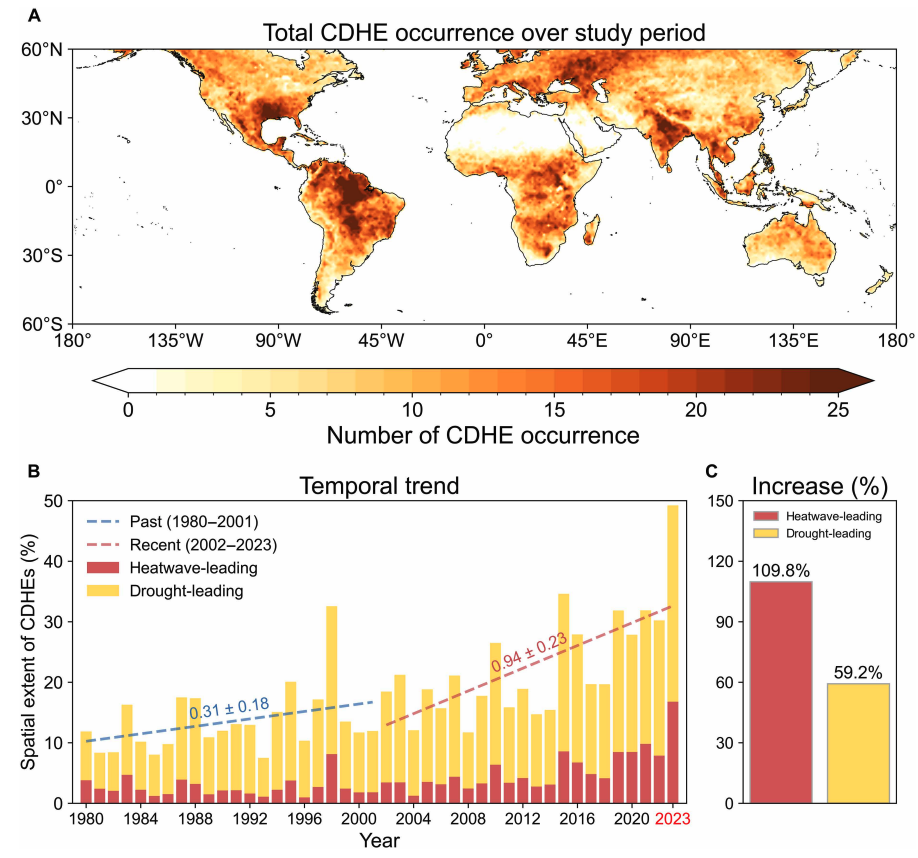
The research finds that the area of land affected by CDHEs has “increased substantially” since the early 2000s.
Heatwave-led events have been the main contributor to this increase, the study says, with their spatial extent rising 110% between 1980-2001 and 2002-23, compared to a 59% increase for drought-led events.
The map below shows the global distribution of CDHEs over 1980-2023. The charts show the percentage of the land surface affected by a heatwave-led CDHE (red) or a drought-led CDHE (yellow) in a given year (left) and relative increase in each CDHE type (right).
The study finds that CDHEs have occurred most frequently in northern South America, the southern US, eastern Europe, central Africa and south Asia.
Threshold passed
The authors explain that the increase in heatwave-led CDHEs is related to rising global temperatures, but that this does not tell the whole story.
In the earlier 22-year period of 1980-2001, the study finds that the spatial extent of heatwave-led CDHEs rises by 1.6% per 1C of global temperature rise. For the more-recent period of 2022-23, this increases “nearly eightfold” to 13.1%.
The change suggests that the rapid increase in the heatwave-led CDHEs occurred after the global average temperature “surpasse[d] a certain temperature threshold”, the paper says.
This threshold is an absolute global average temperature of 14.3C, the authors estimate (based on an 11-year average), which the world passed around the year 2000.
Investigating the recent surge in heatwave-leading CDHEs further, the researchers find a “regime shift” in land-atmosphere dynamics “toward a persistently intensified state after the late 1990s”.
In other words, the way that drier soils drive higher surface temperatures, and vice versa, is becoming stronger, resulting in more heatwave-led compound events.
Daily data
The research has some advantages over other previous studies, Yeh says. For instance, the new work uses daily estimations of CDHEs, compared to monthly data used in past research. This is “important for capturing the detailed occurrence” of these events, says Yeh.
He adds that another advantage of their study is that it distinguishes the sequence of droughts and heatwaves, which allows them to “better understand the differences” in the characteristics of CDHEs.
Dr Meryem Tanarhte is a climate scientist at the University Hassan II in Morocco, and Dr Ruth Cerezo Mota is a climatologist and a researcher at the National Autonomous University of Mexico. Both scientists, who were not involved in the study, agree that the daily estimations give a clearer picture of how CDHEs are changing.
Cerezo-Mota adds that another major contribution of the study is its global focus. She tells Carbon Brief that in some regions, such as Mexico and Africa, there is a lack of studies on CDHEs:
“Not because the events do not occur, but perhaps because [these regions] do not have all the data or the expertise to do so.”
However, she notes that the reanalysis data used by the study does have limitations with how it represents rainfall in some parts of the world.
Compound impacts
The study notes that if CDHEs continue to intensify – particularly events where heatwaves are the precursors – they could drive declining crop productivity, increased wildfire frequency and severe public health crises.
These impacts could be “much more rapid and severe as global warming continues”, Yeh tells Carbon Brief.
Tanarhte notes that these events can be forecasted up to 10 days ahead in many regions. Furthermore, she says, the strongest impacts can be prevented “through preparedness and adaptation”, including through “water management for agriculture, heatwave mitigation measures and wildfire mitigation”.
The study recommends reassessing current risk management strategies for these compound events. It also suggests incorporating the sequences of drought and heatwaves into compound event analysis frameworks “to enhance climate risk management”.
Cerezo-Mota says that it is clear that the world needs to be prepared for the increased occurrence of these events. She tells Carbon Brief:
“These [risk assessments and strategies] need to be carried out at the local level to understand the complexities of each region.”




The post Heatwaves driving recent ‘surge’ in compound drought and heat extremes appeared first on Carbon Brief.
Heatwaves driving recent ‘surge’ in compound drought and heat extremes
Greenhouse Gases
DeBriefed 6 March 2026: Iran energy crisis | China climate plan | Bristol’s ‘pioneering’ wind turbine
Welcome to Carbon Brief’s DeBriefed.
An essential guide to the week’s key developments relating to climate change.
This week
Energy crisis
ENERGY SPIKE: US-Israeli attacks on Iran and subsequent counterattacks across the Middle East have sent energy prices “soaring”, according to Reuters. The newswire reported that the region “accounts for just under a third of global oil production and almost a fifth of gas”. The