Welcome to Carbon Brief’s China Briefing.
China Briefing handpicks and explains the most important climate and energy stories from China over the past fortnight. Subscribe for free here.
Key developments
Steel, aluminium and cement on notice
ETS EXPANSION: China will expand its emissions trading system (ETS) to include the steel, cement and aluminium industries, which will “require an additional 1,500 firms to purchase credits to cover their emissions”, Reuters reported. (The Ministry of Ecology and Environment proposed the expansion in a draft policy last year. Read Carbon Brief’s in-depth Q&A on the ETS.) The newswire added that the system would now cover 8bn tonnes of carbon dioxide (CO2), or “more than 60% of China’s total emissions”, up from 40% currently. The expansion demonstrates a “strong political will [in China] to achieve the country’s ‘dual-carbon’ goals” despite a tense geopolitical climate and domestic “economic pressures”, the Shanghai-based news outlet Sixth Tone quoted Shen Xinyi, researcher at the Centre for Research on Energy and Clean Air (CREA), as saying. Finance news outlet Yicai said the expansion will “intensify the [steel] sector’s fragmentation and force outdated production capacity to shut”, but in the long term would encourage “technological innovation and investment” in the “green transition”.
‘CLEAN’ ALUMINIUM: Aluminium producers are expected to increase their use of “clean energy” to 30% of their total energy use by 2027 according to a new industry development plan, energy news outlet International Energy Net reported, adding that China also aims to “raise output of recycled aluminium to more than 15m tonnes”. (This would more than double its 2020 output. China’s production of “primary” aluminium made from metal ore is around 44m tonnes per year.) The plan also urges aluminium producers to “participate in renewables projects, such as solar, wind, hydrogen and energy storage”, as well as “engage in green electricity trading, purchase green electricity certificates (GECs)…and [invest] in clean-power projects to increase clean energy use”, according to industry news outlet BJX News. Bloomberg said that the directive – which “mirrors similar guidance…given to copper smelters” – also tightens rules for building new aluminium plants in a “bid to tackle overcapacity”.
GRID INVESTMENT: Meanwhile, investments in China’s electricity grid “jumped by about 33% in the first two months” of 2025 to around 44bn yuan ($6bn), Bloomberg reported, although it noted this was “still below the pace needed” to meet China’s 2025 spending target of 650bn yuan ($89bn). Separately, China has launched 30 projects in nine cities to pilot the use of electric vehicle batteries in supporting the grid, Reuters reported. Elsewhere, China’s finance ministry pledged to provide more financial support in 2025 for meeting China’s climate goals and the promotion of renewable energy and the low-carbon transition of “key industries”, BJX News reported.
Low-carbon leadership

‘COMMANDING HEIGHTS’: China must “aim for the commanding heights of future science, technology and industrial development” in “new energy” and other technological “frontiers”, Chinese president Xi Jinping said in a speech published by Qiushi, the country’s top ideological journal. The speech focused on key tasks for building China’s strength in science and technology, noting: “Green [and] low-carbon technologies have contributed significantly to…a beautiful China.” Xi also raised the importance of “international” cooperation, such as for “jointly respond[ing] to global challenges such as climate change…[and] energy security”.
ASIA’S DAVOS: Meanwhile, China’s climate envoy Liu Zhenmin said at the 2025 Boao forum – an event also known as Asia’s Davos – that the “political will of member nations, market forces and technology” meant that the global energy transition is “irreversible”, Bloomberg reported. State broadcaster CGTN quoted Liu saying at the event, held in Hainan province last week, that one key “challenge” would be delivering the $300bn climate-finance goal agreed at COP29. It quoted him adding: “We need to continue to push developed country parties to undertake their responsibility for this payment.” Liu also said a “friendly trade environment and a favorable market environment” is needed for low-carbon technologies to “flow freely” around the world, the Communist party-affiliated People’s Daily reported. Executive vice-premier Ding Xuexiang called on countries to “firmly oppose trade and investment protectionism” in his keynote speech at the event, Bloomberg said. (Ding is China’s “top decision-maker” on climate policy.)
-
Sign up to Carbon Brief’s free “China Briefing” email newsletter. All you need to know about the latest developments relating to China and climate change. Sent to your inbox every Thursday.
TÊTE-À-TÊTE: Elsewhere, China and France “issued a joint statement on climate change…marking the 10th anniversary of the Paris Agreement”, the state-run newspaper China Daily said, in which the nations “reaffirmed their shared commitment to enhancing international cooperation to address climate challenges”. CGTN published the full text of the statement, in which China and France pledged “enhanced communication about their respective upcoming new ambitious [nationally determined contributions] which will cover all economic areas and greenhouse gases, and be aligned with the Paris Agreement goals”. The statement also pledged “continuous efforts to transition away from fossil fuels”. The two countries separately agreed to cooperate on “nuclear energy”, “connected vehicles” and “green hydrogen”, the Singapore-based Straits Times said.
GREEN FINANCE: China has launched a 6bn yuan ($825m) green sovereign bond on the London Stock Exchange in “what is expected to be the first in a series of sales that will expand its footprint in the market”, Reuters reported. Bloomberg said it “highlight[ed China’s] ambitions to bolster its environmental credentials to investors”. (The plan to issue the bond was first announced during Rachel Reeves’ visit to Beijing in January).
Record trade tensions
‘LIBERATION DAY’: The US imposed a new total tariff rate of at least 54% on goods from China, in a move that could encourage China to “branch out and find new markets for its clean-energy technology, accelerating their adoption”, the Scientific American said. (Chinese exports of clean-energy technologies to the US were already low due to existing tariffs.) Politico reported that, as “a lot of” the basic materials for electric vehicle (EV) batteries are sourced from China, US EV manufacturers will be “hit” by the tariffs. Ahead of the announcement, a report on “foreign trade barriers” from the US government dedicated almost 50 of its 400-pages to China, criticising China’s aim to “dominat[e]” industries such as “new energy vehicles”, the New York Times reported. China “firmly opposes” the tariffs, Reuters quoted China’s commerce ministry as saying. (Read Carbon Brief’s article for expert views on the climate impacts of Trump’s tariffs)
EU-CHINA TALKS: China and the EU confirmed that they “agreed to restart talks on minimum [import] price[s]” for Chinese EVs “as soon as possible”, according to Reuters. While Chinese battery EV exports to the EU have “slowed” due to EU tariffs, China’s “exports of plug-in hybrid electric vehicles” – which are not subject to tariffs – “surged” in January and February 2025, the Hong Kong-based South China Morning Post said. Reuters said China “has not shipped any antimony”, a critical mineral used in solar-panel manufacturing, to the EU since it was placed under export controls in October. Meanwhile, Japan placed a 95% anti-dumping duty on imports of Chinese graphite electrodes, which are used in technologies such as electric arc furnace steelmaking and lithium-ion batteries, another Reuters article reported.
TRADE INVESTIGATIONS: China was the subject of a “record number of trade investigations by [World Trade Organization] members last year”, triggered by a boom in exports, the Financial Times reported. It said the 198 trade investigations in 2024 “alleging dumping or illegal subsidies” was double the previous year’s total.
Pricing reform
HIGH-LEVEL OPINIONS: The top offices of the Chinese Communist Party and State Council issued joint opinions on the need to improve pricing mechanisms, which reiterated calls for “market-oriented reform of prices” for energy, reform of feed-in tariffs – which have been used to set prices for coal and renewables – and improving power purchasing systems, Xinhua reported. The document also called for the establishment of “sound” pricing mechanisms for gas, energy storage and other energy flexibility providers, which could indicate plans for “further rolling out capacity mechanisms” to cover further power generation sources in addition to coal, wrote Yan Qin, principal analyst at ClearBlue Markets, on LinkedIn.
OPTIMISING RESOURCES: A representative of the National Development and Reform Commission (NDRC), China’s top economic planner, told business newspaper Daily Economic News that improved pricing mechanisms are the foundation of a better market-oriented economy. The outlet also quoted Lin Weibin, director of the energy policy research office of the China Energy Research Society, saying that an important element of improving pricing mechanisms is to “accelerate the construction of the electricity spot market, and promote the construction of a unified national electricity market”. The opinions are a “powerful impetus” to develop systems that make the use of “energy resources” more efficient and optimise China’s energy structure, Xinhua quoted Deng Yusong, a researcher at the government-backed thinktank Development Research Center of the State Council, as saying.
Spotlight
Guest post: China’s surging solar exports to the global south
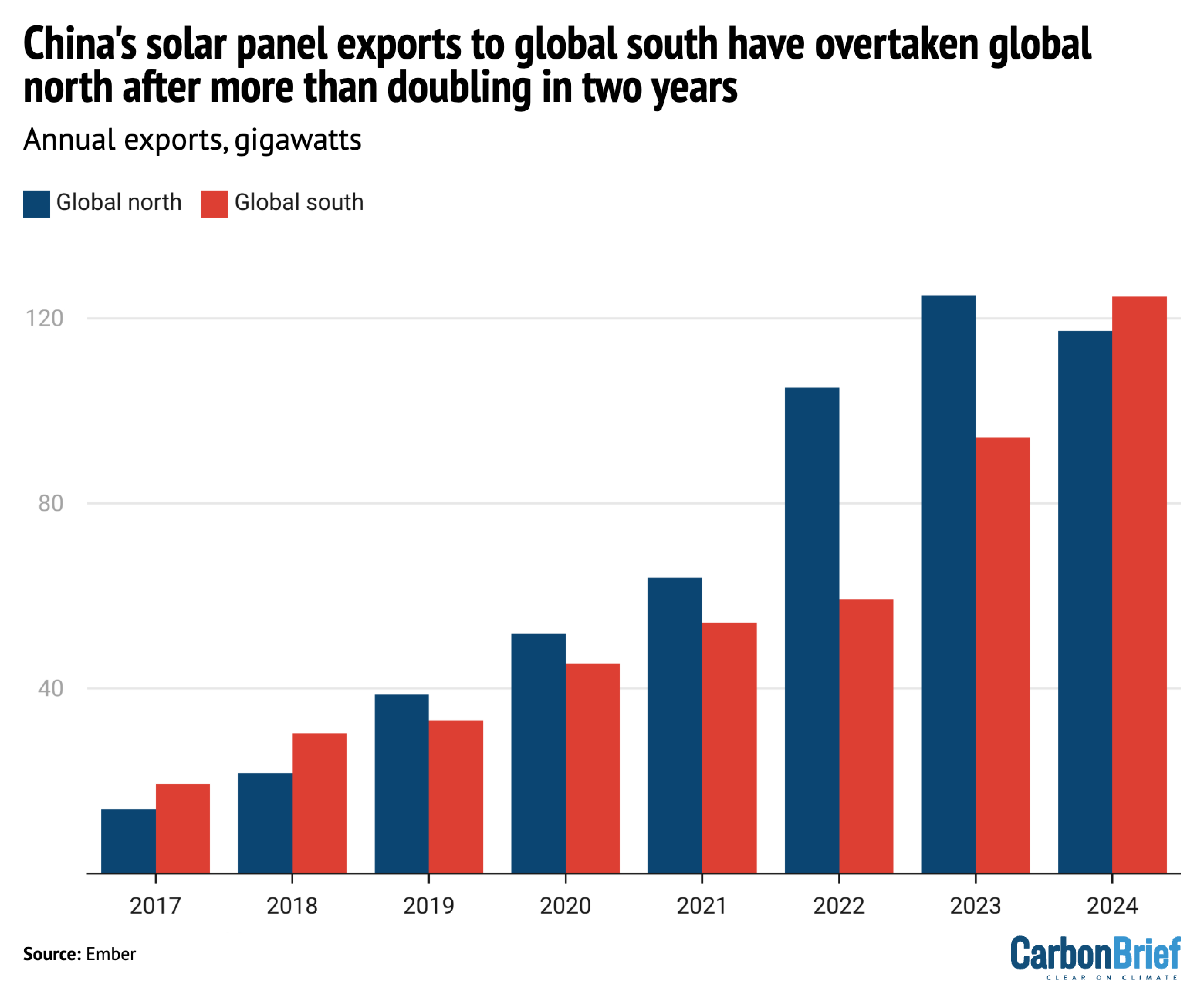
China’s exports of solar panels to the global south have doubled in the past two years, overtaking global-north sales for the first time since 2018, says a recent Carbon Brief guest post.
The guest post is by Dave Jones and Libby Copsey, respectively global insights programme director and data developer at thinktank Ember. Ember’s China solar PV export explorer tracks shipments to more than 200 countries, showing that global south countries, such as Brazil, Saudi Arabia, Pakistan and India, were among the top importers of Chinese solar panels in 2024.
In this issue, Carbon Brief highlights the key findings of the guest post. The full article is available on Carbon Brief’s website.
Top importers
China’s solar panel exports rose by 10% in 2024, with imports by global-south countries rising by 32% and those to the global north falling by 6%, according to Ember’s data.
Global-south imports more than doubled from 60 gigawatts (GW) in 2022 to 126GW in 2024. That surpassed global-north imports, which were only 12% more in 2024 than in 2022, as shown on the chart below.
The Netherlands was the biggest importer in 2024 and has been every year since 2019, as a result of Rotterdam serving as an import hub for much of continental Europe. The next four places were all global-south countries.
Brazil was in second place, importing more than 20GW for the second year in a row. However, the imposition of import taxes by the government, the refusal of electricity distributors to connect new solar systems and solar “curtailment” are all causing headwinds in 2025.
Pakistan and Saudi Arabia jumped to third and fourth, respectively. These two countries have had almost identical imports of Chinese solar panels for the past two years. They stood at 8GW in 2023 and then more than doubled to 17GW in 2024, the export explorer shows.
However, Pakistan has mainly imported panels for small-scale “distributed” installations. In contrast, Saudi Arabia’s import growth has been driven almost entirely by desert solar parks, complete with some battery storage and paid for by international energy companies.
India was in fifth place in 2024. Its module imports remained similar to those in 2023, but its installations rose to a record high, enabled by a step up in new domestic solar panel manufacturing capacity.
In January 2025, that helped India hit 100GW of solar installed, according to government figures. India is partly relying on Chinese imports, whilst simultaneously scaling up its own manufacturing industry.
New markets
There were 15 countries that saw a large uptick in imports of Chinese solar panels towards the end of 2024.
In particular, there were large increases in Nigeria, Algeria and Iraq, where there is clear evidence that demand for panels is growing.
Nigeria’s growth was driven by blackouts in 2024 and the removal of fuel subsidies, Iraq is constructing its first large solar plant, while Algeria has a plan for 3GW of solar projects.
For a cluster of a further 12 countries, which includes many small African and Latin American countries, it is less clear if the recent uptick in solar panel imports is a structural change that will continue into 2025 and beyond.
There are large incentives for China’s solar manufacturing companies to meet year-end targets, so it is possible that containers of solar panels were sold to these countries at discounted rates to help meet these goals.
The recent spike in imports are nevertheless quite large in the context of the small electricity systems of many of these countries. As such, these solar panels would provide a relatively meaningful increase in renewable electricity generation if they go on to be installed.
Reducing reliance
China itself – the biggest of all the global-south solar markets – installed more solar panels than it exported for the second year in a row.
It installed 333GW of solar capacity domestically in 2024, some 38% more than the 242GW of solar panels that it exported.
Solar exports rose by 10% year-on-year, which was a significant slowdown from the rate of growth seen in recent years. However, solar installations outside of China grew by 30%.
This demonstrates a step-up in ambitions to reduce reliance on Chinese solar panel imports by a number of countries around the world.
Watch, read, listen
SHIFTING MINDSETS: Business news outlet Jiemian interviewed the owner of a struggling clean-energy technology distributor in Germany about the challenges of importing Chinese energy products to the EU.
PATIENT CAPITAL?: New Security Beat explored how China is using “resource-backed loans” as part of its overseas development finance strategy, recouping loan payments in the form of oil, minerals and other national resources.
NO MORE BF-BOF: A new report by consultancy Global Efficiency Intelligence examined how China can increase uptake of electric arc furnaces in its carbon-intensive steel industry.
PLOTTING THE FUTURE: Kaare Sandholt, chief international advisor at the Energy Research Institute, spoke with Environment China about the thinktank’s modelling of China’s energy transition, which he recently wrote about for Carbon Brief.
26%
The amount by which China’s glacier area has shrunk since 1960, due to rapid global warming, Reuters reported. The newswire added that 7,000 small glaciers have disappeared completely in China during this period.
New science
npj Climate Action
A new study analysing China’s climate policy found that a higher “density”, or number, of climate policies “does not equate to stronger [climate] action”. The authors created a dataset of 358 climate-related policies adopted by China’s central government from 2016-22. They found “significant variation” in how much different sectors were aligned with China’s most recent nationally determined contribution (NDC) – especially among high-emitting sectors.
Communications Earth & Environment
An emissions trading system (ETS) is needed in order for ammonia produced with renewable energy – known as “renewable ammonia” – to achieve “cost parity” with conventional ammonia before 2040, according to new research. The authors used models to project the economic and carbon costs of seven ammonia production technologies, evaluating the impact of China’s ETS on the levelised cost of ammonia over 2018-60. Expanding the ETS to cover the lifecycle of ammonia production could allow “renewable ammonia” to achieve cost parity 6-37 years sooner than if the system was not implemented, it added.
China’s carbon sinks from land-use change underestimated
Nature Climate Change
A new study found that China’s carbon sinks resulting from land-use change over the past four decades have been underestimated. The study analysed carbon fluxes linked to land-use change between 1981-2020, using independent models and a new dataset integrating remote sensing with China’s national forest inventory. It added that, over the past 40 years, China’s net carbon flux from land-use change removed 7.3bn tonnes of CO2, with the annual average sink since 2001 totalling 0.5bn tonnes of CO2.
China Briefing is compiled by Wanyuan Song and Anika Patel. It is edited by Wanyuan Song and Dr Simon Evans. Please send tips and feedback to china@carbonbrief.org
The post China Briefing 3 April 2025: Solar exports; Carbon market expansion; Leaders’ climate commitments appeared first on Carbon Brief.
China Briefing 3 April 2025: Solar exports; Carbon market expansion; Leaders’ climate commitments

Next week, diplomats from around the world will descend on Yerevan, Armenia, to negotiate a series of decisions under the UN Convention on Biological Diversity (CBD).
Between 19 and 30 October, 196 parties will gather to hammer out the precise wording of the dozens of legal texts that make up the decisions under the Conference of the Parties (COP) to the CBD.
This year’s summit is particularly significant, as it marks the halfway point between the agreement of the Kunming-Montreal Global Biodiversity Framework and the deadline for achieving its targets.
The CBD has found that countries are currently not on track to meet 22 out of the framework’s 23 targets.
During the fortnight, delegates will also be negotiating decisions relating to the two supplemental protocols to the CBD: the Cartagena Protocol, which covers biosafety; and the Nagoya Protocol, which covers access and benefit-sharing for the use of genetic resources.
(The Cartagena and Nagoya Protocols, which are each governed by a “meeting of the parties”, or “MOP”, have fewer parties than the CBD as a whole, with 173 and 141, respectively.)
Carbon Brief is tracking the progress of countries towards consensus on dozens of negotiating texts using the interactive table below.
The tracker includes texts from the COP, as well as the MOPs for the Cartagena and Nagoya protocols. It also includes draft decisions from the most recent subsidiary body meetings, as these form the starting point for the negotiations in Yerevan.
The CBD has three subsidiary bodies: the subsidiary body on scientific, technical and technological advice (SBSTTA), the subsidiary body on implementation (SBI) and the subsidiary body on article 8(j) and other provisions (SB8J).
SB8J focuses on issues related to the Indigenous peoples and local communities. It was established at COP16 in Cali, Colombia, in 2024.
The first two columns of the interactive tracker list the topic of each agenda item and the relevant body, with subsequent columns including dates, page counts and links to the original documents.
The table is searchable and can be sorted using the arrows in the header.
Areas of disagreement in UN draft texts are denoted by square brackets. Counting the brackets in a particular iteration of a text therefore gives a sense of how far parties are from reaching consensus.
The bracket column is colour-coded, with dark green indicating a low number of brackets and red indicating a high number of brackets remaining.
Texts can also present parties with choices using “options” or alternatives (“alt”), which are counted together in the sixth column of the table.
The key discussions in Yerevan will centre around two agenda items in particular. The first is the global review, which will assess progress towards the GBF and make recommendations for accelerating action.
The second is finance, which can be separated into two parts: resource mobilisation and the financial mechanism. On resource mobilisation, biodiverse global south countries are likely to push for an increased amount of international finance for conservation.
Disagreement over the creation of the financial mechanism led to the suspension of COP16 in Cali in October 2024, as parties failed to find agreement on the mobilisation of finance before the end of the summit.
Global south countries want the establishment of a separate financial mechanism under the control of the CBD; global north countries largely prefer to maintain the existing mechanism, which sits under the Global Environment Facility.
At the resumed session of COP16 in Rome in early 2025, countries agreed on a roadmap that would lead to the establishment of a permanent mechanism.