

Climate change played a key role in the “catastrophic” 2023 floods in the Himalayan state of Sikkim in India, a new study says.
The breach of one of the “largest, fastest-growing and most hazardous” glacial lakes in Sikkim, the South Lhonak lake, led to cascading floods that killed 55 people and washed away a 1,200 megawatt (MW) hydropower dam.
The event was identified as a glacial lake outburst flood (GLOF), which is a sudden release of water from a lake fed by glacial melt.
The research, published in Science, explores the many drivers of the GLOF, its extensive impacts and policy implications going forward.
“There are many, many factors that came together here,” the study’s lead author tells Carbon Brief, but the “main driver” was the destabilising effect caused by thawing permafrost.
The research also finds that the South Lhonak lake has been expanding for decades, due to meltwater from the glacier above, with its area growing 12-fold between 1975 and 2023.
The paper concludes that the GLOF highlights the “complex interactions” between climate change, glacier mass loss and human infrastructure in mountainous regions.
It also demonstrates the importance of “robust monitoring systems and proactive measures to minimise devastating consequences and enhance resilience”, the authors add.
Flood cascade
Sikkim is a small Himalayan state in north-east India, bordering China in the north, Bhutan in the east, Nepal in the west and the state of West Bengal in the south.
Part of the eastern Himalaya, Sikkim is host to more than 90 glaciers and Kanchenjunga, the world’s third-highest peak. Sikkim serves as the origin and upper river basin for the Teesta river, one of the largest tributaries of the Brahmaputra river system.
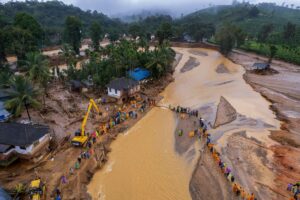
On the night of 3 October 2023, a ridge of frozen rock and other debris on the side of the South Lhonak glacier – called a “lateral moraine” – collapsed into the glacial lake. This set off a tsunami-like wave nearly 20 metres high that breached the front of the lake, sending 50m cubic metres of water – almost half the lake’s volume – downstream.
According to the study, the GLOF’s peak discharge “vastly exceeds” the magnitude of any meteorological flood in the region’s history, equivalent to a “rare” one-in-200-year event.
Dr Ashim Sattar, a glaciologist at the Indian Institute of Technology, Bhubaneswar and the lead author of the study, tells Carbon Brief the sheer scale of impact is not always evident in satellite images. He explains:
“Here, 270m cubic metres of sediment was eroded, enough to fill 108,000 Olympic swimming pools. The South Lhonak Lake itself is 2.2km long. Just walking around it will make you sweat.”
Two hours later, the GLOF and huge volumes of eroded sediment reached the village of Chungthang 35km away, destroying the 1,200MW Teesta-III hydropower project on impact and damaging four other dams downstream.
Exclusive visuals from completely damaged Chungthang Dam in Sikkim
Received from Pokhraj Rai Ji pic.twitter.com/x9gFxs1PC6
— Weatherman Shubham (@shubhamtorres09) October 12, 2023
As the GLOF travelled, it set off 45 secondary landslides, many of them deep-seated and up to 150 metres in depth, with impacts not just in Sikkim, but also in neighbouring West Bengal and Bangladesh.
In all, the flood cascade damaged 25,900 buildings, 31 major bridges and flooded 276km2 of agricultural land. The most heavily inundated zone was in Bangladesh 300km away, where intense cyclonic rainfall – initially attributed as a main GLOF driver – exacerbated flooding.
The figure below, taken from the study, shows before-and-after images and illustrations of the moraine collapse and the flood’s path from Sikkim to Bangladesh, where floodwaters finally discharged into the Brahmaputra river.

Dr Jakob Steiner, a geoscientist at the University of Graz and a member of the Himalayan University Consortium, who was not involved in the study, says the assessment captures the “cascading” impacts of GLOFs and their interaction with other complex, climatic factors in great detail. He tells Carbon Brief:
“Even if the glacial lake is relatively small, it can trigger other movements downstream and that can have far-reaching consequences, even for hydropower plants miles away from any lakes. So the message [of the study] is that you’re not safe anywhere and, hopefully, that’s a message that policymakers will get. Institutionally, however, we are not yet prepared to receive that kind of message.”
What caused the flood?
To study such a complex and multifaceted event, researchers combined satellite imagery, meteorological data, field observations and numerical modeling.
Study lead Sattar tells Carbon Brief that “capturing this entire process into one model is very tricky and complex”.
Throughout the paper, the authors emphasise the “multi-hazard” nature of the disaster, explaining that multiple short- and long-term changes in the climate and terrain converged to create the conditions needed for the event.
However, Sattar tells Carbon Brief that the “main driver” of the GLOF was the long-term impact of rising temperatures on permafrost – the perennially frozen ground that makes up much of the mountain’s slope.
According to the authors, decades of rising temperatures have led to permafrost thaw, which caused “extensive, rapid deformation” of the slope for years preceding the collapse. The paper estimates that permafrost warming has reached a depth of 100 metres below the surface of the soil.
The study also identifies the expansion of the South Lhonak lake as an important driver. The authors find that the South Lhonak glacier, which sits above the lake, has been melting for decades. Meltwater from the glacier flows directly into the lake, which has been gradually filling up.
The charts below show the annual mass balance of the glacier (left) – where a negative number indicates a shrinking glacier – and the increasing area of the lake (right) between 1951 and 2023.

The research finds that the lake has been expanding by 0.32km2 per year over 1975-2023. It notes there has been a “doubling” in the rate of expansion over the past two decades.
The authors suggest that rising temperatures are responsible for the glacier losing mass, as the annual average temperature in the region has been increasing by 0.08C per decade since the 1950s.
The long-term permafrost thaw and growth of the lake means that, by October 2023, the region was in a state of “increased sensitivity” to a multi-hazard cascade, the paper says.
The authors say the final “trigger” was the intense rainfall that hit Sikkim on 3-4 October. Though the rainfall was “typical” for the region and season, the authors say that it “saturated the soil and increased the vulnerability of slopes to failure”.
Dr Stephan Harrison – a researcher from the University of Exeter – tells Carbon Brief that the study is “very significant” and is “written by some of the leading scientists in the field”.
Dr Miriam Jackson is the programme coordinator for the cryosphere initiative at the International Centre for Integrated Mountain Development, and was not involved in the study. She echoes Harrison’s praise, but warns about the “lack of good data” in the region for these sorts of studies. She says:
“We desperately need more data on the status of glaciers and glacial lakes, more meteorology measurements at high elevation and more data on the status of frozen ground in the Hindu Kush Himalaya.”
Harrison and Jackson gave conflicting answers about whether GLOFs are increasing or decreasing globally. However, both pointed to the lack of data on GLOFs, noting that datasets are incomplete or unavailable in many regions and emphasised the need to get better records before definitive answers can be drawn.
Hydropower rush
The Sikkim GLOF event joins a chain of recent disasters in high-mountain Asia that have destroyed hydropower plants. Given the sheer “physical magnitude” of these events and their impacts, the study highlights “potential limits to adaptation” in the Himalaya, warning that “even the most diligent and comprehensive suite of disaster risk reduction strategies [is] unlikely to entirely prevent” loss and damage.
The study draws attention to a “surge” of hydropower development in the Himalayan region near glacial lakes, which it attributes to a rising demand for “stable and renewable energy”.
With more than 650 projects planned or under construction in high-mountain Asia, it warns that many dams are “moving closer to these hazard-prone areas” and this could “exacerbate” GLOF impacts. The Teesta basin, for instance, hosts the highest density of hydropower projects in the Himalayan region, with 47 dams planned, including the reconstruction of the Teesta-III project.

While dams themselves are “susceptible” to a wide array of high-mountain hazards, they also increase the exposure of communities, workers and infrastructure investments to a “greater likelihood” of GLOFs in the future, according to the paper.
Comprehensive risk assessments, stringent building standards, regulating land use and regional cooperation among river-sharing countries are among the measures suggested by the study to reduce GLOF risks.
Sattar says governments “can make a start” by developing “basin-scale” early-warning systems. However, he cautions that structural measures such as draining glacial lakes “are easy to say, but difficult to do” in harsh terrain.
Meanwhile, geoscientist Steiner says it is critical that the key role played by infrastructure development in damage caused by GLOFs is not downplayed – noting that a failure to do so risks “absolv[ing] local institutions of their responsibility”. He concludes:
“As scientists, we find it important to show that climate change is involved, but we have to be aware that the science we create is very, very political… [A] big part of the disaster is not climate change; it’s institutional failures, it’s infrastructural failures.
“If nobody takes the responsibility and everyone just says: ‘it’s my neighbour and not me’, then we are truly in deep shit. Maybe we already are.”

The post ‘Catastrophic’ 2023 lake outburst in India driven by glacial melt and permafrost thaw appeared first on Carbon Brief.
‘Catastrophic’ 2023 lake outburst in India driven by glacial melt and permafrost thaw

Three countries have been named by the Paris Agreement’s compliance committee for failing to submit a nationally determined contribution (NDC) and repeatedly snubbing offers of help with their climate plans.
After months of internal debate over whether to identify serial non-responders, the Paris Agreement’s Implementation and Compliance Committee (PAICC) named the three countries which have failed to engage with it over their NDCs on Friday.
It named Democratic Republic of Congo, Senegal and North Korea in a footnote of its annual report, adding that it decided to name them “with a view to facilitating engagement”, adding that representatives of the three nations had been invited to its meeting in early 2027 “with the purpose of identifying any challenges and constraints”.
“The Committee noted the importance of Parties engaging with the Committee in a timely manner, while noting that some delays may be due to the national capabilities and circumstances of the Parties”, the report said.
-
Under US pressure, World Bank says it will back gas “where appropriate”
The US wants the World Bank to expand its gas support while climate campaigners are pushing for it to end – its head spoke this week of limited backing for the fossil fuel -
IPCC scientists vow to press on with climate reports despite political deadlock
After governments again failed to agree a timeline, nearly 120 IPCC authors pledged to complete their assessment on time and with full scientific rigour -
Paris Agreement committee snubbed over missing NDC climate plans
Many governments have still not submitted a nationally determined contribution to the UN, breaching a key requirement of the Paris Agreement



In July, PAICC said 12 countries had ignored its repeated attempts to discuss why they had not published an NDC as required every five years under the 2015 Paris accord.
Members of the committee had been divided over whether to name them, but at a September meeting decided to do so in their annual report to the annual climate COP summit.
By the time the report was published on Friday, only Congo, Senegal and North Korea “had not communicated an NDC or submitted a [Biennial Transparency Report] and had not yet responded to any of the Committee’s notifications, despite several reminders issued by the Committee in this regard”.
Rainforest and renewable energy ambitions
The silence from Congo and Senegal is notable because the former is home to much of the Congo Basin rainforest while the latter has sought billions of dollars in climate finance to support its renewable energy ambitions.
After Brazil, Congo has more rainforest than any country in the world. This forest, and the country’s peatlands, absorb huge amounts of greenhouse gas but are fast being lost to expanding farmland, charcoal production, logging and mining.
Senegal signed a Just Energy Transition Partnership with Canada and wealthy European nations in 2023, to help it meet its renewable energy targets under the-then government of Macky Sall. It was chair of the Least Developed Countries group between January 2022 and December 2023.

Tejas Rao, who is researching the PAICC as part of a doctoral thesis at Cambridge University, said the governments of the three countries should engage with the committee.
“Engagement costs these governments very little and the committee has shown it will listen,” he said.
“Silence leaves the committee with no basis to help, and it leaves the [governments] exposed to the narrative that they are simply disengaged,” he told Climate Home News.
Paris Agreement requirement
The 2015 Paris Agreement requires all parties to publish an NDC every five years outlining their emissions reduction targets, with each plan meant to be more ambitious than the country’s last NDC.
The latest set – the third round of plans, with new targets for 2035 – was due in February 2025. While most countries missed this deadline, all but around 30 – mostly small emitters but including Egypt, Vietnam and Argentina – have now submitted them.
Over the year, the PAICC – which is made up of government climate officials from developed and developing countries – has been communicating with governments that have not submitted NDCs and trying to overcome barriers to them doing so.
Some nations have cited exceptional circumstances as the reason for not submitting an NDC, a process that requires a significant amount of work in tracking emissions and consulting on how to curb them across the economy. For example, a letter from a Sudanese official to the PAICC, seen by Climate Home News, said that the country’s civil war had led to the suspension of its NDC preparation.
-
IPCC scientists vow to press on with climate reports despite political deadlock
After governments again failed to agree a timeline, nearly 120 IPCC authors pledged to complete their assessment on time and with full scientific rigour -
Under US pressure, World Bank says it will back gas “where appropriate”
The US wants the World Bank to expand its gas support while climate campaigners are pushing for it to end – its head spoke this week of limited backing for the fossil fuel -
Who shapes climate science? The equity question facing the IPCC
Early completion of the next global climate science assessment reports risks excluding research from the Global South, which is key to ensuring the findings are fair
The US and Iran are not signed up to the Paris Agreement and so do not have active NDCs, nor does Taiwan, which is not a UN member state.
Rao said that because the PAICC is “facilitative and non-punitive”, naming the countries “is meant to open a door, not close one – the invited consultation is the point”.
“In recent months, governments that explained their constraints, whether capacity, finance or domestic process, have been met with follow-up and support rather than sanction, and the number of silent governments has fallen sharply,” Rao said.
The post Paris Agreement committee names three countries snubbing it over NDCs appeared first on Climate Home News.
Paris Agreement committee names three countries snubbing it over NDCs