

On 28 April, Canadians will go to the polls to vote for the next prime minister.
The election comes after Justin Trudeau stepped down as leader of the Liberal Party of Canada in January following nine years leading the party as prime minister.
Trudeau cited “internal battles” within the party for the decision, and stated that Canada “deserves a real choice in the next election”.
His successor Mark Carney – the former governor of the Bank of England and the Bank of Canada – called for a snap election on 23 March, just a week after being elected Liberal party leader and, thus, becoming prime minister.
Carney is facing a stiff challenge from Conservative leader Pierre Poilievre, whose party was leading in the national polls from 2023 till the beginning of 2025.
However, the campaigning has occurred under the shadow of US president Donald Trump’s tariffs, with 25% taxes placed on Canada’s steel, aluminium and vehicles exports.
The US president’s tariffs and calls to make Canada the “51st state” have contributed to a late surge of support for the Liberals, according to multiple polls.
Carbon Brief analysis finds that a Conservative victory over the Liberals could lead to nearly 800m extra tonnes of greenhouse gas emissions over the next decade.
In the interactive grid below, Carbon Brief tracks the commitments made by major political parties in their latest election manifestos. The grid covers a range of issues connected to nature, energy and climate change.
The parties covered are:
- The Liberal Party of Canada, the centrist party which has been in power since 2015.
- The Conservative Party of Canada, the right-leaning party which has traditionally been the other dominant party in the nation’s politics.
- The New Democratic Party (NDP), a left-leaning social-democrat party, which won more than 17% of the popular vote in the last election and 24 seats (out of a total of 338).
- The Bloc Québécois, a nationalist, centre-left party that advocates for Quebec sovereignty. In 2021, it won the popular vote in 32 of Quebec’s 78 electoral districts.
- The Green Party of Canada, a left-leaning, environment-focused party which currently has two sitting MPs.
Each entry in the grid represents a direct quote from one or more of these documents. The grid will be updated as each party publishes their manifesto.
Net-zero and climate framing
Climate and energy issues have dropped down the election agenda in Canada.
In a poll of 2,000 adults in late March, just 5% of Canadians said that climate issues would most influence their vote.
More than a third cited the “cost of living” as the top issue influencing their vote, while 19% chose Trump’s impact on Canada. Other key issues singled out by respondents were healthcare, housing, jobs, taxes and government spending.
Trump’s election and subsequent tariff announcements have had a dramatic effect on polling ahead of the election, as seen below which highlights the extreme change in probability of each party winning enough seats to form the next government.
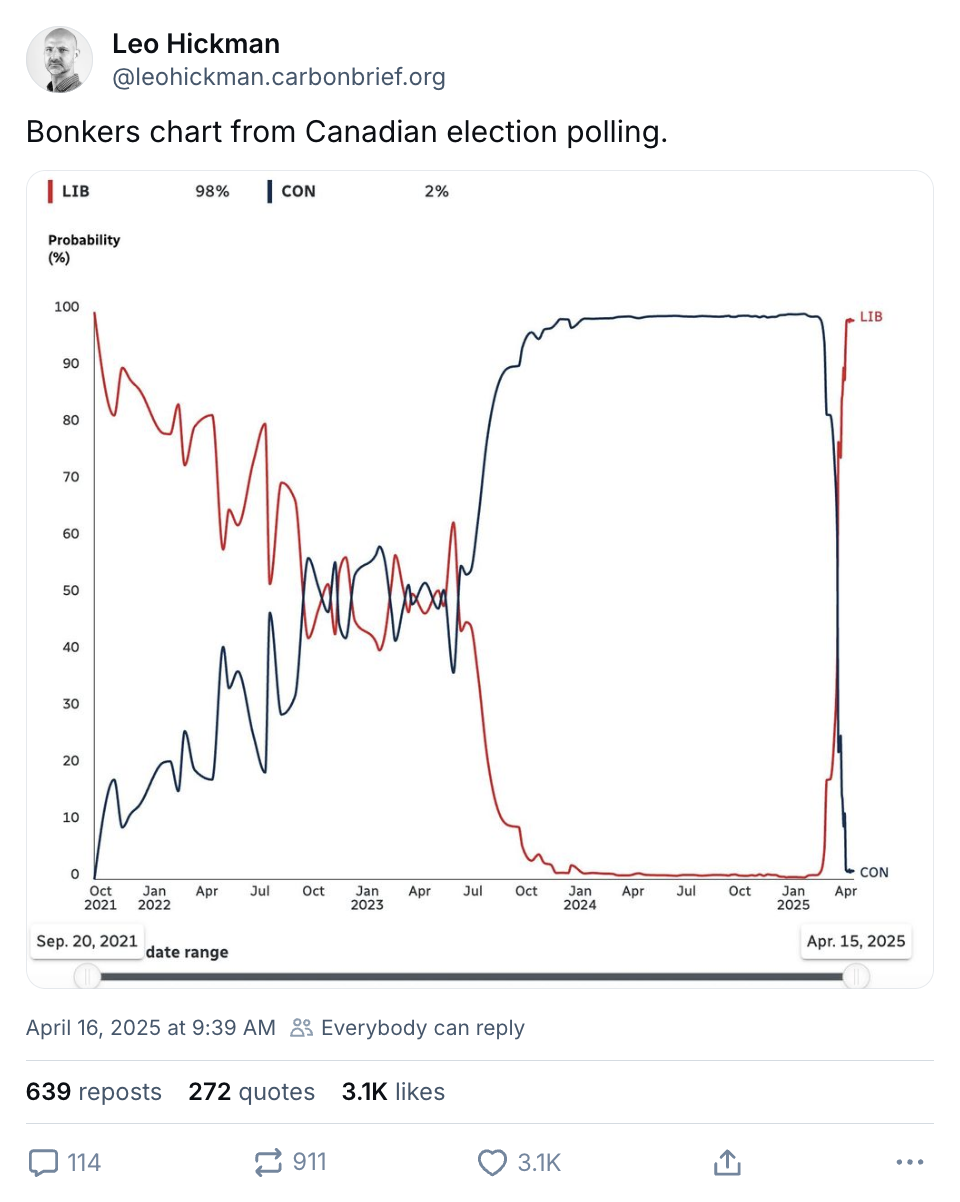
Nevertheless, despite slipping down the priority list for many voters, there are a number of climate and energy issues on the ballot, including the future of the oil and gas industry, electricity grid infrastructure, wildfire protection and the rollout of electric vehicles and “green home” retrofits
In the last general election, held in 2021, all major parties committed to pursuing the 2050 net-zero target, signed into law that year by the ruling Liberal party.
Four years later, that consensus appears to be under strain.
Conservative leader Poilievre has distanced himself from Canada’s net-zero target at rallies, telling supporters the Liberals’ “radical net-zero environmental extremism” has driven investment away from Canada. He has also said that the “radical net-zero movement” means “net-zero growth, net-zero jobs, net-zero paycheque”.
As part of plans to make Canada a “leading energy superpower”, Carney has said his party will “aggressively develop projects that are in the national interest” guided by three objectives: energy security; trade diversification; and long-term competitiveness. In a TV debate, he said he will support production of “low-risk” and “low-emission” oil.
The Liberals have said they will support the construction of an “east-west” electricity grid, which could carry electricity from the hydropower-rich provinces of Quebec, Manitoba and British Columbia to provinces reliant on fossil fuels for electricity generation.
(This is no small feat as electricity falls under provincial jurisdiction and regional systems vary widely. Some provinces have a fully deregulated electricity market, whereas, in others, electricity is produced and sold by “crown corporations” owned by the provincial government.)
The US’ trade war on Canada has also reignited debates around fossil-fuel pipelines, amid widely reported polling which suggests an uptick in support for new oil-and-gas transportation projects.
(Supporters claim pipelines can reduce the oil-and-gas sector’s reliance on the US, by opening up new export opportunities from eastern ports and reducing the flow of oil which travels from western to eastern Canada via pipelines in the US).
Carney has said the Liberals are open to new oil-and-gas pipelines – but only with the support of the provinces and First Nations.
The Conservatives have said they will support pipelines that would transport oil and gas to eastern Canada. (Previous attempts to get west-east pipelines off the ground – including the Energy East crude oil project and the LNG Quebec scheme – have failed amid fierce opposition focused on economic and environmental concerns.)
To fast-track approval of oil-and-gas production and pipelines, Poilievre has said he will repeal a key federal environmental assessment law – bill C-69.
The NDP opposes the Energy East and LNG Quebec projects specifically, but has said it will not rule out pipelines altogether. However, the left-leaning party has said an east-west electricity grid is its “first priority” for growing the energy market.
The Greens, the NDP and Bloc Québécois have pledged to eliminate tax breaks for oil-and-gas companies and redirect funds towards efforts to tackle or adapt to climate change.
Specifically, the Greens say they would invest freed-up funds in clean energy, the NDP on energy-saving retrofits in homes and the Bloc Québécois on climate adaptation measures.
The Liberals have committed to reinstating a zero-emission vehicle subsidy programme paused earlier this year.
Parties have also put forward plans to boost the country’s preparedness to climate change and, in particular, to wildfires. The Liberals have pledged investment, additional training and modern firefighting equipment for the national parks service’s wildfire response teams.
The Greens, on the other hand, are advocating for the launch of a national civil defence corps – a civilian-led national service dedicated to building Canada’s resilience and preparedness for emergencies.
Trade and tariffs
US president Trump’s tariffs and the ensuing trade war have “dominated” the messaging within the campaigns and “transformed the dynamics of the race”.
On 1 February, Trump signed an executive order imposing 25% tariffs on nearly all goods from Canada and Mexico, claiming this was in response to fentanyl smuggling and illegal immigration.
Following this, there have been months of back-and-forth on the tariffs and their levels, with numerous pauses and steps by Canada to retaliate. This included a threat to place a 10% tariff on oil-and-gas exports to the US.
This includes then-prime minister Trudeau announcing tariffs of 25% on C$155bn of US goods, a move welcomed by government-funded policy research organisation the Canadian Climate Institute. In a statement, the institute’s president Rick Smith said:
“The Canadian Climate Institute is in full support of efforts taken by the federal and provincial governments to retaliate against the unprovoked and illegal tariffs imposed by the United States on Canada.”
In March, Trump suspended many of the tariffs, but imposed 25% on steel and aluminium.
Following this, Ontario announced its own tariffs, including a 25% surcharge on electricity exported to Michigan, Minnesota and New York.
Trump dubbed this an “abusive threat from Canada”, threatening to double tariffs on the country’s steel and aluminium. Ultimately, both sides backed down.
There is an asymmetry in economic dependence between the two countries that leaves Canada particularly exposed to the trade war.
In 2023, nearly 77% of Canada’s overall exports were to the US, of which energy products and vehicles were the largest categories, representing 40%. The US accounted for 97% of Canada’s C$124bn of oil exports that year, as well as 45% of its gas, according to government figures.
Meanwhile, Canada only accounts for 14% of US goods exports, ensuring “Canada suffers disproportionately in economic confrontations”, notes Forbes.
Speaking at the beginning of April, Carney said that the tariffs on Canada would “directly affect millions”.
The effect of the tariffs will particularly hit those in the automotive industry. A recent article in Bloomberg suggested that the tariffs threaten to “throw a wrench into the prospects for decarbonising both economies”.
It highlights that Canada is a “world leader” in lower-carbon aluminium and has been building up its electric vehicle (EV) sector. As such, the impact of 25% tariffs on the automotive sector could hamper the transition to EVs.
Additionally, the renewable-energy sector is particularly reliant on cross-border supply chains, leaving it vulnerable to the disruption created by the tariffs and ensuing trade war.
All of the major parties have responded within their campaigns. The Liberal party is planning to match the 25% tariffs on vehicles, along with investing C$5bn into a “trade diversification corridor fund”.
The Conservatives, meanwhile, have said they will not remove the counter tariffs until the US removes all of its tariffs on Canada. They would put almost all of the collected tariffs into tax relief for the workers hit by them.
Elsewhere, the NDP is in favour of the retaliatory tariffs and has threatened to impose a 100% tariff on Tesla products, if Trump moves to apply a tariff to all Canadian goods. Bloc Québécois has called for a pandemic-style wage subsidy to support workers impacted by the tariffs.
The Green party would work with other democracies to pursue joint retaliatory economic measures.
Canada’s carbon tax
An early point of contention within the Canadian election has been the so-called “carbon tax”.
The “pan-Canadian climate framework” was brought in in 2018 and is modelled on the “groundbreaking” carbon-pricing system introduced in British Columbia in 2008.
It places a surcharge on carbon-based fuels and other sources of greenhouse gas emissions. The system has two parts, one for consumers and one for industry, with different rates applied to either.
A key element of the carbon tax is that it is revenue-neutral, with the government paying back any money raised to the taxpayer in the form of rebates.
Despite the criticism levied against it, between 60-70% of non-Conservative leaning voters continue to support the concept of carbon pricing, according to a poll in February.
The carbon tax has previously been “heralded as a cornerstone of the country’s strategy to tackle climate change”, but, amid the cost-of-living crisis, in recent years it has increasingly come under fire.
Throughout 2024, Poilievre sought to position the tax as a key point of difference between his party and the Liberals, arguing that Trudeau must “call a ‘carbon-tax’ election”.
In a statement made in March, Poilievre argued that the tax would combine with the tariffs imposed by the US government, leaving “Trump grinning from ear to ear”. He added:
“We will take the carbon tax off your gas, heat and food. But we will also axe the tax on Canadian steel, aluminum, natural gas, food production, concrete and all other industries. We will be strong, self-reliant and sovereign, standing on our own feet and standing up to the Americans.”
Following Carney’s election as Liberal party leader, one of his first actions was to cut the carbon tax rate to zero for consumers, effectively ending it.
Speaking on his first day in office, Carney said:
“This will make a difference to hard-pressed Canadians, but it is part of a much bigger set of measures that this government is taking to ensure that we fight against climate change, that our companies are competitive and the country moves forward.”
The industrial carbon tax still stands, however, and has drawn increasing focus within the election campaigns.
In March, Poilievre pledged to “completely eliminate the carbon tax” while speaking from a steel mill in eastern Ontario.
(The steel mill had received more than C$3.5m from the carbon-tax scheme, helping it to replace its old gas furnace and consequently reducing its emissions by 17%.)
Carney has promised to bolster the industrial carbon tax, noting that it will be necessary for trade with Europe and other countries in the future.
The NDP has said it will keep the industrial carbon price. Bloc Québécois did not comment on the federal carbon tax explicitly, but has said it will “advocate for carbon pricing across Canada”.
Analysis from the Canadian Climate Institute found that “large-emitter trading systems” – a group which includes the industrial carbon tax, as well as Quebec’s cap-and-trade emissions pricing system – are on track to be the single biggest driver of cuts to Canada’s emissions by 2030, contributing 20-48% of anticipated reductions.
The post Canada election 2025: What the manifestos say on nature, energy and climate appeared first on Carbon Brief.
Canada election 2025: What the manifestos say on nature, energy and climate

Next week, diplomats from around the world will descend on Yerevan, Armenia, to negotiate a series of decisions under the UN Convention on Biological Diversity (CBD).
Between 19 and 30 October, 196 parties will gather to hammer out the precise wording of the dozens of legal texts that make up the decisions under the Conference of the Parties (COP) to the CBD.
This year’s summit is particularly significant, as it marks the halfway point between the agreement of the Kunming-Montreal Global Biodiversity Framework and the deadline for achieving its targets.
The CBD has found that countries are currently not on track to meet 22 out of the framework’s 23 targets.
During the fortnight, delegates will also be negotiating decisions relating to the two supplemental protocols to the CBD: the Cartagena Protocol, which covers biosafety; and the Nagoya Protocol, which covers access and benefit-sharing for the use of genetic resources.
(The Cartagena and Nagoya Protocols, which are each governed by a “meeting of the parties”, or “MOP”, have fewer parties than the CBD as a whole, with 173 and 141, respectively.)
Carbon Brief is tracking the progress of countries towards consensus on dozens of negotiating texts using the interactive table below.
The tracker includes texts from the COP, as well as the MOPs for the Cartagena and Nagoya protocols. It also includes draft decisions from the most recent subsidiary body meetings, as these form the starting point for the negotiations in Yerevan.
The CBD has three subsidiary bodies: the subsidiary body on scientific, technical and technological advice (SBSTTA), the subsidiary body on implementation (SBI) and the subsidiary body on article 8(j) and other provisions (SB8J).
SB8J focuses on issues related to the Indigenous peoples and local communities. It was established at COP16 in Cali, Colombia, in 2024.
The first two columns of the interactive tracker list the topic of each agenda item and the relevant body, with subsequent columns including dates, page counts and links to the original documents.
The table is searchable and can be sorted using the arrows in the header.
Areas of disagreement in UN draft texts are denoted by square brackets. Counting the brackets in a particular iteration of a text therefore gives a sense of how far parties are from reaching consensus.
The bracket column is colour-coded, with dark green indicating a low number of brackets and red indicating a high number of brackets remaining.
Texts can also present parties with choices using “options” or alternatives (“alt”), which are counted together in the sixth column of the table.
The key discussions in Yerevan will centre around two agenda items in particular. The first is the global review, which will assess progress towards the GBF and make recommendations for accelerating action.
The second is finance, which can be separated into two parts: resource mobilisation and the financial mechanism. On resource mobilisation, biodiverse global south countries are likely to push for an increased amount of international finance for conservation.
Disagreement over the creation of the financial mechanism led to the suspension of COP16 in Cali in October 2024, as parties failed to find agreement on the mobilisation of finance before the end of the summit.
Global south countries want the establishment of a separate financial mechanism under the control of the CBD; global north countries largely prefer to maintain the existing mechanism, which sits under the Global Environment Facility.
At the resumed session of COP16 in Rome in early 2025, countries agreed on a roadmap that would lead to the establishment of a permanent mechanism.
related
Analysis: Lula presidency saved at least 20,000km2 of Brazilian Amazon since 2022
Why land-use emissions have fallen by a third this century – in six charts

Analysis: 84% of nations miss deadline to identify ‘nature-harming’ subsidies by 2025
UK withdraws millions in funding from world’s second-largest rainforest in Congo
The post Interactive: Tracking negotiating texts at the COP17 biodiversity summit appeared first on Carbon Brief.
Interactive: Tracking negotiating texts at the COP17 biodiversity summit
A beacon of love
On an outer island of Fiji, two thousand nautical miles from Sydney, is a shining light of hope and resilience for our troubled world.
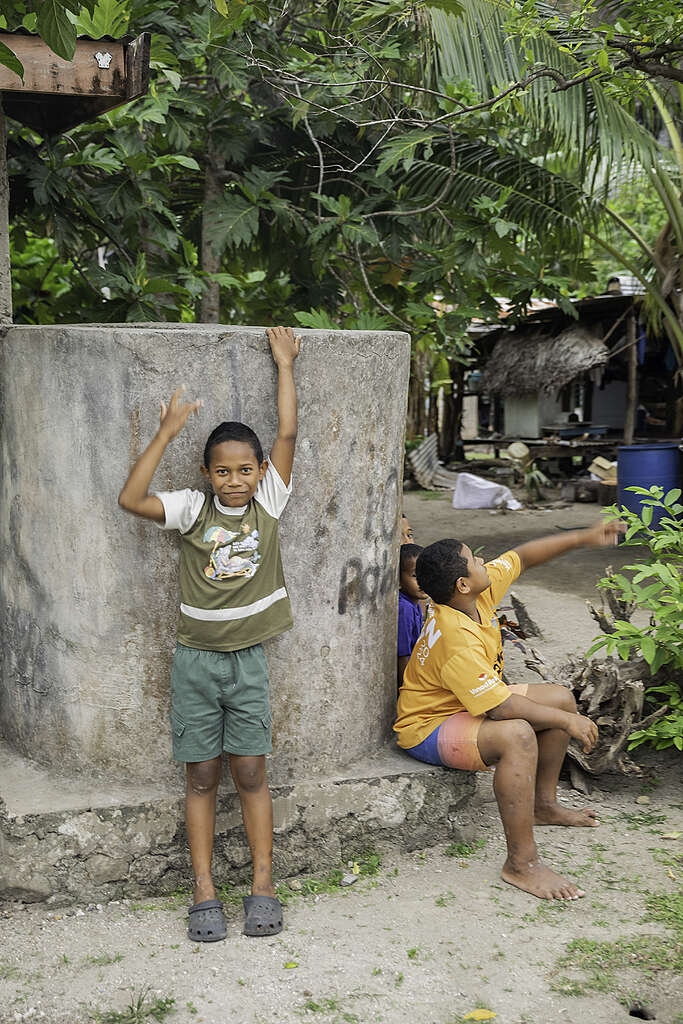
The island of Kioa is home to a Tuvaluan community who migrated from their atoll of Vaitupu in the late 1940s. It is a land of warm hearts, big smiles, and deep cultural roots; a place where the sound of a conch still summons the island together, where islanders paddle out to fish in carved outrigger canoes, and healthy happy children walk barefoot to school.
Here, culture is life. Kioans live sustainably through their traditional knowledge and practices. The island is alive with song, dance and the rhythms of a life tied to the tides, the winds, and the seasons.
Facing the future
Greenpeace has been lucky to have a relationship with Kioa for a number of years now, and we are continually learning from this remarkable community.
Last week, as part of our Voyaging Oceania project, we returned to the island. Our purpose was twofold —- to carry messages from the island to leaders gathering in Nadi this week for the Pacific Pre-COP, and to support the Kioa community in their efforts to improve water security for the island.
Unlike Tuvalu itself, with its eight atolls, Kioa is a mountainous, forested and richly fertile island. It will remain habitable far into the future. Kioans did not initially migrate from Vaitupu due to climate change, but the move was prophetic. They now have a lifeboat.
However, even Kioa faces challenges on our rapidly warming planet, in particular when it comes to water. Climate change is shifting once reliable rainfall patterns. On top of this, the island is already feeling the effect of this year’s intensifying El Niño event, which for Fiji means reduced rainfall and prolonged dry spells.
Right now, fresh water has to be carefully rationed, and is only available for a few hours a day. During last week’s visit aboard our campaigning ship Oceania, Greenpeace was privileged to work with the Kioa community on a new solar-powered water distribution project for the island.
Designed and led by the island, the project involves using a solar pump to move water from a reliable source to a storage tank and then using gravity to distribute the water around the village.
It was a lesson in how local knowledge and ingenuity can be the backbone of today’s climate solutions. To build a dam around the source, the local community knew the exact spot where they could gather gravel at low tide to mix with the cement. They took only what was needed, knowing that all resources must be carefully conserved. Kioa has no roads and no machinery, and it was an all-of-island effort to carry the materials up to the project site, including many heavy bags of sand and rock.
Such projects truly bring to life the vision of a resilient, locally-led, fossil fuel free Pacific.