

The UK is roughly halving the climate aid it allocates to developing countries, when accounting changes and inflation are factored in, according to new analysis by Carbon Brief.
On 19 March, the government announced that the UK would provide “around £6bn” of international “climate finance” over the next three years.
This replaces a previous goal to provide £11.6bn across the 2021-2026 period to help nations in the global south cut their emissions and deal with climate threats.
The new target was reported as a spending reduction of up to 14% compared to recent years, reflecting the UK’s wider plan to cut development aid and spend more on defence.
In fact, Carbon Brief analysis reveals that the cut is far larger in real terms, with the new target worth around 30% less per year once inflation is taken into account.
When also excluding the government’s use of widely criticised “creative accounting” to boost apparent spending, the new pledge is roughly 50% lower than the old one.
The drop in climate finance means that – alongside other major donors – the UK is diverging from an international target, agreed in 2024 at COP29 in Baku, to ramp up climate aid to $300bn a year by 2035.
‘Innovative reforms’
Under the Paris Agreement, the UK and other developed countries committed to provide financial support for climate action in developing countries. This “climate finance” comes from the UK’s wider budget for “official development assistance”.
Successive governments have pledged set amounts of climate finance over five-year periods, supporting everything from solar energy in Nigeria to mangroves in Indonesia.
In 2019, the Conservative government promised to “double” the previous target of £5.8bn for the financial years 2016-17 to 2020-21 and reach a total of £11.6bn between 2021-22 and 2025-26.
The current Labour government inherited this goal in 2024, at a time of geopolitical instability, conflict and threats to global climate action.
Alongside other developed countries, the UK then pledged at the COP29 climate summit in2024 to roughly triple the total amount of global climate finance to $300bn a year by 2035.
With its £11.6bn target expiring in April 2026, the government has been under pressure to set a new goal that would increase climate finance in line with this global ambition.
Instead, since COP29, the UK has announced it will cut overall aid spending to 0.3% of gross national income, compared to the historic 0.7%, to raise money for military spending.
This continues a trend of aid cuts started by the former Conservative government and mirrors similar cuts taking place in other countries. Most notably, the US has virtually eliminated its contribution to international climate finance.
In March, foreign secretary Yvette Cooper finally announced details of how the UK’s headline cuts in overseas aid would impact specific spending priorities between 2026-27 and 2028-29, including climate finance. She said:
“Over the next three years, the UK will spend around £6bn of official development assistance as international climate finance. We will balance support between mitigation and adaptation and maintain a focus on nature.”
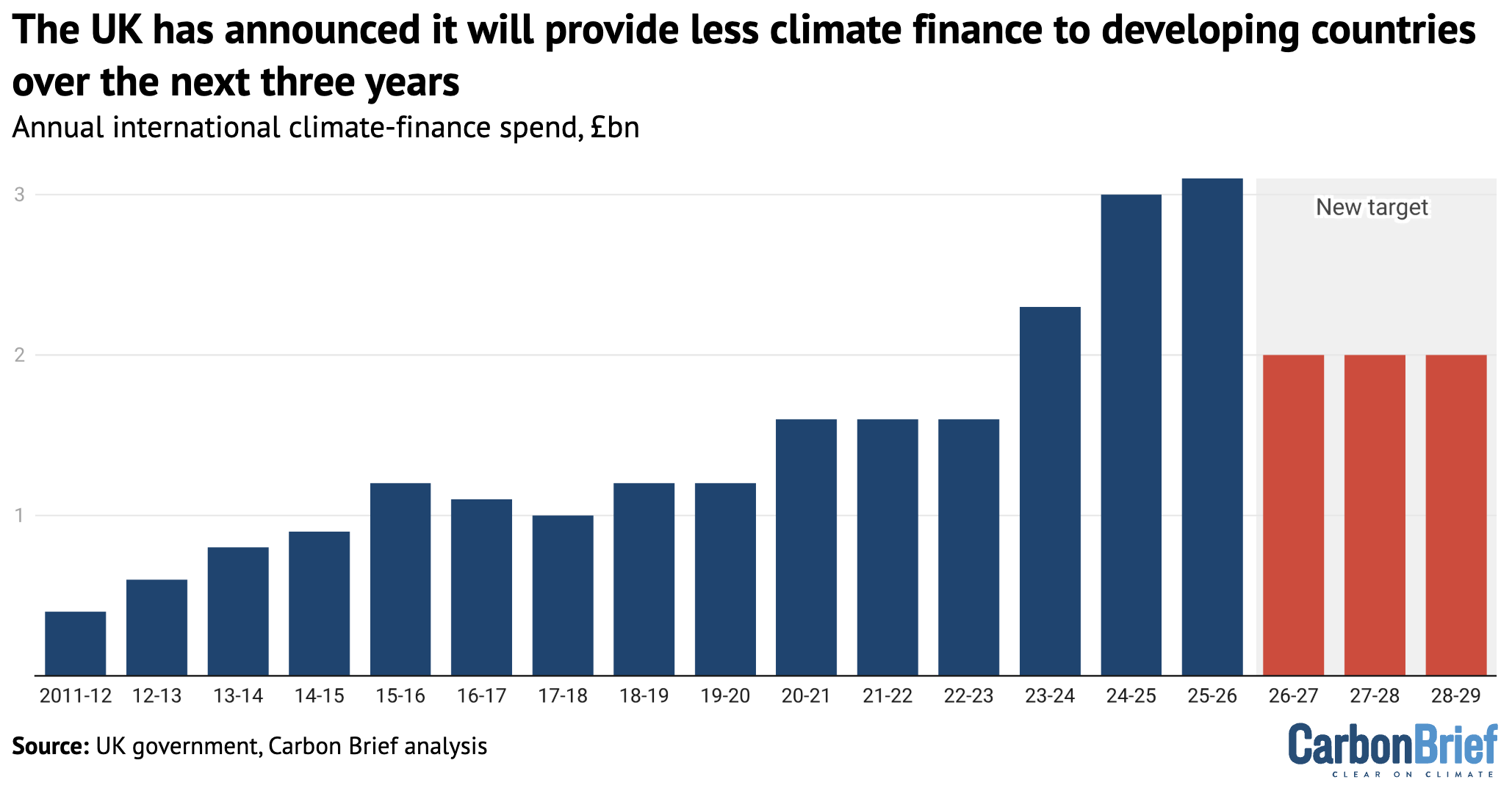
This amounts to a clear cut in annual climate-finance spending, even without considering the impact of inflation or accounting changes, as the chart below shows.
Despite Cooper’s pledge to “maintain a focus on nature”, the government also scrapped the “ring-fencing” of funds for nature and forest conservation, as well as the practice of setting five-year goals to provide more certainty to climate-aid recipients.
(The relatively vague “around” £6bn is also notable, given the previous targets were set at precisely £11.6bn and £5.8bn. This could allow the government to ultimately spend less than £6bn.)
The government is also clear that it is shifting its focus to using public development aid to “unlock private investment for development”, framing its overall approach as “innovative development reforms”. Cooper stated that, as well as the £6bn in climate finance:
“We will aim to generate an additional £6.7bn of UK-backed climate and nature positive investments and to mobilise billions more in private finance.”
Cooper described “climate and nature” as two of the government’s four “priority” themes for its dwindling aid spending.
Nevertheless, the international development committee of MPs expressed “deep concern” about the new climate pledge and NGOs called it a “backward step”.
Accounting changes
Media coverage of Cooper’s announcement stated that the new climate-finance target was 13-14% lower than the previous one.
This is based on the difference between average annual contributions out to 2029 under the new pledge – around £2bn – and the £2.3bn average from the previous period.
However, Carbon Brief analysis suggests that this straightforward approach makes the target seem more ambitious than it actually is.
When the £11.6bn target was set in 2019, only specific, climate-related projects funded directly by the UK government counted towards it. Then, in 2023, the Conservative government decided to loosen the criteria for the funds it counted towards the target.
This included relabelling existing support for multilateral development banks (MDBs), humanitarian aid and more private-sector investments as “climate finance”.
This approach – which mirrors that of other climate-finance donors – means the government is now on track to hit the £11.6bn target. (For more details, see Carbon Brief’s previous coverage.)
NGOs criticised this “creative accounting” at the time. Similarly, the UK’s official aid watchdog described the changes as “moving the goalposts”, as they meant the government could meet its target without providing as much new money. Nevertheless, the current Labour government has retained the changes.
The government released a list of specific aid allocations alongside Cooper’s recent announcement, which includes how much it plans to give to MDBs, as well as the UK-owned development body, British International Investment (BII).
Most of this money would not have been counted as climate finance under the old accounting system. Under the new system, a large portion of it will be.
Carbon Brief estimates that £1.7bn of new climate finance over the next three years – roughly 28% of the total – would not have counted as climate finance before the government’s accounting changes.
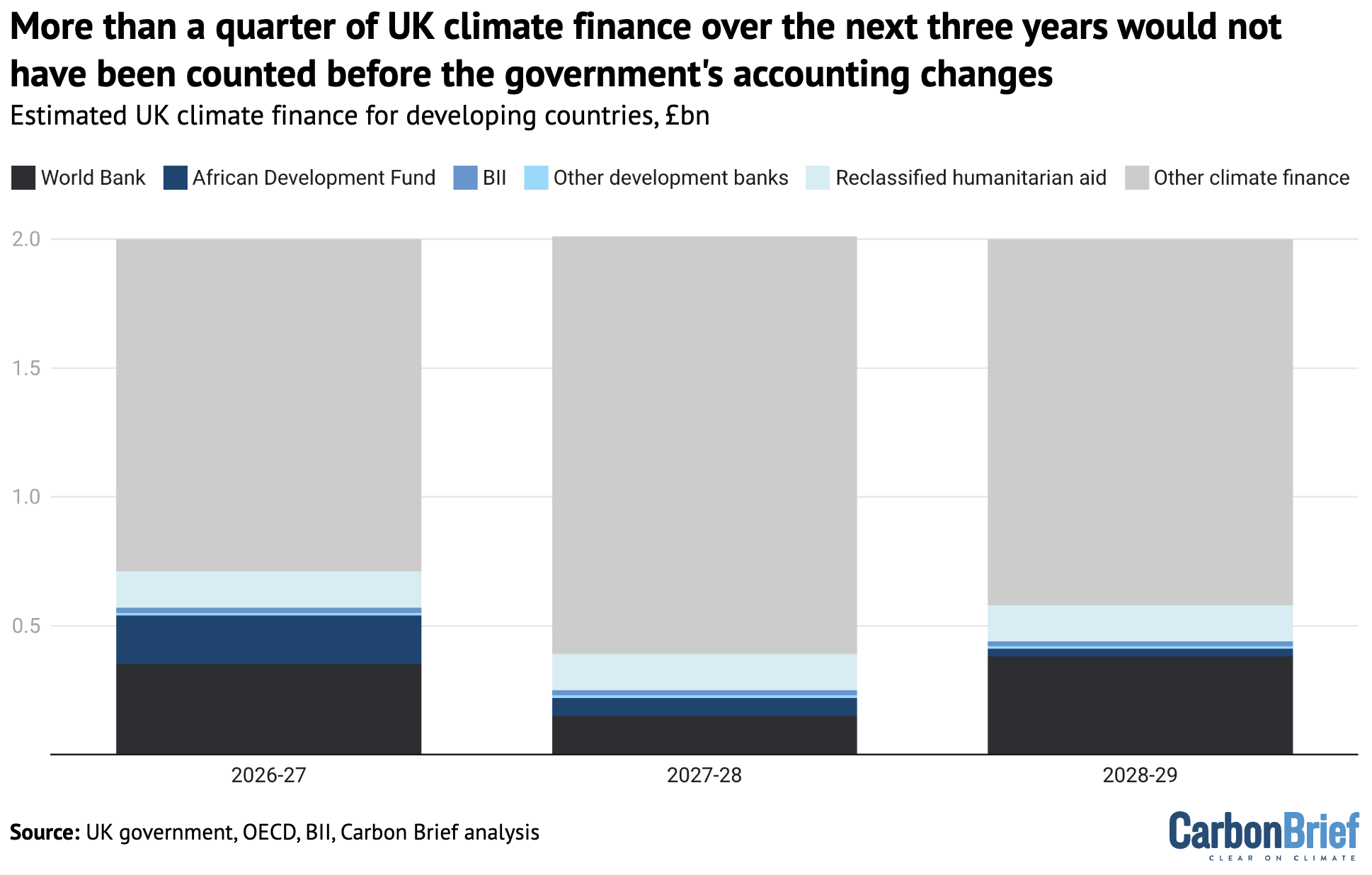
As the chart above shows, much of the money reclassified as climate aid will derive from automatically counting a fixed share of UK funding for MDBs as “climate-relevant”.
MDBs, including the World Bank and the African Development Bank, are major contributors to global climate finance. Member states, such as the UK, pay money into these banks, which then use their financial resources to support development projects.
Notably, while virtually all of the UK’s traditional climate finance has been provided as grants to developing countries, MDBs provide most of their support as loans. The prevalence of loans in global climate finance is a long-standing point of contention for developing countries.
Including inflation
The second key factor that influences the comparison between the UK’s old and new climate-finance targets is inflation. Experts have highlighted the importance of correcting for inflation when considering long-term finance targets.
This issue is particularly important now, as in recent years there has been significant inflation in the UK and around the world. This means the finance that the UK committed to give back in 2019 would not go as far today as it did then.
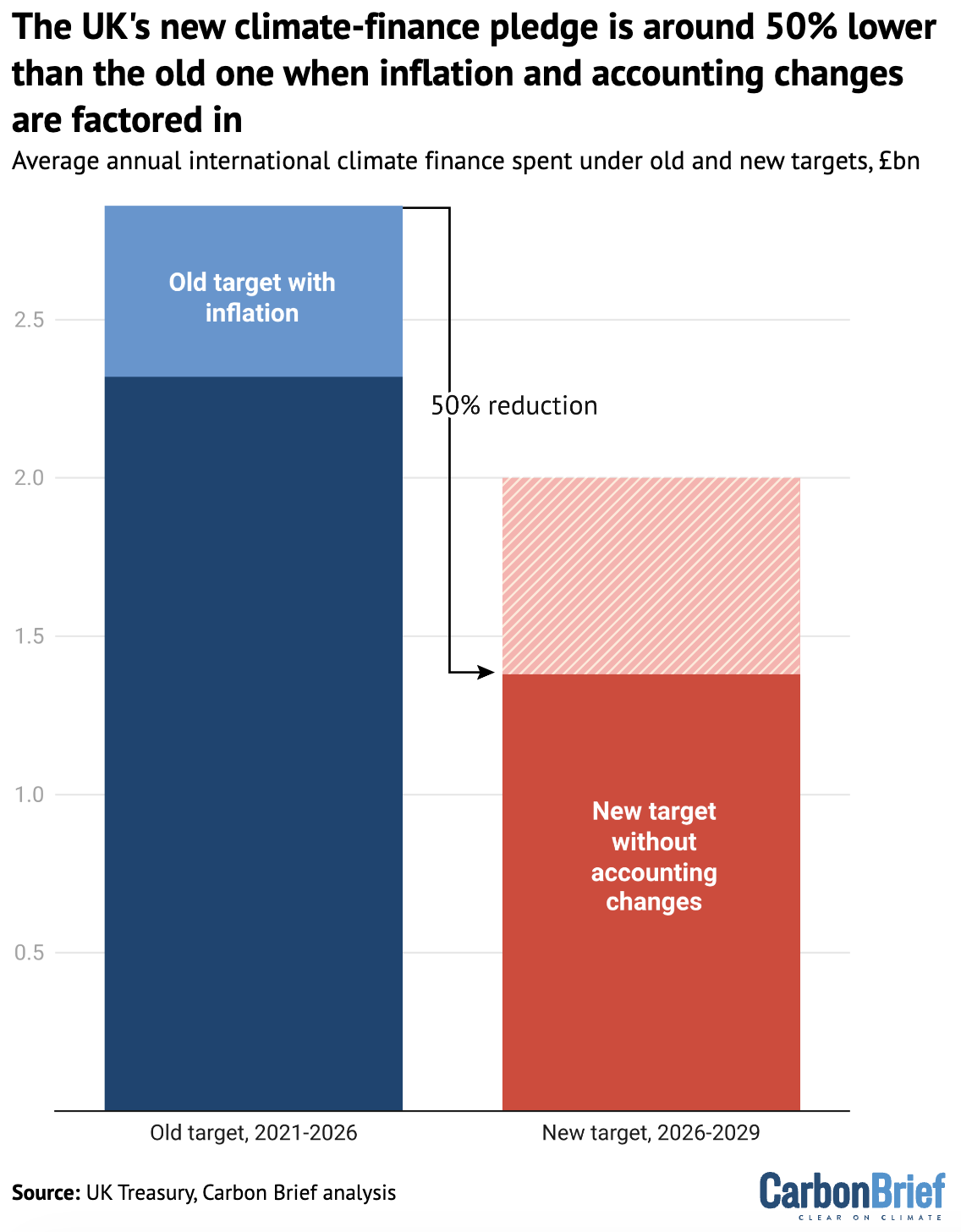
Adjusting for this inflation, Carbon Brief estimates that the £11.6bn target would equate to £14.3bn today, using 2021-22 – the start of the £11.6bn target – as the base year.
This means the government would have to pledge £14.3bn over five years – or £2.86bn a year – just to match the spending power of its previous goal. This new goal of £2bn a year is effectively a 30% real-terms cut in annual climate finance from the UK.
As the chart below shows, the previous climate target from five years ago is roughly twice as large per year as the new 2026 target, after correcting for inflation and once accounting changes have been removed.
Of course, ultimately, the government relied on accounting changes to meet the previous £11.6bn target as well.
Nevertheless, this comparison shows the significant backsliding in ambition, from 2021 when the plan was an £11.6bn goal, relying on a narrow range of sources – to a 2026 target that is lower in real terms, while drawing from a wider range of sources.
Global cuts
In 2024, developed countries such as the UK collectively agreed to raise their global climate-finance contributions to $300bn a year by 2035, as part of their Paris Agreement obligations.
This international target replaced the previous goal of $100bn per year by 2020, which was belatedly met in 2022.
While the new target will include large contributions from the private sector and MDBs, there is an expectation that a significant portion of it will still come directly from developed countries.
In this context, it is clear that the trajectory of UK climate finance is going in the wrong direction – falling, rather than increasing
The UK is certainly not alone in this regard. Speaking in parliament, Cooper told MPs that “allies such as Germany, France and Sweden have made similar choices” to cut aid in order to fund military spending.
Very few developed countries – and none of the biggest donors – have officially announced new or updated climate-finance targets for the coming years.
However, analysis by aid organisation CARE International last year concluded that other major climate-finance donors, including Germany and France, will also see their climate finance fall over the coming year, following cuts to their aid budgets.
The most significant drop has come from the US, which has effectively cut its international climate finance from several billion dollars a year to zero, under the Trump administration.
In addition to cutting its overall contribution, the UK is signalling that it will focus less on grant-based climate finance from government spending and more on “unlocking” billions of pounds in private-sector finance for climate action, as well as on “reform of the international development system”.
Such approaches may end up playing a major role in nations hitting the $300bn target by 2035.
However, this is highly contentious, with many developing countries arguing at UN negotiations that developed countries are reneging on their responsibilities to directly “provide” climate finance.
Methodology
The UK has announced that it will spend “around £6bn” on international climate finance between 2026-27 and 2028-29. Alongside this announcement, it released a list of “official development assistance (ODA) programme allocations 2026-27-2028-29”. These include details of “planned multilateral ODA programming” – covering MDBs – and spending on “arm’s-length bodies, private sector investments, subscriptions”, including BII.
Carbon Brief calculated the climate-related shares of core MDB finance – which the UK now counts as climate finance – using the climate shares for each MDB identified by the Organisation for Economic Co-operation and Development (OECD) in 2023. These estimates may be conservative, as MDBs have committed to increasing the shares of their projects that are climate-related.
Carbon Brief calculated the extra BII contributions that the UK will count as climate finance by assuming, based on the most recent BII annual accounts, that 41% of its commitments each year will be climate-related. Previously, only 30% of BII contributions were counted as climate finance, so Carbon Brief assumed the difference between these shares would be additional.
The government has also said it now automatically counts 30% of all humanitarian assistance provided to the 10% most climate-vulnerable countries as climate finance. Based on figures provided to Carbon Brief via freedom of information request, this amounts to roughly 10% of all humanitarian assistance in recent years. The government has said it will “spend approximately £1.4bn each year in the places with the highest humanitarian need over the next three years”. Carbon Brief assumed that 10% of this – £140m each year – would count as climate finance.
To calculate the impact of inflation on the £11.6bn target, Carbon Brief used the UK Treasury’s GDP deflator, with 2021-22 as the baseline year.
The figures in this analysis are estimates based on the data released by the government so far. Climate-finance data is subject to various accounting changes and the final figures – when they are released – are likely to be different.


The post Analysis: UK is ‘halving’ its climate finance for developing countries appeared first on Carbon Brief.
Analysis: UK is ‘halving’ its climate finance for developing countries

Scientists have vowed to keep working on the next flagship set of reports for the Intergovernmental Panel on Climate Change (IPCC), after a political row over the timeline for their release saw its latest session suspended on Friday evening without agreement.
During the weekend, government officials and scientists alike expressed disappointment over the inability to reach a compromise before some delegates from developing countries and small island states had to leave the week-long meeting in Ethiopia to catch flights home.
The disagreement – which has persisted since early 2024 – turns on whether the three key parts of the AR7 assessment should all be published before the conclusion of the UN’s next Global Stocktake of global climate action, which is due to be completed in late 2028.
The IPCC issued a statement after the close of the session, saying that “key agenda items” – the timelines for the three AR7 reports, as well as the IPCC budget – remain open and under discussion. It said the IPCC’s plenary session and its deliberations on the pending agenda “will resume at the earliest opportunity”, giving no further details of when.
IPCC Chair Jim Skea told delegates in closing remarks that recent months had been some of the most turbulent for the climate science panel and that, if there were stronger words than “profound disappointment” he would use them, according to a summary published by the Earth Negotiators Bulletin (ENB). IPCC discussions happen behind closed doors.
IPCC scientists remained committed
In an open letter, issued on Monday, a group of nearly 120 scientists – from a total of 664 AR7 authors – said they “stand committed to continue working to deliver the AR7 reports in a manner that is rigorous, timely and inclusive, in line with our mandate to be policy-relevant”.
“An assessment that arrives after the decisions it is meant to inform cannot serve its purpose,” they emphasised. “The second Global Stocktake in 2028 is such a decision point, and the world should not have to face it without the IPCCʼs latest assessment.”
Europe, small islands and the least developed countries, plus many Latin American and developed nations, want the IPCC to meet this deadline, arguing that the findings from the UN climate science body are irreplaceable in the UN climate policy-making process.
However, around a dozen developing countries plus Russia have argued that the reports should come later in order to allow for greater research input from the Global South – something that, in their view, would make the findings fairer. They also claim that a shorter timeline would put excessive pressure on experts.
-
Who shapes climate science? The equity question facing the IPCC
Early completion of the next global climate science assessment reports risks excluding research from the Global South, which is key to ensuring the findings are fair -
Governments that support climate science must stand firm against naysayers
The IPCC is meeting to decide the timing of its next major report, as some countries try to delay it and weaken the case for faster emissions cuts


The most vocal of this group at last week’s meeting were India and Saudi Arabia, according to the ENB summary and a developed country diplomat. Critics see this push for a longer timeline as an excuse to deprive government decision-makers of the latest science and ease pressure on emerging economies to raise their ambition, particularly on cutting emissions.
Commenting on last week’s meeting, France’s ambassador for climate negotiations Benoît Faraco said a broad coalition of developed and developing countries from all five continents, “united in their support for science and the timeline proposed by scientists”, had withstood pressure “from a few countries” seeking to slow down the process of adopting the IPCC reports.
He added that France would not back down and would “continue to fight tirelessly for science, protect the integrity of information, and convince our partners that without the best available scientific data, we will be less effective in tackling climate change and protecting our populations”.
Inclusivity proposal stalled
In a bid to unlock a solution for the AR7 timeline, countries discussed ways to improve the inclusivity of the IPCC’s work. One option put on the table was for the IPCC to expand its funding for delegates from developing countries to attend some or all of its sessions from one to two participants, according to the ENB summary and a delegate speaking to Climate Home News.
That would increase the costs for the IPCC to complete AR7 by up to a quarter, according to an assessment shared by the secretariat. The panel’s budget is under severe strain and its officials have warned that, without additional voluntary contributions, it risks running out of money before it can deliver on this assessment cycle.
Climate Home News understands that some of the IPCC’s traditional donors – which mainly include European countries, Japan and Australia – indicated a willingness to support funding for an additional developing country participant. But without an agreement over the budget or the timeline for the reports, that option was ultimately not adopted.
‘Disappointed and worried’
The three reports are managed by working groups that collate and draw overall findings from the latest scientific studies and data on the physical effects of global warming around the world, how to adapt to it, and pathways for cutting planet-heating emissions in order to meet the temperature goals of the Paris Agreement.
Winston Chow, an urban climate professor at Singapore Management University who co-chairs Working Group II on adaptation, wrote in a LinkedIn post that he was “disappointed and worried” for the IPCC authors who have worked “extraordinarily hard” to assess the relevant climate science over the past two years.
He said he shared their concern that “the rigour, time and goodwill they’ve invested are now being put at risk by the Panel’s stalemate”.
As science comes under attack at UN talks, climate movement splits over how to respond
For Working Group II, a meeting for 250 experts writing that report is scheduled for January 2027, followed by the approval of a special report on cities and climate change in Singapore next March.
But because the IPCC’s budget has not been confirmed due to uncertainty about the AR7 schedule, travel support for those researchers is at risk, wrote Chow. “If they cannot participate, our assessments will lose vital expertise, perspectives and scientific breadth, and the collective effort of our authors will be undermined,” he warned.
Scientific work continues
Despite the political holdups, he – together with French climate scientist Robert Vautard, co-chair of Working Group 1 – agreed with IPCC head Skea who told the IPCC’s closing session on Friday: “The engine room of the IPCC is working, and it’s healthy.”
Vautard commented in a separate post on LinkedIn after it ended: “The boat is at full steam.” Working groups I and II are due to start revising the first drafts of their reports, while Working Group III on reducing emissions is finalising its first draft which will be out soon, he wrote.
“The most exciting two years of the cycle are ahead, for the authors. The momentum in the engine room is here and now. Trust the engine room!” he added.
The IPCC and some scientists report that progress has been made towards achieving an equitable balance of authors from the Global North and the Global South.
The group of researchers who signed the open letter on Monday noted that “inclusivity is at the heart of how we work”, with author teams bringing together experts from developed and developing countries with diverse backgrounds and at different stages of their careers.
Plea to overcome political differences
The signatories include several scientists from some of the countries opposed to the alignment of all IPCC reports with the Global Stocktake.
“We are committed to an assessment in which the knowledge, experience and priorities of every region are fully reflected, a commitment we share with the leadership of the IPCC.
Equity is built into how our assessment is being drafted,” they added.
They appealed to governments that make up the IPCC “to overcome their political differences and work together as we do as a global scientific community, so that we can deliver the IPCC reports the world needs to hear”.
In a statement published on Monday, IPCC chair