

Electricity demand on the island of Great Britain has been fully covered by the output of clean-energy sources for a record 87 hours in 2025 to date, new Carbon Brief analysis shows.
This is up from just 2.5 hours in 2021 and 64.5 hours in all of 2024, ahead of the government’s clean-power target for 2030.
The target aims for 95% of the electricity generated in the country in 2030 to come from low-carbon sources, as well as for 100% of national demand to be met without fossil fuels.
The National Energy System Operator (NESO) has a separate target to run the electricity grid without fossil fuels for at least 30 minutes by the end of 2025.
100% clean electricity
The government’s 2030 target has been widely reported as a goal for 95% clean power, with no more than 5% of electricity generation coming from gas.
However, there is a second part to its goal, which is that 100% of national demand in 2030 should be covered by domestic clean-electricity generation.
The two elements mean that the country would need to generate 105% of the electricity it needs – no more than 5% of which would come from gas – with the surplus supply being exported.
The 2030 target relates to electricity supply and demand across the whole year. In 2025 to date, 66% of electricity generation was from nuclear or renewables, which covered 59% of demand. (The difference is due to net imports covering around 17% of demand.)
As such, the 2030 targets are a long way from being met.
Still, there have been an increasing number of periods where 100% of electricity demand on the island of Great Britain has been covered by domestic clean power. (Northern Ireland is part of the separate all-Ireland grid.)
The first ever was a 2.5-hour period from 3.30-6.00am on 30 December 2021, when demand averaged 24.4 gigawatts (GW) and the output from clean-energy sources was 24.9GW.
During 2022-2024, clean-energy supply was sufficient to cover 100% of demand for a total of around 70 hours each year, as shown in the figure below.
In 2025 to date, such periods are becoming increasingly frequent. As of 28 September, demand in Great Britain had been fully covered by clean electricity during a record 87 hours.
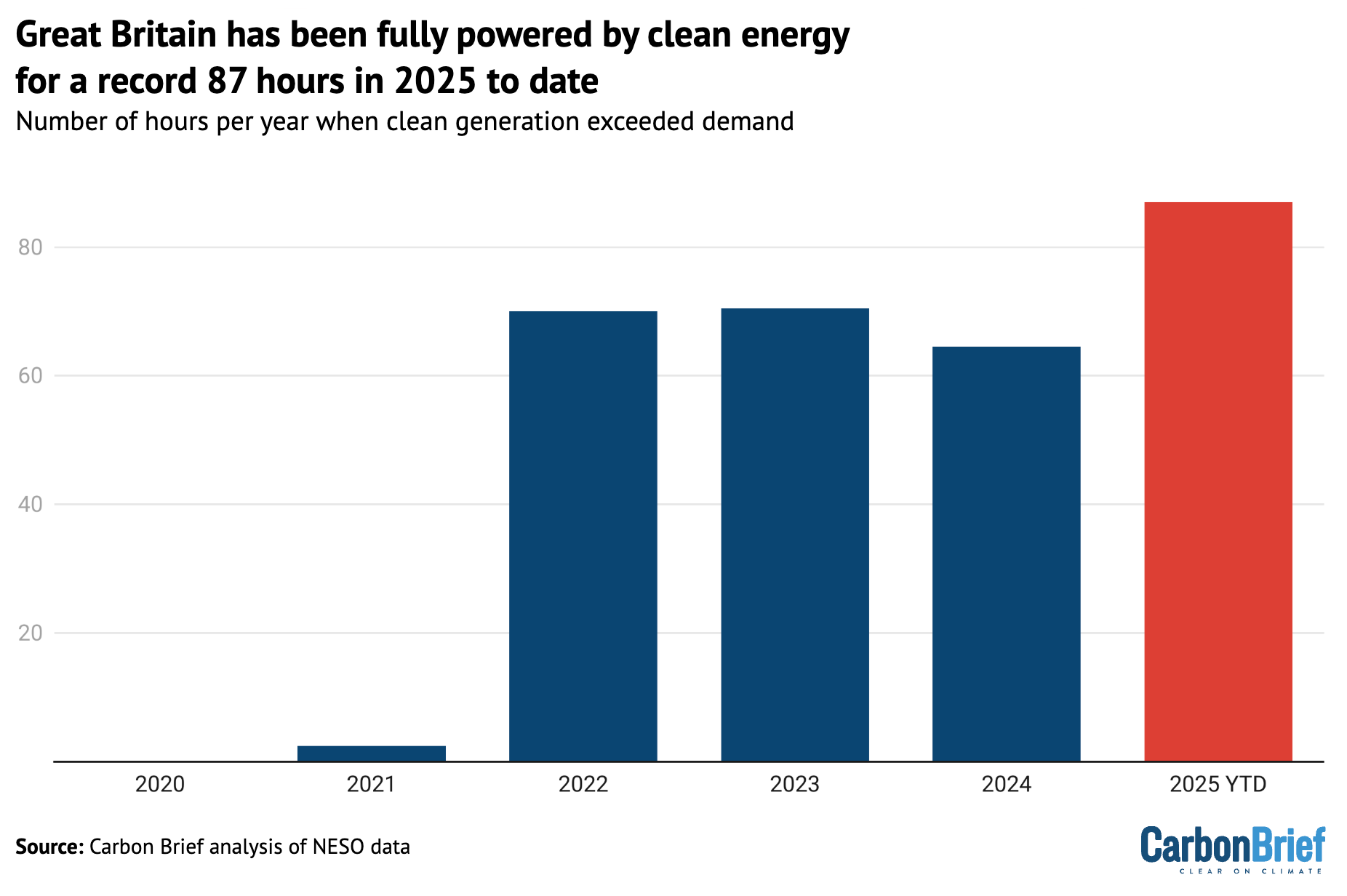
This translates to some 1.3% of hours in 2025 to date, far short of the 2030 target. However, this year’s figure is up 50-fold from 0.03% of hours in 2021 – and double the 0.7% share in 2024.
Cleaner electricity mix
During the periods in 2025 to date where at least 100% of demand was being covered by clean generation, wind power was contributing an average of 72% of demand, followed by 18% from nuclear, 10% from solar, 4% from biomass and 1% from hydro.
This means that, in total, low-carbon sources were generating 105% of national demand during such periods in 2025. Over these periods, gas was also generating enough, on average, to meet 13% of demand. As a result, the country was exporting the equivalent of 19% of demand via its interconnectors with Ireland, France, Belgium, Denmark, Norway and the Netherlands.
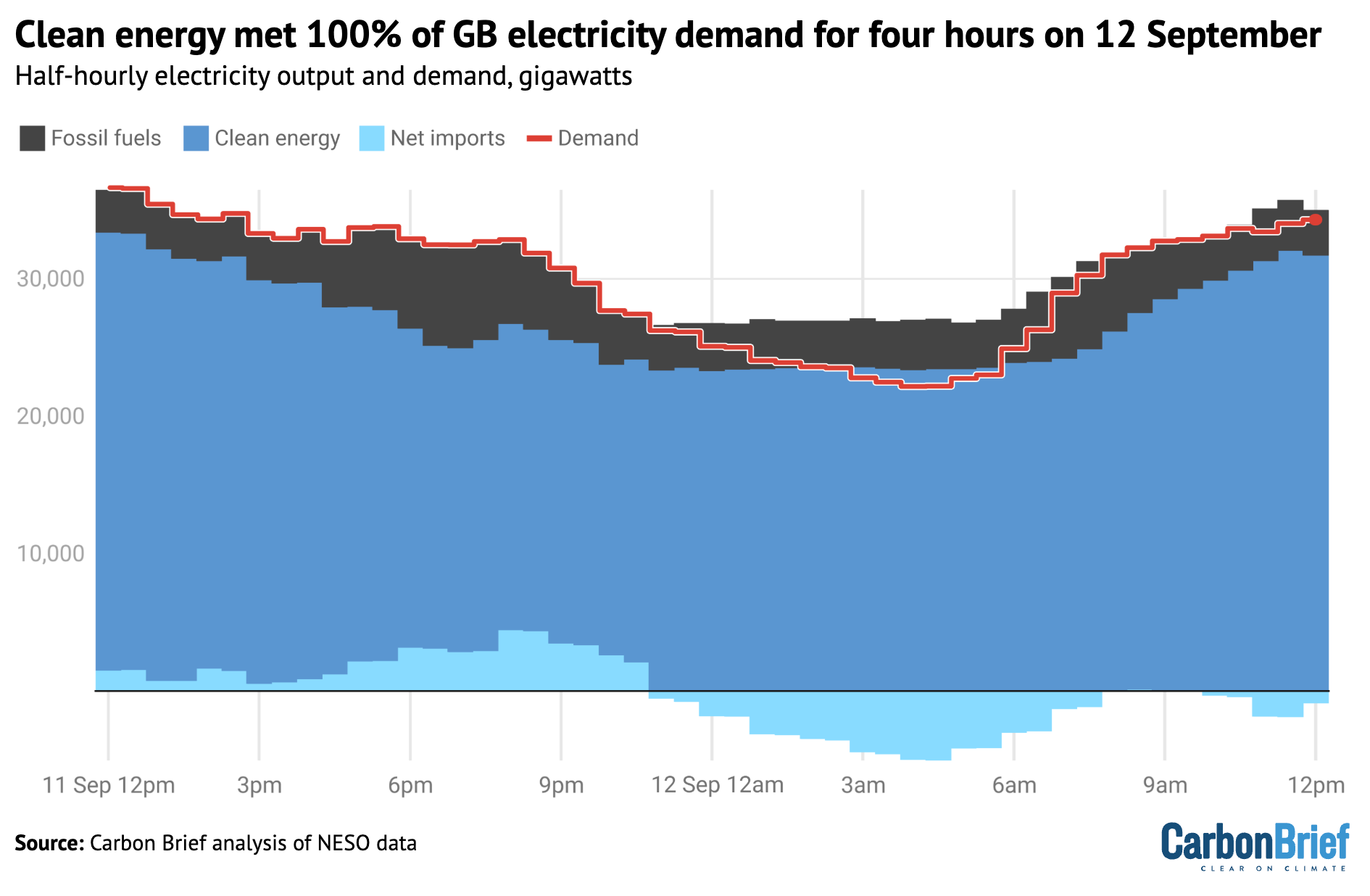
The figure below illustrates the most recent period when 100% of demand was being covered by clean generation, which took place early on Friday 12 September 2025.
For a four-hour period that morning – from 2am until 6am – clean-energy sources (dark blue) were generating enough electricity to cover 100% of national demand (red line).
During this period, clean sources generated an average of 23.5 gigawatts (GW), including 19.1GW from wind and 3.3GW from nuclear. This was more than the average demand of 22.7GW. Gas still generated an average of 3.1GW (black), resulting in net exports of 4.3GW (light blue).
To date, the record for the longest stretch where 100% of demand was being covered by clean energy stands at 15 hours, from midnight on 25 May 2025 through to 3pm on 26 May.
To meet its clean-power target, the government will need to ensure that this record is extended from just 15 hours in 2025 up to a full year by 2030.
A key test of its ability to do so will come in the seventh auction round for “contracts for difference” (CfDs), which offers fixed-price government-backed deals for new clean-energy developers. The results of this round are due to be announced as early as December 2025.
Until then, NESO will be hoping to meet its target – first set in 2019 – of running the GB grid without any fossil fuels for a short period of time, which it refers to as “zero-carbon operation”.
This target only applies to the transmission grid – effectively, the motorways of the network – meaning it excludes almost all solar power and smaller onshore windfarms.
Craig Dyke, NESO’s director of system operations, previously told Carbon Brief that the first-ever period of at least 30 minutes of “zero-carbon operation” was likely to take place this autumn.
Dyke added that NESO was “confident” it could meet the target, which he said would be “absolutely groundbreaking and pretty much world leading”.
The post Analysis: Great Britain has run on 100% clean power for record 87 hours in 2025 so far appeared first on Carbon Brief.
Analysis: Great Britain has run on 100% clean power for record 87 hours in 2025 so far

Three countries have been named by the Paris Agreement’s compliance committee for failing to submit a nationally determined contribution (NDC) and repeatedly snubbing offers of help with their climate plans.
After months of internal debate over whether to identify serial non-responders, the Paris Agreement’s Implementation and Compliance Committee (PAICC) named the three countries which have failed to engage with it over their NDCs on Friday.
It named Democratic Republic of Congo, Senegal and North Korea in a footnote of its annual report, adding that it decided to name them “with a view to facilitating engagement”, adding that representatives of the three nations had been invited to its meeting in early 2027 “with the purpose of identifying any challenges and constraints”.
“The Committee noted the importance of Parties engaging with the Committee in a timely manner, while noting that some delays may be due to the national capabilities and circumstances of the Parties”, the report said.
-
Under US pressure, World Bank says it will back gas “where appropriate”
The US wants the World Bank to expand its gas support while climate campaigners are pushing for it to end – its head spoke this week of limited backing for the fossil fuel -
IPCC scientists vow to press on with climate reports despite political deadlock
After governments again failed to agree a timeline, nearly 120 IPCC authors pledged to complete their assessment on time and with full scientific rigour -
Paris Agreement committee snubbed over missing NDC climate plans
Many governments have still not submitted a nationally determined contribution to the UN, breaching a key requirement of the Paris Agreement

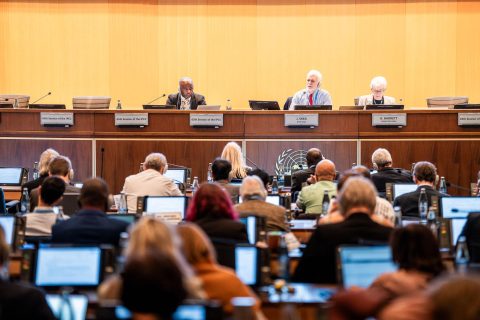

In July, PAICC said 12 countries had ignored its repeated attempts to discuss why they had not published an NDC as required every five years under the 2015 Paris accord.
Members of the committee had been divided over whether to name them, but at a September meeting decided to do so in their annual report to the annual climate COP summit.
By the time the report was published on Friday, only Congo, Senegal and North Korea “had not communicated an NDC or submitted a [Biennial Transparency Report] and had not yet responded to any of the Committee’s notifications, despite several reminders issued by the Committee in this regard”.
Rainforest and renewable energy ambitions
The silence from Congo and Senegal is notable because the former is home to much of the Congo Basin rainforest while the latter has sought billions of dollars in climate finance to support its renewable energy ambitions.
After Brazil, Congo has more rainforest than any country in the world. This forest, and the country’s peatlands, absorb huge amounts of greenhouse gas but are fast being lost to expanding farmland, charcoal production, logging and mining.
Senegal signed a Just Energy Transition Partnership with Canada and wealthy European nations in 2023, to help it meet its renewable energy targets under the-then government of Macky Sall. It was chair of the Least Developed Countries group between January 2022 and December 2023.

Tejas Rao, who is researching the PAICC as part of a doctoral thesis at Cambridge University, said the governments of the three countries should engage with the committee.
“Engagement costs these governments very little and the committee has shown it will listen,” he said.
“Silence leaves the committee with no basis to help, and it leaves the [governments] exposed to the narrative that they are simply disengaged,” he told Climate Home News.
Paris Agreement requirement
The 2015 Paris Agreement requires all parties to publish an NDC every five years outlining their emissions reduction targets, with each plan meant to be more ambitious than the country’s last NDC.
The latest set – the third round of plans, with new targets for 2035 – was due in February 2025. While most countries missed this deadline, all but around 30 – mostly small emitters but including Egypt, Vietnam and Argentina – have now submitted them.
Over the year, the PAICC – which is made up of government climate officials from developed and developing countries – has been communicating with governments that have not submitted NDCs and trying to overcome barriers to them doing so.
Some nations have cited exceptional circumstances as the reason for not submitting an NDC, a process that requires a significant amount of work in tracking emissions and consulting on how to curb them across the economy. For example, a letter from a Sudanese official to the PAICC, seen by Climate Home News, said that the country’s civil war had led to the suspension of its NDC preparation.
-
IPCC scientists vow to press on with climate reports despite political deadlock
After governments again failed to agree a timeline, nearly 120 IPCC authors pledged to complete their assessment on time and with full scientific rigour -
Under US pressure, World Bank says it will back gas “where appropriate”
The US wants the World Bank to expand its gas support while climate campaigners are pushing for it to end – its head spoke this week of limited backing for the fossil fuel -
Who shapes climate science? The equity question facing the IPCC
Early completion of the next global climate science assessment reports risks excluding research from the Global South, which is key to ensuring the findings are fair
The US and Iran are not signed up to the Paris Agreement and so do not have active NDCs, nor does Taiwan, which is not a UN member state.
Rao said that because the PAICC is “facilitative and non-punitive”, naming the countries “is meant to open a door, not close one – the invited consultation is the point”.
“In recent months, governments that explained their constraints, whether capacity, finance or domestic process, have been met with follow-up and support rather than sanction, and the number of silent governments has fallen sharply,” Rao said.
The post Paris Agreement committee names three countries snubbing it over NDCs appeared first on Climate Home News.
Paris Agreement committee names three countries snubbing it over NDCs