



- What timeline options were delegates debating?
- How did the timeline discussions unfold?
- What were the main points of disagreement?
- Why is the IPCC in a ‘serious funding crisis’?
- How have scientists reacted?
- What other issues remain unresolved?
- How are the IPCC AR7 reports progressing?
- How might the IPCC use AI and enhance gender inclusivity?

African leaders at a regional energy summit in Tanzania this week called for more investment in aging grid infrastructure in their countries to tackle widespread power outages that hamper major economies including Nigeria and South Africa, and to expand modern energy access to half of the 600 million people who lack it on the continent.
The conference was organised by Mission 300, an initiative launched in April 2024 by the African Development Bank and the World Bank to provide 300 million energy-poor Africans with electricity by 2030. This will be done mainly by connecting them to national grids or local minigrids powered by renewables such as solar.
The development banks have committed to collectively deliver $40 billion under the initiative – a target that was raised this week to more than $50 billion by contributions from other financial institutions, including the Asian Infrastructure Investment Bank (AIIB) with around $1.5 billion and the Islamic Development Bank Group with $2.65 billion.
To meet the Mission 300 goals, a first batch of 12 countries – Chad, Côte d’Ivoire, Democratic Republic of Congo, Liberia, Madagascar, Malawi, Mauritania, Niger, Nigeria, Senegal, Tanzania and Zambia – presented national energy compacts with detailed targets to scale up electricity access through renewable energy, as well as strategies to boost regional integration and attract private sector investment.
Presenting their plans, African leaders spoke of how outdated infrastructure has limited energy expansion on the continent and held back development in areas like healthcare, education, job creation and digital inclusion.
President Hakainde Hichilema of Zambia said African countries “need energy to develop our economies faster,” adding that “energy is life – as is water”- and energy is essential to extract water for human consumption, agriculture and industry, and keep people healthy.
He pointed to the need for a diversified energy mix coming from different sources including solar, hydro and geothermal, and emphasised that the power they generate must also be transmitted. “We need to take it where it’s needed,” he said.
Other countries echoed a similar concern in their energy compacts. Nigeria’s plan, for instance, stated that “the ability of the transmission system to evacuate available generation capacity is inadequate due to aging and poorly maintained infrastructure”. It called for “targeted concessionary lending to qualifying distribution companies (DISCOs) to strengthen distribution infrastructure”.
Tanzania also mentioned in its compact that the country’s electricity connections are faced with the challenge of “poor reliability and quality of service, caused by a deteriorating network with overloaded transformers [and] distribution feeders”. It called for improvements in the quality of the electricity service that “require investments in grid stabilization, network rehabilitation, reinforcement, and upgrades”.
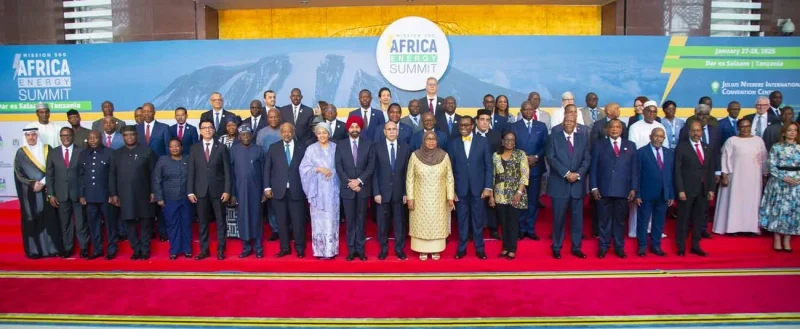
African leaders at the Mission 300 energy summit (Photo: AfDB)
Makhtar Diop, managing director of the International Finance Corporation (IFC), noted that “a lot of the power outages in Africa are not linked often to production – they are often linked to distribution because the [electricity] network is not robust enough” and called for investments in distribution.
The companies managing distribution require capital injections because most are “under-capitalised and not in a good finance situation and therefore not able to invest in operational maintenance”, he added.
Meanwhile, the progress of some countries like Uganda shows that grid improvement and extension to improve distribution is achievable. With World Bank support, the country extended its grid and installed solar energy in health centres and water supply schemes, directly benefiting almost 8.8 million people in rural areas between 2016 and 2023. It has now embarked on another such project, involving the private sector.
Off-grid ‘cheaper and faster’
Off-grid electrification is also seen as key to the Mission 300 objective – and the energy compacts presented in Dar es Salaam reflected how, in the face of delays to grid extensions, distributed renewable energy (DRE) offers a faster means to electrify under-served communities.
Half of the Mission 300 goal is due to be achieved by off-grid connections. World Bank President Ajay Banga said geo-spatial mapping was being used within countries to decide which areas can be connected to the grid and which require DRE, including solar and battery storage systems that are “cheaper and faster” to install.
Coal-reliant South African provinces falling behind on just transition
Woochong Um, CEO of the Global Energy Alliance for People and Plant (GEAPP), said this group of government agencies, development banks and philanthropic foundations, is looking to support “hard-to-reach activities, like the productive use of the electrons by the farmers and people on the ground”. GEAPP is planning to pilot promising models that can be scaled up by banks if they produce successful results, he told Climate Home.
Sarah Malm, executive director of GOGLA, a global association for the off-grid solar industry, said off-grid systems “will complement weak grid environments” as the “least-cost and the fastest way to get basic energy access to households”, especially in rural communities.
“It provides light to study. It provides safety. It provides the ability for a kiosk to stay open at night. It provides really huge quality of life improvements – and then also, when light is intermittent and the grid doesn’t work, it is a source of back-up,” she said.
From 2020 to 2022, off-grid solar accounted for 55% of new connections in sub-Saharan Africa, according to the World Bank, and is projected to provide electricity access to nearly 400 million people by 2030.
Malm believes that off-grid solar is the best way to achieve the global goal of providing everybody with modern, sustainable power by 2030, because extending power grids is a long-term investment and progresses more slowly.
Private-sector investment
African leaders and energy backers at the summit highlighted the role of private-sector investment in fulfilling the goals of Mission 300.
“To actually achieve what we want to do, it requires more than public-sector money, it requires a lot of private sector,” said Akinwumi Adesina, president of the African Development Bank Group. He added that the private sector will play a role in delivering mini-grids and providing electricity to under-served areas.
Indonesia’s next priority should be finding alternatives to replace coal
The cost of capital, however, is one of the major challenges facing businesses in Africa. Mission 300’s partners will “play a big role to reduce the risk using partial risk and credit guarantees” and provide long-term, low-interest capital, as well as develop bankable projects to attract private investors, Adesina said.
Um told Climate Home that GEAPP will work with multilateral development banks to help governments set up regulatory frameworks that can reassure the private sector their investments in African countries are safe.
Diop of IFC said the private sector is not yet as involved as it should be in financing clean energy development in Africa and this has constrained the uptake of renewable energy. He called for a “change in the paradigm” to catalyse heavy investment in renewables.
(Reporting by Vivian Chime; editing by Megan Rowling)
The post African leaders seek investments in ailing grid infrastructure to achieve energy goals appeared first on Climate Home News.
African leaders seek investments in ailing grid infrastructure to achieve energy goals
Continue Reading
Three countries have been named by the Paris Agreement’s compliance committee for failing to submit a nationally determined contribution (NDC) and repeatedly snubbing offers of help with their climate plans.
After months of internal debate over whether to identify serial non-responders, the Paris Agreement’s Implementation and Compliance Committee (PAICC) named the three countries which have failed to engage with it over their NDCs on Friday.
It named Democratic Republic of Congo, Senegal and North Korea in a footnote of its annual report, adding that it decided to name them “with a view to facilitating engagement”, adding that representatives of the three nations had been invited to its meeting in early 2027 “with the purpose of identifying any challenges and constraints”.
“The Committee noted the importance of Parties engaging with the Committee in a timely manner, while noting that some delays may be due to the national capabilities and circumstances of the Parties”, the report said.
-
Under US pressure, World Bank says it will back gas “where appropriate”
The US wants the World Bank to expand its gas support while climate campaigners are pushing for it to end – its head spoke this week of limited backing for the fossil fuel -
IPCC scientists vow to press on with climate reports despite political deadlock
After governments again failed to agree a timeline, nearly 120 IPCC authors pledged to complete their assessment on time and with full scientific rigour -
Paris Agreement committee snubbed over missing NDC climate plans
Many governments have still not submitted a nationally determined contribution to the UN, breaching a key requirement of the Paris Agreement
In July, PAICC said 12 countries had ignored its repeated attempts to discuss why they had not published an NDC as required every five years under the 2015 Paris accord.
Members of the committee had been divided over whether to name them, but at a September meeting decided to do so in their annual report to the annual climate COP summit.
By the time the report was published on Friday, only Congo, Senegal and North Korea “had not communicated an NDC or submitted a [Biennial Transparency Report] and had not yet responded to any of the Committee’s notifications, despite several reminders issued by the Committee in this regard”.
Rainforest and renewable energy ambitions
The silence from Congo and Senegal is notable because the former is home to much of the Congo Basin rainforest while the latter has sought billions of dollars in climate finance to support its renewable energy ambitions.
After Brazil, Congo has more rainforest than any country in the world. This forest, and the country’s peatlands, absorb huge amounts of greenhouse gas but are fast being lost to expanding farmland, charcoal production, logging and mining.
Senegal signed a Just Energy Transition Partnership with Canada and wealthy European nations in 2023, to help it meet its renewable energy targets under the-then government of Macky Sall. It was chair of the Least Developed Countries group between January 2022 and December 2023.

Tejas Rao, who is researching the PAICC as part of a doctoral thesis at Cambridge University, said the governments of the three countries should engage with the committee.
“Engagement costs these governments very little and the committee has shown it will listen,” he said.
“Silence leaves the committee with no basis to help, and it leaves the [governments] exposed to the narrative that they are simply disengaged,” he told Climate Home News.
Paris Agreement requirement
The 2015 Paris Agreement requires all parties to publish an NDC every five years outlining their emissions reduction targets, with each plan meant to be more ambitious than the country’s last NDC.
The latest set – the third round of plans, with new targets for 2035 – was due in February 2025. While most countries missed this deadline, all but around 30 – mostly small emitters but including Egypt, Vietnam and Argentina – have now submitted them.
Over the year, the PAICC – which is made up of government climate officials from developed and developing countries – has been communicating with governments that have not submitted NDCs and trying to overcome barriers to them doing so.
Some nations have cited exceptional circumstances as the reason for not submitting an NDC, a process that requires a significant amount of work in tracking emissions and consulting on how to curb them across the economy. For example, a letter from a Sudanese official to the PAICC, seen by Climate Home News, said that the country’s civil war had led to the suspension of its NDC preparation.
-
IPCC scientists vow to press on with climate reports despite political deadlock
After governments again failed to agree a timeline, nearly 120 IPCC authors pledged to complete their assessment on time and with full scientific rigour -
Under US pressure, World Bank says it will back gas “where appropriate”
The US wants the World Bank to expand its gas support while climate campaigners are pushing for it to end – its head spoke this week of limited backing for the fossil fuel -
Who shapes climate science? The equity question facing the IPCC
Early completion of the next global climate science assessment reports risks excluding research from the Global South, which is key to ensuring the findings are fair
The US and Iran are not signed up to the Paris Agreement and so do not have active NDCs, nor does Taiwan, which is not a UN member state.
Rao said that because the PAICC is “facilitative and non-punitive”, naming the countries “is meant to open a door, not close one – the invited consultation is the point”.
“In recent months, governments that explained their constraints, whether capacity, finance or domestic process, have been met with follow-up and support rather than sanction, and the number of silent governments has fallen sharply,” Rao said.
The post Paris Agreement committee names three countries snubbing it over NDCs appeared first on Climate Home News.
Paris Agreement committee names three countries snubbing it over NDCs